Home Blog Page 414

Three Major Japanese Financial Institutions Tap Canton to Bring Government Bonds On-Chain

0

Mizuho, Nomura, and Japan’s central clearing house are launching a blockchain-based proof-of-concept for collateral management of Japanese government bonds.

Three of Japan’s most prominent financial institutions — Mizuho Financial Group, Nomura Holdings, and Japan Securities Clearing Corporation (JSCC) — have announced a joint proof-of-concept with Canton’s parent company, Digital Asset, to test digital collateral management for Japanese Government Bonds (JGBs) on the Canton Network.

According to a press release shared with The Defiant, the proof-of-concept is part of a broader initiative supported by the Financial Services Agency’s (FSA) Payment Innovation Project. The move aims to verify the efficacy of blockchain for transferring JGB rights within the country’s existing legal framework, specifically the Act on Book-Entry Transfer of Corporate Bonds and Shares.

The project’s main goal is to enable 24/7 real-time collateral transactions, a meaningful upgrade from current infrastructure constrained by business hours and manual reconciliation. By integrating legacy systems with Canton’s blockchain rails, the consortium hopes to dramatically cut the administrative overhead associated with posting and substituting collateral.

The project will also test cross-border scenarios, examining how JGBs can move between clearing houses, institutional investors, clients, and agents across both domestic and international markets, per the release.

JGBs are among the widely accepted forms of eligible collateral globally, according to the release, making their on-chain availability strategically significant.

Canton Network positions itself as a public Layer 1 blockchain with customizable privacy features designed for TradFi institutions. The “public” claim has drawn heat from prominent voices across the crypto industry.

Canton’s TradFi Moves

Canton has been on an institutional partnership tear heading into 2026. Fintech Transcend recently connected to the network, enabling clients to move collateral and cash in real time across counterparties using a mix of traditional and tokenized assets.

Before that, JPMorgan announced it would issue its deposit token natively on Canton, with rollout planned in phases throughout 2026, following DTCC’s selection of Canton to tokenize a subset of the U.S. Treasury securities it holds, citing the platform’s privacy features.

Meanwhile, fellow Japanese TradFi giant Mitsui & Co. has also been expanding its on-chain footprint, with its crypto arm announced last week that it would bring its tokenized metals asset ZipangCoin to Optimism’s L2 OP Mainnet — the first deployment of the token on a public blockchain.

U.S. Treasury debt currently makes up the largest portion of distributed tokenized real-world assets (RWAs) — assets that are transferable on-chain — with over $13.7 billion, over half of which is on Ethereum, per data from RWAxyz.

In contrast, all of the $334.35 billion in tokenized repurchase agreements (repos) on Canton is considered represented value, as it only uses blockchain, in this case Canton, for record keeping.

This article was written with the assistance of AI workflows. All our stories are curated, edited and fact-checked by a human.

Lydian Launches Visa Platinum Crypto Card To Enable Everyday Spending Of Digital Assets

0

Lydian has launched the Lydian Card, a co-branded Visa Platinum card issued by Rain that allows users to spend more than 300 supported digital assets, including stablecoins and major cryptocurrencies, across Visa’s global merchant network.

The card is available in both physical and instant-issue virtual formats and can be used wherever Visa is accepted, giving cardholders access to more than 150 million merchants worldwide, according to a release seen by Bitcoin Magazine. Users will be able to fund, manage, and track transactions through an app or online dashboard, aiming to streamline the conversion of digital assets into everyday purchasing power.

The launch comes amid rapid growth in crypto-linked payment cards. Industry data cited by the company shows monthly crypto card spending has surged from $100 million in early 2023 to more than $1.5 billion today, with forecasts suggesting digital asset spending access could expand by 66%. The trend reflects a shift among crypto holders from passive storage toward active spending.

Crypto use cases to make life less clunky

Lydian is leveraging Rain’s stablecoin-native infrastructure, which supports wallets, cards, onramps, and offramps. Rain recently reported significant growth, including a 30-fold expansion in the past year and a $250 million Series C round that brought its valuation to $1.95 billion.

Executives from both companies said the goal is to reduce friction in crypto payments and make digital assets usable in everyday commerce through existing Visa infrastructure.

Carl Grimstad, CEO of Lydian, said: “Digital asset holders have long struggled to use their funds in everyday life. Converting tokens manually, navigating limited merchant acceptance, and wrestling with clunky user experiences has made spending crypto more complicated than it needs to be. The Lydian Card turns this all on its head.

“Whether tapping in-store or making a purchase online, the Lydian Card makes it simple to spend digital assets. Supported by Visa’s global network and powered by Rain’s infrastructure, the card enables a seamless shift from digital ownership to everyday use, helping users and merchants participate in the $4 trillion digital asset economy.”

Farooq Malik, CEO & co-founder of Rain, said: “Tokenized money and digital assets hold huge potential, but mainstream adoption only happens if spending them in the real-world is actually easy to do. Historically, getting this right has been tricky and complex.

“By using Rain’s on-chain card issuance solution, Lydian is making it convenient for cardholders to use their digital assets everywhere Visa is accepted — a critical step toward unlocking continued usage around the world.”

Visa Architect Recognized by the Crafting Bharat International Awards in “Business of the Year” Category for Excellence in Global Mobility and Immigration Strategy

0

Chennai, Tamil Nadu, India | April 2026 — In a significant recognition of excellence in the global mobility and immigration consulting sector, Visa Architect has been formally honored by the Crafting Bharat International Awards under the prestigious “Business of the Year” category. This accolade highlights the firm’s outstanding contribution to high-impact immigration consulting, strategic profile development, and cross-border mobility planning. The recognition further reinforces the company’s growing reputation as a trusted strategic partner for professionals, entrepreneurs, and organizations navigating increasingly complex international immigration pathways.

Founded by Swatilina Barik, a seasoned legal professional and immigration strategist with over nine years of experience, Visa Architect has steadily emerged as a specialized advisory firm focused on employment-based and investor immigration pathways. These include highly competitive categories such as EB-1A, O-1, EB-2 NIW, and EB-5 petitions. The firm’s strategy-first methodology has set it apart in a crowded market by emphasizing structured case building, evidentiary readiness, and long-term global mobility positioning rather than limiting its services to transactional filing support.

The recognition conferred by the Crafting Bharat International Awards in the “Business of the Year” category reflects the firm’s measurable and consistent impact in helping high-achieving professionals strengthen their immigration profiles prior to petition filing. Visa Architect’s advisory model is built on a comprehensive approach that involves identifying eligibility gaps, curating robust evidence frameworks, and aligning client achievements with U.S. immigration standards and adjudicatory expectations. This meticulous preparation enables stronger, compliance-driven outcomes and enhances the overall credibility of each application.

Under the leadership of Swatilina Barik, the firm has successfully built a reputation for combining legal precision with strategic documentation planning and global case positioning. Her expertise spans Indian legal systems, international immigration frameworks, corporate mobility structures, and specialized pathways for extraordinary ability professionals, researchers, founders, and investors. This multidimensional leadership approach has played a pivotal role in positioning Visa Architect among the most credible and emerging names in immigration strategy and global talent mobility.

Commenting on the recognition, the leadership team at Visa Architect stated that the acknowledgment by the Crafting Bharat International Awards serves as a validation of the firm’s commitment to clarity, compliance, and outcome-oriented immigration planning. The team emphasized that in an increasingly complex global movement landscape, structured strategy and informed execution are critical to achieving successful immigration outcomes.

As the demand for specialized immigration strategy continues to rise worldwide, Visa Architect remains focused on expanding its advisory footprint across the United States and other global jurisdictions. The firm is committed to supporting professionals and organizations with tailored immigration consulting services designed to strengthen applicant positioning, reduce evidentiary risks, and significantly improve petition readiness.

With this recognition from the Crafting Bharat International Awards, Visa Architect further strengthens its standing as a forward-looking enterprise redefining modern immigration consulting. By integrating legal insight, structured planning, and strategic execution excellence, the firm continues to set new benchmarks in the evolving global mobility landscape.as a forward-looking enterprise redefining modern immigration consulting. By integrating legal insight, structured planning, and strategic execution excellence, the firm continues to set new benchmarks in the evolving global mobility landscape.


Ripple CTO Emeritus Warns RLUSD Review Exposed A DeFi Security Red Flag

0

Trusted Editorial content, reviewed by leading industry experts and seasoned editors. Ad Disclosure

Ripple CTO Emeritus David Schwartz, said his review of DeFi bridge designs for Ripple’s RLUSD surfaced a recurring problem that may now be at the center of the KelpDAO/rsETH incident: critical security controls exist, but teams are often nudged toward lighter configurations because they are easier to operate and faster to scale.

In a series of posts on X, Schwartz said he evaluated “a lot of DeFi bridging systems” for potential RLUSD use and focused “almost exclusively” on security and risk. What stood out, he wrote, was not a lack of tooling. In his telling, many systems already offered strong protections against the kind of failure now being discussed around KelpDAO. The problem was that those protections often came with friction.

Ex-Ripple CTO Warns Bridge Failures Could Repeat

“One thing I noticed is that most schemes were very well designed and had really strong mechanisms available to protect against exactly the type of attack the the KelpDAO/rsETH situation seems to have been caused by,” Schwartz wrote. “However, one thing I noticed was that they generally in effect recommended not bothering to use the most important security mechanisms because they have convenience and operational complexity costs.”

The former Ripple-CTO is not saying bridge teams lack security features on paper. He is saying some business models are built around making those features optional, even when the assets secured can eventually grow large enough to make the tradeoff untenable.

“Their sales pitch was that they have the best security features but they’re easy to use and scale assuming you don’t use the security features,” he wrote. “I have a funny feeling part of the problem is going to be something like KelpDAO choosing not to use key LayerZero security features out of convenience. I hope I’m wrong.”

The broader concern, in Schwartz’s framing, is incentive design. If applications are allowed to choose their own trust assumptions, competition can drift toward lower-friction setups rather than higher-assurance ones. That point was raised explicitly by XRP community figure Vet, who argued that letting applications define their own security inevitably “races to the bottom.”

Schwartz partly pushed back, saying simpler setups can make sense when value is still small, or where assets are already backed by a trusted issuer and can be frozen. But he also suggested that in open crypto markets, temporary shortcuts have a way of becoming permanent.

“That gets insanely complicated. I’d say probably not,” the former Ripple CTO wrote when asked whether projects could face liability for losses. “But the whole DeFi bridging industry is infected with people using moderate security because ‘we just need to get it working, we’ll improve it later’ that grows to protecting huge amounts of money and the later improvements never come.”

He was similarly blunt on the industry’s habit of relearning the same lesson after each blowup. “We could wait until we have a perfect solution, but that’s not the choice everyone has made,” Schwartz said. “So every once in a while, we’re going to have a big failure and then everyone will be careful for a month or two and the cycle will repeat.”

Overall, Schwartz frames the issue as structural: DeFi keeps trying to scale cross-chain liquidity before it has solved how to govern bridge risk at the level other people’s money demands. Even Schwartz, while defending some narrower uses of simpler bridge setups, conceded that decentralized governance remains ill-suited to hard security decisions around custodial risk.

The backdrop is the April 18 rsETH incident involving KelpDAO. An attacker exploited KelpDAO’s LayerZero-powered rsETH bridge and drained 116,500 rsETH, valued at roughly $290 million. Aave’s Guardian then froze rsETH and wrsETH markets across the deployments where the asset was listed, stressing that Aave itself had not been hacked and that the issue was scoped to the asset rather than the lending protocol.

Aave later said all pools remained operational, but the freeze halted new deposits and new borrows against rsETH collateral while the situation was assessed. The episode quickly turned into a broader DeFi risk event because rsETH had been integrated into lending markets, raising fresh questions about collateral standards, bridge configuration choices and whether convenience-first interoperability is still being underpriced across the stack.

At press time, XRP traded at $1.40.

XRP price chart
XRP hovers below the 200-week EMA, 1-week chart | Source: XRPUSDT on TradingView.com

Featured image created with DALL.E, chart from TradingView.com

Editorial Process for bitcoinist is centered on delivering thoroughly researched, accurate, and unbiased content. We uphold strict sourcing standards, and each page undergoes diligent review by our team of top technology experts and seasoned editors. This process ensures the integrity, relevance, and value of our content for our readers.

Bitcoin Price Could See Another Crash, But What Is The Long-Term Prognosis?

0

Trusted Editorial content, reviewed by leading industry experts and seasoned editors. Ad Disclosure

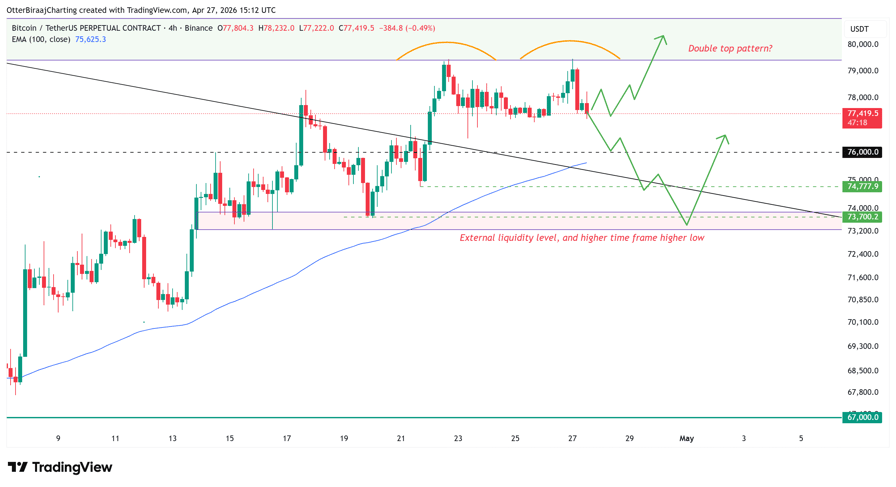
With the Bitcoin price clearing $78,000 last week, it has triggered bullish sentiment in the crypto market once again. This move has also led to forecasts that the Bitcoin price is headed back for the 6-figure mark. However, not everyone is following this school of thought and believes that the rally will continue. Crypto analyst Behdark has debunked the bullish predictions, forecasting that the cryptocurrency’s price is actually headed lower before recovering.

How Low Will The Bitcoin Price Go?

Despite the increase in price, the crypto analyst has predicted that it is likely that the Bitcoin price crashes first from here. The bullish sentiment in the market, Behdark believes could be misleading for investors, as this could be a deliberate ploy by market makers to actually get the most people involved before crashing the price again.

As the analyst explains, the underlying Bitcoin structure is still very bearish, especially given the fact that the digital asset looks to be forming a triangle or diamagnetic pattern. The latter is a complex corrective pattern, meaning that it can often be clouded in recoveries before crashing down further again.

In either case, both of these patterns point to a high possibility that the Bitcoin price would go down first before up. Thus, it is likely that there would be opportunities to buy the cryptocurrency lower before eventually waiting for the run-up.

Bitcoin price
Source: TradingView

With this, the crypto analyst has identified the major levels that investors should watch out for that could be the best time to actually short the cryptocurrency. Mainly, two levels are of the most interest as these are where the bears could make their stand in terms of establishing resistance.

The first of these is just above $77,000 as the price continues to struggle with declining momentum. Next is the $80,552 level, where there is likely the most resistance to the current rally, thus making them the points that could trigger a downward corrective move.

Once the decline begins, then the first stop would be just above $72,800 for the first support level. Next is the $67,885 level for better support, but a break of this would eventually lead to another 10% crash. The last major level is $67,677, which still lies above the established cycle support of $60,000.

Bitcoin price chart from Tradingview.com
BTC price falls again | Source: BTCUSD on Tradingview.com

Featured image from Dall.E, chart from TradingView.com

Editorial Process for bitcoinist is centered on delivering thoroughly researched, accurate, and unbiased content. We uphold strict sourcing standards, and each page undergoes diligent review by our team of top technology experts and seasoned editors. This process ensures the integrity, relevance, and value of our content for our readers.

Two Different Approaches to Quantum Threats

0

The quantum divide between Bitcoin and Ethereum

Quantum computing has long been viewed as a distant, largely theoretical threat to blockchain systems. However, that perspective is now starting to change.

With major technology companies such as Google establishing timelines for post-quantum cryptography, and crypto researchers re-examining long-held assumptions, the discussion is shifting from abstract theory to concrete planning.

However, Bitcoin and Ethereum, two major blockchain networks, are addressing the quantum computing threat in different ways. Both networks depend on cryptographic systems that could, in principle, be compromised by sufficiently powerful quantum computers. However, their approaches to addressing this shared vulnerability are evolving in markedly different directions.

This divergence, often referred to as the “quantum gap,” has less to do with mathematics and more to do with how each network handles change, coordination and long-term security.

Did you know? Quantum computers do not need to break every wallet at once. They only need access to exposed public keys, which means older Bitcoin addresses that have already transacted could theoretically be more vulnerable than unused ones.

Why quantum computing matters for blockchains

Blockchains rely heavily on public-key cryptography, particularly elliptic curve cryptography (ECC). This framework allows users to derive a public address from a private key, enabling secure transactions while keeping sensitive information protected.

If quantum computers achieve sufficient scale and capability, they could fundamentally weaken this foundation. Algorithms such as Shor’s algorithm could, in theory, allow quantum systems to compute private keys directly from public keys, thereby jeopardizing wallet ownership and overall transaction security.

The consensus among most researchers is that cryptographically relevant quantum computers are still years or even decades away. Nevertheless, blockchain platforms present a distinct challenge. They cannot be updated instantaneously. Any substantial migration requires extensive coordination, rigorous testing and broad adoption over multiple years.

This situation highlights a key paradox: Although the threat is not pressing in the near term, preparation needs to begin well in advance.

External pressure is accelerating the debate

The discussion has moved well beyond crypto-native communities. In March 2026, Google announced a target timeline to transition its systems to post-quantum cryptography by 2029. It cautioned that quantum computers pose a significant threat to existing encryption and digital signatures.

This development is particularly relevant for blockchain systems because digital signatures play a fundamental role in verifying ownership. While encryption is vulnerable to “store-now, decrypt-later” attacks, digital signatures face a distinct risk. If compromised, they could increase the risk of unauthorized asset transfers.

As major institutions begin preparing for quantum resilience, blockchain networks face growing pressure to outline their own mitigation strategies. This is where the differences between Bitcoin and Ethereum become more apparent.

Did you know? The term “post-quantum cryptography” does not refer to quantum technology itself. It refers to classical algorithms designed to resist quantum attacks, allowing existing computers to defend against future quantum capabilities without requiring quantum hardware.

Bitcoin’s approach: Conservative and incremental

Bitcoin’s approach to quantum risk is guided by its core philosophy: minimize changes, maintain stability and avoid introducing unnecessary complexity at the base layer.

One of the most widely discussed proposals in this context is Bitcoin Improvement Proposal 360 (BIP-360), which introduces the concept of Pay-to-Merkle-Root (P2MR). Instead of fundamentally altering Bitcoin’s cryptographic foundations, the proposal seeks to limit exposure by changing the structure of certain transaction outputs.

The objective is not to achieve full quantum resistance for Bitcoin in a single move. Rather, it aims to create a pathway for adopting more secure transaction types while preserving backward compatibility with the existing system.

This approach mirrors the broader mindset within the Bitcoin community. Discussions often reflect extended time horizons, ranging from five years to several decades. The community is focused on ensuring that any changes do not undermine Bitcoin’s core principles: decentralization and predictability.

Nevertheless, this strategy has attracted criticism. Some argue that delaying more comprehensive measures could leave the network vulnerable if quantum advances arrive faster than expected. Others contend that making hasty changes could introduce avoidable risks into a system designed for long-term resilience.

Ethereum’s approach: Roadmap-driven and adaptive

Ethereum, by contrast, is pursuing a more proactive and structured strategy. The Ethereum ecosystem has begun formalizing a post-quantum roadmap that treats the challenge as a multi-layered system upgrade rather than a single technical adjustment.

A key element in Ethereum’s approach is “cryptographic agility,” which refers to the ability to replace core cryptographic primitives without undermining the stability of the network. This aligns with Ethereum’s broader design philosophy, which emphasizes flexibility and continuous iterative improvement.

The roadmap covers multiple layers:

  • Execution layer: Investigating account abstraction and alternative signature schemes that can support post-quantum cryptography.

  • Consensus layer: Assessing replacements for validator signature mechanisms, including hash-based options.

  • Data layer: Modifying data availability structures to ensure security in a post-quantum setting.

Ethereum developers have positioned post-quantum security as a long-term strategic priority, with timelines extending toward the end of the decade.

In contrast to Bitcoin’s incremental proposals, Ethereum’s approach resembles a staged migration plan. The goal is not immediate rollout but gradual preparation, allowing the network to transition when the threat becomes more concrete.

Why Bitcoin and Ethereum are taking different approaches to the quantum threat

The divergent approaches of Bitcoin and Ethereum are not a coincidence. They arise from fundamental differences in architecture, governance and philosophy.

Bitcoin’s base layer design emphasizes robustness and predictability, fostering a cautious attitude toward significant upgrades. Any change must meet a high bar for consensus and, even then, is usually limited in scope.

Ethereum, by contrast, has a track record of coordinated upgrades and protocol evolution. From the shift to proof-of-stake to ongoing scaling improvements, the network has demonstrated a willingness to execute complex changes when needed.

This distinction shapes how each network views the quantum threat. Bitcoin generally sees it as a remote risk that warrants careful, minimal intervention. Ethereum treats it as a systems-level issue that requires early planning and architectural adaptability.

In this context, the “quantum gap” is less about disagreement over the nature of the threat and more about how each ecosystem defines responsible preparation.

Did you know? Some early Bitcoin transactions reused addresses multiple times, unintentionally increasing their exposure. Modern wallet practices discourage address reuse partly because of long-term risks such as quantum attacks, even though the threat is not immediate.

An unresolved challenge for both Bitcoin and Ethereum

Despite their differing strategies, neither Bitcoin nor Ethereum has fully resolved the quantum threat.

Bitcoin continues to examine various proposals and weigh trade-offs, yet no clear migration path has been formally adopted. Ethereum, although more advanced in its planning, still faces substantial technical and coordination hurdles before its roadmap can be fully implemented.

Several open questions remain relevant to both ecosystems:

  • How to migrate existing assets protected by vulnerable cryptography

  • How to coordinate upgrades within decentralized communities

  • How to balance backward compatibility and forward security

These difficulties underscore the complexity of the issue. Post-quantum security represents more than a technical upgrade. It is also a test of long-term adaptability, governance and coordination.

Could security posture influence market narratives?

As institutional interest in quantum risk continues to grow, differences in preparedness could eventually shape how markets assess blockchain networks.

The reasoning is simple: A network that demonstrates greater adaptability to threats may be viewed as more resilient over the long term.

However, this idea remains largely speculative. Because quantum threats are still seen as a long-term concern, any near-term market effects are more likely to stem from narrative than from concrete technical developments.

Nevertheless, the fact that the discussion is now entering institutional research and broader public discourse suggests that it could become a more prominent consideration in the future.

Bitcoin, ether, solana slide, oil jumps on renewed U.S.-Iran war risks

0

Bitcoin is absorbing the return of Middle East risk better than oil or equities.

Bitcoin traded at $74,335 on Monday morning, down 1.6% over 24 hours but still up 4.8% on the week after the U.S. Navy seized an Iranian ship over the weekend and Tehran reimposed controls on the Strait of Hormuz.

Ether slipped 2.6% to $2,272, Solana fell 1.5% to $84, and BNB held flat at $618, with the broader top-10 showing red across the board but none of the moves breaching 3%.

Brent crude jumped 5.7% to $95.50 a barrel, European natural gas futures surged as much as 11%, S&P 500 futures fell 0.6% after Friday’s record close, and European equity futures indicated a 1.2% drop at the open. Gold fell 0.8% to $4,790, and the dollar edged up as traditional war-hedge demand returned.

The weekend flare-up reversed a three-week unwind of war risk premium. Iran had declared the Strait “completely open” on Friday, prompting the S&P 500’s record close and a broad rally across emerging markets.

By Sunday morning, Trump was threatening to destroy every power plant and bridge in Iran if negotiations fail, and Tehran was signaling it may skip a second round of talks while the U.S. maintains its naval blockade.

This is the fourth major Iran-related risk event crypto has absorbed since the conflict began, and the pattern of shrinking sell-offs continues. Earlier escalations produced sharper drawdowns in bitcoin than this one, with each successive flare-up compressing the magnitude of the crypto reaction even as oil and equities continue to price each headline fresh.

The divergence suggests crypto has largely finished pricing the geopolitical tail risk that traditional markets are still reacting to, either because holders who were going to sell on Iran headlines have already sold, or because the spot ETF bid has become a more reliable floor than the futures-driven weekend gaps that defined earlier cycles.

What traders will watch through the U.S. session is whether the 10-year Treasury yield holding near 4.27% and the dollar bid pull bitcoin lower through the risk-parity channel, or whether the equity correlation that dominated Q1 loosens on a day when the driver is explicitly geopolitical rather than macro-liquidity.

If bitcoin holds $74,000 through the European open and the Strait of Hormuz situation deteriorates further, the asset’s emerging reputation as a geopolitical shock absorber gains another data point. If the move extends below $73,000 on any incremental Iran headline, the shrinking-sell-off thesis breaks.

Bitcoin Drops to $74K as US-Iran Tensions Flare

0

Bitcoin erased its weekend gains as it fell below $74,000 on Sunday after the US military seized an Iranian cargo ship, putting pressure on a ceasefire between the two countries. 

Bitcoin (BTC) had soared above $78,300 late Friday on Coinbase, its highest price since early February, but dropped to between $75,000 and $76,000 over the weekend after Iran said it would close vital oil routes in the Strait of Hormuz.

The cryptocurrency then sank sharply late on Sunday to briefly trade below $74,000 after the US military said it opened fire on, and later seized, an Iranian cargo ship it claimed tried to run its blockade of Iranian ports, with Tehran accusing the US of violating an agreed ceasefire. 

The two-week ceasefire between the US and Iran, which had helped boost the markets and temper oil prices, is set to end on Wednesday.

Bitcoin’s price in US dollars on Coinbase over the last five days has fallen over the weekend amid rising tensions between the US and Iran. Source: TradingView

Tehran has vowed to retaliate over the US military’s seizure of the ship and has rejected a new round of peace talks slated for Monday in Islamabad, Pakistan, due to the US blockade, Iranian state media reported.

Related: Bitcoin eyes $90K as whales absorb 20x daily BTC supply in 30 days

US stock futures sank Sunday night amid rising tensions, with S&P 500 futures dropping 0.8%, Nasdaq-100 futures falling 0.6% and Dow Jones futures declining 0.9%, or about 450 points.

Oil futures also soared amid the hostilities and Iran’s threat to close the Strait of Hormuz, with crude oil futures rising over 4.5% to over $95 a barrel.

The Crypto Fear & Greed index rose by two points to a score of 29 out of 100 on Monday, its highest score since late January, but which still indicated a sentiment of “fear.”

Magazine: Bitcoin will not hit $1M by 2030, says veteran trader Peter Brandt