Shares of bitcoin miners turned AI infrastructure providers surged Monday after Hut 8 (HUT) and IREN (IREN) announced billions of dollars in new contracts, easing concerns that demand for AI computing capacity may be slowing.
Hut 8 rose as much as 17% after signing a 15-year, $9.8 billion lease for the second phase of its Beacon Point AI data center campus in Texas. The agreement, with the same investment-grade customer that leased the first phase, doubles the tenant’s footprint to 704 megawatts (MW) and fully commercializes the site’s 1 gigawatt of power capacity.
IREN gained as much as 19% after announcing $2.8 billion in new multiyear cloud services contracts with AI developers. The company raised its year-end AI Cloud annualized run-rate revenue target to more than $4 billion, saying about 85% of that revenue is now under contract.
The news spilled over to peers across the high-performance compute sector. Mining (CIFR) gained 11% and TeraWulf (WULF) added 6.4%. Bitcoin miners Riot Platforms (RIOT) and MARA Holdings (MARA) advanced 5% and 9%, respectively. The CoinShares Bitcoin Miners ETF (WGMI) rose 8.5%.
Cointelegraph is committed to providing independent, high-quality journalism across the crypto, blockchain, AI, and fintech industries.
All news, reviews, and analyses are produced with full journalistic independence and integrity. For more details on our standards and processes, please read our Editorial Policy.
It adds new capabilities to Plutus, the platform developers use to write Cardano’s smart contracts, unifying the built-in functions available across the platform’s three versions so older applications gain newer features.
The upgrade also tightens several of the ledger’s validation rules, including one guaranteeing that no two stake pools can reuse the same cryptographic identity key.
“As well as Plutus improvements and Plutus Cost Model enhancements, this upgrade lays the foundation for the next upgrade, the Dijkstra era hard fork, which will introduce Ouroboros Leios to Cardano,” Input Output wrote in a development report on Friday.
Ouroboros Leios is a scaling proposal for the proof-of-stake consensus model that Cardano runs. It is expected later in 2026 and aimed at sharply increasing transactions per second without weakening the protocol’s security guarantees.
Van Rossem is the procedural groundwork for Ouroboros, both in the ledger changes it ships and in the precedent it sets: that Cardano can now upgrade itself by vote.
The hard fork is named for Max van Rossem, a Cardano governance contributor who helped shape the network’s constitution and died in October 2025.
What the hard fork means for a Cardano user
There are no visible changes for someone casually holding or spending ADA. Transactions work the same way, wallets do not need updating and the fee to send ADA is unchanged. The upgrade does not alter how the network looks or feels to use.
Crypto wallet firm Exodus Movement (EXOD) will cut about 25% of its global workforce as it reshapes its business around stablecoin payments and card infrastructure.
The Omaha, Nebraska-based company said in a filing the layoffs are part of a broader effort to lower costs while supporting its strategy of building a full-stack payments platform.
The restructuring comes as Exodus continues to integrate Monavate, an electronic money institution, and crypto payments firm Baanx, two acquisitions that have expanded its payments capabilities and international footprint.
Exodus said it expects to record pre-tax restructuring charges of between $2.5 million and $3.5 million, mostly tied to severance and employee-related costs. Affected workers will receive severance, continued benefits and transition support.
The company said the restructuring should generate annual cash operating expense savings of $10 million to $13 million, with the full benefit expected in 2027.
EXOD is higher by 2.2% in early trading Monday, but remains down nearly 85% year-over-year.
Bitcoin (BTC) starts the last full week of July holding key support while macro clouds continue to gather.
Key points:
Bitcoin preserves its 200-week trend line at the weekly close, leading to short-term BTC price targets of up to $67,000.
US-Iran war rhetoric ramps up, with oil prices hitting five-week highs ahead of a week of corporate earnings reports.
Bitcoin spot demand retreats from its early-July uptick despite ETF inflows.
Bitcoin’s Puell Multiple heads higher, but analysts are wary of calling a “generational low.”
Crypto market sentiment hits highest levels since the start of June.
Trader sees “further relief” for Bitcoin bulls
In a familiar move, Bitcoin saw sell-side pressure soon after the weekly close going into Monday morning, with local lows reaching $63,700, data from TradingView confirms.
Despite this, traders are becoming increasingly optimistic on shorter time frames as range lows continue to hold.
“Wouldn’t surprise me if we see some further relief this week – towards 65-67k,” trader Jelle predicted in his latest analysis posted Monday morning on X.
BTC/USD one-day chart. Source: Jelle/X
Trader Daan Crypto Trades noted that BTC/USD had sealed its third consecutive weekly close above the 200-week simple moving average (SMA), currently at $63,322.
“To really get this interesting you want to see a strong push higher now to retrace that last leg down and get back above the Weekly 200EMA,” he told X followers, referring to the 200-week exponential moving average (EMA) at $68,521.
“Until then, we’re just caught in this $60K choppy price range.”
Others doubled down on bullish conviction, with trader Roman again flagging multiple bullish divergences across BTC price metrics, including the relative strength index (RSI), a classic leading indicator.
Contrasting the optimism was seasonality, with BTC price cycle history demanding another year of bear-market moves.
“Bitcoin is more than halfway through its second year in the current BTC Four Year Cycle. 2025 proved to be the year of the $BTC Bull Market peak. And 2026 has proven itself to be the year of the Bitcoin Bear Market,” trader and analyst Rekt Capital summarized.
“2027 will be the Bottoming Out year to precede an entirely brand new future Bitcoin Bull Market.”
BTC/USD 12-month chart. Source: Rekt Capital/X
As Cointelegraph reported, Rekt Capital now calculates the current bear market to be just over 70% complete.
Iran worries send oil prices higher
Geopolitical risk is top of the agenda for risk-asset traders this week as the US-Iran war escalates once again.
Iran’s foreign minister warned of potentially “unresolvable” nuclear disputes while US President Donald Trump called on lawmakers to add Iran to a sanctions bill that was initially directed at Russia.
Source: Truth Social
Oil futures surged at the weekly open, with WTI crude at five-week highs above $80 per barrel and Brent crude topping $90.
CFDs on US WTI crude oil one-day chart. Source: Cointelegraph/TradingView
As Cointelegraph reported, the return of the conflict saw the swift closure of the Strait of Hormuz, a key global oil route, that was briefly cleared for traffic as part of the now-failed US-Iran peace deal.
The latest Iran events provide volatile backdrop to the week’s macro outlook, which focuses on major corporate earnings as tech stocks face new headwinds.
In the coming days, Tesla, Alphabet and Intel will all report, providing a potential short-term volatility catalyst across risk assets.
“Earnings season is officially in full-swing,” trader resource The Kobeissi Letter summarized in a thread on X.
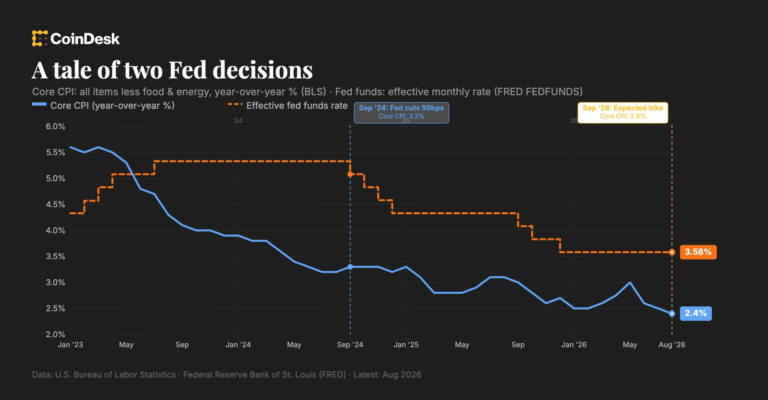
Following last week’s lower-than-expected US inflation data, meanwhile, Trump was buoyant, calling the numbers “great news.”
“As Investment pours into our Country, Factory Construction surges, Manufacturing Jobs rise, and Prices fall, there is so much to be proud of — The Golden Age of America is here!” he wrote in a post on Truth Social.
Markets remained conservative on policy changes from the Federal Reserve, with the latest data from CME Group’s FedWatch Tool showing consensus for a 0.25% interest-rate hike in September.
Fed target-rate probabilities for September FOMC meeting (screenshot). Source: CME Group
Bitcoin spot demand returns lower
Lackluster spot-market demand remains a key stumbling block on the road to bull-market recovery, research says.
In a blog post on Monday, onchain analytics platform CryptoQuant revealed that a modest supply increase at the start of July had already dissipated.
“Bitcoin’s 30-day Spot Demand recovered sharply to around -80K BTC in early July but has since deteriorated again to nearly -170K BTC,” contributor ScenarioX wrote.
Bitcoin demand data (screenshot). Source: CryptoQuant
Earlier, Cointelegraph reported on spot demand staying negative while recovering significantly on a rolling 30-day basis as BTC/USD hit $64,000. At the same time, futures markets saw a more pronounced influx of interest.
This was reflected in net flows to the US spot Bitcoin exchange-traded funds (ETFs), which were positive for four out of five days last week, per data from UK-based investment manager, Farside Investors.
“Despite this significant decline in spot demand, Bitcoin’s price has remained relatively stable, mainly due to easing short-term selling pressure and short covering in the derivatives market,’ ScenarioX said.
“However, derivatives demand remains insufficient to support a sustainable uptrend on its own. This leaves the market in a structurally fragile state, where renewed spot selling could trigger a sharp downside move.”
US spot Bitcoin ETF netflows (screenshot). Source: Farside Investors
CryptoQuant suggested that the market could still continue to gain “for a while” before futures demand was exhausted.
“However, the rally without meaningful spot demand is likely to end in a significant long liquidation event,” ScenarioX warned.
Puell Multiple lows fail to convince
A classic BTC price metric is showing signs of a reversal this month, but CryptoQuant warns that it is too early to talk of a “generational low.”
The Puell Multiple, which measures the USD value of newly issued BTC each day relative to its 365-day moving average, continues to head higher after seeing macro lows in early June.
“A low reading means miner income is well below normal,” CryptoQuant contributor TheChessOnChain explained in a blog post.
Bitcoin Puell Multiple. Source: CryptoQuant
Puell in turn reflects on Bitcoin miners’ financial stability, and June’s 0.87 reading was the lowest since September 2024. Zooming out, however, each BTC price cycle has delivered higher lows for Puell, potentially boosting that latter reading’s chances of forming the next floor.
“These bottoms are getting shallower, and the four-year supply cut (the halving) is not the cause: the metric scales both sides of its ratio, so cutting new supply cancels out. The real driver: price falls less each cycle (down 83% in 2018, 77% in 2022, less since), so miner income never sinks as deep,” TheChessOnChain said.
Bitcoin Puell Multiple data (screenshot). Source: CryptoQuant
While Puell lows do not strictly correspond to BTC price bear-market bottoms, TheChessOnChain suggests that waiting for new lower readings — including the metric’s classic deep value territory — may be a flawed strategy.
“The 2024 and 2026 lows came with price still high, so they are Puell lows, not price bottoms. Waiting for the classic sub-0.5 zone, where miners sell at a loss, may mean waiting for a level that no longer prints,” they said.
“Today reads as easing miner pressure, not a generational low. It turns decisive only if it holds beneath recent lows for weeks.”
Crypto sentiment gauge nears two-month high
Despite macro headwinds brewing over the weekend, crypto market sentiment continues to post a steady recovery.
Related: Bitcoin bottom countdown nears 50 days after BTC supply in loss passed 50%
The latest readings of the Crypto Fear & Greed Index show panic slowly dissipating among the broader investor base.
On Monday, the gauge measured 29/100 — still within its “fear” bracket but at its highest levels since the start of June. For much of the intervening period, crypto was gripped by “extreme fear.”
Crypto Fear & Greed Index (screenshot). Source: Alternative.me
In commentary on the rebound last week, research platform Santiment underscored its timing with the return of ETF inflows.
“After a long outflow stretch throughout May and June, this shift signals ETF demand is back and confidence in crypto is starting to pick up again,” it wrote on X.
Santiment argued that “encouraging” US inflation data had helped boost risk appetite, while “crypto policy optimism added another reason for sidelined buyers to re-enter.”
Brazil’s securities regulator, the Comissão de Valores Mobiliários (CVM) said it created a working group to draft an experimental framework for tokenized securities.
The regulator said the framework will cover the registration, custody, trading and settlement of securities using distributed ledger technology.
The group must send its first proposal to the CVM’s board within 60 days of being formally installed, while a broader review will run for 120 days, with a possible 30-day extension.
The group brings together 14 CVM departments and may consult government agencies, market associations, self-regulatory bodies and outside specialists. It will also review cybersecurity risks, international regulatory models and results from earlier sandbox programs, the regulator said.
Brazil already applies securities law according to a token’s economic characteristics. The CVM’s 2022 guidance clarified that using blockchain does not change whether an asset qualifies as a security.
The new review will focus on what happens around the asset.
Blockchains can combine functions that are normally split between exchanges, custodians, registrars, depositories and settlement systems. That raises questions over who controls the official ownership record, how private keys are held, when transactions can be reversed and who is liable when systems fail.
The crypto market is drifting lower, with bitcoin BTC$64,861.00 losing 1% since midnight UTC while ether (ETH) is holding up marginally better, shedding 0.65% even as some other risk assets, like U.S. equity index futures, advance.
Futures on the Nasdaq 100 and S&P 500 indexes posted gains of 0.35% and 0.20%, respectively, expanding the divergence between crypto and stocks that has defined much of this year.
Gold is little changed, holding above $4,000, and the Dollar Index (DXY) also barely moved, leaving crypto without a clean macro narrative to lean on.
CoinMarketCap’s Fear and Greed index sits at 34, deep in “fear” territory, while the average relative strength index (RSI) across crypto pairs has slipped to 44.07, nudging back toward the oversold conditions that set up July’s relief rally.
Derivatives positioning
Churn over conviction: Crypto futures are characterized by churning rather than new position establishment. While trading volume surged 81% to $127 billion in the past 24 hours, open interest (OI) remained flat at approximately $111 billion.
Leverage demand stalls: Bitcoin BTC$64,861.00 futures OI growth stalled near 750K BTC, failing to gain traction despite a recent swing that took the price above $64,000. This stagnation indicates that demand for leverage remains low and is a clear sign investors are not comfortable increasing their risk exposure. A similar pattern of caution is evident in ether (ETH) and XRP futures.
Solana capital outflow: Solana (SOL) is seeing a distinct trend of contraction, with futures OI declining to 62 million tokens, the least since early May. This represents a significant drop from the June 24 peak of over 76 million, signaling substantial position unwinding and capital outflows from the SOL market.
Bitcoin cash outlier: BCH$214.61 stands out as today’s exception. OI in BCH futures has surged by 20% to 1.73 million tokens, matching the record high set on June 21. This build-up increases the likelihood of volatile price action ahead, particularly as the token has slipped 3% to $213 over the past 24 hours.
Bearish market delta: Broadly speaking, bears appear to be driving the price action across most top-tier tokens. This is reflected in negative 24-hour cumulative volume delta (CVD) readings for most major coins, including bitcoin and ether. Notably, the privacy-focused ZEC has posted the most negative CVD in the market.
Volatility fear gauge alert: Traders should stay alert for potential market turbulence. Bitcoin’s 30-day implied volatility index (BVIV) is nearing the 36% mark. This level has served as a floor in recent years; previous instances of the index hitting this threshold have often preceded major volatility booms and sharp bitcoin price slides.
Options sentiment divergence: On the Deribit options exchange, persistent downside caution is keeping BTC and ETH puts priced higher than calls. However, 24-hour volume figures reveal a tactical bias toward the upside: the $70,000 Bitcoin call has emerged as the most-traded contract, while the $2,450 call is leading the rankings for ether.
Token talk
Zcash (ZEC) reversed course on Monday after its recent run, falling 3.68% to $527. The pullback follows a period of outperformance and may reflect profit-taking.
AI tokens are among the broader losers, with FET dropping 2.94% and TAO shedding 2.58%, giving back some of the gains posted last week as the sector struggles to sustain momentum.
PUMP$0.001977 is the standout mover of the past 24 hours, surging 20% following a wave of noise on social media, led by crypto influencer Ansem who posted bullish analysis alluding to the company making $30 million to $40 million per month in a bear market.
Jupiter (JUP) also advanced, rising 1.02% to $0.197 alongside a pickup in trading volume, continuing the token’s gradual rehabilitation after weeks of heavy losses.
Lighter (LIT) slipped a further 1.83%, extending a pullback from its record highs as profit-taking continues to weigh on a token that surged more than 200% between May and early July.
CoinMarketCap’s Altcoin Season indicator is at 55/100, the highest reading in months, though the Fear and Greed score of 34 suggests the market remains cautious despite pockets of altcoin strength.
The Bank of Korea’s central bank digital currency (CBDC) plans are moving forward with nine participating banks.
The second phase of BOK’s CBDC program is scheduled for September with real-transaction testing, Yonhap News Agency reported on Monday.
“The Bank of Korea will provide the infrastructure for the institutional CBDC, and each bank will conduct its own business using deposit tokens,” a BOK official told YNA. “From the second phase, we will lay the groundwork for commercialization.”
The BOK’s second phase will expand to include a total of nine participating banks, including Gyeongnam Bank and iM Bank. The country’s top three banks, KB Kookmin, Shinhan, Hana, and Woori Financial Group, are also participating in the CBDC project.
“The goal is to create an environment where the won can be traded freely regardless of time or place,” Yonhap quoted the government as saying.
CBDCs are a digital form of blockchain-based fiat currency that are managed by the issuing central bank and considered legal tender. Only a handful of countries have officially introduced a CBDC. Bahamas unveiled one in October 2020, Nigeria in 2021, and Jamaica in 2022, according to the Atlantic Council’s CBDC tracker.
While past patterns are never a guarantee of future performance, volatility metrics are widely known to be mean-reverting. This cyclical nature suggests that periods of below-average volatility are often followed by higher turbulence, while above-average volatility paves the way for market stability.
Currently, the index is trading below both its 30-day and 200-day simple moving averages. In essence, volatility is relatively “cheap” and sitting at a historically reliable support zone, suggesting the measure could be set to rise, which means another round of turbulence.
For now, bitcoin continues to trade just above $64,000, maintaining the range-bound price action that has persisted since last Wednesday. While some analysts have noted two consecutive weeks of spot ETF inflows, the capital movement is tiny compared with the billions yanked from the market during the preceding eight-week outflow streak.
Global volatility gauges in traditional markets are currently offering mixed signals. South Korea’s KOSPI VIX is currently above 70%, its highest level since the 1990s. Meanwhile, Wall Street’s VIX jumped over 12% to reach 18% on Friday, where it continues to hover. However, these levels have been in the play for months, which means that stocks are anything but panicked.
Additionally, the MOVE index, the 30-day volatility gauge for U.S. Treasury notes that underpins global finance, remains steady around 70%, as it has since April, offering a constructive cue for risk assets. Stay alert!