Home Blog Page 415

Ripple Scores New Korea Banking Deal With K Bank Partnership

0

Trusted Editorial content, reviewed by leading industry experts and seasoned editors. Ad Disclosure

South Korea’s internet-only lender K bank has signed a strategic partnership with Ripple to test blockchain-based overseas remittances, marking another bank-facing expansion for Ripple’s payments infrastructure in Asia.

The agreement, announced Monday by K bank and first reported by The Korea Herald, was signed at the lender’s headquarters in Seoul. K bank CEO Choi Woo-hyung and Ripple Asia-Pacific Managing Director Fiona Murray attended the ceremony alongside officials from both companies.

K Bank Taps Ripple For Blockchain Remittance Tests

The partnership centers on whether Ripple’s global network and blockchain infrastructure can improve the speed, cost efficiency and transparency of K bank’s overseas remittance system. For Ripple, the deal extends its long-running institutional payments strategy into South Korea’s digital banking market. For K bank, it gives the lender a live testing track for blockchain-based cross-border settlement at a time when stablecoins and tokenized payment rails are becoming a more serious part of bank-level infrastructure discussions.

“We are pleased to partner with K bank, which has helped set the standard for digital banking in Korea and continues to drive innovation,” Murray said. “This partnership will help strengthen K bank’s competitiveness in blockchain-based overseas remittance technology,” Choi said.

K bank is already conducting a proof of concept with Ripple for overseas remittances. According to the bank, the first phase tested transfers through a separate application, while the second phase is now assessing transaction stability by virtually linking customer accounts with internal systems. That detail is notable because it suggests the project is moving beyond a standalone test environment and toward a model that examines how blockchain-based remittance infrastructure could interact with bank-side account architecture.

The second phase will also test on-chain transfers with partners in the United Arab Emirates and Thailand. K bank has signed memorandums of understanding in both markets for stablecoin-based transactions, according to the report. That gives the Ripple partnership a broader regional angle: the work is not only about improving a domestic Korean bank’s remittance stack, but also about testing how blockchain rails may function across specific cross-border corridors.

The wallet component is also part of the experiment. K bank used an in-house wallet in the first phase of the proof of concept, but plans to use Ripple’s SaaS-based digital wallet, Palisade, in the second phase. The goal is to test a faster and more scalable model for compliance and deployment, according to the bank.

Notably, Ripple has expanded deeper into stablecoin infrastructure after launching RLUSD in 2024. It has applied for a US trust bank charter, with the approval process still underway.

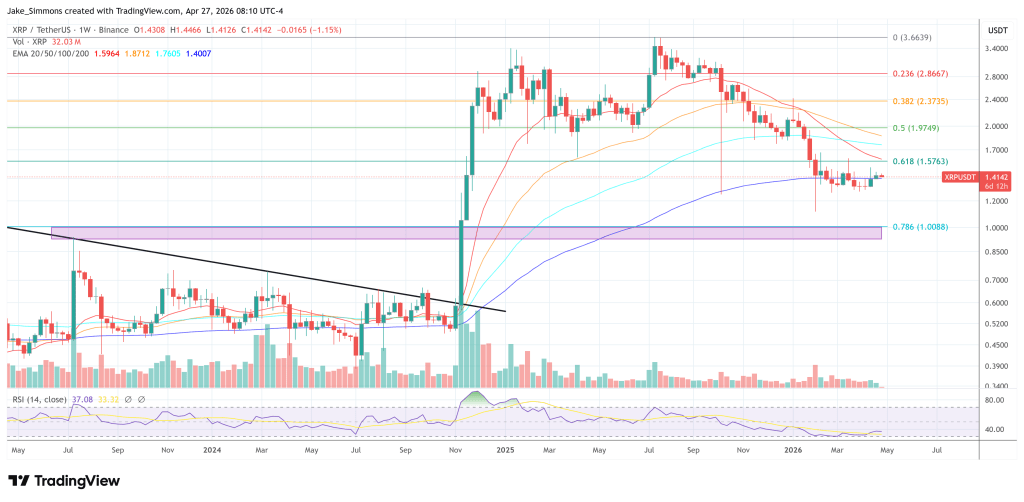
At press time, XRP traded at $1.41.
XRP price chart
XRP closed above the 200-week EMA, 1-week chart | Source: XRPUSDT on TradingView.com

Featured image created with DALL.E, chart from TradingView.com

Editorial Process for bitcoinist is centered on delivering thoroughly researched, accurate, and unbiased content. We uphold strict sourcing standards, and each page undergoes diligent review by our team of top technology experts and seasoned editors. This process ensures the integrity, relevance, and value of our content for our readers.


Fidelity Digital Assets sees early stabilization signals in crypto market

0

The digital assets market entered the second quarter in consolidation mode, but Fidelity Digital Assets said underlying data points to early signs of stabilization beneath the surface.

In its Q2 2026 Signals Report published Monday, the crypto trading firm highlighted improving conditions across a number of key metrics, including unrealized profitability, momentum and network usage.

Rather than focusing solely on prices, the report is framed through a broader lens of risk, positioning and cycle dynamics across bitcoin , ether (ETH) and solana (SOL).

Bitcoin, the largest cryptocurrency, continues to serve as the market’s primary source of resilience, with unrealized profit levels and dominance metrics indicating that capital remains concentrated in the most established and liquid asset during the consolidation phase.

“BTC’s dominance continues to gradually increase after declining throughout the latter half of 2025,” wrote analysts led by Daniel Gray.

The digital asset was trading around $77,000 at publication time.

Crypto markets have turned in a choppy performance in recent months, with bitcoin and other major tokens largely range-bound as investors navigate a complex macro backdrop.

Sticky inflation, shifting expectations around central bank rate cuts and periodic volatility in global equities have weighed on risk appetite, while ongoing regulatory scrutiny in the U.S. and abroad has added another layer of uncertainty.

At the same time, conflicts in Eastern Europe and the Middle East and trade frictions between major economies have contributed to bouts of risk-off sentiment, limiting sustained upside across digital assets.

At the same time, the analysts noted that momentum and profitability indicators are consistent with a corrective period, one that may be laying the groundwork for a more stable market structure.

A notable divergence is emerging between price and network activity. The analysts pointed to sustained usage across Ethereum and Solana, suggesting that demand at the protocol level remains intact even as valuations lag.

Taken together, these signals reflect a market still in recovery, but with structural improvements underway that may not yet be fully reflected in prices, the report said.

Read more: Bitcoin faces near-term pressure as liquidity tightens, Hilbert Group CIO says

BTC rally showing lack of conviction, says analyst

0

Bitcoin’s recent climb toward $80,000 is showing signs of strain, with low trading volume and muted derivatives activity raising questions about how durable the rally may be.

In a weekly report, 10x Research head Markus Thielen pointed to a disconnect between price action and underlying market participation. “Bitcoin rallied 4.7% over the past week, yet the accompanying data tells a cautious story beneath the surface,” he wrote.

Trading volumes have dropped sharply. Bitcoin weekly volume came in 17% below average, while ether (ETH) volume fell 20%. At the same time, funding rates — a measure of leveraged positioning — remain deeply negative. “Funding rates fell 6.8% to the 3rd percentile and volumes collapsed 33% to the 4th percentile,” Thielen said, adding that the move higher “was driven by spot buying or short covering rather than leveraged long conviction.”

That distinction matters. Spot buying, often linked to institutional demand, tends to be steadier but less explosive than leveraged trades. It also leaves the market without the kind of momentum typically seen in strong bull runs.

Institutional flows have been a bright spot. Bitcoin ETFs have recorded nine consecutive days of inflows, helping push total April inflows to $2.5 billion. Bitcoin dominance has also climbed to 60%, signaling capital is concentrating in the largest cryptocurrency rather than spreading across the market.

Still, Thielen cautioned that the rally’s structure remains fragile. “The market has shifted from a more actively traded environment to one where participants are largely on the sidelines,” he wrote, describing a “low-funding, low-volume regime that historically reflects hesitation rather than momentum.”

Options markets reinforce that view. Volatility has fallen into the lower quartile of its historical range, and traders are pricing in relatively modest price swings over the coming week. “The market is pricing in a relatively calm environment,” the report noted, even as sentiment gauges approach elevated levels.

Ethereum paints a similar picture, though with even weaker participation. Volumes have dropped more than 50%, and derivatives positioning shows limited appetite for risk. “The volume implosion points to a market where conviction remains low, and participants are largely disengaged,” Thielen said.

Despite these signals, the setup is not outright bearish. With leveraged long positions limited, the risk of forced liquidations on the downside is reduced. “Near-term risk/reward is asymmetric to the upside if a catalyst emerges,” Thielen wrote.

That catalyst may come from outside the crypto space. The report highlights macroeconomic developments as the key factor that could determine direction in the days ahead. For now, bitcoin’s rally appears intact, but without stronger participation, it may struggle to hold unless broader market conditions provide support.

Who’s pledging to Aave’s $300 million DeFi recovery effort after massive Kelp DAO exploit

0

In the often-fractured world of decentralized finance, crises tend to expose fault lines. This time, they’re also revealing an unusual level of coordination.

Aave, one of DeFi’s largest lending protocols, is at the center of a broad recovery effort following losses tied to the Kelp DAO exploit, drawing in capital and credit commitments from across the industry. The effort, informally dubbed “DeFi United,” has raised about $303 million in commitments as of Monday, according to its website, with much of the capital still pending governance approval.

The exploit, which rippled into rsETH markets and created risk across lending positions on Aave, has prompted what is shaping up to be one of the most coordinated industry responses to a DeFi incident.

“There’s a shared priority around supporting users and restoring normal market conditions,” an Aave Labs spokesperson told CoinDesk. “Many of these participants are deeply connected to DeFi, whether through infrastructure, capital, or user access, and have a direct interest in ensuring markets function as expected.”

At the core of the effort is Aave itself. A governance proposal outlines a plan for the DAO to allocate up to 250,000 ETH as part of the recovery. Founder Stani Kulechov has separately indicated he would donate 5,000 ETH personally. Other contributors within Aave’s orbit are also stepping in, including Aave’s Emilio Frangella (500 ETH), BGD Labs’ Ernesto Boado (100 ETH), BGD Labs (250 ETH), and KPK’s Marcelo Ruiz de Orlano (100 ETH).

‘Long-standing’ relationships

But the response has quickly extended beyond Aave, and in some cases began with direct outreach.

Following the April 18 bridge hack that impacted rsETH, Kulechov reached out to Consensys and other ecosystem participants early to help coordinate a response, according to a Consensys spokesperson.

The firm, alongside its founder Joseph Lubin, agreed to commit up to 30,000 ETH in financial support to help advance the recovery and protect users. Sharplink played a strategic advisory role in those discussions, the spokesperson said.

“The Ethereum ecosystem has always been at its best when it moves together,” Lubin said in a statement. “DeFi United is exactly that, a broad, coordinated response to protect users and strengthen the infrastructure we’ve all helped build. Consensys is proud to contribute alongside other stewards in the ecosystem.”

The effort has also drawn smaller contributions from across the community.

Lido has put forward a proposal to allocate up to 2,500 stETH, while EtherFi is discussing a 5,000 ETH plan aimed at supporting users and limiting bad debt across DeFi. Mantle has proposed a 30,000 ETH credit facility loan, adding to a growing pool of backstop liquidity. Compound also put forward a proposal to give up to 3000 ETH to the fund.

Other contributions are taking the form of deposits into Aave itself. Babylon Foundation plans to deposit $3 million in USDT, while Renzo has supplied more than $10 million from its treasury. Circle Ventures is purchasing AAVE tokens, and additional deposits have come from entities including Avalanche Foundation, Solana Foundation, and Justin Sun, according to Aave Labs.

The list of participants continues to grow. Entities that have not publicly specified the size of their commitments include Ethena, LayerZero, Frax Finance, and Ink Foundation, alongside Tyro.

“These are long-standing Aave relationships across the ecosystem,” the Aave Labs spokesperson added. “Teams like Consensys, Sharplink, and others have been in close contact throughout.”

Not all contributions are structured the same way. Some participants are offering grants, others deposits, and several are extending credit lines, highlighting different approaches to balancing support with risk management.

In parallel, Aave Labs has put forward a proposal asking Arbitrum governance to approve the release of roughly 30,765.67 ETH immobilized by the network’s Security Council into the coordinated remediation effort, with the goal of “making affected rsETH holders whole” and restoring rsETH’s backing.

Much of the capital remains subject to governance approval, and several proposals are still under discussion. Even so, the breadth of participation underscores how widely the exploit’s impact has been felt across DeFi.

“The Ethereum ecosystem has always been at its best when it moves together,” Lubin said. “DeFi United is exactly that: a broad, coordinated response to protect users and strengthen the infrastructure we’ve all helped build.”

Ian Allison contributed reporting.

Read more: Why DeFi is not dead after the KelpDAO exploit

Western Union (WU) gears up stablecoin launch to settle global transactions without SWIFT

0

Western Union (WU) is preparing to roll out a stablecoin strategy that could reshape how the 175-year-old money-transfer company settles payments across its global network.

CEO Devin McGranahan said on the company’s first-quarter earnings call that Western Union’s U.S. dollar stablecoin (USDPT) is in the final stages of readiness and is expected to launch next month. The firm announced in October that the digital dollar will run on Solana (SOL) and will be issued with federally chartered crypto bank Anchorage Digital.

Western Union plans to use the stablecoin first as an alternative to the interbank settlement rails it uses today to move money between the company and its agents.

“We are not originally launching [USDPT] as consumer-facing,” McGranahan said. “We are launching it as an alternative to the interbank SWIFT settlement network that we use today.”

That matters, he said, because Western Union’s business still depends on legacy banking systems that settle only on business days and can take two or three days in some markets. Stablecoins could allow the company to settle with partners in real time, including over weekends and holidays, while reducing capital tied up in the system, he added.

The second piece of the company’s strategy is the Digital Asset Network (DAN), which lets crypto wallet companies offer Western Union as a cash-out option. Through that network, wallet users will be able to convert digital assets into local currency through Western Union’s retail footprint, McGranahan said.

The company said its partner pipeline represents tens of millions of crypto wallets globally.

Western Union also plans to launch a Stable Card, expected later this year. It will let customers hold funds in stablecoins and spend through card networks. McGranahan said the card could be useful in inflation-sensitive markets where customers want access to U.S. dollar-denominated value with everyday spending utility.

“We expect to begin rolling this out across dozens of markets with an initial wave targeted for later this year,” he said.

Western Union’s stablecoin push comes as its core remittance business faces pressure, with rival fintechs and crypto payments firms increasingly using blockchain tech for cross-border payments. MoneyGram, for example, is looking to Circle’s USDC stablecoin, while Stripe launched its own stablecoin infrastructure with a payments-focused chain Tempo.

Read more: DoorDash is bringing stablecoin payments to masses with Stripe-backed blockchain

Bitcoin signals flash caution as conference kicks off and momentum fades

0

Bitcoin’s Sunday night rally stalled out near $79,400 and is beginning to show signs of fatigue, with several indicators pointing to potential short-term weakness as the price trades back around $77,000.

First, the Coinbase premium index has turned negative for the first time since April 8, according to Coinglass data.

The move to -0.04% follows a 14-day stretch of positive readings, the longest since October, that signaled consistent demand from U.S. investors and a run-up in the bitcoin price from $66,000 to $79,000.

The index measures the price difference between Coinbase, a platform for U.S. institutions, and offshore exchanges like Binance. A flip into negative territory suggests that this cohort is no longer aggressively buying, leaving the market more reliant on offshore flows. As the Coinbase premium turns negative, this tends to coincide with price pullbacks or consolidation.

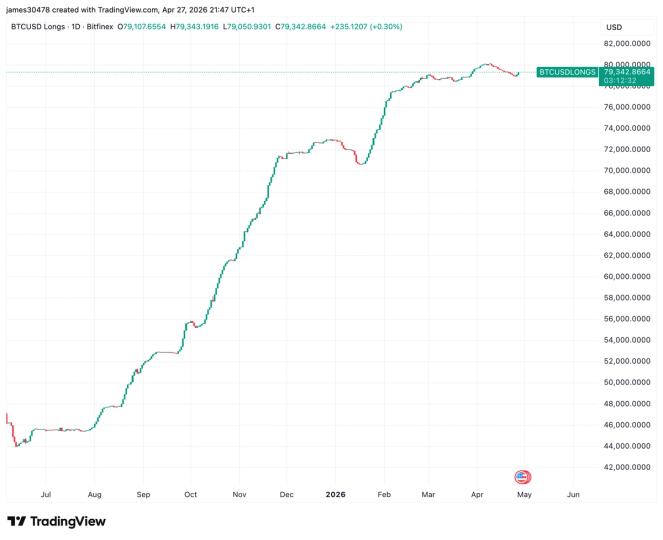
At the same time, the large Bitfinex whale, closely tracked for directional pricing, remains near cycle peak long exposure. Holdings currently sit at 79,342 BTC, just shy of the 80,100 BTC high. This entity typically divests its position once a local bottom is all but confirmed or when there is clear upside momentum.
The fact that exposure remains near the cycle peak despite bitcoin’s push toward $79,000 suggests a lack of short-term upside, raising the risk of a price decline.

Adding to these headwinds, bitcoin failed to reclaim the short-term holder realized price (STHRP) at $79,200. This metric represents the average on-chain acquisition cost of coins held for fewer than 155 days, a cohort that tends to be more reactive to price swings. The longer the price stays below the STH RP, the more likely recent buyers are to continue to exit, putting further pressure on the price.

Last but not least, the flagship Bitcoin conference has begun, with prior gains already fading, and if history is any guide, further downside follows.

Vitesse Strengthens U.S. Commercial Team with Appointment of Shareen Minor as Chief Revenue Officer, North America

0

Vitesse, the trusted financial infrastructure connecting the global insurance ecosystem, announced the appointment of Shareen Minor as chief revenue officer, North America. Minor brings more than 20 years of experience across carriers, TPA operations and PE-backed insurtechs, and will lead Vitesse’s commercial growth across the United States, reporting to Curt Hess, executive president, North America.

The appointment follows a period of deliberate investment in the U.S. market. In 2024, Vitesse secured $93 million in Series C funding led by KKR with a clear mandate to bring its insurance treasury and payments platform to the U.S. insurance market, supporting expansion across product, operations and commercial growth. Since then, the company has connected nearly 500 insurance network participants to its platform, a 42% increase year over year, and grown payment volumes by 32% in the last financial year. Building on that foundation, Vitesse is now accelerating its commercial growth in the U.S.

Minor most recently served as chief revenue officer at Ontellus, where she delivered double-digit revenue growth including 30% expansion within existing client bases and was instrumental in driving the company through a successful private equity exit. Before that, she held senior roles at Charles Taylor Adjusting and Technical Services, Engle Martin and Associates, and NatGen Premier, where she helped scale a new enterprise from zero to $50 million in revenue in 15 months.

“Shareen has spent her career inside the organizations we serve, working with TPA operations, building carrier relationships and navigating the commercial pressures our customers face every day,” said Phillip McGriskin, CEO and co-founder of Vitesse. “That experience is exactly what we need as we build deeper partnerships with the carriers, TPAs and MGAs we are here to serve.”

“We have spent the past two years building a U.S. operation that works, with the right product, the right regulatory foundation and the right team,” said Curt Hess, executive president, North America. “The next step is growth, and Shareen is the right person to lead that. She knows this market from the inside, has the relationships that matter and understands the pressures carriers and TPAs are under. I look forward to what we will build together.”

The market opportunity is significant. Research published by Vitesse in its 2025 State of Claims Finance report found that 74% of U.S. insurers struggle to access readily available claims funds and only 1% rate collaboration between claims and finance teams as highly effective.

“The U.S. market is ready for a more modern, transparent approach to claims funds management,” said Shareen Minor, chief revenue officer, North America. “Vitesse brings the technology and infrastructure to deliver that. I’m excited to build upon our partnerships with carriers, TPAs and the broader claims ecosystem and help clients take control of their claims funds, strengthen treasury oversight and unlock real operational value.”

The appointment further establishes Vitesse as the category-defining financial infrastructure for the global insurance market, helping carriers, TPAs and MGAs deliver claims payments faster and with greater visibility and control.

Kalshi Says Bitcoin Payments And Prediction Markets Are Building A New Exchange For Big Money

0

Kalshi’s head of crypto, John Wang, used a Bitcoin 2026 fireside chat to argue that regulated prediction markets offer a more accessible way to trade Bitcoin than traditional spot venues. He opened by describing his path at Kalshi and pushed back on the idea that the exchange is a pure crypto platform, saying Bitcoin and other digital assets serve as key payment rails rather than its core product. 

According to Wang, Bitcoin is now the largest source of user payments into Kalshi’s apps, underscoring how deeply the asset’s audience overlaps with the platform’s trader base.

Bitcoin predictions and insider trading on Kalshi

Moderator Conner Brown asked Wang on why a Bitcoin holder would choose Kalshi over spot markets to express a price view. Wang said prediction markets are attractive because they can apply to almost any outcome while preserving a simple user experience.

He argued that people already like trading Bitcoin and other cryptocurrencies and find them accessible, but that spot markets remain out of reach for many users compared with a straightforward contract that settles on a clear event result.

In his view, Kalshi can sit on top of that demand and package directional Bitcoin views in a format that feels more intuitive than managing wallets and navigating crypto exchanges.

Brown also raised concerns about insider trading and where to draw the line in event markets. Wang said Kalshi uses know-your-customer checks and internal protocols to protect traders and emphasized that information asymmetry is a challenge in equities and other markets as well. 

He framed the question as one of incentives, warning that if platforms fail to protect their users they risk turning markets into insider arenas that erode trust. The safeguards and norms for prediction markets are still developing, he said, but he expects investor protection standards to converge with those in more established asset classes.

Looking ahead, Wang positioned Kalshi as an exchange being built from the ground up for a new category of contracts rather than a niche trading venue. He said the company is constructing infrastructure for event-based exposure that can sit alongside traditional markets and added that he expects large hedge funds to take significant positions in prediction markets over time. 

Kalshi is set to launch cryptocurrency perpetual futures today, expanding beyond its core event-based contracts into continuous derivatives trading. The new product will allow traders to hold positions without expiration, using U.S. dollars as initial collateral, with plans to add stablecoins later.

Backed by its regulatory status and growing trading volumes, the move positions Kalshi to compete more directly with offshore crypto derivatives platforms.

Aven Launches Bitcoin-Backed Visa Card With Up To $1M Credit

0

Aven has introduced a bitcoin-backed credit card that allows users to borrow against digital assets without selling holdings, marking a shift in crypto-linked consumer finance, according to statements shared with Bitcoin Magazine. 

The Aven Bitcoin Visa Card, unveiled today at the Bitcoin Conference 2026 in Las Vegas, provides a credit line of up to $1 million secured by bitcoin collateral. The product targets long-term holders seeking liquidity without triggering taxable events tied to asset sales.

The card combines a revolving credit line with fixed-term loan options, offering repayment periods of up to 10 years. Interest rates for both structures start at 7.99% APR, which the company said is below typical rates in the bitcoin-backed lending market.

“The industry norm for borrowing at fixed rates against bitcoin is a 1-year term. At Aven, we have 10X the industry standard, unlocking a wide variety of use cases previously not feasible,” Aven’s Sisun Lee said, speaking at The Bitcoin Conference.

Aven’s bitcoin custody structure

Borrowers pledge bitcoin through custody and infrastructure provided by BitGo Inc. and BitGo Bank & Trust, a federally regulated digital asset trust bank. The structure separates asset custody from card issuance, which is handled by Coastal Community Bank under a Visa network license.

The product includes no annual or origination fees and offers 2% cash back on purchases. Aven positions the card as a tool that bridges crypto holdings with traditional credit access, aiming to expand the utility of bitcoin within household balance sheets.

The card also offers up to a 5-year interest-only period for added flexibility. The company is one of the few Bitcoin-backed loan providers offering both fixed-term and interest-only plans in the same product.

“At Aven we believe that the hardest money ever created deserves the best financial products. With the Aven Bitcoin Card, we’re just getting started,” Lee said.

Bitcoin-backed lending has grown with the rise in digital asset adoption, though it has faced scrutiny over risk management and collateral volatility. Fixed-rate, longer-term structures such as Aven’s may appeal to borrowers seeking more predictable repayment schedules compared with margin-style loans that can face liquidation risk during price swings.

Aven, founded in 2019, focuses on asset-backed lending products designed to lower borrowing costs. The company reports that its platform has saved customers more than $300 million in interest payments through March 2026.

The launch signals continued convergence between crypto infrastructure and regulated financial services, as firms seek to integrate digital assets into mainstream credit markets while addressing risk, custody, and compliance requirements.

MARA Holdings targets bitcoin quantum threat and network resilience with new foundation

0

Las Vegas — MARA Holdings (MARA) CEO Fred Thiel announced the launch of the MARA Foundation at the Bitcoin Conference Monday, outlining a broad effort to support the long-term resilience of the bitcoin network beyond the firm’s bitcoin and AI mining operations.

“Bitcoin is the most important decentralized system ever created, but its future is not guaranteed,” Thiel said, framing the initiative around the idea that the network requires active stewardship.

Thiel described bitcoin as “a public utility that nobody owns, but everybody depends on,” adding that decentralization “doesn’t mean it runs on itself, it means responsibility is distributed.”

The foundation will focus on maintaining bitcoin’s core properties as “sound, durable money,” while advocating for its open and global use. Key priorities include supporting the network’s security budget, particularly the development of a sustainable transaction-fee market, and funding research into emerging risks, such as quantum computing.

MARA also plans to fund open source development across scaling, mining, and user infrastructure, expand access to self-custody, and promote financial sovereignty worldwide.

Education and policy engagement are central to the initiative, including technical training, multilingual resources, and outreach to regulators.

As part of the launch, MARA will award $100,000 to one of three nonprofit organizations, with the recipient chosen by community vote, underscoring Thiel’s call for shared responsibility across the ecosystem.