Market dynamics continue to paint a bullish picture for bitcoin BTC$75,263.35 even as Iran-related developments and DeFi hacks dominate headlines.
U.S.-listed spot ETFs pulled in $663 million on Friday, the most since Jan. 15. Total inflows reached $996 million last week, up from $786 million the week prior, according to data source SoSoValue. This points to strong institutional interest in the largest cryptocurrency.
For a meaningful price rally to emerge, it’s a trend that needs to be sustained.
“ETF flow regimes provide a secondary read: Sustained inflows signal structural demand, while intermittent flows indicate tactical positioning, with consistency mattering more than magnitude,” said Timothy Misir, head of research at BRN, in an email.
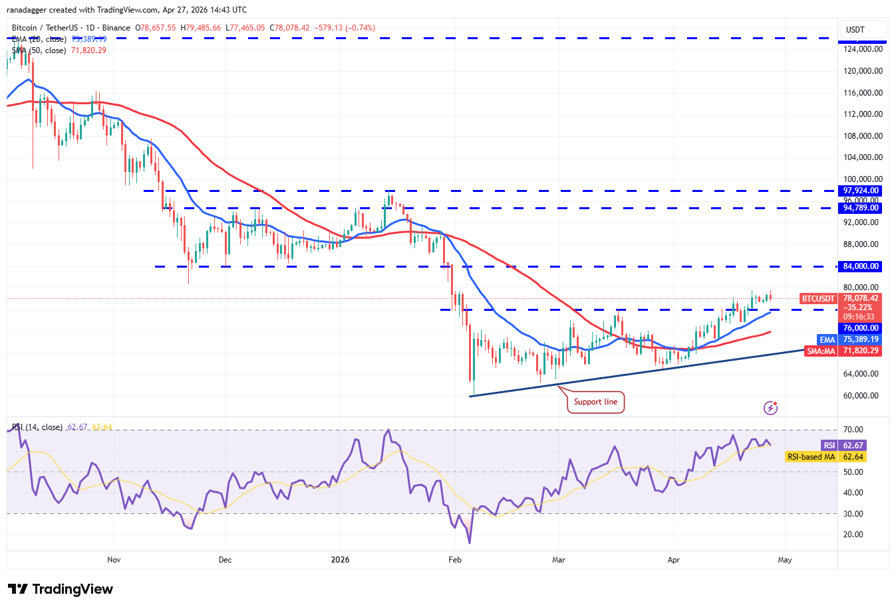
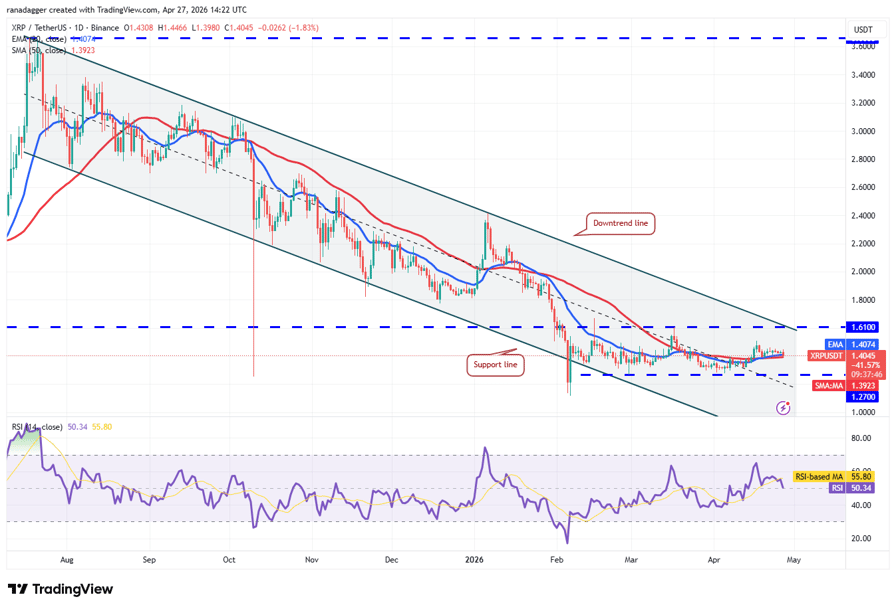
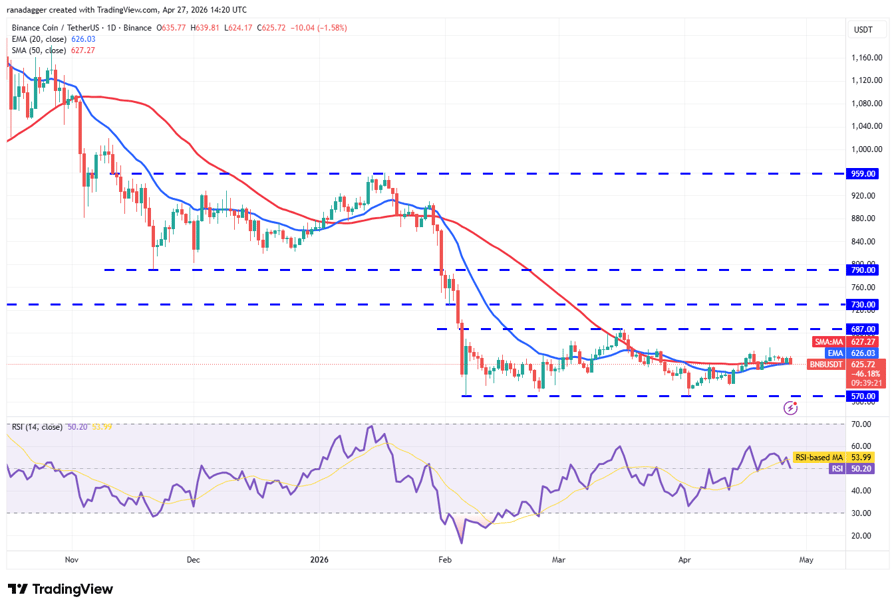
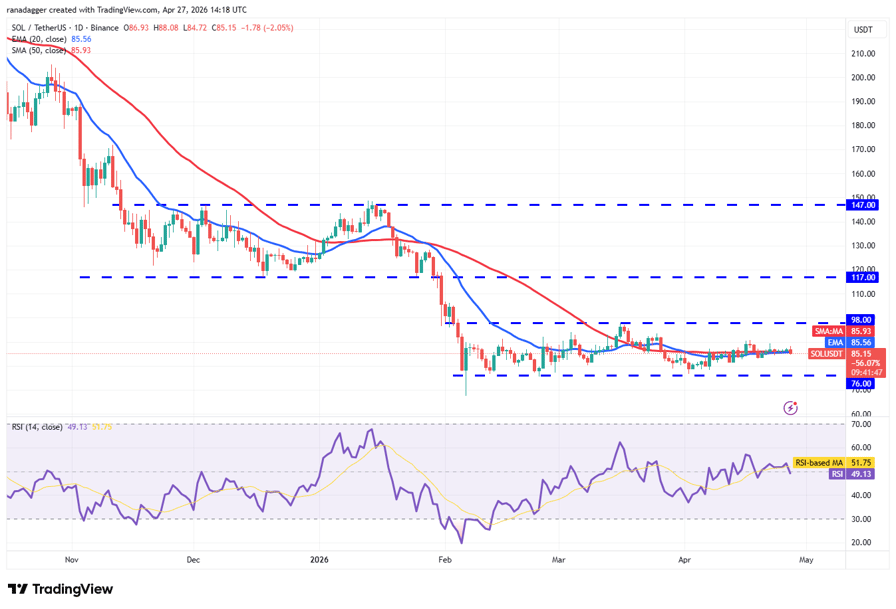
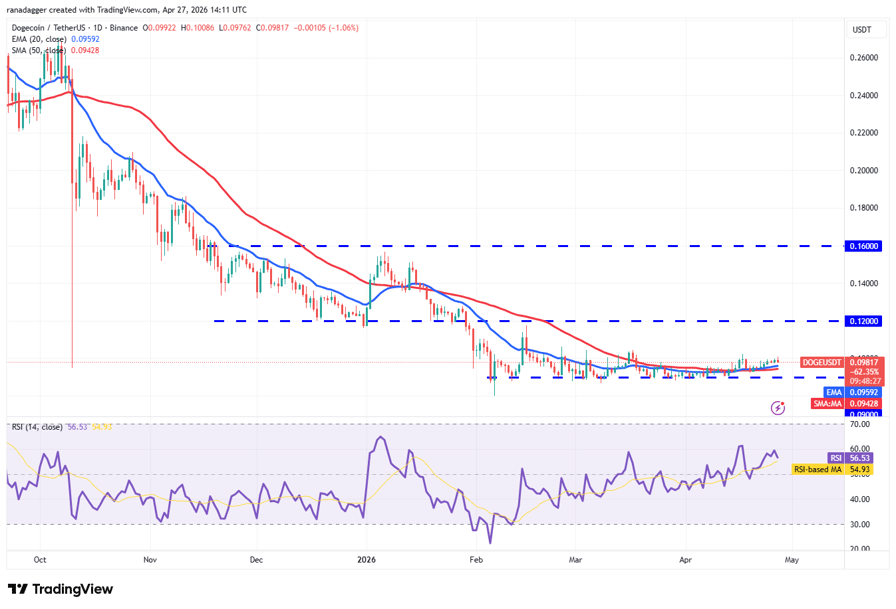
Bitcoin is trading just above $75,000 after hitting highs above $78,000 on Friday, according to CoinDesk data. The prices has largely held steady over the past 24 hours. Similar patterns are evident in ether (ETH), XRP (XRP), Solana (SOL) and other major tokens.
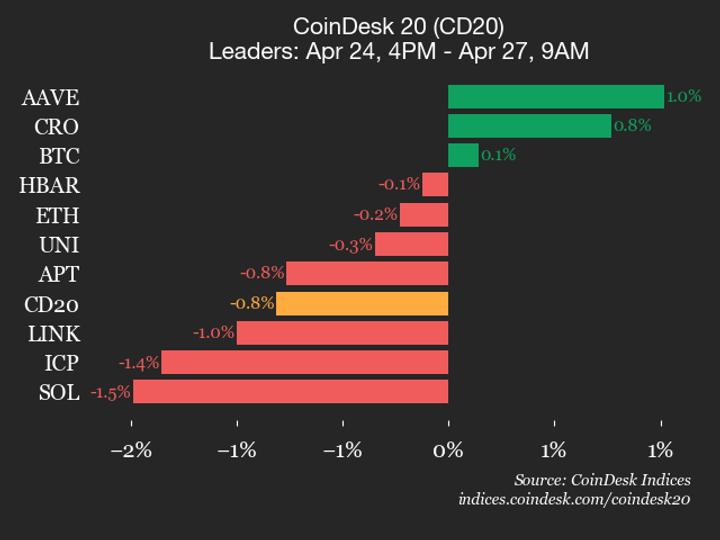
DeFi platform Aave’s AAVE token has dropped 1% to $90 as the protocol faces collateral damage from the weekend hack of KelpDAO. The DeFi dominance rate, which measures the share of DeFi coins in the total crypto market value, has held flat at around 3%.
“The pressure on the leading cryptocurrency is linked to negative reactions in stock markets to news about Iran, which has reduced risk appetite. BTC has lagged significantly behind equities in recent days, building potential but not yet moving to realize it,” Alex Kuptsikevich, the chief market analyst at FxPro, said in an email.
According to the latest reports, the U.S. attacked and seized an Iranian cargo ship attempting to bypass restrictions on Iran’s ports.
Meanwhile, traders are actively building short positions, betting against a breakout. This could fuel a “short squeeze” if prices hold steady, forcing traders to cover bearish bets and potentially pushing spot prices higher. Stay alert!
Read more: For analysis of today’s activity in altcoins and derivatives, see Crypto Markets Today . For a comprehensive list of events this week, see CoinDesk’s “Crypto Week Ahead.”
What’s trending
Today’s signal
Solana’s SOL price trades below key support for the 12th straight week. (TradingView)
The chart shows weekly price swings in solana (SOL), with each candle showing a full week of trading activity, including the opening, closing, high and low prices.
One level stands out: $95.16, the low registered in April.
SOL has remained below that level for 11 consecutive weeks after dropping below it in early February. In technical analysis, a level that previously acted as “support,” a price floor where buying interest tends to emerge, often becomes “resistance” once it is broken. That means traders who previously bought around that level may now look to sell if prices revisit it, limiting upside momentum.
The fact that SOL has not yet climbed back points to a sustained bearish sentiment and potential for deeper losses. The next major support is seen directly at $50.
A strong move above that level, backed by a surge in trading volumes, is needed to invalidate the bearish outlook.
Michael Saylor’s Strategy (MSTR) added 34,164 bitcoin to its treasury over the past week at an average price of about $74,395 per coin, for a total cost of roughly $2.54 billion, according to a Monday filing.
The purchase brings the company’s total holdings to 815,061 BTC, acquired for approximately $61.56 billion at an average cost basis of $75,527. With BTC currently trading at around $75,000, Strategy’s stash is currently break even. Strategy is the world’s largest publicly-listed bitcoin holder. It began acquiring BTC as a balance sheet asset in 2020.
Last week’s acquisitions were funded by $2.2 million raised through sales of the company’s preferred stock, Stretch (STRC), and $366 million from common stock offerings.
MSTR shares are down more than 2.5% in pre-market trading.
PayDo, the UK-licensed Electronic Money Institution, has officially launched new customer-to-business (C2B) settlement accounts. The new feature, housed within its all-in-one electronic money solution, is designed to help merchants accept and rapidly settle payments made directly from customers’ bank accounts.
The rollout expands PayDo’s payment capabilities beyond the standard business-to-business (B2B) services typically offered to online merchants. Built specifically to handle open banking payment flows, the C2B accounts are designed to reduce settlement delays, eliminate the need for manual payment requests, and provide merchants with instant payment confirmations.
Settling in under two seconds
The operational efficiency of the new accounts relies on speed. When a customer selects a pay-by-bank option at a digital checkout, the payment is initiated through their personal banking app and transferred directly into the PayDo ecosystem.
Once the funds are received by the system, they are settled directly to the merchant’s business account in under two seconds. The merchant is then provided with an immediate notification that the funds have cleared.
By supporting these direct C2B bank payments, PayDo aims to help merchants improve their overall settlement speed, simplify their day-to-day payment operations, and gain greater visibility over incoming funds through a single, unified account structure.
Serhii Zakharov, CEO and founder of PayDo, emphasized the practical impact of the new feature.
“We’ve moved the needle from making open banking possible to making it operationally effective for businesses processing significant payment volumes,” Zakharov stated. “This is how a promising payment rail becomes a more practical and reliable part of day-to-day commercial infrastructure.”
Meeting the demand for alternatives
The launch reflects a broader industry demand for payment methods that combine a smooth user experience with faster settlement and lower operational friction. Under this model, customers can pay without manually entering lengthy account details, while merchants benefit from quicker access to their funds—representing a potentially more cost-effective alternative to traditional card payment flows.
The new solution is built entirely on Payment Initiation Services technology. It sits firmly within PayDo’s wider business account ecosystem, which currently enables merchants to receive funds, manage their balances, pay suppliers, and move money globally from a single platform.
In addition to its new settlement capabilities, PayDo continues to offer merchant accounts and checkout services featuring Visa and Mastercard acquiring, alongside access to more than 350 alternative payment methods.
Cryptocurrency investment products logged another week of strong inflows on ceasefire optimism and a Bitcoin price breakout driving investor sentiment.
Crypto exchange-traded products (ETPs) posted $1.4 billion in inflows last week, beating the prior week’s $1.1 billion and marking the second-largest weekly inflows since January, CoinShares reported on Monday.
Following the three-week inflow streak totaling $2.7 billion, crypto ETPs now have net year-to-date inflows of around $3.8 billion, with assets under management (AUM) at $154.8 billion — the highest level since early February after dipping to as low as $128 billion in March.
The uptick in crypto funds has likely been driven by a recovery in risk appetite on US-Iran ceasefire extension talks, CoinShares head of research James Butterfill said.
The sentiment was further reinforced by Bitcoin (BTC) nearly touching $78,000 on Friday, according to CoinGecko.
Ether funds turn positive year to date
Bitcoin led last week’s ETP gains by a significant margin, with inflows totaling $1.12 billion. The gains brought year-to-date inflows to $3 billion, with AUM at $123 billion.
The majority of gains were contributed by US spot Bitcoin exchange-traded funds (ETFs), which posted $1 billion in inflows last week.
Ether (ETH) investment products also picked up with $328 million inflows in its strongest week since January, finally lifting the ETPs into green year-to-date with $197 million inflows.
Crypto ETP flows by asset (in millions of US dollars). Source: CoinShares
Still, altcoin ETPs, including XRP (XRP) and Solana (SOL), recorded negative flows, with XRP leading the outflows at $56 million. Solana recorded minor outflows of $2.3 million.
Short-Bitcoin products saw a modest $1.4 million of inflows, suggesting residual but limited hedging demand.
Regionally, the US dominated the surge with $1.5 billion of inflows, while Germany ranked second with just $28 million of inflows. Switzerland saw the largest redemptions last week, with outflows totaling $138 million.
Addressing the implications of recent economic data, CoinShares’ Butterfill suggested that March’s Consumer Price Index (CPI) increase of 3.3% appears to have been largely looked through by markets, with core CPI at 2.6% seen as relatively contained, pointing to inflation pressures that remain more supply-driven than broad-based.
Related: Bitcoin erases weekend gains as US-Iran ceasefire faces pressure
Nomura’s Laser Digital echoed that view, telling Cointelegraph that backward-looking macro indicators currently offer only limited insight while conflicts continue to affect supply chains and spending patterns.
“Delayed indicators like CPI and PMIs mostly reflect past conditions rather than the current situation,” Laser Digital said, adding that the outlook remains “cautiously optimistic.”
The Crypto Fear & Greed Index. Source: Alternative.me
Sentiment improvement was also reflected in the Crypto Fear & Greed Index, which moved from “extreme fear” to “fear,” with the score rising above 29 on Monday for the first time since Jan. 29.
Magazine: Bitcoin ‘on track’ for $90K, ETFs pull in nearly $1B: Hodler’s Digest, April 12 – 18
Cointelegraph is committed to independent, transparent journalism. This news article is produced in accordance with Cointelegraph’s Editorial Policy and aims to provide accurate and timely information. Readers are encouraged to verify information independently. Read our Editorial Policy https://cointelegraph.com/editorial-policy
Ethereum Name Service gateway eth.limo has revealed that the domain hijacking on Friday was caused by a social engineering attack directed against EasyDNS, its domain name service provider.
According to a postmortem published by eth.limo on Saturday, an attacker impersonated one of its team members to initiate an account recovery process with easyDNS, granting access to the eth.limo account and allowing them to alter domain settings.
“The NS records were changed and directed to Cloudflare… Once we understood that a DNS hijack had taken place, we immediately notified the community as well as Vitalik Buterin and others. We then began contacting EasyDNS in an attempt to respond to the incident,” the company said.
Eth.limo serves as a Web2 bridge, providing access to around 2 million decentralized websites using the .eth domain name. Hijacking the service could allow an attacker to redirect users to malicious websites. Ethereum co-founder Vitalik Buterin warned users Friday to avoid his blog until the incident was resolved.
Mark Jeftovic, CEO of easyDNS, has publicly accepted responsibility for the incident in its own postmortem report.
“We screwed up and we own it,” said Jeftovic on Saturday.
“This would mark the first successful social engineering attack against an easyDNS client in our 28-year history. There have been countless attempts.”
Both companies have pointed to the Domain Name System Security Extension (DNSSEC) in thwarting the hacker’s attempts to do further damage.
The attacker couldn’t produce valid cryptographic signatures, so Domain Name System resolvers rejected the attacker’s forged DNS responses, causing users to see error messages instead of being redirected to malicious sites.
“DNSSEC was enabled for their domain when the attackers attempted to flip their nameservers, presumably to effect some manner of phishing or malware injection attack, DNSSEC-aware resolvers, which most are these days, began dropping queries,” Jeftovic said.
Source: eth.limo
In its postmortem, eth.limo noted that because the attacker lacked the signing keys, they were unable to bypass the safeguards, which likely “reduced the blast radius of the hijack. We are not aware of any user impact at this time. We will provide updates if that changes.”
easyDNS makes changes since the attack
Jeftovic described the social engineering attack as “highly sophisticated,” and said easyDNS is still conducting a post-mortem on how the breach occurred, and has already begun rolling out changes to prevent a recurrence.
Source: easyDNS
“In eth.limo’s case, we will be migrating them to Domainsure, which has a security posture more suited toward enterprise and high-value fintech domains, TLDR there is no mechanism for an account recovery on Domainsure, it’s not a thing,” he added.
“On behalf of everyone here, I apologize to the eth.limo team and the wider Ethereum community. ENS has always had a special place in our heart as the first registrar to enable ENS linking to web2 domains and we’ve been involved in the space since 2017.”
The eth.limo incident is the latest in a series of domain hijackings targeting crypto projects. Days earlier, decentralized exchange aggregator CoW Swap lost control of its website after an unknown party hijacked its domain.
Steakhouse Financial, a DeFi advisory and research firm, similarly disclosed at the end of March that it had lost control of its domain to an attacker.
Magazine: Will the CLARITY Act be good — or bad — for DeFi?
Cointelegraph is committed to independent, transparent journalism. This news article is produced in accordance with Cointelegraph’s Editorial Policy and aims to provide accurate and timely information. Readers are encouraged to verify information independently. Read our Editorial Policy https://cointelegraph.com/editorial-policy
Latin American digital bank Plata has closed on a $405 million Series C at a $5 billion valuation.
Editorial
This content has been selected, created and edited by the Finextra editorial team based upon its relevance and interest to our community.
The round was led by Bicycle Capital with new investors Qatar Investment Authority (QIA), BTG Pactual, Valor Capital Group, and previous investors.
The bank’s value has almost doubled from a $3 billion figure secured just six months ago.
Since launching three years ago, Plata has grown to serve over 3.5 million active customers and has raised more than $2 billion in debt and equity.
The raise comes shortly after the Mexican neobank began offering deposit services alongside its initial suite of credit products. It is also eyeing regional expansion after receiving authorisation last July to operate as a financial institution in Colombia.
“This round reflects investors’ confidence not only in our execution to date, but also in the scale of the opportunity ahead,” says Neri Tollardo, co-founder and CEO of Plata. “We built a technology-led platform designed to broaden access to better financial services at scale. The launch of full banking operations in Mexico is a pivotal milestone — it expands our product range and gives us access to retail deposit funding, meaningfully strengthening our funding model for the next phase of growth.”
The company, founded by three former Tinkoff executives, built its technology infrastructure in-house, including a proprietary core banking system, CRM, and AI-powered risk engine, developed by a team of over 800 STEM professionals.
The aftershocks of the Saturday’s KelpDAO hack are spreading through stablecoin markets in ways that were not immediately obvious.
Int he first 24 hours post the attack, users on Aave borrowed approximately $300 million against their tether deposits of stablecoin tether USDT$1.0002 on the platform, according to Chaos Labs data.
The borrowing spike isn’t a sign of demand; it is a sign users can’t withdraw. With stablecoin pools maxed out, depositors are taking loans against their own funds at a loss just to access liquidity.
Think of it this way: Imagine a bank refusing to process customer fiat deposit withdrawal requests. So, out of desperation, customers take out loans on these deposits. This credit creation isn’t healthy, but a desperate move for liquidity.
“We’re now seeing some negative secondary effects of illiquidity in Aave stablecoin markets,” said monetsupply.eth, the pseudonymous head of strategy at Spark, a rival DeFi lending platform. “Because users can’t withdraw due to 100% utilization, there has been a ~$300 million increase in borrowing with USDT collateral in just the past day since the rsETH exploit.”
To understand how a single exploit on KelpDAO ended up locking every stablecoin exit on Aave simultaneously, you need to understand how the system is supposed to work — and exactly where it broke.
What is Aave and how it’s supposed to work
Aave is a decentralized finance (DeFi) protocol that enables users to lend and borrow cryptocurrencies without intermediaries. Think of it as a bank, except it runs entirely on code on a public blockchain, with no human gatekeepers.
Users deposit assets into lending pools and earn interest. Others borrow from those same pools by posting crypto assets as collateral, which exceeds the loan amount. The system is designed to self-correct automatically through interest rates. When lots of people want to borrow, rates rise, making borrowing more expensive and encouraging lenders to deposit more. When demand falls, rates drop.
The whole system operates on one core assumption: that there is always enough liquidity – enough assets in the pool – for lenders to withdraw their deposits when they want to, and for borrowers to unwind their positions when they need to.
When that assumption breaks down, everything else breaks with it. That’s what happened after the KelpDAO exploit.
rsETH and the KelpDAO exploit
rsETH is a liquid re-staking ether token issued by KelpDAO.
When you stake ether (ETH), you lock it up to help secure the Ethereum network in exchange for a yield, similar to earning interest on a bond. Some protocols issue a liquid staking token (LST) that represents your staked ETH.
Re-staking goes a step further, reusing those already-staked assets to secure additional systems, effectively stacking yield on yield. In return, you receive a receipt token representing your position. rsETH is one such receipt token and it has been widely used as collateral across the DeFi world.
On April 18, an attacker manipulated KelpDAO’s bridge infrastructure into releasing 116,500 rsETH — roughly 18% of the token’s circulating supply, worth approximately $292 million. These fake, unbacked tokens were immediately deposited into lending protocols, mostly Aave, to borrow real ETH and other assets such as wrapped ether (wETH) against them. Fake tokens in, real money out.
“That [borrowed] WETH is gone. The rsETH holding its place in the vaults is worth whatever an unbacked claim is worth — approaching zero on the L2 side, where 20+ chains held bridged rsETH backed by a now-empty mainnet lockbox,” 0xyanshu, a pseudonymous crypto operator known for work around on-chain finance and risk, said.
Aave froze rsETH markets on V3 and V4 within hours, with founder Stani Kulechov affirming the exploit was external and Aave’s contracts were not compromised. That freeze stopped the bleeding. But it also set off the chain reaction that produced the $300 million borrowing surge.
How $300 million in borrowing materialized in a single day
When the exploit news broke, whales and big funds withdrew billions of dollars worth of cryptocurrencies from Aave’s liquidity pools within hours. Because they moved first and in large numbers, their withdrawals drained liquidity pools.
“When the rsETH exploit happened and AAVE incurred bad debt, whales like Justin Sun, MEXC exchange, and others immediately withdrew billions from AAVE,” analyst Duo Nine, said in an explainer. “Initially, the ETH market hit 100% utilization, meaning you could not withdraw your ETH from AAVE.”
This soon spread to USDT and USDC pools, raising their utilization rates to 100%, as over $6 billion in assets left the protocol within hours. Every lending pool holds a fixed amount of assets deposited by users. When every dollar of those assets has been borrowed out, nothing remains for withdrawals.
“That’s because AAVE lost over $6 billion in liquidity in the past 24h,” Duo Nine wrote. “As whales took out their money, USDT and USDC also hit 100% utilization. These markets are now also stuck with money locked.”
This is when the $300 million secondary borrowing surge began.
Trapped USDT and USDC depositors, unable to simply withdraw their money, reached for the only exit still available to them. They began by drawing loans from their locked deposits.
“Some users decided to borrow against USDT/USDC and exit via other markets at a 10-25% loss,” Duo Nine explained. “Basically you borrow GHO/DAI/USDe against your locked USDT/C.” It was not a trading strategy.
It has been a desperate act of borrowing against their own money at a loss, accepting 75 cents on the dollar, just to extract any liquidity from the system at all. Aave allows users to borrow up to 75% of the total loan-to-value (LTV) of their deposited collateral, depending on the asset and its risk parameters.
“With a 75% max LTV, users with stuck USDT deposits can take out up to 3/4 of the value of their Aave position. But this ends up reducing liquidity in other markets, with USDC and USDe markets now at 100% utilization as well,” monetsupply.eth, the pseudonymous head of strategy at Spark, a rival DeFi lending platform, observed.
For anyone watching DeFi from the outside, the message is clear: “Decentralized” does not mean “without risk.”
Bitcoin BTC$75,194.05 options worth roughly $7.9 billion are set to expire on Deribit this Friday, with positioning data pointing to $62,000 and $75,000 as key levels to watch out for.
The $75,000 level is where most trading in call options, which represent bullish bets, has happened, according to data source Glassnode. Around $395 million in call open interest is concentrated at the $75,000 strike as of writing. That figure represents the dollar value of the number of active call options contracts today.
More importantly, “gamma exposure” is deeply negative at the 75,000 strike – it means dealers’ hedging flows are likely to amplify price movements around this level. As the price rises, they may need to buy more, and as it falls, sell more, reinforcing the direction of the move.
As a result, the 75,000 level can act as a zone of heightened volatility, where price swings become sharper rather than stabilizing.
Options are derivative contracts that give the buyer the right to buy or sell the underlying asset, in this case, BTC, at a predetermined price at a later date. A call option gives the right to buy and a put option gives the right to sell.
It’s like paying a booking fee to reserve a right to transact a house at today’s price – you have the right to buy or sell it later at that price, but you’re not obligated to go through with the transaction if the market price moves against you.
BTC: Options Gamma Exposure (Glassnode)
On the downside, the largest concentration of put open interest sits at $62,000, with roughly $330 million in contracts, marking the main zone of downside protection.
Between the two, there’s this max pain level of $71,000, which can act as a magnate heading into the expiry. The “max pain” point is the price level at which the largest number of options contracts are expected to expire worthless on the settlement date, though this level can shift as prices and open interest change leading up to expiry.
All in all, the options market is effectively sitting between $62,000 and $75,000, with $71,000 acting as a midpoint. Unlike March, when bitcoin traded below max pain, the market is now sitting above it, to test whether bitcoin can hold onto its gains.
Potential short squeeze higher
Funding rates in perpetual futures have remained negative, indicating a build-up of short positions that could fuel a squeeze if prices hold higher. Bears could square off their bearish bets if prices remain resilient above $75,000, which could add to the upward momentum.
While data from Checkonchain shows Deribit now holds around $31 billion in open interest, the largest across options markets, surpassing even BlackRock’s IBIT, which stands near $28 billion.
At InsurTech NY, Dan Kies from Camunda explains how the company is applying orchestration and automation to improve key insurance processes.
Kies says there are multiple areas where technology can make a difference, particularly in fraud reduction, underwriting, and payments. Many of these processes still rely on outdated workflows, including manual communication, paper-based systems, and slow decision cycles.
Camunda’s focus is on improving how these workflows are managed.
Kies explains that orchestration can help reduce unnecessary steps, improve efficiency, and ensure that processes move more smoothly from one stage to the next. This includes reducing delays in payments and improving how underwriting decisions are made.
He adds that one of the key priorities is listening to carriers.
Rather than applying technology in isolation, Camunda works closely with insurers to understand their specific needs and challenges, ensuring that solutions are aligned with real-world requirements.
Kies also highlights the value of InsurTech NY.
He says the event provides an opportunity to hear from a wide range of perspectives, from legal and actuarial teams to technology leaders. These conversations help broaden understanding and provide insights that might not emerge in day-to-day work.
Looking at the industry more broadly, Kies points to a shift in focus toward the consumer.
He explains that rising costs and changes in coverage availability are creating new challenges, and insurers need to respond by offering more appropriate solutions. This includes helping customers understand their risks and making it easier to access the right coverage.
Kies also notes the importance of improving claims and underwriting processes, as well as reducing unnecessary costs across the system.
Overall, his view is that better workflows can lead to better outcomes for both insurers and customers.
As bitcoin BTC$75,323.23 heads into this year’s flagship Bitcoin Conference in Las Vegas next week, traders will be watching for a familiar pattern, a potential “sell-the-news” event that has played out in previous years.
The largest cryptocurrency is trading around $75,000, recovering from a local bottom of around $60,000 in early February after collapsing more than 50% from its October all-time high.
Data from Galaxy Research and Investing.com spanning 2019 to 2025 show the price of bitcoin tends to rise in the run-up to these conferences, delivers a mixed performance during the event and declines substantially afterward.
For instance, bitcoin gained about 3% in the 24 hours before the 2024 event in Nashville (featuring then-presidential candidate Donald Trump) and roughly 10% ahead of the 2019 conference in San Francisco, suggesting positioning builds into peak attention. Price action during the conference is typically subdued as the narrative fails to deliver, and the weakest performance occurs in the days and weeks that follow.
In the 2022 bear market, often compared to the current 2026 bear market environment, bitcoin fell just 1% during the Miami conference before sliding nearly 30% over several weeks. Similar post-conference weakness was seen in 2019, 2021 and 2023, where any momentum failed to hold.
Even in 2024, when Nashville hosted Trump to outline plans to position the U.S. as a bitcoin superpower, gains during the event were short-lived and marked a local top, just ahead of the yen carry-trade unwind in August that pushed bitcoin as low as $49,000.
Conferences tend to coincide with peaks in attention and liquidity as bullish narratives build up to the event, creating conditions for investors to unwind positions.
With sentiment still fragile and prices recovering from deep losses, the key question for 2026 is whether Bitcoin Vegas will once again act as an exit liquidity event.