Home Blog Page 404

Bitcoin Pushes Above $78,000 as Risk Assets Shake Off Hawkish Fed

0

Crypto markets open May with a rally despite an unresolved Hormuz blockade.

Bitcoin pushed back above $78,000 on Friday, clawing back some of late April’s losses in the first trading session of May as crypto markets steadied after a three-day streak of institutional outflows.

BTC is changing hands near $78,225, up 2.8% over 24 hours, per CoinGecko. Ether is trading at around $2,303, up 2.2% on the day. Total crypto market capitalization climbed 2.1% to $2.68 trillion.

BTC Chart

Among other large-caps, XRP added 2% to $1.39, BNB rose 0.6% to $619, and Solana gained 1.5% to $84. Hyperliquid’s HYPE rallied 4.4% to $41.

The bounce extends a two-day rally that kicked off shortly after the Fed left benchmark interest rates unchanged, citing elevated inflation that partially reflects “the recent increase in global energy prices”, with WTI crude futures still above $100 a barrel and the Strait of Hormuz effectively closed by the mutual US-Iran blockade.

Leverage is rebuilding alongside the spot bid. Bitcoin futures open interest has increased by nearly 9% over the past 24 hours to $58.5 billion, per CoinGlass. Around $132 million in BTC futures positions were liquidated over the past 24 hours as today’s bounce caught traders short.

ETF Flows

Spot Bitcoin ETFs snapped a three-session outflow streak on April 30 with $14.76 million in net inflows, per SoSoValue data, lifting cumulative net inflows to $58.09 billion and total net assets back above $100 billion. The modest print followed three straight days of redemptions totaling $490 million.

April still closed as the strongest month for spot Bitcoin ETFs in 2026 by a wide margin. BlackRock’s iShares Bitcoin Trust (IBIT) led with roughly $2 billion in net inflows, while Grayscale’s GBTC posted around $280 million in net outflows. Morgan Stanley’s recently launched MSBT contributed $194 million.

Spot Ether ETFs ended the month worse. The category bled another $23.64 million on April 30, a fourth straight outflow session that brought the streak’s combined redemptions to $183.75 million.

XRP’s Sentiment Turns Bullish, But What Is Stopping a Price Breakout?

0

XRP’s (XRP) sentiment on social media has risen sharply over the last few days, but overhead resistance at $1.40 kept the price in consolidation.

Key takeaways:

  • XRP’s social media sentiment has risen 240% over the last 30 days to a two-year high.
  • XRP price recovery may face resistance at $1.40, with a prolonged consolidation likely.

.

XRP sentiment jumps on integration with Rakuten Pay 

News of XRP’s integration with the Japanese payment platform, Rakuten Wallet, has sparked renewed optimism among investors. 

Related: XRP set for ‘strongest’ 2026 monthly ETF inflows as bulls target $2

This integration allows Rakuten’s over 44 million users to convert their loyalty points (worth over $23 billion) directly into XRP, trade it in-app, and spend it at over 5 million merchant locations via the Rakuten Pay app. 

This marks “one of the largest retail deployments of $XRP as a payment method to date,” bridging loyalty programs, payments, and crypto utility in a major world economy, Ripple said in an X post on Thursday.

XRP integrates with Rakuten Pay. Source: Ripple

As a result, XRP saw its “2nd highest bullish sentiment across social media in the past 2 years,” Santiment said in a Thursday post on X. 

Santiment’s Positive/Negative sentiment indicator, which measures the ratio of positive to negative social media mentions for a cryptoasset, shows XRP has a score of 3.9, levels last seen in early 2024.

This was more than 240% higher than the 1.135 value recorded on March 29, following a 20% price drop over two weeks. 

Traders are showing excitement over the fact that XRP is “seeing further adoption,” the onchain data provider said, adding:

“As far as price goes, these events don’t often instantly lead to major price outbreaks. It is usually after the initial wave of euphoria, after FOMO calms down, that the impact of this kind of news sees the bullish outcome.”

XRP’s Positive/Negative sentiment metric. source: Santiment

“Buy $XRP with points. Spend it across millions of merchants in Japan,” analyst John Squire said in reaction to the development, adding:

“This is what mass adoption looks like.”

Following this news, XRP/USD jumped 2% over the last 24 hours, but remains 62% below its $3.66 multi-year high reached in July 2025. 

XRP faces stiff resistance above $1.40

XRP’s recent 18% rally from its local low at $1.27 reached on April 5 was stopped at $1.48, coinciding with the upper boundary of a symmetrical triangle. 

This trend line has suppressed the price since early February, as shown in the chart below. 

Bulls must push the price above the $1.40-$1.45 resistance zone to confirm a bullish breakout from the triangle. This area is also where the 50-day exponential moving average, the 100-day simple moving average and the upper trend line of the triangle sit, reinforcing the significance of this resistance zone.

XRP/USD daily chart. Source: Cointelegraph/TradingView

According to XRP’s cost-basis distribution data, investors hold approximately 2 billion XRP at an average cost of $1.40-$1.45, creating a potential resistance zone. This concentration suggests many investors may sell at break-even, potentially stalling XRP’s upward momentum.

XRP cost basis distribution chart. Source: Glassnode

A break above this supply area could open the way for a rally toward the measured target of the triangle at $2.10, about 50% above the current price. 

In a Friday post on X, analyst ChartNerd said a big move was brewing for XRP price once resistance above $1.40 is “cleared.”

As Cointelegraph reported, the XRP/USD pair was required to hold the $1.27 support and rise above the moving averages around $1.40 to signal a trend change. 

This article is produced in accordance with Cointelegraph’s Editorial Policy and is intended for informational purposes only. It does not constitute investment advice or recommendations. All investments and trades carry risk; readers are encouraged to conduct independent research.

XRP’s Leverage Just Reset To February Levels After the Fed Decision – Here Is the Full Picture

0

Trusted Editorial content, reviewed by leading industry experts and seasoned editors. Ad Disclosure

XRP has been struggling to hold above $1.35 as the market absorbs a wave of post-Fed deleveraging that has compressed derivatives activity to levels not seen since the beginning of the year. The price is at a critical juncture — and a CryptoQuant report tracking the aftermath of the April 29 Federal Reserve decision has mapped exactly what happened to XRP’s market structure in the hours and days that followed.

The Fed held rates unchanged at 3.50% to 3.75%, consistent with expectations. Jerome Powell simultaneously confirmed he would remain on the Federal Reserve Board as a governor after his chairmanship ends — a development that kept macro attention elevated across risk assets rather than allowing markets to settle into the rate decision alone. For XRP, the combined effect was immediate and visible across the derivatives market.

Binance open interest for XRP fell to approximately $208 million on April 29 — a contraction that brought leverage levels back to the same area recorded in February 2026. The significance of that regression is not just the level itself but what it represents: all the leveraged positioning that accumulated between February and late April has been unwound in a compressed period, resetting the derivatives structure back to its starting point.

XRP Multi Exchange Open Interest | Source: CryptoQuant

The reset happened fast. What follows it is the question the current price level is building toward answering.

The Leverage Is Gone. The Demand Has Not Arrived Yet

The CryptoQuant report extends the picture beyond open interest to confirm that the deleveraging has been accompanied by genuine demand weakness rather than simply a technical reset. All CEX Estimated Spot CVD has declined to approximately $920 million since April 17 — meaning real, underlying buying activity across centralized exchanges has weakened during the same period that leverage was being removed. The two forces moving in the same direction simultaneously are the details that prevent the current setup from being read as straightforwardly constructive.

XRP Binance Cumulative Net Taker Volume / OI % Change
XRP Binance Cumulative Net Taker Volume / OI % Change | Source: CryptoQuant

The perpetual market adds a third layer of confirmation. Binance Perpetual CVD declined from approximately -$271 million to -$383 million, a further deepening of $112 million in net sell-side pressure even as open interest was contracting. Sellers remained active in the perpetual market throughout the reset period rather than stepping back alongside the leveraged longs.

The liquidation data ties the structure together. Long positions dominated the liquidation activity from April 17 through the end of the month, with the pressure concentrating particularly around the Fed and Powell headlines on April 29. The participants most exposed were the ones who had built long exposure, and the forced exits from those positions added supply to a market that was already seeing spot demand weaken.

The takeaway the report identifies is precise and conditional. XRP’s market structure is cleaner than it was — excess leverage has been removed, fragile positions have been cleared. But clean is not the same as ready. For a meaningful recovery to develop from the current $1.35 level, spot CVD needs to stabilize and begin recovering. Until that signal appears, the reset is complete, and the next move remains unconfirmed.

XRP Compression Tightens As Market Tests Post-Deleveraging Support

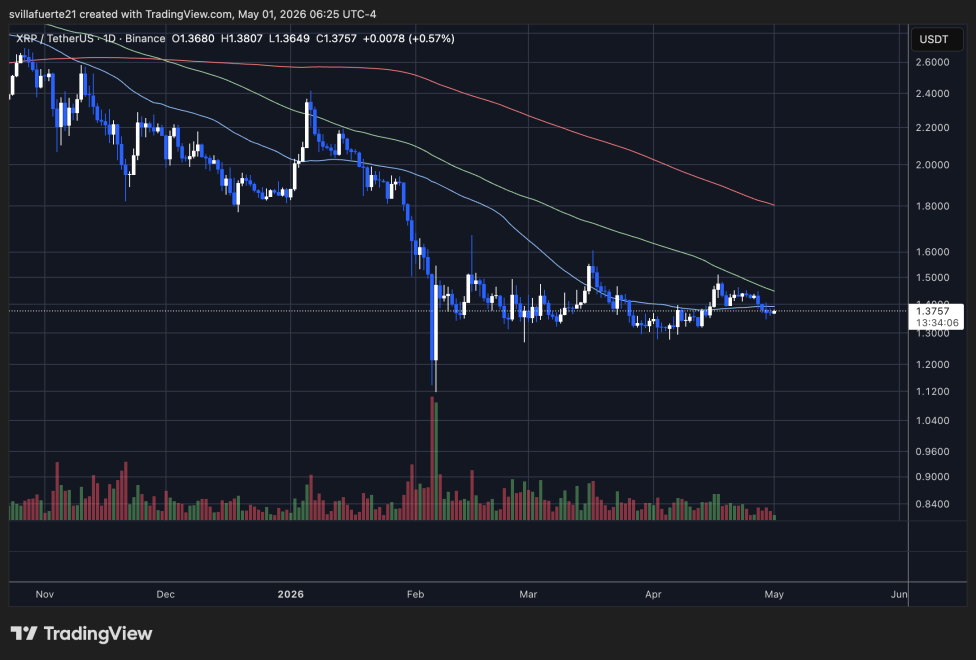
XRP is trading near $1.37, holding a narrow range that has defined price action since the sharp February selloff. The structure is neutral but increasingly compressed. After the capitulation wick toward $1.15, price stabilized and has since formed a sequence of shallow higher lows, suggesting passive accumulation rather than aggressive trend reversal.

XRP consolidates below $1.40 price level | Source: XRPUSDT chart on TradingView
XRP consolidates below the $1.40 price level | Source: XRPUSDT chart on TradingView

However, the broader context remains restrictive. XRP is still trading below all major moving averages, with the 50-day acting as immediate resistance and the 100-day and 200-day trending downward above the price. This alignment keeps the market in a medium-term bearish structure despite short-term stabilization.

The $1.35 zone is the key pivot. It has acted repeatedly as both support and equilibrium, reflecting a balance between buyers absorbing supply and sellers defending upside attempts. The recent rejection near $1.45 reinforces the presence of overhead supply, limiting momentum.

Volume trends support the consolidation thesis. Activity has declined significantly compared to the February breakdown, indicating reduced participation following the deleveraging event. This typically precedes expansion but does not indicate direction.

A decisive break above $1.45 would shift the structure and expose $1.60. Failure to hold $1.33–$1.35 would invalidate the higher-low pattern and likely trigger a move back toward $1.25, where prior demand emerged.

Featured image from ChatGPT, chart from TradingView.com 

Editorial Process for bitcoinist is centered on delivering thoroughly researched, accurate, and unbiased content. We uphold strict sourcing standards, and each page undergoes diligent review by our team of top technology experts and seasoned editors. This process ensures the integrity, relevance, and value of our content for our readers.

Galoy Unveils Bitcoin Banking ‘Sidecar,’ Helps Banks With BTC

0

Galoy is widening its push into U.S. banking at a moment when many institutions still wrestle with how, or whether, to bring Bitcoin into their product stack. 

Ahead of this week’s Bitcoin 2026 conference in Las Vegas, Galoy unveiled an expanded version of its Bitcoin-native core banking platform, aiming to turn a fragmented set of experiments into something closer to a coherent operating model for banks and credit unions.

The update bundles six core use cases into a single system: Bitcoin-backed lending, Lightning payments, stablecoin payments aligned with emerging legislative frameworks, Bitcoin exchange under the OCC’s riskless principal model, custody options, and embedded wallet infrastructure. 

Rather than replacing existing core systems, Galoy said the software acts as a “sidecar,” a layer that sits alongside legacy rails. That framing reflects a reality inside most institutions, where replacing core infrastructure remains a multi-year effort few are willing to undertake.

For many banks, the most tangible entry point may be BTC-backed lending. The logic feels familiar. Lenders already understand collateralized loans tied to equities or real estate. Bitcoin introduces volatility, but the structure maps onto existing credit practices. 

What has been missing is tooling that can handle real-time collateral monitoring and liquidation triggers without adding operational strain. Galoy’s platform leans into that gap, offering LTV tracking, accounting systems, and approval workflows that resemble traditional credit processes.

Addressing bitcoin uncertainty

The company also introduced three tools meant to address a quieter obstacle: uncertainty. 

Regulatory posture in the U.S. has shifted in tone but remains complex. Galoy’s “Regulatory Radar” aggregates guidance from federal and state agencies into plain language summaries, a nod to compliance teams that need interpretation as much as raw information.

Meanwhile, its “Portfolio Analyzer” and “LTV Risk Scenarios” tools speak to a deeper concern inside banks: how BTC exposure behaves under stress. By pre-loading data from thousands of U.S. financial institutions, the analyzer allows executives to see how a Bitcoin lending book might fit within their balance sheet. 

The risk scenarios tool pushes further, modeling how sharp price moves could ripple through collateral and capital.

Behind the product expansion sits a broader shift in tone across the industry. A few years ago, Bitcoin in banking often lived in innovation labs or pilot programs. Now, the conversation has moved closer to revenue lines and risk committees. That shift brings a different kind of scrutiny. 

Last year, Galoy launched Lana, software that enables smaller banks to offer bitcoin-backed loans, aiming to expand access and drive down high borrowing rates as more institutions enter the market. 

TradeXYZ Launches Pre-IPO Perpetuals – “The Defiant”

0

IPOP markets reference anticipated public equity, convert to standard perps once shares list, and settle by TWAP if the listing fails.

Hyperliquid-based perpetuals platform TradeXYZ on Friday launched Pre-IPO Perpetuals (IPOP), a new contract type designed to enable continuous price discovery for companies in the weeks leading up to a public listing.

According to the platform’s documentation, IPOP markets are cash-settled perpetuals that reference a company’s anticipated public equity, trade on share price rather than market capitalization, and are expected to convert into standard externally-priced perps once the underlying company lists and there is sufficient market data to support oracle pricing.

The first IPOP market is Cerebras (CBRS), the wafer-scale AI chipmaker that filed its public S-1 with the SEC on April 17 and is targeting a mid-May Nasdaq debut. The CBRS contract launched today with an Outside Launch Date of May 30 and a 60-day Settlement Period running through July 30. If Cerebras lists by May 30, the market converts to a standard CBRS perp. If not, settlement defaults to a time-weighted average of the IPOP price across the market’s full lifespan.

TradeXYZ said the contracts are not shares, IPO allocations, or tokenized equity, and confer no ownership, voting, or dividend rights. Pricing uses a Hyperp-style mechanism that replaces an external oracle with a market-derived reference price, with funding calculations based on a 30-minute exponentially weighted moving average of the previous day’s minutely mark prices.

The launch extends TradeXYZ’s push into on-chain real-world asset (RWA) exposure. The platform secured a license from S&P Dow Jones Indices in March to launch the first officially sanctioned S&P 500 perpetual.

TradeXYZ flagged risks specific to IPOP markets in a separate disclaimer, including the possibility of step changes in mark price at conversion that could trigger liquidations on positions near maintenance margin, alternative settlement methodologies in cases of acquisition or material adverse events, and the prospect of foreign listings or business combinations being treated as conversion or settlement triggers.

This article was written with the assistance of AI workflows. All our stories are curated, edited and fact-checked by a human.

Qolo Expands Partnership with KeyBank to Launch a New Virtual Commercial Card Program

0

WHY THIS MATTERS

The expansion of the partnership between Qolo and KeyBank to launch Key Virtual Card (KeyVC) addresses a significant pain point in corporate treasury: the fragmentation of payment systems. Historically, businesses have had to jump between separate platforms to manage virtual card spending and traditional cash management. By embedding virtual card issuance directly into KeyBank’s Virtual Account Management (KeyVAM) platform, this integration allows commercial clients to treat virtual cards as a native treasury tool. This is particularly vital in 2026, as middle-market and institutional firms face increasing pressure to automate accounts payable and improve the “velocity” of their working capital.

From a security and oversight perspective, this move shifts virtual cards from a niche payment method to a core component of controlled spending. Qolo’s infrastructure provides the back end for fraud monitoring and chargeback support, ensuring that as businesses scale their use of virtual cards, they do not increase their operational risk. For KeyBank, leveraging a fintech partner like Qolo allows it to deploy high-tech commercial card features much faster than building in house, helping it compete with both traditional megabanks and emerging B2B “spend management” unicorns.

Qolo, a leading fintech provider of modern treasury solutions, announced an expanded partnership with KeyBank with the launch of Key Virtual Card (KeyVC), a new virtual commercial card program that helps businesses more easily manage and track payments. The new offering allows KeyBank’s commercial clients to create and manage virtual cards directly within Key’s Virtual Account Management platform (KeyVAM). By bringing virtual cards into the same system clients already use for treasury and cash management, the program helps businesses pay suppliers more efficiently while maintaining stronger oversight of spending and reconciliation.

Qolo and KeyBank have had a multi-year partnership, with KeyVAM launching in 2024. Through the expansion of this partnership, Qolo provides the behind‑the‑scenes technology that enables KeyBank to issue and process virtual commercial cards, including support for fraud monitoring, disputes, and chargebacks. 

“Commercial clients are increasingly looking for simpler and more controlled ways to manage payments.” said John Withrow, Head of Commercial Cards at KeyBank. “By expanding our partnership with Qolo, we’re making virtual cards easier to use within our existing treasury platforms, helping clients streamline accounts payable, improve visibility, and maintain better control over how and when money is spent.”

“Managing commercial payments can be complex, often requiring businesses to juggle multiple systems and reporting processes. KeyVC is designed to reduce that complexity by allowing clients to use virtual cards alongside other treasury tools, with consistent reporting and simplified reconciliation across payment types. Businesses want payment tools that fit naturally into how they already operate,” said Rouzbeh Rotabi, Chief Operating Officer at Qolo. “Working with KeyBank, we’ve built a virtual card solution that feels like a seamless part of the treasury environment – giving finance teams more flexibility, stronger controls, and clearer insight into their spending.”

The virtual commercial card offering will be available to KeyBank’s clients across the bank’s Middle Market and Institutional Banking segments.

FF NEWS TAKE

The launch of KeyVC highlights the ongoing evolution of “embedded treasury,” where the lines between a traditional bank account and an agile fintech platform continue to blur. Qolo is effectively acting as the high-speed engine inside KeyBank’s established banking chassis, allowing the bank to offer “fintech-speed” card issuance while maintaining its status as a trusted, regulated custodian. This “platform-within-a-platform” model is the future of commercial banking, as it allows legacy institutions to offer a unified user experience that keeps clients from moving their payment volume to third-party digital wallets.

However, the real test for KeyVC will be the depth of its “consistent reporting” promise. As finance teams move away from manual reconciliation, the ability to see virtual card data in real time alongside ACH and wire transfers within KeyVAM will be the primary differentiator. If Qolo can ensure that these diverse data streams are truly synchronized, it will solve one of the biggest headaches for CFOs: the month-end “reconciliation lag.” For Qolo, this expanded partnership cements its position as a critical infrastructure layer for the banking industry, moving beyond simple processing to become a holistic enabler of modern commercial finance.

Aave Deposits on MegaETH Cross $575M as Post-TGE Liquidity Pours In

0

MegaETH’s DeFi TVL has doubled since Thursday’s MEGA token launch, with USDM and Terminal Points farming pulling in fresh capital.

Aave’s deposits on MegaETH crossed $575 million on Friday as capital continued flowing into the Ethereum Layer 2 network a day after its long-awaited MEGA token launch.

The figure represents a sharp jump from the roughly $355 million in total DeFi deposits MegaETH hosted at the time of the TGE on Thursday, when Aave already accounted for the bulk of the network’s total value locked (TVL).

MegaETH, which markets itself as a “real-time” blockchain capable of more than 100,000 transactions per second with sub-10 millisecond block times, launched its mainnet on Feb. 9 with Aave deployed on day one. As part of that arrangement, MegaETH committed to a five-year revenue guarantee of at least $10 million to the Aave DAO.

The Aave market on MegaETH revolves primarily around USDM, the network’s native stablecoin built with Ethena and backed by USDtb. Yield generated on USDM flows back to the MegaETH Foundation, which uses it to buy back MEGA, tying lending activity directly to the token’s economics.

Capital inflows have accelerated alongside MegaETH’s Terminal Points season, an eight-week campaign that opened on April 28 and runs through June 23, rewarding users for depositing into and using ecosystem apps.

MEGA opened trading at around $0.22 on Thursday before falling roughly 30% to $0.15 in early price discovery, well below the $6 billion fully diluted valuation its pre-market perpetuals notched on Hyperliquid last October.

This article was written with the assistance of AI workflows. All our stories are curated, edited and fact-checked by a human.

KnowBe4 Taps Flywire to Transform Global Invoice-to-Cash Operations

0

Global payments enablement and software company Flywire Corporation has entered into a new strategic partnership with KnowBe4, the provider of the world’s largest security awareness training and simulated phishing platform. KnowBe4 has selected Flywire as its preferred partner for global accounts receivable (A/R) and international payments.

The newly signed three-year agreement will provide KnowBe4 with an invoicing and payments solution tailored for enterprise-scale needs. The cybersecurity firm, which currently serves over 70,000 organizations worldwide, has committed millions of dollars in annual payment volume through the Flywire platform.

Scaling operations and ditching legacy providers

As KnowBe4 continues its rapid global expansion, the company required a robust, scalable solution to replace legacy payment providers and streamline its complex cross-border workflows. By combining Flywire’s invoice-to-cash software with its proprietary global payments network, KnowBe4 can now automate its entire invoice-to-cash lifecycle for customers across hundreds of countries.

The integrated offering is expected to provide the cybersecurity platform with several core operational upgrades:

  • End-to-End A/R Automation: The integration will streamline billing, collections, and payment processing within a single platform. This automation is expected to drive significant back-office efficiency gains, reducing the time spent on manual reconciliation by approximately 95 per cent.
  • Global Reach and Reduced Transaction Costs: KnowBe4 will gain the ability to accept and settle payments in over 140 local currencies across more than 240 countries and territories. By utilizing local processing capabilities, KnowBe4 expects to capture millions of dollars in potential savings by optimizing exchange rates and reducing global transaction fees.
  • Accelerated Revenue: A single, robust integration into KnowBe4’s system of record will eliminate the technical burden of maintaining multiple different payment providers. This “future-proof” approach is designed to reduce Days Sales Outstanding (DSO), improve cash flow predictability, and deliver significant IT resource savings.
Transforming payments into a growth enabler
Vlad Kaplunsky, VP of tax & treasury at KnowBe4

Vlad Kaplunsky, VP of tax & treasury at KnowBe4, emphasized the importance of modernizing the back office to fuel long-term expansion.

“As KnowBe4 continues to expand its footprint around the world, we required a sophisticated payments partner that could scale alongside our global operations,” Kaplunsky stated. “By integrating with Flywire, we are not only providing our international customers with a more seamless and localized payment experience, we are also driving significant value by automating complex back-office workflows. This partnership allows our teams to move away from manual reconciliation and focus on the strategic initiatives that will fuel our long-term growth.”

Ryan Frere, EVP and GM of B2B at Flywire

Yuneeb Khan, chief financial officer at KnowBe4, echoed this sentiment, calling the partnership a “critical milestone in strengthening our international finance operations as we expand our global footprint”.

Ryan Frere, EVP and GM of B2B at Flywire, noted that KnowBe4 represents the exact kind of high-growth technology leader that Flywire’s infrastructure was built to support.

“Their finance team was managing an increasingly complex web of cross-border payments, manual reconciliation, and disparate systems – all while trying to scale rapidly across new markets,” Frere explained. “We’re giving KnowBe4 the infrastructure to get paid faster, reduce operational drag, and deliver a better experience to their customers worldwide. This is what it looks like when payments stop being a bottleneck and start being a growth enabler.”

Bitcoin Demand, Spot And Institutional Flows Increase As Bulls Chase $80K

0

Several Bitcoin (BTC) data points suggest that $80,000 is the next destination for the cryptocurrency. Bitcoin gained 2.52% to trade above $78,800 on Friday after holding support at the 100-day exponential moving average. Spot market buy volumes also strengthened while the cumulative volume delta (CVD) reached 11,500 BTC, its highest level since Feb. 17. 

BTC futures activity is picking up, with the open interest rising 6.64% to 257,000 BTC, indicating fresh positioning.

Bitcoin’s daily trend recovery shows fresh positioning

Bitcoin rebounded from its 100-day exponential moving average (100-EMA) after retesting the daily trend over the past two days. The move lifted the price by 2.52% to $78,800 on Friday, holding the short-term uptrend intact.

The 100-day EMA, currently acting as dynamic support on the daily chart, suggests that the higher time-frame chart remains bullish. 

BTC/USDT on the one-day chart. Source: Cointelegraph/TradingView

The spot demand is strengthening at the same time. The spot cumulative volume delta (CVD), which tracks net buying versus selling, reached 11,500 BTC, a new high since Feb. 17. This indicates buyers are absorbing the supply during the recent dip. 

Derivatives positioning is expanding in tandem with price, pointing to fresh participation. The aggregated open interest has risen 6.64% to 257,000 BTC over the past 24 hours, indicating new positions are being added as Bitcoin consolidates below $80,000. 

BTC price, spot, and futures CVD. Source: Velo

This follows a recent leverage flush of roughly 9,000 BTC, suggesting that excess positioning has been cleared as the leveraged market rebuilds. 

The futures CVD adds further context. Futures volume has recovered to 98,300 BTC, signaling a return of net buying pressure. However, it remains below the levels seen during the April 27 correction, suggesting trader positioning is still developing. 

At the same time, liquidity continues to cluster in the $78,000–$80,000 range, with $2.1 billion in short positions at risk, which could lead to a short squeeze near the key level.

Bitcoin liquidation heatmap. Source: CoinGlass

Related: Bitcoin ETFs draw $2B in April for highest monthly inflows this year

BTC demand from institutions tightens the available supply

BTC institutional activity continues to lean supportive. The 30-day change in OTC desk balances has fallen to around -20,700 BTC, matching levels last seen in March 2025. The lower balances indicate BTC moving off desks, reducing the immediately available supply.

Bitcoin: Total OTC desk balance. Source: CryptoQuant

The exchange-traded fund (ETF) flows show a similar pattern. With ETF flows reaching $1.97 billion in April. Bitcoin research newsletter Ecoinometrics noted a nine-day streak of inflows, the longest in 2026.

Ecoinometrics explained that while the pace of inflows is moderate, the consistency has improved, adding, 

“The last time flows showed this kind of persistence was right before the October 2025 peak. Not saying we’re there yet, but it tells you the direction is improving.”

The near-term focus is on how long flows sustain themselves and whether liquidity above $80,000 thins as spot, futures, and institutional participation increase.

ETF inflow streak improves for Bitcoin. Source: Ecoinometrics/X

Related: Bitcoin’s $75K cost basis emerges as key support zone for current bull trend

This article is produced in accordance with Cointelegraph’s Editorial Policy and is intended for informational purposes only. It does not constitute investment advice or recommendations. All investments and trades carry risk; readers are encouraged to conduct independent research.

Regional Openness and the Shift to Cloud Processing

0

At the Money 20/20 Asia event in Bangkok, the focus on the evolving APAC financial landscape centered on the increasing “opening up” of the region. Suresh Vaghjiani, CEO and Founder of CLOWD9, discussed how governments that were historically inward-facing and protective of their banking industries are now embracing a more open approach. This shift is exemplified by countries like Thailand, which has become one of the first in the area to offer new banking licenses, triggering a competitive race for entry and a newfound willingness to learn from other global regions.

However, this transition presents a unique economic challenge, as European financial solutions can often be too costly for the APAC market, where operations run on very low margins. Vaghjiani highlighted that in this region, success is driven by volume and extreme operational efficiency. To address this, CLOWD9 provides cloud-based processing that operates on a pay-as-you-use model, similar to a pay-as-you-go phone. This approach allows clients to avoid the high costs associated with expensive peak times, ensuring that their processing remains highly cost-efficient.

For banks and fintechs adopting these cloud-native solutions, the impact over the next 12 months is significant. By moving away from traditional, high-cost infrastructure, institutions can launch new services at a 90% reduction in cost compared to other regions. This efficiency allows firms to respond to the region’s openness quickly and competitively, turning the challenge of low-margin environments into an opportunity for high-volume growth.

Key Highlights from Suresh Vaghjiani:

  • The Opening of APAC: Vaghjiani discusses the shift from protective government policies to a more open, competitive banking environment in regions like Thailand.

  • Overcoming High-Cost Barriers: Why traditional European financial solutions are often economically unviable in the low-margin, high-volume APAC market.

  • Pay-As-You-Go Processing: How CLOWD9 utilizes cloud technology to offer a flexible payment model that eliminates the burden of expensive peak-time costs.

  • Massive Cost Reductions: A look at how firms can achieve up to a 90% reduction in launch costs by utilizing efficient, cloud-native processing.