Home Blog Page 405

Bitcoin, USDT ‘safe passage’ scam hits Hormuz as one ship reportedly duped and fired upon

0

Shipowners are receiving fraudulent messages asking for crypto payments in exchange for safe passage across the Strait of Hormuz, and at least one may have been taken in, Reuters reported Tuesday.

Marisks, a Greek maritime risk services company, issued a warning saying several shipping companies had received messages from scammers posing as Iranian authorities and asking for bitcoin or USDT. The firm said it believed at least one ship fell victim to the scam and was fired upon while trying to pass through the strait over the weekend, Reuters said.

Shipping traffic through the strait has largely been blocked by Iran since Feb. 28, when the U.S. and Israel initiated a war on the Middle East country. According to Reuters, there are roughly 20,000 oil tankers and other freighters stranded in the Gulf.

A week ago, U.S. President Donald Trump ordered a naval blockade of the Strait of Hormuz and has since seized one Iranian vessel trying to evade the operation.

On April 9, Tehran, ⁠which controls the chokepoint, proposed crypto tolls on vessels in exchange for safe transit. Hamid Hosseini, spokesperson for Iran’s Oil, Gas and Petrochemical Products Exporters’ Union, said the crypto fees would likely be charged in bitcoin.

Marisks issued its alert on Monday. Iran has not made any comment, Reuters added.

“These specific messages are a scam,” Marisks said, assuring the messages did not come from official Iranian sources.

“After providing the documents and assessing your eligibility by the Iranian Security Services, we will be able to determine the fee to be ⁠paid in ​cryptocurrency (BTC or USDT). Only then will your ​vessel be able to transit the strait unimpeded at the pre-agreed time,” said the fraudulent message cited ​by Marisks, according to Reuters.

The shipping company did not immediately respond to a CoinDesk request for comment.

Bitcoin (BTC) price holds above a make-or-break level before Warsh confirmation hearing

0

Bitcoin is trading with a positive bias above the $75,000 level, which CoinDesk recently highlighted as a critical threshold for bulls to maintain control.

Still, some observers are urging caution, noting that prices need to hold above that level through Wednesday, when the U.S.–Iran ceasefire is set to end.

“The ceasefire is set to expire Wednesday evening Washington time, and the market has to price two paths, extension and de-escalation versus renewed escalation and oil stress. That is why even with BTC strong, the tape can still gap fast. It is headline risk with a timer,” analysts at Marex said in an email to CoinDesk.

An escalation could take oil prices well above the March high of $119, potentially sending Asian and global equity markets into a tailspin. The question remains whether bitcoin, which held relatively steady around $70,000 during the March conflict, will remain resilient or come under pressure along with the broader market.

As of the time of writing, no delegation from Iran had departed for the talks in Pakistan. On Monday, President Donald Trump warned of a major escalation in the conflict if the ceasefire ends without a deal.

Also on analysts’ radar is Kevin Warsh’s nomination hearing for Federal Reserve chair, scheduled for Tuesday. Warsh has a reputation as an “inflation hawk” who opposed interest-rate cuts and quantitative easing following the 2008 crash.

So what he says during the session could move markets. “His remarks could act as a near-term catalyst, particularly if they reinforce expectations of policy easing,” digital assets trading firm QCP Capital said in a note.

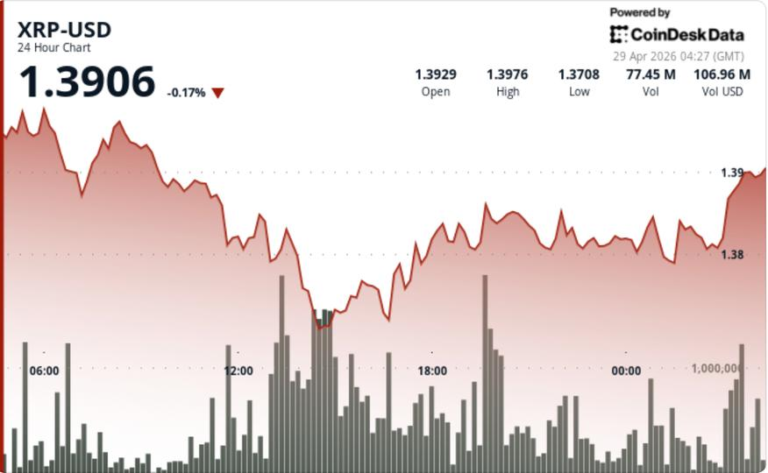
Speaking of the broader market, major cryptocurrencies such as ether (ETH), solana (SOL), and XRP (XRP) have risen by less than 2% over the past 24 hours, underperforming bitcoin. Smaller tokens such as XLM and TON have risen by more than 5% each. The CoinDesk Memecoin Index is up over 3%.

Notably, the DeFi Select Index added 2%, which is surprising given the industry-wide fallout from the weekend hack of KelpDAO. That saw the attacker drain rsETH, a liquid restaking token widely used as collateral on several DeFi platforms.

Decentralized lender Aave has taken the biggest hit, with the total value of crypto assets locked on its platform falling to $16 billion, down nearly $10 billion since before the hack.

Aave’s native token, AAVE, has declined 18% to $93 since the hack. At the same time, open interest in futures tied to the token hit a record high of 3.59 million tokens. Increased demand for leveraged bets points to potential for more volatility ahead. Stay alert!

Read more: For analysis of today’s activity in altcoins and derivatives, see Crypto Markets Today . For a comprehensive list of events this week, see CoinDesk’s “Crypto Week Ahead.”

What’s trending

Today’s signal

The chart shows XRP’s daily price swings in candlestick format. The white line represents the average price over 100 days and the yellow line represents the prolonged bear market.

XRP remains below both the average and the trendline even as market leaders bitcoin and ether (ETH) have topped these levels on their respective price charts.

Until the price reclaims both the 100-day average and the downtrend line, momentum remains comparatively weak versus BTC and ETH, which have already established firmer bullish structures.

Premarket data (CoinDesk)

Almost 80% of Japanese institutional investors are eyeing crypto for their portfolios by 2029

0

Attitudes to crypto investment in Japan are shifting from cautious interest to active portfolio planning, according to a survey by Nomura and its digital asset arm, Laser Digital, with almost 80% of the country’s institutional investors saying they plan to add crypto in the next three years.

The shift reflects a growing view of crypto as a diversification tool. Many of the respondents cited low correlation with traditional asset classes as a key reason for adding exposure. Allocations, though, remain restrained, with more than half targeting between 2% and 5% of their portfolios.

It also reflects improving sentiment: 31% percent of respondents described their outlook on crypto as positive, compared with 25% in 2024, while negative sentiment declined to 18%.

The findings come as Japan refines one of the more established regulatory frameworks for digital assets among major economies. The country was an early mover in regulating crypto exchanges following the Mt. Gox collapse in 2014. Recent efforts have focused on integrating digital assets into existing financial laws, including updates tied to the Financial Instruments and Exchange Act.

That clarity has helped foster a domestic crypto ecosystem anchored by major companies such as SBI Holdings, the financial conglomerate that operates one of Japan’s largest crypto businesses, and bitFlyer, a long-standing exchange. Traditional financial institutions have also entered the industry.

Nomura, one of the world’s largest financial services companies, founded Laser Digital in 2022 to expand into trading, asset management and venture investing, while firms like Mitsubishi UFJ Financial Group have explored tokenized deposits and stablecoins.

Interest is expanding beyond simple price exposure. More than 60% of respondents expressed interest in income-generating strategies such as staking and lending, as well as derivatives and tokenized assets. That suggests investors are beginning to treat crypto less as a speculative trade and more as a broader financial toolkit.

Stablecoins are another area of focus. Sixty-three percent of respondents identified potential use cases, including treasury management, cross-border payments and foreign exchange transactions. Trust appears to be highest for stablecoins issued by major financial institutions, highlighting the importance of familiar counterparties.

Still, barriers remain. Investors pointed to challenges including the lack of established valuation frameworks, counterparty risks such as fraud or asset loss, and regulatory uncertainty. High volatility also continues to weigh on adoption.

Even so, those concerns are shifting. Rather than debating whether to invest, institutions are now focused on how to do it.

The survey was conducted in December and January and gathered responses from 518 investment professionals, including institutional investors, family offices and public-interest organizations.

Philippine SEC Warns Against dYdX, Crypto Platforms

0

The Philippine Securities and Exchange Commission (SEC) has issued a public investor alert warning Filipinos not to invest in dYdX and six other crypto trading platforms, saying they are not registered or authorized to solicit investments in the country.

In a Facebook post on Tuesday, the SEC named dYdX, Aevo, gTrade, Pacifica, Orderly, Deriv and Ostium, stating that based on its findings, the platforms appear to be offering investments to the public in exchange for promised returns, profits or interest. 

The regulator said none of the listed entities are registered with the Commission or hold the required authorization under its crypto-asset service provider (CASP) framework, which requires firms offering crypto-related services in the Philippines to obtain licenses and meet capital and operational requirements.

The SEC also warned that individuals promoting any of the listed platforms in the Philippines may face criminal liability under the Securities Regulation Code. Under Sections 28 and 73 of the law, violators could be fined up to 5 million Philippine pesos (about $89,000) or imprisoned for up to 21 years, or both.

The advisory highlights a broader shift toward stricter enforcement in the Philippines, where regulators have increasingly moved from warnings to access restrictions. On Dec. 24, 2025, Philippine regulators blocked Coinbase and Gemini as part of their broader crackdown on unlicensed CASPs. 

Philippine SEC advisory against dYdX. Source: Philippine SEC

Broader crackdown on unlicensed crypto operators

The latest advisory comes as Philippine regulators continue to step up enforcement against crypto platforms operating without local authorization.

In 2024, authorities moved to block access to Binance after a compliance deadline expired, with regulators also directing app stores to remove the trading platform’s app from users’ devices in the country. 

Related: Cambodian lawmakers propose severe prison time for crypto scammers

The crackdown has since expanded to include other major platforms. In August 2025, the SEC issued an advisory naming 10 exchanges, including OKX, Bybit, KuCoin and Kraken, for offering crypto services without registration, warning that their activities exposed Filipino investors to risks. 

While regulators have targeted unlicensed operators, compliant firms have continued rolling out crypto products. In 2025, PDAX partnered with Toku to enable stablecoin salary payouts, while digital bank GoTyme launched crypto services with Alpaca, allowing users to buy and hold digital assets within its app.

Magazine: Telegram avoids Philippines ban, yen carry trade going onchain: Asia Express