Australian bank ANZ has taken full control of a joint venture it had set up with French payments firm Worldine in 2022.
Editorial
This content has been selected, created and edited by the Finextra editorial team based upon its relevance and interest to our community.
ANZ has agreed to acquire Worldine’s 51% share in the company for A$89m.
According to the bank, the move is consistent with its strategy to focus on payments and transaction banking.
“The ANZ 2030 strategy puts transaction banking at the centre of what we deliver to customers – whether it’s improving their experiences, offering them leading technologies and platforms, or keeping them safe,” said ANZ managing director, transaction banking, institutional, Lisa Vasic.
“This acquisition will allow us to strengthen our direct relationship with our customers and better meet our customer’s needs, as we continue to focus on providing our small business customers.”
Worldine announced in November that it was looking to raise $500m to finance an overhaul designed to restore cash flow generation.
The company saw its share price drop by more than 20% earilier in 2025 following allegations that the company had covered up client fraud in order to protect its revenue.
The transaction, which is subject to regulatory approval, is expected to be completed in the second half of the fiscal year for 2026.
Polymarket is seeking regulatory approval to reopen its main prediction markets platform to US users, Bloomberg reported Tuesday, citing people familiar with the matter.
According to Bloomberg, Polymarket has been engaging with the US Commodity Futures Trading Commission (CFTC) to lift the prohibition on US-based customers.
The move would mark a broader US return for the company, which re-entered the market in a limited form last year through its regulated QCEX-based setup but still keeps Americans off its main international exchange.
Any broader relaunch would reverse a restriction dating back to Polymarket’s 2022 settlement with the CFTC, which required the platform to block US users and pay a $1.4 million civil penalty over unregistered event contracts.
Removing the prohibition would require a formal CFTC commission vote, a process that could be easier given that four commissioner seats are vacant, leaving fewer members needed to reach a decision, according to the report.
A full US return would add to competition in the country’s fast-growing prediction markets sector, where rivals such as Kalshi have built a stronger foothold even as the industry faces mounting legal and regulatory scrutiny at both state and federal levels.
Polymarket declined to comment to Cointelegraph about the report.
Polymarket made US comeback with sports event contracts in late 2025
Polymarket has so far made limited progress in resuming US operations. In December 2025, Polymarket announced that its US app was rolling out with waitlist-only access. The app initially focused exclusively on sports contracts, with Polymarket saying it would be “followed by markets on everything.”
Source: Polymarket
Some prediction platforms have had more success operating in the US than Polymarket. Kalshi, one of Polymarket’s biggest rivals, has emerged as a leading local prediction platform and an official market provider for major US crypto exchange Coinbase.
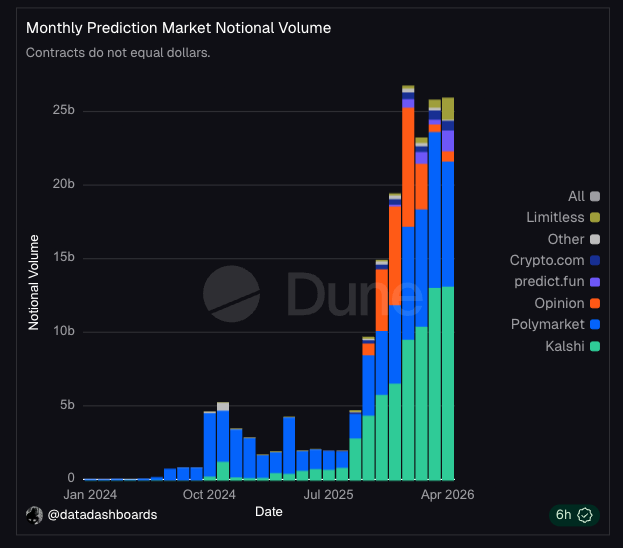
Polymarket losing volume share to Kalshi as both platforms face legal pressure in the US
Polymarket was once a leading prediction market platform, accounting for more than 90% of total monthly notional volume in November 2024, according to a Dune dashboard compiled by Datadashboards.
The platform’s volume reporting has been questioned by firms such as Paradigm, and Polymarket has been steadily losing share to Kalshi since September 2025.
Source: Datadashboards (Dune)
Despite Kalshi outstripping Polymarket in volumes, both platforms have faced legal scrutiny in the US.
Related: Kalshi, Polymarket among 27 prediction platforms banned in Brazil
In the latest US state action, Wisconsin’s top law enforcement official on April 23 filed a lawsuit against Kalshi and Polymarket, alongside companies including Coinbase, Robinhood and Crypto.com, alleging that the firms facilitate illegal sports betting through “event contracts.”
Additionally, the CFTC and Justice Department last week accused a US soldier of using classified information to make more than $400,000 on Polymarket’s international exchange, which authorities said he accessed via a VPN, in violation of US restrictions.
Magazine: How to fix suspected insider trading on Polymarket and Kalshi
Cointelegraph is committed to independent, transparent journalism. This news article is produced in accordance with Cointelegraph’s Editorial Policy and aims to provide accurate and timely information. Readers are encouraged to verify information independently.
A small group of traders may be driving prediction markets, but an even smaller group is taking most of the money.
A new report from blockchain analytics firm Solidus Labs finds that profit concentration on Polymarket is extreme, with fewer than 1% of wallets capturing roughly half of all gains in key markets.
Across Polymarket’s politics markets between December 2025 and February 2026, just 0.55% of profitable maker wallets captured 50% of gains, the report finds, while 0.26% of winning taker wallets accounted for nearly the same share. In dollar terms, roughly $8 million of about $16 million in profits accrued to each of those tiny cohorts.
The data sharpens a picture already forming in academic work: a London Business School and Yale paper, previously analyzed by CoinDesk, found that about 3% of Polymarket traders drive most price discovery.
A small minority moves the prices. A smaller minority keeps the money.
The contrast underscores a key point: concentration does not necessarily imply wrongdoing. Some traders are simply more sophisticated, better capitalized, or faster to act on information. But the report argues that the scale of the imbalance suggests a structural divide between a small group operating with significant advantages and the broader base of participants.
“The participants capturing a disproportionate share of profits are operating in a different league entirely,” the report said, pointing to capital depth, infrastructure, and execution strategies that are out of reach for most users.
Solidus’ study also flags signs of wash trading, with roughly 15% of volume in some markets showing patterns consistent with self-trading or economically neutral positions.
Because outcome tokens in a binary prediction market sum to roughly $1.00, a trader could buy YES on both Trump and Harris inside the same time window, register volume on each leg, and finish economically delta-neutral.
Solidus says this trade has no equivalent in traditional finance.
Some of that volume may be incentive farming rather than pure manipulation. It’s widely speculated that Polymarket’s upcoming $POLY airdrop will factor in trading volume as a metric to allocate tokens.
Market surveillance sales pitch
Solidus is not a neutral observer. The firm sells HALO, the surveillance platform whose output the report relies on, and recently signed a deal to deploy that platform across more than 4,000 markets on Kalshi, Polymarket’s largest U.S.-regulated competitor.
The data is onchain and verifiable. The framing — that prediction markets need surveillance infrastructure, preferably Solidus’s — is part of the pitch.
That doesn’t change the underlying numbers. It does suggest reading them with a hand on the wallet.
If earlier research showed that a small minority moves these markets, the latest data point to something sharper.
If earlier research showed that a small minority moves these markets, the latest data suggests an even starker conclusion: an even smaller group consistently wins them.
The Arbitrum-based RWA perps protocol now routes net directional flow to Jump and prime brokers offchain, retiring the single-pool model that absorbed all trader risk.
Ostium Labs on Tuesday rolled out what it calls the first “decentralized execution layer,” an architectural overhaul that routes net directional flow from the protocol’s traders to a network of institutional hedging partners, including Jump, prime brokers, and other firms active in traditional markets.
Until now, Ostium’s public liquidity pool both settled trades and absorbed all net directional exposure, a structure the team said served early users but capped execution quality and open interest. Under the new model, a separate capital pool programmatically routes net exposures offchain to institutional partners and settles once daily. A buffer layer sits atop the public liquidity pool, which now operates as an intraday lending layer rather than a counterparty.
“Programmatically hedging onchain flow with traditional market participants required building a new kind of infrastructure, a translation layer between smart contracts and institutional-grade messaging protocols, with sub-100-millisecond latency across every step,” CTO Marco Antonio Ribeiro said in a press release viewed by The Defiant.
Co-founder and CEO Kaledora Kiernan-Linn has long said that orderbooks are the wrong venue for tokenized real-world assets, and that the right model is to quote directly from the underlying market.
By referencing real-time depth from offchain venues, Ostium said its allowable open interest now scales dynamically across most major assets, removing static caps and introducing rollover fees that reflect the underlying asset’s carry cost. Users retain custody of funds, and settlement remains instant onchain.
With the new infrastructure in place, Ostium plans to take on centralized CFD brokers, targeting a market that moves roughly $10 trillion in monthly volume.
Ostium Monthly Volume
Monthly trading volumes on Ostium hit an all-time high of $6.11 billion in March, and the platform has processed more than $50 billion in cumulative volume since launching in 2024, according to DeFiLlama.
This article was written with the assistance of AI workflows. All our stories are curated, edited and fact-checked by a human.
US investment group Bridgepoint has acquired a majority stake in a firm that claims to be the world’s largest independent provider of identity security services.
Editorial
This content has been selected, created and edited by the Finextra editorial team based upon its relevance and interest to our community.
Headquartered in Germany, iC Consult employs more than 850 people and has offices in North America, Europe and Asia.
In the last five years, the company has experienced 20% growth and expanded its presence.
The growth is in keeping with the expansion of the identity and access managament (IAM). Thanks to a combination of evolving cybersecurity threats and rapid AI developmemnt, the market is worth more than €2.5bn annually and is forecast top continue its double-digit growth.
As a result of the transaction, the management team, led by the recently appointed CEO Jurgen Biermann, will remain with the company.
The previous owner of the stake, Carlyle, will fully exit its holding. No financial detials of the transaction were disclosed.
According to a statement, iC Consult will use Bridgepoint’s support to focus on “accelerating international expansion, strengthening its managed services offering, further investing in AI-enabled capabilities, modernizing and evolving its service portfolio, and continuing to pursue selective M&A opportunities”.
“Bridgepoint brings not only capital, but also deep sector expertise and a strong track record of helping companies like ours scale internationally,” said Biermann.
“We see a significant opportunity to further modernise and evolve the platform, including expanding its capabilities for securing agentic AI while continuing to strengthen its managed services offering and selectively pursuing M&A to expand the company’s international footprint,” said Maciej Chrystowski, director, technology team at Bridgepoint.
The transaction is expected to complete in Q3 2026.
The Aave-linked recovery group DeFi United has published a technical implementation plan to restore rsETH backing after the April 18 Kelp bridge exploit released 116,500 rsETH, worth about $293 million at the time, without a corresponding burn on Unichain.
The plan would convert committed Ether (ETH) into rsETH in tranches and deposit the tokens into the affected bridge lockbox, allowing the bridge to resume normal operations once the backing is restored. LayerZero and Kelp have also implemented additional security measures before the bridge returns to full operation, according to Aave.
In parallel, DeFi United plans to clear attacker-linked positions across Aave and Compound to recover collateral and resolve market impairments caused by the exploit. The group said seven addresses associated with the exploiter still hold active rsETH-backed positions on Aave and Compound, representing about 107,000 rsETH of the original 116,500 rsETH released in the incident.
Related: Kelp restaking platform exploited, $293M drained in attack
The proposed sequence would temporarily adjust the rsETH oracle price to enable controlled liquidations, transfer recovered collateral to a DeFi United multisig, restore the oracle, redeem the rsETH for ETH and use the resulting funds to clear deficits across affected markets.
The recovery plan moves the rsETH effort from pledges and public commitments into a coordinated technical process that depends on governance approvals, temporary oracle changes and execution across several DeFi protocols. While the process is designed to restore rsETH backing, it remains contingent on DAO votes, finalized agreements and the attacker not disrupting the liquidation steps.
Source: Aave
Ethereum backers joined the recovery effort
The technical plan follows earlier efforts to secure funding and governance support for the rsETH recovery.
On Monday, Consensys and Ethereum co-founder Joe Lubin had joined DeFi United with a commitment of up to 30,000 ETH, while Sharplink, a publicly traded Ethereum treasury company, joined in an advisory role to help structure the recovery plan.
Related: Crypto protocols pledge 43K ETH to restore rsETH backing
On the same day, Aave Labs had asked the Arbitrum DAO to release 30,765 ETH frozen by the Arbitrum Security Council after the exploit and send the funds to DeFi United.
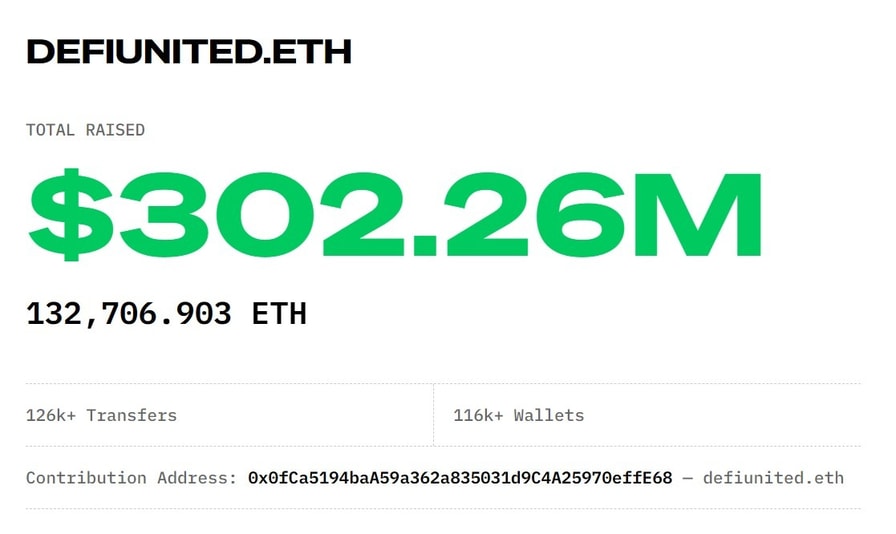
DeFi United secured over $300 million in commitments. Source: DeFi United
As of Tuesday, the DeFi United website showed $302.26 million in total raised or committed toward the recovery effort, equal to 132,706.903 ETH, though some commitments remain subject to DAO votes and final execution.
Magazine: AI-driven hacks could kill DeFi — unless projects act now
Cointelegraph is committed to independent, transparent journalism. This news article is produced in accordance with Cointelegraph’s Editorial Policy and aims to provide accurate and timely information. Readers are encouraged to verify information independently.
Global payments platform Wirex has officially reached a major milestone on its Banking-as-a-Service (BaaS) platform, processing over $1billion in annualised onchain stablecoin volume in a mere 131 days. The achievement highlights a surging market demand for robust payment infrastructure as stablecoins increasingly integrate into everyday corporate and consumer finance.
Stablecoin adoption is currently accelerating at a rapid pace, with the monthly transfer volume for non-USD stablecoins surging 16x between 2023 and 2026. While 80 per cent of this activity is driven by real-world use cases like payments, payroll, and settlement, many firms are prevented from building these complex products in-house due to severe resource and budget constraints.
Consequently, businesses are increasingly turning toward trusted, regulated infrastructure providers like Wirex to power their operations.
Democratising stablecoin infrastructure
Launched in November 2025, Wirex BaaS was specifically designed to solve modern integration challenges. The platform enables fintech apps, neobanks, and digital platforms to offer a comprehensive suite of regulated financial products through a single API.
These integrated capabilities are built entirely on stablecoin rails and include:
Stablecoin-funded cards connected directly to global Visa and Mastercard networks.
Seamless cross-border payouts and push-to-card payments.
Instant 1:1 fiat-to-stablecoin conversion.
Embedded stablecoin banking infrastructure, featuring yield and cashback options.
Wirex stands out as the only stablecoin BaaS provider with principal membership in both Visa and Mastercard for dual USDC and EURC settlement. According to the company, interest has surged since its launch, with the platform already securing over 300 enterprise clients, including Simple App, Trustee, and Cardano.
Shattering industry records
The rapid adoption of the BaaS platform has led to unprecedented growth metrics. Wirex reached the $1billion annualised volume milestone in less than half the time of its leading competitors, easily surpassing RedotPay’s previous industry record of 276 days.
Key performance highlights for the platform include:
Processing $105million in onchain card volume in March alone, which is equivalent to approximately $1.3billion annualised.
Achieving a massive 34 per cent growth in onchain card volume from February to March.
Processing over 2.4 million onchain transactions since launch, with nearly 1.3 million onchain card transactions occurring in March alone.
Pavel Matveev, CEO and co-founder, Wirex
Wirex noted that its March transaction numbers comfortably exceed the combined figures reported by competitors Rain and RedotPay during the same period. The company attributes this success to its comprehensive stack; while competitors offer narrow slices of infrastructure, Wirex prevents customers from having to integrate with multiple platforms, saving them significant time and money on compliance and operations.
Pavel Matveev, co-founder of Wirex, emphasised the platform’s unique and highly scalable market position.
“Stablecoins are transforming financial services, and Wirex is enabling platforms globally to adopt them as real payments infrastructure,” Matveev stated. “We provide what competitors can’t: full-stack integration, backing from the biggest payment networks, and a decade‑long track record of compliance and innovation.”
Matveev added: “With an average integration time of just 44 days, partners are choosing Wirex because they need a fast, trusted solution that scales globally.”
Looking ahead
Wirex continues to expand its product offerings to bridge traditional and digital finance. The company recently launched stablecoin push-to-card services for its BaaS customers, alongside “Wirex Agents” to support stablecoin-powered agentic payments.
Trusted by over 7 million users since 2014, the firm has processed more than $20billion in transactions across 130 countries, remaining steadfast in its mission to build the world’s most advanced stablecoin‑powered payments platform.
Czech National Bank Governor Aleš Michl used a Bitcoin industry stage in Las Vegas to defend a reserve strategy that mixes strict inflation control with measured exposure to digital assets.
He described the bank’s move to add a small Bitcoin allocation as a way to raise expected returns without increasing overall portfolio risk.
Michl said that when he became governor in mid‑2022, inflation in the Czech Republic was near 20%. He told the audience that the central bank pledged to bring inflation back to 2% within two years and met that goal through discipline, not “magic.”
He said money had been too cheap for too long, the currency had weakened, and there was too much easy money in the system. The bank responded by supporting saving and strengthening the Koruna, and its rule now is “to stay hawkish forever.”
Alongside that stance, Michl highlighted the scale of the Czech National Bank’s balance sheet. He said the institution manages about 180 billion dollars in foreign exchange reserves, equal to roughly 44% of Czech GDP, and described those reserves as among the largest in the world relative to the size of the economy.
The task, he said, is to “build for the future,” think ahead, and invest in a way that protects the country. That has meant shifting away from low‑return bonds and increasing exposure to assets such as stocks and gold through low‑risk portfolios.
Bitcoin has low long-term correlation
Michl said the next question for the bank was whether it could do more to build a stronger portfolio for the long run. That led to an internal debate over Bitcoin. He recalled first using Bitcoin to buy coffee in Prague and acknowledged that its price swings make it look risky, since its value can be higher one day and lower the next. He argued that other assets also move up and down and that the key issue for a central bank is how each asset behaves inside a broader portfolio.
According to Michl, Czech National Bank research found that Bitcoin has low long‑term correlation with many traditional reserve assets and does not move in the same way as them. Over longer horizons, he said, Bitcoin can provide returns that are not closely linked to other holdings. On that basis, the bank introduced a 1% Bitcoin position in its reserves.
In the bank’s analysis, he said, a 1% allocation lifts expected returns in Czech Koruna terms while leaving overall portfolio risk unchanged. “When you add Bitcoin to your portfolio it works better, returns go up and risk stays the same – that is diversification,” he told the audience.
Michl framed the move as part of a broader philosophy for central banking in an era of digital assets. His message to the crowd was to remain “conservative but innovative” in how institutions work and invest.
For the Czech National Bank, that has meant a strict anti‑inflation stance and a strong domestic currency, paired with a controlled experiment in using Bitcoin and other non‑traditional assets to strengthen reserves over time.
The retail crowd has spoken: Bitcoin’s BTC$77,411.90 price is headed above $90,000 in the days ahead in a move that would flip the year-to-date return from negative to positive. What’s in doubt is whether the market plays ball.
Analytics firm Santiment scanned thousands of crypto social media posts across X, Reddit, Telegram and other platforms and found that over the past week, calls have skewed heavily toward BTC price trading above $90,000. Mentions of the $50,000–$59,000 range are being dismissed as expressions of fear, uncertainty, doubt or their acronym, FUD.
Clearly, the crowd is expecting the slow recovery from the February low of around $60,000 to extend well into May. And why not? Flows into exchange-traded funds (ETFs) are back, and bitcoin has held up through weeks of Iran-related conflict, oil price surges and a string of DeFi hacks that once again highlighted the risks embedded in blockchain infrastructure.
What do you call a market that doesn’t fall on a stack of bad news? Bullish, right? That’s what the crowd seems to be pricing in.
Santiment says this bullishness as precisely the reason to be cautious.
“Price predictions of a coin are a great way to see what the OPPOSITE likely path for prices will look like,” the firm said on X, implying that overly bullish social sentiment can act as a contrarian indicator for a potential bearish performance.
As American poet Charles Bukowski put it, although he wasn’t talking about markets: “Wherever the crowd goes, run in the other direction. They’re always wrong.”
Contrarian traders in traditional markets use similar sentiment gauges, including the AAII Investor Sentiment Survey, which tracks retail investor bullishness versus bearishness. There’s also the CNN Fear & Greed Index, which aggregates market momentum and positioning signals into a single sentiment barometer.
Interestingly, BTC’s recovery rally has already stalled this week, with prices pulling back to $77,000 from highs above $79,000 on Monday. Whether this is just a pause, or the start of a broader reversal, remains to be seen.
The European arm of global cryptocurrency exchange KuCoin has hired anti-money laundering (AML) and compliance expertise in a bid to appease its regulator, which recently demanded the exchange halt business in Europe due to a staffing shortfall.
KuCoin EU, which holds a Markets in Crypto Assets (MiCA) license from Austria’s FMA, appointed Carmen Kleinhans as anti-money laundering officer (AMLO), alongside the expansion of its broader AML function, the company said in a press release on Wednesday.
The exchange also hired Austrian compliance veterans Stephan Klinger and Bernd Träxler as deputy anti-money laundering officers.
KuCoin EU Managing Director Sabina Liu said the exchange had “communicated fully” with the FMA when the action happened in February.
“We always maintain a very transparent, open dialog with them, and the other way around as well. They have been very honest, transparent and very supportive of us,” Liu said in an interview. “Since February, we have been looking to strengthen the whole compliance team, making many appointments. So it is quite a large team now.”
KuCoin has had a rough rise of late, having been barred from the U.S. after a Commodity Futures Trading Commission (CFTC) order and being slapped by Dubai’s VARA regulator for operating without the appropriate license.
Liu was unable to provide a timeline for when the Austrian regulator would allow KUCoin EU to resume operations in Europe. “I think everything needs to be in discussion with the FMA,” she said.