Nine Democratic lawmakers in the US House of Representatives have called on the Federal Trade Commission to launch a probe into how prediction markets are advertising to customers compared to how they present themselves to regulators.
In a statement on Wednesday, US Representatives Kevin Mullin and Gabe Vasquez said the FTC should investigate whether online prediction market platforms are misleading customers by advertising as gambling platforms while telling regulators they are financial tools offering investment products.
Prediction markets allow users to trade contracts on the outcome of future events. They have also been facing scrutiny over insider trading, with Congress launching a probe into Polymarket and Kalshi in May and questioning the companies’ responses to insider-trading incidents on their platforms.
The Democratic lawmakers allege that prediction market platforms use language associated with sports gambling, including legal betting and betting on sports without a sportsbook, while attempting to evade state gambling regulations.
A group of nine Democratic lawmakers is calling on the FTC to launch a probe into prediction markets. Source: Kevin Mullin
“These prediction market companies are presenting themselves differently to regulators than they are to the public, and that kind of contradictory messaging can mislead consumers about what rules and protections actually apply,” Mullin said.
“We are urging the FTC to investigate these practices and ensure consumers are protected from this potentially deceptive activity,” he added.
In their letter, the lawmakers are also asking the FTC for detailed information by June 29 on whether it has plans to take investigative or enforcement action against prediction market platforms for possible deceptive practices.
Related: Kalshi bans 3 US politicians for betting on their own election races
At the same time, the lawmakers have asked whether the FTC has received complaints about prediction markets and if the FTC considers public perception and legal filings when determining if a company has engaged in possible deceptive practices.
US Representatives Jared Huffman, Raul Ruiz, Salud Carbajal, Mike Levin, Dina Titus, Paul Tonko, and Valerie Foushee have also signed the letter.
Prediction markets have emerged as a significant real-world use case for blockchain, with some platforms relying on crypto rails and stablecoins for settlement and payments.
In March, transactions hit record highs amid growing interest in political and geopolitical event contracts, improved accessibility and positive regulatory developments for the industry.
Magazine: Big Questions: Do we really only need 2–5 cryptocurrencies?
Strategy’s recent bitcoin sale, the first in more than three years, sparked a major dispute on Polymarket, with the dispute settlement body led by UMA token holders ultimately ruling against bettors who wagered the sale would occur by May 31.
The controversy began after Strategy disclosed in a June 1 filing that it had sold 32 bitcoin between May 26 and May 31. Traders who bought Yes on the May market argued the company had clearly sold bitcoin before the deadline. Others countered that the transaction was not publicly disclosed until June 1 and therefore should not count toward a May 31 cutoff.
UMA token holders, who serve as the dispute-resolution layer for Polymarket’s oracle system, sided decisively with the latter view.
The resolution means bettors who wagered that Strategy would sell bitcoin by May 31 lost despite the company later disclosing the sale occurred during the final week of May. The June contract, meanwhile, resolved Yes because the transaction became public during June.
The result was driven by a handful of large token holders, which undercuts the core promise of decentralized finance where governance is democratized and not led by few whales.
The biggest vote came from borntoolate.eth, which cast 3.11 million voting weight for No. Other major No votes included UMA contributor Kevin Chan with 1.53 million voting weight and several wallets casting more than 1 million each. Together, the four largest No voters controlled nearly 7 million voting weight, more than 25 times the entire Yes side.
Several wallets identified as affiliated with Risk Labs, the company behind UMA, also voted No, alongside other prominent UMA ecosystem participants.
Not everyone is pleased with the resolution. Galaxy Research, which had significant exposure to the May contract, pushed back sharply on X. The firm stressed that Strategy explicitly sold the 32 Bitcoin between May 26 and May 31, and that the market’s resolution criteria should focus on when the sale occurred — not when it was publicly announced on June 1.
“Strategy’s SEC-filed Form 8k explicitly stated that Strategy sold between May 26–31. A plain reading of the resolution criteria would suggest that the market should have resolved to YES, hence the controversy,” the firm said.
A dormant launchpad contract from 2021 was emptied this week through a quiet ownership transfer and a one-wei fee reset — the latest in a string of BNB Chain drains that turn admin keys into the attack surface.
An attacker drained roughly $7.3 million from more than 1,400 legacy liquidity-provider positions sitting in old DxSale locker contracts on BNB Chain, security firms PeckShield and Coinsult flagged on May 29, a drain made possible not by a smart-contract bug but by a silent ownership transfer routed through roughly 80 wallets nine months earlier.
The attacker, operating from address `0xC457…FA69`, took control of the legacy locker, reduced its lock-modification fee to one wei, reset lock-expiration timestamps to 68 seconds after the Unix epoch and then batch-withdrew across 1,400-plus pools, according to Coinsult’s trace of the privileged `setFee` call. The wallet was funded from Bybit and possibly routed through AnySwap; PeckShield reported 2,958 BNB — about $1.87 million at the time of the drain — moved through two consolidation wallets and into Binance deposit addresses.
The episode crystallizes a pattern that has run through every major BNB Chain exploit of the last six months: the network’s biggest losses are coming from compromised owner keys and abused admin functions, not novel cryptographic flaws.
Access-control failures accounted for 69% of all BNB Chain losses in 2024, according to a joint Hacken / BNB Chain security report published in September. BNB Chain, the smart-contract network now ranked second by TVL at $5.37 billion behind only Ethereum, absorbed more than $200 million in exploit losses across 12 incidents last year, more than four times the $47 million it lost in 2024, according to DeFiLlama data.
DxSale, a launchpad widely used in the 2021 cycle to mint tokens and lock liquidity on BNB Chain, eventually posted an incident notice on its official X account confirming an exploit was under investigation, hours after PeckShield and Coinsult had flagged the drain. Founders of projects that had used DxSale’s locker years earlier woke up to find LPs they believed were permanently locked already on their way to mixers.
The Ownership Trail
The on-chain analyst who first flagged the incident, who posts as Tahax on X, said the DxSale deployer had silently transferred ownership of the legacy locker to a new wallet “nearly nine months ago,” around August 2025, with no public announcement and no migration path for projects whose LPs were still inside. The admin rights then walked through roughly 80 intermediate wallets before landing at the address that executed the drain, a pattern Tahax described as deliberate obfuscation of who actually controlled the contract by the time it was emptied.
The locker contract itself was unverified on BscScan, Tahax noted, leaving observers unable to inspect the upgrade path or confirm whether a deliberate backdoor was present from the start. Community researchers have raised the possibility of insider involvement, pointing to screenshots circulating on Telegram in August 2025 that advertised a service offering to unlock old DxSale LPs and claimed internal access. None of that has been proven.
The EIP-7702 Companion Pattern
The DxSale drain follows a more technically sophisticated BNB Chain incident from November, in which the launch-week protocol GANA Payment lost $3.1 million within nine days of going live. In that case, a leaked owner key was paired with an EIP-7702 delegator contract — the new batch-delegation primitive introduced by Ethereum’s Pectra upgrade and inherited by BNB Chain — to bypass the staking contract’s `onlyEOA` check and drain the vault through eight rotated-ownership iterations of a stake-unstake reward-inflation loop.
Quill Audits and SlowMist’s Yu Xian confirmed the EIP-7702 mechanism on the GANA exploit, identifying the malicious delegator at `0x7A44bD9C6095Ca7b2A6f62FE65b81924c6cAb067` and tracing the laundering: 1,140 BNB through BSC Tornado Cash, roughly $2.1 million bridged to Ethereum via deBridge and Stargate, and 346 ETH eventually fed through Ethereum Tornado Cash in incremental batches.
EIP-7702 has exceeded 25,000 wallet upgrades across Ethereum, BNB Chain and other EVM networks since Pectra activated, and BNB Chain alone hosts more than 5,200 of those accounts. Wintermute’s research team reported in May that more than 97% of EIP-7702 delegations on mainnet were pointing to a small set of copy-pasted sweeper contracts — a sign the primitive is being weaponized faster than legitimate smart-wallet use is scaling.
The Sector Backdrop
Across the broader market, PeckShield’s May tally put crypto losses at $81.7 million across 40 incidents — down 87% from April’s $647 million spike — and the firm’s bridge audit flagged eight cross-chain exploits totaling $328.6 million through the first half of May, an indication that bridges remain the year’s most-attacked category. BNB Chain’s roughly $8.1 million in May losses came almost entirely from DxSale and a smaller $815,000 Alephium Bridge incident.
BNB traded at $632 on Wednesday, down 6.1% over the prior 24 hours and 3.3% over the past week, with the broader BSC ecosystem absorbing the news against a $85 billion market cap. PancakeSwap, the chain’s dominant DEX, processed $743 million in 24-hour volume during the same window.
What Holders Can Do
DxSale users with funds in legacy lockers have limited options. The drained assets were swapped to BNB and routed through bridge and mixer services, making on-chain recovery unlikely without exchange-level cooperation. PeckShield’s flagging of Binance deposit addresses is the most plausible recovery vector, though the pattern of past BSC exploits suggests the bulk of the stolen funds will surface only through investigator-led de-mixing. Whether DxSale follows up with a compensation plan or simply silence will determine whether the rest of its still-locked liquidity stays put or rushes for the exits.
Investment bank Goldman Sachs has teamed up with fund servicing giant Apex Group and digital asset exchange Archax to tokenize real estate, the firms said on Thursday.
Infrastructure provider Ownera and real estate investment manager LRC Group are also included in the debut of the blockchain-native real estate fund.
The tokenization of real-world assets (RWAs) is all the rage among crypto native firms and traditional finance players alike, but real estate has so far proved elusive as an asset class, at least in terms of scalable distribution.
The fund combines blockchain-native issuance with established fund structures, according to a press release, and is “designed to enhance operational efficiency and transparency, while enabling potential future transferability and maintaining robust governance and regulatory oversight.”
The fund shares are tokenized using GS DAP, Goldman Sachs’ blockchain platform. LRC Group acts as manager and Archax serves as custodian for the regulated digital securities and the first distribution partner. Ownera facilitates connectivity between participants and distribution channels.
Apex Group is providing Alternative Investment Fund Manager services through Fundrock LIS, along with fund administration and depositary services of assets other than financial instruments through Apex Fund Services Luxembourg.
“Issuing blockchain native fund units on GS DAP enables investment in real estate assets with precision while unlocking more seamless transferability in the future,” said Mathew McDermott, global head of digital assets at Goldman Sachs.
Cardano founder Charles Hoskinson said he is “taking a break” after warning that the blockchain’s ecosystem faces a coming “wave of failures,” as ADA fell below $0.20 for the first time in more than five years.
I’m taking a break. TTYL
— Charles Hoskinson (@IOHK_Charles) June 3, 2026
ADA is down nearly 10% on the news, according to CoinDesk market data. The token is down nearly 70% over the past year.
The comments came in response to the shutdown of TapTools, a Cardano analytics platform that said it would cease operations after four years building on the network.
“This is where we’re at as an ecosystem,” Hoskinson said in a video posted earlier this week.
The Cardano creator said he had warned earlier this year that deteriorating market conditions would force some projects to close.
“I said at the beginning of the year, we’re going to see a lot of people collapse because the markets are really bad,” he said. “There’s going to be a wave of failures in the ecosystem.”
Hoskinson also expressed frustration with what he characterized as limited community support for deploying treasury funds to support ecosystem growth.
“There doesn’t seem to be a lot of community desire to spend the treasury to take these ventures to the next level,” he said.
The remarks come days after Cardano’s community voted against funding the ecosystem’s flagship 2026 Summit conference in Singapore, forcing organizers to cancel the event.
Ethereum treasury company Bitmine Immersion Technologies is launching a $300 million perpetual preferred stock offering, borrowing a page from Strategy’s financing playbook.
Bitmine told the SEC on Wednesday that it intends to offer 3 million of its 9.5% Series A perpetual preferred stock at $100 per share, which will trade under the symbol BMNP within 30 days of issuance.
Preferred shares are a hybrid of stocks and bonds. Investors are not directly betting on the company’s growth but lending it money in exchange for regular payments. For every $100 share, Bitmine will pay dividends on a weekly basis, amounting to $9.50 per year.
The firm plans to use income from its staked Ether (ETH) to pay the dividends, similar to offerings from Michael Saylor’s Bitcoin treasury company, Strategy.
Strategy launched its Stretch (STRC) perpetual preferred stock in July 2025. Unlike Bitmine’s BMNP, which has a fixed rate, STRC uses a variable rate that Strategy adjusts monthly with the goal of keeping the trading price stable near $100.
STRC has scaled to $8.5 billion in just nine months and is now the largest preferred stock by market cap in the world, according to a May SEC filing.
“Digital Credit, highlighted by STRC, has been a big success. STRC has shown strong demand, high liquidity, and low volatility,” said Phong Le, Strategy president and CEO.
In March, Le said that roughly 80% of STRC holders were retail investors.
Related: 80% of Strategy’s ‘Stretch’ buyers are mom-and-pop investors
Bitmine’s annualized staking revenue by week. Source: SEC
Bitmine said the net proceeds of its proposed offering would be used for general corporate purposes, including buying more Ether, expanding staking and validator infrastructure through Made in America Validator Network (MAVAN) and repurchasing common stock.
Bitmine announced on Monday that it currently owns 4.49% of the total ETH supply and is 90% of the way to its “Alchemy of 5%” plan in just 11 months.
The firm has 4.7 million staked Ether, worth around $8.3 billion at current prices. However, unrealized losses on that ETH are nearly $9 billion.
The perpetual stock offering comes at a tough time for Ether investors, with the asset falling more than 12% over the past seven days to a 14-month low of $1,734 in early trading Thursday.
“In our view, ETH prices are not reflecting the strengthening of Ethereum fundamentals, but then again, this is not surprising given we are in the early stages of crypto spring,” said Bitmine chairman Tom Lee on Monday.
Bitmine stock fell nearly 6% Wednesday to $16.90, its lowest level since it pivoted to Ethereum in June 2025, according to Google Finance.
Magazine: Big Questions: Do we really only need 2–5 cryptocurrencies?
Bitcoin price has tumbled to its lowest level in months Wednesday night, crashing below $62,000 and wiping out a sharp intraday loss of more than $5,300 — a decline of nearly 8% in 24 hours — as a perfect storm of institutional exodus, leverage liquidations, geopolitical fear, and a symbolic but jarring sale by Michael Saylor’s Strategy converged to shatter market confidence.
At approximately 10:00 PM EDT, Bitcoin price was changing hands at $61,463.22, down from a 24-hour high of $67,416.50 and dangerously close to the psychologically critical $60,000 floor. The selloff erased weeks of tentative recovery and put the world’s largest cryptocurrency nearly 51% below its all-time high of $126,277, set in October 2025.
The catalyst that many analysts believe broke the market’s will was a Monday SEC filing from Strategy revealing that the firm sold 32 Bitcoin between May 26 and May 31, generating approximately $2.5 million at an average price of $77,135 per coin.
While negligible relative to Strategy’s holdings of more than 818,000 BTC, the transaction represented the company’s first disclosed net reduction of its Bitcoin position in years — a jarring break from co-founder Michael Saylor’s long-standing “never sell” doctrine.
The move was intended to fund dividend obligations on its STRC preferred shares, which carry an annual variable dividend of 11.5%. Still, the market reacted viscerally. Bitcoin price immediately fell below $72,000 following the announcement, and Strategy’s own stock dropped nearly 6% the same day.
Today, STRC traded hands around $94.
Bitcoin price craters as BTC ETFs continue outflows
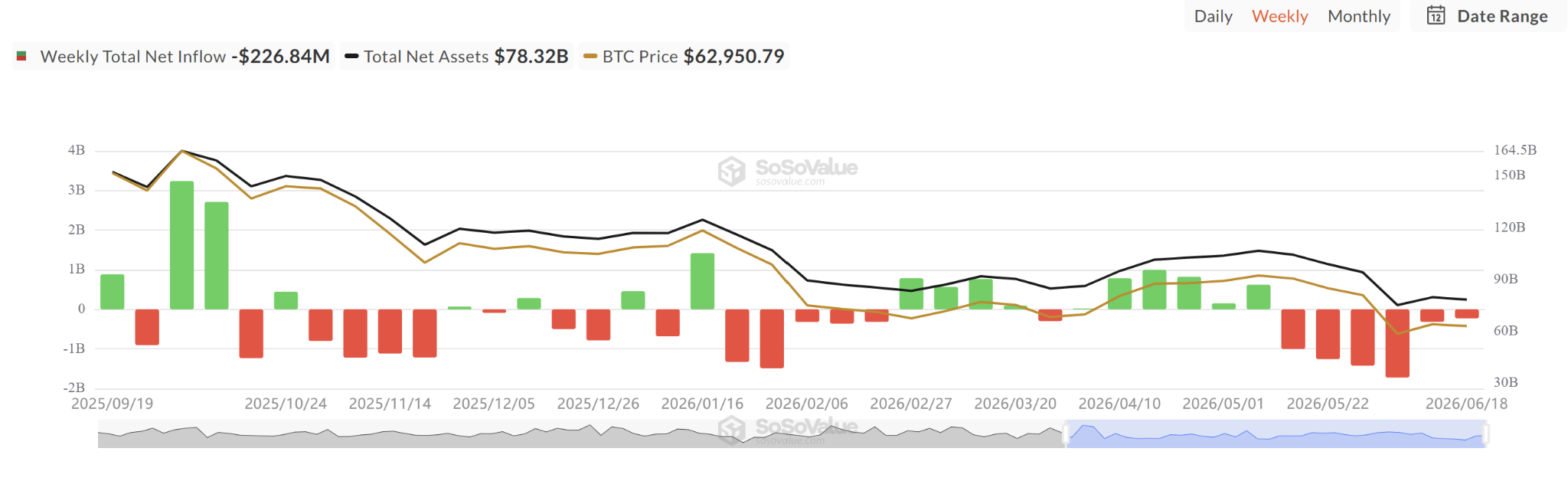
U.S. spot Bitcoin ETFs recorded an 11-to-12 consecutive day streak of net outflows, the longest run since the products launched, with total withdrawals reaching approximately $3.45 billion across that period. The week ending May 29 alone saw $1.42 billion in net outflows, marking the third-largest weekly withdrawal on record.
For the full month of May, cumulative spot Bitcoin ETF outflows reached $2.30 billion — the worst single month of 2026 — even as Bitcoin’s price only fell 3.69% in that time, suggesting institutions were quietly derisking at a pace far ahead of what price action alone implied.
Beyond crypto-specific factors, Bitcoin price has been whipsawed by a deteriorating macroeconomic backdrop. Escalating U.S.-Iran tensions — including military flare-ups in the Middle East — have driven investors toward safety, triggering a risk-off move that has hammered high-volatility assets across the board.
Adding to the bearish picture is the gravitational pull of the artificial intelligence boom. Capital that might have once flowed into Bitcoin is increasingly chasing AI-linked equities, with the impending IPOs of OpenAI and SpaceX diverting speculative interest.
TapTools, the most-used analytics platform on Cardano, said on X it will wind down within two weeks after losing its fifth senior executive in a year. Founder Charles Hoskinson warned in a video the same day that more older Cardano-ecosystem projects will fold in the second half of 2026.
TapTools, the four-year-old analytics and price-tracking platform that became the default front-end for trading and project discovery on Cardano, said on X on Tuesday that it will wind down operations over the next two weeks after a fifth senior executive departure left it without the technical leadership to keep running.
The platform served more than one million users and powered backend data for hundreds of Cardano-native token protocols, according to its own account of the shutdown. Cardano itself now carries roughly $123.85 million in total value locked, placing it 28th by chain TVL on DeFiLlama — behind Stellar, Near, Aptos and Mantle, and roughly two orders of magnitude below Ethereum’s $39.9 billion. ADA trades at $0.2146, down 13.97% over the past 30 days and 93% from its September 2021 all-time high, per CoinGecko.
For a Layer 1 once positioned as a top-five smart contract platform, the loss of its leading analytics surface is not a UX inconvenience — it is the most legible symptom yet of an ecosystem that no longer generates the volume, fees or treasury support to fund its own infrastructure. Hoskinson’s response in a video posted to X on Tuesday was that more failures are coming.
What TapTools Said
In its public statement, TapTools attributed the wind-down to a combination of staff attrition and operating costs the ecosystem could not absorb. Both co-founders, the chief operating officer and the chief technology officer had already departed earlier this year. The company’s backend developer was promoted to fill the CTO seat as the team narrowed its product strategy. That engineer has also left, taking technical knowledge “that cannot be replaced overnight,” the platform said.
“Infrastructure costs are real. Development costs are real. Support costs are real,” TapTools wrote. “Operating a platform that serves the ecosystem at scale is expensive.”
The company said it remains open to an acquisition or outside funding that would keep the platform running.
Wave of Failures
Hoskinson, co-founder of Input Output Global and the public face of Cardano, framed TapTools’s exit as a leading indicator rather than an isolated event.
In a video psoted on X, he warned that a substantial portion of older Cardano-ecosystem projects are no longer in an investable state and that the second half of 2026 will bring a “wave of failures,” forced protocol consolidation and micro-cap wind-downs.
He also acknowledged that an earlier proposal he made to backstop struggling ecosystem projects through a treasury-funded index never got off the ground.
“I came up with the plan of an index. It did not get executed,” Hoskinson said in the video, arguing that Cardano’s governance community had chances to support some projects and declined.
A Pattern
The TapTools shutdown is the second high-profile exit from the Cardano ecosystem in six weeks. NFT marketplace JPG.Store, the dominant venue for Cardano NFTs since 2021, entered restricted mode on April 23, disabling new listings, offers, lending and minting, and completed a full shutdown of its main and Comet platforms on May 23.
The governance side has been just as thin. The Cardano Foundation cancelled the Cardano Summit 2026 last week after a 7.8 million ADA treasury proposal to fund the event drew 65.21% support from Delegated Representatives, short of the two-thirds threshold required under the network’s Voltaire governance framework. A separate 32.9 million ADA request linked to IOG’s research and development budget is currently facing more than 80% DRep opposition.
The macro picture from on-chain data is consistent with the narrative. Cardano’s $123.85 million TVL has it sitting below Aptos, Mantle and Movement on DeFiLlama’s chain rankings, and its largest DEX, SundaeSwap V2, clears just $1.86 million in 24-hour volume.
Cardano TVL & DEX Volume. Source: DeFiLlama
Foundation Funding
Comparable Layer 1 ecosystems have leaned on direct foundation funding. In 2021, the Avalanche Foundation deployed a $180 million Avalanche Rush program, including direct AVAX incentives to Aave and Curve, to seed liquidity on the chain. Polygon Labs has run multiple iterations of Polygon Village, a roughly $90 million grants and mentorship program denominated in MATIC.
Cardano’s funding model is structurally different: IOG, the Cardano Foundation and EMURGO each manage their own budgets. The on-chain treasury, the largest single pool, is governed through the network’s Voltaire framework, which routes every disbursement to a Delegated Representative vote. The design surfaces accountability, but it also makes the kind of fast, foundation-led ecosystem bailouts Avalanche and Polygon executed difficult to land when the DRep electorate is in a cost-cutting mood.
What Comes Next
The Cardano treasury holds more than 1 billion ADA available for governance-approved disbursement, but the two most recent flagship asks, the Summit funding and the IOG R&D budget, have either failed outright or drawn supermajority opposition.
The next test is whether any Cardano-only project applies for a treasury-funded rescue under Voltaire, and whether the same DRep base that rejected Summit funding signs off. In the meantime, the comparable measure of ecosystem health — TVL, DEX volume, native infrastructure — is shrinking from both ends.
Israeli Prime Minister Benjamin Netanyahu said Wednesday that his relationship with U.S. President Donald Trump remains intact despite reports of a tense phone call between the two leaders over Israel’s military actions in Lebanon.
“We have common goals,” Netanyahu told CNBC. “Sometimes we have, as in the best of families, these tactical disagreements where you always find a way to work them out … We can disagree in the morning, and by the afternoon we have common action.”
Asked directly whether his relationship with Trump had shifted, Netanyahu replied: “No, no. This has been a great relationship.” He called Trump “the greatest friend that Israel has ever had in the White House” and said the two leaders “always find a way to work out our differences.”
The comments come after Trump acknowledged reports that he called Netanyahu “f-ing crazy” during a phone exchange focused on fighting in Lebanon.
The comments come as investors monitor U.S.-Iran negotiations for clues about future sanctions, oil exports and geopolitical risk in the Middle East.
Netanyahu also downplayed concerns that disruptions around the Strait of Hormuz could create a lasting energy shock. Drawing a comparison to the 1973 Arab oil embargo, he argued that markets would adapt by developing new supply routes and energy sources.
“People are going to develop alternative sources, and they’re already developing alternative routes,” he said.
Netanyahu pointed to existing efforts to move energy exports through routes outside the Persian Gulf and said higher production from other suppliers could offset disruptions. “There are many things you can do,” he said, predicting that countries in Asia, Europe and elsewhere would accelerate efforts to diversify energy supplies.
His remarks suggest Israel’s government expects any market impact from tensions with Iran to be mitigated over time by shifts in global energy trade, even as traders continue to watch developments in the Gulf for potential effects on oil prices and shipping routes.
US spot Bitcoin ETFs pulled in another $519 million of net redemptions on June 2, extending the longest outflow run since the funds launched and tipping a leveraged market into $1.86 billion of forced selling.
Bitcoin slid below $66,000 in early Wednesday trading and traded as low as $65,372 before rebounding above $67,000, capping a 6% one-day drop that has erased the price action of the last two months and pushed the world’s largest cryptocurrency 47% below its October all-time high.
BTC spot was changing hands near $66,787, off 2.8% on the day and down 11.7% over the past week, according to CoinGecko.
The drawdown landed on the same day US spot Bitcoin exchange-traded funds posted their longest withdrawal streak on record. The cohort gave up a net $519.19 million on June 2, extending consecutive daily outflows to 12 trading sessions, the deepest such run since the products launched in January 2024, SoSoValue data show.
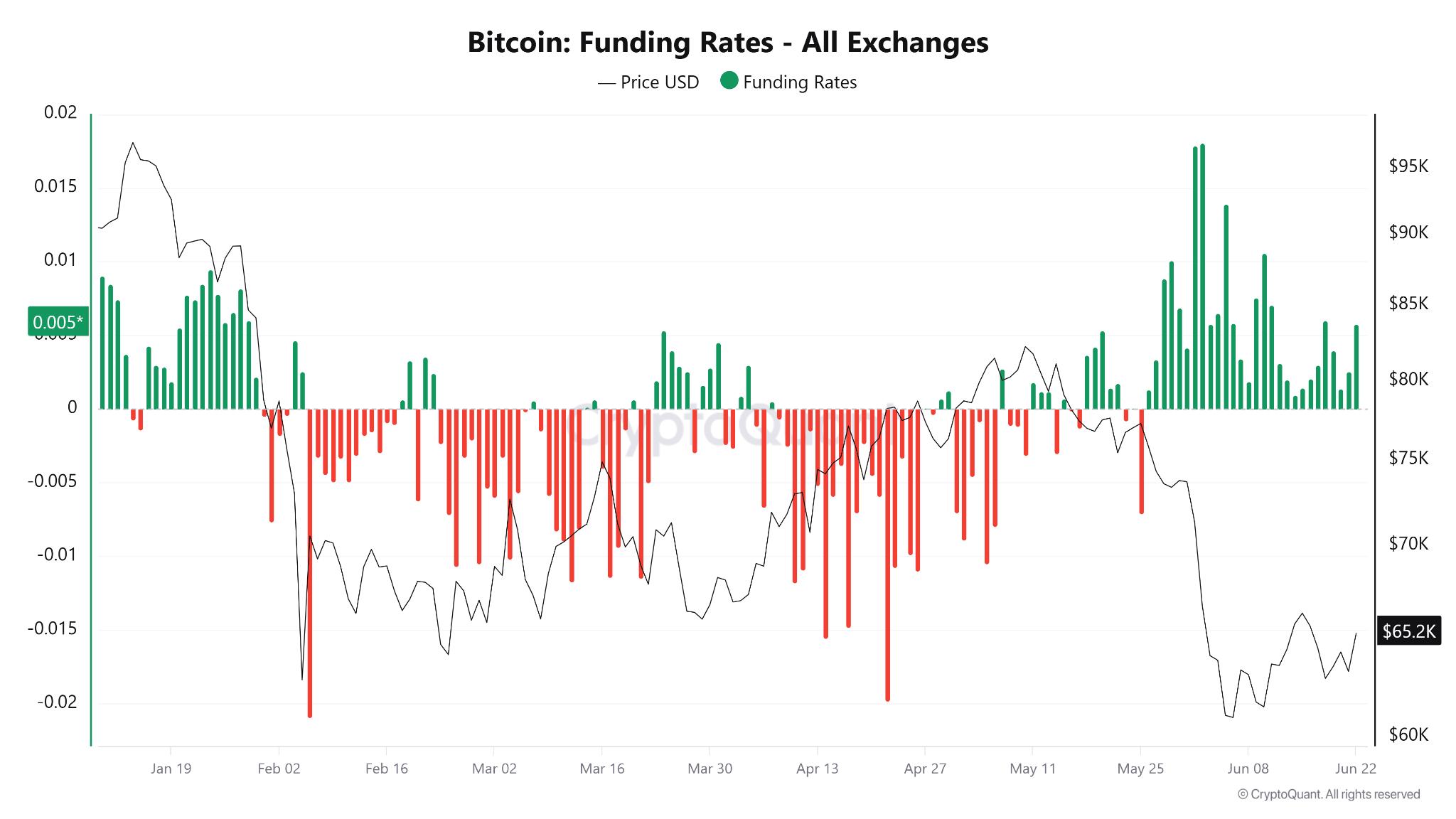
The cascade then forced more than $1.86 billion in leveraged crypto positions to liquidate over 24 hours, Coinglass dashboard data show, with Bitcoin alone accounting for $896 million.
The latest market moves reverse the trade that defined the last 18 months. US spot ETFs were the marginal institutional buyer that lifted Bitcoin from $40,000 to a $126,080 peak. They are now the marginal seller, and the order has switched at a moment when the largest single corporate holder, Strategy, has just broken its four-year buy-and-hold streak.
The ETF Bid Has Paused
BlackRock’s iShares Bitcoin Trust, the biggest of the cohort, led the June 2 withdrawals with $308.64 million in net redemptions. Grayscale’s GBTC shed $83.51 million, Fidelity’s FBTC lost $45.14 million and Ark 21Shares’ ARKB gave up $16.67 million. Morgan Stanley’s MSBT was the only fund to take money in, recording $14.77 million of inflows.
Monday produced another $483.76 million of net outflows, also per SoSoValue, taking the two-day damage to roughly $1 billion.
The withdrawal tape sits beneath a broader retreat. Total crypto market capitalization fell to about $2.39 trillion on Wednesday, a 2.9% daily drop, with Bitcoin’s share holding at 55.87%, meaning the rest of the complex is bleeding harder. Ether dropped 5.3% to $1,866; Solana fell 5.4% to $74.54, CoinGecko shows.
Strategy, the corporate-treasury vehicle that holds 843,706 BTC worth about $56 billion at current spot, disclosed last week it had sold 32 BTC to fund a dividend distribution — its first sale of Bitcoin in nearly four years and a symbolic break from a position whose mark-to-market value has fallen roughly $50 billion from its October peak.
Separately, the Mt. Gox bankruptcy estate moved 10,306 BTC on Monday, reviving creditor-distribution concerns, and Iranian missile strikes on the US Fifth Fleet headquarters in Bahrain stoked a broader risk-off bid in dollars and gold.
The Liquidation Cascade
Long positions accounted for roughly 88% of the $1.86 billion wipeout, Coinglass show, with about $1.66 billion of long notional flushed against just $200 million of shorts. Bitcoin futures took $896.4 million of liquidations, Ether $482.17 million and Solana $91.46 million, with the bulk concentrated in a single intraday window as BTC broke $66,000.
Open interest in Bitcoin perpetuals fell sharply through the move, a sign that the unwind cleared leverage rather than simply rotating it. On the options side, Deribit data shows that downside hedging demand has pushed open interest into $50,000-strike puts, with dealers sitting on a negative-gamma zone between $68,000 and the mid-$50,000s, a setup that mechanically pulls dealer hedging into more selling on weakness.
Where the Damage Stops
BTC spot is still trading more than 50% above the level at which the spot ETFs first cleared their largest cumulative inflow milestone in early 2024, when the price sat near $42,000.
Stablecoins are still at near record-highs. Tether’s USDT still floats $187.5 billion and Circle’s USDC $76.1 billion, per DeFiLlama, both within a fraction of recent highs. The institutional money that has left the ETF cohort has, so far, mostly been parked rather than spent.