Euro-denominated trading accounts for only a small share of Binance’s activity, as the exchange faces uncertainty over its European licensing prospects under the Markets in Crypto-Assets Regulation (MiCA).
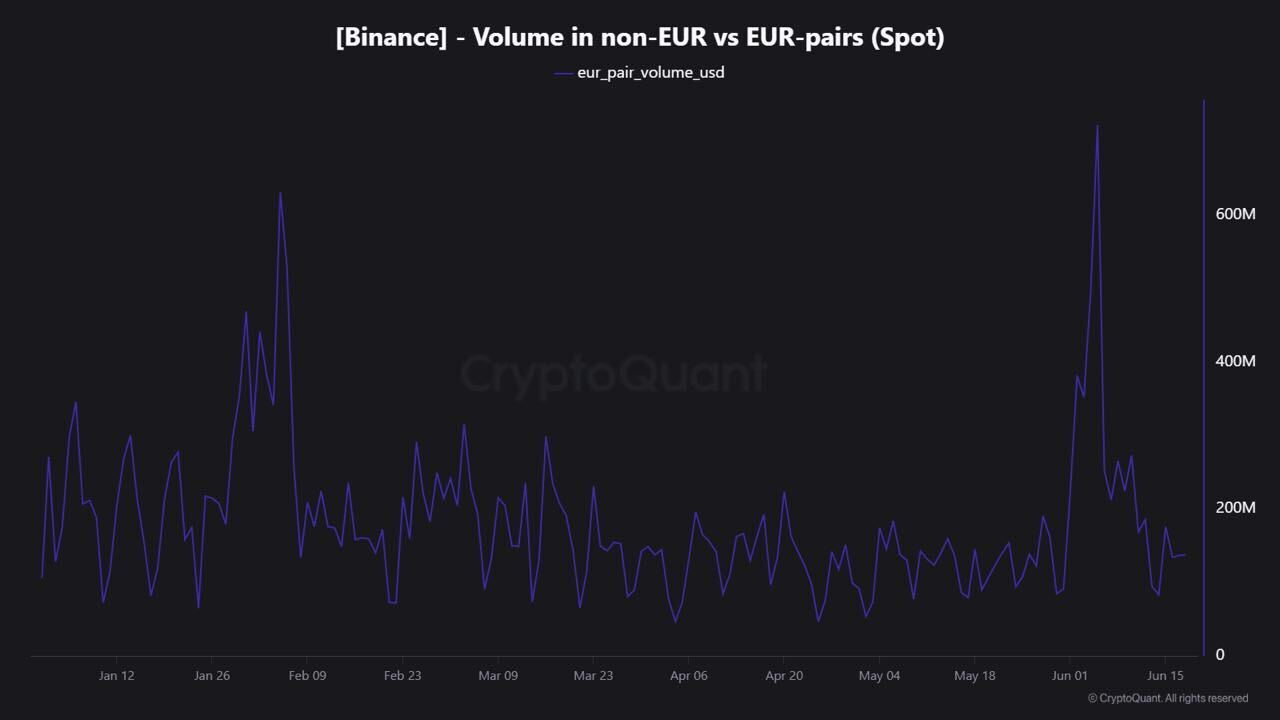
Euro (EUR) trading accounts for around 1% of Binance’s spot volume, CryptoQuant analyst Maartunn told Cointelegraph.
“Binance’s inflows remain globally distributed, which may limit the impact of potential MiCA-related setbacks,” Maartunn said, pointing to the exchange’s diversified user base across regions.
Source: CryptoQuant
The data comes as Greek regulators are reportedly preparing to reject Binance’s licensing application ahead of MiCA’s transitional deadline on July 1, a move that could complicate the exchange’s ability to serve EU residents.
Binance ranks among Europe’s biggest crypto exchanges
Even though EUR trading represents only about 1% of Binance’s global spot volume, the exchange still processes hundreds of millions of dollars in euro-denominated trades.
According to CryptoQuant data, Binance’s daily EUR-pair volumes have ranged from roughly $100 million to $250 million in 2026, with occasional spikes above $600 million.
Source: CryptoQuant
According to a December 2024 report by Kaiko, Binance, alongside Bitvavo, Kraken and Coinbase, accounted for more than 85% of all euro-denominated crypto trading volume.
Related: WhiteBIT secures MiCA license in Austria ahead of July 1 EU deadline
Unlike Binance, Bitvavo, Kraken and Coinbase are among the major exchanges that have already secured MiCA authorization, allowing them to offer services across the EU under the framework’s passporting regime.
83% of CASPs have yet to receive a MiCA license
Binance’s licensing uncertainty comes as many crypto asset service providers (CASPs) are still adapting to MiCA’s requirements.
According to estimates based on European Securities and Markets Authority (ESMA) data cited by market analyst Merlijn Geurds, only around 210 of more than 1,200 firms operating under pre-MiCA registration regimes have obtained full authorization under the new framework.
Source: Merlijn Geurds
Geurds told Cointelegraph the gap reflects the cost and complexity of compliance, which requires governance standards, compliance controls and operational safeguards that many smaller firms lack.
“The result is consolidation by design,” Geurds said, adding: “A smaller group of well-capitalized, licensed players gets a passport to all 27 states, while a long tail faces forced migrations or cutoffs.”
Cointelegraph contacted Binance for comment on the size of its European business and the potential impact of MiCA-related restrictions but had not received a response by publication.
Magazine: SBF will never get a pardon, Trump peace deal boosts Bitcoin: Hodlers Digest June 14-21
Taiko, an Ethereum layer-2 blockchain, has urged its users to withdraw assets from the network’s bridges after an exploit on one of its bridge protocols saw attackers make off with $1.7 million in the latest decentralized finance hack this month.
“We have confirmed a compromise of Taiko’s chain state verification mechanism,” Taiko posted to X early on Monday. “As a result, the security assumptions of all bridges deployed on Taiko can no longer be relied upon.”
“We strongly advise all users to withdraw their funds from all bridges deployed on Taiko immediately,” it added.
It is the latest in a series of crypto protocol exploits this month, which now number at least 23, according to DeFiLlama. The Humanity Protocol and Syscoin Bridge, which lost over $30 million and $8 million, respectively, have been the largest two exploits so far in June.
Source: Taiko
Taiko said it was coordinating partners to contain the incident and had paused affected systems.
Crypto security firm Blockaid said that the root cause appears to be a flaw in how the Taiko bridge validated source signals.
It said that message proofs were accepted as valid on Ethereum without corresponding legitimate proofs on the Taiko blockchain.
“This allowed the attacker to register and later retrieve fraudulent bridge messages, resulting in unauthorized asset releases from the ERC20 vault,” Blockaid said.
Blockaid estimated that at least $1 million had been stolen, while Lookonchain and PeckShield suggested the value of assets stolen could be as high as $1.7 million.
The exploiter has already transferred 1.99 million Taiko (TAIKO) tokens worth around $189,000 to MEXC, stated PeckShield. TAIKO is currently trading down 98% from its 2024 peak at $0.084, according to CoinGecko.
Related: Secret Network bridge exploited for $4.7M with ‘infinite mint’ bug
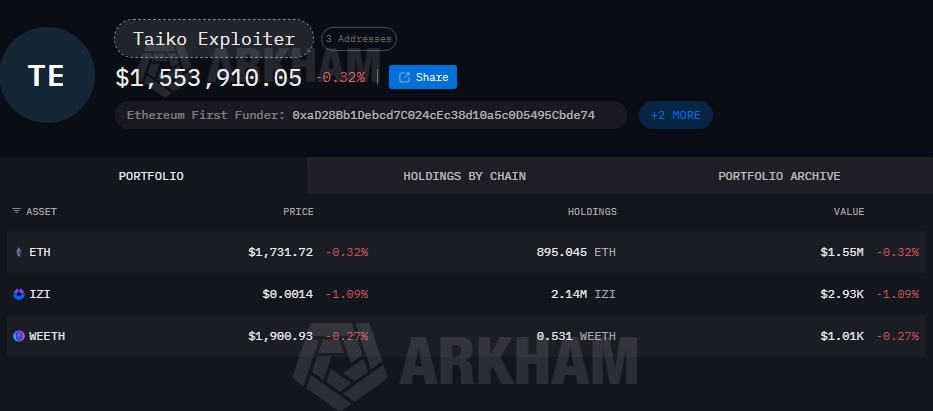
Blockchain intelligence firm Arkham shows Taiko exploiter wallets holding around $1.5 million, primarily in Ether (ETH).
The Taiko exploiter account holds more than $1.5 million in ETH. Source: Arkham Intelligence
Exploits in June are mounting up
The attack comes just days after the discovery on Friday of a smart contract exploit on the Secret Network, which resulted in the theft of $4.67 million worth of assets.
On Saturday, around $1.1 million was drained from the OLPC/LABUBU liquidity pool on PancakeSwap. LABUBU is a memecoin inspired by the popular toys of the same name.
Other notable exploits in June include Aztec Connect, RetoSwap, Raydium AMM, and the largest one so far this month, Humanity Protocol.
Michael Saylor and his embattled Strategy (MSTR) sold more common stock last week, using the proceeds to add a relatively small amount of bitcoin and $300 million in cash to its balance sheet.
The company sold about 2.7 million shares of MSTR, according to a Monday morning filing, raising $335.5 million. About $35 million of that was used to acquire 520 bitcoin at an average price of $67,068 each. The other $300 million was added to cash already on the balance sheet, bringing reserves to $1.4 billion.
The latest acquisition brings Strategy’s total bitcoin holdings to 847,363 BTC, acquired at a total cost of roughly $64.01 billion, or an average purchase price of $75.651 per coin.
Baillie Gifford, a 118-year-old investment firm based in the Scottish capital of Edinburgh, unveiled a fixed-income tokenized fund in association with global custody giant BNY, the companies said on Monday.
Baillie Gifford Enhanced Yield Fund (BAGEY) is denominated in dollars, and gives eligible investors access to an actively managed, short-duration portfolio of public corporate bonds using the Ethereum and Solana public blockchains, according to a press release.
The fund is operated through a U.K.-regulated Open-Ended Investment Company (OEIC), a type of collective investment fund structured as a limited liability company that spreads capital from multiple investors across equities or bonds.
The fund, which currently offers a yield of around 7%, will be available to eligible investors in the U.K., Switzerland and Cayman Islands, subject to applicable laws, regulations and distribution restrictions.
Tokenization of real-world assets (RWAs) has taken the traditional finance world by storm, but merely wrapping legacy infrastructure in a digital layer will not fundamentally improve finance, said Theo Golden, head of digital assets and tokenization at Baillie Gifford.
The second quarter of 2026 has already become the most-hacked quarter on record by incident count, with 83 exploits targeting cryptocurrency protocols, according to analysis by market insights platform Unfolded based on DefiLlama data.
However, the $755.3 million stolen during the quarter so far is significantly lower than the $3.56 billion lost in the fourth quarter of 2020, which remains the costliest quarter on record for crypto hacks.
KelpDAO’s $293 million hack and Drift Protocol’s $280 million exploit were the largest incidents of the quarter.
The figures suggest hacking activity is becoming more frequent, even as total losses remain below previous record levels.
Cryptocurrency hacks by monthly sum, all-time chart. Source: DefiLlama
The rising incident count and lower aggregate losses may reflect a smaller pool of value available to attackers, according to Dmytro Tarasiuk, product director at risk intelligence platform CORE3 and crypto security rating platform CER.live. He noted that total value locked in DeFi has fallen from $164 billion before the Oct. 10 liquidation event to about $73 billion at press time.
The industry’s most pressing vulnerability remains that protocols are re-engineered faster than their underlying risk management complexity, which often means that projects “declare a [three-of-six] multisig [and] store [three] keys on one laptop,” leading to more operational vulnerabilities, he told Cointelegraph.
Bridge exploits emerged as the leading attack vector in Q2 2026
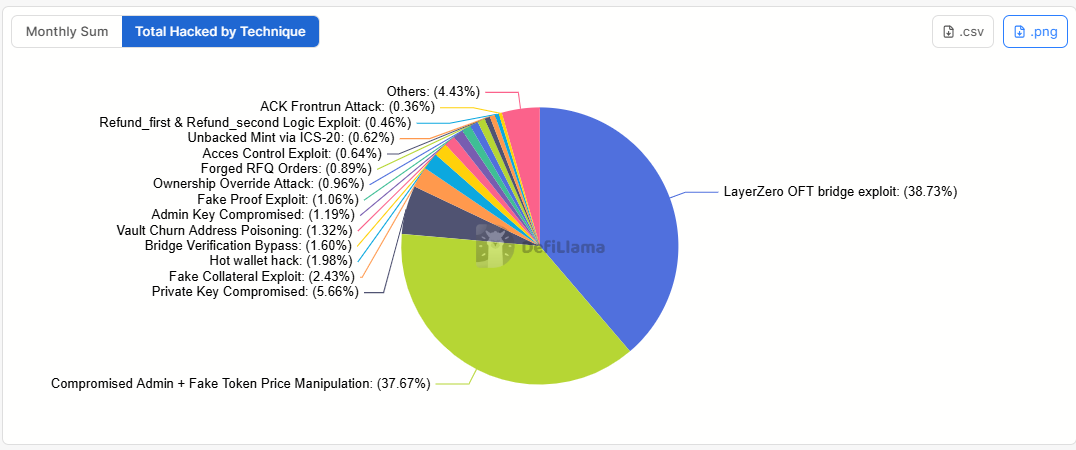
Cross-chain bridge exploits emerged as the biggest attack vector of the quarter, with $351 million in value hacked from bridges alone.
The LayerZero OFT bridge exploit, which led to the $293 million KelpDAO hack, accounted for more than 38% of the value stolen during the quarter. Compromised admin attacks and fake token price manipulation accounted for 37% of losses, while private key compromises represented 5.66%.
Total hacked by technique in Q2 2026. Source: DefiLlama
Ethereum layer-2 blockchain Taiko was the latest network to suffer an exploit on one of its bridge protocols, as hackers stole $1.7 million by compromising Taiko’s chain state verification mechanism.
Related: Humanity Protocol’s $36M loss tied to suspected North Korean hackers: Quantstamp
Other notable incidents of the past quarter include the $36 million stolen from Humanity Protocol on June 8 and the $10.7 million exploit on THORChain on May 15.
Other recent incidents include two exploits on Aztec Connect’s abandoned smart contracts, each resulting in $2.1 million stolen and $1.3 million stolen from decentralized exchange Raydium earlier in June.
The incidents add to the ongoing debate about whether the development of new artificial intelligence models has reshaped the crypto industry’s security landscape, concerns that arose from the series of exploits in April.
During a recent interview, Mitchell Amador, the CEO of bug bounty platform Immunefi, told Cointelegraph that the proliferation of new AI models has shifted the cybersecurity playing field in favor of attackers, causing a “vulnerability apocalypse” that led to the resurgence in exploits.
Magazine: Coinbase hack shows the law probably won’t protect you — Here’s why
Bitcoin (BTC) treads water around $64,000 to start the week, but market participants see plenty of catalysts coming.
Key points:
The US dollar is on the rebound, and history shows that Bitcoin rarely enjoys a strong DXY.
July often does the opposite of June, and this forms the case for BTC price relief next.
PCE inflation data is due out against a backdrop of uncertain US-Iran peace.
Bitcoin’s relationship to oil prices is boosting the odds of $60,000 support holding.
Short-term holders may have sold off, but whales are not interested in “capitulation” at current prices.
Bitcoin traders eye new US dollar challenge
A familiar headwind for Bitcoin price action is back in focus this week amid ongoing efforts to end the US-Iran war.
The US dollar index (DXY) is back above 100, and has hit its highest levels in over a year, per data from TradingView.
BTC/USD vs. US dollar index (DXY) four-hour chart. Source: Cointelegraph/TradingView
DXY, which measures dollar strength against a basket of US trading-partner currencies, is typically inversely correlated with crypto markets. Ongoing strength in the index thus poses a threat to broader upside in crypto and risk assets.
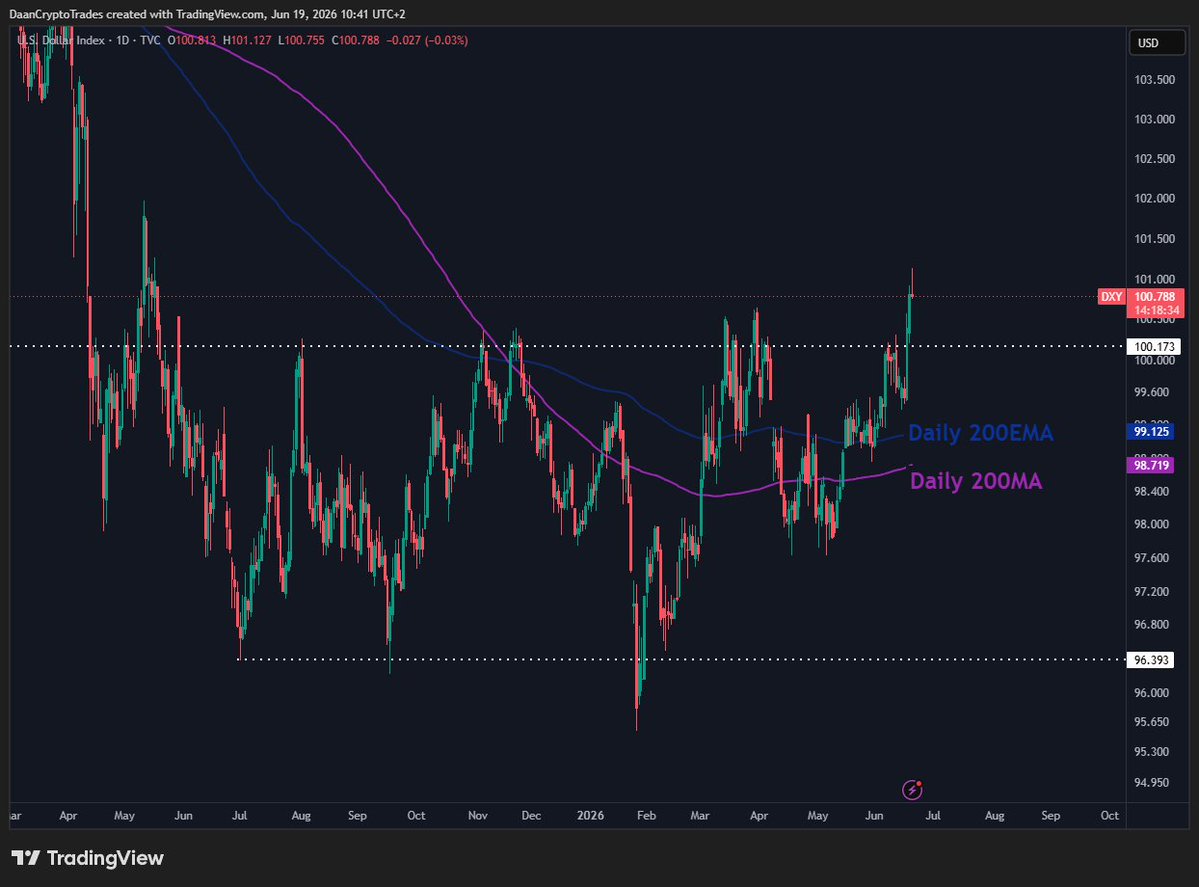
“Breaking the big 100 level while being supported by its Daily 200MA/EMA,” trader Daan Crypto Trades summarized in a post on X over the weekend, referring to the 200-day simple (SMA) and exponential (EMA) moving averages.
“If this ends up holding above 100, it would put some pressure on risk assets. So it’s good to watch.”
US dollar index (DXY) one-day chart. Source: Daan Crypto Trades/X
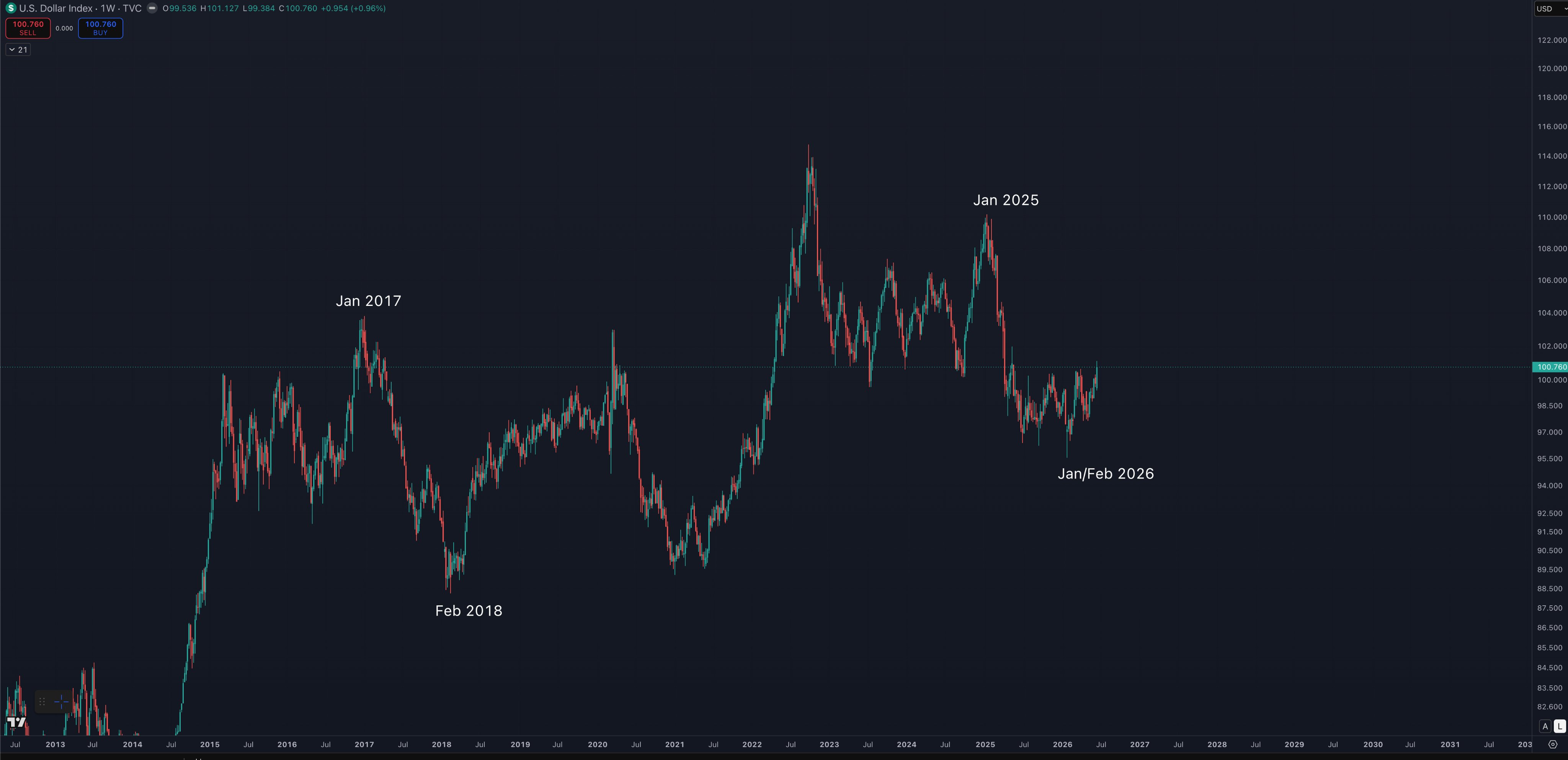
Trader Benjamin Cowen saw an ongoing DXY “bull case” into the latter half of 2026.
US dollar index (DXY) one-week chart. Source: Benjamin Cowen/X
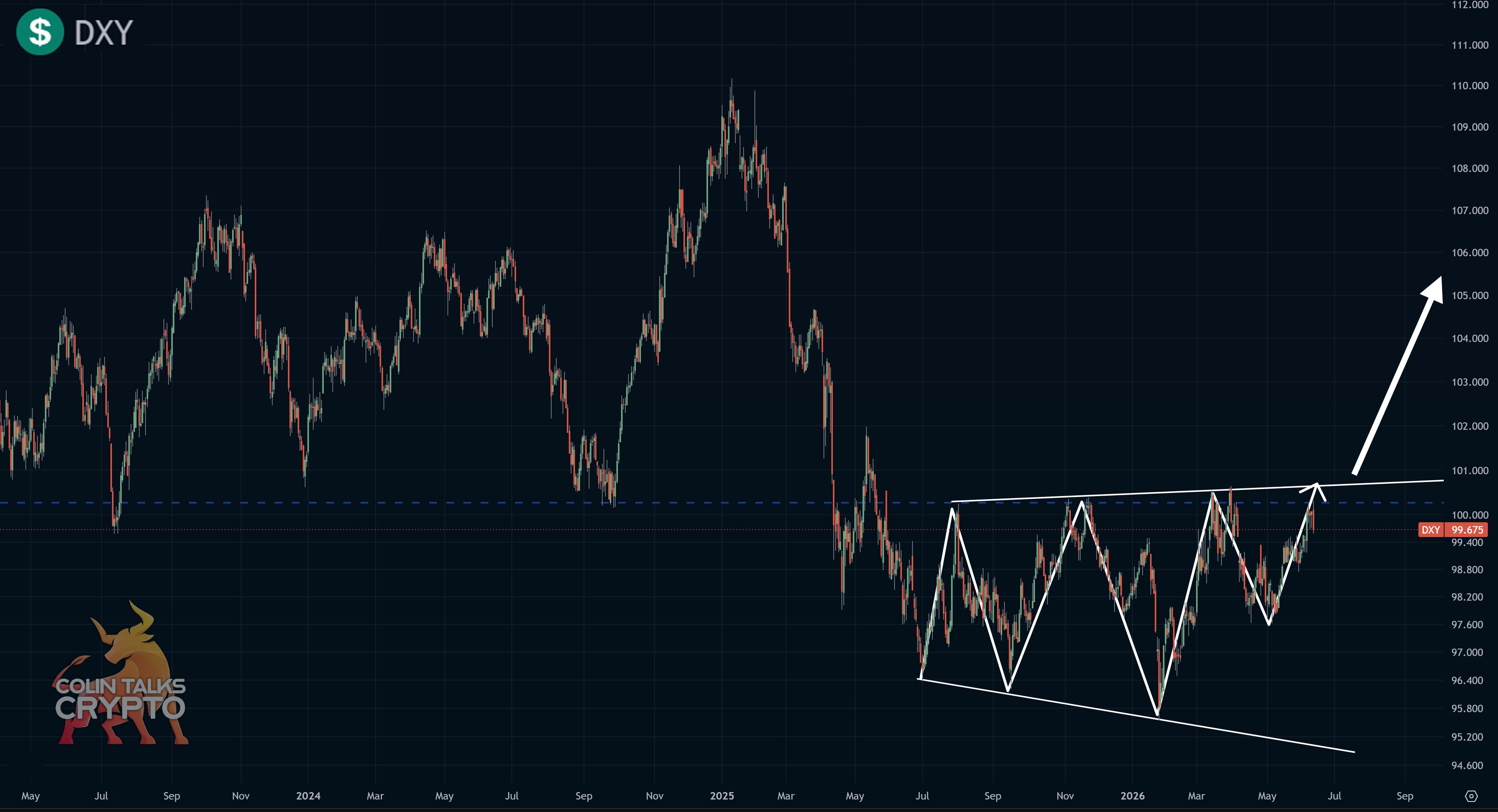
“$DXY is currently testing the upper range of a megaphone aka broadening wedge pattern. If it breaks above this pattern instead of rejecting then that would be a pretty big upward target– somewhere around 106,” ColinTalksCrypto, creator of the YouTube channel of the same name, added.
“It would be bad for risk assets as well.”
US dollar index (DXY) chart. Source: ColinTalksCrypto/X
Trader Aksel Kibar expected an “important week” for DXY, eyeing the end of a year-long period of consolidation.
Bitcoin continues to circle $64,000 following some brief volatility after the weekly close.
BTC price action eyes July benefits
In his latest market commentary, trader and analyst Rekt Capital had a silver lining for Bitcoin bulls.
Despite the BTC price weakness this month, the historical relationship between the months of June and July means that the pressure may soon ease.
“History suggests that whatever June does, July will do the opposite,” he told X followers this weekend.
“Therefore if June is red, July will likely be green.”
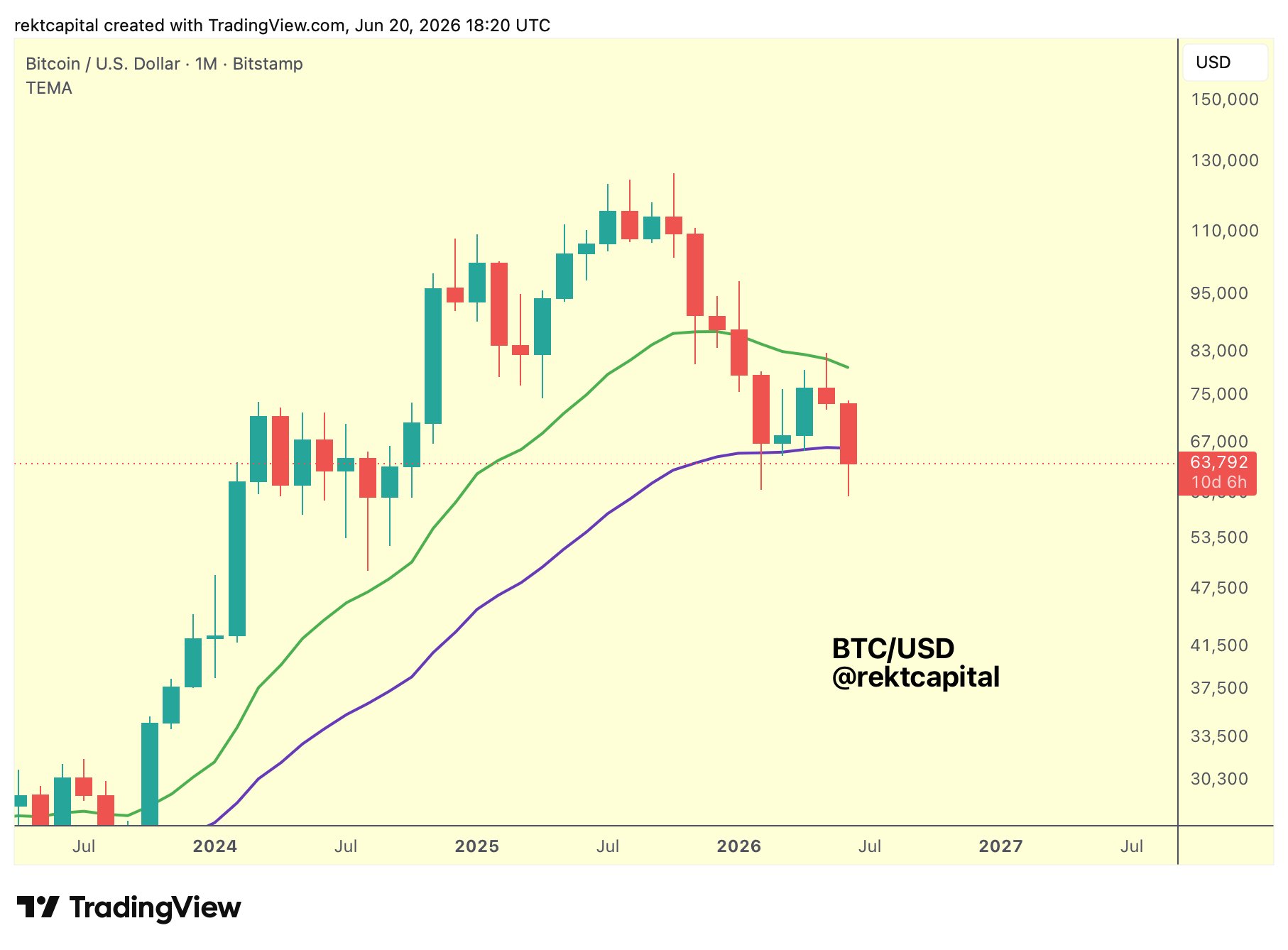
BTC/USD one-month chart with 21, 50EMA. Source: Rekt Capital/X
An accompanying chart showed BTC/USD acting in a range bordered by its 21-month and 50-month EMAs.
“So if June ends the month like this, it will confirm a loss of the 50-Month EMA as support. And so July will likely relief rally to turn the EMA into new resistance,” Rekt Capital added.
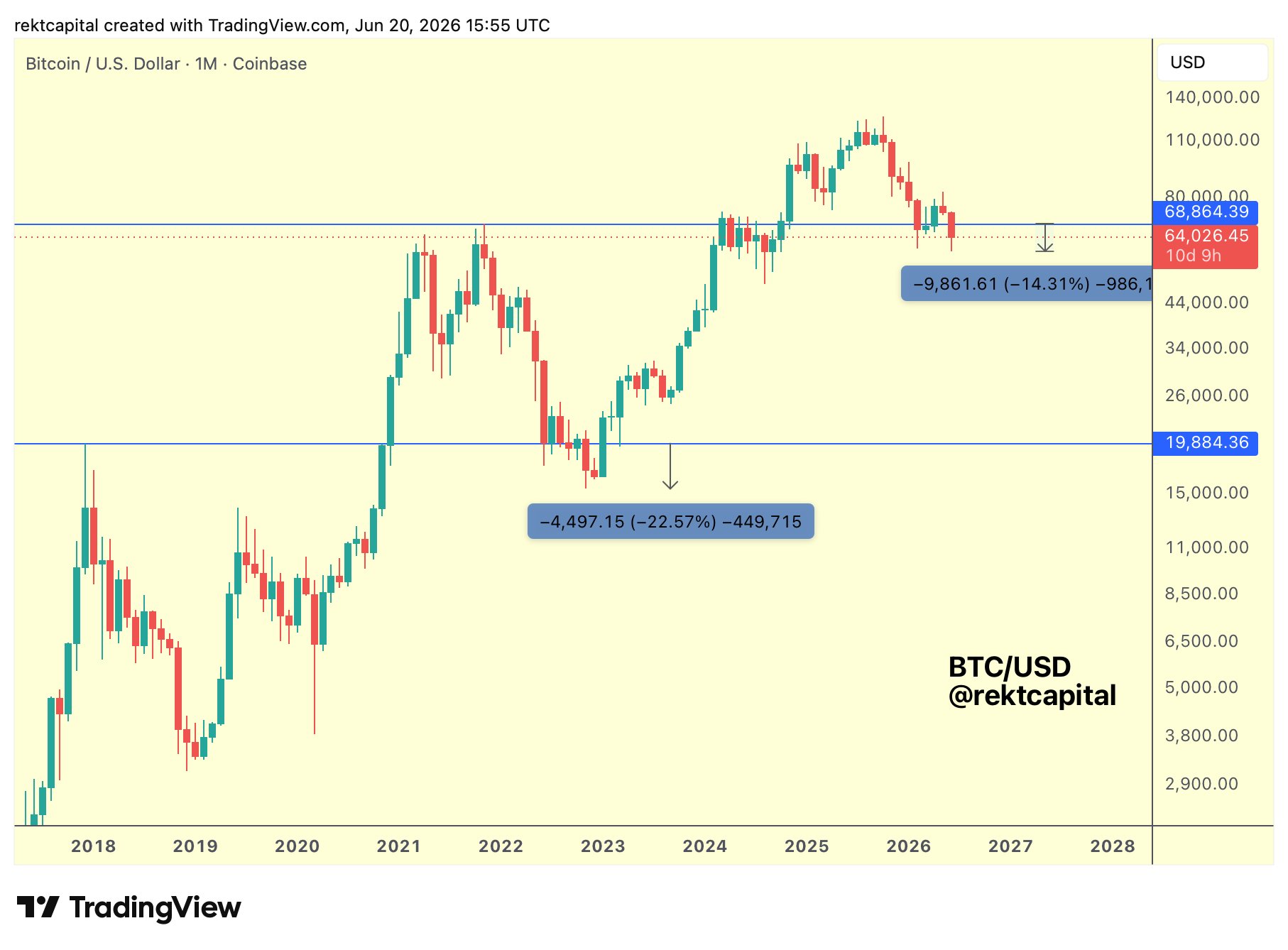
That implies that in future, bulls will have to contend with a fresh round of BTC price downside. Earlier, Rekt Capital suggested that the bear market should continue for some months to come, once again based on historical tendencies.
“History suggests there’s still time left and a bit more downside to go,” he reiterated on X while comparing previous bear markets.
BTC/USD one-month chart. Source: Rekt Capital/X
PCE data due with US-Iran peace under pressure
Inflation remains the firm focus for markets this week as the US Federal Reserve’s “preferred” yardstick leads the macro data releases.
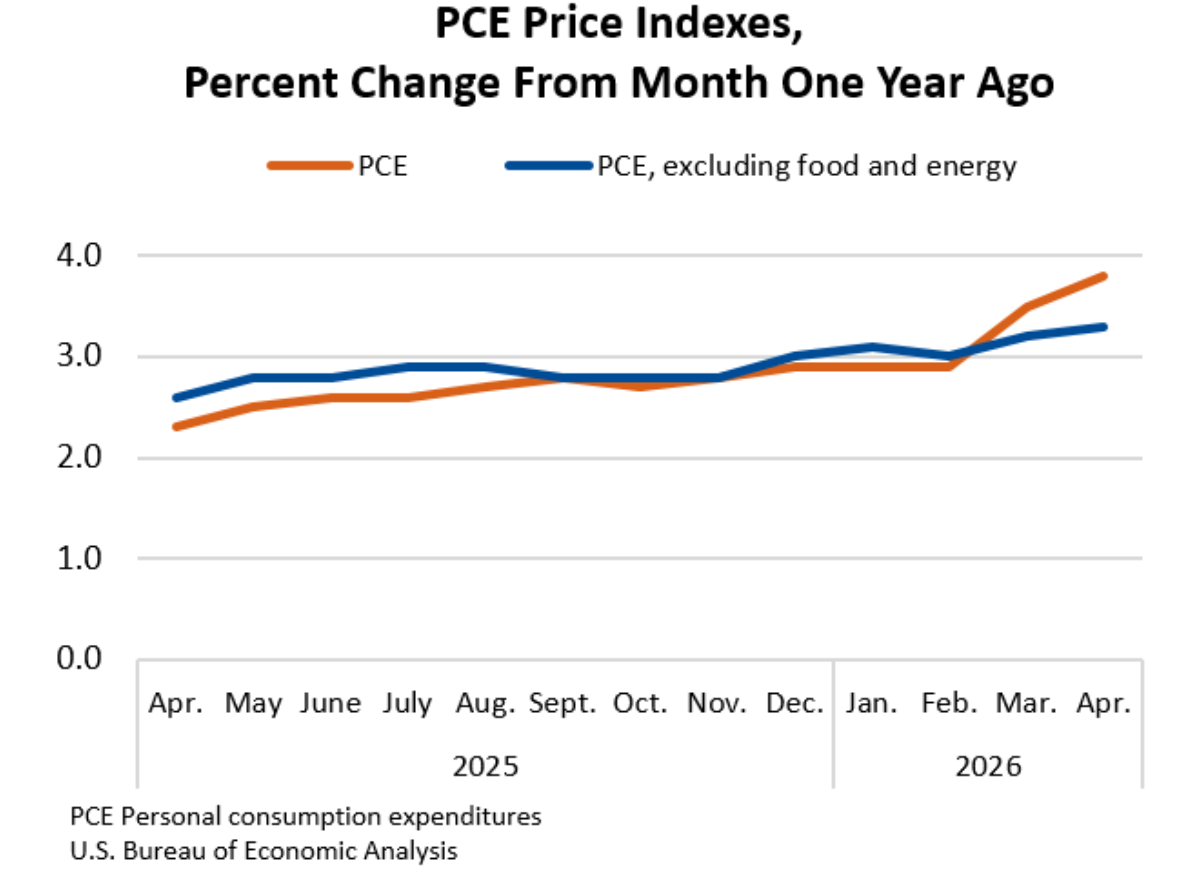
The May print of the Personal Consumption Expenditures (PCE) index is due out on Thursday.
US PCE index % change (screenshot). Source: US Bureau of Economic Analysis
April saw PCE hitting three-year highs, reflecting the ongoing impact of the US-Iran war on inflation trends.
“While investors are hoping that the deal between the U.S. and Iran and corresponding pullback in oil prices will temper inflation, price pressures are spreading beyond energy,” trading resource Mosaic Asset Company wrote in the latest edition of its regular newsletter, The Market Mosaic.
“That’s because multiple catalysts are coming together at the same time to drive a jump in inflation.”
Mosaic highlighted “large” federal budget deficits and supply-chain issues contributing to cost upside.
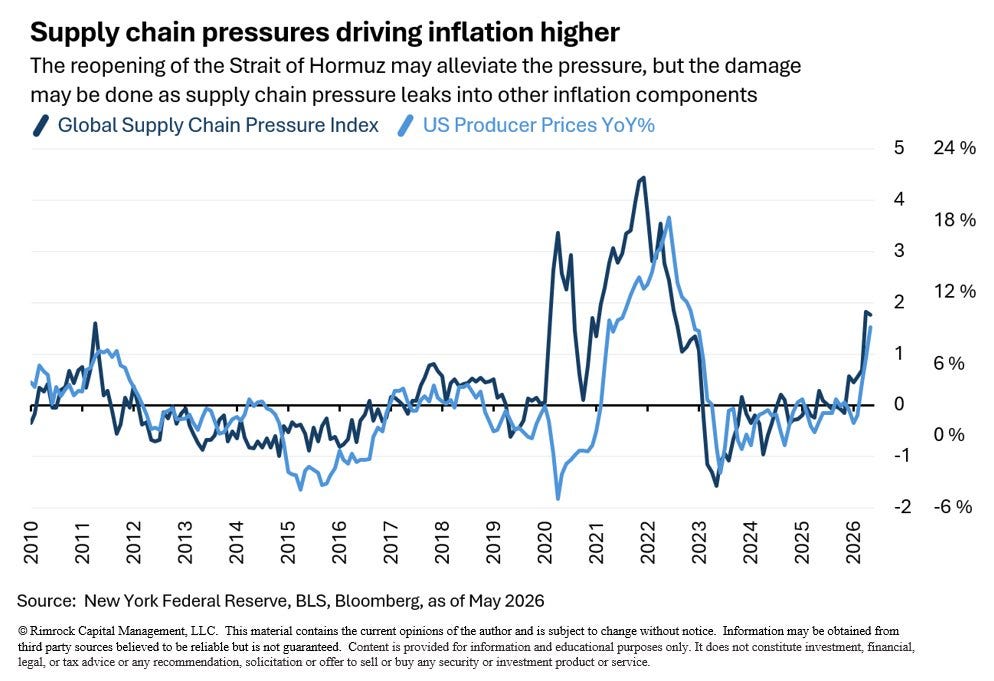
“Cost increases from energy prices and upheaval following last year’s trade war are likely playing a key role,” it added alongside a chart of Producer Price Index (PPI) data.
“You can see that supply chain pressures tends to lead changes in producer prices.”
Global supply-chain and PPI data. Source: Mosaic Asset Company
Higher inflation means ostensibly less chance of the Fed cutting interest rates, which in turn creates a headwind for crypto and risk assets. As Cointelegraph reported, markets even see the Fed hiking rates before the end of the year.
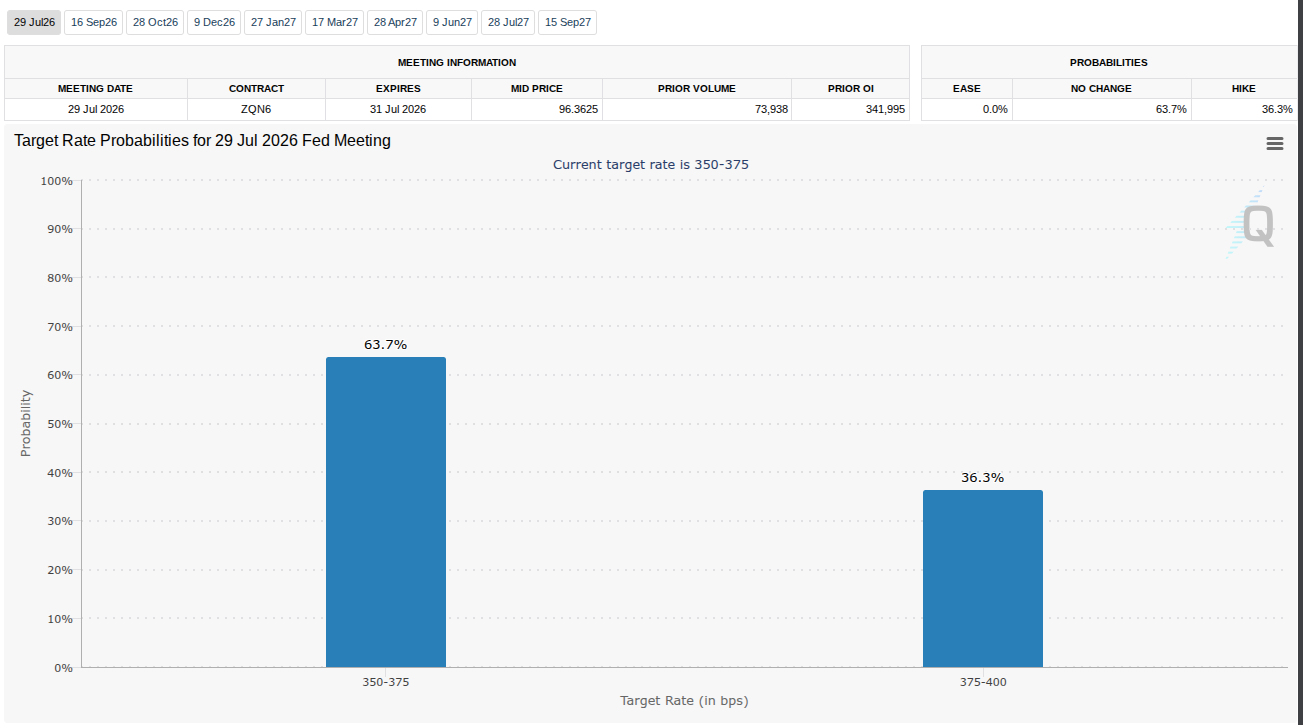
The latest data from CME Group’s FedWatch Tool puts the odds of a hike at the Fed’s next meeting in late July at around 36%.
Fed target rate probabilities for July 29 FOMC meeting (screenshot). Source: CME Group
“Concerns over persistently high inflation isn’t the only reason for the Fed to consider hiking interest rates. Recent economic data has been surprising to the upside as well,” Mosaic noted.
Beyond PCE, Thursday will also see revised Q1 GDP data and initial jobless claims.
Oil helps preserve $60,000 support odds
The US-Iran peace deal, despite already showing signs of strain, has had a lasting impact on oil prices.
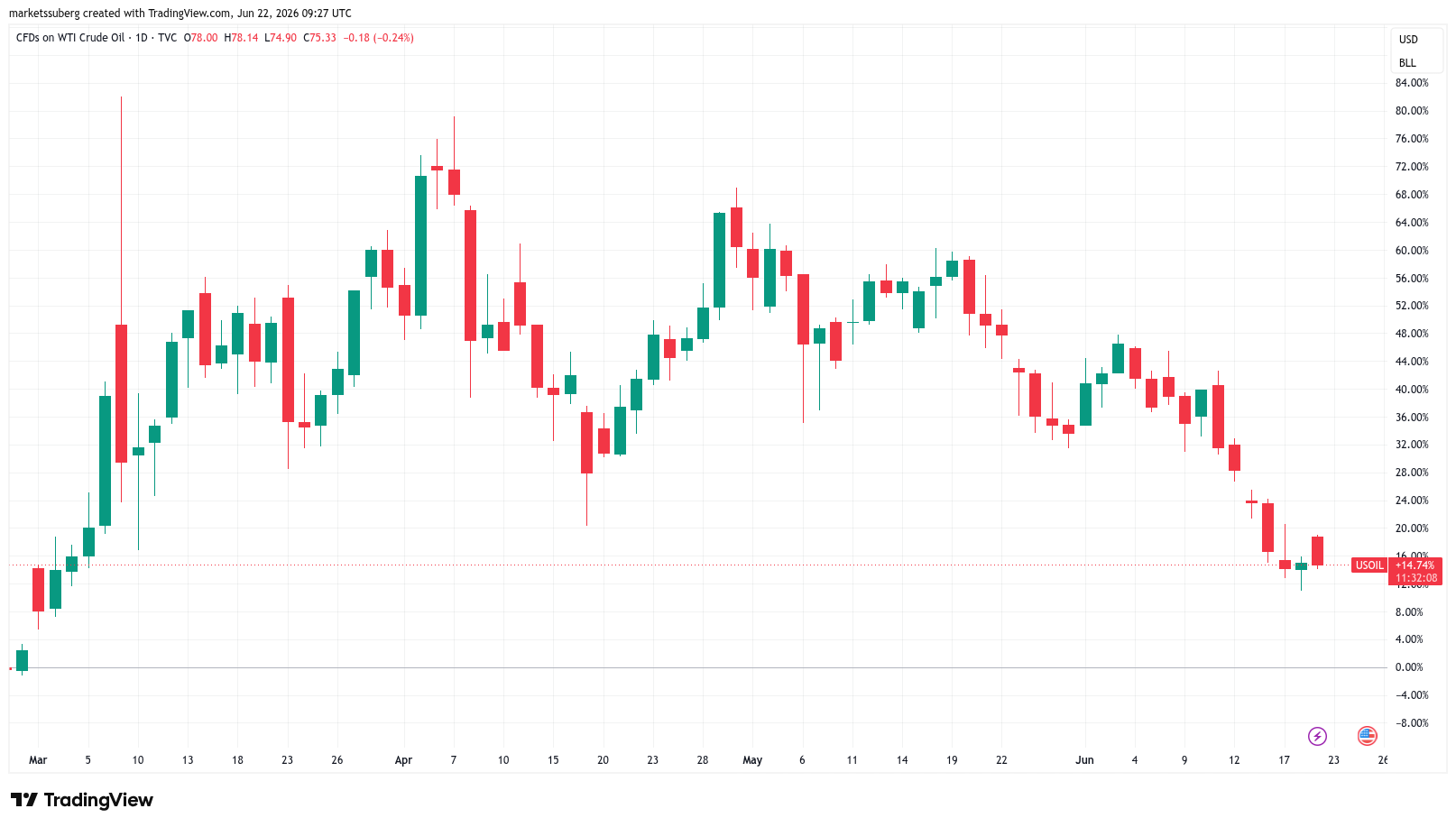
As the two parties signed it, US WTI crude fell to $73 per barrel, its lowest level since early March and nearly 40% below its local peak.
CFDs on US WTI crude oil one-day chart. Source: Cointelegraph/TradingView
Bitcoin has had a broadly inverse correlation to oil. Recent weeks have shown a different relationship in play as risk assets climb, while the peace deal still offers a step up to the mid-$60,000 zone.
Onchain analytics platform Glassnode says it believes that based on oil’s latest moves, there should be cause for Bitcoin bulls to relax in the short term.
“Bitcoin rallied, and also gold rallied,” it said in a video analysis late last week, adding that accumulation trends were helping support $60,000 as a local bottom.
Glassnode described “decent” buying-up of the supply at the lows.
“I believe there’s a chance that this may be a durable bottom, at least to a certain extent — maybe not the absolute bottom, but I think there’s a decent chance that that $60,000 level will be defended by quite a few different cohorts here,” it concluded.
Bitcoin speculators turn “emotional”
As Cointelegraph reported, largest global exchange Binance has been on the radar in recent days thanks to conspicuous Bitcoin selling pressure.
Related: Bitcoin market cap rebound to take ‘5-10 years’ after dropping 10 places since mid-2025
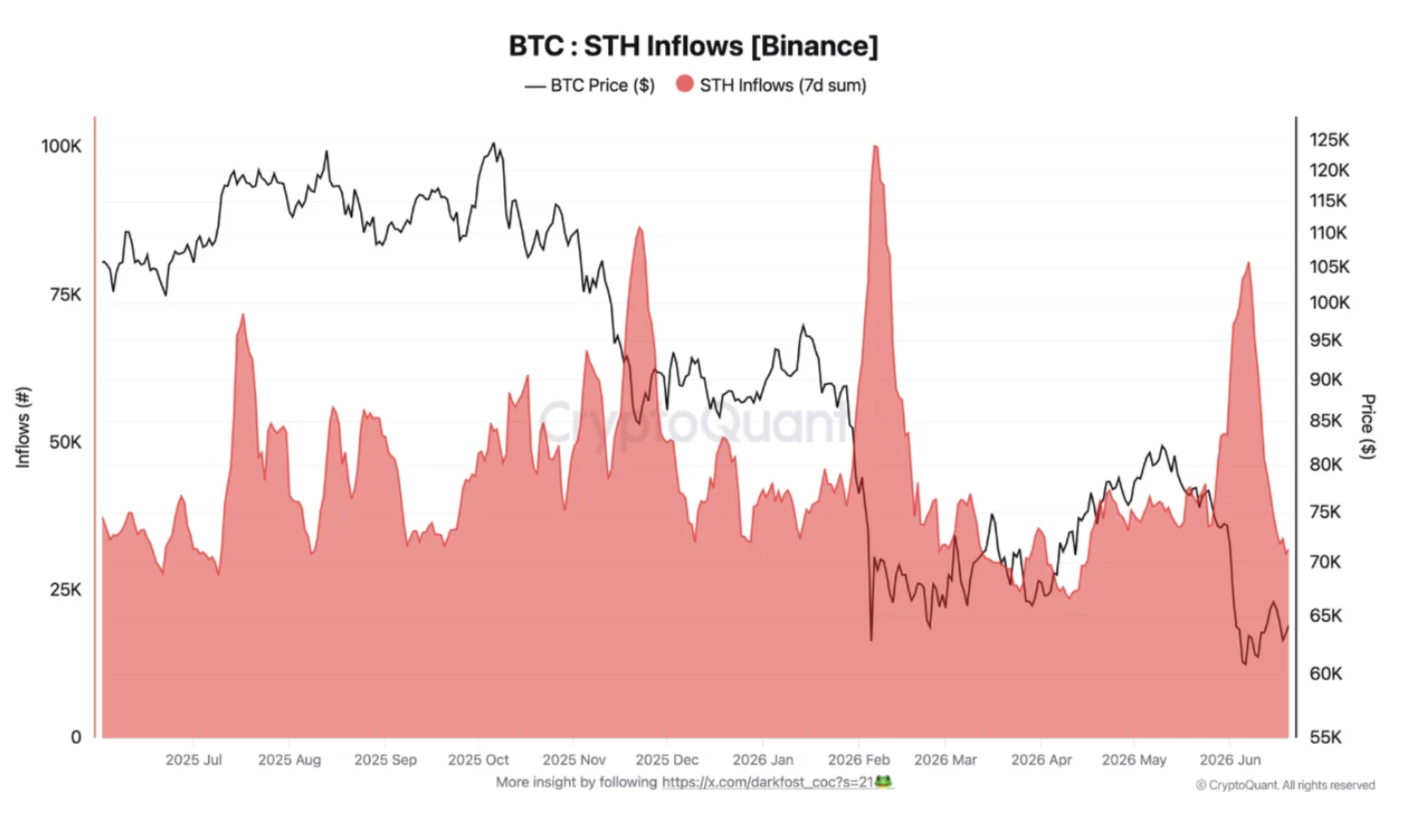
In its latest research, onchain analytics platform CryptoQuant sheds light on the scale of the offload, which notably involves newer investors.
“Once again, it was the STHs who suffered the most from this correction and reacted most sharply,” contributor Darkfost wrote on Sunday.
Darkfost referred to short-term holders (STHs) — investors hodling coins for up to six months. BTC/USD dropping back to February lows, which versus its May peak represented a drop of nearly 30%, resulted in an “emotional” response from the cohort.
“During the month of June, STH inflows on Binance exceeded 80,000 BTC over 7 days, representing approximately $5B in selling pressure,” he reported.
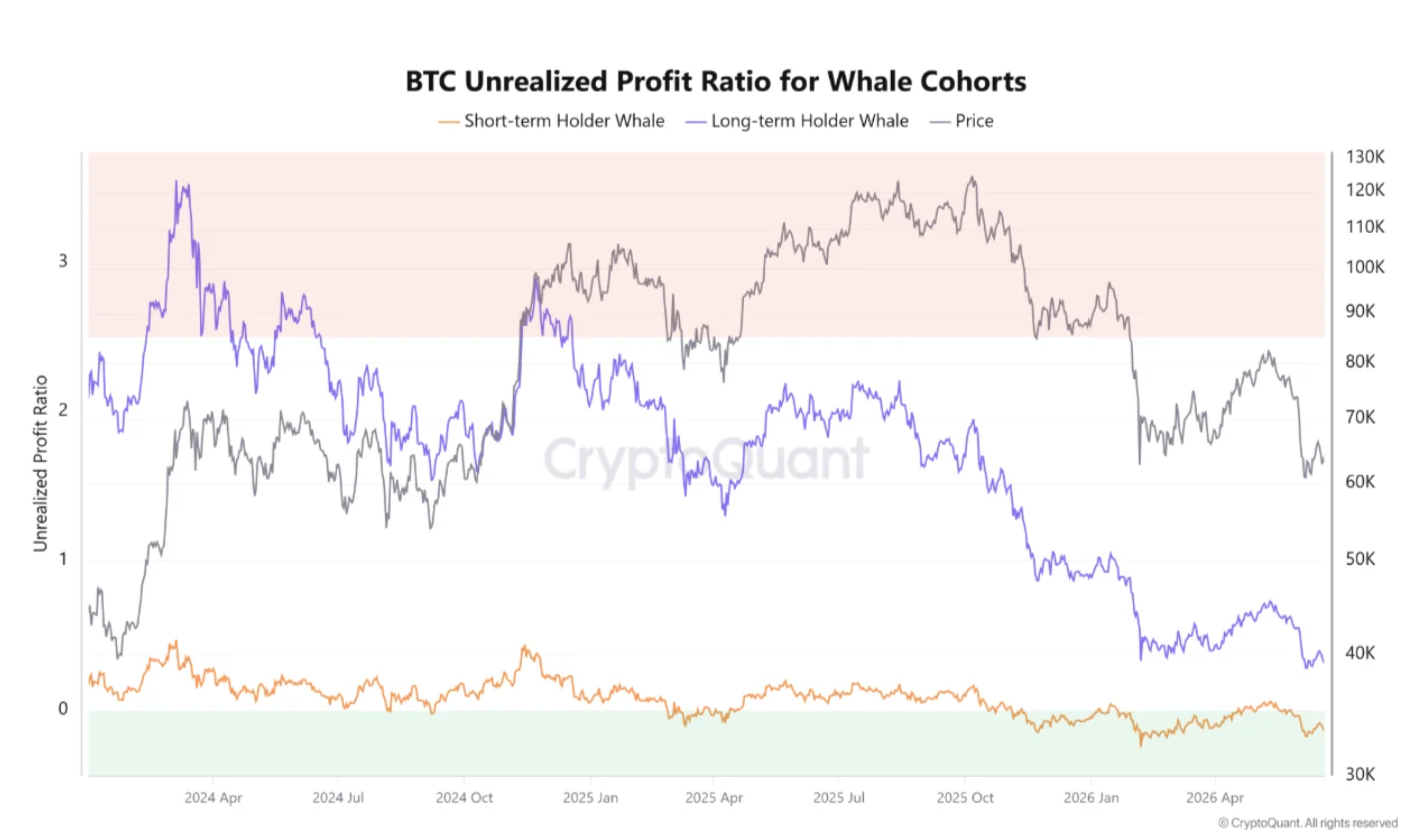
The impact of the selling has yet to be reflected in the actions of large-volume investors, who remain nonchalant in the current price range. Analyzing the profitability of older and newer Bitcoin whales, CryptoQuant contributor CryptoZeno suggested that the market has found a form of equilibrium.
“The gap between long-term and short-term whale profitability highlights a market transitioning through consolidation rather than capitulation,” they summarized.
“Long-term whales continue to hold positions despite reduced gains, while short-term whales remain largely neutral. This combination often reflects a period of market stabilization where speculative excess is gradually removed from the system.”
Bitcoin whale unrealized profit ratio (screenshot). Source: CryptoQuant
Digital assets are attempting to decouple from a complex macro environment following a dramatic sequence of central bank shifts, headlined by the Bank of Japan’s historic push to 1.0% interest rates and newly appointed Federal Reserve Chair Kevin Warsh’s restructured FOMC policy framework.
Traders enter the week balancing an apparent drop in concerns over energy-driven inflation against a stark warning of tighter liquidity in the near-term.
While the official signing of the U.S.-Iran peace treaty provides relief by opening the Strait of Hormuz, it’s also stripped haven assets of their immediate momentum. Instead, capital is reorganizing around a heavy U.S. data cluster, with the market bracing for Thursday’s crucial Core PCE print to evaluate the trajectory of consumer inflation.
With the bitcoin BTC$64,111.91 price stabilizing above major psychological support at $64,000, the macro weight that pressed on digital assets for months may finally be dissipating.
What to Watch
(All times ET)
Crypto
June 22: The U.S. SEC and CFTC open their newly issued joint public comment window targeting data reporting frameworks. The 60-day window invites industry feedback to harmonize and streamline regulatory reporting across swap and digital-asset derivatives markets.
Macro
June 23, 4:00 a.m: Eurozone Flash Manufacturing and Services PMIs for June
June 25, 8:30 a.m: U.S. Final Q1 GDP growth annualized est. 1.6% (Prev. 1.6%)
June 25, 8:30 a.m: U.S. May Core PCE Price Index YoY est. 3.3% (Prev. 3.3%); MoM est. 0.24% (Prev. 0.2%)
June 25, 8:30 a.m: U.S. Initial Jobless Claims for period ending June 20 est. 224K (Prev. 226K)
Earnings
Token Events
Governance Votes & Calls
Lido DAO is voting on various network matters, including approving the Staking Router v3 architecture, migrating to upgraded community and curated staking modules to support the Ethereum Pectra hard fork, winding down simple DVT clusters, revoking specific multichain bridge endpoints, and appointing a new director for the Lido Labs Foundation. Voting ends June 22.
Ssv.network DAO is voting on a proposal to conclude its Incentivized Mainnet Program for validator clusters paying network fees in SSV on June 30. The transition framework offers full rewards for July to any SSV cluster that migrates to an ETH-denominated cluster. Voting ends June 23.
Goldfinch DAO is voting on a proposal to begin an orderly wind-down of Goldfinch Prime and transition the protocol into a “maintenance mode” focused solely on managing the recovery and collection of remaining legacy borrower pool payments. Voting ends June 23.
GnosisDAO is voting on a “treasury redemption” proposal that allows GNO holders to voluntarily exchange their tokens for a pro-rata distribution of the DAO’s liquid assets at net asset value (NAV), along with a discounted share of capital called by GnosisVC. Voting ends June 26.
Unlocks
June 22: MegaETH Bridge (MEGA) to unlock 2.5% of its circulating supply worth $13.71 million. June 23: Toncoin (TON) to unlock 0.72% of its circulating supply worth $59.63 million.
June 24: Humanity (H) to unlock 2.93% of its circulating supply worth $52.67 million.
That key is meant to stay sealed inside secure hardware so the proofs can be trusted. With it exposed, the attacker could enroll their own provers as legitimate and sign fraudulent proofs that Taiko’s verifier accepted, then fake a bridge withdrawal that released real assets on Ethereum.
.@taikoxyz was reportedly attacked, with losses exceeding $1.7M. Our initial investigation suggests the likely root cause was an exposed Raiko SGX enclave signing key on GitHub. Raiko is Taiko’s multi-prover stack for Taiko and Ethereum blocks, so an exposed Raiko SGX enclave key… https://t.co/8BIiEeNtYJ pic.twitter.com/eAq9Xjngz8
— BlockSec Phalcon (@Phalcon_xyz) June 22, 2026
Taiko urged all users to withdraw from every bridge on the network, asked centralized exchanges to suspend deposits of its TAIKO token, and had its block producers stop making new blocks during the investigation.
By about 2 a.m. ET it said the exploit was contained and withdrawals through the main bridge and token vault were fully stopped. The exploiter had already moved about 2 million TAIKO, worth roughly $170,000, to an account on the MEXC exchange.
The dollar loss is small, but the flaw came from the same DeFi mechanism that have caused hundreds of millions worth of losses this year.
Forged cross-chain messages drained $292 million from Kelp DAO’s bridge in April and $11.4 million from the Verus-Ethereum bridge in May, the same failure where one chain is tricked into trusting a fake instruction from another. Bridges have produced more than $340 million in losses across at least 14 exploits in 2026, making it the costliest target in crypto. Taiko’s damage stayed contained mainly because the team caught and froze it within hours.
Validators are entities that keep Ethereum running by locking up ether (ETH), checking transactions and earning staking rewards for doing so. Funding, in this context, means paying for the shared work Ethereum relies on, such as developer tools, security research, public infrastructure and other projects that help the network but do not always have a direct business model.
The proposal seeks to shift that burden toward validators, who earn ETH rewards for securing the network and benefit when Ethereum becomes more valuable.
It argued that validators are natural long-term stakeholders because better ecosystem funding can increase network activity, ETH burn and the value of staked ETH.
Validators could also select preferred funding recipients under the proposal. Those preferences would be combined into a ‘splitter’ contract that distributes redirected funds among chosen addresses. The design is meant to let validators “set and forget” their preferences rather than vote on every grant.
At current staking levels, the post estimated that validators receive roughly 700,000 ETH a year in rewards. A 5% to 10% redirect could send about 50,000 to 70,000 ETH a year toward ecosystem funding. That equates to about $120 million at ether’s current market prices.
Bitcoin is trading around $64,000 ahead, per CoinDesk pricing data, still searching for a catalyst strong enough to break the range it has held for weeks.
Selling from spot bitcoin ETFs has eased from earlier this month, but fresh institutional demand has yet to return.
U.S. spot bitcoin ETFs have now posted a sixth straight week of net outflows, data shows, with only a sparse few days of green. The scale has narrowed, but the absence of any sustained inflow shows institutions remain defensive as markets reassess the Federal Reserve’s interest-rate path.
A bigger weight is the rebounding dollar. After the June meeting, the Fed’s cautious message weakened expectations for near-term rate cuts, lifting the Dollar Index, which measures the greenback against major currencies, to the 100.6-100.8 area while keeping Treasury yields high.
With liquidity still tight, capital favors assets with steadier yields over volatile ones like bitcoin.
Easing geopolitical tension after the U.S.-Iran deal has improved risk appetite, a short-term support. It has not been strong enough to offset the firmer dollar and the cautious flows.
Bitcoin will likely hold a $60,000 to $67,000 range in the near term, said Simon-Peter Massabni, head of business development at XS.com, in emailed comments to CoinDesk. The market is “balanced between supportive and restrictive forces,” he said, with eased ETF selling and better sentiment on one side and an unsupportive Fed and unconfirmed institutional flows on the other.
A sustainable recovery in the second half would need more time to accumulate, a return of ETF inflows and stronger institutional demand. Until then, the current rebounds look technical rather than the start of a new uptrend.