

Bitcoin’s next major move may hinge less on sentiment and more on U.S. dollar flows, as shifting Federal Reserve liquidity conditions set the stage for a potential crypto rebound driven by macro forces. Fed Balance Sheet Reversal May Push Bitcoin Price Higher, Arthur Hayes Says Arthur Hayes outlined a macro-driven outlook for crypto markets tied […]
ETH Charts Point To 25% Rally, But A Support May Happen First

Ether (ETH) is trading near $3,300, and one futures market trend points to another 10% to 25% upside move. However, the market may first see a liquidation-driven price dip before any sustained rally develops.
Key takeaways:
-
Ether’s Leverage Ratio is near 0.60, a level that has historically preceded 10% to 25% rallies after short pullbacks.
-
The ETH SOPR remains below 1, indicating realized losses still outweigh profits despite recent price gains.
Ether leverage setup favors upside after a short cleanup
Crypto analyst Pelin Ay highlighted a recurring structure in Ether’s leverage dynamics. When the Leverage Ratio rises rapidly above price on Binance, it leads to short-lived downside wicks that flush overleveraged long positions, followed by strong upside reactions.
This pattern appeared multiple times in 2025, notably in February, April, September and November. A similar sequence occurred in October, when a sharp leverage spike triggered a sudden dump before the trend continuation.
Currently, the Leverage Ratio sits near 0.60, which is relatively elevated. Notably, the leverage is not declining despite recent price gains, signaling persistent risk appetite. Pullbacks at these leverage levels have preceded 10% to 25% rallies, implying Ether could still be positioning for a sharp upside move after a final liquidity sweep.
Meanwhile, Glassnode analyst Sean Rose noted a divergence in ETH holder behavior. Despite Ether outperforming Bitcoin from January lows, ETH’s spent-output profit ratio remains below 1, indicating that the aggregated losses outweigh profits. This suggests a weaker conviction among ETH spot holders compared to the BTC participants.

Related: Short squeeze hits top 500 cryptos as traders unwind bearish bets
Data suggests an ETH dip is overdue
Ether printed its highest daily close since Nov. 12, 2025, at $3,324. A 25% rally from here would place ETH above $4,100, but the probability of a minor dip remains elevated.

On the daily chart, Ether formed an order block from $3,050 to $3,170 during the recent impulse. This zone aligns with the point of control on the Visible Range Volume Profile (VRVP), an indicator that highlights the price level where the most trading volume has occurred since September 2025.
The price could gravitate back to this level, as it represents an area of fair value where buyers and sellers previously agreed on the price.
Supporting this view, Hyblock data shows net long concentration above $500 million between $3,040 and $3,100. Such dense positioning increases the likelihood of a short-term sweep into this range, potentially setting the stage for a stronger continuation move afterward.

Related: Efforts to bulletproof Ethereum are paying off in user metrics
This article does not contain investment advice or recommendations. Every investment and trading move involves risk, and readers should conduct their own research when making a decision. While we strive to provide accurate and timely information, Cointelegraph does not guarantee the accuracy, completeness, or reliability of any information in this article. This article may contain forward-looking statements that are subject to risks and uncertainties. Cointelegraph will not be liable for any loss or damage arising from your reliance on this information.
US Crypto Policy Debate Intensifies as CLARITY Act Support Fractures

Trusted Editorial content, reviewed by leading industry experts and seasoned editors. Ad Disclosure
Washington’s long-running effort to bring regulatory clarity to the U.S. crypto market has entered a more uncertain phase. The Digital Asset Market Clarity Act, known as the CLARITY Act, was expected to move closer to a Senate vote this week.
Instead, a sudden withdrawal of support from Coinbase and a last-minute pause by Senate leadership have exposed deep divisions within the industry and among lawmakers. While the White House insists the bill is still on track, the debate over how digital assets should be regulated is becoming more fragmented.
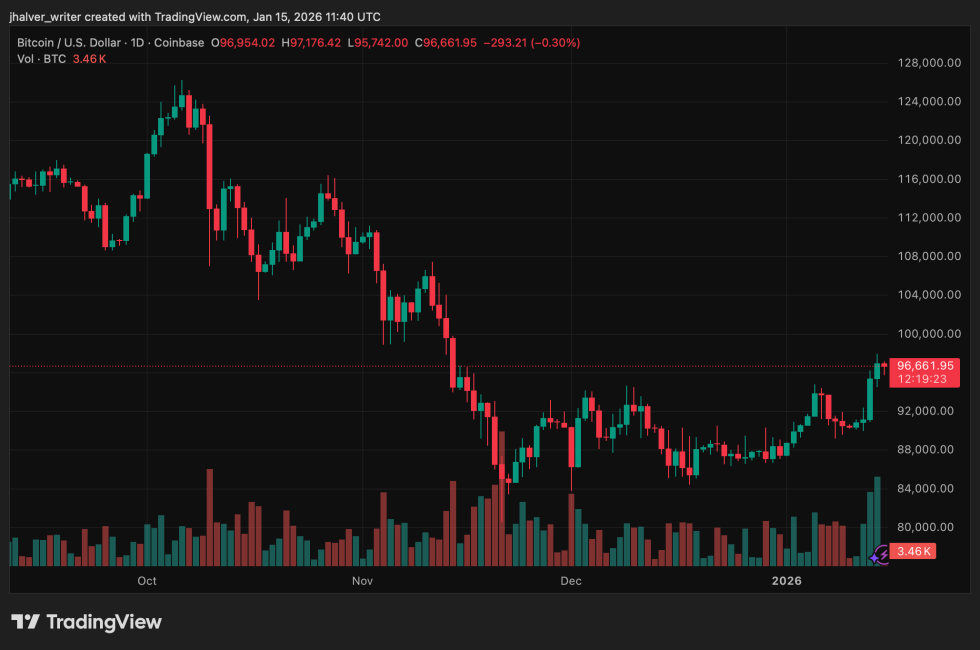
BTC's price records some gains on the daily chart. Source: BTCUSD on Tradingview
Coinbase Withdrawal Triggers Legislative Pause
The immediate turning point came when Coinbase CEO Brian Armstrong announced that the company could no longer support the current draft of the CLARITY Act.
Armstrong argued that the bill would be worse than the existing regulatory uncertainty, citing concerns over limits on tokenized equities, restrictions on crypto rewards, and expanded government access to financial data.
Shortly after, Senate Banking Committee Chair Tim Scott introduced a brief pause in the bill’s progress, cancelling a scheduled markup.
Scott described the delay as procedural rather than political, stating that negotiations were ongoing and bipartisan talks continued. A new markup date has been set for January 27, once updated bill language is released.
Despite the setback, White House AI and crypto czar David Sacks reiterated that the administration still backs the legislation. He said the pause should be used to resolve remaining issues and push forward a framework that allows innovation while strengthening oversight.
Industry Split Over SEC and CFTC Roles
At the core of the dispute is the division of regulatory authority between the Securities and Exchange Commission (SEC) and the Commodity Futures Trading Commission (CFTC) as outlined in the CLARITY Act.
Crypto exchanges generally favor the CFTC’s approach, which treats many digital assets as commodities. The SEC, by contrast, applies securities laws that impose stricter compliance requirements.
Critics argue the bill shifts too much power to the SEC, particularly over tokenized equities and certain crypto products. Coinbase has warned that the proposed rules could effectively block the development of on-chain stock trading and limit user reward programs.
Other industry leaders, including executives from Ripple, a16z, and Kraken, have taken a more cautious stance. While acknowledging flaws in the draft, they argue that passing some form of market structure legislation is better than leaving the sector in regulatory limbo.
Banks, Stablecoins, and the Broader Stakes
Another contentious issue is stablecoin regulation. The CLARITY Act would make it difficult for crypto platforms to offer yield or interest-like rewards on stablecoin holdings. Banks support these restrictions, saying they protect financial stability.
Lawmakers also point to past failures, such as the FTX collapse, as evidence that clearer rules are needed to protect consumers and national security. However, frustration is growing behind the scenes.
Senate sources indicate that some committee members were dissatisfied with Coinbase’s timing, perceiving the withdrawal as disruptive to months of negotiations.
Cover image from ChatGPT, BTCUSD chart from Tradingview

Editorial Process for bitcoinist is centered on delivering thoroughly researched, accurate, and unbiased content. We uphold strict sourcing standards, and each page undergoes diligent review by our team of top technology experts and seasoned editors. This process ensures the integrity, relevance, and value of our content for our readers.
Iran Turns to Crypto Amid Collapsing Economy, Protests

Crypto usage in Iran has spiked amid the country’s mass protests, with a surge of Iranians withdrawing Bitcoin to preserve value amid instability, according to Chainalysis.
Protests in Iran began around Dec. 28 over worsening economic conditions, after the Iranian rial hit record lows against the US dollar. Demonstrations escalated nationwide, with Iran’s regime responding by cutting internet access, carrying out mass arrests, and reportedly killing thousands.
Chainalysis said in a report on Thursday that Iran’s crypto ecosystem hit $7.78 billion in 2025, which accelerated amid the ongoing unrest with a substantial increase in the number of daily crypto transfers and the amounts transacted.
“Most telling is the surge in withdrawals from Iranian exchanges to unattributed personal Bitcoin wallets. This surge suggests Iranians are taking possession of Bitcoin at a markedly higher rate during protests than they were beforehand,” it said.
“This behavior represents a rational response to the collapse of the Iranian rial, which has lost nearly all of its value, rendering it effectively worthless against major currencies like the euro.”
Chainalysis noted that Iran’s government has also turned to crypto, with the Islamic Revolutionary Guard Corps’ (IRGC) crypto activity accounting for half of the total crypto ecosystem in the fourth quarter of 2025, with IRGC-associated addresses receiving more than $3 billion in total last year.
Crypto part of the resistance
Chainalysis said Bitcoin’s (BTC) role during the unrest in Iran isn’t just confined to capital preservation; it’s also become “an element of resistance, providing liquidity and optionality in an increasingly restricted economic environment.”
“Unlike traditional assets that are illiquid and often subject to government control, BTC’s censorship-resistant and self-custodial nature offers financial flexibility — particularly valuable in a situation where individuals may need to flee or operate outside government-controlled financial channels.”
Chainalysis said it has found other regions experiencing “war, economic turmoil, or government crackdowns” have also seen increased Bitcoin withdrawals during times of instability.
Crypto likely to remain crucial tool
TRM Labs tracked roughly $3.7 billion in total crypto flows in Iran between January and July 2025. At the same time, around seven million people, out of the country’s 92 million population, are estimated to be crypto users, according to Statista.
Related: Tether’s role in Venezuela, Iran highlights the duality of stablecoins
“As sanctions pressure and international opprobrium intensify, and Iran’s economic volatility persists, cryptocurrency will likely remain a crucial tool for Iranians seeking financial sovereignty,” the Chainalysis team said.
Magazine: How crypto laws changed in 2025 — and how they’ll change in 2026
Cointelegraph is committed to independent, transparent journalism. This news article is produced in accordance with Cointelegraph’s Editorial Policy and aims to provide accurate and timely information. Readers are encouraged to verify information independently. Read our Editorial Policy https://cointelegraph.com/editorial-policy
Michael Saylor's Strategy still has major upside despite 2025 plunge, says TD Cowen

Strategy remains an effective proxy for bitcoin exposure, particularly for investors with a long-term view, analyst Lance Vitanza said.
FCA opens applications for stablecoin sprint

The UK’s Financial Conduct Authority is inviting fintechs, banks and other stakeholders to apply for a “stablecoin sprint” to help shape policy and set standards for the future of payments.
Editorial
This content has been selected, created and edited by the Finextra editorial team based upon its relevance and interest to our community.
The two-day event in London in March will explore how stablecoins can be used for retail payments, cross-border payments, ecommerce and business to business transactions.
Fintechs, banks, payment service providers, tech companies, stablecoin issuers, law firms, and consumer and merchant groups are al invited to apply by 4 February.
In May, the watchdog will also hold a roundtable focused on trade payments in stablecoins.
With stablecoins gathering momentum around the globe, the FCA has consulted on issuing qualifying stablecoins as it gears up to publish its final crypto rules this year.
The regulator also recently launched a stablecoin-specific cohort of its regulatory sandbox to support issuers in testing UK-issued coins.
Bitcoin Drops Pace At $97K As Retail Stays Sidelined: Did The Rally End?

Key takeaways:
-
Retail traders remain sidelined despite BTC’s rebound, as low funding rates and muted interest point to fragile investor sentiment.
-
Institutional investors are buying the spot Bitcoin ETFs again and corporate buyers building BTC treasuries may help send BTC back to $100,000.
Bitcoin (BTC) price stabilized near $95,500 on Thursday following an 8%, three-day rally that wiped out $465 million in short BTC futures positions. However, according to web search and derivatives metrics, retail traders have remained on the sidelines. Bitcoin’s pullback from $97,900 may have further weakened investor sentiment.
The Bitcoin perpetual futures funding rate stood at 4% on Thursday, signaling limited demand for bullish positions. Under neutral conditions, the indicator typically ranges from 8% to 12% to compensate for the cost of capital. These derivatives are retail traders’ preferred instruments because their prices closely track the spot market, unlike monthly BTC contracts traded on CME.
Institutional Bitcoin buying offsets weak retail investor interest
The tech-heavy Nasdaq index traded just 1.6% below its all-time high on Thursday as traders gained confidence after chipmaker TSMC reported a 35% increase in quarterly earnings. Still, despite Bitcoin’s recent gains, the current $95,500 level remains 25% below the $126,219 all-time high. More importantly, overall interest in the cryptocurrency market has been declining.

Google Trends data shows global search interest for “crypto” at 27 on a 0 to 100 scale, not far from the 12-month low of 22. Retail traders tend to chase recent winners, particularly as the price of silver has climbed 28% in two weeks. Bitcoin has long been viewed as a direct competitor to precious metals, but crypto traders typically focus on shorter-term performance.

Part of Bitcoin traders’ skepticism can be attributed to socio-political risks and concerns around maintaining the US Federal Reserve’s independence.
The US Justice Department’s criminal inquiry into cost overruns tied to the Federal Reserve’s building renovation has raised concerns about whether the administration of President Donald Trump is pressuring the Fed to cut interest rates. Fed Chair Jerome Powell’s term ends in April, leading traders to anticipate stronger economic stimulus measures in the second half of 2026.
Bitcoin has yet to prove itself as a reliable hedge during periods of economic turmoil, and as a result, even amid gains in stocks and precious metals, retail traders fear the cryptocurrency market could suffer the most during a downturn.
Related: Iran is cut off from the internet–Here’s how crypto could still work
Adding to the tensions, Trump has threatened to retaliate against Iran over its violent response to anti-government protests. Iran produces more than 3 million barrels of oil and controls a major global chokepoint for tanker flows. The heightened uncertainty follows a Jan. 3 US military operation that captured then-Venezuelan President Nicolas Maduro.

The lack of interest from retail traders is not a death sentence, as the Bitcoin spot exchange-traded fund (ETF) industry has surpassed $120 billion in assets. Public companies continue to follow Michael Saylor’s Strategy (MSTR US) playbook and have purchased more than $105 billion in Bitcoin. Institutional investor demand gained relevance through 2025 and could ultimately be the deciding factor behind a sustained bullish move toward $100,000.
This article does not contain investment advice or recommendations. Every investment and trading move involves risk, and readers should conduct their own research when making a decision. While we strive to provide accurate and timely information, Cointelegraph does not guarantee the accuracy, completeness, or reliability of any information in this article. This article may contain forward-looking statements that are subject to risks and uncertainties. Cointelegraph will not be liable for any loss or damage arising from your reliance on this information.
Belgium’s KBC To Offer Bitcoin Trading To Retail Investors

Belgium’s second-largest bank, KBC Group, is set to become the first bank in Belgium to allow retail clients to buy and sell crypto.
Starting the week of February 16, private investors will be able to trade Bitcoin through Bolero, KBC’s online investment platform.
The offering will operate within a regulated framework under the European Union’s Markets in Crypto-Assets Regulation (MiCAR), positioning KBC as the first Belgian bank to meet the requirements for providing crypto asset services.
KBC said it has submitted a full Crypto Asset Service Provider (CASP) notification to the relevant supervisory authority, clearing the way for the launch.
The bank framed the move as a response to growing demand from retail investors for regulated access to cryptocurrencies, while emphasizing the risks associated with the asset class.
“By offering the opportunity to purchase and sell crypto within a regulated framework, we are making innovation concrete and accessible,” said Erik Luts, chief innovation officer at KBC Group. “At the same time, we are demonstrating that KBC remains ready to assume its role as an innovator in a market where new players are rapidly evolving.”
KBC’s execution-only model
The launch will initially be limited to Bitcoin and Ether and will follow an execution-only model. Bolero customers will make their own investment decisions and will not receive personalized investment advice.
Before being allowed to trade crypto, clients must complete a knowledge and experience test designed to assess their understanding of the risks, including price volatility and the possibility of total loss, the bank said.
KBC and Bolero are adopting a so-called “closed-loop” model aimed at reducing fraud and money-laundering risks. Customers will only be able to buy and sell crypto within the Bolero platform, with no ability to transfer assets to or from external wallets or exchanges.
The bank will also provide custody services, meaning clients will not have to manage private keys themselves.
According to KBC, the move is partly driven by demographic trends. Studies cited by the bank indicate that around 45% of Belgians in their thirties already invest in cryptocurrencies.
Bolero’s customer base skews relatively young, with roughly 60% under the age of 40, and “Bitcoin” ranks among the most searched terms on the platform.
Bolero CEO Céline Pfister said the platform aims to introduce crypto “in an accessible way” while ensuring investors are well informed. At launch, educational materials will be made available through the Bolero Academy.
In a similar move, Germany’s second-largest lender DZ Bank secured authorization under the EU’s Markets in Crypto-Assets Regulation earlier last year, enabling it to launch a retail crypto trading platform across the country’s cooperative banking network.
The BaFin-approved “meinKrypto” platform will allow Volksbanken and Raiffeisenbanken customers to trade Bitcoin and other cryptocurrencies directly within their existing banking apps, subject to individual bank notifications.
Bitcoin slides below $96,000 as key crypto bill stalls in Congress
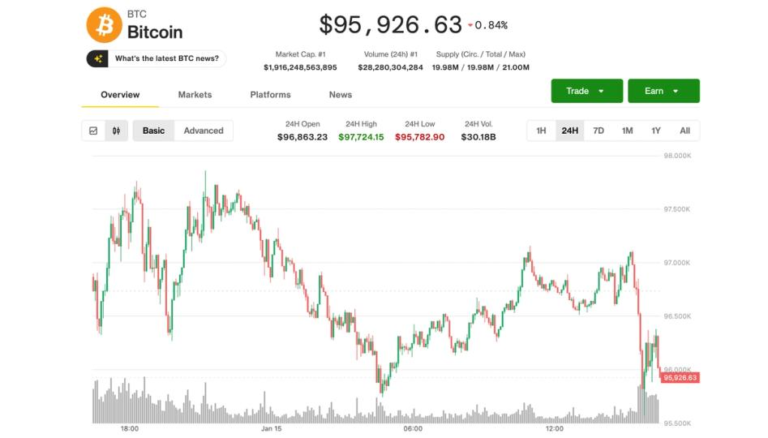
After a brief reprieve, crypto returned to selling off during U.S. market hours on Thursday.
Cerebras Poses an Alternative to Nvidia With $10B OpenAI Deal

Cerebras’ $10 billion deal with OpenAI positions the startup and its wafer-scale engine as a challenger to Nvidia in the AI chip market, while helping OpenAI try to accelerate the performance of its large AI models.
The multiyear deal, revealed on Jan. 14, requires Cerebras to deliver 750 megawatts of wafer-scale systems to OpenAI starting later this year. OpenAI will use the wafer-scale engine to deliver near-real-time responses for tasks such as coding, inference, image generation, and complex reasoning. The Cerebras version of an AI chip is larger and, the vendor says, faster than Nvidia GPUs.
The agreement gives Cerebras, which has struggled to expand its customer base since it was founded in 2015 beyond Abu Dhabi-based AI and tech holding company G42, a foothold in the AI chip market as one of several chipmakers trying to rival Nvidia. It also addresses a key challenge for enterprises finding that massive generative AI models are often too slow or costly for real-time use.
A Stage for Cerebras
The deal gives Cerebras an opportunity to prove the capabilities of its wafer-scale engine.
While some have previously seen the AI vendor as a somewhat experimental company focused on science applications, this partnership is the “ultimate stamp of legitimacy,” said Mike Leone, an analyst at Omdia, a division of Informa TechTarget.
“It transforms them overnight from a niche alternative into a serious contender that every other AI lab now has to pay attention to,” Leone said.
Potential Benefits for Enterprises and OpenAI
Competition from chipmakers, including longstanding semiconductor companies Broadcom and AMD, along with Cerebras, could benefit enterprises by potentially driving down AI service prices over time.
“Overall, an enterprise customer is going to have more choices when it comes to how they get their AI stuff that they want,” said David Nicholson, an analyst at Futurum Group.
The deal also tackles the paramount market issue: AI model speed.
“The industry is grappling with a difficult trade-off right now where smarter models are becoming much heavier and slower to run,” Leone said. “It appears this partnership is trying to solve that specific friction point. By focusing on inference speed, they seem to be trying to ensure that future AI agents can handle complex tasks without the lag that currently frustrates users.”
For OpenAI, which has seen competition from Google and others intensify amid questions about OpenAI’s long-term financial viability, the agreement with Cerebras, is a win, particularly after Google’s major agreement with Apple earlier this week to power Apple’s AI initiatives with the Google Gemini foundation model. This deal shows OpenAI is expanding its infrastructure for a future when AI does the work for users, not just converses with them, Leone said.
“There is a deeper story here about the shift from chatbots to actual agents,” he said. “When you’re just chatting, a few seconds of delay is fine. But when you have an AI agent trying to solve a complex problem that requires twenty steps of ‘thinking’ in the background — that requires a level of speed that standard hardware struggles to deliver efficiently.”
Chipping Away at Nvidia
If Cerebras proves its hardware accomplishes that, it could lead to erosion of market share for Nvidia.
“Cerebras, in my opinion, is the biggest single threat, from a hardware company perspective, to Nvidia,” Nicholson said. “This negatively affects Nvidia in the long term, if OpenAI proves out that a data center built on Cerberus technology is superior.”
Nicholson noted that some observers see Nvidia as being at a relative disadvantage because it lacks a wafer-scale product. Nvidia’s approach involves producing many separate chips from a wafer by cutting them out and assembling them, which can result in mechanical and electrical errors due to discarded, faulty chips. In contrast, Cerebras keeps the entire wafer intact as a single, large chip, connecting only the working cells. This approach may reduce system complexity and potential error points.
“At its surface, it’s so obvious that what Cerebras does is technically superior,” Nicholson added. “But Nvidia has been able to get away with its inferior technology because it has the full stack and it has the industry connections and momentum.”
However, Cerebras faces the challenge of delivering at a massive scale almost immediately, Nicholson said.
Also, integration is a challenge. Enterprises interested in Cerebras might find its technology too complicated to integrate with their systems and find they need more talent to them it work better. This could make it less appealing to non-hyperscalers.
“It’s a lot easier to go with the ready-made solution from Nvidia,” Nicholson said.
Meanwhile, Nvidia forged a $20 billion licensing agreement with Groq, another AI chip startup, last month. And Nvidia has been in talks with OpenAI to sell the generative AI vendor Nvidia chips, representing 10 gigawatts.
Cerebras says it has also entered into deals with IBM and Meta. OpenAI and Cerebras had a pre-existing relationship, with OpenAI at one point exploring an acquisition of the chipmaker, the Wall Street Journal reported. OpenAI CEO Sam Altman is a personal investor in Cerebras.