Home Blog Page 1189

Bitmine Deepens Ethereum Bet With $514M ETH Staking Move – Staking Exposure Reaches $5.6B

0

Trusted Editorial content, reviewed by leading industry experts and seasoned editors. Ad Disclosure

Ethereum has reclaimed the $3,300 level after weeks of choppy and uncertain price action, offering bulls a brief sense of relief. However, upside momentum remains fragile, as buyers continue to struggle against the $3,400 zone, a level that has repeatedly capped recent advances. This area now stands as a clear short-term inflection point, separating a potential recovery phase from what some analysts still describe as a broader bearish structure.

Market participants remain divided. On one side, skeptics argue that the latest rebound resembles a classic relief rally, driven by short covering and temporary sentiment improvement rather than a genuine shift in trend.

From this perspective, Ethereum may still be vulnerable to renewed downside if macro conditions tighten or risk appetite fades. On the other side, more constructive analysts believe the stabilization above $3,300 could mark the early stages of a recovery, with higher levels coming into focus if resistance is convincingly reclaimed.

Adding complexity to the narrative, on-chain developments continue to draw attention. Just a few hours ago, Bitmine staked an additional 154,304 ETH, worth roughly $514 million, signaling sustained confidence from large players despite market uncertainty. As price compresses below resistance, Ethereum now sits at a critical juncture where conviction from both bulls and bears is being tested.

Bitmine Ethereum Transfers | Source: Arkham

Bitmine’s Growing Staking Footprint Signals Long-Term Conviction

According to data reported by Lookonchain, Bitmine’s Ethereum exposure has reached a notable scale. In total, the firm has now staked approximately 1,685,088 ETH, valued at around $5.62 billion at current prices. This places Bitmine among the largest single staking participants in the Ethereum ecosystem, underscoring the growing role of institutional and quasi-institutional actors in securing the network.

What makes this positioning particularly relevant is Bitmine’s overall balance. The company reportedly holds about 2.133 million ETH in total, meaning that close to 80% of its Ether reserves are actively staked rather than sitting idle. This allocation suggests a long-term, yield-oriented strategy rather than a short-term trading approach. By committing such a large portion of its holdings to staking, Bitmine is effectively signaling confidence in Ethereum’s medium- to long-term outlook, despite ongoing price volatility and macro uncertainty.

From a market perspective, large-scale staking reduces the amount of ETH that is readily liquid and available for sale. While this does not eliminate selling pressure entirely, it can contribute to a tighter circulating supply during periods of demand recovery.

At the same time, concentrated staking activity highlights how network security and yield generation are increasingly influenced by large holders. As Ethereum trades near key resistance levels, Bitmine’s positioning reinforces the narrative that some major players remain structurally committed, even as short-term price direction remains contested.

Ethereum Tests Key Weekly Resistance

Ethereum’s price action on the weekly chart shows a market attempting to stabilize after a volatile multi-year cycle. ETH has reclaimed the $3,300 area and is now trading just below a clearly defined resistance zone near $3,400. This level has repeatedly capped upside during prior rallies, making it a critical area for bulls to reclaim with conviction.
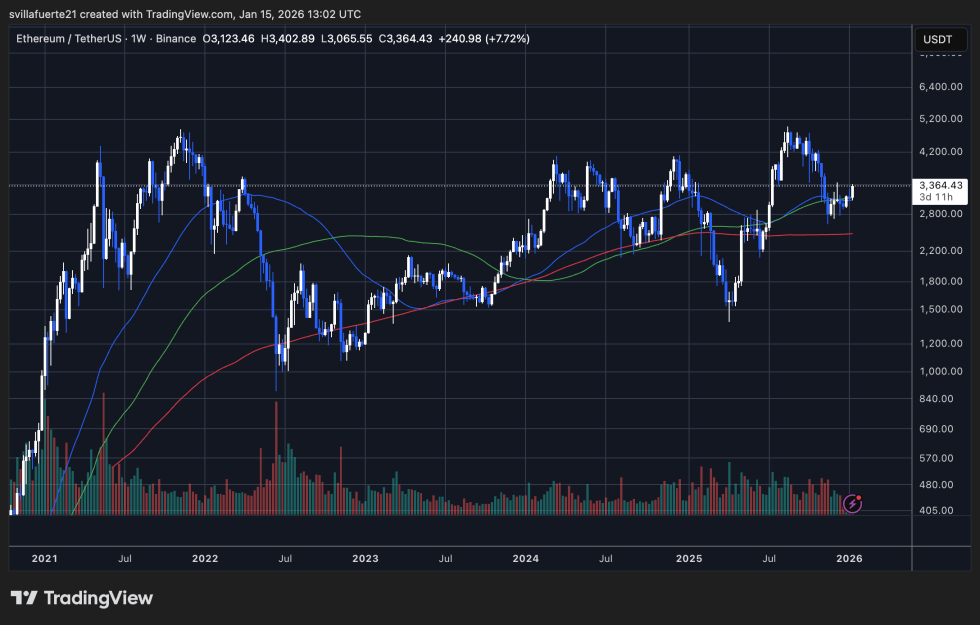
ETH consolidates around critical liquidity level | Source: ETHUSDT chart on TradingView

From a trend perspective, Ethereum remains above its long-term moving averages, including the 200-week line, which continues to slope upward. This suggests that despite recent drawdowns, the broader structural uptrend has not been invalidated. However, price is still trading below the previous cycle highs near $4,200–$4,400, highlighting that ETH is in a recovery phase rather than a confirmed breakout.

Momentum has improved compared to late 2025, with higher lows forming after the sharp sell-off toward the $1,600–$1,800 region. Volume during the rebound has been moderate, signaling participation without clear signs of speculative excess. This supports the idea of controlled accumulation rather than euphoric chasing.

Still, the inability to cleanly break above $3,400 keeps downside risk relevant. A rejection here could lead to renewed consolidation toward the $2,800–$3,000 zone. For bullish continuation, ETH needs a sustained weekly close above resistance, which would shift market structure and open the path toward higher liquidity zones above $3,800.

Featured image from ChatGPT, chart from TradingView.com 

Editorial Process for bitcoinist is centered on delivering thoroughly researched, accurate, and unbiased content. We uphold strict sourcing standards, and each page undergoes diligent review by our team of top technology experts and seasoned editors. This process ensures the integrity, relevance, and value of our content for our readers.


Policy Forces Reshape Bitcoin Trading as Four-Year Cycle Weakens

0

In brief

  • Political and fiscal actions are exerting greater influence on crypto prices than traditional cycle-based or on-chain indicators.
  • Expansionary spending, subdued real yields, and blurred monetary boundaries are reinforcing Bitcoin’s sensitivity to liquidity conditions.
  • Regulatory progress in Washington is emerging as a key variable shaping investor positioning and institutional appetite.

A new regime in which political announcements move markets more than internal metrics has begun to undermine the relevance of Bitcoin’s four-year cycle

While equities rallied in 2025, Bitcoin lagged, pointing to a market increasingly driven by liquidity expectations and policy timing rather than broad risk appetite.

Under the traditional four-year model, early 2026 would typically mark a late-cycle or post-peak phase. Instead, price action suggests investors are deferring that transition, with policy signals exerting greater influence than the halving-based cycle.

“Bitcoin reacts preemptively when markets expect quasi-QE,” Ryan Yoon, senior analyst at Seoul-based Tiger Research, told Decrypt. “Since Bitcoin is highly sensitive to liquidity, it is expected to lead the market.”

Quasi-QE refers to liquidity support delivered through fiscal or administrative channels that suppresses borrowing costs, without formal central-bank asset purchases.

Policy paradigm

Pre-election fiscal stimulus and confused monetary boundaries are driving this shift, creating what Binance’s Full-Year 2025 and Themes for 2026 report describes as a backdrop of “financial repression.”

Trump’s tariffs and public pressure on Federal Reserve Chair Jerome Powell to cut interest rates, alongside other policy interventions, have increasingly blurred the lines between fiscal, trade, and monetary policy, the report says.

As a result, U.S. policy has tilted toward suppressing borrowing costs and managing financial conditions through fiscal expansion and administrative action rather than conventional monetary tightening.

“Overall, the combination of fiscal dominance and financial repression creates a structurally supportive backdrop for digital assets,” the report reads. “Expansionary fiscal policy alongside suppressed real yields weakens traditional sovereign debt dynamics, while distortions in regulated credit markets increase the appeal of alternative financial rails.”

In other words, heavy government spending and policy-driven low interest rates are eroding the appeal of bonds and bank credit, prompting investors to seek alternatives such as crypto.

The report adds that governments, led by the U.S., are advancing multi-trillion-dollar spending measures ahead of the 2026 midterm elections, while elevated public debt is increasingly seen as constraining the Federal Reserve and raising the risk of quasi-QE delivered through administrative channels.

What’s next? 

Policy forces are likely to play a key role in dictating Bitcoin’s 2026 outlook, acting in tandem with sustained institutional demand patterns.

With progress on the delayed crypto market-structure bill emerging as a key driver of prices and eclipsing traditional on-chain signals, the near-term catalyst is regulatory.

“The crypto industry lobby has a warchest exceeding $100 million and a midterm election is coming up in November, so there is every incentive for U.S. lawmakers to hammer out a legislative outcome that favors the crypto industry,” Peter Chung, head of research at Presto Research, told Decrypt.

“The market narrative constantly evolves. Right now, it is right to focus on the CLARITY Act as it is an event that will shape the industry growth in the long run,” Chung added.

Though institutional demand from ETFs remains a structural support, policy development will dictate institutional thinking and, therefore, demand.

“Policy will definitely influence institutional demand, especially given their focus on long-term fundamentals,” Chung concurred.

Yoon had a similar take, suggesting that policy direction will determine whether the remaining demand from governments and institutions materializes. 

“The next twelve months are a critical window,” he said. “If these laws do not align with the timing of liquidity expansion, their impact will be limited.”

Daily Debrief Newsletter

Start every day with the top news stories right now, plus original features, a podcast, videos and more.

Ethereum Activity Retention Doubles With Record Transactions

0

Ethereum network activity has shown a sharp increase in new users, with “activity retention” almost doubling over the past month, according to crypto on-chain analytics platform Glassnode.

Month-over-month “activity retention” shows a sharp spike in the new cohort, “indicating a surge in first-time interacting addresses over the past 30 days,” Glassnode reported on Thursday.

It added that this reflects a notable influx of new wallets engaging with the Ethereum network, “rather than activity being driven solely by existing participants.”

New activity retention, or new network addresses, has spiked from just over 4 million to around 8 million addresses this month. 

Activity retention measures how many users continue to be active over time, essentially showing whether users stick around and continue using the network, rather than showing up once and disappearing.

Ethereum activity retention spikes to all-time high. Source: Glassnode

Daily transactions on Ethereum hit highs

Over the last year, the number of active addresses on the Ethereum network has more than doubled from around 410,000 accounts recorded this time last year to over 1 million on Jan. 15, according to Etherscan. 

Meanwhile, the number of daily transactions on Ethereum spiked to an all-time high of 2.8 million on Thursday, marking an increase of 125% since the same time last year. 

Related: Efforts to bulletproof Ethereum are paying off in user metrics

Macroeconomics outlet Milk Road reported on Thursday that this was due to an explosion of stablecoin usage on Ethereum while fees are collapsing.

“That’s the result of Ethereum pushing execution to L2s while keeping settlement secure on L1. That’s what scalable financial infrastructure actually looks like,” it stated.

Stablecoin usage on Ethereum is at an all-time high amid record-low fees. Source: Token Terminal 

“A lot to be optimistic about” with Ethereum

Confidence and sentiment around Ethereum are improving. “There’s a lot to be optimistic about when looking at Ethereum,” Justin d’Anethan, head of research at Arctic Digital, told Cointelegraph. 

“Near term, indicators that have been pushed into oversold territory have turned up and seem to hint at much higher prices, fueled by renewed capital inflows into ETFs, stablecoins, and native crypto protocols,” he added. 

Ethereum’s network activity has surged as daily transactions climb past 2 million while staking has reached nearly 36 million ETH, observed Nick Ruck, director of LVRG Research.

“These strong on-chain fundamentals, combined with sustained ETF inflows and growing ecosystem optimism, position ETH for a potential breakout above current resistance levels in the near term as liquidity tightens amid heightened institutional participation with recent scaling upgrades boosting speed and lowering gas fees,” he added.

All of this heightened network activity and sentiment should be bullish for the blockchain’s token. “There’s a lot of compression taking place with ETH, and that’s likely to break out in the coming week,” said MN Fund founder Michaël van de Poppe on Thursday.