Home Blog Page 986

Visa to acquire Prisma Medios de Pago and Newpay in Argentina

0

Visa (NYSE: V) today announced that it has entered into a definitive agreement to acquire Prisma Medios de Pago S.A.U. (“Prisma”) and Newpay S.A.U. (“Newpay”) in Argentina from Advent International. This strategic acquisition underscores Visa’s commitment to providing clients with the advanced capabilities and technologies that accelerate the adoption of innovative payment solutions for consumers and businesses across the country.

Prisma provides credit, debit and prepaid card issuer processing. Newpay is a multi-network infrastructure provider that operates real-time payments services, the Banelco ATM network and the bill payment platform PagoMisCuentas.

Upon closing, the combined technology platforms of Prisma and Newpay, together with Visa’s global network and value-added services, will accelerate the deployment of advanced technologies such as tokenization, biometric authentication, intelligent risk tools and agentic commerce solutions. These end-to-end capabilities will improve services from issuers and enhance speed and security for consumers, while delivering agnostic processing that supports any card brand processed by Prisma and all payment methods offered by Newpay.

“This acquisition is an important step for Visa in Argentina, strengthening our client partnerships and advancing innovation across the payments ecosystem,” said Ryan McInerney, CEO of Visa. “By bringing together Prisma’s and Newpay’s deep local expertise with Visa’s global solutions and technology, we will empower our clients to make payments simpler, faster, and more secure for consumers and businesses.”

“We see significant opportunities to expand digital payments adoption and modernize financial services, capabilities and infrastructure across the country,” said Gabriela Renaudo, Group Country Manager, Visa Argentina and Southern Cone. “This investment reflects Visa’s commitment to contribute to Argentina’s growth and enhancing its competitiveness in global commerce.”

The transaction is subject to closing conditions and is expected to close in Visa’s fiscal second quarter of 2026. Payway S.A.U. is not part of this transaction and will remain owned by funds managed by Advent International, continuing to operate independently as a merchant acquirer.

Ethereum Makes History With Majority Of Supply Staked – What It Means For Price And Network

0

Trusted Editorial content, reviewed by leading industry experts and seasoned editors. Ad Disclosure

While buying interest in Ethereum may be losing momentum, the staking ecosystem has been experiencing significant growth over the past few months. Following a period of steady rise, the quantity of ETH locked away in staking contracts has reached a critical landmark that could impact its market outlook.

Over Half Of All Ethereum Now Staked

Ethereum’s price has fallen below the $2,000 mark once again as Wednesday drew to a close. During the waning price action, the network seems to have reached a historical inflection point, as shown by the massive staking ecosystem growth.

In an X thread, Everstake, a leading and responsible validator, has outlined a crucial landmark for ETH, which could play a role in shaping its future. ETH staking activity just exploded, with more than half of the entire supply being locked away in staking, marking the first time in its history. With the switch to proof-of-stake, Ethereum’s staking participation has increased steadily. However, its economic design enters a new phase when it surpasses the 50% of all supply.

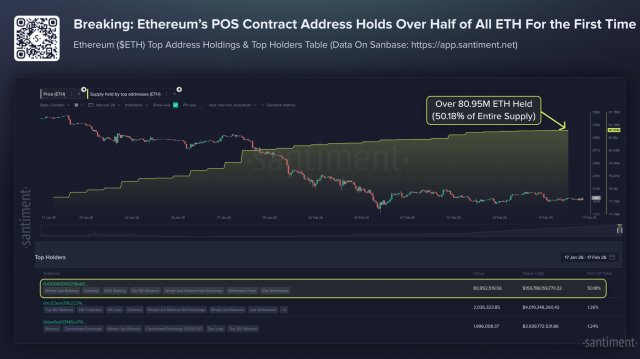
Everstake’s report is solely derived from data from Santiment, a popular on-chain data analytics platform. Data from the platform shows that the proof-of-stake contract on Ethereum now controls 50.18% of the total historical ETH issuance. Beyond just being a remarkable figure, it represents a key milestone in the project’s 11 history. In other words, this implies that the majority of ETH is no longer circulating or active in the market.

Ethereum
More than half of ETH is in staking contracts | Source: Chart from Everstake on X

When over 50% of the supply is being locked away in staking contracts, the liquid supply reduces, and fewer coins become available for trading. Such patterns often ignite sentiment as they decrease selling pressure and create a market sensitivity to new demand. At the same time, the development indicates conviction from long-term holders. 

Users are determined to secure the network rather than carry out trades in short-term volatility. Everstake remains confident that this is a structural shift for Ethereum. It’s reducing supply coupled with steady or growing demand points to robust price dynamics for ETH over time. “It doesn’t guarantee an immediate pump, but it changes the foundation the price is built on,” the firm stated.

A Market That Has Fallen Into Cold Levels

After an analysis of the MVRV Z-Score, RVT, and NUPL, Alphractal disclosed that the Ethereum market temperature is near cold levels. Specifically, this key metric measures whether the market is overheated or oversold, providing insights into risk-elevated periods and when asymmetry favors long-term positioning. 

When it gets close to zero or falls below, it indicates that the market has calmed down. Historically, readings below 0 typically precede a phase where risk and speculative are flushed, increasing the potential for long-term accumulation even as price declines. 

These zones underscore periods of reduced unrealized profits, triggering a balanced valuation and removing emotional excess from the market. In the past, major expansion phases have been preceded by extended positions in cold temperature zones, as weaker participants gradually exit and stronger hands progressively accumulate.

Ethereum
ETH trading at $1,981 on the 1D chart | Source: ETHUSDT on Tradingview.com

Featured image from Pixabay, chart from Tradingview.com

Editorial Process for bitcoinist is centered on delivering thoroughly researched, accurate, and unbiased content. We uphold strict sourcing standards, and each page undergoes diligent review by our team of top technology experts and seasoned editors. This process ensures the integrity, relevance, and value of our content for our readers.

‘Warhammer’ Veteran Jervis Johnson Warns AI Could Become the ‘Asbestos of the Internet’

0

In brief

  • In an interview, Jervis Johnson compared AI to “the asbestos of the internet.”
  • In January, Games Workshop formally barred generative AI from Warhammer design.
  • Johnson warned that generative AI could do developers more harm than good.

Artificial intelligence could become “the asbestos of the internet,” according to one of the architects of Warhammer 40,000.

Jervis Johnson, the longtime designer behind Warhammer 40,000, Necromunda, and Blood Bowl, criticized generative AI while supporting Games Workshop’s formal ban on the technology in its creative process.

“Most of the stuff that I’ve seen doesn’t seem to actually quite match up to the hype,” Johnson told gaming outlet FRVR. “I saw a great quote recently saying that AI is going to be like the asbestos of the internet and the computer industry. That we’re going to be spending decades getting this stuff out again after we’ve used it a lot and found out it’s actually a bit rubbish.”

Games Workshop, founded in 1975 and listed on the London Stock Exchange since 1994, is one of the largest tabletop gaming companies globally. In January, the maker of Warhammer 40,000 and Warhammer: Age of Sigmar reported about $422 million in revenue and roughly $178 million in operating profit for the 26 weeks ended Nov. 30, 2025.

In its half-yearly report released in January, Games Workshop CEO Kevin Rountree said the company does not allow AI-generated content or AI to be used in its design processes, or its unauthorized use outside of GW, including in any of its competitions.

“We have agreed an internal policy to guide us all, which is currently very cautious, e.g., we do not allow AI-generated content or AI to be used in our design processes or its unauthorized use outside of GW, including in any of our competitions,” Rountree said during an investor call.

Johnson said he supports that policy.

“I think it’s the right move for a lot of companies, to be perfectly honest,” he said. “I haven’t had a lot of experience with AI because I don’t use it. It’s not the way that I work, and I’m old so I don’t have to. It’s a newfangled kind of thing that I didn’t really get involved with in the first place.”

He said generative AI does not deliver high-end creative work, and in the end may be more harmful to developers than helpful.

“I think that if you’re going to do stuff at the top end, do properly interesting, creative stuff, then AI doesn’t help you,” Johnson said. “It’s a hindrance basically because it allows you to be a bit lazy and not put in the effort.”

Johnson described the development of Warhammer 40,000 as a process built on sustained human effort.

“There was a lot of work involved there, a lot of thinking, and thought, and meetings, and planning, and discarding ideas,” he said. “I worry that, with AI, what it does is it just cuts that out and shortcuts to kind of an average answer.”

Daily Debrief Newsletter

Start every day with the top news stories right now, plus original features, a podcast, videos and more.

Kraken xStocks Surpasses $25B in Tokenized Stock Volume

0

Kraken’s tokenized equities platform, xStocks, has surpassed $25 billion in total transaction volume less than eight months after launch, underscoring accelerating adoption as tokenization gains traction among mainstream investors.

Kraken disclosed Thursday that the $25 billion figure includes trading across centralized exchanges and decentralized exchanges, as well as minting and redemption activity. The milestone represents a 150% increase since November, when xStocks first crossed $10 billion in cumulative transaction volume.

The xStocks tokens are issued by Backed Finance, a regulated asset provider that creates 1:1 backed tokenized representations of publicly traded equities and exchange-traded funds. Kraken serves as a primary distribution and trading venue, while Backed is responsible for structuring and issuing the tokenized instruments.

When xStocks debuted in 2025, it offered more than 60 tokenized equities, including shares tied to major US technology companies like Amazon, Meta Platforms, Nvidia and Tesla.

Source: xStocks

Kraken said onchain activity has been a key growth driver since launch, with xStocks generating $3.5 billion in onchain trading volume and surpassing 80,000 unique onchain holders.

Unlike trading that occurs solely within centralized exchanges’ internal order books, onchain activity takes place directly on public blockchains, where transactions are transparent and wallets can self-custody assets. 

Growing onchain participation suggests users are not only trading tokenized equities but also integrating them into broader decentralized finance (DeFi) ecosystems.

Kraken said that eight of the 11 largest tokenized equities by unique holder count are now part of the xStocks ecosystem, signaling increased market share in the emerging tokenized equities sector.

Related: Kraken launches tokenized securities trading in Europe with xStocks

Tokenized stocks mirror stablecoins’ early growth

Tokenization of real-world assets (RWAs) remains one of the fastest-growing segments of the digital asset market, even as broader crypto prices have trended lower since the start of the year. 

Tokenized RWAs have increased 13.5% in total value over the last 30 days, according to industry data. By comparison, the broader crypto market shed roughly $1 trillion in market value over the same period. 

Market observers say tokenized stocks may be experiencing their own “stablecoin moment,” a reference to the rapid early adoption that propelled dollar-pegged digital assets into mainstream use. 

Data from Token Terminal shows tokenized stocks reached a market capitalization of $1.2 billion in December, after being virtually nonexistent six months earlier.

The market cap of tokenized stocks has grown considerably since September of last year. Source: Token Terminal

Related: Crypto’s 2026 investment playbook: Bitcoin, stablecoin infrastructure, tokenized assets

Cointelegraph is committed to independent, transparent journalism. This news article is produced in accordance with Cointelegraph’s Editorial Policy and aims to provide accurate and timely information. Readers are encouraged to verify information independently. Read our Editorial Policy https://cointelegraph.com/editorial-policy

Figure Technology data breach hits nearly 1 million accounts

0

The personal information of nearly one million Figure Technology customers has been compromised following a social engineering attack on the blockchain-based lender.

Editorial

This content has been selected, created and edited by the Finextra editorial team based upon its relevance and interest to our community.

Hackers stole Figure customers’ email addresses, names, dates of birth, physical addresses, and phone numbers, according to the Have I Been Pawned breach notification site.

Figure has provided little detail on the attack but told TechCrunch that an employee was tricked by a social engineering attack that saw the theft of “a limited number of files”.

Hacking group ShinyHunters has claimed responsibility and posted 2.5 gigabytes of data on its website, where it publishes stolen data if hacked companies do not pay a ransom.

Figure was co-founded by industry veteran Mike Cagney. Cagney previously built fintech SoFi but left in 2017 amid sexual harassment allegations.

The company connects origination, funding, and secondary market activity, claiming more than 200 partners for its loan origination system and capital marketplace. The firm and its partners have originated over $22 billion of home equity and it went public last year.

Optimism token price plunges 25% as Coinbase cuts off DAO from millions in revenue – DL News

0

  • Base will begin using in-house code, rather than Optimism’s OP Stack.
  • The move could have significant ramifications for the Superchain, a collection of blockchains that includes Sony’s Soneium, Uniswap’s Unichain, and Kraken’s Ink.
  • “This is a hit to near-term onchain revenues,” OP Labs CEO Jing Wang said on X.

Coinbase just broke up with the Optimism Collective — to the tune of tens of millions of dollars.

The US’ top crypto exchange is overhauling its nearly three-year partnership with the layer 2 software developer, saying that Coinbase’s Base blockchain will use in-house code moving forward, rather than Optimism’s OP Stack.

A spokesperson for Optimism confirmed that Coinbase will stop sharing Base revenue with the Optimism Collective. That revenue has topped $16 million over the course of the partnership.

“This is a hit to near-term onchain revenues,” OP Labs CEO Jing Wang said on X. “But as cryptotwitter has been saying for ages, we needed to evolve our biz model.”

Coinbase will instead remain as a customer of OP Labs’ “OP Enterprise” service, Wang added.

Base’s withdrawal hammered the price of Optimism’s token, OP. It has lost a quarter of its value since Wednesday, and was trading just under $0.14 as of this writing, down from its all-time high of $4.84 in 2024.

Coinbase has long shared 15% of Base revenue with the Optimism Collective, the digital cooperative that manages the OP Stack. To date, Base has contributed 8,387 Ether, worth about $16.4 million at Wednesday’s prices.

That’s 41% of the Optimism Collective’s lifetime revenue. But Base’s share of that revenue has shot up in recent months. In January, it hit 90%.

The move could, therefore, have significant ramifications for the Superchain, the collection of blockchains using the OP Stack. That list includes Sony’s Soneium, Uniswap’s Unichain, Kraken’s Ink, Worldcoin’s World Chain, and Optimism’s own OP Mainnet.

Wang and Coinbase didn’t return DL News’ requests for comment.

“We’re grateful for our three-year partnership with Base and proud to have helped it become one of the most successful Layer 2 deployments in history,” an Optimism spokesperson said in a statement shared with DL News.

“Our focus remains on delivering enterprise-grade blockchain infrastructure to our ecosystem, and we will continue to serve Base as an OP Enterprise customer while they build out their independent infrastructure.”

‘Disappointing’

OP Labs, a privately held company, has raised more than $175 million from the likes of Andreessen Horowitz and Paradigm. Its software engineers are responsible for maintaining and improving the OP Stack, though any changes they propose must be approved by the Optimism Collective.

A related entity, the Optimism Foundation, recently said it would seek to shift to the Collective at least some responsibility for funding Labs’ operations.

Superchain members’ tithe is denominated in Ether. That multimillion-dollar pot of crypto initially sat dormant, with the Collective instead issuing grants denominated in OP.

Those grants are intended to lure software developers to the Superchain — more developers means more applications, and more applications means more users.

But Optimism recently began putting that Ether to work.

Last March, The Collective approved staking most of the Ether in order to earn passive yield.

And, just last month, the collective approved a buyback programme meant to tie the value of OP to the Superchain’s success. Half of all the revenue flowing into the Collective is now being used to purchase OP. The Foundation was given permission to actively manage the other half.

Why Superchain?

“It’s disappointing, but in many ways unsurprising,” PaperImperium, a pseudonymous member of Optimism Collective delegate GFX Labs, told DL News. “Base has to answer shareholders and do what is best for them.”

The OP Stack is open-source: that means anyone can use the code for any reason, without seeking permission from Optimism.

“So why do chains like Base, Mode, Worldcoin, Zora, and all others in the Superchain choose to contribute shared revenue?” Optimism wrote in a 2024 blog post. “The answer lies in the network structure designed to benefit the entire Collective.”

Improvements to the OP Stack were supposed to turn the Superchain’s various members from a federation of siloed blockchains into a single, interoperable network.

“That unfortunately has not materialised despite years of technical work,” PaperImperium said.

Coinbase said it was making the move in order to speed its upgrade cadence, simplify its code, and pilot changes that could eventually appear on Ethereum.

“We could not have gotten so far so quickly without the world-class technology underpinning the OP Stack and are grateful for the collaboration over the last three years,” Coinbase said in a blog post.

When Base joined Optimism in 2023, it was given “the opportunity” to earn up to 118 million Optimism tokens over a six year period. It was not immediately clear how many of those tokens Base had earned or what would happen with the remainder.

Optimism did score a victory on Wednesday, when Ether.fi said it would move its crypto-based credit card from layer 2 blockchain Scroll to OP Mainnet.

“Over the coming months, ~70,000 active cards, ~300,000 accounts, and millions in user TVL are moving to Optimism,” Optimism said in a blog post. “For Optimism, this positions OP Mainnet as a leading chain for payments activity.”

As for Coinbase, Wang said it would remain as a customer of OP Labs’ “OP Enterprise: Mission-Critical” service, given Base’s ongoing reliance on Optimism-built code.

“If Base makes so many changes that it’s no longer recognizable as the OP Stack then they will no longer require ‘Mission Critical’ support from us,” she wrote.

Aleks Gilbert is DL News’ New York-based DeFi correspondent. You can reach him at aleks@dlnews.com.


Square expands partner ecosystem in 2026, empowering sellers with connected tools, insights, and expertise to accelerate growth

0

With nearly 1,000 industry-leading partners including Amazon, ClassPass, Intuit QuickBooks, Uber Eats, and Wix, Square is enabling sellers to save time managing systems and gain time engaging customers

Square today announced that it is expanding its partner ecosystem in 2026, further solidifying its standing as the provider of choice for sellers and partners alike. With key partners including Amazon, Apple, Intuit QuickBooks, and Uber Eats choosing Square, the company is reinforcing its commitment to providing sellers with the best-in-class tools needed to succeed. Seventy-one percent of enterprise sellers utilize at least one of Square’s partner solutions, and the options Square provides are rapidly expanding. Through the Square App Marketplace, sellers can seamlessly access and integrate proven tools that optimize how they run and scale their business.

“From the beginning, Square was built to empower local businesses by providing an open, interconnected ecosystem,” said Morgan Kuntze, Global Partnerships Lead at Block. “Sellers have the flexibility to choose how they accept payments, reach customers, and run their operations. Simultaneously, Square enables our best-in-class partners to innovate, scale, and reach millions of engaged businesses. By investing in both sides of this ecosystem, we’ve created a flywheel of shared success that strengthens our end-to-end network.”

Whether a business is just getting started or rapidly scaling, Square’s partner ecosystem empowers businesses to operate more efficiently and move forward with confidence as they grow. Sellers can continue using their preferred tools without having to re-work their backend. As they expand, Square enables them to easily add new partners that meet their increasingly complex needs – without disrupting what’s already working.

Powering Sellers to Take Payments Wherever Customers Are

Sellers rely on a range of digital tools to connect with customers, from websites and booking apps to industry-specific platforms. Square integrates directly into these existing workflows, making it easy to accept payments anywhere business happens so that sellers never miss a sale. With nearly 1,000 partners – more than two-thirds of whom have built integrations – Square supports the gamut of food & beverage (F&B), retail, health and beauty, and professional services businesses. Sellers can connect to the likes of Wix, Whoosh, WooCommerce, and a number of electronic medical record (EMR) providers via Reference Health. For bespoke solutions, individual developers or sellers can build on Square’s open developer platform and APIs to create custom, integrated solutions that support the unique needs of their business.

Enabling Discovery Everywhere Customers Explore

Today’s consumers are searching, browsing, and ordering across search engines, maps, social platforms, and online marketplaces. Square makes it easy for sellers to get discovered wherever customers are already looking. Through integrations with platforms like Google; social channels including Facebook and Instagram; and marketplaces such as ClassPass, DoorDash, Groupon, Grubhub, and UberEats, sellers can sync listings, activate channels, and enable ordering or booking directly from search results, social feeds, and voice assistants. Square also partners with agencies like Griffin Collective and Vibe Digital Marketing to extend reach through SEO and targeted marketing expertise, helping businesses grow locally and scale globally.

Providing the Freedom to Focus with a Seamlessly Connected Back Office

Square helps sellers run day-to-day operations smoothly and stay focused on the business – not the back office. Whether sellers rely on Square-built functionality or prefer an existing external tool, Square’s partner integrations streamline accounting, inventory, fulfillment, and operations. Sales and accounting are synced with tools like QuickBooks, Restaurant365, and Xero. From inventory management with Thrive for Shopify users, to automation through Zapier, distribution through the Etsy marketplace, and fulfillment partners including Faire, Printful, Shippo, and ShipStation, Square enables smooth day-to-day operations while workflows run in the background, saving sellers valuable time.

Facilitating Smarter, Faster Decisions with Actionable Insights

Running a business means making constant decisions, often with incomplete information. Square brings together real-time transaction data, costs, inventory, and market signals across its partner ecosystem to help sellers act with confidence. Integrations with analytics and reporting platforms provide a holistic view of performance, revealing what’s selling, where costs are rising, and how demand is shifting. Partners like reservations solution OpenTable delivers insights into customer behavior and preferences. Meanwhile, HotSchedules will soon integrate Square’s real-time sales data to help restaurants schedule to demand, maximize profits every shift, and improve service quality.

Unlocking Expert Support and Value Through Trusted Partners

Square collaborates with industry associations, technology advisors, broadline food distributors, and vetted partners who understand sellers’ unique needs – providing both expert guidance and exclusive benefits that help businesses operate more efficiently. Partners such as LegalZoom, FoundersCard, and Sysco not only optimize backend connections, but also offer compelling credits and discounts. Square further partners with restaurant associations across the US – including the California Restaurant Association, Illinois Restaurant Association, and New York State Restaurant Association – to help sellers evaluate, implement, and optimize their tech stacks.

In addition, Square sellers gain access to exclusive partner offers, including $250 off bookkeeping with Paperchase, among others.

“As we expand our enterprise partnerships in 2026, we’re redefining what it means to be a business platform – one that’s open by design, flexible by default, and built to scale alongside sellers at every stage of growth,” added Kuntze.

Bitcoin’s Lightning Network Passes $1 Billion In Monthly Volume

0

Bitcoin’s Lightning Network, the layer-two protocol designed to facilitate faster and cheaper transactions, has surpassed $1 billion in monthly transaction volume, according to new data from River. 

In November 2025, the network processed an estimated $1.17 billion across 5.22 million transactions, marking a milestone in adoption despite Bitcoin’s stagnant price performance throughout the year.

River’s research aggregates anonymized data from major Lightning node operators to provide a network-wide estimate. Their methodology accounts for overlapping channels and extrapolates to untracked nodes, giving a more accurate picture of the Lightning ecosystem. 

“This approach allows us to debunk misconceptions that Lightning adoption isn’t happening,” River said, noting contributions from entities including ACINQ, Kraken, Breez, Lightspark, LQWD, and others, covering over 50% of network capacity.

Interestingly, the transaction count fell slightly compared to 2023. Researchers attribute this to the fading of micropayment experiments in gaming and messaging that had temporarily inflated activity. 

While these applications did not achieve sustained adoption, River said they expect future experimentation — particularly with AI-powered agentic payments — to drive new spikes in network usage.

Last week, Lightning Labs released an open-source toolkit that enables AI agents to run Lightning nodes, make autonomous payments, and host paid services using the Network, addressing the need for native, machine-to-machine transactions. 

Bitcoin lightning transactions shifts toward larger transfers

Despite being known as a network for micropayments, the average Lightning transaction in November 2025 was $223, up from $118 the previous year. Analysts say this reflects the dominant use case today: moving larger sums between exchanges rather than everyday small purchases. 

“Micropayment theory suggested high-frequency, low-value payments, but mental transaction costs for humans limit this behavior,” River explained in a social media report. “AI agents, which do not incur mental costs, could change this dynamic, potentially leading to more frequent, smaller payments in the future.”

Lightning Network’s rise highlights a layer of Bitcoin adoption that price charts often miss, driven by exchange activity and a growing number of businesses accepting this form of payment. 

Crossing $1 billion in monthly volume marks a milestone for Bitcoin’s layer-two infrastructure and signals progress toward using BTC as a means of transaction and settlement.

Looking ahead, River plans to release a comprehensive report on Bitcoin adoption next week, which will include additional metrics showing meaningful growth in usage and integration across the crypto ecosystem.

SEC Leadership Speaks on ‘Number go Down‘ Regulatory Concerns

0

Paul Atkins and Hester Peirce spoke at ETHDenver on Wednesday on the future of regulation at the SEC and its response to crypto market volatility.

Paul Atkins, chair of the US Securities and Exchange Commission (SEC), and the agency’s crypto task force head, Hester Peirce, said Wednesday they would support efforts to clarify how “tokenized securities interact with existing regulation,” better positioning industry developers.

Speaking to attendees at the ETHDenver conference on the future of regulation, Atkins and Peirce addressed concerns about volatility in many cryptocurrency prices and how the agency plans to move forward with digital asset regulation amid a potential market structure bill in Congress.

In response to “falling crypto prices of late,” likely referring to the price of Bitcoin (BTC) and Ether (ETH) falling by more than 28% and 40%, respectively, in the previous 30 days, Atkins said:

“As regulators, the best thing we can do is to ensure that the rules governing the asset classes we regulate enable people to have the information they need to express their market sentiments through decisions about whether to buy, sell, or hold the assets at issue.”

SEC’s Hester Peirce (left) and Paul Atkins (right). Source: ETHDenver

Neither commissioner directly spoke on efforts to pass market structure legislation in Congress, although Peirce said that the SEC had “provided technical assistance” on the matter. A bill moving through the US Senate, called the CLARITY Act when it passed the House of Representatives in July, could shift much of the SEC’s authority over digital assets to the Commodity Futures Trading Commission (CFTC).

Related: Democratic lawmakers slam SEC Chair Atkins over crypto enforcement

ETHDenver, happening this week in Colorado, is one of the largest cryptocurrency events in the United States, bringing together developers and industry leaders.

CFTC is still understaffed, despite Senate-confirmed chair

Michael Selig, confirmed as a commissioner and chair of the CFTC in December, remains the sole leader at an agency intended for five commission members. As the US Senate considers provisions within the market structure bill, some lawmakers have pushed for language requiring at least four commissioners to be confirmed before the law can take effect.

Magazine: Brandt says Bitcoin yet to bottom, Polymarket sees hope: Trade Secrets