
Home Blog Page 984

CLARITY Act On Track For April Passage, Senator Says

0

Trusted Editorial content, reviewed by leading industry experts and seasoned editors. Ad Disclosure

US lawmakers and crypto leaders say a major bill could move fast. According to an on-site interview, Senator Bernie Moreno told reporters he hopes the US CLARITY Act will clear Congress by April.

The comment came during a recent gathering with members of the press, and it set off a flurry of reaction across markets and inside the halls of power.

Lawmakers And Industry At Odds Over Clarity Act

Reports note that the biggest fight left on the table is stablecoin yields. Coinbase CEO Brian Armstrong said industry talks are more hopeful now, but he had pulled his group’s backing earlier because the bill would ban interest-bearing stablecoins and put the SEC front and center as the lead regulator.

That tug-of-war matters. Banks worry that easy yield on crypto tokens could pull deposits and weaken their model. Crypto firms counter that such products are useful and in demand. Both sides also want clear rules so firms can plan ahead.

Policymakers Have Momentum

Based on reports, the White House reacted strongly when one major exchange stepped back from support. The executive office signaled surprise and urged quicker agreement.

Markets noticed. Prediction markets moved, with odds on passage swinging dramatically in response to the media interview.

Polymarket showed a sharp uptick in probability that the bill would pass — then a pullback once details were questioned.
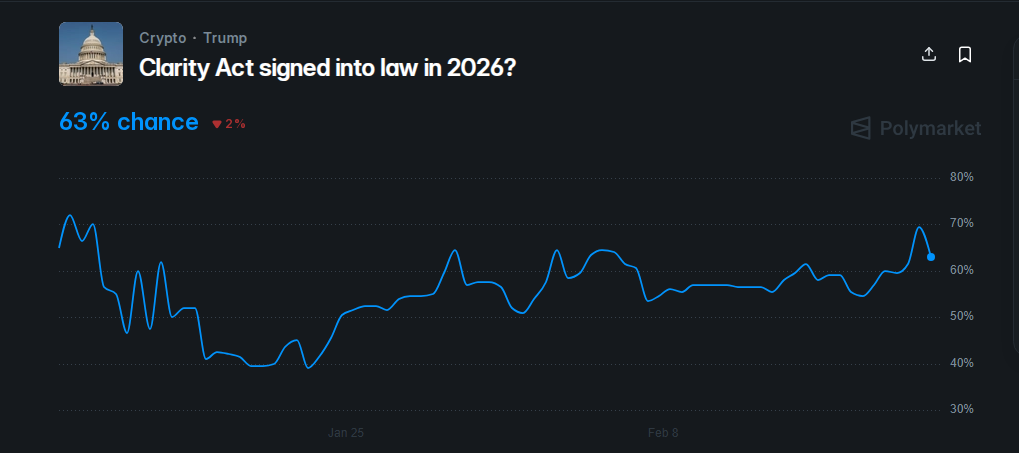
Source: Polymarket

“Hopefully by April,” Moreno said during an interview at US President Donald Trump’s Mar-a-Lago resort in Florida on Wednesday.

BTCUSD currently trading at $66,621. Chart: TradingView

What Could Break The Deal

Trump has pushed a pro-crypto message, and that helps gathering momentum among allies in Congress. But partisan lines remain.

If members tie the bill too closely to a single political brand, bipartisan support could fray. Also, banks and regulators are not uniform: some large institutions want stricter rules; others prefer limited, clearer guardrails that let certain products exist under oversight.

Why Fast Passage Is Uncertain

Reports say industry players want clarity asap, while some regulators want broader authority. That difference explains the public sparring.

Negotiators can and do move quickly when leadership prioritizes a measure, yet complex financial bills often require many rounds of drafting and amendment. Even so, lawmakers and execs at industry meetings appear to be pushing hard for a resolution soon.

If the bill clears, it could bring clearer rules for exchanges, banks, and stablecoin issuers. For investors, clarity is usually good. For firms, the shape of the final text will determine whether new products live or die.

Featured image from Wallpapers.com, chart from TradingView

Editorial Process for bitcoinist is centered on delivering thoroughly researched, accurate, and unbiased content. We uphold strict sourcing standards, and each page undergoes diligent review by our team of top technology experts and seasoned editors. This process ensures the integrity, relevance, and value of our content for our readers.


Trump-linked crypto venture WLFI taps Securitize for Maldives resort tokenization

0

World Liberty Financial is tapping real-world asset specialist Securitize to help tokenize loan interests tied to the Trump International Hotel and Resort in the Maldives.

Rather than direct equity in the properties, investors will be able to buy tokens tied to loan revenue, according to a Wednesday announcement timed for the privately held company’s Mar-A-Lago crypto conference.

World Liberty Financial is turning to one of the largest companies in digital securities. Securitize has worked with major asset managers such as BlackRock, Hamilton Lane and Apollo Global Markets to issue tokenized funds and private credit on public blockchains. BlackRock and Cathie Wood’s Ark Invest are also investors in the firm, which plans to go public by merging with a Cantor Fitzgerald-sponsored special-purpose acquisition company (CEPT).

“We built World Liberty Financial to open up decentralized finance to the world,” said Eric Trump, a co-founder of the company. “With today’s announcement, we are now extending that access to tokenized real estate.”

Eligible accredited investors will receive a fixed yield and payments linked to the loan’s performance. The sale will take place under U.S. private placement rules, with restrictions on resale.

Plans to tokenize the Maldives resort were unveiled in November. The resort, developed by DarGlobal in collaboration with the Trump Organization, is expected to include about 100 beach and overwater villas and reach completion in 2030. In October, Eric Trump said on CoinDesk TV that WLFI planned to tokenize a new real estate project.

The latest announcement focuses on who will handle the mechanics. Securitize will oversee issuance and compliance for tokens representing interests in a development loan connected to the project.

While tokenization of traditional assets like stocks and funds has gained the attention of Wall Street firms, real estate represents a smaller slice of the $25 billion tokenized asset market. Proponents argue that blockchain rails can streamline property ownership records and settlement, but uneven regulation and thin secondary trading pose a risk, an EY report noted last year.

The company’s WLFI token has dropped 6.6% in the past 24 hours to 11.63 cents.

OCC-Regulated Anchorage Digital Brings Stablecoin Minting to Banks

0

Anchorage Digital has introduced a federally regulated stablecoin platform aimed at helping licensed international banks move U.S. dollars across borders in minutes instead of days. Federally Chartered Crypto Bank Debuts Stablecoin Settlement Platform The company, which operates as a federally chartered trust bank under oversight from the Office of the Comptroller of the Currency, said […]

Google Releases Gemini 3.1 Pro, Targeting Enterprises

0

With the next level of agentic AI requiring high-level reasoning, Google on Tuesday released Gemini 3.1 Pro to deliver it.

Google said Gemini 3.1 Pro represents the next step in core reasoning. The model is better at complex problem-solving and is meant for tasks for which a simple answer is not enough. With coding tasks, the model can generate website-ready animated scalable vector graphics (SVGs) directly from text prompts. SVGs are images created with instructions rather than pixels.

The release of Gemini 3.1 Pro follows generative AI vendor and Google rival Anthropic’s introduction on Feb. 17 of Sonnet 4.6, a model that focuses on improved coding and computer use skills. It also comes a week after Google upgraded Gemini Deep Think, its thinking model to solve challenging research problems.

The release also illuminates a trend in the AI market in which model providers are pushing toward the next step of agentic AI and touting that better reasoning will help enterprises get there. Since reasoning is a significant part of agentic AI, a model with improved reasoning skills is a superior AI system than one with subpar reasoning capabilities.

Related:Anthropic Tries to Change the Conversation With Sonnet 4.6

“In principle, it is true that if you want to do complex tasks, you have to be able to do better reasoning,” said Chirag Shah, a professor at the Information School at the University of Washington.

However, better reasoning is not the only building block needed for complex tasks, Shah said. Moreover, it is unclear what Google means by “complex.”

“Just saying that, ‘oh this model can do complex tasks,’ you have to take it with a grain of salt because it depends on how you define complex,” he said.

But Gemini 3.1 Pro also demonstrates other strong capabilities, such as the ability to ingest, understand, and consume data from an API, and to code a simulation using integrated tools, said William McKeon-White, an analyst at Gartner. 

“This is good, continued progress,” McKeon-White said. “However, there wasn’t something I would say is a fundamental gamechanger.”

Beyond touting better reasoning skills, Google, in rolling out updated iterations of its core foundation model, Gemini, is also showing how it is building models that serve multiple enterprise needs. Although Google has yet to become known as the preferred AI vendor for a specific task, as Anthropic is known for coding, the tech giant is aiming to show enterprises that it is still well-versed in those tasks.

“They want to be the one-stop shop for all your model needs,” Shah said, adding that Google is trying to build a portfolio that will appeal to enterprises that might care about coding, searching and informational tasks. While enterprises might have the option to choose from Anthropic, OpenAI, Google or other vendors, most will settle on only one ecosystem to buy into. Google is trying to provide well-crafted models that fit different enterprise needs.

Related:Nvidia and Meta Agree to Wide-Ranging new AI Chip Deal


Ethereum price eyes historic slide as Bitwise flags $1,500 – DL News

0

  • Ethereum is in the midst of its sixth straight down month.
  • The second largest crypto is down nearly 40% in the past month.
  • Max Shannon of Bitwise reckons $1,500 could be on the cards.

Ethereum price risks crashing 22% to hit $1,500 as it’s on track to suffer through its worst streak in history, according to Max Shannon, senior research associate at Bitwise.

If the second biggest cryptocurrency’s price continues to fall in March, it would be within reach of the seven-month slump that extended between May and November 2018.

“Until a clear macro or idiosyncratic catalyst emerges to revive momentum and sentiment, downside risks extend below $1,500 for Ethereum,” Shannon told DL News.

For Shannon, there’s one clear-cut culprit behind Ethereum’s woes, and that’s Bitcoin. Ethereum moves in tandem with Bitcoin but suffers bigger swings. When Bitcoin drops 10%, Ethereum typically falls further, Shannon said.

“ETH continues to trade as a highly correlated, high-beta expression of BTC,” Shannon said, meaning Ethereum amplifies whatever Bitcoin does.

Plus, the market is ignoring good news and focusing purely on price charts, with Bitcoin leading the way down, Shannon said.

Baffling investors

On paper, though, things should be going Ethereum’s way.

It has lined up everything needed to hit another record. It, like the rest of the crypto industry, are enjoying a wave of regulatory clarity across the world.

A smattering of issuers have launched US spot Ethereum exchange-traded funds, and the $300 billion stablecoin sector relies heavily on the blockchain. It has even been name-checked by BlackRock’s CEO Larry Fink.

The stars have seemingly aligned, but Ether continues to give investors lacklustre price returns.

A glimmer of hope

There’s light at the end of the tunnel, however.

Options trades have backed off their most extreme bearish bets, said Shannon. Options give investors the right to buy or sell an asset at a certain price. The dealers who sell these options need to hedge their bets by buying or selling the actual cryptocurrency as it moves in one direction or another.

Right now, there’s a concentration of options in the range between $2,100 and $2,400. If Ethereum can climb back into that range — which means a rally of 10% to 20% — options dealers would be forced to buy Ether to protect themselves.

Still, to get Ethereum trending back upwards there need to be catalysts.

“The passage of the Clarity Act, and the resurgence of [digital asset treasuries] and ETFs purchasing more than 100% of the new supply, should boost ETH closer to new all-time highs,” he said.

Pedro Solimano is a markets correspondent based in Buenos Aires. Got a tip? Email him atpsolimano@dlnews.com.

Forest Lawn Memorial Parks Achieves Complete Spend Management Through Vroozi Platform Integration

0

WHY THIS MATTERS:

Procurement is often treated as a back-office control function. But Forest Lawn Memorial Parks & Mortuaries’ expanded deployment of Vroozi shows what happens when spend management becomes embedded across the operational core of an organisation.

By integrating Vroozi’s AI-powered procure-to-pay suite with NetSuite ERP and Shopify, Forest Lawn has moved beyond simple purchase order automation. It now manages all organisational spend across more than 1,000 suppliers — covering indirect procurement, direct materials, and specialised services such as Dove Release, musicians, ministers and interpreters — within a single, unified platform.

Vroozi, a leading provider of AI-powered procurement and accounts payable automation solutions, today announced that Forest Lawn Memorial Parks & Mortuaries has successfully implemented comprehensive spend management across their organization through the Vroozi platform, integrating procurement operations with NetSuite, and Shopify systems.

Forest Lawn, which began using Vroozi procurement software in 2018, has expanded its use of the platform to manage all organizational spend across more than 1,000 suppliers, including both indirect procurement and direct material purchases. After finding success with purchase management functionality, Forest Lawn added accounts payable capabilities in 2023, now utilizing Vroozi’s complete procure-to-pay suite. The implementation, which employees know as the “Forest Lawn Marketplace,” coincides with Forest Lawn’s recent transition to NetSuite ERP, with Vroozi supporting multiple phases of the migration including temporary integrations with transitional systems such as Bill.com.

“Our goal has always been to bring all spend under management for complete visibility and compliance,” said Gretchen Vance, Vice President of Procurement at Forest Lawn Memorial Parks & Mortuaries. “What we’ve achieved goes beyond that initial vision – we’re now triggering purchase orders directly from Shopify sales orders, automatically replenishing inventory at reorder points, and even managing specialized services like Dove Release services through the same platform. The integration work with NetSuite and now Shopify means procurement isn’t a separate function anymore – it’s woven into how we operate every day.”

The expanded implementation includes several key integrations:

Inventory Management with NetSuite: Forest Lawn uses Vroozi to automatically replenish stock. When inventory reaches reorder points in NetSuite, the system triggers purchase orders in Vroozi, which creates and sends orders to suppliers. Vroozi updates the inventory system when items are ordered and increases quantity on hand when goods are received.

Order Fulfillment through Shopify: Forest Lawn is connecting Shopify to their procurement workflow. When flower shop orders are fulfilled via Shopify, the API integration fulfills the orders through Vroozi. 

Service Procurement: The organization uses Vroozi to manage services including Dove Release, Musicians, Ministers and Interpreters for ceremonies.

“Forest Lawn really shows what’s possible when procurement platforms serve as the backbone for entire operational workflows,” said Shaz Khan, Co-founder and Chief Strategy Officer at Vroozi. “Since partnering with Forest Lawn in 2018, we’ve watched them continuously expand their use of the platform, from replacing manual-intensive processes to now connecting procurement with inventory management, sales operations, and fulfillment systems. When a sale triggers an inventory need that creates a purchase order that updates multiple systems in real-time, that’s when procurement becomes genuinely strategic to the business.”

The comprehensive implementation represents significant progress from Forest Lawn’s initial deployment in 2018, when the organization moved from manual, paper-based procurement processes to digital operations. The current integration extends that foundation to create connections across multiple business systems, supporting the organization’s continued growth and operational efficiency.

FF NEWS TAKE:

Forest Lawn’s journey — from manual paper-based processes in 2018 to a fully integrated digital marketplace — reflects a broader trend: procurement is becoming a strategic control tower for enterprise operations.

Vroozi’s value proposition here isn’t just AI-powered automation. It’s its ability to act as connective tissue between core systems. When procurement can trigger actions based on sales data, update inventory in real time, and manage services alongside goods, it stops being siloed and becomes part of revenue enablement and operational resilience.

The branding of the system internally as the “Forest Lawn Marketplace” is also telling. This isn’t positioned as an internal control tool — it’s an operational ecosystem. That shift in perception often determines whether digital transformation initiatives stick.

Bitcoin $60K Retest Odds Rise As Bearish Options, ETF Outflows Show Fear

0

Key takeaways:

  • Professional traders are paying a 13% premium for downside protection as Bitcoin struggles to maintain support above $66,000.

  • While stocks and gold remain strong, $910 million in Bitcoin ETF outflows suggest that institutional investor caution is rising.

Bitcoin (BTC) price entered a downward spiral after rejecting near $71,000 on Sunday. Despite successfully defending the $66,000 level throughout the week, options markets reflect growing fear as professional traders avoid downside price exposure. 

Even with relative strength in the stock market and gold prices, traders seem to be effectively betting on a $60,000 retest rather than overreacting to Bitcoin price dips.

BTC two-month options delta skew (put-call) at Deribit. Source: laevitas.ch

Bitcoin put (sell) options traded at a 13% premium relative to call (buy) instruments on Thursday. Under neutral conditions, the delta skew metric typically ranges between -6% and +6%, indicating balanced demand for upside and downside strategies. The fact that these levels have been sustained over the past four weeks shows that professional sentiment is leaning heavily toward caution.

Top BTC options strategies at Derbit past 48h, USD. Source: Laevitas.ch

This bearish bias is clear in the neutral-to-bearish positioning seen in Bitcoin options. According to Laevitas data, the bear diagonal spread, short straddle and short risk reversal were the most traded strategies on the Deribit exchange over the past 48 hours.

The first lowers the cost of the bearish bet because the short-term option loses value faster, while the second maximizes profit if Bitcoin price barely moves. The short risk reversal, on the other hand, generates profit from a downward move with little to no upfront cost, but it carries unlimited risk if the price spikes.

Weak institutional demand for Bitcoin ETFs fuels discontent

To better gauge the risk appetite of traders, analysts often look at stablecoin demand in China. When investors rush to exit the cryptocurrency market, this indicator usually drops below parity.

USD stablecoin premium/discount relative to USD/CNY rate. Source: OKX

Under neutral conditions, stablecoins should trade at a 0.5% to 1% premium relative to the US dollar/Yuan exchange rate. This premium compensates for the high costs of traditional FX conversion, remittance fees and the regulatory friction caused by China’s capital controls. The current 0.2% discount suggests moderate outflows, though this is an improvement from the 1.4% discount seen on Monday.

Part of the current discontent among traders can be explained by the lackluster flows in Bitcoin exchange-traded funds (ETFs), which serve as a proxy for institutional demand. 

Related: Bitcoin ETFs still sit on $53B in net inflows despite recent outflows–Bloomberg

US-listed Bitcoin ETFs daily net flows, USD. Source: Farside Investors

US-listed Bitcoin ETFs have seen $910 million in total outflows since Feb. 11, which likely caught bulls off balance, especially as Bitcoin traded 47% below its all-time high while gold prices hovered near $5,000, up 15% in just two months. Similarly, the S&P 500 index sat only 2% below its own all-time high, indicating that this risk-aversion is largely restricted to the cryptocurrency sector.

While Bitcoin options signal a fear of further downside, traders are likely staying extremely cautious until a clear rationale for the crash to $60,200 on Feb. 6 finally emerges.