
Home Blog Page 983

OpenAI KYC provider accused of sharing users’ crypto addresses with federal agencies – DL News

0

  • OpenAI KYC provider accused of sharing customers’ data.
  • Persona’s code allegedly show US government connection.
  • Integration lets operators monitor crypto addresses.

A company that conducts the know-your-customer checks required to access OpenAI’s advanced chatbots is allegedly sending customer data — including associated crypto addresses — to federal agencies.

A February 18 investigation published by security researchers who go by vmfunc, MDL, and Dziurwa found publicly accessible code that appears to send data collected by Persona, the KYC provider, to The Financial Crimes Enforcement Network — or FinCEN — a bureau of the US Department of the Treasury that safeguards the financial system from illicit use.

“The same company that takes your passport photo when you sign up for ChatGPT also operates a government platform that files Suspicious Activity Reports with FinCEN and tags them with intelligence programme codenames,” the investigation’s authors said.

“So you uploaded a selfie to use a chatbot? Congratulations! It’s now being compared against a database of every politician, head of state, and their extended family tree on earth.”

‘Unanswered questions’

Multiple IT specialists and security experts confirmed to DL News that the investigation and its findings appear legitimate.

“It appears the research is credible and you can verify that the government domains cited do exist, and are highly likely hosted on dedicated infrastructure by Persona,” Tanuki42, a pseudonymous security researcher who contributes at SEAL911 and zeroShadow, the blockchain incident response groups, told DL News.

“That said, there are still a lot of unanswered questions around motives, what this platform is used for, and who it is used by.”

Persona CEO Rick Song has since responded to the allegations publicly on X. He accused the investigation’s authors of not reaching out to him before publishing their findings.

In emails between vmfunc and Song posted by Song on his X account, the Persona CEO said his firm does not work with any federal agency today. He has yet to directly address the findings of the investigation.

“I am genuinely disappointed in how all of this has been handled,” Song said on Thursday in a since-deleted X post. “What has really been frustrating for me is that I also admire vmfunc’s work and their clear talent.”

Vmfunc, also known in online circles as Celeste, is widely regarded as credible because of their track record of technical investigations that other security experts have repeatedly validated.

OpenAI and Persona did not immediately respond to DL News’ requests for comment.

Surveillance fears

The allegations come as both crypto users and the broader public grow increasingly concerned about the mass surveillance and privacy-eroding capabilities of enforced identification checks.

The fear is that companies like Persona, working with government agencies, could use identification data collected from customers to create a vast Orwellian surveillance network that uses opaque criteria to place users on watchlists without their knowledge, consent, or public oversight.

In recent years, more and more platforms have started requiring users to hand over personally identifiable information, often in the name of preventing crime or protecting vulnerable groups.

Yet critics say the checks do more harm than good.

Many of the biggest companies that provide KYC services have been found to misuse and mishandle data.

Even when companies aren’t misbehaving, the huge swaths of data they hold make them lucrative targets for hackers. Several more platforms have in recent years suffered data breaches, leaking millions of users’ personal data.

The issue is close to the hearts of crypto advocates.

Many early Bitcoin contributors were self-styled cypherpunks, privacy activists advocating for cryptography and privacy-preserving technologies to protect the public against government and corporate surveillance.

Persistent monitoring

When a user is prompted to verify their identity with OpenAI, their KYC data — usually a photo of their passport, a selfie, and a short video of their face — is sent to Persona for verification.

That data is then automatically screened against global sanctions and warning lists, undergoes facial similarity scoring, and is checked against records of people linked to terrorism, cybercrime and other financial crimes.

That’s all standard stuff.

But at the same time, the same information is sent directly to government agencies, according to Vmfunc, MDL, and Dziurwa.

The investigation found code that gives operators the ability to file suspicious activity reports straight to FinCEN; file equivalent reports to Canada’s financial intelligence unit; tag data with intelligence programme codenames; screen associated crypto addresses through Chainalysis, a blockchain security platform; and conduct over 250 more verification checks.

According to the investigation, the Chainalysis integration assesses cryptocurrency addresses for risk, analyses the other addresses they’ve interacted with, checks the value of the funds they contain, and tries to identify their owners.

“There’s also a native crypto address watchlist system layered on top,” the investigation’s authors said. “This isn’t a one-shot lookup but a persistent monitor. Your wallet goes on the list once and gets polled indefinitely against Chainalysis’ cluster graph.”

Chainalysis did not immediately respond to DL News’ request for comment.

The problem is that it isn’t clear what criteria need to be met to trigger the crypto address screening, the watchlist system, or any of the other actions. It’s also unclear if OpenAI users are specifically warned that their data could be used in this way when undergoing KYC checks.

According to the investigation, the code that runs these functions has been in place since November 2023.

As for how long data that is forwarded to the government agencies is kept for? That’s not clear either.

“What is the actual biometric retention period?” the investigation’s authors said. ”OpenAI says ‘up to a year.’ the code says three years max. Government IDs retained ‘permanently.’ Which is it?”

Tim Craig is DL News’ Edinburgh-based DeFi Correspondent. Reach out with tips at tim@dlnews.com.
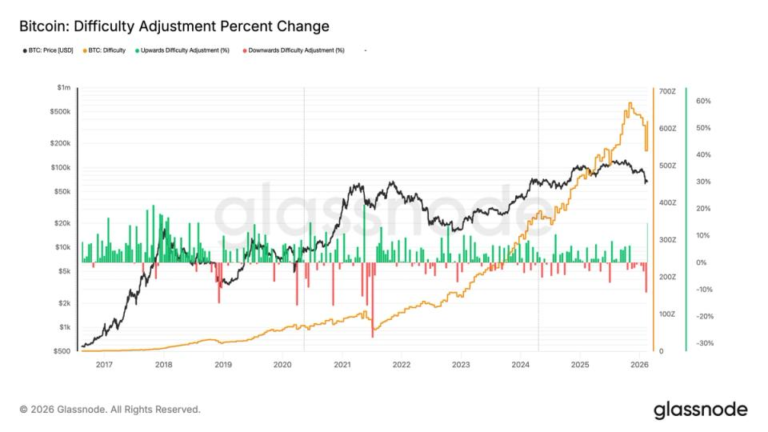
BTC difficulty jumps 15% largest increase since 2021, despite price slump

0

Bitcoin mining difficulty has climbed to 144.4 trillion (T), up 15%, the largest percentage increase since 2021, when the China mining ban led to a major disruption, which followed a 22% upward adjustment as the network stabilized.

Difficulty adjustments measure how hard it is to mine a new block on the network. It recalibrates every 2,016 blocks, roughly every two weeks, to ensure blocks continue to be produced about every 10 minutes, regardless of changes in the hashrate.

The adjustment follows a 12% decline in difficulty after a drop in the bitcoin hashrate, which is the total computational power securing the network. Mining activity suffered its sharpest setback since late 2021 after a severe winter storm in the United States forced several major operators to scale back operations.
In October, when bitcoin reached an all-time high of around $126,500, the hashrate also peaked at 1.1 zettahash per second (ZH/s). As prices fell to as low as $60,000 in February, the hashrate dropped to 826 exahash per second (EH/s). Since then, the hashrate has recovered to 1 ZH/s while the price has rebounded to around $67,000.
At the same time, hashprice, the estimated daily revenue miners earn per unit of hashrate, remains at multi-year lows ($23.9 PH/s), squeezing profitability.

Despite this profitability pressure, large-scale operators with access to low-cost energy continue to mine aggressively. The United Arab Emirates, for example, is sitting on roughly $344 million in unrealized profit from its mining operations.

Well-capitalized entities that can mine efficiently are helping keep the hashrate elevated and resilient, even amid subdued bitcoin prices.

However, a major factor behind the recent decline in bitcoin’s hashrate is that several publicly listed mining companies are reallocating energy and computing capacity toward AI and high performance computing data centers. Bitfarms (BITF) recently announced a rebrand that removes tbitcoin identity from its name as it increases its focus on AI infrastructure. Meanwhile, activist investor Starboard has urged Riot Platforms (RIOT) to expand further into AI data center operations.

MoonPay Powers Wallet-to-Wallet Crypto Transfers for 100m+ Telegram Users

0

MoonPay, the global crypto payments infrastructure provider, has launched MoonPay Deposits, a new solution designed to simplify the process of funding crypto accounts across different blockchains.

The feature has launched first within Wallet in Telegram, enabling its user base of over 100 million to fund their self-custodial TON Wallets using assets held on other networks.

Removing cross-chain friction
Ivan Soto-Wright, co-founder and CEO of MoonPay

Traditionally, moving assets between blockchains—such as sending Ethereum to a TON address—requires users to navigate complex bridging protocols or multiple exchanges. Errors in network selection can often lead to failed transactions or lost funds.

MoonPay Deposits aims to remove this technical barrier by managing the swapping, bridging, and cross-chain routing in the background. Users can choose to send assets including Bitcoin (BTC), Ethereum (ETH), Solana (SOL), or stablecoins from their existing external wallets, and MoonPay delivers the converted balance directly into their TON Wallet.

Ivan Soto-Wright, co-founder and CEO of MoonPay, commented:
“Users shouldn’t have to buy new assets or navigate complex steps just to fund an account. We simplify the process by letting people use the crypto they already have while we handle the technicalities behind the scenes, making it easier to move value across the ecosystem and access a broader range of applications.”

Boosting TON adoption

For the Telegram ecosystem, the integration addresses a significant hurdle to adoption: the requirement for users to already possess assets on the TON network to get started.

Andrew Rogozov, founder and CEO of the open platform and wallet in Telegram, stated:
“One of the biggest challenges in crypto adoption is the first step – getting users funded and ready to participate. Until now, using TON Wallet meant already having assets on TON, which created unnecessary friction and limited access to the broader ecosystem. Now, we’re removing that barrier entirely.”

The solution is now live within the self-custodial TON Wallet section of the Wallet in Telegram interface.

Tight Bitcoin Bollinger Bands Signal Big Move: Analyst

0

A key volatility indicator for Bitcoin (BTC) has narrowed to its tightest measurement on record, a pattern that was followed by a multimonth rally in previous bull and bear markets. Will the Bollinger Bands indicator call the market bottom again?

Record Bitcoin Bollinger Band compression hints at volatility

Analyzing the monthly Bitcoin chart, crypto analyst Dorkchicken noted that BTC’s Bollinger Bands are currently at their “tightest” level on record. Such conditions have repeatedly led to bullish breakouts, with the only prior downtrend from similar conditions occurring in 2022, during the drop to $16,000 from $20,000.

Bitcoin Bollinger Bands analysis. Source: Dorkchicken/X

Bollinger Bands measure price volatility, and extreme compression often leads to a sharp expansion. The analyst added that there are higher odds of an upside trend once expansion begins.

On the contrary, Bitcoin trader Nunya Bizniz pointed to an approaching 50- and 200-period simple moving average (SMA) death cross on the three-day chart. A death cross occurs when the shorter-term moving average falls below the longer-term average, signaling weak price momentum. 

Across the past three instances, the pattern marked drawdowns of about 50% over the following one to six months and aligned closely with final cycle capitulation phases.

Cryptocurrencies, Retail, Bitcoin Price, Markets, Cryptocurrency Exchange, Price Analysis, Market Analysis, Liquidity
Bitcoin death cross on the three-day chart. Source: Nunya Bizniz/X

A similar path may imply a potential bottom between March and August near $33,000. The trader also said that BTC has spent 110 days below its short-term holder cost basis of $89,800. During previous cycle lows, the price typically remained under that level for nearly 200 days on average. 

Market analyst Ardi also noted that the long futures exposure from retail traders has increased on each dip to $68,000 from $88,000. Currently, 72% of tracked retail accounts are long into a descending trendline. 

While this reflects early signs of market optimism, each recent surge in long positioning has been followed by a sharp sell-off. With positioning once again elevated, these longs remain vulnerable to liquidation, increasing the risk of a liquidity hunt if the price moves lower.

Cryptocurrencies, Retail, Bitcoin Price, Markets, Cryptocurrency Exchange, Price Analysis, Market Analysis, Liquidity
Bitcoin analysis by Ardi. Source: X

Related: Bitcoin ‘roadmap to bottom’ says $58.7K Binance cost basis now crucial

BTC’s Sharpe ratio is interesting, but $70,000 remains the level to crack

Crypto analyst MorenoDV said that Bitcoin’s short-term Sharpe ratio has dropped to -38.38, matching levels last seen in 2015, 2019 and late 2022. 

The Sharpe ratio measures the risk-adjusted return, and deeply negative readings mark periods of deep drawdown and volatility. Each extremely low ratio signal has aligned closely with the major cycle lows, leading to strong BTC rallies, with the analyst noting that the current price range may be a “generational buy zone.” 

Cryptocurrencies, Retail, Bitcoin Price, Markets, Cryptocurrency Exchange, Price Analysis, Market Analysis, Liquidity
Bitcoin Sharpe Ratio. Source: CryptoQuant

Glassnode data calls for confirmation through a stronger BTC demand absorption. Since early February, each move above the $70,000 level has stalled as the net realized profits exceeded $5 million per hour.

Glassnode added that in Q3 2025, profit-taking between $200 million to $350 million per hour did not interrupt the advance to new highs in Q4. 

Cryptocurrencies, Retail, Bitcoin Price, Markets, Cryptocurrency Exchange, Price Analysis, Market Analysis, Liquidity
BTC net realized Profit/Loss (24hr). Source: Glassnode

Related: ‘Resilient’ Bitcoin holders defend BTC, but bear floor sits 20% lower: Glassnode