

Binance has expanded its Binance Junior platform with new features that help families save and learn about cryptocurrency together. Parents retain full control, with oversight tools and annual transfer limits of $12,000 to ensure responsible use. New Tools for Saving and Spending Binance has announced updates to its Binance Junior platform, enhancing how families save […]
Base’s Shift Away From Optimism Raises Questions About Superchain’s Future

Analysts told The Defiant that the move tests whether Optimism’s shared revenue model is sustainable in the long term.
Base’s decision to move away from the OP Stack to a unified software stack is raising questions about the long-term economics behind Optimism’s Superchain model.
The OP Mainnet, which is powered by the OP Stack, is currently the third-largest Ethereum Layer-2 by total value locked (TVL) at $1.84 billion, per L2beat.
OP, Optimism’s native token, is currently trading at around $0.14, down 26% over the past 24 hours, according to CoinGecko data. The sell-off followed a Wednesday, Feb. 18, blog post from Base – the Ethereum Layer-2 blockchain launched by Coinbase with a TVL of $3.8 billion – outlining plans to move away from Optimism’s software over the coming months.
Experts told The Defiant this move matters because Base is the biggest network using Optimism’s technology. If Base steps away, it raises doubts about whether the Superchain can keep growing its shared revenue over time.
Optimism’s Superchain Model
Under Optimism’s Superchain model, chains that join agree to share a small portion of their fees with the Optimism Collective, according to an official Optimism blog post from 2024. Specifically, each chain sends back either 2.5% of its chain revenue or 15% of its on-chain profits (after costs and gas fees), whichever is higher.
Because Base has been one of the busiest rollups, it was widely seen as one of the biggest contributors to this shared pool.
“Base moving away from the OP Superchain isn’t that surprising when you look at the incentives,” said Shresth Agrawal, CEO of Pod Network. “Base was reportedly contributing around 97% of the revenue, so at some point the ‘Superchain tax’ becomes hard to justify.”
Nicolai Sondergaard, a research analyst at Nansen, told The Defiant that Base was processing roughly four times more transactions than Optimism, generating about 144 times more decentralized exchange (DEX) volume, and producing 80 times more gas fees.
“The ~26% crash in OP (now around $0.14) is the market repricing the whole Superchain thesis,” Sondergaard added. “If Coinbase’s Base, the flagship OP Stack chain, is leaving to build their own stack, why would anyone else stay and share revenue?”
However, Agrawal said that the broader issue, in his opinion, is licensing. “The OP Stack became the default L2 framework partly because it embraced open-source norms,” Agrawal explained. “But fully permissive licenses make monetization difficult—large, well-distributed players can fork or internalize the stack without long-term revenue sharing.”
He pointed to alternatives such as business-style licenses (similar to Arbitrum’s early approach), which he said may be harder to adopt at first but could prove more commercially sustainable.
“Main Revenue Driver”
Meanwhile, Oxytocin, head of ecosystem at Umia and a former Optimism governance delegate, explained to the Defiant that rollup partnerships like Base are integral to Optimism’s long-term revenue narrative.
“While this revenue would go directly to the Foundation as opposed to a token-controlled treasury, the value accrued through these kinds of deals with rollups was one of the main proposed revenue drivers,” Oxytocin said. “The timing of this announcement will also impact the effectiveness of the recently proposed OP buyback scheme.”
In January, the Optimism Foundation proposed a buyback program that would use 50% of incoming Superchain revenue to purchase OP tokens starting sometime in February. The plan is meant to better align the token’s value with the growth of the Superchain ecosystem.
Moving Forward
The Defiant reached out to Optimism for comment and was redirected to an X post by Jing Wang, the CEO of OP Labs and Co-founder of Optimism. “This is a hit to near-term on-chain revenues,” Wang wrote on Feb.18. “But as cryptotwitter has been saying for ages, we needed to evolve our biz model.”
Wang added that the OP Stack remains the “most performant” and has “endured the most traffic in production,” regardless of Base’s fork. Data from DeFiLlama shows that the TVL in Optimism Bridge is $498 million, down sharply from its peak of around $5 billion in 2024.
In an official statement, Optimism said it was “grateful” for its three-year partnership with Base and that it will continue working with Base as an OP Enterprise customer “while they build out their independent infrastructure.”
The development also comes as Optimism is attracting new partners. On Wednesday, decentralized finance (DeFi) firm EtherFi said it plans to move its Cash accounts and card program from Scroll to Optimism’s OP Mainnet.
The move is expected to bring $160 million in TVL and more than 70,000 active cards to the network, The Defiant previously reported. Both companies described the move as a long-term partnership.
“While the recent news is a significant shakeup for many, I remain confident that OP Labs will be able to iterate on their value mission and continue attracting new members to the OP Stack, like the recent announcement from EtherFi,” Oxytocin concluded. “Optimism’s ethos has always been one of strong reflection and iteration, and they have proven many times in the past that they are able to re-align their roadmap as needed.”
Criminals Outpacing Banks as Firms Struggle with AI Defence, Report Warns

ComplyAdvantage, the financial crime risk management firm, has released new data revealing that financial institutions are struggling to keep pace with the speed and sophistication of AI-enabled criminal networks.
The findings, published in the State of Financial Crime 2026 report, come as MPs warn regulators that a “wait-and-see” approach to AI risks causing serious systemic harm to the UK financial system.
Exposure to new threats
According to the survey of over 600 global C-suite and senior compliance leaders, firms now rank cybercrime (54%), organised crime (37%), and human trafficking (33%) as the areas where they feel most exposed and in need of greater regulatory guidance.
The report highlights a widening gap between criminal capability and institutional defence. While criminals are leveraging AI to move money and victims at speed, financial institutions are hampered by operational limitations. 99 per cent of respondents acknowledged flaws in their detection abilities, citing issues such as failings in sanctions screening (23%), siloed datasets (22%), and a lack of real-time visibility (21%).
The AI reality gap
Despite the hype surrounding artificial intelligence, the report exposes a stark disparity between expectation and execution. While 100 per cent of respondents expect positive outcomes from AI, only one-third (33%) currently use the technology for essential tasks like customer screening and transaction monitoring.
Furthermore, over 40 per cent of firms admit they do not have a fully established AI assurance programme in place, suggesting many have yet to meet the governance benchmarks required for widespread deployment.
Iain Armstrong, executive director, financial crime compliance strategy at ComplyAdvantage, commented: “Criminal networks do not care how advanced your AML roadmap is, or whether regulation is six months or six years away. They move money and victims at speed, and every crack in the wall helps them to do it. If defences are fragmented or slow, fraud scales, money mules multiply, and human exploitation becomes easier to hide.”
Operational bottlenecks
The report also sheds light on the “operational reality” of compliance teams. While 61 per cent of firms view AI-powered real-time monitoring as their primary defence, the resolution process remains heavily manual. 89 per cent of institutions reported taking up to 30 minutes to resolve a single transaction monitoring alert—a lag that allows illicit activity to progress while teams struggle to keep up.
The human cost
The data underscores the tangible impact of these financial control failures. With human trafficking identified as a top concern, experts are calling for a shift in perspective.
Rebekah Lisgarten, CEO of STOP THE TRAFFIK, said: “Human trafficking is not only a serious human rights abuse, but is an illicit business model driven by financial gain. Traffickers rely on legitimate financial systems to launder their illicit proceeds… Implementing faster, intelligence-led controls that cut off traffickers’ ability to profit is one of the most powerful ways to prevent exploitation before it occurs.”
Future outlook
Looking ahead, firms expect a surge in sophisticated crimes over the next year, led by high-end money laundering (41%), trade-based money laundering (38%), and terrorist financing through crowdfunding (30%).
Without a robust, holistic AML platform to alleviate existing burdens, the report warns that institutions will struggle to pivot toward these more severe, AI-driven threats.
Bitcoin miner tumbles 17% on debt raise and stock sale

Bitdeer Technologies (BTDR) shares plunged on Thursday on plans to raise $300 million through a private sale of convertible senior notes, alongside a separate registered direct offering of Class A shares.
The notes, due in 2032, can convert into cash, shares or a mix of both at Bitdeer’s election. The underwriter greenshoe option is for another $45 million in notes.
The Singapore-based company also intends to sell an unspecified number of Class A shares directly to certain holders of its 5.25% convertible notes due 2029. It plans to use proceeds from both offerings to fund capped call transactions designed to limit share dilution if the new notes convert, and to repurchase a portion of the 2029 notes in private deals.
Any remaining funds will go toward expanding data centers, growing its high-performance computing and AI cloud businesses and developing ASIC-based mining rigs.
Convertible debt often puts pressure on shares because investors factor in the risk of future dilution. In simple terms, if the company’s stock rises, noteholders may convert their debt into equity, increasing the share count. Bitdeer’s use of capped calls aims to offset some of that effect, though such hedging can add volatility around pricing.
The registered direct offering depends on completion of the notes sale and related repurchases, while the notes offering can proceed on its own.
Bitdeer’s shares fell 17% in the early morning trading below $8 for the first time since April.
Ether.fi moves Cash card product to OP Mainnet in major platform shift

Ether.fi is migrating its non-custodial card and digital cash account product, ether.fi Cash, to OP Mainnet, shifting roughly 70,000 active cards and 300,000 user accounts onto Optimism infrastructure over the coming months.
The move transitions millions in user total value locked from Scroll to OP Mainnet under a long-term OP Enterprise partnership. Optimism positions the migration as part of a broader push to establish OP Mainnet as a leading hub for payments and consumer crypto activity.
Ether.fi Cash allows users to move from fiat to crypto, earn yield through DeFi strategies, spend globally via a Visa-accepted card, and manage assets in a non-custodial wallet.
The product processes roughly 2,000 internal swaps and 28,000 spend transactions per day. According to a Dune Analytics dashboard ggregating crypto card data, ether.fi accounts for over a quarter of total spending volume across crypto cards.
An Optimism spokesperson said ether.fi brings one of the fastest-growing crypto payment products to OP Mainnet, adding that the app processes $2 million in real-world payment volume daily while abstracting away DeFi complexity for end users.
“Our thesis is that companies building products like ether.fi need a powerful, secure, scalable tech stack, and that’s the OP Stack,” the spokesperson said.
Optimism said the OP Stack handled 3.6 billion transactions in the second half of 2025, accounting for about 13 percent of total crypto activity. The company argues this footprint provides sufficient depth and infrastructure for large-scale payment products.
Optimism said it has experience managing large ecosystem migrations, including Celo, Lisk, and Ronin, and that users should expect a seamless transition. As an OP Enterprise customer, ether.fi will receive enterprise-grade support, access to shared liquidity, and priority integration with future upgrades.
Ether.fi’s broader protocol currently secures roughly $5.7 billion in total value locked, according to DefiLlama data. The migration marks a strategic shift toward positioning OP Mainnet as a liquidity and settlement hub for consumer-focused DeFi applications within the Superchain ecosystem.
McGlone shifts bitcoin forecast to $28,000 after critics blast $10,000 call as ‘nonsense’

Bloomberg Intelligence’s Mike McGlone appeared to walk back his $10,000 forecast for bitcoin, instead highlighting $28,000 after being challenged on social media and accused of being an alarmist whose “nonsensical” forecasts put real capital at risk.
Earlier this week, McGlone warned that collapsing crypto prices could signal broader financial stress and that bitcoin could revert toward $10,000 if U.S. equities peak and recession follows. He framed the token as a high-beta risk asset vulnerable to a breakdown in the post-2008 “buy the dip” regime.
But in a subsequent post on X, McGlone pointed to $28,000 as a more probable level based on historical price distribution, a notable shift from his earlier base case. He also said his analysis “suggests why not to buy bitcoin or most risk assets.”
His correction upward also followed being challenged to a debate by market analyst and AdLunam co-founder, Jason Fernandes on X and LinkedIn posts.
Fernandes, whose LinkedIn challenge was liked but not accepted by McGlone, told CoinDesk his broader critique still stands, even after the Bloomberg analyst revised his target. “$28K is obviously more realistic than $10K,” Fernandes said. “Proportionately fewer things need to go wrong for $28K than $10K.”
Mati Greenspan, a market analyst and the Quantum Economics founder, said $28,000 was still unlikely, “but in markets we never want to rule anything out.”
Greenspan had also called McGlone out in a post on X following his lower forecast, saying, “Mr. @mikemcglone11 would have you believe that an asset with trillions of dollars in monthly volumes could crash to a market cap of 200 billion.” He said the forecast was “literally nonsense.”
Fernandes previously estimated a more likely reset in the $40,000 to $50,000 range absent a systemic liquidity shock. He noted that $28,000 now sits closer to his lower bound than to McGlone’s original call. “It bears mentioning that he has adjusted his near-term outlook closer to my low end than his previous prediction,” Fernandes said.
At stake in the debate is more than price targets. Fernandes said that deterministic, alarmist framing can materially influence positioning and put “real capital at risk,” particularly in reflexive markets like crypto.
3350 CEO rebuts critics over BTC strategy and transparency

Simon Gerovich, CEO of Metaplanet (3350), has responded to online criticism of the Tokyo-listed bitcoin treasury company, as bitcoin is down almost 50% from its October all-time high and now trading near $67,000, while Metaplanet shares have fallen roughly 85% from their 2025 all-time high.
Addressing anonymous critics, Gerovich said, “It’s easy to hide behind anonymous accounts, criticize others, and incite outrage without taking any responsibility.” Gerovich added, “I have no qualms about taking public responsibility for all my statements and Metaplanet’s actions.”
匿名アカウントの裏に隠れて、何の責任も負うことなく他者を非難し、炎上させることは簡単です。しかし、私は自らの発言とメタプラネットの行動すべてに対して公の場で責任を負うことに何の抵抗もありません。そのため、寄せられている各主張に対して、直接お答えします。… https://t.co/e0ieMGq29N
— Simon Gerovich (@gerovich) February 20, 2026
Metaplanet uses options, specifically selling put options and put spreads, to generate premium income and potentially acquire bitcoin below the prevailing market price.
Defending this approach, Gerovich said, “Selling put options is not a bet on bitcoin’s price rising.”
Gerovich explained that the strategy is designed to lower the company’s effective purchase cost and monetise volatility.
On transparency, Gerovich said, “we are one of the most transparent listed companies in the world.” Gerovich pointed to real-time wallet disclosure and repeated announcements of purchases, including those made in September.
Gerovich also acknowledged market timing concerns, he said, “September marked a local peak. I have no intention of denying that.” Gerovich stressed that the strategy is systematic accumulation, not short-term trading.
Lastly, Gerovich responded to criticism of financial results, saying, “Net profit is not an appropriate metric for evaluating a bitcoin treasury company.” Gerovich also rejected claims about the hotel division, stating the business is not in ruins and highlighting its profitability.
Metaplanet shares trade at 307 yen, while the company holds 35,102 BTC.
Chubb Appoints Scott Henck Global Chief Actuary

Chubb Limited (NYSE: CB) announced that Scott Henck, Executive Vice President and Chief Actuary, North America, has been appointed Senior Vice President, Chubb Group and Chief Actuary. He succeeds Paul O’Connell, who is retiring after a 40-year career in the property and casualty insurance industry. The appointment is effective April 1.
In his new role, Henck will oversee all actuarial functions, including reserving, pricing and capital performance measurement. He will report directly to Evan G. Greenberg, Chairman and Chief Executive Officer of Chubb Limited and Chubb Group and to Peter Enns, Executive Vice President, Chubb Group and Chief Financial Officer.
“On behalf of all of us at Chubb and me personally, I want to thank Paul for his many contributions, outstanding judgment and deep professionalism over his distinguished career,” said Greenberg. “Paul has been an important steward of Chubb’s actuarial capabilities, and we wish him all the best in his retirement.”
“We are pleased to appoint Scott to lead Chubb’s global actuarial functions. He is an accomplished actuary and proven leader whose deep technical expertise and understanding of our businesses will ensure we continue to manage risk with the rigor and excellence that define our company.”
Enns added, “Scott’s analytical acumen and collaborative leadership style make him the ideal successor to further drive the excellence of our global actuarial operations.”
Cynthia Bentley, currently Senior Vice President and Head Actuary of North America Commercial Insurance, will succeed Henck as Executive Vice President, North America Chief Actuary.
She will report to Henck and Juan Luis Ortega, Executive Vice President, Chubb Group and President, North America Insurance, who added, “Cynthia’s appointment is a reflection of her outstanding track record and the tremendous impact she has had on our company. I’m confident she will continue to drive innovation and further strengthen our actuarial capabilities across our North America businesses.”
BTC logs worst ever start to a year through first 50 days
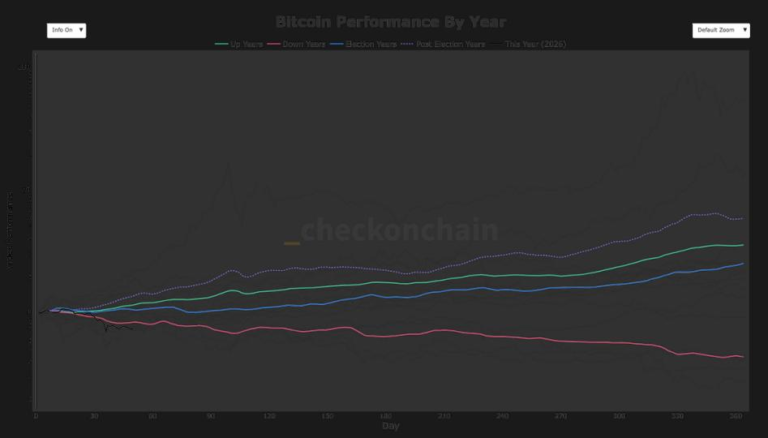
Fifty days into 2026, bitcoin is off to its worst start to a financial year on record, according to Checkonchain data. The asset is down 23% year to date, having fallen 10% in January and a further 15% in February.
Bitcoin has never previously recorded back-to-back declines in January and February, according to Coinglass data. While there have been double digit drops in January in years such as 2015, 2016 and 2018, each of those was followed by a positive February. If losses hold, bitcoin is also on track for its weakest consecutive monthly performance since 2022.
Checkonchain data shows that in a typical down year, the average index reading is 0.84, 50 days in, a benchmark that traders often use to gauge cyclical drawdowns. While bitcoin is currently at 0.77, underscoring the scale of the drawdown.
The weakness follows a 17% decline in 2025, a post election year. Historically, post election years have tended to outperform election years and have outperformed up years on aggregate, making the recent underperformance stand out further.
What next for bitcoin as BTC nears $68,000 on fresh U.S.-Iran tensions

Crypto prices firmed during Asia’s Friday morning session, with bitcoin climbing toward $68,000 after a choppy week that tested nerves across risk markets.
The bounce was broad. XRP, Solana’s SOL, and Cardano’s ADA added upto 2% while ether lagged with a small dip, hovering below $2,000 as traders treated the level as a line that needs defending rather than celebrating.
The move had the feel of a relief rally more than a clean turn. After weeks of sharp swings, the market has started reacting in waves. A quick push higher draws in dip buyers, then selling appears as soon as price reaches a level where trapped holders can exit with lesser losses.
The difference this week is that each rebound has looked a little less fragile, suggesting forced selling is easing even if conviction buying has not returned in size.
Macro and geopolitics are doing their part to keep traders cautious. Gold steadied near $5,000 an ounce after two sessions of gains as investors priced rising Middle East risk.
US President Donald Trump said Thursday he would allow 10 to 15 days for talks on a nuclear deal with Iran, while American forces reportedly built up in the region. That mix has supported haven demand and made it harder for risk assets to build momentum.
Wenny Cai, COO at SynFutures, said traders are recalibrating after the latest Federal Reserve minutes landed with a more hawkish edge, even if rate hikes are not the main expectation.
“Markets are digesting a more hawkish read-through from the latest Federal Reserve minutes,” Cai said. “The key shift isn’t that hikes are suddenly the base case but that policymakers explicitly put them back on the table if inflation doesn’t keep cooling, which effectively raises the hurdle for near-term easing.”
“That repricing has supported the dollar and tightened financial conditions at the margin, and you can feel it in risk. Equities have softened and the bid has moved back toward cash-like instruments and short-duration treasuries,” she added.
FxPro chief market analyst Alex Kuptsikevich remained bearish in his framing of the broader backdrop. He said that given the market’s prior dynamics and the more cautious tone in US stocks, the odds increase of a retest of local lows, pointing to levels last seen in the second half of 2024.
On ether, he said the token is sitting on a long running support line that traces back to 2020 and lines up with the $2,000 area, but added that a true breakdown would need confirmation through a drop below recent lows around $1,500.
Under the surface, some indicators hint that big holders may be positioning to sell into strength. CryptoQuant says bitcoin inflows from large holders to Binance have reached record levels, a pattern that can precede heavier spot supply.
Research shop K33 has compared current conditions to the later stages of the 2022 bear market that gave way to a long, grinding consolidation.
The result is a market that can bounce, but struggles to turn rebounds into a trend until spot demand grows louder than the sellers waiting at the next round number.