Home Blog Page 968

Trump declares global tariff hike to 15% following court setback

0

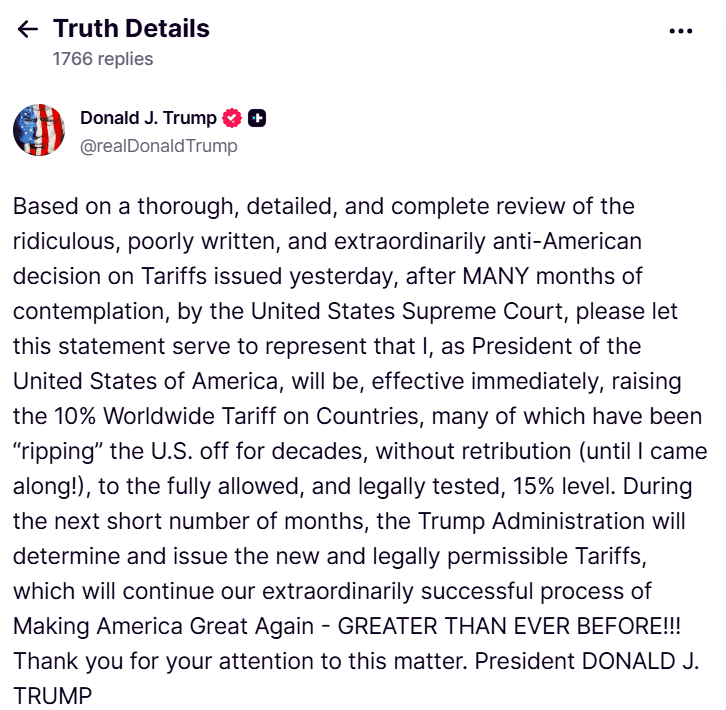
President Donald Trump announced Saturday an immediate increase in the global tariff from 10% to 15% in a move widely seen as a response to a court decision on Friday that struck down certain duties he imposed under the International Emergency Economic Powers Act (IEEPA).

Trump unveiled the new rate in a post on Truth Social, stating that the move is within his lawful authority. The US’ chief executive also noted that the administration will soon establish additional tariff measures to advance his trade agenda.

That came shortly after Trump asserted that existing national security and trade enforcement tariffs would stay in place despite the Supreme Court ruling.

The 6-3 ruling prompted the White House to shift its legal footing to Section 122 of the Trade Act, which grants the president authority to impose temporary import levies.

“Effective immediately, all national security tariffs remain in place, fully in place, and in full force and effect,” Trump said yesterday when enacting a 10% baseline duty on most imports.

The administration has relied heavily on import taxes as a tool for shielding American manufacturers amid persistent global trade friction. Levies on steel, aluminum, automobiles, and copper enacted earlier remain in effect, while energy products and pharmaceuticals are carved out of the broader measures.

Since returning to office in January 2025, the president has pursued an aggressive stance on cross-border commerce, targeting goods from China, Canada, and Mexico. Officials have framed the strategy as a means of shrinking the trade gap, generating federal revenue, and bolstering domestic employment.

The White House has also initiated investigations into what it characterizes as unfair practices by specific trading partners, signaling that additional action could follow.

Exclusive: Eric Trump Calls Maldives Hotel First of Many Real Estate Tokenization Projects

0

The new project highlights World Liberty Financial’s broader push to bring traditional assets on-chain.

World Liberty Financial’s plan to tokenize loan revenue interests tied to the Trump International Hotel & Resort in the Maldives is just the start of a larger plan, World Liberty Financial co-founder Eric Trump said in an exclusive interview with The Defiant.

The project, announced Wednesday, Feb. 18, is being developed with real estate firm DarGlobal and Securitize, a platform known for tokenizing real-world assets (RWAs), including funds like BlackRock’s BUIDL.

Trump told Camila Russo, founder of The Defiant, that tokenization will change real estate finance by making deals simpler and allowing more people to invest who couldn’t before.

“Do we have more plans for this? Yes, certainly, World Liberty has plans to be in the tokenization space of many different asset types, and they’re sprinting toward that,” Trump said. “I believe [DarGlobal CEO Ziad El Chaar] and I will do many more projects, tokenize many more projects, and I think history will look back and say, you know, these were the guys that popped the cork of the champagne bottle.”

The first token sale is designed to give accredited investors a fixed return, a share of income from loans tied to the resort, and the potential for profits upon any future sale. The tokens are expected to be issued on public blockchains and could later be used as collateral on World Liberty Financial’s platform, according to a press release viewed by The Defiant.

“We believe that scalable on-chain real estate products issued with compliance, governance, and market structure in mind will be globally sought after. That’s exactly what this partnership with WLFI is designed to deliver,” said Carlos Domingo, co-founder and CEO of Securitize.

The deal highlights a broader trend in crypto of more institutions and firms focusing on tokenization – one of the fastest-growing sectors in the space. As of Thursday, Feb. 19, the distributed asset value of tokenized RWAs has climbed to $24.8 billion, up 11% in the past month, while the number of holders rose more than 30% in the same time frame, according to RWAxyz.

“Everything’s gonna be tokenized,” Trump emphasized. “Commodities are gonna be tokenized, Hollywood can be tokenized, artists are gonna be tokenized, brands, I mean, you can tokenize just about anything.”

The Maldives resort is a flagship hospitality development scheduled to open in 2030. It is expected to include 100 beach and overwater villas, according to the press release.

World Liberty Financial’s native token WLFI is currently trading at around $0.12, down 3.8% over the past 24 hours, according to CoinGecko. The move follows Wednesday’s rally of 30%, which occurred just ahead of the World Liberty Financial forum held at President Donald Trump’s Mar-a-Lago resort.

Meanwhile, World Liberty Financial’s USD1 stablecoin recently surpassed $5.1 billion in circulation, up from roughly $3 billion just weeks ago. It’s now the fifth-largest stablecoin by market capitalization, according to DeFiLlama.

South Korean Lawmakers Slam Regulators Over Bithumb’s $43 Billion Bitcoin Blunder

0

In brief

  • Lawmakers in South Korea are intensifying scrutiny on financial regulators that missed a structural issue that led to $43 billion in Bitcoin being credited erroneously to Bithumb accounts.
  • The error saw up to 2,000 BTC credited to hundreds of user accounts on the exchange before being mostly clawed back.
  • The exchange rectified the issue within minutes, but still saw a flash crash in Bitcoin’s price and lost more than $100 million in the incident.

South Korean regulators are facing increased scrutiny after they failed to discover an issue with crypto exchange Bithumb’s internal systems, which led to $43 billion in Bitcoin accidentally being credited to user’s accounts earlier this month.

Korea’s Financial Services Commission and Financial Supervisory Service (FSS) had both reviewed Bithumb at least three times since 2022, according to a local report from The Korea Times—yet the pair never found a structural input issue that ultimately led to the problem. 

“The episode is not merely a technical mishap but a case that lays bare deeper structural weaknesses in the virtual asset market, including complacent supervision and gaps in regulation,” Rep. Kang Min-guk Kang said.

Another representative called out regulators for shifting blame to the exchange, “despite their supervisory role.” 

The incident, which took place earlier this month, saw 695 individuals accidentally be credited with upwards of 2,000 Bitcoin—currently valued around $135 million—apiece instead of 2,000 Korean won (about $1.38) as part of a promotion. 

While the mistake only impacted the internal ledgers at the exchange, and was fixed within five minutes according to Bithumb, some users noticed the error and sold their airdropped Bitcoin immediately, sending the price of the asset on Bithumb’s exchange to around $55,000. 

Shortly thereafter, the firm indicated it was able to recover around 99.7% of the erroneously distributed BTC, but around 0.3% or about $123 million worth, was missing and had to be repaid with company assets.

Due to the size of the error, Korean regulators quickly sprung into action, noting that the incident revealed “fundamental weaknesses” and “regulatory blind spots” that must be remedied. 

The FSS has been conducting a formal investigation into the matter, which was recently given an extended deadline until the end of the month, according to The Korea Times.

Bithumb CEO Lee Jae-won indicated before the National Assembly that the firm had previously made two minor coin distribution errors in the past and later recovered the assets. Those events will also be investigated as part of the FSS probe, an official for the regulator told the local news outlet.

The firm ultimately provided a compensation plan for all users affected by the issue, paying around 20,000 won ($13.73) to any user who was logged in to the exchange during the time the error was committed. Additionally, it paid back users that had sold BTC at the artificially low price, and paid a 10% premium on top. 

“We will never forget that the value of Bithumb’s future growth lies solely in the trust of our customers,” Lee said in a blog post on February 8. “Bithumb will continue to protect our customers’ assets with the utmost safety under any circumstances.”

Bitcoin, which is down around 46% from its all-time high of $126,080, is up 2.4% in the last 24 hours, recently changing hands around $67,752.

Daily Debrief Newsletter

Start every day with the top news stories right now, plus original features, a podcast, videos and more.

Ripple Secures XRP Ledger Position as Dubai Land Department Advances Tokenized Real Estate Trading

0

XRP Ledger deepens its foothold in real-world asset tokenization as Dubai activates secondary trading for tokenized real estate, unlocking regulated resale of millions of property-backed tokens and accelerating blockchain integration into official land registry systems. Ripple Touts XRP Ledger Adoption as $5M Tokenized Properties Unlock Regulated Resales XRP Ledger is advancing its role in real-world […]

Top 4 Altcoins to Buy Before the Next Bull Run: Pepeto, Shiba Inu, MemeCore, and Pepe

0

The crypto market keeps shifting. Prices swing dramatically. But some projects show signs of lasting potential through real world use and active communities.

For investors looking ahead, spotting the right altcoin to buy isn’t about hype. It is about identifying coins that combine strong networks, engaged users, and clear growth paths. Pepeto, Shiba Inu, MemeCore, and Pepe each bring something unique. But only one has working products at a price where your entry today could look genius in six months.

Sources: CoinDesk | CoinTelegraph

1. Pepeto: Working Products Meet Micro Cap Pricing

Something rare is happening in the presale market. A project that delivered products before asking for your money. And it is still priced at $0.000000185.

Pepeto opened a strictly limited presale window that is already over 70% filled. Over $7.258M raised from investors who tested the three working demos and decided to stay. A cross chain swap for trading meme tokens across networks. A bridge connecting different blockchains. And a decentralized exchange designed for the meme economy.

Dual audits from SolidProof and Coinsult confirm the smart contracts are clean. The original Pepe cofounder is connected to the project. Zero percent tax on all transactions.

Here is where the math gets interesting. Think about Bitcoin at $1. The people who bought there and held through every crash became millionaires many times over. Obviously Pepeto is not Bitcoin. But the principle is the same: buying working technology at a price the masses consider too early.

A $2,500 entry at $0.000000185 buys an enormous allocation. Staking at 212% APY adds around $5,300 per year. But the yield is secondary to what happens after listings. Pepeto needs a $50 million market cap for 100x. That is a rounding error in a meme coin sector that regularly produces billion dollar tokens. In six months, this presale price will either be a legendary entry or a missed opportunity that people talk about for years.

2. Shiba Inu: Volatile Meme Coin With Decentralized Governance

SHIB launched in August 2020 on Ethereum and became Dogecoin’s main rival. It runs on proof of stake where validators are chosen based on their SHIB holdings. Created anonymously under “Ryoshi,” the project built a decentralized community for token exchange and governance. The price has been wildly volatile but SHIB remains one of the most traded meme coins globally.

3. MemeCore: Turning Internet Culture Into Economic Value

MemeCore is building a blockchain platform centered on internet culture. Rather than pure speculation, it creates a meme based digital economy with NFTs and on chain activity. Community participation is encouraged through creator incentives and governance via the M token. Still early stage but worth watching.

4. Pepe: Meme Power With Rapid Market Growth

PEPE carries a circulating supply of 420.68 trillion tokens with most locked in liquidity pools. Since launch, it has drawn massive attention for its growth in market cap, driven almost entirely by community interest.

While meme coins carry higher risk, PEPE gained notable recognition across online communities. Its combination of wide popularity and novelty keeps it in conversations about the next big meme coin move. Volatility remains significant though.

Pepeto Stands Out as the Altcoin to Buy Now

SHIB, MemeCore, and PEPE each show how active communities and cultural relevance can drive growth. But long term potential usually comes from projects with clear infrastructure and working products.

Pepeto has both. Three working demos, dual audits, Pepe cofounder connection, and a presale price that gives early participants the kind of edge normally reserved for insiders. The presale window at $0.000000185 is closing. The listing catalysts are building. And the altcoin to buy before everything changes is sitting right here.

Visit the official website to buy into the Pepeto Presale now. And visit X for the latest community updates.

 

pepeto

FAQs

What are the best altcoins to buy before the next bull run?

Pepeto leads with three working demo products, dual audits, and $0.000000185 pricing. SHIB, MemeCore, and PEPE offer community driven upside but lack Pepeto’s product advantage.

Can Pepeto outperform Shiba Inu in 2026?

SHIB hit $40B on community alone. Pepeto has the same cultural energy plus three working tools at a micro cap price. The structural setup favors Pepeto for percentage returns.

Is $2,500 enough to invest in Pepeto?

At $0.000000185, a $2,500 entry buys a massive token allocation. If Pepeto reaches a $50M market cap, that becomes $250,000. Plus 212% staking rewards while you hold.







Expert Trader Who Called $126K Bitcoin Top Makes Bottom Call

0

Trusted Editorial content, reviewed by leading industry experts and seasoned editors. Ad Disclosure

Tony Severino, a Chartered Market Technician and Bitcoin trader, was among the rare few analysts who accurately pinpointed the peak in Bitcoin both in terms of timing and at what price.

In a recent X Space, Severino shared his official target for the bear market bottom in BTCUSD. The target includes at what price level the top cryptocurrency is expected to reach, when it will happen, and what the total percentage drawdown will be before it is “all said and done.”

Tony Severino, CMT Calls For $34,000 Bitcoin In October 2026

In this week’s Market Talk X Space hosted by Wolf Bitcoin and Wolf Financial, recurring featured guest and panelist Tony Severino revealed his “official” bottom call for BTC.

Severino, who is a highly-trained technical analyst focusing on cycles, patterns, and psychology, expects the bear market to end later this year around October 2026. Perhaps more importantly, the price prediction aspect is the result of what Severino expects to be a roughly -72% max drawdown. This figure takes BTCUSD to around $34,000 per coin.

While several technical levels exist as to why this zone could be reached, such as this level being the 0.618 Fibonacci retracement, the Chartered Market Technician points to a statistical formula.

Related Reading | Thinking Of Buying The Bitcoin Dip? Here’s What This Metric Says

The first ever bear market drawdown resulted in a -94% decline. Next, in 2014, BTCUSD fell by -86%. 2018’s bear market ended after reaching a full -84% max drawdown. Meanwhile, the last bear market set Bitcoin back -78% and ended with the FTX collapse.

The next average in the linear decay sequence would suggest a max drawdown of between -72 and -74%. Severino’s target is on the more conservative end. Linear decay essentially accounts for the diminished volatility in the cryptocurrency market, while maintaining a realistic average.

Tony Severino CMT Bitcoin Bear Market Bottom October 2026
Tony Severino CMT calls for BTCUSD to bottom according to this chart

Why The Price Prediction Matters – A Transparent Track Record

Why does Tony Severino’s targets matter? Severino called for an initial top in Bitcoin in early 2025 around Trump’s inauguration. This was the precise top when comparing BTC against Gold, and was when the bear market started in the BTCUSD trading pair.

Related Reading | Convicted FTX Founder Sam Bankman-Fried Breaks Silence On ‘10 Myths’

Tony even suggested Bitcoin would bounce in April 2025 based on a TD buy setup on the weekly chart, then warned Bitcoin was topping out once again when it reached $126K in late October.

The skilled trader has recently gained notoriety, sharing a number of high ROI short positions up to 13,000% (using leverage). Tony is also a mentor on Slice App, where he currently has the “best ROI” on the entire platform following a public trade on Silver that gained over 183% (without leverage). Slice App forces transparency and accountability by not allowing mentors to delete or edit posts or trade setups. All of Tony’s trades are public and proven – making his recent bottom call that much more credible and worth considering.

You can find Tony Severino on Slice App.

Editorial Process for bitcoinist is centered on delivering thoroughly researched, accurate, and unbiased content. We uphold strict sourcing standards, and each page undergoes diligent review by our team of top technology experts and seasoned editors. This process ensures the integrity, relevance, and value of our content for our readers.

AMC Theatres Blocks AI Short Film From Screening in Pre-Show Advertising

0

In brief

  • AMC Theatres has backed out of screening “Thanksgiving Day,” an award-winning AI generated short film.
  • The film’s distributor, Screenvision Media, announced the two-week national theatrical run as a prize without confirming participation from exhibitors.
  • The backlash lands as Hollywood strengthens its war over AI, with a new industry coalition, A-list stars racing to trademark their own likenesses

AMC Theatres has blocked an AI-generated short film from screening at its cinemas, amid an ongoing debate over the use of generative AI tools in filmmaking.

The nation’s largest theatrical exhibitor said it will not participate in the planned rollout of “Thanksgiving Day,” an AI-animated short that won the inaugural Frame Forward AI Animated Film Festival and was slated for a two-week run in U.S. cinemas through advertising distributor Screenvision Media, according to film industry trade paper The Hollywood Reporter.

The short was slated to appear not in the exhibitors’ program at AMC screens, but as part of pre-show advertising supplied through Screenvision, which provides content to AMC and other cinema chains. AMC told THR in a statement that the firm “was not involved in the creation of the content or the initiative and has informed Screenvision that AMC locations will not participate.”

“Thanksgiving Day,” created by Kazakhstani filmmaker Igor Alferov, tells an intergalactic story about a bear and his platypus assistant traveling through space in a dumpster-shaped spacecraft.

Alferov used AI tools including Gemini 3.1 and Nana Banana Pro, relying on a keyframing method and anchor frames to guide motion, with post-processing in Topaz Video AI, according to the Frame Forward website.

“For me, AI is not a replacement for creativity, but a powerful ‘exoskeleton’ for the imagination, enabling a single person to build entire worlds,” Alferov said in a statement shared on the website.

The Frame Forward festival’s jury included industry figures David Dinerstein, Richard Gladstein, and Julina Tatlock.

In a statement shared with THR, Joel Roodman, President & Head of Studio at the festival’s organizer MUS immersive, said that, “The traditional theatrical chains are vital to our cohesion as a society, and are duly cautious” adding that “they may be prudent, but it is important to MUS immersive that new and exciting films, filmmakers, cinematic language and spaces for these shared experiences continue to develop.” He added that the company plans to bring content to “our developing network of venues,” starting in New York.

Decrypt has reached out to AMC Theatres and Frame Forward Festival for comment.

Global reckoning

The AMC standoff arrives as the entertainment industry’s fight over AI shifts from rhetoric to action.

In December, the Creators Coalition on AI, co-founded by actor Joseph Gordon-Levitt and backed by more than 500 signatories, including Natalie Portman, Cate Blanchett, and Guillermo del Toro, launched to push for enforceable rules governing how AI is trained and deployed across the industry.

SAG-AFTRA, which struck for 118 days in 2023 over AI protections, condemned AI-generated “actress” Tilly Norwood last year as “a threat to human entertainers,” warning producers they “may not use synthetic performers without complying with our contractual obligations.”

Academy Award-winning actor Matthew McConaughey recently secured eight federal trademarks, including a sound mark on his “Alright, alright, alright” catchphrase, to deter unauthorized AI replication of his voice and likeness.

At a Variety and CNN town hall at the University of Texas at Austin, McConaughey addressed AI concerns alongside his “Interstellar” co-star Timothée Chalamet.

“It’s coming. It’s already here. Don’t deny it,” McConaughey said. “It’s not going to be enough to sit on the sidelines and make the moral plea that, ‘No, this is wrong.’ It’s not gonna last. There’s too much money to be made, and it’s too productive. So I say: Own yourself. Voice, likeness, et cetera. Trademark it. Whatever you gotta do, so when it comes, no one can steal you.”

The Oscar winner is also an investor in ElevenLabs, an AI voice company he partnered with last November to produce Spanish-language versions of his “Lyrics of Livin'” newsletter using AI-replicated versions of his own voice.

Daily Debrief Newsletter

Start every day with the top news stories right now, plus original features, a podcast, videos and more.

Ethereum’s Vitalik Buterin proposes AI ‘stewards’ to help reinvent DAO governance

0

Ethereum cofounder Vitalik Buterin proposed a technical overhaul of decentralized autonomous organizations (DAOs), calling for the use of personal artificial intelligence agents to privately cast votes on behalf of users and help scale digital governance.

The plan, published on social media platform X one month after Buterin criticized DAOs for drifting into low participation and power centralization, aims to shift users away from delegating votes to large token holders.

Instead, individuals would deploy their own AI model, trained on their past messages and stated values, to vote on the thousands of decisions DAOs face.

“There are many thousands of decisions to make, involving many domains of expertise, and most people don’t have the time or skill to be experts in even one, let alone all of them.” Buterin wrote. “So what can we do? We use personal LLMs to solve the attention problem.”

First is privacy of content, ensuring sensitive data remains confidential. AI agents would operate within secure environments such as multi-party computation (MPC) or trusted execution environments (TEEs), enabling them to process private data without leaking it to the public blockchain.

Second is the anonymity of the participant. Buterin called for the use of zero-knowledge proofs (ZKPs), a cryptographic tool that allows users to prove they’re eligible to vote without revealing their wallet address or how they voted.

This guards against coercion, bribery, and whale watching, where smaller voters mimic the decisions of large token holders.

These AI stewards would automate routine governance participation and flag only key issues for human review.

To filter out low-quality or spammy proposals, an emerging problem as generative AI floods open forums, Buterin suggests launching prediction markets. In these, agents could bet on the likelihood that proposals would be accepted.

Good bets would earn payouts, incentivizing valuable contributions while penalizing noise.

Buterin also called for privacy-preserving tools such as multi-party computation and trusted execution environments, enabling AI agents to assess sensitive data, such as job applications or legal disputes, without exposing it on a public blockchain.

Read more: From 2016 hack to $150M Endowment: the DAO’s second act focuses on Ethereum security

Jordi Visser: AI and crypto will disrupt existing market structures, stablecoins are processing more volume than Mastercard, and Bitcoin’s performance is closely tied to software ETFs

0

AI’s rise could reshape money markets, leaving traditional players behind as crypto gains traction.

Key Takeaways

  • AI and crypto are poised to disrupt existing market structures significantly.
  • The next decade may see a reshaping of money markets with different beneficiaries than in the past.
  • Stablecoins are processing more transaction volume than major credit card companies like Mastercard.
  • Profit margins are increasing even as job creation remains stagnant, presenting a unique economic situation.
  • Investor fear is growing over AI’s potential to disrupt software companies.
  • Bitcoin’s performance is closely aligned with software ETFs, indicating a strong correlation.
  • AI’s rise has shifted attention and funding away from SaaS and crypto sectors.
  • Despite current challenges, crypto is expected to recover, though it currently lacks venture capital support.
  • Higher Bitcoin prices are seen as a key catalyst for changing market sentiment.
  • The AI bubble is no longer a focal point, but software panic presents a buying opportunity.
  • There is skepticism about the rotation of funds from gold and silver into Bitcoin and crypto.
  • AI is expected to disrupt all fiat assets, with hard assets being the last to be affected.

Guest intro

Jordi Visser heads AI Macro Nexus Research for 22V. Prior to joining 22V, he founded and led Visser-Labs as Chief Strategist, advising asset managers on disruptions from AI and digital assets. He previously served as President and Chief Investment Officer of Weiss Multi-Strategy Advisers for two decades, where he built the macro strategy and developed the firm’s data analytics model for behavioral alpha.

The transformative potential of AI and crypto

  • “AI and crypto are about to disrupt and change everything software is breaking growth investors are panicking.” – Jordi Visser
  • The next decade could see a deflationary shock that reshapes money markets.
  • “Stablecoins just processed more volume in a month than Mastercard does in an entire year.” – Jordi Visser
  • AI’s impact is expected to cause significant shifts in economic structures.
  • The rapid growth of stablecoins highlights their increasing importance in financial markets.
  • “Profit margins are growing while job creation remains stagnant.” – Jordi Visser
  • A unique economic situation is emerging with growing profit margins and stagnant job creation.
  • “There’s a movement away from software from anything that is getting disrupted by AI.” – Jordi Visser
  • Investor fears about AI disrupting software companies are on the rise.
  • “Bitcoin versus software ETFs… they effectively track perfectly.” – Jordi Visser
  • Bitcoin’s performance is closely tracking with software ETFs, indicating a correlation.
  • “I didn’t expect the software panic to start this soon.” – Jordi Visser

AI’s impact on SaaS and crypto markets

  • “AI has taken all of the attention away from SaaS and all of those startup companies.” – Jordi Visser
  • AI’s rise has shifted focus and funding away from SaaS and crypto sectors.
  • “I still believe crypto will come out of this differently but for now you have no VC money.” – Jordi Visser
  • Despite current challenges, crypto is expected to recover, but lacks venture capital support.
  • “People always ask me what the next catalyst for Bitcoin will be and I say higher prices.” – Jordi Visser
  • Higher Bitcoin prices are seen as a key catalyst for changing market sentiment.
  • “I had written a paper three weeks ago saying the AI bubble you never hear AI bubble anymore.” – Jordi Visser
  • The AI bubble is no longer a focal point, but software panic presents a buying opportunity.
  • “I think there’s a chance we made the low last week for both software and for Bitcoin.” – Jordi Visser
  • There is a chance that recent lows for software and Bitcoin mark a market turning point.
  • “I don’t buy that all of this money from gold and silver is gonna somehow rotate into Bitcoin and crypto.” – Jordi Visser
  • There is skepticism about the rotation of funds from gold and silver into Bitcoin and crypto.
  • “All fiat assets will be disrupted by AI, with hard assets being the final stage of this disruption.” – Jordi Visser

The future of job markets and entrepreneurship

  • “Within five years, there will be significant disruption in knowledge work due to advancements in AI.” – Jordi Visser
  • AI is expected to significantly disrupt knowledge work within five years.
  • “The only way Bitcoin can get the money it needs is there has to be disruption where people question the assets that exist in the world.” – Jordi Visser
  • Bitcoin needs disruption in existing assets to gain acceptance as a growth asset.
  • “AI gives them education AI gives them an ability to build businesses.” – Jordi Visser
  • AI democratizes opportunities for entrepreneurship, especially in developing countries.
  • “Bitcoin likely will become the savings account and stablecoins will become for spending.” – Jordi Visser
  • Bitcoin is likely to become a savings account in emerging markets, while stablecoins will serve as the spending currency.
  • “Stablecoins have taken over the transaction side.” – Jordi Visser
  • Stablecoins are likely to continue growing in transaction volumes, potentially outpacing Bitcoin.
  • “The acceptance around the globe is happening.” – Jordi Visser
  • The increase in stablecoin volumes indicates a growing acceptance and utility globally.

Stablecoins and their disruptive potential

  • “Stablecoins are taking a hockey stick on adoption right now.” – Jordi Visser
  • Stablecoins will disrupt traditional payment companies like Mastercard as their adoption accelerates.
  • “AI and stablecoin both do is there’s an ability to take out the middlemen.” – Jordi Visser
  • Stablecoins and AI can reduce the need for intermediaries, posing a challenge for companies like Mastercard.
  • “The entire world of consumption is gonna change.” – Jordi Visser
  • The rise of AI agents will fundamentally change consumption patterns, particularly through stablecoins.
  • “NFTs are an important part of the next five years.” – Jordi Visser
  • NFTs will play a crucial role in the next five years, not just in art but in community and experience.
  • “By the end of this year we’ll have 200 IQ infinity running around.” – Jordi Visser
  • By the end of this year, AI will significantly enhance idea generation, leading to innovative solutions.
  • “The current NFT landscape is chaotic, but it will eventually lead to real use cases.” – Jordi Visser
  • The current NFT landscape is chaotic, but real use cases are expected to emerge from the hype.

The role of NFTs in a digital future

  • “NFTs become very important to me.” – Jordi Visser
  • NFTs will become integral to proving the authenticity of real-world assets in a world increasingly filled with fakes.
  • “It accelerates everything by many many multiples.” – Jordi Visser
  • The proliferation of AI will accelerate the need for tokenization of real-world assets.
  • “The value of an asset is determined by the belief of the masses.” – Jordi Visser
  • The value of an asset is determined by the belief of the masses, not just the wealthy.
  • “Democratization of money and asset ownership will give equal voting power.” – Jordi Visser
  • In the future, democratization of money and asset ownership will give equal voting power to individuals regardless of wealth.
  • “Human beings wanna deal with human beings.” – Jordi Visser
  • Human connection will always be valued over automation in jobs.

Economic challenges and the role of AI

  • “The current economic system is facing a significant challenge due to the unsustainable nature of systemic inflation.” – Jordi Visser
  • The current economic system is facing a significant challenge due to the unsustainable nature of systemic inflation.
  • “The world will be flooded with entrepreneurs eating away at enterprise business.” – Jordi Visser
  • AI will lead to a surge of entrepreneurs that will disrupt traditional enterprise businesses.
  • “The government will struggle to control the economic changes.” – Jordi Visser
  • The government will struggle to control the economic changes brought about by AI and globalization.
  • “We are heading towards a dystopian future.” – Jordi Visser
  • We are heading towards a dystopian future where technological advancements will outpace societal adjustments.
  • “We are printing tons of money which is why nominal GDP is growing so fast.” – Jordi Visser
  • Significant money printing from both corporate and governmental levels is contributing to nominal GDP growth.
  • “The wealthy may suffer more in the job market due to technological advancements.” – Jordi Visser
  • The wealthy may suffer more in the job market due to technological advancements, while lower-income jobs remain stable.

Bitcoin and commodities in the investment landscape

  • “Bitcoin should be viewed as a scarce commodity rather than a software asset.” – Jordi Visser
  • Bitcoin should be viewed as a scarce commodity rather than a software asset.
  • “Commodities are gonna continue to go higher.” – Jordi Visser
  • Commodities, particularly silver and copper, are expected to continue increasing in value due to their necessity in technology and AI.
  • “The US dollar is gonna weaken in my opinion.” – Jordi Visser
  • The US dollar is likely to weaken as capital flows shift towards manufacturing outside the US.
  • “Brazil stands to benefit significantly from AI.” – Jordi Visser
  • Brazil stands to benefit significantly from AI due to its ownership of critical minerals.
  • “Investing in commodities and manufacturing outside the US is more favorable.” – Jordi Visser
  • Investing in commodities and manufacturing outside the US is more favorable compared to the US’s focus on software.

Bitcoin to zero? Google searches for the term hit record in U.S. as BTC price drops

0

Google searches in the U.S. for “bitcoin zero” surged to a record 100 on the company’s relative interest scale in February, coinciding with bitcoin’s slide toward $60,000 after a 50%-plus drawdown from its October all-time high.

The spike could be read as a signal of widespread capitulation and, potentially, a contrarian buy signal. Similar peaks in 2021 and 2022 occurred near local lows in the bitcoin price.

The global data, however, tells a different story. Worldwide, the same term peaked at 100 back in August, falling to as low as 38 this month. Rather than setting record highs, global fear searches have been declining for months.

(Google Trends)

The divergence suggests any panic is more localized than universal. That fits the backdrop. U.S.-specific catalysts — such as tariff escalation, tensions with Iran and broader risk-off rotation in domestic equities — have dominated the macro narrative in recent weeks.

Retail investors in the U.S. may be reacting to those headlines more acutely than holders in Asia or Europe, where bitcoin’s drawdown is landing in a different news cycle.

There’s also a methodological wrinkle worth flagging. Google Trends doesn’t report raw search volume, but scores interest on a relative 0-to-100 scale, where 100 simply marks a term’s own peak within the selected time window.

A score of 100 in February 2026, when bitcoin’s U.S. retail audience is meaningfully larger than it was during the 2022 bear market, doesn’t necessarily mean more people are searching in absolute terms. It means the term spiked relative to a higher baseline.

Bitcoin’s user base and mainstream visibility have themselves grown dramatically since 2021. The takeaway is that retail fear is clearly elevated in the U.S., but the “searches hit a bottom” framework may not carry the same weight when the global trend is cooling. It may still be contrarian fuel, just not the kind that guarantees a clean trend reversal.