Home Blog Page 967

CME Group to Launch 24/7 Crypto Futures Trading

0

CME Group is set to commence 24/7 cryptocurrency futures trading on its CME Globex platform.

CME Group, the world’s largest financial derivatives exchange, is set to launch 24/7 crypto futures trading on its CME Globex platform beginning on May 29, pending approval from U.S. regulators.

In a press release published today, the exchange said crypto futures and options will trade continuously on CME Globex “with at least a two-hour weekly maintenance period over the weekend.”

The exchange added that all holiday or weekend trading from Friday evening through Sunday evening will have a trade date of the following business day.

Tim McCourt, global head of equities, FX and alternative products at CME Group, said the exchange is expanding its crypto offerings as “client demand for risk management in the digital asset market is at an all-time high, driving a record $3 trillion in notional volume across our Cryptocurrency futures and options in 2025.”

CME Group also revealed cryptocurrency futures and options trading has continued to set new volume records in 2026.

So far this year, average daily volume has reached 407,200 contracts, a 46% increase from a year earlier, while average daily open interest stands at 335,400 contracts, up 7% year over year.

Futures contracts account for most of the activity, with average daily volume of 403,900 contracts, representing a 47% annual increase.

CME was one of the first regulated derivates marketplaces in the U.S. to offer cash-settled Bitcoin futures trading, back in 2017. The platform now offers futures and options for several large-cap crypto assets, including BTC, ETH, SOL, and XRP.

As The Defiant reported earlier this month, the exchange is considering launching its own token, possibly on a decentralized blockchain.

This article was generated with the assistance of AI workflows.

Bloomberg Report Argues Bitcoin’s Digital Gold Thesis Is Cracking, Bitcoiners Disagree

0

A new Bloomberg analysis argues bitcoin is facing a “$1 trillion identity crisis,” as falling prices, exchange-traded fund (ETF) outflows, and rising competition from gold, stablecoins, and prediction markets are testing the asset’s long-standing narratives, at least according to the authors. Bloomberg Touches Upon Bitcoin’s Alleged ‘Identity Crisis’ At the center of the article written […]

UK-fintech Provided Over £17.5m in Emergency Wage Advances to More Than 55,000 Employees in the Last Year

0

PayCaptain, the world’s first B Corp-certified payroll solution, reports a landmark year of growth, with a 73% increase in new customers for 2025 and an average of 70% YoY revenue growth in the last two years. As the cost-of-living crisis deepens, PayCaptain has provided financial agility for 55,000 employees across 260 forward-thinking brands including TGI Fridays, Dishoom, Roadchef, NEOM, Charlie Bigham’s and Monica Vinader dedicated to combining efficient payroll with tools to support the financial health of staff. 

At the heart of this growth are PayCaptain’s innovative financial tools designed to help UK workers build financial resilience. In 2025 alone, the platform helped workers access over £17.5 million in urgent pay when they needed it most, reducing reliance on expensive payday loans and shielding families from financial stress. Simultaneously, it has enabled £1.48 million in automated savings to help the UK’s workforce build long-term security. 

PayCaptain’s mission to ensure every employee is “Better Off, Because of Us” has never been more vital. Recent data from the Living Wage Foundation confirmed that three in five workers were forced to skip meals regularly, were unable to heat their homes, fell behind on bills or took out a payday loan to cover their essentials last year. In addition, money.co.uk research reveals that one in six UK adults have no savings at all. Through its 2025 partnership with ClearBank, PayCaptain’s platform has enabled automated, interest-bearing, and FSCS-protected savings that move money into a “rainy day” pot before it can be spent.

Simon Bocca, Founder of PayCaptain says, “We founded PayCaptain on a simple truth: ‘doing good’ is only sustainable if it makes absolute commercial sense for the businesses adopting it. Low financial resilience and the resulting anxiety aren’t just personal issues, they are a drain on workplace harmony and a hidden tax on bottom-line performance. By putting people back in control of their pay, we solve a major commercial friction point for our customers. Our rapidly growing customer base proves that you don’t have to choose between a high-performing business and a supported workforce – PayCaptain is proof that they are one and the same.”

PayCaptain is on track to surpass £5 million ARR by the end of 2026, supported by new hires including Melanie Mills, Fractional Commercial Director and a robust pipeline of integrations with partners like Deel, ELMO, Rotageek, SenseHR and Bizimply.

“What PayCaptain has achieved in just over five years is incredibly impressive and they are another example of the UK’s prowess in financial sector technology innovation,” adds Mills.  “The growth is testament to the fact that the PayCaptain team has solved a problem traditional payroll has ignored for decades. After spending the last decade at the intersection of fintech, payments, and financial wellbeing, it is rare to see a proposition so equally compelling for both the business and the individual employee. I am thrilled to join at such a pivotal moment to help drive this growth to the next level and be part of the story as we scale.” 

Mentioning ‘bitcoin’ on AI agent OpenClaw’s Discord will get you banned

0

The word “bitcoin” or any other mention of crypto will get you banned from the OpenClaw Discord. Not for spam, not for shilling, but just for saying it.

Peter Steinberger, the Austrian developer behind OpenClaw, the open-source AI agent framework that has surged past 200,000 GitHub stars since its release in late January, has enforced a blanket no-crypto rule on the project’s community server.

A user who recently mentioned bitcoin in passing — in the context of using block height as a clock for a multi-agent benchmark, not promoting a token — was blocked immediately.

Steinberger was clear about the ban in a follow-up reply to the X post.

We have strict server rules that you accepted whe you entered the server. No crypto mention whatsoever is one of them, he said.

The rule comes after what happened in late January, when crypto nearly destroyed the project from the inside.

The trouble started after AI powerhouse Anthropic sent Steinberger a trademark notice over the project’s original name, Clawdbot, which the AI company argued was too close to Anthropic’s own “Claude.” Steinberger agreed to rebrand.

But in the brief seconds between releasing his old GitHub and X handles and securing the new ones, scammers seized both accounts and began promoting a fake token called $CLAWD on Solana.

That token hit $16 million in market capitalization within hours. When Steinberger publicly denied any involvement, it crashed over 90%, wiping out late buyers. Early snipers walked away with profits, and Steinberger was left fielding harassment from traders who blamed him for not endorsing the token.

“To all crypto folks: please stop pinging me, stop harassing me,” he wrote on X at the time. “I will never do a coin. Any project that lists me as coin owner is a SCAM.”

“You are actively damaging the project.”

Security researchers at blockchain firm SlowMist and independent auditors found hundreds of OpenClaw instances exposed to the public internet with no authentication, partly because the tool’s localhost trust model breaks when run behind a reverse proxy.

Separately, a researcher found 386 malicious “skills” — add-on scripts for OpenClaw agents — published on the project’s skill repository, many targeting crypto traders specifically.

Steinberger has since joined OpenAI to lead its personal agents division, with OpenClaw moving to an independent open-source foundation. The project is thriving.

But the crypto ban on Discord stays, leaving a scar from a weeks-long episode that showed how fast speculative token culture can engulf a legitimate software project and nearly bury it.

Nasdaq hires product manager to lead tokenization innovation

0

Nasdaq, the global exchange operator and market technology provider, is seeking a product manager to spearhead its tokenization efforts as Wall Street accelerates efforts to bring traditional assets onto blockchain infrastructure.

The New York-based role will oversee the full product lifecycle for digital asset issuance, from initial concept through widespread institutional adoption, according to a LinkedIn post.

The position requires candidates to collaborate directly with broker-dealers, custodians, and market operators to develop workflows that satisfy regulatory and operational standards.

Key responsibilities include managing token creation processes, handling corporate actions such as dividends and proxy voting, and building compliance frameworks for identity verification and sanctions screening.

The move comes after Nasdaq filed with the SEC to support trading of tokenized versions of its listed equities, aligning with the regulator’s broader rulemaking agenda that could enable crypto activity on national exchanges.

Speaking at ETHDenver this week, SEC Chair Paul Atkins and Commissioner Hester Peirce outlined details of a forthcoming innovation exemption aimed at tokenized securities.

Positioned as a measured, incremental advance, it would allow controlled experimentation with onchain trading via specialist transfer agents, whitelisting, volume caps, and temporary relief from select rules to test DeFi-style mechanisms like AMMs.

Anchorage Digital Launches Regulated ‘Stablecoin Solutions’

0

Anchorage Digital has launched a new offering called Stablecoin Solutions, enabling banks to perform near-instant USD settlements.

Anchorage Digital has announced the launch of Stablecoin Solutions, a federally regulated service that enables banks to conduct near-instant USD settlements globally via blockchain technology. This move by Anchorage Digital, the first federally chartered crypto bank in the U.S., aims to modernize cross-border settlements while adhering to stringent regulatory standards.

The new offering consolidates minting, redemption, custody, fiat treasury, and settlement under Anchorage Digital Bank, N.A., operating under the oversight of the Office of the Comptroller of the Currency (OCC). This positions Anchorage to offer a seamless integration of stablecoin technology within traditional banking frameworks, eliminating the complexities of state-by-state licensing.

“Stablecoins are becoming core financial infrastructure,” said Nathan McCauley, co-founder and CEO of Anchorage Digital. “Stablecoin Solutions gives banks a federally regulated way to move dollars globally using blockchain rails, without compromising custody, compliance, or operational control. This is about modernizing settlement while preserving the standards the financial system depends on.”

Stablecoin Solutions aims to compress settlement timelines from days to minutes, reduce trapped liquidity, and mitigate counterparty and settlement risks by replacing traditional banking methods like correspondent banking and nostro/vostro pre-funded accounts. The offering supports various stablecoins, including Tether’s USA₮ and Ethena Labs’ USDtb, providing banks with flexible, stablecoin-agnostic rails.

Anchorage Digital’s foray into stablecoin solutions aligns with broader trends in the crypto industry, where major players like PayPal are also expanding their stablecoin activities.

This article was generated with the assistance of AI workflows.
IoTeX confirms token safe incident, says situation ‘under control’

0

IoTeX’s IOTX coin dropped almost 10% after suspicious activity was detected in one of its token safes, CoinGecko data shows.

The team behind the blockchain platform built for Internet of Things (IoT) applications stated that the incident is under investigation and reassured users that the impact is far less severe than rumors have suggested.

The breach was first reported by Specter, an on-chain monitoring account known for tracking blockchain irregularities in real time.

According to the investigator, an apparent compromise of IoTeX’s private key allowed the attacker to empty its token safe. A range of assets, including USDC, USDT, IOTX, PAYG, WBTC, and BUSD, were extracted, converted into ETH, and partially bridged to Bitcoin, with 45 ETH moved across chains.

According to the investigator’s early assessment, the losses have reached approximately $8.8 million so far.

IoTeX said it has engaged major exchanges and security partners to help track and immobilize the hacker’s holdings.

Etherfi, Scroll’s Top Fee-Generator, Leaves for Optimism

0

Both etherfi and Optimism described the transition as a long-term partnership.

Decentralized neobank and crypto card issuer etherfi is leaving Scroll for Optimism, taking with it millions of dollars in total value locked and monthly fees generated on Scroll, data shows.

In an X post on Wednesday, Feb. 18, etherfi said it plans to move its Cash accounts and card program from Scroll to Optimism’s OP Mainnet, migrating more than 70,000 active cards, roughly 300,000 user accounts, and nearly $160 million in TVL in the coming months.

With etherfi, Scroll’s own TVL is only around $188 million as of today, Feb. 19, per data from DefiLlama.

Top protocols by monthly average 1Y fees on Scroll. Source: DefiLlama

The decision marks a clear break from Scroll, an Ethereum ZK rollup, where etherfi was the dominant consumer-facing app. According to data from DefiLlama, as of today, EtherFi Cash, the company’s crypto card and digital account product, accounted for roughly $13.2 million in annualized fees, and over $23,000 in the past 24 hours.

the-defiant
Scroll dApps by daily fees paid. Source: DefiLlama

For comparison, Aave V3, the second-largest protocol on Scroll by annual fees, boasts only around $564,000 over the past year, meaning EtherFi Cash produced nearly 23 times more in fees.

the-defiant
Etherfi’s fees and TVL since launch in 2025. Source: DefiLlama

Since launching its Cash product in September 2024, the company says it has processed more than $265 million in card spend, positioning the service as one of the largest non-custodial crypto card programs currently in operation, the firm noted in its X post announcing the migration.

‘Long-Term Partnership’

Per its post, etherfi is framing the transition as a “long-term partnership,” pointing to deeper liquidity, broader DeFi integrations and native stablecoin support on Optimism.

In commentary for The Defiant, etherfi co-founder Rok Kopp explained that Optimism “has been one of the pioneers of the L2 space and Ethereum scaling solutions more broadly, and the Superchain has powered many of the most widely used blockchain products in the world.”

Kopp added:

“We are excited to build on battle tested, cost efficient infrastructure we know we can scale effectively on. Working with the OP Labs team has been our pleasure, and we believe our collaboration can help propel the DeFi neobanking space to new heights”

Optimism, for its part, also described the migration in a Feb. 18 blog post as a “long-term OP Enterprise partnership” aimed at scaling on-chain payments.

With its leading fee-generating dApp departing, Scroll now faces losing a big chunk of its revenue.

The Defiant reached out to etherfi and Scroll for comments on the move, but hasn’t heard back by press time.

Platform, People, and Agentic AI

0

Marco Li Mandri sets out ING’s three-part AI plan for the next two to three years: move fast, scale responsibly, and make sure people can actually use the tools. The goal isn’t scattered pilots, but AI becoming part of everyday work in a few big-impact areas, backed by the right controls and skills.

First, Li Mandri says ING wants to rapidly scale AI and agentic AI in focus domains like the contact centre and wider customer service. Practically, that means changing how customers get help and how staff deliver it, not just answering FAQs, but summarising issues, suggesting next steps, pulling relevant information quickly, and routing cases while also flagging retail customer interaction, where AI could smooth high-volume journeys like onboarding, product questions, payments, disputes, and fraud, making experiences more personalised and proactive.

ING also describes building one global platform to serve all countries and domains, concentrating ING’s agents and technology in a shared foundation which supports faster reuse across teams and makes the essentials easier to standardise: model onboarding, monitoring, auditability, data access, and change management. It also strengthens safety and responsibility through consistent guardrails, clearer accountability, and tighter control over data access and output monitoring which is critical in a regulated, high-stakes environment.

Lastly, Li Mandri focuses on people as leaders need to learn how to operate in an AI-driven world, including realistic capabilities, risks, and how work changes when humans and AI share tasks. Colleagues need practical skills too: prompting well, judging output quality, and staying critical. ING’s data fluency programme is meant to build these habits across the organisation, reinforcing that AI strategy is as much about people and governance as it is about models and platforms.

Bitcoin Whale Exchange Ratio Climbs To Highest Level In 11 Years — Data

0

Trusted Editorial content, reviewed by leading industry experts and seasoned editors. Ad Disclosure

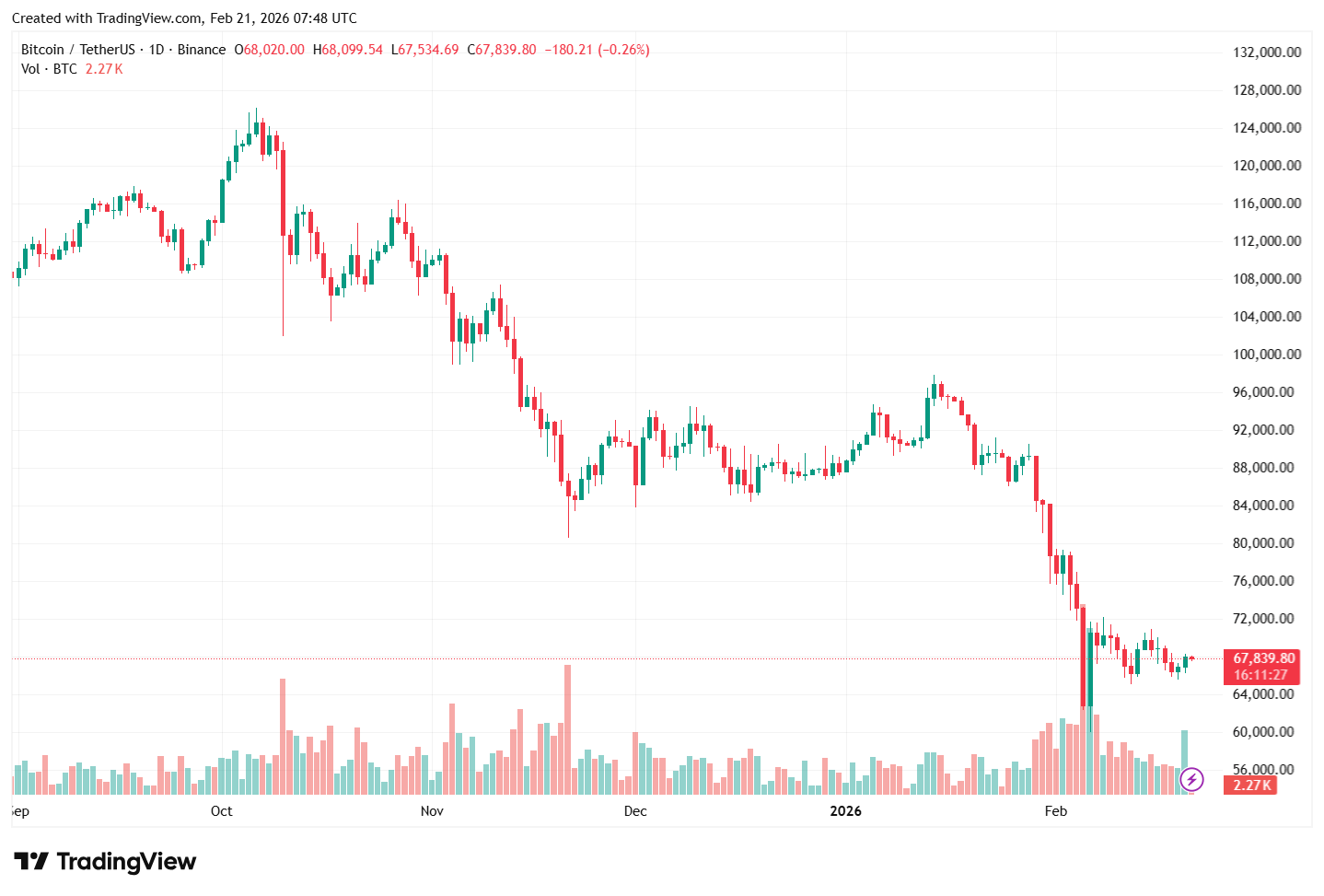
The price of Bitcoin has been stuck in a consolidation range below $70,000 so far this week, after spending most of the previous weekend above it. While the flagship cryptocurrency’s price movement has been largely — and painfully — sideways in recent weeks, this represents a notable improvement from how the month of February started.

The new month ushered in a fresh low just above the $61,000 level for Bitcoin, confirming the start of the bear market. Amidst the relative stability in recent weeks, a recent on-chain evaluation suggests that BTC and the broader cryptocurrency mark is still at risk of further downside volatility.

BTC’s Future In The Hands Of Large Investors: CryptoQuant

In the last bull cycle, the price action of Bitcoin was heavily influenced and impacted by the increased influx and activity of institutional investors (primarily through the spot exchange-traded funds). Similarly, it appears that the large investor cohort will still be at the wheel even during the bear market.

According to CryptoQuant’s latest market report, the Bitcoin exchange inflows — and the immediate selling pressure — have normalized since the capitulation spike in early February. This trend can be seen in the decline in exchange inflows from around 60,000 BTC at the start of the month to around 23,000 BTC now.

While the acute sell-off phase appears to be easing off, a troubling trend seems to be brewing among Bitcoin’s largest investors. In its market report, CryptoQuant highlighted that the BTC exchange whale ratio has climbed to 0.64, its highest level since 2015, suggesting that whale inflows account for a significant portion of the exchange deposits being seen.

Bitcoin

Source: CryptoQuant

Meanwhile, the average BTC deposit size has also reached a level not seen since mid-2022, during the heat of the last bear market. This trend further reinforces the idea that institutional or large investors are behind the increasing exchange supply.

CryptoQuant noted that the altcoin market is still facing elevated distribution pressure, with the average daily number of altcoin exchange deposits rising from 40,000 in Q4 2025 to 49,000 in 2026. This continuous capital rotation out of riskier assets reflects weakened market confidence and increases the risk of downside volatility.

[20 February 2026] Exchange Flow Redistribution: Whale Deposit Activity Grows Amid Declining Stablecoin Inflows

Source: CryptoQuant

Meanwhile, the ongoing flow of stablecoins out of exchanges points to a decline in marginal buying power (or “dry powder”) in the Bitcoin market. According to CryptoQuant data, net USDT flows into exchanges have fallen sharply from a one-year high of $616M in November 2025 to only $27M, turning negative at times (-$469M in late January).

Ultimately, the combination of the increased selling pressure from Bitcoin’s large holders, rising altcoin distribution, and consistent stablecoin outflows suggests that the crypto market structure remains at risk of further downside volatility.

Bitcoin Price At A Glance

As of this writing, the price of Bitcoin stands at around $67,580, reflecting a mild 1% increase in the past 24 hours.

Bitcoin

The price of BTC on the daily timeframe | Source: BTCUSDT chart on TradingView

Featured image from iStock, chart from TradingView

Editorial Process for bitcoinist is centered on delivering thoroughly researched, accurate, and unbiased content. We uphold strict sourcing standards, and each page undergoes diligent review by our team of top technology experts and seasoned editors. This process ensures the integrity, relevance, and value of our content for our readers.