

MARA Holdings has finalized its purchase of a 64% stake in Exaion from EDF Pulse Ventures, positioning the firm to lead European AI and high-performance computing infrastructure. MARA France completed the acquisition of a majority stake in Exaion on February 20, 2026, following formal regulatory approval from the French government. The partnership includes NJJ Capital, […]
INSHUR Appoints Christopher Aragon as Head of US Sales and Operations to Drive Growth and Expand Mobility Insurance Footprint

INSHUR, the leader in insurance solutions for the on-demand economy, announced the appointment of Christopher Aragon as Head of US Sales and Operations. In this role, Aragon will be responsible for overseeing the company’s revenue engine and commercial operations, with a focus on scaling profitable growth, strengthening execution across sales functions, and ensuring tight coordination between commercial strategy and execution as INSHUR continues to expand globally.
Aragon joins INSHUR with more than 20 years of experience in the insurance and mobility industry, having held senior leadership roles at Tint, Outdoorsy/Roamly, Turo, and Progressive. His background spans sales, underwriting, claims, risk management, and automation, with a focus on designing and scaling data-driven insurance programs for shared economy, fleet, and gig-driver ecosystems, aligning closely with INSHUR’s mission to build insurance infrastructure designed for how mobility actually works today.
“Christopher brings a strong blend of expertise and insights thanks to his successes in building data-driven insurance programs across the on-demand mobility economy,” said Dan Bratshpis, CEO and co-founder of INSHUR. “His experience at leading mobility and insurance companies gives us valuable perspective on where the market is headed and where we can push it forward. As we scale our first-to-market Off-rental (Period X™) and On-rental (Period Z) car share products, his expertise in this category will be invaluable. His deep understanding of the on-demand economy allows him to translate complex regulatory and operational constraints into innovative products and scalable commercial systems that customers actually need.”
“I was drawn to INSHUR by the environment they’ve created at the intersection of deep insurance knowledge and modern mobility needs,” said Aragon. “The company’s focus on building durable and cohesive systems is a flywheel where revenue growth, operational integrity, and customer outcomes are constantly reinforcing each other. It’s a rare combination, and I believe it’s the foundation for carrying on the future of mobility insurance in both a responsible and sustainable manner.”
With over 40 million people in the US involved in gig economy work, rideshare and delivery drivers are the backbone of the on-demand economy, powering one of the biggest economic shifts in decades. INSHUR supports this workforce by simplifying commercial insurance for rideshare, carshare, and last mile delivery, aligning coverage with real driving activity to build trust between drivers, platforms, and insurers. Through embedded, flexible commercial auto insurance, INSHUR enables coverage that fits how people actually work today.
Morning Minute: Base Breaks Up With Optimism

🔵 Base Breaks Up With Optimism
📌 What Happened
🗣️ What They’re Saying
Rumor mill saying Base token is coming later this year and this drove a lot of the decision making for leaving Optimism.
Hearing they will use their new stack to drive value to the token, which wasn’t previously possible.
— Andy (@andyyy) February 18, 2026
🧠 Why It Matters
🌎 Macro Crypto and Markets
Corporate Treasuries & ETFs
Meme Coin Tracker
💰 Token, Airdrop & Protocol Tracker
🚚 What is happening in NFTs?
Daily Debrief Newsletter
Start every day with the top news stories right now, plus original features, a podcast, videos and more.
Anthropic Launches Claude Code Security, Shaking up Cybersecurity Stocks

This week, the artificial intelligence (AI) giant Anthropic rolled out Claude Code Security, an AI-driven code-scanning tool that hunts vulnerabilities and drafts patches, jolting cybersecurity markets while raising pointed questions about jobs and industry power shifts. Can Claude Code Security Replace Human Scanners? Anthropic’s latest addition to its Claude Code platform arrives with a simple […]
TreviPay Announces AI-Powered Growth Center to Help Enterprises Predict Buyer Behavior and Drive B2B Sales
TreviPay, a fully managed B2B payments platform, today announced the availability of the Growth Center, a set of capabilities within the TreviPay Client Portal to help identify buyer growth opportunities more strategically and build stronger, longer-lasting supplier relationships. With its advanced features, the new Growth Center enables businesses to explore buyer needs, spot trends and optimize key steps in the order-to-cash (O2C) process. Integrated into TreviPay’s global payments network, the customizable add-ons will help businesses use their O2C programs to deepen buyer relationships and drive lasting engagement.
For many suppliers, growth is not only about bringing in new buyers. It also means keeping existing buyers engaged, spotting early signs of dormancy and giving sales, operations and finance teams a practical way to act without adding friction. By combining transactional data, behavioral insights and predictive intelligence, TreviPay Growth Center enables clients to identify where growth opportunities exist, which buyers need attention and how best to engage them before revenue is at risk.
“TreviPay’s network was built to help businesses grow,” said Dan Zimmerman, Chief Product and Technology Officer at TreviPay. “The Growth Center helps clients use predictive insights to spot changes in buyer behavior, re-engage customers and measure the impact of incentives, without adding work for other teams. It’s part of how we deliver value clients can’t easily replicate and help protect long-term program performance.”
As part of TreviPay’s 2026 predictions, AI is projected to be the engine to power credit, invoicing and collections – not simply as automation, but as the intelligence anticipating risk, preventing revenue leakage and strengthening buyer-supplier relationships. The Growth Center is designed to help clients act on these insights and improve program performance. The result is a smarter, more efficient approach to managing incentive programs, helping businesses optimize loyalty investments and predict future engagement. Capabilities include:
- Buyer insights to help sellers understand purchasing trends and engagement signals
- Predictive insights to identify buyers at risk of going dormant, then inform targeted outreach and incentives
- Tools to support testing and iteration so teams can improve campaign performance over time
- Rebate management to easily configure incentives with automated tracking and reporting
- Dashboards providing at-a-glance visibility into program performance and overall program health
TreviPay Growth Center Case Studies
With general availability expected in Q2 2026 for all clients, TreviPay continues to explore Growth Center capabilities. In pilot testing with a major US-based retailer, TreviPay’s latest AI and machine learning models predicted which buyers would go dormant with high accuracy. The buyers identified have been actioned by either engagement campaigns or incentives.
TreviPay has used these predictive signals to trigger buyer outreach, such as email reminders tied to available credit alongside targeted incentives. All tests resulted in an immediate increase in new spend, and in one example, 59 previously dormant buyers made $103,946 in purchases within eight days of the outreach.
In another example, the Growth Center’s Rebate Manager, which has been embedded with a large manufacturer for over one year, supported 14% year-over-year sales growth through a promotional incentive offering.
Netherlands Bans Polymarket Over ‘Illegal Gambling Services’

In brief
Prediction markets around the world
Regulatory headwinds
Daily Debrief Newsletter
Start every day with the top news stories right now, plus original features, a podcast, videos and more.
$100M Crypto Laundering Bust Reveals 81 Bank Accounts and Offshore Transfers

Nearly $100 million in investor funds was funneled through shell companies, offshore accounts, and major cryptocurrency exchanges in a sweeping federal money laundering case, underscoring risks and red flags crypto investors cannot afford to ignore. Federal Crackdown Uncovers $100 Million Crypto Laundering Operation Financial fraud schemes involving cryptocurrency continue to draw federal enforcement action. The […]
5 Ways: How to Charge Apple Watch Without Charger?
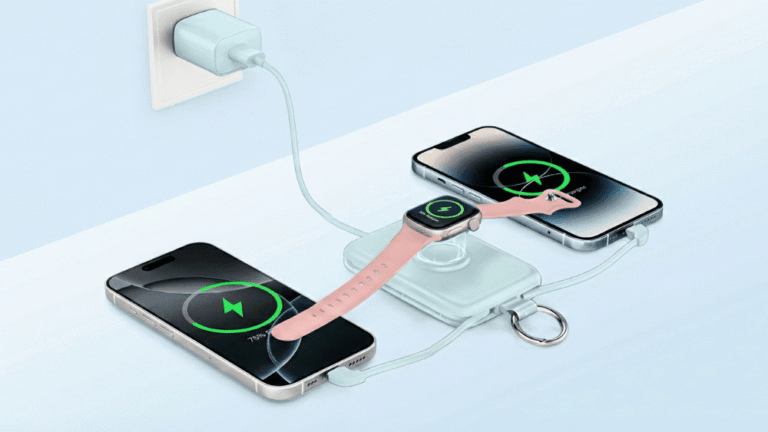
Apple Watch users often lose or damage their chargers, but there are other ways to charge their devices. The short answer is: Use a specialized 2-in-1 power bank, a MagSafe Duo, or plug your watch cable directly into an iPhone 15/16/17.
This guide details 5 hardware solutions, along with tips on how to charge without a wall adapter and safety precautions to protect your battery.
5 Ways to Solve How to Charge Apple Watch Without Charger?
1. Use the Official Apple MagSafe Duo Charger
The MagSafe Duo is a reliable official accessory that features a dedicated magnetic puck for the watch alongside an iPhone charging pad. It serves as an excellent backup, allowing you to charge both devices from a single wall adapter. Note that it requires a high-wattage power brick to charge both devices efficiently at the same time.
2. Use a 2-in-1 Portable Power Bank
The most efficient method to minimize cable clutter is a specialized portable charger like the RORRY D-Series.
- Wireless Convenience:It features an integrated magnetic charging module, allowing you to wirelessly charge your Apple Watch anywhere without bringing an extra cable.
- Dual Charging:With a built-in cable for your phone, you can charge both your iPhone and Apple Watch simultaneously from one compact device, making it perfect for on-the-go use.
3. Use iPhone Reverse Wired Charging (iPhone 15–17 Series)
If you own an iPhone 15, 16, or 17, you can use the phone’s battery to charge your watch via reverse wired charging. Simply plug your Apple Watch magnetic cable (USB-C version) directly into the iPhone’s USB-C port. The phone will function as a power bank and transfer energy to the watch.
4. Locate a Public Charging Station
In an emergency, you can utilize charging stations in specific public spaces. Official Apple retail stores have demo tables with active charging pucks available for quick top-ups. Additionally, many high-end gyms and modern hotels now equip cardio machines and bedside alarm clocks with integrated Apple Watch magnetic chargers.
5. Use a 3-in-1 Mobile Wireless Charging Station
Whether for travelers or home use, a foldable 3-in-1 charging station is a superior alternative to loose cables. These devices unfold to provide dedicated charging spots for an iPhone, AirPods, and Apple Watch. By plugging this single station into a wall outlet or laptop, you can power all your Apple devices without needing the original watch cable.
How to Charge Apple Watch Without a Power Adapter?
If you have the cable but lack the wall plug, use these common USB power sources:
- Third-Party Adapters:Any standard USB wall adapter from other reputable brands works perfectly fine.
- Computer or Laptop:Plug the cable into any active USB port. Ensure the laptop is awake, as sleep mode often cuts power to the ports.
- Portable Power Bank:Choose a portable charger or MagSafe Power Bank that supports charging multiple devices, so you can charge your devices even without an adapter.
- Car USB Port:Most modern vehicles have USB media or charging ports that provide sufficient current to charge the watch while driving.
How to Charge Your Apple Watch Safely?
Adhere to these safety protocols to preserve battery health:
- Choose Reputable Brands:Use Apple-certified (MFi) brands or trusted manufacturers like RORRY. Generic chargers often lack voltage protection, which can damage the battery.
- Avoid Extreme Heat:Never charge in direct sunlight or hot cars. Lithium-ion batteries degrade rapidly in high temperatures.
- Keep Surfaces Clean:Dust or debris on the magnetic charger or watch back can interfere with induction and cause overheating.
- Ensure Stability:Place the charger on a flat surface. A loose connection causes constant disconnection/reconnection, generating unnecessary heat.
I’ve already learned how to charge my Apple Watch, but it’s also important to learn whether I can charge the Apple Watch while simultaneously charging the power bank, and how to charge a power bank.
Conclusion
From using your iPhone’s USB-C port to finding public outlets, you have several effective options to stay powered. However, for the most streamlined experience, a dedicated solution like the RORRY D-Series is ideal, as it completely eliminates the need for extra cables. By following these five methods and safety tips, you can ensure your Apple Watch never runs out of power.
FAQs
What is the “secret port” on the Apple Watch?
It’s a hidden 6-pin diagnostic port on older models (Apple Watch Series 6 and earlier) used only by Apple technicians for repairs and diagnostics—not for consumer charging. It was removed starting with Series 7 and later models.
Can an iPhone Air charge an Apple Watch?
Yes, but only via cable. iPhone 15 and later models (including iPhone Air) support wired reverse charging through USB-C (up to ~4.5W). No wireless reverse charging for Apple Watch is supported on any iPhone.
What is reverse wireless charging?
It’s the feature that lets a phone wirelessly charge accessories placed on its back. iPhones do not support this for Apple Watch (only wired reverse charging is available on USB-C models).
Can I use an iPad to charge my Apple Watch?
Yes. Plug the Apple Watch Magnetic Charger directly into a USB-C iPad’s port (iPad Pro 2018+, Air 4+, mini 6+, iPad 10+).
How do I know if a dead Apple Watch is charging?
Look for a red lightning bolt icon—it means the watch is charging from very low/zero battery. If the screen stays black, leave it on the charger for at least 30 minutes until the icon appears. Once charging, it may turn green or show an animation.

Crypto Investors Move ‘Pretty Wide’ Amid Dip: Robinhood Exec

Crypto investors are increasingly exploring beyond the top three cryptocurrencies as the market downturn continues, according to Robinhood’s head of crypto, Johann Kerbrat.
“I think what we see from our customers is that they actually see it as an opportunity,” Kerbrat told Cointelegraph during an exclusive interview, adding that they are seeing it as “an opportunity to buy the dip.”
“So we actually see a lot of customers continuing to trade crypto and diversifying, not just on the top two or three assets, but actually going pretty wide,” he said, referring to the largest two cryptocurrencies by market capitalization, Bitcoin (BTC) and Ether (ETH).
It signals that investors are potentially becoming more comfortable with crypto as an asset class, including its volatility and market swings.
Investors have a “very clear view” on Bitcoin and Ethereum
It comes just months after Coinbase Asset Management president Anthony Bassili told Cointelegraph in November that the average investor still hasn’t reached a clear consensus on what the third crypto asset beyond the top two warrants serious attention.
“The market is very unsure as to what’s the next asset they want to own after that,” he said, adding that Solana (SOL) is “maybe” the third asset on the radar. Bassili said at the time that there is a “very, very clear view” in the community in terms of Bitcoin being the first priority, followed by Ethereum.
Institutional crypto asset trading platform MidChains CEO Basil Al Askari told Cointelegraph that “we’re seeing full-scale asset managers entering with very large block trades going into predominantly the top 20 assets.”
“Not necessarily smaller cap altcoins, or not necessarily into DeFi or yield products,” Al Askari said, adding, “it’s baby steps.”
“I don’t think it’s impossible to see large investment managers and funds build specific teams around strategies that do different things along the risk curve, and so I do think that’s very possible,” Al Askari said.
Crypto holders are looking for use cases
Meanwhile, Kerbrat said he’s also seeing more crypto holders on the platform not just holding their tokens, but actively using them.
Kerbrat said staking has gained “very strong traction” since Robinhood rolled out the feature in December, and that more crypto holders are now exploring decentralized finance (DeFi) despite the market uncertainty.
Related: Trump raises global tariff rate to 15%, but crypto markets are unfazed
“It’s been pretty fun to see, to be honest. It’s always surprising,” Kerbrat said.
It comes as overall crypto sentiment has weakened, with the Crypto Fear & Greed Index remaining in “Extreme Fear” since the start of February.
Meanwhile, US spot Bitcoin exchange-traded funds (ETFs) have posted five consecutive weeks of net outflows, with investors pulling roughly $3.8 billion from the products over the period.
Magazine: Bitcoin may take 7 years to upgrade to post-quantum: BIP-360
Cointelegraph is committed to independent, transparent journalism. This news article is produced in accordance with Cointelegraph’s Editorial Policy and aims to provide accurate and timely information. Readers are encouraged to verify information independently. Read our Editorial Policy https://cointelegraph.com/editorial-policy
House Dems Raise National Security Alarms Over Trump Family’s Crypto Bank Charter Request

In brief
Daily Debrief Newsletter
Start every day with the top news stories right now, plus original features, a podcast, videos and more.