Home Blog Page 965

Vitalik Buterin plans bolt-on cypherpunk layer to upgrade existing Ethereum

0

Vitalik Buterin, the co-founder of Ethereum, said on Friday he plans to build a “cypherpunk-principled” layer as an integrated extension to the Ethereum network, targeting core improvements like resistance to censorship, compatibility with zero-knowledge cryptography, and streamlined consensus mechanisms.

He estimated that in five years, or sooner, with AI-assisted coding and verification, the new layer could eventually take over, and the existing framework would be re-implemented into the new system.

Buterin’s remarks came in response to a statement from a crypto community member who suggested that he should abandon the original Ethereum and rebuild a brand-new “cypherpunk chain” from scratch.

Ethereum, which powers smart contracts and layer 2 scaling networks, faces ongoing criticism over fragmentation caused by its proliferating secondary networks.

Related governance proposals under consideration include forced inclusion lists aimed at compelling validators to process legitimate transactions, as well as specifications for enhanced wallet security supporting multi-signature and quantum-resistant features.

ETH was trading at around $1,960 at press time, down 4% in the last 7 days, per TradingView.

Latam Insights: El Salvador Defends Its Bitcoin Strategy, Prospera Faces an Uncertain Future

0

Welcome to Latam Insights, a compilation of the most relevant crypto news from Latin America over the past week. In this edition, El Salvador defends its continuous bitcoin purchases, Prospera faces an uncertain future in Honduras, and Argentina facilitates “mattress money” investments in crypto assets. ‘Not A Stock:’ El Salvador Defends Bitcoin Purchases Amid Market […]

Lithuania Establishes the Baltics’ Most Mature Fintech Community

0

Vilnius, Lithuania – February 20, 2026 – Lithuania’s licensed fintech landscape is reaching a new level of maturity as the country’s leading companies unite under a single representative body. The association Fintech Hub LT has announced the addition of four premier crowdfunding platforms—Röntgen, Profitus, InRento, and BeMyBond—establishing the most comprehensive fintech community in the Baltic States.

The association now represents approximately 100 sector participants, spanning all major licensed verticals: payments, digital banking, peer-to-peer (P2P) lending, crowdfunding, and crypto-assets.

“Our mission is to unite companies supervised by the Bank of Lithuania that adhere to the highest standards of compliance,” says Greta Ranonytė, Head of Fintech Hub LT. “By consolidating these diverse licensed sectors, we are fostering a more mature growth environment. Acting as a direct bridge between the industry and government institutions, we can now more effectively represent the sector’s voice, providing constructive proposals to refine the legal framework and enhance the business climate in Lithuania.”

Ranonytė emphasizes that as Lithuania competes for fintech leadership across Europe, this consolidation is a strategic step toward a more unified and efficient market. The association will continue to drive value for its members through specialized training, regular regulatory dialogues, and the promotion of industry best practices.

Lithuania’s Fintech Impact by the Numbers:

282 active fintech companies, 8,000+ professionals employed in the sector and 35 million European customers served by Lithuanian-licensed companies.

About Fintech Hub LT

Fintech Hub LT is a Lithuanian fintech industry association representing licensed financial technology companies operating under the supervision of the national regulator. The association promotes responsible innovation, regulatory excellence, and sustainable growth of the fintech ecosystem in Lithuania and across Europe.

Bitcoin Spot ETFs Register 5-Week Negative Streak – Details

0

Trusted Editorial content, reviewed by leading industry experts and seasoned editors. Ad Disclosure

As Bitcoin price struggles persist, the Bitcoin Spot ETFs continue to witness consistent net negative performance, highlighting the heightened bearish sentiments among retail and institutional investors. As the latest trading session closed on February 20, the Bitcoin ETFs have now experienced five consecutive weeks ending on a red note, as combined net outflows within this period climbed to $3.81 billion.

Investors’ Exit From Bitcoin Spot ETFs Continue

According to data from SoSoValue, the Bitcoin ETFs registered $315.89 million in net outflows in the third week of February. Notably, trading commenced on Tuesday with a negative showing that lasted for three days, resulting in aggregate net withdrawals of $403.9 million. On Friday, the institutional funds saw a positive change, as total net inflows reached $88.04 million, albeit still far from breaking the multi-week red streak.

More data from SoSoValue showed that BlackRock’s IBIT processes $303.4 million in net outflows, accounting for most of the bearish action as has been frequently observed. Meanwhile, Fidelity’s FBTC investors withdrew $19.60 million more than deposits. Other ETFs with significant negative readings included Grayscale’s GBTC, Bitwise’s BITB, and 21Shares/Ark Invest’s ARKB, with net outflows ranging from $8 million to $10 million. Valkyrie’s BRRR experienced the least net redemption activity, valued at $1.7 million.

On the other hand, Grayscale’s BTC registered $35.97 million in net inflows to maintain a positive showing for the third consecutive week. Other Bitcoin Spot ETFs, including VanEck’s HODL, Invesco’s BTCO, Franklin Templeton’s EZBC, WisdomTree’s BTCW, and Hashdex’s DEFI, all recorded zero netflow, highlighting a concerning reluctance in market participation by institutional investors. 

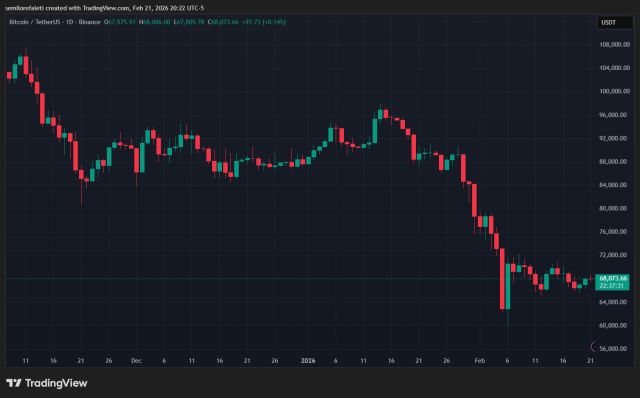
At press time, Bitcoin is valued at $68,357 as the cumulative total net inflow for the Bitcoin Spot ETFs stands at $54.01 billion, while total net assets are valued at $85.31 billion. Notably, BlackRock’s IBIT maintains undisputed market dominance, accounting for 60% of the reported assets under management.

Ethereum ETFs Mirror BTC Counterparts

Based on data from SoSoValue, the Ethereum ETFs are experiencing a persistent struggle similar to that observed with Bitcoin Spot ETFs. Over the last week, total net outflows reached $123.37 million, ensuring the institutional funds are yet to record a combined positive net flow in over six weeks.  At the time of writing, total net assets for the Ethereum Spot ETFs are valued at $11.14 billion.  Meanwhile, Ethereum trades at $1,978 following a 0.45% gain in the past day. 

Bitcoin Spot ETFs
BTC trading at $68,071 on the daily chart | Source: BTCUSDT chart on Tradingview.com

Featured image from Unsplash, chart from Tradingview

Editorial Process for bitcoinist is centered on delivering thoroughly researched, accurate, and unbiased content. We uphold strict sourcing standards, and each page undergoes diligent review by our team of top technology experts and seasoned editors. This process ensures the integrity, relevance, and value of our content for our readers.

Silicon Valley Engineers Charged With Theft of Google, Tech Trade Secrets

0

In brief

  • Federal prosecutors have charged three former Google engineers with trade secret theft and obstruction.
  • The defendants face up to 10 years in prison for each trade secret count and up to 20 years for obstruction.
  • Prosecutors allege that trade secrets were routed to unauthorized locations, including access from Iran.

Federal prosecutors have arrested three Silicon Valley engineers accused of stealing sensitive chip security trade secrets from Google and others and routing them to unauthorized locations, including Iran, raising national security concerns.

A federal grand jury in the U.S. District Court for the Northern District of California returned an indictment against Samaneh Ghandali, Soroor Ghandali, and Mohammadjavad Khosravi. The indictment was filed Wednesday and unsealed Thursday in San Jose, according to a statement from the DOJ.

While employed at Google, Samaneh Ghandali allegedly “transferred hundreds of files, including Google trade secrets, to a third-party communications platform,” to channels bearing each defendant’s first name, the DOJ said.

A copy of the unsealed indictment was not immediately available at the time of writing. Decrypt has reached out to the relevant DOJ office for further information and comment.

The trio allegedly used their employment at Google and two other unnamed companies to access confidential files tied to mobile computer processors. Per the DOJ, the stolen material included trade secrets related to processor security and cryptography, and Google materials were later copied to personal devices and to work devices associated with the other companies where the defendants were employed.

Prosecutors allege that the defendants sought to conceal their actions by deleting files, destroying electronic records, and submitting false affidavits to victim companies denying that they had shared confidential information outside the company.

In one episode described in the indictment, the DOJ alleges that in December 2023, the night before traveling to Iran, Samaneh Ghandali photographed roughly two dozen images of another company’s work computer screen displaying trade secret information.

While in Iran, a device associated with her allegedly accessed those photographs, and Khosravi allegedly accessed additional trade secret material.

According to the DOJ, Google’s internal security systems detected suspicious activity in August 2023 and revoked Samaneh Ghandali’s access. The indictment alleges she later signed an affidavit stating she had not shared Google’s confidential information outside the company.

All three defendants are charged with conspiracy and theft of trade secrets under federal law, as well as obstruction of justice under a statute that criminalizes corruptly altering, destroying, or concealing records or other objects to impair their use in an official proceeding.

The obstruction charge carries a statutory maximum sentence of 20 years in prison.

Risks and security implications

Observers say the case illustrates how insider access to advanced semiconductor and cryptographic systems can carry national security implications.

“Employees with legitimate access can quietly extract highly sensitive IP over time, even with existing controls in place,” Vincent Liu, chief investment officer at Kronos Research, told Decrypt.

The risk to semiconductor and cryptography firms often comes from “trusted insiders, not hackers,” he added, describing insider risk as a “persistent, structural vulnerability requiring constant monitoring and strict data compartmentalization.”

In such cases, “the insider is the attack surface,” Dan Dadybayo, strategy lead at crypto infrastructure developer Horizontal Systems, told Decrypt. “Firewalls don’t matter when the exfiltration vector is legitimate access,” he said, arguing that when engineers can move “architecture, key management logic or hardware security design out of controlled environments, the ‘perimeter’ collapses.”

If sensitive processor and cryptographic IP reached Iran, Dadybayo said regulators would likely respond aggressively.

He pointed to “tighter enforcement of deemed export rules where knowledge access itself counts as export” and “stricter segmentation, monitoring and licensing requirements inside U.S. firms,” adding that advanced chips and cryptography “are no longer treated as neutral commercial goods” but “instruments of geopolitical power.”

The case also exposes gaps between formal compliance and real-world resilience.

“In most technology organizations, information-theft risks are assumed to be mitigated by obtaining SOC 2 and ISO certifications,” Dyma Budorin, executive chairman at crypto security and compliance firm Hacken, told Decrypt.

Such frameworks “often measure compliance maturity, not actual resilience against a determined attacker—especially an insider.”

Certification, he said, proves controls exist “at the time of audit,” but “it does not prove that sensitive data cannot be stolen.”

Because these standards prescribe common safeguards, Budorin argued, they can make defenses predictable.

For sophisticated attackers, “compliant” often means predictable, he added, warning that real security requires “continuous validation, behavioral monitoring, and adversarial testing,” or organizations risk being “compliant on paper while critically exposed in practice.”

Daily Debrief Newsletter

Start every day with the top news stories right now, plus original features, a podcast, videos and more.

Kraken‑Backed Tokenized Stocks Surpasses $25 Billion in Volume

0

The xStocks framework has exceeded $25 billion in total transaction volume, establishing a new liquidity benchmark for tokenized traditional assets on blockchain infrastructure. The Kraken-backed xStocks ecosystem reached a milestone $25 billion in total transaction volume on February 19, 2026, marking a shift in the adoption of tokenized U.S. equities. The platform currently supports over […]

Share Profit Calculator: Calculate ROI on Your Share Trades

0

Understanding whether a share trade was truly profitable is not always as simple as comparing the buy price to the sell price. Brokerage fees, position size, and timing all affect the real outcome. For investors who want clarity and better decision-making, a share profit calculator is a practical tool for calculating return on investment and assessing performance with accuracy.

This article explains how profit on share trades is calculated, why ROI matters, and how using the right tools can improve your investing outcomes.

What ROI really means in share trading

Return on investment, commonly referred to as ROI, measures how efficiently your capital has been used. In share trading, ROI shows how much profit or loss you have made relative to the amount you invested.

The basic concept is simple. You compare the net profit from a trade to the initial investment cost. However, without accounting for all associated costs, this figure can be misleading.

This is where a trustworthy share profit calculator becomes valuable. It factors in the elements that are often overlooked, giving you a clearer view of your true performance.

Costs that impact your real profit

Many investors focus only on price movement, but several costs affect the final result of a trade.

Brokerage fees are the most obvious. You typically pay brokerage when buying shares and again when selling them. These fees reduce your net profit or increase your loss.

Other factors may include:

  • Position size, which determines the total capital committed
  • Market spreads between buy and sell prices
  • Foreign exchange costs for international shares
  • Holding costs or account fees in some cases

When calculating ROI manually, it is easy to forget one or more of these components. A share profit calculator ensures all relevant costs are included.

How a share profit calculator works

At its core, a share profit calculator uses a simple set of inputs:

  • Buy price per share
  • Number of shares purchased
  • Sell price per share
  • Brokerage or transaction fees

Using this information, the calculator determines your gross profit, net profit, and ROI percentage.

For example, if you purchased shares at a lower price and sold them higher, the calculator subtracts brokerage fees from the gross gain to show your actual profit. It then divides that profit by your total investment to calculate ROI.

This process removes guesswork and provides a consistent way to evaluate every trade.

Why ROI is more useful than raw profit

A trade that generates a large dollar profit is not always a better investment than one with a smaller profit. ROI allows you to compare trades of different sizes on an equal footing.

For instance, making a $500 profit on a $5,000 investment represents a stronger return than making $800 on a $20,000 investment. Without calculating ROI, it is easy to misjudge which trade was more effective.

Using a share profit calculator helps you identify which strategies, timeframes, or asset types deliver the best returns relative to risk and capital used.

Supporting better trading decisions

Beyond analysing past trades, a share profit calculator can also be used for planning future ones. By adjusting the sell price input, you can test different scenarios and see how they affect ROI.

This is particularly useful when setting profit targets or deciding whether a potential trade offers enough upside to justify the risk. It also helps in understanding how brokerage costs impact short-term trades compared to longer-term investments.

For active traders, this type of analysis supports more disciplined decision-making and reduces reliance on emotion.

Tracking performance over time

Consistently using a share profit calculator across all trades allows you to track performance trends. Over time, patterns begin to emerge.

You may notice that certain types of trades consistently deliver stronger ROI, while others underperform. You may also identify that frequent trading erodes returns due to brokerage costs.

These insights are difficult to spot without structured analysis. By calculating ROI on every trade, you build a clearer picture of what is working and what needs adjustment.

Avoiding common mistakes in profit calculation

One of the most common mistakes investors make is ignoring selling costs. Another is failing to account for the total capital invested, including brokerage on entry.

Relying on approximate calculations can also lead to overconfidence or unnecessary risk-taking. Small errors repeated over many trades can distort performance assessment and lead to poor strategic decisions.

A reliable share profit calculator helps avoid these pitfalls by standardising calculations and ensuring consistency.

Integrating profit calculation with broader strategy

Profit calculation should not exist in isolation. It is most effective when combined with clear goals, risk management, and portfolio planning.

For example, understanding ROI helps you decide when to exit a trade, rebalance your portfolio, or allocate capital to new opportunities. It also supports tax planning by providing accurate records of gains and losses.

Used regularly, profit calculation becomes part of a structured investing process rather than an afterthought.

Clarity leads to better outcomes

Successful investing is not just about making profitable trades. It is about understanding why they were profitable and whether the return justified the risk.

A share profit calculator provides clarity by showing the real outcome of each trade, including costs and efficiency. This insight helps investors refine their approach, avoid repeating mistakes, and focus on strategies that deliver consistent, sustainable returns.

By making ROI calculation a habit, you put yourself in a stronger position to make informed, confident decisions with every share trade.


US President Trump Raises Global Tariff Rate to 15%, Crypto Doesn’t Budge

0

US President Donald Trump is now using alternative legal routes to levy tariffs, but critics say his authority to impose them is still limited.

United States President Donald Trump announced on Saturday that he is raising the 10% global tariff rate announced on Friday to 15%, which will take effect immediately. 

Trump reiterated his criticism of the Supreme Court’s decision to strike down his authority to levy tariffs under the International Emergency Economic Powers Act (IEEPA). In a Saturday Truth Social post, he said:

“As President of the United States of America, I will be, effective immediately, raising the 10% worldwide tariff on countries, many of which have been ‘ripping’ the US off for decades, without retribution, until I came along, to the fully allowed, and legally tested, 15% level.”

On Friday, Trump announced a 10% global tariff rate to be added on top of already existing tariffs that remained valid after the court ruling, under alternative legal statutes outlined in the Trade Expansion Act of 1962 and the Trade Act of 1974. 

Source: Donald Trump

However, pro-crypto attorney Adam Cochran said the scope of these laws also limits Trump’s authority to levy broad tariffs indefinitely.

“The law he is using only allows this to be on countries we have a deficit with, for a set period of 150 days, and at a capped percentage,” he said. 

Each new tariff announcement from Trump caused turmoil in the crypto and stock markets, with severe downturns that negatively impacted asset prices and fueled macroeconomic uncertainty among investors.  

Related: US lawmakers critical of Trump tariffs, say it will derail the economy

Crypto markets held firm in the wake of the latest tariff announcements

The crypto market, which usually experiences heavy sell-offs in response to tariff announcements, held firm in the wake of the latest tariff headlines.

US Government, United States, Donald Trump
Bitcoin’s price barely reacted to the Trump tariff announcements on Friday and Saturday. Source: TradingView

The price of Bitcoin (BTC) held steady at the $68,000 level, and Ether (ETH) also remained firm, showing little to no change since Friday when the new tariffs were announced.

The Total3 indicator, which tracks the entire market capitalization of the crypto sector, excluding BTC and ETH, fell by less than 1% on Saturday and remains at about $713 billion at the time of this writing.

Magazine: ‘Everything feels like it’s going to shit’: Peter McCormack reveals new podcast