
Home Blog Page 964

Quantum computing risk puts 7 million BTC including Satoshi Nakamoto’s 1 million at stake

0

In the event that quantum computers one day become capable of breaking Bitcoin’s cryptography, roughly 1 million BTC attributed to Satoshi Nakamoto, the creator of the Bitcoin network, could become vulnerable to theft.

At today’s price of about $67,600 per bitcoin, that stash alone would be worth approximately $67.6 billion.

But Satoshi’s coins are only part of the story.

Estimates circulating among analysts suggest that roughly 6.98 million bitcoin may be vulnerable in a sufficiently advanced quantum attack, Ki Young Ju, the founder of CryptoQuant, recently wrote on X. At current prices, the total amount of coins currently exposed represents roughly $440 billion.

The question that is now becoming increasingly prevalent in and outside bitcoin circles is simple and, at times, quite controversial

Why some coins are exposed

The vulnerability is not uniform. In Bitcoin’s early years, pay-to-public-key (P2PK) transactions embedded public keys directly on-chain. Modern addresses typically reveal only a hash of the key until coins are spent, but once a public key is exposed through early mining or address reuse, that exposure is permanent. In a sufficiently advanced quantum scenario, those keys could, in theory, be reversed.

Neutrality vs. intervention

For some, freezing those coins would undermine bitcoin’s foundational neutrality.

“Bitcoin’s structure treats all UTXOs equally,” said Nima Beni, founder of Bitlease. “It does not distinguish based on wallet age, identity, or perceived future threat. That neutrality is foundational to the protocol’s credibility.”

Creating exceptions, even for security reasons, alters that architecture, he said. Once authority exists to freeze coins for protection, it exists for other justifications as well.

Georgii Verbitskii, founder of crypto investor app TYMIO, raised a relevant concern: the network has no reliable way to determine which coins are lost and which are simply dormant.

“Distinguishing between coins that are truly lost and coins that are simply dormant is practically impossible,” Verbitskii said. “From a protocol perspective, there is no reliable way to tell the difference.”

For this camp, the solution lies in upgrading cryptography and enabling voluntary migration to quantum-resistant signatures, rather than rewriting ownership conditions at the protocol layer.

Let the math decide

Others argue that intervention would violate Bitcoin’s core principle: private keys control coins.

Paolo Ardoino, CEO of Tether, suggested that allowing old coins to reenter circulation, even if through quantum breakthroughs, may be preferable to altering consensus rules.

“Any bitcoin in lost wallets, including Satoshi (if not alive), will be hacked and put back in circulation,” he continued. “Any inflationary effect from lost coins returning to circulation would be temporary, the thinking goes, and the market would eventually absorb it.”

Under this view, “code is law”: if cryptography evolves, coins move.

Roya Mahboob, CEO and founder of Digital Citizen Fund, took a similar hardline stance. “No, freezing old Satoshi-era addresses would violate immutability and property rights,” she told CoinDesk. “Even coins from 2009 are protected by the same rules as coins mined today.”

If quantum systems eventually crack exposed keys, she added, “whoever solves them first should claim the coins.”

However, Mahboob said she expects upgrades driven by ongoing research among Bitcoin Core developers to strengthen the protocol before any serious threat materializes.

The case for burning

Jameson Lopp said that allowing quantum attackers to sweep vulnerable coins would amount to a massive redistribution of wealth to whoever first gains access to advanced quantum hardware.

In his essay Against Allowing Quantum Recovery of Bitcoin, Lopp rejects the term “confiscation” when describing a defensive soft fork. “I don’t think ‘confiscation’ is the most precise term to use,” Lopp wrote. “Rather, what we’re really discussing would be better described as ‘burning’ rather than placing the funds out of reach of everyone.”

Such a move would likely require a soft fork, rendering vulnerable outputs unspendable unless migrated to upgraded quantum-resistant addresses before a deadline — a change that would demand broad social consensus.

Allowing quantum recovery, he adds, would reward technological supremacy rather than productive participation in the network. “Quantum miners don’t trade anything,” Lopp wrote. “They are vampires feeding upon the system.”

How close is the threat?

While the philosophical debate intensifies, the technical timeline remains contested.

Zeynep Koruturk, managing partner at Firgun Ventures, said the quantum community was “stunned” when recent research suggested fewer physical qubits than previously assumed may be required to break widely used encryption systems like RSA-2048.

“If this can be proven in the lab and corroborated, the timeline for decrypting RSA-2048 could, in theory, be shortened to two to three years,” she said, noting that advances in large-scale fault-tolerant systems would eventually apply to elliptic curve cryptography as well.

Others urge caution.

Aerie Trouw, co-founder and CTO of XYO, believes “we’re still far enough away that there’s no practical reason to panic,”

Frederic Fosco, co-founder of OP_NET, was more direct. Even if such a machine emerged, “you upgrade the cryptography. That’s it. This isn’t a philosophical dilemma: it’s an engineering problem with a known solution.”

In the end, the question is about governance, timing and philosophy — and whether the Bitcoin community can reach consensus before quantum computing becomes a real and present threat.

Freezing vulnerable coins would challenge Bitcoin’s claim of immutability. Allowing them to be swept would challenge its commitment to fairness.

Risk-Off Capital Shifts Toward Tokenized Assets as DeFi Pulls Back

0

In brief

  • Tokenized real-world assets grew 8.7% to $24.8 billion over the past month, even as the broader crypto market weakened.
  • DeFi’s total value locked fell 25% to $94.8 billion, with major protocols posting double-digit declines.
  • The divergence points to capital rotation rather than exit, as investors shift from DeFi yields into lower-risk, tokenized assets, Decrypt was told.

Tokenized real-world assets are showing steady growth despite a bearish market—a divergence that experts say reflects capital maturing within crypto rather than fleeing it entirely.

The RWA sector posted 8.68% growth in distributed asset value over the past month, reaching $24.84 billion, according to RWA.xyz. 

Represented asset value, which tracks tokenized assets that cannot move between wallets or leave the issuing platform, remained largely flat, growing just 0.51% to $372.97 billion.

DeFi’s total value locked, on the other hand, has plunged 25% over the past month to $94.84 billion, according to DeFiLlama data.

The drop is a result of nearly every major protocol, including Aave, Lido, Eigen Layer, and Binance Staked ETH, posting double-digit declines in the last 30 days.

Still, the divergence reflects a maturing market where capital rotates rather than retreats, experts told Decrypt. 

“DeFi yields were compressed, so lending and staking decreased alongside the market,” Sergej Kunz, co-founder of 1inch, told Decrypt. “At the same time, tokenized treasuries offer 4% on-chain returns with minimal risk. People are not leaving the space, they’re entering in a slightly less risky way.”

Unlike DeFi’s declining TVL, the distributed asset value of tokenized real-world assets, excluding stablecoins, has shown sustained growth across multiple sectors.

Tokenized U.S. Treasury debt, commodities, and private credit with $10.7 billion, $6.9 billion, and $2.9 billion in distributed value are up 10%, 20% and 15%, respectively, over the past month. 

The rotation, rather than exit, makes the shift structural, according to Rico van der Veen, CEO of Programmable Credit Protocol.

“RWA protocols offer what DeFi never could: enforceable rights, regulatory clarity, and cash flows that don’t depend on token emissions,” he told Decrypt. 

Despite the strong fundamentals for RWA assets, tokens linked to the sector have struggled—a dynamic both experts said was a result of the broader market downturn.

“Prices across the entire market are down. This is not specific to RWA projects,” Kunz said. “TVL is still growing, which shows demand is still there. Sentiment hasn’t yet caught up with the fundamentals. When it does, these projects will likely reprice very quickly.”

Van der Veen offered a more sobering take, explaining that the value is accruing to the instruments, not the tokens. 

“BlackRock’s BUIDL has $1.5 billion-plus under management. That value sits in the fund, not in any governance token,” he said. “Most RWA tokens are still utility tokens with no claim on the revenues flowing through the protocol. Adoption and token price are decoupling, permanently.”

Daily Debrief Newsletter

Start every day with the top news stories right now, plus original features, a podcast, videos and more.

What next for Ripple-linked token as losses at highest since 2022

0

XRP has just logged its largest weekly realized loss spike since 2022, a sign that panic selling may have reached an extreme.

On-chain data shows roughly $1.93 billion in realized losses in a single week, meaning coins moved at prices below their original purchase levels. The last time losses of that magnitude were recorded, about 39 months ago, XRP went on to rally 114% over the following eight months.

Realized losses measure actual losses, not paper drawdowns. They spike when holders capitulate, choosing to lock in losses rather than wait for a rebound. Unlike unrealized losses, which can vanish if price recovers, realized losses represent final decisions.

That absorption piece matters.

For realized losses to surge into the billions, there must be aggressive selling pressure, but there must also be buyers willing to take the other side. Large capitulation events often coincide with liquidity stepping in at lower levels. Historically, these moments tend to cluster near market bottoms because much of the weaker positioning gets cleared out in one move.

When weak hands are flushed, the composition of holders shifts. The coins that change hands during capitulation typically move from short-term, emotionally driven traders to longer-term buyers with stronger conviction or better cost bases. That redistribution can create a more stable foundation for price.

However, context is key. The 2022 spike came after a prolonged drawdown and broader crypto deleveraging. Today’s environment includes macro uncertainty, shifting regulatory narratives and still-elevated volatility across majors. A realized loss spike increases the probability that sellers are exhausted, but it does not eliminate macro headwinds.

Another variable to watch is follow-through. In prior cycles, sustained recoveries required not just a single capitulation print but stabilization in spot demand and declining sell pressure in the weeks that followed. If realized losses remain elevated or quickly re-accelerate, that would suggest distribution is not finished.

For now, the data points to emotional extremes. Historically, that has been fertile ground for rebounds. Whether it becomes a durable trend shift depends on what happens after the panic subsides.

Email Checks: A Modern Solution for Fast and Secure Payments

0

In today’s digital-first business environment, speed and convenience are essential when managing financial transactions. One increasingly popular solution is email checks, a modern payment method that allows businesses and individuals to send payments electronically through email. By combining the familiarity of traditional checks with the efficiency of digital delivery, this method offers a secure, cost-effective, and streamlined approach to handling payments.

What Are Email Checks?

Email checks are electronic payments sent directly to a recipient’s email address instead of being printed and mailed as paper checks. The sender generates a digital payment through a secure platform, and the recipient receives instructions via email on how to deposit or process the funds.

Unlike physical checks, there is no need for envelopes, stamps, or bank visits. The entire process happens online, making it ideal for remote businesses, freelancers, and companies with distributed teams.

How This Payment Method Works

The process of sending payments electronically through email is simple:

  1. The payer creates a payment using a secure digital platform.

  2. The recipient receives a notification via email.

  3. The recipient follows the instructions to deposit the funds into their bank account.

  4. The transaction is processed through secure banking networks.

Funds are typically transferred via ACH (Automated Clearing House), ensuring a safe and regulated transaction. This digital workflow reduces delays commonly associated with traditional mail.

Key Benefits for Businesses

1. Faster Payment Delivery

Mailing a paper check can take several days, especially across long distances. Sending payments electronically ensures near-instant delivery of payment notifications, speeding up the overall payment cycle.

2. Reduced Operational Costs

Businesses save on printing, postage, paper, and administrative handling. Over time, these savings can significantly reduce overhead expenses, especially for companies issuing large volumes of payments.

3. Improved Cash Flow Management

Quicker delivery and processing mean faster access to funds. This helps organizations maintain healthier cash flow and better financial planning.

4. Enhanced Security

Physical checks can be lost, stolen, or altered. Digital payment platforms use encryption and authentication measures to protect financial information. Every transaction is tracked, providing a clear audit trail for both sender and recipient.

5. Eco-Friendly Payment Option

Eliminating paper checks contributes to sustainability goals. Organizations looking to reduce their environmental footprint benefit from paperless payment systems.

Email Checks vs. Traditional Paper Checks

Traditional checks require manual handling at every step—printing, signing, mailing, receiving, and depositing. Each stage introduces potential delays and security risks. In contrast, electronic delivery eliminates physical handling and speeds up the process.

Additionally, remote work environments demand digital solutions. With teams operating across different cities or countries, electronic payment systems ensure seamless financial operations without geographical limitations.

Who Should Use This Payment Method?

This digital payment approach is suitable for various industries and professionals, including:

  • Small and medium-sized businesses

  • Freelancers and independent contractors

  • E-commerce companies

  • Property management firms

  • Insurance providers

  • Healthcare organizations

Any organization that regularly issues vendor payments, reimbursements, or contractor fees can benefit from faster and more efficient transactions.

Security and Compliance Considerations

Security is a top priority when dealing with financial data. Modern electronic payment systems comply with banking regulations and utilize secure encryption technologies. Multi-factor authentication and identity verification further reduce the risk of fraud.

Because transactions are recorded digitally, businesses can easily monitor payment history, reconcile accounts, and resolve disputes when necessary. This transparency enhances trust between payers and recipients.

The Future of Digital Payment Delivery

As digital transformation accelerates across industries, businesses are moving away from paper-based financial processes. Payment platforms continue to innovate, offering integration with accounting software and enterprise resource planning systems. Automation features also enable recurring payments, scheduled disbursements, and real-time tracking.

With growing demand for speed, efficiency, and security, solutions like email checks are becoming a preferred option for organizations aiming to modernize their payment infrastructure.

Conclusion

Email checks represent a practical evolution of traditional payment methods. By enabling secure, paperless transactions delivered instantly through email, they help businesses reduce costs, enhance efficiency, and strengthen financial control. As companies continue embracing digital solutions, adopting modern payment technologies is a smart step toward sustainable growth and operational excellence.


ProShares’ stablecoin-ready ETF has $17 billion debut, sparking speculation about Circle

0

ProShares’ new ETF built for the fast-growing, $300 billion world of stablecoins had a massive launch, fueling speculation that one major stablecoin issuer may be involved.

The fund, called the ProShares GENIUS Money Market ETF (IQMM), is designed to hold short-term U.S. Treasuries and meet the reserve requirements laid out in the GENIUS Act, a federal law regulating stablecoin issuers in the U.S. It’s the first ETF structured specifically to fit those rules, and that positioning may have caught the attention of some of the largest players in crypto.

The ETF logged a whopping $17 billion in trading volume on its first day, suggesting that some large players were allocating to the fund. For context, BlackRock’s spot bitcoin ETF — one of the most anticipated launches in many years— saw $1 billion in first-day volume.

Circle moving funds or internal shuffle?

The massive volume has left analysts speculating about the source of the inflows.

Nate Geraci, president of The ETF Store, said in an X post that the heavy flows might signal a deal with a major U.S.-based stablecoin issuer. “Looking at assets, believe that would only leave Circle,” he said, referring to the company behind the $74 billion USDC token.

However, Circle’s main reserve fund for USDC, managed by BlackRock, hasn’t shown any major changes so far. It held nearly $64 billion in assets as of Friday, up from $59 billion at the end of January, data shows.

What’s more likely is that the initial volume came from ProShares’ own funds moving assets for cash management purposes.

Ben Johnson, head of client solutions for asset management at Morningstar, noted that one of ProShares’ leveraged ETFs, QTTT, moved $6 billion into IQMM on launch day. That kind of internal allocation would explain a large portion of the day-one activity.

Playbook for stablecoin reserves

Still, demand from stablecoin issuers is a real possibility. With over $300 billion in U.S. dollar stablecoins in circulation, a significant portion of those reserves could eventually be allocated to ETFs like IQMM.

Markus Thielen, founder of 10x Research, wrote in a Friday report that IQMM is “currently the only purpose-built tool” that meets the GENIUS Act rules while providing high-speed liquidity.

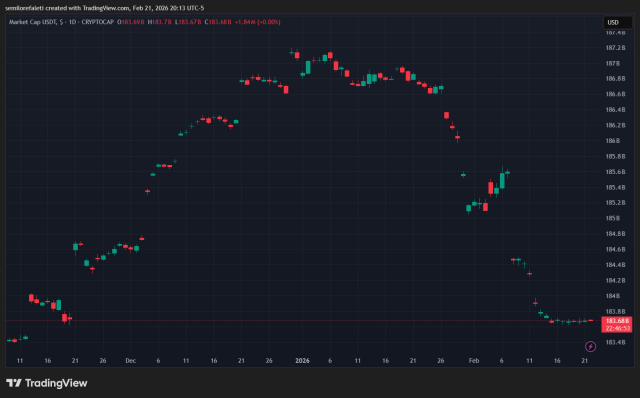
That could make it a go-to choice for U.S.-based issuers like Circle, Paxos and BitGo — and even for banks looking to issue their own tokenized deposits under the new law. Tether, which runs the largest stablecoin in the world with the $184 billion USDT token, has also rolled out a stablecoin with federal bank Anchorage Digital in the U.S. market.

As stablecoins become increasingly regulated with new tokens launching, tens of billions in additional assets could eventually flow into funds like IQMM, Thielen said.

Custodia CEO Says Trump Family Crypto Ties Are Part of Clarity Act Problem

0

In brief

  • Caitlin Long says Trump-linked crypto activity has made passing the Clarity Act harder.
  • She says the bill’s chances are a “coin flip” in the Senate.
  • Without legislation, Long says crypto regulation could be reversed by future administrations.

If Congress fails to pass the CLAIRITY Act, Custodia Bank CEO Caitlin Long says controversy tied to President Donald Trump’s family will share part of the blame.

Speaking at ETH Denver on Wednesday, Long said Trump-associated meme coins and other crypto ventures, including World Liberty Financial, have made it more difficult to secure bipartisan backing for the bill, which would define how digital assets are regulated in the U.S. and clarify the roles of federal agencies.

“It created controversy,” Long told Decrypt. “Lummis herself has said it made her job harder,” she said, referring to efforts by Wyoming Senator Cynthia Lummis.

Because of this, Long said, the bill’s prospects remain uncertain.

“I think it’s a coin flip at this point,” she said. “I wouldn’t be surprised either way, if it gets enacted or it dies.”

Introduced in May 2025, the CLARITY Act would codify key crypto market structures and create a comprehensive regulatory framework for digital assets, splitting oversight between the SEC and the CFTC.

It passed the House in July 2025, but as of February 2026, the CLARITY ACT has been delayed in the Senate due to disputes over DeFi and stablecoin provisions.

Long said regulators could seek similar outcomes through rulemaking, but such actions would lack permanence in the face of the American political system.

“When a new administration comes in, those rules can be reversed through new rule-making,” she said. “Whereas if Congress puts it in statute, it doesn’t mean it can’t be changed. It’s just a lot harder to change. So it’s much better if Congress enacts the law, and that means it’s durable.”

Long said what lawmakers are calling an ethics issue tied to the Trump family’s involvement in crypto has become “the big showstopper in the CLARITY Act.”

“There is a possibility they reach an agreement on something the White House can live with, and Congress is comfortable with, but they’ve got to be able to get the cloture vote,” she said, referring to the 60 votes required in the Senate. “They’ve got to get seven Democrats over the line, and the Democrats are very outspoken, in particular, Elizabeth Warren, against the Trump family’s activities in this area.”

Long said there is bipartisan support for crypto legislation, pointing to Senators Lummis and Kirsten Gillibrand working together on crypto policy.

Despite the worry that the bill may not pass, and amid the crypto’s extended downturn, Long said market volatility has not dampened hope.

“Those of us who’ve been around for a long time, a 50% drawdown is nothing,” she said, adding that for people entering the space during a downturn, Long said bear markets present an opportunity to learn.

“Bear markets are the best time to get self-educated,” she said. “Best advice I’ve always given is just invest in yourself, because this is something that you’re not going to learn in school.”

Daily Debrief Newsletter

Start every day with the top news stories right now, plus original features, a podcast, videos and more.

BTC Price Analysis All But Guarantees Bitcoin Higher by Early 2027

0

Bitcoin past performance gave 88% odds of higher prices by early 2027, the latest in a series of new bullish BTC price predictions.

Bitcoin (BTC) at $122,000 in ten months could be an “average return” if history repeats itself.

Key points:

  • An “informal” Bitcoin price metric gives 88% odds of BTC/USD trading higher by early 2027.

  • $122,000 per coin would mark an “average return” based on prior performance.

  • Bullish BTC price predictions remain in place despite the current low sentiment.

BTC price ended half of past 24 months higher

New analysis from network economist Timothy Peterson gives almost 90% odds of a BTC price being higher by early 2027.

Bitcoin’s underperformance since Q4 2025 has not removed every bullish BTC price prediction that leverages historical data.

For Peterson, monthly price action over the past two years points to a recovery through the rest of the year.

“50% of the past 24 months have been positive. This implies a 88% chance that Bitcoin will be higher 10 months from now,” he reported on X. 

“The average return is exp(60%)-1 = 82% => $122,000. Data goes back to 2011.”

Trailing positive BTC price months with put option payoff data. Source: Timothy Peterson/X

In a previous post, Peterson acknowledged that trailing price performance is more useful for identifying trend “inflection points” than price targets.

“This metric measures frequency, not magnitude. So Bitcoin could trend sideways for months and this metric could still go down. But it is still very useful for identifying inflection points,” he wrote, calling the tool “informal.”

Trailing positive BTC price months. Source: Timothy Peterson/X

A survey conducted by Peterson on Sunday, meanwhile, underscored existing bearish crypto market sentiment.

Source: Timothy Peterson

Bitcoin bulls double down

As Cointelegraph reported, other market sources continue to beat on a major BTC price recovery in 2026.

Related: Bitcoin whales participate in V-shaped accumulation, offsetting 230K BTC sell-off

Among them is an analysis from Bernstein, which this month offered a $150,000 target, calling Bitcoin’s comedown its “weakest bear case” in history.

US banking giant Wells Fargo additionally sees $150 billion in capital inflows into Bitcoin and stocks by the end of March.

“Speculation picks up with bigger savings…we expect YOLO to return,” analyst Ohsung Kwon wrote in a note last week.