Home Blog Page 963

Grant Cardone: Combining real estate with Bitcoin creates an unmatched financial asset, why unit count is crucial for revenue, and how Bitcoin enhances cash flow

0

Combining real estate with Bitcoin could redefine investment strategies and boost cash flow.

Key Takeaways

  • Combining real estate with Bitcoin creates a distinct financial asset that competitors struggle to replicate.
  • Grant Cardone plans to sell his Bitcoin holdings if it reaches a million dollars.
  • The number of units in real estate is crucial for determining business success.
  • Rent increases significantly impact revenue, especially with a large number of units.
  • Cardone integrates Bitcoin into real estate investments by allocating funds based on real estate costs.
  • He views market downturns as opportunities to acquire more Bitcoin.
  • Combining real estate with Bitcoin can enhance cash flow and asset value.
  • Most new investors in Cardone’s ventures are more interested in real estate than Bitcoin.
  • Bitcoin’s utility gives it an edge over treasury companies.
  • Scaling in the crypto space is more challenging than many investors anticipate.
  • Real estate offers a stable investment alternative to Bitcoin’s volatility.
  • Current US laws are unfair to non-accredited investors, limiting their access to better opportunities.
  • Tracking transactions for tax purposes in decentralized markets is complex.
  • Government restrictions on investments should be reduced to allow more personal financial freedom.
  • Raising funds from non-accredited investors is more challenging than from accredited ones.

Guest intro

Grant Cardone is CEO of Cardone Capital, a private equity real estate firm managing a multifamily portfolio worth over 5 billion dollars, and founder of Cardone Training Technologies, which has trained over 850,000 individuals and businesses globally. He has raised over 1.88 billion dollars in equity through social media crowdfunding and is a New York Times bestselling author whose 10X Rule established the 10X Global Movement. With a net worth estimated at 600 million dollars built through real estate investing, sales training, and entrepreneurship, Cardone brings deep experience in converting real estate assets into alternative investments.

The unique financial vehicle of real estate and Bitcoin

  • “The combination of real estate and Bitcoin creates a unique financial vehicle that competitors cannot replicate.” – Grant Cardone
  • Cardone’s strategy involves using Bitcoin as a differentiator in the real estate market.
  • “The real estate and the bitcoin combined is gonna become a bit of a biological transformation financial vehicle esto esto dude.” – Grant Cardone
  • This approach positions Cardone’s investments as innovative and competitive.
  • Real estate and Bitcoin together offer a new asset class that traditional investors can’t easily mimic.
  • Cardone’s hybrid model leverages the strengths of both real estate and Bitcoin.
  • The integration of Bitcoin into real estate investments provides a hedge against market volatility.
  • Cardone’s approach is designed to capture value from both real estate stability and Bitcoin’s growth potential.

The importance of unit count in real estate

  • “The most important number in business is the number of units in real estate.” – Grant Cardone
  • Unit count directly correlates with potential income in real estate investments.
  • Increasing rent by even a small amount can lead to significant revenue gains.
  • “Every time rent goes up $25 I make $80,000,000 for sure if it goes up $250 I make 800,000,000.” – Grant Cardone
  • This principle underscores the scalability of real estate investments.
  • Cardone emphasizes the importance of maximizing unit count for revenue growth.
  • The strategy focuses on acquiring properties that can accommodate rent increases.
  • Real estate investors should prioritize unit expansion to enhance cash flow.

Integrating Bitcoin into real estate investments

  • Cardone explains his formula for integrating Bitcoin into real estate investments.
  • “My formula is whatever the real estate cost to bill less what I paid is my bitcoin allocation.” – Grant Cardone
  • This strategy allows for strategic allocation of Bitcoin based on real estate costs.
  • Cardone views market downturns as opportunities to acquire more Bitcoin.
  • “I want more… the number never feels good but I love it.” – Grant Cardone
  • His approach reflects a contrarian investment strategy, viewing dips as buying opportunities.
  • This integration offers a diversified investment portfolio, balancing risk and reward.
  • Cardone’s strategy is designed to capitalize on both real estate stability and Bitcoin’s growth.

Enhancing value and cash flow with Bitcoin

  • Combining real estate investments with Bitcoin can enhance value and cash flow.
  • “I’m trying to combine the thievery… converting the discount to bitcoin I end up with something that could actually go you know parabolic.” – Grant Cardone
  • This strategy leverages Bitcoin’s potential for exponential growth.
  • Most new investors are real estate-focused, not Bitcoin enthusiasts.
  • “None of them are at this conference… they’re real estate investors that want cash flow and are willing to take a hope note.” – Grant Cardone
  • The approach appeals to traditional investors seeking stable returns with potential upside.
  • Cardone’s strategy positions real estate as a stable foundation with Bitcoin as a growth catalyst.
  • This model offers a unique investment opportunity that combines stability and potential high returns.

Bitcoin’s competitive edge over treasury companies

  • Bitcoin cannot be beaten by treasury companies that lack utility.
  • “You can’t beat bitcoin with bitcoin… there needs to be you can’t take bitcoin where where you’re you have a challenge utility already the world already challenges the utility of it.” – Grant Cardone
  • Cardone emphasizes the importance of utility in maintaining Bitcoin’s competitive edge.
  • Investors often underestimate the difficulty of scaling in the crypto space.
  • “I think people just got… underestimated how difficult it really is to scale and they underestimate you know the noise on the way down.” – Grant Cardone
  • This insight highlights the challenges of growth in the crypto industry.
  • Real estate provides a more stable investment compared to Bitcoin’s volatility.
  • “You don’t have a 40% gain in real estate ever… very gradual over long periods of time very boring.” – Grant Cardone

The evolving perception of treasury companies

  • The term ‘treasury company’ will become negatively connotated in the future.
  • “I said no I do not wanna be called a treasury company… I know there will be a day when the word treasury company will be it’s like a four letter word yeah like you know like an std.” – Grant Cardone
  • Cardone predicts a shift in perception, viewing treasury companies as risky.
  • Real estate asset value is determined by rental income and location.
  • “The value of that asset is the people that are paying me rent right and the location of that asset in the surrounding neighborhood.” – Grant Cardone
  • This insight emphasizes the importance of cash flow and location in real estate valuation.
  • Cardone’s perspective challenges traditional views on asset valuation.
  • The focus is on sustainable income rather than speculative gains.

The impact of US investment laws on non-accredited investors

  • Current US laws are unfair to non-accredited investors who need access to better investment opportunities.
  • “I can just tell you that the laws in this country are terrible for the nonaccredited investor… 98% of America is not accredited which who needs the best the better investments.” – Grant Cardone
  • This insight highlights issues of accessibility and equity in the financial system.
  • Tracking transactions for tax purposes in a decentralized market is a major challenge.
  • “You’re gonna have one token let’s say if if we got down to $1 tokens could be traded five times in one day how how can I possibly keep up with that.” – Grant Cardone
  • The complexity of compliance in a rapidly changing market is a significant concern.
  • These challenges underscore the need for regulatory clarity and innovation.
  • Cardone advocates for more inclusive investment opportunities for all investors.

Advocating for personal financial freedom

  • The government should allow individuals to invest their money freely without restrictions.
  • “I just wish they would get out of the way… let me invest if I wanna invest my last thousand dollars with you I should be able to do it.” – Grant Cardone
  • Cardone expresses a desire for reduced government intervention in personal investments.
  • The biggest problem in the country is that people do not work hard enough to earn money.
  • “The biggest problem in this country is people rip themselves off because they don’t work hard enough to earn enough money to have anything to get ripped off for.” – Grant Cardone
  • This viewpoint emphasizes individual responsibility over systemic issues.
  • Raising money from non-accredited investors is significantly more challenging.
  • “The fastest way to raise money is from accredited for people with big checks… the nonaccredited money just doesn’t come in.” – Grant Cardone

The future of real estate and Bitcoin as a financial asset

  • The combination of real estate and Bitcoin will create a new financial asset over time.
  • “The real play for me with the real estate bitcoin hybrid is I’m gonna create… a new financial asset over time… the real estate and the bitcoin combined is gonna become a bit of a biological kinda transformation financial vehicle.” – Grant Cardone
  • This insight presents a vision for the future of financial assets by merging two markets.
  • Large real estate investment trusts (REITs) cannot replicate this hybrid model.
  • “The reits that I compete with can never do this… this is my perfect moat they can never do this.” – Grant Cardone
  • Cardone identifies a strategic advantage in his approach, creating a competitive moat.
  • The recent decline in Bitcoin offers a window to build the hybrid model without competition.
  • “I think I’m gonna have at least two or three years to build this out… they were like I’m gonna go let let’s go play on the cardone the the hybrid bitcoin real estate thing… and then they saw this thing fall apart.” – Grant Cardone

Predictions for Bitcoin’s price trajectory

  • Bitcoin could reach $10,000 in two to three years.
  • “I think I can do that in two or three years 10,000 bitcoin two years that in two or two or three years.” – Grant Cardone
  • This prediction is based on Cardone’s analysis of market trends.
  • Real estate syndicators typically do not make as much money as it appears on paper.
  • “Real estate syndicators really don’t make that much money and I know it looks good on paper.” – Grant Cardone
  • This statement challenges common perceptions of profitability in real estate syndication.
  • Selling Bitcoin at a high price allows for significant profit without starting over in real estate.
  • “If that bitcoin 2,000 bitcoin goes to a million dollars tomorrow guarantee you I’m gonna sell that bitcoin.” – Grant Cardone

XRP Realized Losses Spike To New 3-Year High — What Happened Last Time?

0

Trusted Editorial content, reviewed by leading industry experts and seasoned editors. Ad Disclosure

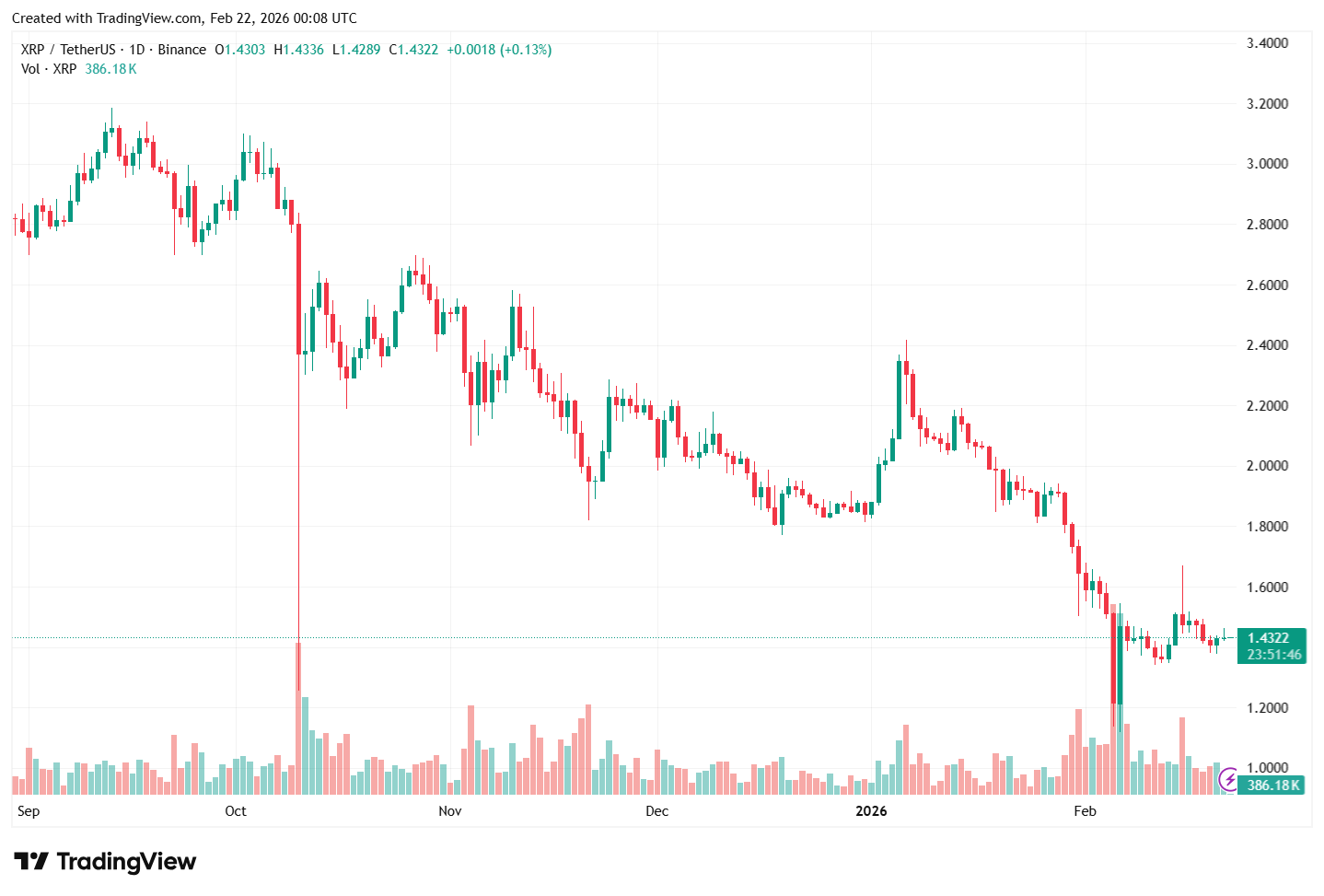
The price of XRP has been relatively calm throughout February, especially following an early-month descent to just above $1.1. Hovering around $1.4, the second-largest altcoin has struggled to continue its recovery to around the $2 mark.

However, it appears the altcoin’s struggles might not last for long, especially if history repeats itself over the next few months. According to the latest on-chain data, XRP has surpassed a threshold that has coincided with a period of extended rally in the past.

XRP Price Surged 114% After Last Realized Loss Spike

In a February 21st post on the social media platform X, Santiment shared that XRP investors are realizing their losses at a rate not seen in nearly four years. The blockchain firm revealed that the volume of realized losses climbed to approximately 908 million in the past week.

As Santiment explained in its post, these significant realized losses occur when a large number of investors sell their coins at a price lower than what they originally paid. Typically, this period coincides with the peak of market fear, where investors panic-sell their holdings for a loss instead of holding on and hoping for a rebound.

However, a spike in realized losses can be a relevant positive signal, as it has been for the price of XRP in the past. This trend implies that a significant percentage of the weak hands have left the market, with much of the damage already done.

From a historical perspective, a surge in realized losses has often preceded market bottoms. When the previous weekly milestone of 1.93 billion in realized losses occurred in 2022, the altcoin’s value witnessed an over 114% surge in the following eight months.

Santiment wrote in the X post: 

This is because extreme fear tends to peak before price does. Once sellers are exhausted, even a small amount of new buying pressure can push prices higher. That does not guarantee an immediate rally, but it increases the probability of a bounce.

Nevertheless, it is worth mentioning that Ripple’s partial victory in its case against the United States Securities and Exchange Commission played a role in XRP’s 2023 surge. As shown in the chart below, the altcoin’s price appears to be seeing some bullish momentum since the notable realized loss spike. 

XRP

Source: @santimentfeed on X

XRP Price At A Glance

As of this writing, the price of XRP stands at around $1.44, reflecting a 1% jump in the past 24 hours. An over 100% upswing from the current price point would see the altcoin return to around $3.

XRP

The price of XRP on the daily timeframe | Source: XRPUSDT chart on TradingView

Featured image from iStock, chart from TradingView

Editorial Process for bitcoinist is centered on delivering thoroughly researched, accurate, and unbiased content. We uphold strict sourcing standards, and each page undergoes diligent review by our team of top technology experts and seasoned editors. This process ensures the integrity, relevance, and value of our content for our readers.

Bitdeer’s Bitcoin Balance Hits Zero After Total Sell-Off

0

Trusted Editorial content, reviewed by leading industry experts and seasoned editors. Ad Disclosure

Bitdeer Technologies Group has emptied its Bitcoin treasury, selling every coin on its books and bringing its corporate balance to zero.

The move follows weeks of steady disposals and comes as the company pursues fresh capital to fund expansion plans outside pure mining.

Bitdeer Sells Entire Bitcoin Holding

Based on reports, the company offloaded both newly mined tokens and long-held reserves through February 2026. Around 189.8 BTC from recent output were sold, along with roughly 943.1 BTC previously kept on the balance sheet.

By the time the transactions were settled, no crypto remained in corporate custody. Reports say this drawdown gathered pace after Bitdeer unveiled plans to raise more than $300 million through convertible notes.

The stock market responded quickly. Shares slid about 15% after the disclosures, reflecting concern over dilution and rising debt obligations. While miners often sell part of their production to cover operating costs, a full liquidation of reserves is rare. That distinction has fueled debate among investors about what the decision signals.

Bitcoin Price Action

Bitcoin’s own price backdrop has been anything but calm. The alpha coin has been choppy but steady around key macro headlines, holding a range near the mid-$67,000s to high-$60,000s in recent sessions.

After heightened geopolitical tension between the US and Iran stirred safe-haven flows and wider swings in risk assets, BTC briefly climbed above $68,000 before profit-taking pulled it back. Traders remain cautious. Volatility has been tied to geopolitical risk mood and movements in traditional markets.

Bitcoin is now trading at $67,617. Chart: TradingView

At the same time, the US Supreme Court’s ruling that struck down parts of US President Donald Trump’s tariff framework triggered a modest bounce across risk assets, including Bitcoin.

Gains didn’t last long. BTC ticked up after the SC ruling but later met selling pressure as markets weighed the impact and Trump signaled new tariff options.

The overall pattern points to range-bound trading, with macro headlines guiding short-term direction rather than a strong breakout.

Why The Company Chose To Raise Cash

Reports note that Bitdeer plans to channel the new funds into expansion of data centers, AI-related services, and in-house ASIC development. Management appears to favor liquidity over holding through price swings.

Some analysts argue this is a practical response to tighter mining economics, where power costs and equipment upgrades strain margins.

Others view the complete sale as a bold pivot away from the “hold and wait” model embraced by certain competitors.

The company has not signaled a permanent exit from holding Bitcoin in the future, but for now, its balance sheet stands empty of the asset it produces.

Featured image from Unsplash, chart from TradingView

Editorial Process for bitcoinist is centered on delivering thoroughly researched, accurate, and unbiased content. We uphold strict sourcing standards, and each page undergoes diligent review by our team of top technology experts and seasoned editors. This process ensures the integrity, relevance, and value of our content for our readers.

Insurity Announces Billing-as-a-Service Now Costs Less Than Running Billing In-House for P&C Carriers and MGAs

0

Insurity, a leading provider of cloud-based software for property and casualty insurance carriers and MGAs, announced major advancements to its Billing-as-a-Service platform, establishing it as a lower-cost model for billing than running operations internally.

The expansion directly addresses the long-held belief that internal billing operations are the most economical option for carriers and MGAs. By centralizing payments, collections, and reconciliation on a single standardized platform, Insurity reduces the hidden operational costs, staffing requirements, and system maintenance burdens that often make in-house billing more expensive than it appears.

Insurity Billing-as-a-Service is built on a cloud-native architecture with deeper enterprise-grade banking integrations and a modern user experience designed to support scale, performance, and evolving payment needs. Rather than relying on fragmented, customized systems that are expensive to maintain, customers operate on one shared services platform that supports direct bill, agency bill, and complex billing structures without bespoke builds. As volume grows, the cost per transaction declines, allowing insurers to scale without adding billing headcount or infrastructure.

“Many smaller carriers, mutuals, and MGAs believe billing is cheaper to manage internally until they fully account for staffing, reconciliation work, compliance oversight, system upkeep, and delayed time-to-cash,” said David Giacomini, VP & Senior Business Unit Leader at Insurity. “Insurity Billing-as-a-Service gives carriers and MGAs a straightforward replacement. We take full ownership of billing operations and deliver it at a lower total cost, while providing the transparency and flexibility real-world insurance workflows demand.”

Through partnerships with a tier-one global banking institution and best-in-class providers for payment processing, lockbox services, and document management, Insurity has built an integrated ecosystem capable of supporting complex transaction flows while scaling alongside customer growth. Faster onboarding allows customers to launch new lines of business quickly and begin issuing and collecting premiums without standing up internal billing teams.

“Our customers are in growth mode. They want to issue more policies, not manage billing infrastructure,” said Jatin Atre, President at Insurity. “Insurity Billing-as-a-Service gives them a clear economic advantage by providing a smarter alternative to costly, in-house billing. It reduces operating costs, simplifies financial operations, and more importantly, removes the friction that slows down producers and policy issuance.”

For more information about Insurity Billing-as-a-Service, contact Elizabeth.Hutchinson@insurity.com.

How decentralized AI is leveling the playing field

0

As AI infrastructure investments surge toward $300B in 2025 alone, fueled by mega-projects like the $500B Stargate initiative and hundreds of billions in Nvidia chip purchases, the decentralized AI space offers a compelling alternative to Big Tech’s centralized dominance. Now’s the time to invest in it.

In the rapidly evolving landscape of artificial intelligence, a seismic shift is underway, one that promises to redefine how we build, deploy and interact with AI. While centralized AI, dominated by tech giants like Amazon, Microsoft and Google, has driven remarkable progress, the recent shift toward agentic AI creates a unique opportunity for decentralized AI. It’s why the sector is poised to become the most exciting and critical space over the next few years.

With a global AI market projected to grow at a 35.9% CAGR through 2030, the stark valuation gap—$12 trillion for centralized AI enterprises versus ~$12 billion for decentralized AI—signals an unprecedented investment opportunity. Bridging this gap will not only yield massive financial returns but also reshape the ethical, technical and societal foundations of AI. Here’s why decentralized AI, powered by open-source principles and blockchain technology, is the future.

The valuation gap: a $15 trillion opportunity


Centralized AI, controlled by a handful of tech behemoths, commands a staggering $12 trillion~ in enterprise value, fueled by their dominance of nearly 70% of global cloud infrastructure. Yet, this concentration of power comes at a cost: stifled competition, ethical lapses, a loss of agency and control for both individual and corporate users and a one-size-fits-all approach that often stifles innovation.

Meanwhile, decentralized AI, valued at just $12 billion, is a nascent yet rapidly growing ecosystem. The blockchain AI market alone is projected to skyrocket from $6 billion in 2024 to $50 billion by 2030, reflecting a staggering 42.4% CAGR, and I don’t believe these figures will come close to the actual outcome, as the real numbers are likely to be much higher. This disparity isn’t a sign of weakness but a clarion call for investors. The next two to three years will see decentralized AI platforms—think Bittensor, Artificial Superintelligence Alliance,The Manifest Network, Venice.Ai or Morpheus—close this gap by democratizing access, fostering innovation and addressing the critical flaws of centralized systems.

And as the agentic AI age approaches, conjuring visions of hundreds of billions of independent AI agents executing instructions and transacting on behalf of individuals and companies, the case for decentralized AI becomes all the more urgent.

How can these agents be truly autonomous in a centralized model? How can we know –and prove– that they are living up to the legal definition of an “agent?” In other words, it’s a fiduciary with 100% responsibility to its owner, not to a third party (such as the platform on which it is hosted). The explosion of innovation this hyper-competitive, hyper-collaborative “Internet of AI agents” points to will only be possible if those agents are given the privacy and control they need to truly act independently. There is no “free market of ideas” without the actors in that market having their own free will. Over the past quarter, the explosion of localized AI agent frameworks built on open architectures, such as OpenClaw, has demonstrated how quickly sovereign AI can move when unshackled from centralized cloud control. By moving AI from corporate servers to local, peer-to-peer networks, users are shifting from “renting” intelligence to owning their own fully autonomous stacks. This structural re-architecture bypasses Big Tech gatekeepers, sparking a wave of innovation and privacy that centralized platforms can no longer control.

Privacy: empowering individuals over corporations

Centralized AI thrives on vast data lakes, often harvested with little regard for individual privacy. Big Tech’s history of squashing competition and skirting ethical boundaries, whether through monopolistic practices or opaque data usage, has eroded trust. Decentralized AI, by contrast, leverages blockchain’s cryptographic security to prioritize individual privacy. Users control their data, sharing it selectively via secure, transparent protocols. Platforms like Akash Network ensure that personal data remains encrypted and decentralized, preventing the kind of mass exploitation seen in centralized systems. This privacy-first approach isn’t just ethical; it’s a market differentiator in an era where 83% of enterprises are shifting workloads to private clouds to escape public cloud vulnerabilities.

But it’s not only individuals who are disadvantaged by the current centralized model. Businesses, institutions and entire industries have been forced to keep their most valuable datasets locked away. Sometimes for competitive reasons, sometimes because of fiduciary, custodial, or regulatory obligations, making sharing with centralized LLMs flatly impossible. The risk of inadvertently uploading trade secrets, proprietary R&D, sensitive customer records or regulated data into the black box of a hyperscaler has been a hard stop for meaningful enterprise-scale AI adoption.

But the deeper significance of this shift goes beyond unlocking long-dormant corporate data vaults; it redefines what enterprise trust in AI actually looks like. This is core to the mission of organizations like the Advanced AI Society, which argues that we are entering an era where enterprise customers will not merely prefer privacy-preserving infrastructure; they will demand something far stronger: proof of control. Not marketing promises, not compliance checklists, but cryptographic, verifiable assurance that the business, and only the business, controls its data, compute pathways, storage substrates, proprietary model weights and fine-tuned derivatives. In a world where AI touches regulated workflows, intellectual property and customer-sensitive operations, enterprises will insist on provable guarantees that nothing escapes their perimeter, and nothing can be silently copied, scraped or siphoned by a third party. Decentralized AI is the first architecture capable of delivering this new trust standard. It shifts the question from “Do we trust our vendor?” to “Can we verify our sovereignty?” and that inversion is the fault line upon which the next decade of enterprise AI adoption will hinge.

This is where decentralized AI and confidential computation transform the playing field. For the first time, companies can safely apply their private datasets to local or domain-specific model training without surrendering custody or visibility. Whether through encrypted compute, zero-knowledge architectures, or decentralized execution layers, the data never leaves their control. What was once an unbridgeable chasm of AI potential on one side and locked corporate data on the other can now finally be crossed.

And that unlock is enormous. Non-internet-platform companies represent the vast majority of the world’s valuable information: pharmaceutical research vaults, medical imaging archives, energy exploration data, financial pattern histories, supply chain telemetry, manufacturing QA logs and more. These troves have been sealed off from AI’s learning loops due to the inherent danger of centralized training. Decentralized, privacy-preserving AI flips that equation, turning previously inaccessible datasets into catalytic assets.

If AI is truly going to cure cancer, solve energy scarcity, overhaul logistics, accelerate drug discovery or reinvent scientific research, it cannot rely solely on whatever scraps of information Big Tech has scraped from the public internet. The great breakthroughs will come when the off-internet world—the real, industrial, scientific and institutional world—can safely contribute its data to AI models without risking exposure, theft or exploitation.

Decentralized AI is the architecture that makes that future possible. It doesn’t just empower individuals against corporations; it empowers every enterprise that has been forced to sit on the sidelines. And when those data vaults finally open on their own terms and under their own control, that will be the great unlock that propels AI from impressive novelty to civilization-scale engine.

Compute capacity: harnessing the world’s spare resources

Centralized AI’s Achilles’ heel is its insatiable demand for compute power, requiring dozens of gigawatts to train and run models like GPT-4 or Llama. Data centers strain global energy grids, raising environmental concerns and increasing consumer costs.

Decentralized AI flips this paradigm by tapping into spare compute capacity such as idle GPUs in homes, offices or even smartphones. Platforms like Targon (Bittensor Subnet 4), focused on making AI inference faster and cheaper, aggregate distributed resources to deliver scalable solutions. OAK Research highlights that Targon’s benchmarks reportedly outperform Web2 solutions in certain tasks, offering lower-cost inference with acceptable quality—a game-changer for commodification, scaling and downstream integrations. By efficiently using existing energy sources, decentralized AI aligns with a sustainable future while democratizing access to cutting-edge technology.

Blockchain as the backbone of trust and innovation

AI is moving to blockchains, and for good reason. Blockchain solves critical pain points that centralized systems sidestep or exacerbate:

  • Training validation: Decentralized networks like Bittensor use consensus mechanisms (e.g., Yuma Consensus) to validate AI model outputs, ensuring quality without centralized gatekeepers.
  • Copyright compliance: Blockchain’s immutable ledger tracks data and model provenance, addressing intellectual property disputes—a growing concern in AI.
  • AI guardrails: Decentralized governance creates transparent, community-driven rules to prevent misuse.
  • Value transactions: Tokens like those on Akash enable fair reward distribution for contributors, from miners to validators.
  • Data security and privacy: Distributed storage and encryption protect sensitive data, unlike centralized clouds prone to breaches. These features empower a collaborative ecosystem where developers, users and enterprises co-create value, unhindered by Big Tech’s competitive stranglehold.

Open source: the catalyst for exponential growth

Decentralized AI thrives on open-source principles, fostering innovation at a pace centralized systems can’t match. Open-source models, like those on Bittensor for specialized tasks, invite global contributions and enable rapid iteration on use cases ranging from video analysis to predictive markets. Centralized AI, by contrast, locks models behind proprietary walls, limiting adaptability and accessibility. Open-source decentralized platforms not only accelerate innovation but also align with the growing demand for transparency in AI development—a demand Big Tech often ignores.

The investment case: why now?

The $12 trillion centralized AI market is a mature Goliath, but its growth is constrained by ethical scandals, energy demands and diminishing returns. Decentralized AI, though smaller, is a nimble $12B David, poised for exponential growth. Its ability to address privacy, leverage distributed computing and foster open innovation makes it a superior long-term bet. Investors who back platforms like Bittensor, Storj, or Akash now, while valuations are low, may stand to reap outsized returns as the blockchain AI market scales to $200 billion by 2030. The shift is already underway: enterprises are moving to private clouds, and communities are embracing decentralized governance.

The future is decentralized

Decentralized AI isn’t just a technological evolution; it’s a societal necessity. It counters Big Tech’s monopolistic grip, protects user privacy and harnesses global resources for sustainable growth. As platforms like Bittensor and Akash pioneer scalable compute markets, they pave the way for a world where AI serves the many, not the few. The delta in the valuation gap will close. Not because centralized AI will falter, but because decentralized AI’s potential is too vast to ignore. For investors, developers and visionaries, this is the most exciting space to watch, build and invest in over the next three years. The revolution is here, and it’s decentralized.

Matt Corallo: Most crypto wallets are quantum-safe, Bitcoin’s soft fork could require proof of seed phrase ownership, and the Ethereum Foundation is leading in quantum threat response

0

Bitcoin’s path to quantum safety may be smoother than expected, with proactive steps already underway.

Key takeaways

  • Most crypto wallets use quantum-safe derivation schemes for seed phrases, enhancing security against quantum threats.
  • A soft fork could be implemented in Bitcoin to require proof of seed phrase ownership, addressing potential quantum threats.
  • Identifying relevant Bitcoin developers is challenging due to noise from less impactful contributors.
  • Organizations like Chaincode Labs and Blockstream Research are crucial in advancing post-quantum security for Bitcoin.
  • The Bitcoin community may adapt to post-quantum challenges faster than anticipated.
  • There is a forming consensus among Bitcoin developers on approaches to address quantum threats.
  • Preparing Bitcoin for a post-quantum world may be easier than expected, despite higher data requirements.
  • Current post-quantum cryptographic schemes are in early stages and may not be reliable yet.
  • Quantum computing poses a significant threat to all cryptographic protocols, including Bitcoin.
  • The Ethereum Foundation is taking a more proactive approach to quantum threats compared to Bitcoin.
  • Bitcoin may take seven years to upgrade to a post-quantum state, but proactive steps are being taken now.
  • The public perception of quantum threats may pose a greater risk to Bitcoin than the actual technological threat in the short term.

Guest intro

Matt Corallo is a Bitcoin Core contributor at Chaincode Labs. He is a co-founder of Blockstream and the creator and maintainer of the Fast Internet Bitcoin Relay Engine (FIBRE).

Quantum-safe measures in crypto wallets

  • “Most crypto wallets use derivation schemes that are quantum safe” – Matt Corallo
  • Seed phrases in wallets enhance security against quantum threats.
  • A soft fork could require proof of seed phrase ownership to combat quantum threats.
  • “We could do a soft fork in Bitcoin and require proof of seed phrase” – Matt Corallo
  • Understanding wallet security mechanisms is crucial for future-proofing against quantum computing.
  • Quantum-safe measures are already integrated into many crypto wallets.
  • The implications of quantum computing on wallet security are significant.
  • Adapting to quantum threats doesn’t necessarily require extensive wallet upgrades.

Identifying relevant Bitcoin developers

  • “It can be hard to tell who’s relevant in Bitcoin development” – Matt Corallo
  • Noise from less impactful contributors complicates identifying key developers.
  • Organizations like Chaincode Labs focus on post-quantum security.
  • “Chaincode Labs has spent time on mapping out a post-quantum future for Bitcoin” – Matt Corallo
  • Understanding the dynamics of the Bitcoin development community is crucial.
  • The distinction between impactful and non-impactful contributors is essential.
  • Engaging with the right developers is critical for stakeholders.
  • The Bitcoin community is preparing for post-quantum challenges.

Consensus and roadmap for post-quantum Bitcoin

  • A consensus is forming among developers on addressing quantum threats.
  • “There’s a consensus forming in terms of approaches” – Matt Corallo
  • Preparing Bitcoin for a post-quantum world may be easier than expected.
  • Higher data requirements are a consideration in preparing for quantum threats.
  • “Bitcoin core developers are conservative about data requirements” – Matt Corallo
  • A roadmap to address quantum threats is gaining consensus.
  • The technical feasibility of adapting Bitcoin is optimistic.
  • Developers are actively working on post-quantum security measures.

Challenges and opportunities in post-quantum cryptography

  • Current post-quantum cryptographic schemes are in early stages.
  • “Post-quantum schemes are still fairly young” – Matt Corallo
  • Hash-based signatures allow gradual transition without immediate reliance.
  • “You can start using addresses that commit to post-quantum hash-based signatures” – Matt Corallo
  • Integrating new cryptographic methods is a strategic approach.
  • The reliability of current post-quantum schemes is under evaluation.
  • A gradual transition to post-quantum cryptography is possible.
  • Bitcoin’s security measures are evolving to address future threats.

Quantum computing’s impact on cryptographic protocols

  • Quantum computing poses a significant threat to cryptographic protocols.
  • “A quantum computer could keep plans secret, leaving holders vulnerable” – Matt Corallo
  • Ethereum is more proactive in addressing quantum threats than Bitcoin.
  • “The Ethereum Foundation has a group dedicated to working on this” – Matt Corallo
  • The threat of quantum computing requires immediate attention.
  • Differing strategies between Ethereum and Bitcoin highlight contrasting approaches.
  • Quantum threats are a critical risk in the blockchain space.
  • Proactive measures are essential to mitigate quantum vulnerabilities.

Transitioning to post-quantum public keys

  • The transition to post-quantum public keys involves community consensus.
  • “You have to flip that switch, it’s up to the community” – Matt Corallo
  • Cryptocurrencies face similar challenges as other cryptographic systems.
  • “There’s not much unique about any crypto in this decision” – Matt Corallo
  • Community consensus is crucial for accepting old public keys.
  • The decision-making process involves complex considerations.
  • The broader industry issue of quantum security affects all cryptographic systems.
  • Transitioning to post-quantum security is a shared challenge across industries.

Market dynamics and Bitcoin forks

  • The market will prefer forks that disable insecure spend paths.
  • “The market is gonna prefer the fork with insecure spend paths disabled” – Matt Corallo
  • Market forces determine the value and fate of crypto.
  • “It’s up to the market, not consensus among all stakeholders” – Matt Corallo
  • The role of market dynamics is critical in crypto forks.
  • Developers prioritize principles like censorship resistance.
  • “Contributors focus on principles rather than specific constituencies” – Matt Corallo
  • Bitcoin’s development is guided by foundational principles.

Trustlessness and quantum threats

  • Trustlessness is a key focus for Bitcoin developers.
  • “Trustlessness is the right answer for Bitcoin development” – Matt Corallo
  • Quantum computing threatens Bitcoin’s trustlessness.
  • “A quantum computer stealing coins impacts trust in the system” – Matt Corallo
  • User confidence is tied to the system’s trustlessness.
  • Developers prioritize user autonomy and security.
  • Ongoing security considerations are necessary for Bitcoin.
  • Quantum threats challenge the core principles of Bitcoin.

Bitcoin’s competition for capital

  • Bitcoin faces competition from new investment classes like AI.
  • “Bitcoin is competing for capital with AI, a new investment class” – Matt Corallo
  • Short-term price movements are not a priority for developers.
  • “Developers focus on principles, not short-term price” – Matt Corallo
  • Market dynamics could favor forks with lower supply.
  • “Forks with lower supply might win in market dynamics” – Matt Corallo
  • The investment landscape shift impacts Bitcoin’s performance.
  • Developer priorities differ from market price fluctuations.

Cryptographic risks and mitigation strategies

  • Traditional mathematical breakthroughs could threaten cryptography.
  • “There’s a risk of traditional breakthroughs leading to cryptographic issues” – Matt Corallo
  • Requiring multiple signature schemes can mitigate risks.
  • “Require two different signature schemes to ensure security” – Matt Corallo
  • Cryptographic vulnerabilities evolve progressively over time.
  • “Cryptographic primitives aren’t broken overnight” – Matt Corallo
  • Proactive measures are necessary to address cryptographic risks.
  • The blockchain community is considering technical solutions to complex problems.

Bitcoin May Rebound to $85K as CME ‘Smart Money’ Slashes Short Bets

0

Bitcoin (BTC) bottomed after CME futures speculators turned net bullish in April 2025. A similar positioning shift is resurfacing in 2026, raising the odds of a BTC price recovery in the coming weeks.

Key takeaways:

BTC futures, technicals hint at $85,000 price target

Non-commercial Bitcoin futures traders cut their net position to about -1,600 contracts from roughly +1,000 a month earlier, according to the CFTC Commitment of Traders (COT) report published last week.

Bitcoin futures net short position. Source: CFTC Commitment of Traders (COT)

In practice, this means that large speculators, including hedge funds and similar financial institutions, have shifted from net short to long, with bulls outnumbering bears on the CME.

The rapid net-short unwind implies that “smart money” added longs “with some urgency,” said analyst Tom McClellan, while pointing to two similar past swings that preceded Bitcoin price bottoms.

For instance, BTC’s price gained around 70% after a sharp dip in CME Bitcoin futures net shorts in April 2025. In 2023, BTC price rose by over 190% under similar futures market conditions.

BTC/USD weekly price chart. Source: TradingView

As of February, the smart money swing is flashing once again, just as Bitcoin defends its 200-week exponential moving average (200-week EMA, the blue line), which has acted as a bear-market floor in most major drawdowns of the last decade.

On Sunday, BTC’s 200-week EMA was hovering around near $68,350.

BTC/USD weekly price chart. Source: TradingView

The last time Bitcoin traded around this moving average during deep sell-offs (in 2015, 2018 and 2020), it eventually marked the end of the downtrend and the start of a new recovery phase.

Related: Bitcoin historical price metric sees $122K ‘average return’ over 10 months

Bitcoin’s weekly relative strength index (RSI) remains in oversold territory, a sign that selling pressure is nearing exhaustion.

That further raises Bitcoin’s odds of recovering in the coming weeks. A decisive rebound from the 200-week EMA could trigger a run-up toward the 100-week EMA (the purple wave) at roughly $85,000 by April.

Bitcoin bulls aren’t out of the woods yet

McClellan cautioned that the smart money shift is “a condition, not a signal,” meaning Bitcoin could still slide from its current price levels before a durable low forms.

That may trigger the 2022 scenario, wherein BTC plunged by over 40% after breaking below its 200-week EMA despite similar oversold conditions.

BTC/USD weekly price chart. Source: TradingView

A repeat of that 40% plunge in 2026 could result in BTC prices falling toward $40,000, or 60% from its record high of around $126,270.

Some analysts, including Kaiko, also see BTC potentially bottoming around $40,000–$50,000 based on its “four-year cycle” framework.