Home Blog Page 876

Ethereum Exodus Continues: Supply On Crypto Exchanges Dries Up To Years-Long Low

0

Trusted Editorial content, reviewed by leading industry experts and seasoned editors. Ad Disclosure

With the Ethereum price slowly demonstrating bullish traction after reclaiming the $2,000 mark, sentiment is turning positive once again. During this price action, investors are choosing to hold the leading altcoin rather than sell, which is indicated by a significant drop in crypto exchanges’ reserves.

Available Ethereum On Exchanges Hits New Lows

Following the bounce in Ethereum’s price, the supply of ETH sitting on cryptocurrency exchanges has experienced a sharp decline. According to the report, the number of the coin available on crypto exchanges has fallen to new lows, signaling a notable shift in market structure and sentiment.

As per the chart shared by Leon Waidmann, an optimist and the head of research at Lisk, the metric is currently sitting at a multi-year low. As coins continue to migrate from trading platforms into private wallets or long-term storage, the amount of liquid accessible for instant sale is gradually decreasing.

Currently, over 16 million ETH is left on cryptocurrency exchanges, falling from about 23 million ETH in 2023. Even though the price of ETH has declined sharply from a new all-time high, holders kept withdrawing their coins from platforms. This is considered a positive development for Ethereum as fewer ETH reserves on exchanges means less immediate sell pressure on the altcoin.

Ethereum
Source: Chart from Leon Waidmann on X

When reserves drop during a price crash, this is an interesting trend as it implies that holders are not panic-selling. Waidmann highlighted that these holders are deliberately moving ETH off cryptocurrency exchanges to staking contracts, cold storage, and Decentralized Finance (DeFi).

These investors are making an active choice to hold, and this is historically how supply shocks are started without a price pump. While everyone else is preoccupied with the red candles, there is a silent accumulation. The market may be scared currently, but on-chain data is telling a different story.

ETH Is Attracting A Massive Wave Of Adoption

Ethereum adoption is picking up pace at a significant rate, as evidenced by its mainnet activity. The network’s activity has spiked to unprecedented levels, with its daily transactions climbing to an all-time high despite the bear market. The milestone shows a significant rise in on-chain demand, which is fueled by increased DeFi activity, stablecoin transfers, NFT interactions, and the emergence of AI and real-world asset protocols.

Data shows that the mainnet transactions per day have surged to nearly 3 million. This is a notable number when compared to levels seen in previous cycles, especially during a bull run. Waidmann noted that the current number of daily transactions is more than the ones seen in the 2021 bull run and in the 2023 recovery.

Despite the fact that the price of ETH is down, the network is experiencing its busiest period, signaling sustained engagement beneath the surface. Record-breaking transaction counts frequently indicate increasing utility rather than being pure speculation.

Ethereum
ETH trading at $1,995 on the 1D chart | Source: ETHUSDT on Tradingview.com

Featured image from Freepik, chart from Tradingview.com

Editorial Process for bitcoinist is centered on delivering thoroughly researched, accurate, and unbiased content. We uphold strict sourcing standards, and each page undergoes diligent review by our team of top technology experts and seasoned editors. This process ensures the integrity, relevance, and value of our content for our readers.

Former LAPD Officer Convicted In $350,000 Bitcoin Kidnapping And Home Invasion

0

A Los Angeles County jury has found former Los Angeles Police Department officer Eric Halem guilty of kidnapping and bitcoin robbery in a 2024 home invasion that targeted a teenage cryptocurrency holder.

The verdict followed a two-week trial in Los Angeles County Superior Court, where prosecutors argued that Halem, 38, and three alleged accomplices posed as police officers to gain entry to a high-rise apartment in Koreatown. 

Once inside, they restrained a 17-year-old and his girlfriend and stole a hard drive containing private keys to roughly $350,000 in bitcoin.

The victim, who testified under his first name, Daniel, told jurors that the men threatened to kill him if he did not hand over the device. According to testimony, the group wore vests identifying themselves as police and used an access code obtained from a conspirator who had rented the unit to the teenager, according to The Los Angeles Times. 

They took the elevator to the 18th floor and entered the apartment during the early morning hours of Dec. 28, 2024.

Daniel’s girlfriend was placed in LAPD-issued handcuffs, and Daniel was subdued and cuffed before the suspects demanded the hard drive with the bitcoin. Prosecutors said the teenager complied under threat of being shot.

Halem served 13 years with the Los Angeles Police Department and left the department in 2022. At the time of the robbery, he was working as a reserve officer. Evidence presented at trial showed that he operated a luxury car rental business, DriveLA, and had pursued other ventures, including an app for actors to audition remotely and discussions about a reality television project.

Jurors deliberated for less than a day before returning guilty verdicts on kidnapping and robbery charges. Halem is scheduled to be sentenced on March 31. Prosecutors have said the charges carry the possibility of a life sentence.

A policeman’s oath ‘violation’

In closing arguments, Deputy District Attorney Jane Brownstone told jurors that Halem violated the oath he took as a police officer. She pointed to text messages sent after the robbery in which Halem wrote that he was monitoring police radio traffic. 

After two alleged accomplices were arrested, Halem wrote in another message that he knew they were “talking” and that “Someone I know fed wise called me,” according to evidence shown in court.

Halem’s attorney, Megan Maitia, challenged the prosecution’s case and criticized the investigation. She argued that detectives relied on selected text messages drawn from large volumes of data and failed to corroborate the teenager’s account. 

Daniel admitted during testimony that he had obtained his bitcoin holdings through fraud, though that admission did not negate the robbery charge.

Maitia also questioned the prosecution’s portrayal of the group as organized criminals. Trial testimony indicated that the suspects drove to the scene in a green Range Rover and an orange Lamborghini Urus registered to Halem’s rental business and equipped with GPS trackers.

If Halem had planned the robbery, she asked, why use vehicles that could be traced to him.

Halem did not testify, and the defense called no witnesses.

His co-defendants have not yet stood trial and have maintained their innocence. One of them, Gabby Ben, 51, has prior fraud convictions. 

Gemini 3.1 Flash-Lite Offers Choice on How It Processes Inputs

0

Enterprise developers can now choose the level of thinking they need for a specific task with Google’s newly released Gemini 3.1 Flash-Lite, it’s latest reasoning model. 

On Tuesday, the cloud provider launched Gemini 3.1 Flash-Lite in preview, calling it the fastest and most cost-efficient Gemini 3 series model, built for high developer workloads. 

With the model, enterprises can choose the different depths of thinking — minimal, low, medium or high — needed, depending on the task that is being performed. The model runs in AI Studio, a platform developers can use to build, test and deploy applications using Gemini models, as well as in Vertex AI, a platform for building and scaling machine learning models. The model is suitable for high-volume translation, content moderation and complex workloads, such as generating user interfaces and dashboards, following instructions and creating simulations, according to Google. 

Related:OpenAI Unveils $110B in Funding, Expands AWS Partnership

With its new model, Google aims to target a challenge many enterprise developers face when working with reasoning models. Often, thinking models take time perform a task, which can be costly and wasteful if the developer does not need an in-depth level of analysis for a particular task. By enabling enterprise developers to choose the level of thinking, Google is also helping enterprises develop multi-purposed agents. 

“This is an ideal model for agents,” said Mark Beccue, an analyst at Omdia, a division of Informa TechTarget.  

He added that while other AI model providers are focused on reasoning models and agents, Google’s strategy tends to be enterprise driven. In this case, Google’s approach is focused on reducing the number of tokens that a model uses, which gives businesses a performant but cheaper model option.  

“If you can make something two-and-a-half times faster and cut the price almost in half, that’s a huge game,” said Bradley Shimmin, an analyst at Futurum Group.  

He added that enterprise developers are also beginning to distribute tasks across multiple models rather than rely on one. For example, a developer building AI agents might need Gemini 3.1 Pro for planning and building, whereas 3.1 Flash-Lite could be used for basic documentation or code generation. 

“It’s not a game of overwhelming with greatness,” Shimmin said. “It’s a game of optimizing with greatness.” 

Developers have started to realize with other model releases, such as Qwen 3.5-9B from earlier this week, that it might be better to turn off the ability for the model to process its task because having it on slows down the model and limits optimization.  

Related:Google Releases Nano Banana 2 With Added AI Features

“As you get more into more complex interactive sessions or longer context windows, you’re sometimes not better off with the extra thinking time,” Shimmin said. 

Gemini 3.1 Flash-Lite is an example of how models continually evolve and grow in the AI market, Beccue said. 

“We’re moving at a rapid pace to bring in models that will be more efficient, better,” he said. “They’re getting better and more efficient.” 

Google said its new model costs $ 0.25 per one million input tokens and $1.50 per one million output tokens. 

Indiana Governor Signs Bill Allowing Bitcoin In State Retirement Plans

0

Indiana Gov. Mike Braun has signed legislation allowing bitcoin and cryptocurrency investments in the state’s public retirement and savings plans, opening the door for state employees to gain exposure to digital assets through self-directed accounts.

The measure, House Bill 1042, requires Indiana’s public retirement boards, deferred compensation committees, and annuity savings programs to offer self-directed brokerage accounts that include at least one cryptocurrency investment option by July 1, 2027. 

The accounts will allow participants to allocate a portion of their retirement savings to bitcoin, crypto assets, or crypto-linked exchange-traded funds, subject to investment guidelines and oversight established by plan administrators.

Under the law, participants will be able to select and manage their own cryptocurrency holdings alongside traditional assets such as stocks, bonds, and ETFs. Retirement boards will retain authority to set allocation limits, establish administrative fees, and ensure that account valuations reflect prevailing market prices.

The legislation defines cryptocurrency as a virtual currency not issued by a central authority that functions as a medium of exchange and relies on encryption to regulate issuance, verify transfers, and prevent counterfeiting. Indiana lawmakers said the definition provides clarity for public investment programs evaluating digital asset exposure.

Indiana and other U.S. states love bitcoin

With the bill’s passage, Indiana joins a growing list of states exploring the integration of bitcoin and crypto products into public investment portfolios.The proposal comes amid growing interest from U.S. states and municipalities in incorporating digital assets into public portfolios, reflecting broader trends in cryptocurrency adoption and financial innovation.

South Dakota recently introduced House Bill 1155, which would allow the state to invest up to 10% of public funds in Bitcoin.

Earlier this year, Rhode Island lawmakers introduced Senate Bill S2021 to temporarily exempt small Bitcoin transactions from state income and capital gains taxes, with a $5,000 monthly and $20,000 annual cap. 

The bill treats Bitcoin as a “digital, decentralized currency” and allows residents and Rhode Island–based businesses to self-certify eligibility while keeping simple records. 

The exemption would take effect January 1, 2027, and expire January 1, 2028, as a pilot program to reduce tax friction on everyday Bitcoin use.

New Hampshire is another state actively championing Bitcoin.

In May 2025, New Hampshire became the first U.S. state to allow its treasury to invest in Bitcoin and other large-cap digital assets, authorizing up to 5% of certain public funds to be allocated into crypto under House Bill 302. BTC currently qualifies under the market-cap rule.

Bitcoin price rescued by ‘boomer’ ETF investors, says analyst – DL News

0

  • Bitcoin exchange-traded funds have taken in $1.5 billion in the past five days.
  • Nearly every provider brought in funds.
  • “Even I’m impressed,” said Eric Balchunas, Bloomberg Intelligence ETF expert.

Boomers are throwing Bitcoin a lifeline.

Over the past five days, presumably elderly investors have bought up $1.5 billion in spot Bitcoin ETFs. For Balchunas, they are keeping the top crypto afloat in spite of galloping geopolitical tensions and a staggering 50% drawdown from its October 2025 highs.

“Boomers to the rescue again,” Eric Balchunas, a Bloomberg Intelligence ETF expert, said on X on Tuesday. It’s the “biggest haul in a while,” he added, as nearly every one of the ten original spot Bitcoin ETFs saw action.

“This is after a 50%(!) drawdown and most underwater. Even I’m impressed.”

Why are market watchers so shocked? To start, many didn’t expect ETF investors to be such staunch buyers of Bitcoin.

Since crypto has always been deemed an asset that younger generations alone understand, baby boomers — the generation of persons born between 1946 and 1964 — weren’t going to get it, or feel comfortable enough to buy it.

But the exact opposite has happened. Indeed, while many Bitcoin investors rushed for the exits amid yet another bull-to-bear market downturn, buyers of spot Bitcoin ETFs have mostly stayed put and gone long.

Bitcoin ETFs hold more than $107 billion worth of Bitcoin, according to DefiLlama. Moreover, institutions now control 12% of the network’s entire supply.

Unflinching institutions

Don’t be fooled by the boomer quip.

While Balchunas used the generational shorthand to describe steady ETF buying, there’s another story cooking: unflinching institutional accumulation.

Since October, 17 of the top 25 largest Bitcoin ETF holders have added to their positions during the same period, according to Zac Townsend, CEO of Meanwhile, a Bitcoin insurance firm.

While many retail traders chase short-term profits, institutions are allocating — in droves and for the long-run.

That’s something that other ETF experts had already highlighted, in fact, despite the nearly 50% downturn and yet another military conflict in the Middle East.

“ETF investors clearly aren’t panicking,” said Nate Geraci, co-founder of the ETF Institute.

Pedro Solimano is a markets correspondent based in Buenos Aires. Got a tip? Email him at psolimano@dlnews.com.

Kalshi Faces Backlash Over Khamenei Market Resolution

0

Kalshi’s resolution of prediction markets tied to the death of Iran’s Supreme Leader Ali Khamenei has sparked controversy.

Kalshi, a CFTC-regulated prediction market platform, is facing backlash over its handling of markets linked to the death of Iran’s Supreme Leader, Ali Khamenei.

Traders expressed dissatisfaction with Kalshi’s decision not to resolve a market titled “Ali Khamenei out as Supreme Leader?” to “yes” after his death was announced.

Kalshi market

Kalshi CEO Tarek Mansour explained the company’s no-death-market policy, stating, “We don’t list markets directly tied to death. When there are markets where potential outcomes involve death, we design the rules to prevent people from profiting from death.” The platform reimbursed fees and settled trades based on the odds when the market closed at 39.5%, rather than a full resolution to “yes,” which would have resulted in far higher payouts.

Kalshi’s market rules specified that if a leader leaves solely due to death, the market would resolve based on the last traded price prior to the death. Despite this, some users remained frustrated, urging others to consider alternative platforms like Polymarket, which resolved a similar market to “yes.”

However, a similar dispute occurred when Polymarket ruled a U.S. capture of Venezuelan leader Nicolás Maduro didn’t qualify as an “invasion,” upsetting traders at the time.

This article was generated with the assistance of AI workflows.

Vibe Coding Was Just the Beginning

0

Experts can debate how advanced AI tools are today, but a clear benefit for enterprises is how the technology can quickly equip employees with information that would otherwise take time to acquire. 

For example, non-coders can develop code by prompting an AI system with natural language using a technique called vibe coding. The concept now extends beyond coding to other types of professional work. An employee without legal training, for example, could use tools such as Anthropic Claude Cowork to better understand a contract. In other words, employees are moving beyond vibe coding to vibe living. 

“One of the phenomena that’s taking place is that as non-experts, you can move into fields where you don’t have expertise — and before that was quite difficult,” said Abel Sanchez, research scientist and executive director of MIT’s Geospatial Data Center, on the latest episode of Targeting AI. He added that because of vibe living, employees who understand how to use the technology will have a competitive edge. 

Related:Microsoft Partners with SpaceX’s Starlink on Global Connectivity

“It’s the power user,” Sanchez said. “It’s the human within AI. You will not be replaced by an AI. You will be replaced by a human using an AI. And I think that’s the winning combination.” 

However, despite the success some have found, many feel AI is not as advanced as experts think. 

“The humans, we still have things that the machine doesn’t have,” said John Williams, a professor of civil and environmental engineering at MIT. He added that AI, for example, is good at deductive reasoning, but humans are good at integration and intuitive reasoning.  

Will Bitcoin Rise Or Fall As A Result?

0

Key takeaways:

  • Bitcoin shows resilience by decoupling from traditional equities and gold despite increasing US dollar strength.

  • Institutional demand for Bitcoin remains robust, as evidenced by the $1.5 billion in recent ETF net inflows in 7 days.

Bitcoin (BTC) successfully defended the $68,000 level on Tuesday despite a 1% decline in the Nasdaq 100 Index and a 3.6% drop in gold prices. Although Bitcoin initially decoupled from traditional markets, traders remain concerned as the US dollar strengthened against other major fiat currencies, even as the United States risks a prolonged war with Iran.

US Dollar Index (left) vs. Bitcoin/USD (right). Source: TradingView

The US dollar index (DXY) reached 99.4 on Tuesday, rising from 96.6 only three weeks earlier. This strength in the US dollar is attributed to investors seeking safety in cash and government bonds, signals typically associated with a risk-off environment. Conversely, periods of DXY weakness usually coincide with positive returns for Bitcoin, such as the bull run observed between March 2025 and August 2025.

However, a broader analysis shows the US Dollar Index remains well below the 105–110 range maintained between November 2024 and March 2025. The past 12 months actually reflect consolidation rather than sustained strength. Bitcoin’s recent decoupling from tech stocks appears more significant, as the correlation had previously surged even with the Nasdaq 100 trading just 6% below its all-time high.

Bitcoin/USD 30-day correlation vs. Nasdaq 100 futures. Source: TradingView

The 30-day rolling correlation between Bitcoin and the Nasdaq 100 dropped to 69% after peaking at 92% one week prior. Bitcoin’s market identity has shifted repeatedly over time, being viewed variously as an independent monetary system, digital gold, an unstoppable onchain database, or a speculative vehicle. Therefore, predicting a Bitcoin crash based solely on US dollar strength seems unjustified.

An undeniable lack of bullish momentum persists, likely driven by factors such as the Oct. 10, 2025, flash crash, quantum computing concerns, disappointment with the progress of a US Strategic Bitcoin Reserve, and the shift of investor attention toward AI. Traders are also still searching for a specific catalyst for the decline toward $60,000, which heightens prevailing fear and uncertainty.

Bitcoin’s bear market enhances the impact of negative news

A recent US Securities and Exchange Commission (SEC) filing from MARA Holdings (MARA US) led market participants to misinterpret the company’s Bitcoin reserve strategy. Traders expressed concerns that MARA might replicate the actions of other prominent listed miners, such as Cango (CANG US), Bitdeer (BTDR UR), and Core Scientific (CORZ US), which recently liquidated their entire Bitcoin holdings.

Source: X/RobSamuelsIR

MARA Vice President of Investor Relations Robert Samuels denied those rumors, explaining that the company “may buy or sell from time to time,” which does not mean there is an intention to liquidate the majority of their reserves. Market participants may have acted impulsively before this clarification, largely because Bitcoin has been in a bear market while competitors shifted their core business models toward AI data centers.

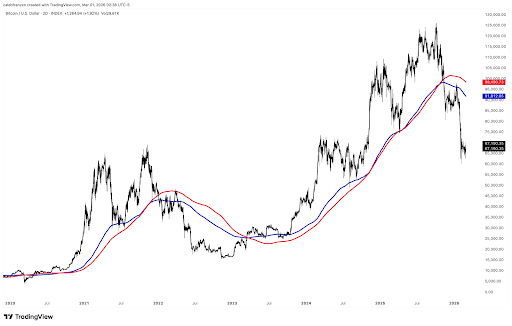
Related: Bitcoin price chart ‘death cross’ is back, reviving late-cycle fears

Relative strength in the US Dollar Index should not be viewed as an automatic sell signal for Bitcoin. This is particularly true as the cryptocurrency shows resilience while gold exhibits signs of exhaustion, retesting $5,000 support following a 25% year-to-date rally in 2026. Bitcoin holders still face a difficult path toward regaining full confidence after a 52% contraction from the all-time high, though overall sentiment is beginning to improve.

The $1.5 billion in net inflows into Bitcoin exchange-traded funds since Feb. 24 serves as a clear indicator that institutional demand is accelerating. Nevertheless, traders will likely wait for a definitive breakout above $75,000 before concluding that the bear market has ended. Until that threshold is met, data points like the US Dollar Index will likely continue to exert some negative pressure on Bitcoin, regardless of the currently weak correlation.