Oracle provider RedStone has launched its price feed infrastructure on the Stellar network, introducing a new data layer for decentralized finance (DeFi) applications on a blockchain historically focused on payments and stablecoin transfers.
The deployment makes price feeds for major crypto assets and stablecoins available on the Stellar mainnet, including Bitcoin (BTC), Ether (ETH), USD Coin (USDC) and PayPal USD (PYUSD). The rollout also includes pricing data for the Franklin Templeton BENJI tokenized money market fund.
RedStone said the feeds are designed to support financial applications like lending markets, decentralized exchanges (DEXs) and tokenized real-world asset (RWA) platforms building on Stellar.
The launch adds a new infrastructure provider to Stellar’s emerging DeFi stack as developers experiment with lending, tokenized assets and onchain financial services.
Stellar expands DeFi infrastructure
RedStone said the price feeds rely on a deviation-based update system and freshness checks intended to ensure data accuracy for financial applications.
“Stellar has long demonstrated its strength as a blockchain for real-world financial activity, particularly in payments and stablecoins,” RedStone co-founder Marcin Kazmierczak said in a statement.
He added that an enterprise-level oracle infrastructure was “what has been missing” for the network to unlock more advanced financial applications.
Related: ‘ClickFix’ hackers pose as VCs, hijack QuickLens in latest crypto attacks
RedStone operates in a competitive oracle market dominated by Chainlink. Data from DeFiLlama shows Chainlink secures about 64% of the market by value, followed by Chronicle with 11%.
Internal protocol oracles account for about 6%, while Pyth and RedStone hold about 5.8% and 5.5%, respectively.
The launch comes weeks after a DeFi exploit on Stellar highlighted risks tied to price feeds and collateral valuation in lending protocols.
On Feb. 21, attackers drained roughly $10 million from a YieldBlox DAO-managed lending pool built on the Blend protocol after manipulating the price of the USTRY token used as collateral.
A security analysis by blockchain security firm BlockSec found the lending protocol relied on a price path linked to the shallow USTRY/USDC market on Stellar’s decentralized exchange. The manipulated price inflated the token’s collateral value, allowing the attacker to borrow assets beyond its real worth.
A Redstone spokesperson told Cointelegraph that relying on thin onchain markets for price discovery can expose lending pools to manipulation risks.
“The February exploit was only possible because an oracle was deriving a price from a market with less than one dollar in hourly trading volume,” the spokesperson said.
RedStone said its price feeds instead use deviation-based updates, typically around 0.5% to 1% for stablecoins, along with minimum daily refreshes to ensure data remains current.
Magazine: Telegram avoids Philippines ban, yen carry trade going onchain: Asia Express
Cointelegraph is committed to independent, transparent journalism. This news article is produced in accordance with Cointelegraph’s Editorial Policy and aims to provide accurate and timely information. Readers are encouraged to verify information independently. Read our Editorial Policy https://cointelegraph.com/editorial-policy
Kraken Financial gained direct access to the Federal Reserve’s payment system, with the Fed confirming approval while imposing initial restrictions, marking a bullish step toward deeper integration between crypto institutions and U.S. banking rails. Kraken Financial Gains Direct Access to Federal Reserve Payment System A major milestone for crypto integration into traditional finance emerged as […]
Upwind, the runtime-first cloud security leader, today announced that its cloud-native application protection platform (CNAPP) is now integrated with the Extended plan in AWS Security Hub, Amazon Web Services’ unified security solution. This integration enables customers to gain deep, real-time visibility across their AWS workloads while reducing alert noise and focusing on the risks that matter most. By combining AWS detection services with Upwind’s runtime context, customers can prioritize active risk, streamline security operations, and strengthen protection of their workloads on AWS, through a simplified single-vendor Amazon Confidential experience with one contract, one bill, consolidated support, and flexible pricing through AWS.
Upwind, the runtime-first cloud security leader, today announced that its cloud-native application protection platform (CNAPP) is now integrated with the Extended plan in AWS Security Hub, Amazon Web Services’ unified security solution. This integration enables customers to gain deep, real-time visibility across their AWS workloads while reducing alert noise and focusing on the risks that matter most. By combining AWS detection services with Upwind’s runtime context, customers can prioritize active risk, streamline security operations, and strengthen protection of their workloads on AWS, through a simplified single-vendor Amazon Confidential experience with one contract, one bill, consolidated support, and flexible pricing through AWS.
“Cloud infrastructure changed faster than the security models designed to protect it. Integrating Upwind’s runtime-first cloud security platform with Security Hub Extended Plan, allows decisions based on live signals, not assumptions.” -Amiram Shachar, CEOShare
Cloud security has reached an inflection point. As organizations rapidly scale containerized workloads, serverless architectures, and AI-driven applications, traditional approaches built on periodic scans and static posture checks are struggling to keep pace. Security teams need systems that operate at cloud speed, where detection, correlation, and response happen in real-time and continuously, not in snapshots.
AWS Security Hub Extended plan delivers curated enterprise security solutions from AWS and partners with simplified purchasing. It streamlines procurement through a single vendor experience – one contract, one bill, consolidated support, and flexible pricing. Security Hub Extended plan brings together the best of AWS detection services and curated partner solutions from endpoint and identity to security operations and artificial intelligence. These solutions enable defense-in-depth across your organization while simplifying deployment.
The Extended Plan for AWS Security Hub simplifies how enterprises deploy and manage security tooling within AWS. By integrating directly into this framework, Upwind becomes part of a consolidated operating model, allowing security leaders to standardize procurement and align security operations more tightly with their existing AWS investments.
“AWS Security Hub Extended plan and Upwind deliver what enterprises need most: unified visibility and clarity across increasingly complex cloud environments,” said Amiram Shachar, CEO & Co-founder at Upwind. “Cloud infrastructure has changed faster than the security models designed to protect it. The next era of cloud security must be built on runtime signals; that’s actually the only way to understand what is truly happening in production. By integrating Upwind’s runtime-first cloud security platform with Security Hub Extended Plan, customers can base their decisions on live signals, not assumptions. That changes how teams prioritize risk, how they operate, and how fast they can move. This is the direction cloud security is heading.”
Together, AWS Security Hub and Upwind help organizations shift from fragmented investigations to a more unified security workflow. Security Hub surfaces correlated findings and attack paths across AWS services, while Upwind enriches those findings with runtime-level insight to validate and investigate real risk. The result is a more connected security workflow that reduces friction between detection and remediation. For large enterprises operating at scale, the ability to combine centralized visibility with runtime-level insight is critical. As environments grow more distributed and teams more specialized, integrations like this allow security, engineering, and cloud operations to work from a shared source of truth.
“Upwind provides deep visibility and clarity across our AWS environment, allowing us to focus on real, actionable risk,” said Jerich Beason, CISO at Waste Management. “After an in-depth evaluation of CNAPP platforms and extensive hands-on testing, we chose Upwind and rolled it out across our AWS and broader cloud infrastructure. Since deployment, we’ve seen a significant reduction in security alerts and fewer irrelevant CVEs. That level of clarity enables our teams to prioritize what actually matters and operate far more efficiently. Cloud security has lacked meaningful context for too long. Upwind shows us what is happening in our environment and why it matters. The agent built on the platform allows us to interrogate our data in real time, saving time and money while strengthening our overall security operations. Just as important, they have earned the trust of our engineers and security teams and continue to operate at the speed we expect from modern cloud partners.”
As cloud-native architectures evolve and AI-driven workloads expand, security strategies must evolve alongside them. Integrations built on shared telemetry and complementary capabilities represent the next step in how enterprises protect modern cloud environments at scale.
Morgan Stanley has tapped Coinbase and BNY Mellon to serve key custody and administrative roles for its proposed spot Bitcoin exchange-traded fund, according to an amended registration statement filed with the U.S. Securities and Exchange Commission.
The filing for the Morgan Stanley Bitcoin Trust outlines a structure in which Coinbase Custody Trust Company and BNY will act as bitcoin custodians, responsible for safeguarding the fund’s digital assets and facilitating transfers tied to share creations and redemptions.
BNY will also serve as administrator, transfer agent and cash custodian, overseeing accounting, shareholder records and cash management for the trust.
The ETF is designed as a passive vehicle that will hold bitcoin directly rather than using derivatives or leverage. Shares of the trust would reflect the performance of the underlying bitcoin held in custody, giving investors exposure through brokerage accounts without requiring direct ownership of the cryptocurrency.
JUST IN: 🇺🇸 Morgan Stanley issues new SEC filing for a spot Bitcoin ETF, announcing Coinbase and BNY Mellon as the custodians 👀 pic.twitter.com/52UCwS7geu
Under the proposed custody framework, most of the trust’s bitcoin would be stored in offline cold-storage vaults, where private keys remain disconnected from the internet.
The structure is a popular one and is intended to reduce exposure to cyber threats that have long concerned institutional allocators.
A portion of the holdings may move to trading wallets during periods of share creation or redemption, when authorized participants exchange cash for bitcoin or redeem shares for the underlying asset.
The filing notes that custody insurance is maintained but shared across multiple clients and may not cover all potential losses. The disclosure mirrors language used across other spot Bitcoin ETF filings, reflecting industry practice as traditional asset managers move into direct digital asset exposure.
Morgan Stanley first filed for the trust in January, marking one of the most significant entries by a major U.S. bank into the spot Bitcoin ETF race.
Morgan Stanley: Bullish on bitcoin
The latest filing comes as Morgan Stanley expands its crypto strategy across its wealth management and brokerage platforms. Executives have said the firm plans to allow clients on its E*Trade platform to buy and sell spot cryptocurrencies through a partnership before rolling out a more integrated custody and exchange solution.
Last week at Strategy World, Amy Oldenburg, head of digital asset strategy at Morgan Stanley, said the bank views custody as a core component of its long-term roadmap. The firm manages about $8 trillion in client assets, and leadership has indicated that a significant share of clients already hold crypto off-platform.
Bringing those holdings in-house would allow Morgan Stanley to provide custody, trading and related services under its own oversight.
The bank has also applied for a national trust bank charter that would permit it to hold cryptocurrencies directly for institutional clients. Approval would position Morgan Stanley to compete with crypto-native custodians and deepen its role in the digital asset market.
Crypto markets became the first outlet for investor reaction after US and Israeli strikes on Iran rattled global sentiment over the weekend.
At around 7:30 am (UTC) on Saturday, or in the wee hours of Wall Street, US President Donald Trump posted a video to announce that the US and Israel had launched attacks against Iran. Bitcoin (BTC) immediately reacted and dropped to around $63,000.
Meanwhile, traders rushed to crypto-native platforms to trade commodities futures while traditional markets remained closed.
Bitcoin’s rollercoaster weekend foreshadowed major indexes opening lower on Monday. Source: TradingView
Including the latest war breaking out, major geopolitical events have frequently occurred over the weekend or late Friday evenings. As crypto is increasingly tied to macro settings, Bitcoin’s 24/7 trading is evolving as a gauge of stock markets while they’re closed.
“The initial [weekend] move to the downside was sharp but contained, [and] Bitcoin never broke its broader market structure. When confirmation came that [Supreme Leader Ayatollah Ali Khamenei] had been killed and the immediate escalation risk appeared limited, price retraced quickly, and Bitcoin held its footing,” Jonatan Randin, senior market analyst at PrimeXBT, told Cointelegraph.
“By Monday morning, traditional market participants who had been watching crypto through the weekend already had a clear read on sentiment: This was a significant geopolitical event, but not a systemic one,” he added.
Bitcoin absorbing geopolitical shocks in real time
Though not always the case, governments and public companies often consider releasing important announcements before or after markets close. A guideline from New Zealand on dealing with financial products is among those that directly state this:
“Unless compelling reasons exist to release the announcement or media release while the affected market is open, it should be made when the market is closed to give investors time to consider the information before the market opens.”
Due to the nonstop trading cycle, crypto investors often don’t have time to assess the information and must react in real time, as observed during the war escalation over the weekend.
“While liquidity can be thinner during these periods, occasionally amplifying short-term volatility, the uninterrupted market ultimately enhances real-time price discovery and accelerates the adjustment process,” Iliya Kalchev, analyst at Nexo Dispatch, told Cointelegraph.
Related: $19B crypto market crash: Was it leverage, China tariffs or both?
It certainly felt that way on Oct. 10, 2025, when the crypto market experienced its largest liquidation event on record. Trump threatened steep tariffs against China, which was enough to tank markets.
This occurred before the US closing bell, so Bitcoin sank along with major stock market indexes. However, crypto markets continued to operate afterward, and liquidations continued, totaling around $19 billion.
The mass liquidation event known as 10/10 showed investor sentiment evolving through Bitcoin’s price before markets opened. Source: TradingView
For macro traders, this makes crypto a real-time sentiment gauge during geopolitical shocks. When events occur outside traditional trading hours, investors increasingly turn to digital asset markets to express their views on risk, liquidity or inflation expectations before equity, bond or commodity markets reopen.
Crypto’s 24/7 market does not stop at Bitcoin or other spot assets. Much of the activity now flows through perpetual futures across centralized and decentralized exchanges, while institutions are also experimenting with tokenized real-world assets (RWAs) that bring traditional financial instruments onto blockchain rails.
24/7 trading open beyond spot crypto
As Bloomberg reported, perpetual futures decentralized exchange Hyperliquid became a popular trading platform for commodities and traditional assets, like oil and precious metals.
Hyperliquid’s volume also usually drops on weekends, DefiLlama data shows. But in the past weekend of geopolitical unrest, its volume remained high and matched that of business days.
Hyperliquid’s trading volume did not have its usual weekend drop. Source: DefiLlama
Bitwise chief investment officer Matt Hougan added that Tether’s tokenized gold XAUT had a spike in trading volume over the weekend, while prediction markets volume set new records.
Weekend trading demand is increasingly reflected in traditional finance through surging institutional interest in RWAs. Tokenized assets inherit some of crypto’s market features, including cross-border accessibility and trading outside conventional market hours.
Related: Banks can’t seem to service crypto, even as it goes mainstream
McKinsey and Standard Chartered estimate tokenized assets could reach around $2 trillion by 2030, while Boston Consulting Group projects the market could grow to between $16 trillion and $30 trillion over the same period.
Traditional markets are also moving to extend their trading hours. In December, Nasdaq sought approval for a 23-hour trading system, split into day and night sessions with a maintenance hour in between, which wasn’t well received by financial services firm Wells Fargo.
“I cannot think of an action that single-handedly gamifies the stock market even more than it has already become. This is the epitome of making trading even more like gambling,” Wells Fargo’s trading desk said in a note to clients, as reported by CNBC.
In January, the New York Stock Exchange said it is developing a 24/7 blockchain platform for stocks and exchange-traded funds.
Crypto markets absorbing global shocks in real time
Weekend geopolitical shocks are increasingly testing the structure of global markets. While traditional financial systems pause between trading sessions, crypto continues to absorb information and reflect investor sentiment in real time.
“Bitcoin has evolved into a highly sensitive macro asset, reacting not only to technology-sector dynamics but also to shifts in liquidity conditions, monetary policy expectations and geopolitical tensions,” Kalchev said.
Bitwise’s Hougan said the weekend trading activity made traditional stock exchanges look “archaic.”
While more traditional finance venues are exploring extended or uninterrupted trading systems, Hougan said the blockchain markets’ performance during the past weekend’s military escalation suggested the blockchain transition may happen faster than he previously expected. He claimed he previously expected traditional finance to move onchain within 10 years.
Magazine: Would Bitcoin really be at $200K if not for Jane Street? Trade Secrets
Cointelegraph Features and Cointelegraph Magazine publish long-form journalism, analysis and narrative reporting produced by Cointelegraph’s in-house editorial team and selected external contributors with subject-matter expertise. All articles are edited and reviewed by Cointelegraph editors in line with our editorial standards. Contributions from external writers are commissioned for their experience, research or perspective and do not reflect the views of Cointelegraph as a company unless explicitly stated. Content published in Features and Magazine does not constitute financial, legal or investment advice. Readers should conduct their own research and consult qualified professionals where appropriate. Cointelegraph maintains full editorial independence. The selection, commissioning and publication of Features and Magazine content are not influenced by advertisers, partners or commercial relationships.
The United Kingdom House of Lords grilled Coinbase’s top international policy executive on Wednesday over whether stablecoins would drain bank deposits and add new risks to the UK financial system, pressing him on everything from Silicon Valley Bank‑style runs to illicit finance and Know Your Customer (KYC) rules.
During the Lords’ stablecoins inquiry, Tom Duff Gordon, Coinbase’s vice president for international policy, insisted that fully reserved, regulated stablecoins were “safer than uninsured bank deposits” because they are backed one‑to‑one by cash and high‑quality government securities and can be redeemed at par.
He argued that stablecoins could materially reduce payment costs, speed up cross‑border payments, and underpin new artificial intelligence driven “agentic” payment flows.
Related: Gemini exit a ‘blow for policymakers’ with UK crypto hub ambitions
Duff Gordon pushed back on suggestions that Coinbase was seeking to dodge KYC obligations and warned that overly tight Bank of England and Financial Conduct Authority (FCA) proposals on capital, holding limits and rewards risk would choke off competition. That, he said, would leave the UK lagging the United States’ Guiding and Establishing National Innovation for US Stablecoins (GENIUS) Act regime and Europe’s Markets in Crypto Assets Regulation (MiCA) framework in the global race to attract stablecoin innovation.
Lords probe deposit drain and crime concerns
The Lords repeatedly challenged Duff Gordon on who actually bears redemption risk in a crisis, whether current arrangements merely shift risk from banks to non‑bank issuers, and whether allowing rewards on stablecoins would trigger a “deposit drain” from UK banks.
Coinbase’sTom Duff Gordon gives evidence. Source: Parliament TV
Duff Gordon countered that fears over disintermediation and credit creation were “wildly exaggerated,” and that stablecoins were already used by major corporates and card plans to cut payment costs.
Related: UK Lords launch stablecoin inquiry as Bank of England moves to finalize rules
Committee members also raised concerns about the role of stablecoins in crime, prompting Duff Gordon to emphasize Coinbase’s KYC, Anti-Money Laundering (AML) and sanctions screening of customers. He argued that onchain transparency and exchange-level controls could make it easier, not harder, to police illicit flows compared with traditional cash.
UK could fall behind in stablecoin race
Adam Jackson, chief strategy officer at Innovate Finance, an independent industry body for the UK financial technology sector, argued that the UK risked establishing a regime that was “more prescriptive and less competitive” than the EU’s MiCA rules. “We risk being second movers but second movers who are less competitive than the first movers,” he warned.
The hearing came as a sharp contrast to the committee’s previous session, where critics including Financial Times commentator Chris Giles and US law professor Arthur E. Wilmarth Jr expressed their doubts about whether stablecoins were likely to become a mainstream form of money in the UK and backed a tougher Bank of England approach.
Wilmarth Jr went so far as to brand the US’s GENIUS Act as a “disastrous mistake” for letting non‑banks into “the money business.”
Magazine: Big questions: Should you sell your Bitcoin for nickels for a 43% profit?
Cointelegraph is committed to independent, transparent journalism. This news article is produced in accordance with Cointelegraph’s Editorial Policy and aims to provide accurate and timely information. Readers are encouraged to verify information independently. Read our Editorial Policy https://cointelegraph.com/editorial-policy
The Sui Dollar (USDsui), the stablecoin of the Sui blockchain, went live Wednesday with a promise that income from the assets backing the token will be funneled back into the ecosystem from which it sprang.
Yield on the bonds and liquid assets backing USDsui will be used to repurchase and remove SUI$0.9388 tokens from circulation or deployed to decentralized finance (DeFi) protocols and into automated market making for incentivizing swaps, said Adeniyi Abiodun, a co-founder at Mysten Labs, the original contributors to Sui.
Stablecoin growth has been rapid, and the $310 billion market-cap industry led by Tether and Circle Internet (CRCL) is entering the global payments arena. Both companies keep all the yield generated by the masses of U.S. Treasury bonds backing their dollar-pegged tokens, USDT and USDC, respectively.
“I think we are starting to see a dislocation of the business model of stablecoin issuers, whereby the yield is largely kept to external agencies that don’t really pour value back to the ecosystem,” said Adeniyi Abiodun, co-founder at Mysten Labs, the original contributors to Sui. “That yield effectively can get funneled back from the foundation straight to the Sui ecosystem.”
Plans for the coin, which is issued by Bridge, the stablecoin firm acquired last year by payments giant Stripe, were first announced toward the end of 2025. Sui was built by a group of former Meta engineers who worked on the soial media company’s abandoned Libra/Diem digital dollar project.
“Right now those funds do not hit the ecosystem; they really flow out,” Abiodun said. “We are all about closing that loop. So it’s real yield from real world finance that is going back into DeFi that creates a flywheel.”
Bootstrapping a stablecoin is not such a heavy lift when your network has carried over $1 trillion in stablecoins: the likes of USDT, USDC and other stablecoins, Abiodun said.
“The Sui Foundation actually has USDC and other stablecoins today, and so can transition a lot of that straight to Sui Dollar. Mysten Labs can do the same. On top of that, we actually have a lot of investors and hedge funds who are interested in minting Sui USD. So bootstrapping this is actually very easy,” he said.
Abiodun’s former Facebook colleagues and Libra coin partners are the Mysten Labs co-founders: George Danezis (chief scientist), Sam Blackshear (CTO), Evan Cheng (CEO), Kostas Kryptos Chalkias (chief cryptographer).
The White House’s crypto adviser pushed back on JPMorgan CEO Jamie Dimon’s assertion that stablecoin issuers who pay interest should be regulated like banks.
Stablecoins need not be treated like deposits because the Genius Act explicitly bars issuers from lending the reserves that back their tokens, Patrick Witt, the executive director of the President’s Council of Advisors for Digital Assets, wrote in an X post.
Dimon said banks want stablecoin issuers that pay interest on customer balances to face the same rules as traditional lenders, sharpening the debate over U.S. crypto regulation.
He also addressed reported tensions with Coinbase CEO Brian Armstrong, who withdrew support for the proposed Clarity Act a day before the Senate Banking Committee was scheduled to vote on the legislation. Dimon argued there needs to be a line between rewards paid on transactions and interest paid on stored balances.
“Rewards are the same as interest,” Dimon said. “If you are going to be holding balances and paying interest, that’s the bank. You should be regulated by a bank.”
Banks would accept a compromise in which crypto platforms offer rewards tied to transactions, he said. But firms that function like deposit-taking institutions should meet the same standards as banks, including capital and liquidity rules, anti-money laundering controls and federal deposit insurance requirements.
“The deceit here is that it is not the paying of yield on a balance per se that necessitates bank-like regulations, but rather the lending out or rehypothecation of the dollars that make up the underlying balance,” Witt said. Rehypothecation occurs when banks use clients’ collateral to support their own borrowing.
He also pointed to the Genius Act, which he said “explicitly forbids stablecoin issuers from doing the latter. Stablecoins ≠ Deposits.”
South Korea’s government and ruling party have reportedly agreed on a plan to cap the ownership stakes of major shareholders in domestic crypto exchanges at 20%.
The Democratic Party of Korea’s digital asset task force and the Financial Services Commission (FSC) agreed to set the maximum shareholding limit at 20% after discussions, according to a Wednesday report by local media outlet Herald Economy.
However, regulators may allow exceptions of up to 34% for new businesses through an enforcement decree. The threshold references the Commercial Act’s 33.3% veto threshold in general shareholders’ meetings, per the report.
Under the proposal, exchanges would reportedly have three years from the law’s enforcement to adjust their ownership structures. Smaller exchanges may receive an additional three-year grace period. Larger platforms like Upbit and Bithumb, which together control roughly 90% of the local market, would be required to reduce major shareholder stakes within the initial three-year period.
Related: Korea halts trading as key indexes drop 10% on Middle East crisis
Major Korean exchanges exceed proposed ownership cap
Current ownership levels across South Korea’s major exchanges exceed the proposed cap. Upbit chairman Song Chi-hyung holds about 25.52%, while Bithumb Holdings owns roughly 73.56% of Bithumb. Coinone chairman Cha Myung-hoon controls about 53.44%, Mirae Asset Consulting is set to hold around 92.06% of Korbit following an acquisition, and Binance owns about 67.45% of GOPAX.
Top Korean crypto exchanges. Source: CoinGecko.
The proposal, which has received some backing among regulators, faces a lengthy legislative process. A member of the National Assembly is expected to introduce the bill, though the sponsor has not yet been determined. Passage may prove challenging, as some lawmakers, including members of the ruling party, have raised concerns about restricting ownership in the sector.
An industry insider warned that the measure could have broader implications for competition. “This is unprecedented worldwide and has low global consistency. If it is excessively introduced, it could have serious negative effects such as limited competition, slowed innovation, and strengthened barriers to entry,” they reportedly told the outlet.
Related: South Korea orders cross-agency probe after repeated crypto custody failures
South Korea tightens crypto licensing rules
In late January, South Korea’s National Assembly approved changes to the country’s crypto licensing framework, introducing stricter entry requirements for virtual asset service providers (VASPs). The updated rules allow authorities to examine executives and major shareholders for a wider range of potential violations, including drug trafficking, tax evasion, fair-trade breaches and serious economic crimes.
In February, Democratic Party lawmaker Kim Seung-won also announced plans to draft amendments to the Capital Market and Financial Investment Business Act and the Act on the Protection of Virtual Asset Users that would mandate disclosure from individuals who provide investment advice or encourage trading of financial products or virtual assets.
Magazine: Bitcoin may take 7 years to upgrade to post-quantum — BIP-360 co-author
Cointelegraph is committed to independent, transparent journalism. This news article is produced in accordance with Cointelegraph’s Editorial Policy and aims to provide accurate and timely information. Readers are encouraged to verify information independently. Read our Editorial Policy https://cointelegraph.com/editorial-policy
Trusted Editorial content, reviewed by leading industry experts and seasoned editors. Ad Disclosure
Ripple says it is tightening the XRP Ledger amendment process after a critical flaw was found in the proposed Batch amendment (XLS-56), an incident that exposed gaps in review even as the network’s last-resort safeguards prevented any mainnet impact.
In a post on X, RippleX Head of Engineering J. Ayo Akinyele said the bug was identified last week by Cantina AI, reported responsibly, and quickly validated as critical. The issue never became exploitable on mainnet because the amendment had not yet been activated, and a hotfix was issued to disable both Batch and the related fix amendment while a broader remediation is reviewed.
Ripple Responds To The Critical Bug
Akinyele did not try to soften the significance of the lapse. “The Batch amendment progressed further than it should have,” he wrote. “As active participants in the amendment lifecycle, we share responsibility for ensuring that review, signaling, and activation safeguards meet the highest standard. In this case, we must do better.”
At the same time, Ripple is framing the episode as a failure of early-stage review rather than of the XRPL governance model itself. Akinyele said “the amendment process functioned as designed,” noting that activation gating prevented harm to mainnet and the bug bounty disclosure route worked as intended. But he added a sharper warning: “Those safeguards matter, but they should serve as a final line of defense, not the primary one.”
That distinction runs through the rest of Ripple’s response. Rather than suggesting tighter centralized control, Akinyele argued that amendment security on XRPL must remain distributed across core contributors, validators, the XRPL Foundation and outside researchers. “No single entity controls activation. No single entity owns risk in isolation,” he wrote, describing that structure as both a consequence of decentralization and a strength, provided it is matched by layered defenses and better coordination.
Ripple’s proposed fixes are broad. Akinyele said future releases that introduce features carrying “theoretical risk of disruption” will go through multiple independent audits with reputable security firms in coordination with the XRPL Foundation. The idea is straightforward: different teams catch different classes of issues, and redundancy reduces blind spots when code touches consensus-critical behavior.
The company also plans to expand the bug bounty program and formalize adversarial testing campaigns before activation. Akinyele pointed to initiatives such as the Lending attackathon and a UBRI-sponsored hackathon as models for that approach, arguing that incentivizing white-hat attackers before launch is far cheaper than reacting after the fact. He added that lessons from the Batch incident have already affected other roadmap items, saying Ripple “deliberately held lending back” to allow for more review, testing and scrutiny before moving toward activation.
Part of that next phase will rely more heavily on AI. Akinyele said Ripple is incorporating AI-assisted code review, automated invariant discovery, agentic fuzzing and simulated attack scenarios into its software development lifecycle. “AI does not replace expert C++ engineers, but rather augments them,” he wrote, especially when “subtle logic interactions at critical points can create outsized risk.”
Longer term, Ripple says it wants formal verification to become standard for high-risk ledger components. That includes modeling amendment behavior before activation, proving safety properties for critical components and integrating formal methods from XLS specification through implementation and testing. The broader aim, Akinyele said, is end-to-end assurance that amendment code is not only functionally correct but aligned with defined security and safety properties.
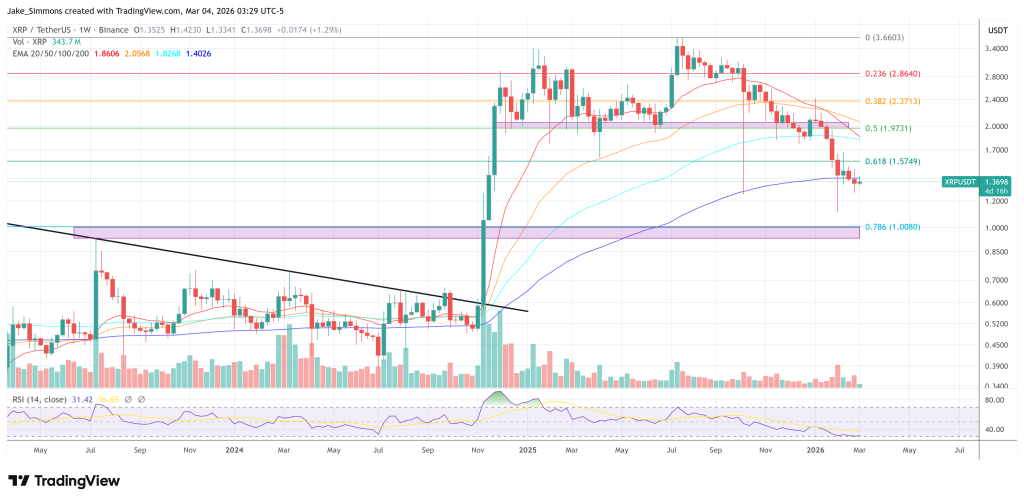
At press time, XRP traded at $1.3698.
XRP falls below the 200-week EMA agan, 1-week chart | Source: XRPUSDT on TradingView.com
Featured image created with DALL.E, chart from TradingView.com
Editorial Process for bitcoinist is centered on delivering thoroughly researched, accurate, and unbiased content. We uphold strict sourcing standards, and each page undergoes diligent review by our team of top technology experts and seasoned editors. This process ensures the integrity, relevance, and value of our content for our readers.