Home Blog Page 870

Ripple Outlines Next Steps After Critical XRPL Amendment Bug

0

Trusted Editorial content, reviewed by leading industry experts and seasoned editors. Ad Disclosure

Ripple says it is tightening the XRP Ledger amendment process after a critical flaw was found in the proposed Batch amendment (XLS-56), an incident that exposed gaps in review even as the network’s last-resort safeguards prevented any mainnet impact.

In a post on X, RippleX Head of Engineering J. Ayo Akinyele said the bug was identified last week by Cantina AI, reported responsibly, and quickly validated as critical. The issue never became exploitable on mainnet because the amendment had not yet been activated, and a hotfix was issued to disable both Batch and the related fix amendment while a broader remediation is reviewed.

Ripple Responds To The Critical Bug

Akinyele did not try to soften the significance of the lapse. “The Batch amendment progressed further than it should have,” he wrote. “As active participants in the amendment lifecycle, we share responsibility for ensuring that review, signaling, and activation safeguards meet the highest standard. In this case, we must do better.”

At the same time, Ripple is framing the episode as a failure of early-stage review rather than of the XRPL governance model itself. Akinyele said “the amendment process functioned as designed,” noting that activation gating prevented harm to mainnet and the bug bounty disclosure route worked as intended. But he added a sharper warning: “Those safeguards matter, but they should serve as a final line of defense, not the primary one.”

That distinction runs through the rest of Ripple’s response. Rather than suggesting tighter centralized control, Akinyele argued that amendment security on XRPL must remain distributed across core contributors, validators, the XRPL Foundation and outside researchers. “No single entity controls activation. No single entity owns risk in isolation,” he wrote, describing that structure as both a consequence of decentralization and a strength, provided it is matched by layered defenses and better coordination.

Ripple’s proposed fixes are broad. Akinyele said future releases that introduce features carrying “theoretical risk of disruption” will go through multiple independent audits with reputable security firms in coordination with the XRPL Foundation. The idea is straightforward: different teams catch different classes of issues, and redundancy reduces blind spots when code touches consensus-critical behavior.

The company also plans to expand the bug bounty program and formalize adversarial testing campaigns before activation. Akinyele pointed to initiatives such as the Lending attackathon and a UBRI-sponsored hackathon as models for that approach, arguing that incentivizing white-hat attackers before launch is far cheaper than reacting after the fact. He added that lessons from the Batch incident have already affected other roadmap items, saying Ripple “deliberately held lending back” to allow for more review, testing and scrutiny before moving toward activation.

Part of that next phase will rely more heavily on AI. Akinyele said Ripple is incorporating AI-assisted code review, automated invariant discovery, agentic fuzzing and simulated attack scenarios into its software development lifecycle. “AI does not replace expert C++ engineers, but rather augments them,” he wrote, especially when “subtle logic interactions at critical points can create outsized risk.”

Longer term, Ripple says it wants formal verification to become standard for high-risk ledger components. That includes modeling amendment behavior before activation, proving safety properties for critical components and integrating formal methods from XLS specification through implementation and testing. The broader aim, Akinyele said, is end-to-end assurance that amendment code is not only functionally correct but aligned with defined security and safety properties.

At press time, XRP traded at $1.3698.
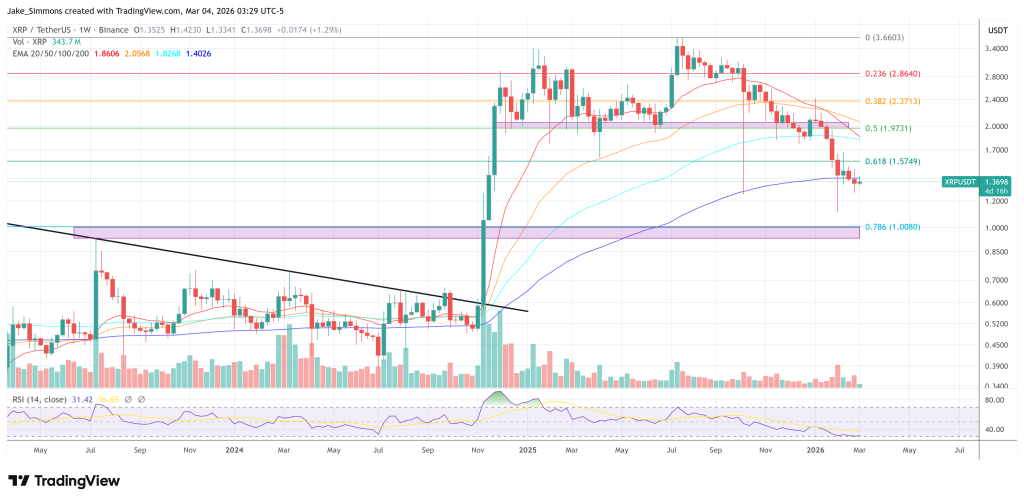
XRP price chart
XRP falls below the 200-week EMA agan, 1-week chart | Source: XRPUSDT on TradingView.com

Featured image created with DALL.E, chart from TradingView.com

Editorial Process for bitcoinist is centered on delivering thoroughly researched, accurate, and unbiased content. We uphold strict sourcing standards, and each page undergoes diligent review by our team of top technology experts and seasoned editors. This process ensures the integrity, relevance, and value of our content for our readers.

Why Tron profitability reveals ‘uncomfortable reality’ for Ethereum and Solana, says analyst – DL News

0

  • Tron is actively turning a profit unlike other layer 1 networks.
  • Ethereum and Solana led losses in 2025, according to Kaiko.
  • This is becoming more important as institutions take a closer look at the industry.

Tron, the $26 billion blockchain co-founded by Justin Sun, has emerged as the industry’s most profitable network.

Analysts at Kaiko measured revenue for various blockchain networks, including Solana and Ethereum, using 2025 data and found that all but one network posted annual losses.

More importantly, a new institutional demographic is taking a much harder look at these numbers, thanks in part to the arrival of spot crypto exchange-traded funds.

“This exposes an uncomfortable reality the market has largely ignored,” wrote Laurens Fraussen, a research analyst at Kaiko, on Tuesday.

“While these protocols were never designed to run as traditional businesses, this matters increasingly for the investors, institutions, and retail traders who now hold these tokens.

Blockchain business

Blockchain revenue, unlike revenue ginned up by a traditional company, follows a slightly different arithmetic.

Networks like Ethereum, Solana, and Tron are constantly issuing new native tokens to pay validators for securing the network.

This constant issuance, not unlike equity issuance from a traditional company, dilutes the value of existing token holders and should be understood as a cost on the network.

That doesn’t mean that these networks aren’t generating revenues. Last year, Ethereum raked in over $260 million while Solana generated $170 million.

It’s just that this revenue is being outpaced by inflationary pressures on the token’s price due to constant dilution.

“Ethereum and Solana generate meaningful revenue, $260 million and $170 million, respectively,” Fraussen said. “But inflation costs of $1.88 billion and $4.32 billion make both deeply unprofitable to holders.”

What’s driving Tron?

Meanwhile, Tron raked in $624 million last year while incurring very little inflationary costs.

In fact, in 2025, the Tron network was destroying more of its native TRX token than it was issuing, creating a deflationary supply dynamic, according to Fraussen.

The latest date paints a similar picture. Tron continues to lead blockchain revenue by chain, according to DefiLlama.

The Tron network has established itself as the primary blockchain for stablecoin transactions, providing it with a steady revenue stream.

“The result is a revenue floor that Ethereum and Solana lack,” said Fraussens, “where fee income tracks speculation rather than utility.

Liam Kelly is DL News’ Berlin-based DeFi correspondent. Have a tip? Get in touch at liam@dlnews.com.

Market infrastructure firms warn tokenized securities face higher costs, split liquidity without interoperability

0

The world’s largest market infrastructure operators are warning that tokenized securities will struggle to scale unless the industry agrees on how blockchains and traditional finance systems connect.

In a joint white paper, the Depository Trust and Clearing Corporation (DTCC), Euroclear and Clearstream, working with Boston Consulting Group, argued that “interoperability is a prerequisite for digital asset security (DAS) adoption at scale.” Without it, they wrote, assets risk being trapped on isolated networks, leaving “operational costs high” and liquidity fragmented as trading volumes grow.

The group stopped short of endorsing any single technology. Instead, it framed the problem as structural. Dozens of public and permissioned blockchains now host pilots and live products. Each uses its own standards, smart contract logic and settlement design. That diversity, the paper says, makes integration harder and increases operational and regulatory risk.

The authors rejected the idea that one dominant ledger will emerge. The operating model, they said, is shifting toward a “network-of-networks, with standards, gateways, and regulated service providers” linking digital and traditional systems. In that environment, assets must move across platforms while preserving what the paper calls “the asset’s integrity, ownership rights and lifecycle, with full legal and regulatory compliance.”

They summarized the goal in a short phrase: “same asset, same rights, same outcome.”

The warning comes as tokenization gains ground in repo markets and pilot programs across the U.S. and Europe. While onchain securities remain small compared with global equity and FX markets, the paper notes that large-scale infrastructure is already in motion, including more than $300 billion in daily repo activity across major platforms.

Still, many workflows depend on legacy rails. Tokenized bonds may trade on-chain, but cash often settles through real-time gross settlement systems or bank payment networks. Custodians and central securities depositories still maintain books of record. The paper assumes this coexistence will last for years.

The framework also extends beyond technical bridges. Interoperability, the authors argued, must cover assets and liabilities, ownership recognition, lifecycle events, ledger finality and legal enforceability. Without alignment across those layers, cross-chain or cross-border transactions may require extra reconciliation steps that erode promised efficiency gains.

The group called on regulators and market participants to develop working groups focused on governance, standards and resilience. “Collective action today will shape resilient markets tomorrow,” the paper states.

That push comes as major Wall Street firms argue tokenization could reshape financial markets by enabling 24/7 trading, faster settlement and more efficient use of collateral. Executives at large banks and asset managers have said blockchain-based rails may eventually reduce back-office costs and free up capital tied up in multi-day settlement cycles. Some have described tokenized assets as a path toward more integrated global markets, where cash and securities move in near real time.

The paper does not dispute that vision. Instead, it suggests that achieving it depends less on launching new chains and more on aligning the rules that govern them.

Tether and City of Lugano Commit $6.4 Million to Plan ₿ Phase II

0

Tether and the City of Lugano have launched a four-year strategic expansion to transform the Swiss city into a global hub for digital infrastructure. Tether and municipal leaders announced the launch of Plan ₿ Phase II on March 3, 2026, in Lugano, Switzerland. This next stage of the partnership follows a successful four-year pilot that […]

QUBE Events Bring Back the 24th NextGen Payments & RegTech Forum

0

QUBE Events is excited to bring back the 24th NextGen Payments & RegTech Forum, taking place on 5 March 2026 at the Marriott Hotel, Zurich, one of the world’s leading financial centres. This prestigious forum offers valuable opportunities and powerful partnerships across all aspects of finance, from banking and payments to fintech, compliance, and regulatory technology.

Proudly sponsored by: Amaranth Advisory, BioCatch, UMCA Technologies, EasyReg and Dydon AI.

Connect with 200+ key decision-makers and visionary leaders who have successfully driven transformative innovation and are taking the stage to share and exchange groundbreaking ideas and strategies that will shape the future of finance in this era of rapid innovation.

Get ready to be part of the conversation that’s driving the next wave of financial transformation!

AGENDA HIGHLIGHTS:

  • Your Bank’s AI Strategy is Wrong
  • The Future of Payments & Compliance in 2026
  • From Theory to Execution: How Agentic AI is Reshaping Payments Compliance
  • Financial Crime: AI-Driven Defence & ‘Follow the Money’ Collaboration
  • Wallets & Super Apps: Adoption, Competition & Policy in CH/EU
  • Agentic Experiences
  • Cross-Border B2B Payments: Interoperability, Transparency & Compliance
  • AI in Swiss Finance: Governance, Risk & ROI
  • Regulatory Outlook for Switzerland
  • Consent, Control and Code: From Open Banking to Agentic Commerce
  • Latest Update on the Swiss AML and Transparency Acts
  • Tokenisation & Digital Assets: Payments, Treasury & Capital Markets

INDUSTRY EXPERTS READY TO TAKE THE STAGE:

  • Agata Marty, Co-Founder & CEO at FinCredible, Board Member of the Swiss FinTech Association
  • Alexandra Lloyd, Risk and Compliance Manager and Head of AML at YouHodler
  • Alex Maruta, Product Director at Natech Banking Solutions
  • Ashley Barnes, Head of European Regional Treasury Centre Countries at HSBC Bank plc
  • Benjamin Richter, AI Specialist at Nexi Switzerland
  • Cedric Ming, Founder at MFM Regulatory Advisory
  • Chris McAteer, Chief Compliance Officer at AMINA Bank
  • David G.W. Birch, Author, Advisor and Commentator on Digital Financial Services
  • David Kauer, Senior Innovation Manager and Member of Management at PostFinance
  • Edouard Hurstel, General Manager, Europe at Lorum
  • Efi Pylarinou, Global Fintech and Tech Thought Leader
  • Elisa-Sophie Eikevaag, Head of Multi-Rail Fraud Prevention at SIX
  • Enrico Giacoletto, Managing Partner and Founder at EasyReg
  • Erik Meierhoff, Chief Commercial Officer at Wallee Group
  • Eva Maybud, Managing Director at Accenture Finance & Risk Services
  • Fabian Meyer, Founder & Managing Partner at Amaranth Advisory
  • Géraldine Monchau-Richard, Co-Founder Women in WEB3 Switzerland and Head of Business Development at Allnews
  • Hartwig Gerhartinger, Global Lead Compliance Regulatory Enterprise Risk Government Affairs at Paysafe Payment Solutions Ltd
  • Jan Freudenreich, Head of IT Security at Basler Kantonalbank
  • JB Helip, Global Head of Payment Third Party Risk and Governance at eBay
  • Jeff-Richard Angehrn, CFO / Leiter Services at Raiffeisen Bank Zürich
  • Katharina Kasia Lasota Heller, Chief Executive Officer at LEXCELLENCE
  • Luca Magnoni, Chief Technology Officer at Alpian Bank
  • Mathias Schollmeyer, Pre-Sales Consultant at BioCatch
  • Michaela Schuetz, Deputy Head of Money Laundering Reporting Office Switzerland at Bundespolizei, fedpol
  • Natalie Brisset, Global Head of Sales, Cross Border Payments at Atlantic Partners Asia
  • Nicolas Niklewicz, Deputy Head of Financial Crime Compliance at Revolut Switzerland Payments AG
  • Oleksandr Svyryd, Legal, Regulatory, and Compliance Counsel
  • Oscar Neira, Head of Sales and Marketing at Incentage.com
  • Philippe Meyer, Head of Digital and Blockchain Solutions at BBVA
  • Piotr Romaniuk, Product Manager Stablecoins & Tokenised Assets at Worldline
  • Romano Ramanti, Vice Director and Certified Ethical Hacker at Zürcher Kantonalbank
  • Severin Pflüger, Attorney at Law and Partner at Zürcher Rechtsanwälte AG
  • Stefan Wengi, Founding Partner at Acrea
  • Tatjana Schaefer, Global Head Treasury & Payments, Managing Director Senior Advisor at Julius Baer
  • Tim Khamzin, Founder and Chief Executive Officer at Vivox AI
  • Tina Balzli, Partner, Head of Fintech & Blockchain at CMS Switzerland
  • Tomasz Wolowski, Senior Manager at PwC Switzerland
  • Victor Bergmann, Head of Partnerships, Domestic Schemes and DACH at Google Pay
  • Yogi Abhyankar, Managing Director, Head of Wealth Regulatory Reporting and Client Tax Operations at Citi

EVENT CHAIRMEN:

  • Robert Courtneidge, Payment Industry Expert
  • Koen Vanderhoydonk, Founder and Chief Executive Officer at The Connector

WHY ATTEND?

  • Stay Ahead: Stay informed about the evolving payment landscape and regulatory changes.
  • Elite Networking: Connect with senior peers in a relaxed, exclusive environment.
  • Targeted Engagement: Participate in pre-arranged one-on-one meetings with top solution providers, tailored to your specific interests.

CONSIDERING SPONSORSHIP?

Our Sponsors get access to QUBE Events’ bespoke business development platform, geared with a personal account executive, private meeting spaces, and pre-screened one-to-one meeting itineraries to maximize ROI.

This is the perfect opportunity to elevate your expertise, build your network of influential contacts, and stay ahead of the curve!

To register and access the agenda:https://www.qubevents.com/nextgen-payments-regtech-zurich

Take advantage of the 10% discount code, apply at checkout: qube10

For more information on registration, contact info@qubevents.com