Cardano’s ADA token is now available as a payment option in 137 Spar stores across Switzerland.
The brick-and-mortar retail payments option is available through Cardano’s integration with fiat on- and off- ramp platform DFX.swiss.
The partnership is “planting seeds” for a financial ecosystem in which “paying with ADA is as natural as paying with a card,” the Cardano Foundation’s CEO said.
Cardano’s ADA token is now available as a payment option in Spar supermarkets across Switzerland, following the blockchain’s integration with fiat on- and off-ramp platform DFX.swiss.
The integration leverages DFX.swiss’ crypto payment standard Open Crypto Pay, already used to enable payments in cryptocurrencies including Bitcoin, Ethereum, and the USDC, USDT and DAIstablecoins.
You can now pay with $ADA at 137 SPAR stores across Switzerland.
In partnership with @DFX_swiss and @BrickTowers, we are helping bring blockchain into everyday commerce through real-time, low-cost retail payments.
Read the full press release: https://t.co/gvYRHclp4F
Open Crypto Pay enables Cardano users to spend ADA tokens from native wallets to be used directly at the checkout for payment in Swiss Spar stores, by scanning a QR code. Stores receive payment in Swiss francs, “regardless of the cryptocurrency the customer paid in,” according to the Open Crypto Pay website.
The platform does not implement specific double-spend protection for brick-and-mortar merchants, calling it a “theoretical issue” as unlikely given the technical complexity and ease with which other methods of non-payment, such as “leaving a store without paying,” can be accomplished.
So far, 137 Spar supermarkets across Switzerland and neighboring Lichtenstein can accept payments using Open Crypto Pay—though according to a map on its website, stores in Geneva, Swiss capital Bern, and Davos, which hosts the World Economic Forum, have yet to be onboarded.
Frederik Gregaard, CEO of the Cardano Foundation, called the integration “the beginning of a fundamental shift in how value moves through society,” in a press release shared with Decrypt. He added that the partnership is “planting seeds” for a financial ecosystem in which “paying with ADA is as natural as paying with a card.”
Switzerland and crypto
Switzerland has gained a reputation as an early adopter of crypto, with some 350 businesses in the city of Lugano now accepting Bitcoin for payment as of December 2025.
While a citizen-led initiative has campaigned for an amendment to the Swiss Constitution to allow the country’s central bank to add Bitcoin to its reserves, the Swiss National Bank remains ambivalent about the prospect.
In April 2025, the bank’s chairman Martin Schlegel rejected the idea, citing crypto’s volatility and market liquidity as concerns. “Cryptocurrency cannot currently fulfill the requirements for our currency reserves,” he added.
Daily Debrief Newsletter
Start every day with the top news stories right now, plus original features, a podcast, videos and more.
CleanSpark (CLSK), a U.S.-based bitcoin BTC$71,379.49 mining company that operates large-scale data centers, sold almost all the bitcoin it produced last month to generate cash for an expansion into artificial intelligence (AI) and high-performance computing (HPC).
The Nasdaq-listed miner produced 568 BTC in February and sold 553 BTC, roughly 97%, according to its latest operational update. The sales generated about $36.65 million in proceeds at an average price of $66,279 per bitcoin, one of the highest production-to-sales ratios the company has reported.
The sale reflects a broader trend among bitcoin miners pivoting toward AI and HPC, with companies increasingly selling either new production or reducing their balance-sheet holdings to help fund new data center and infrastructure development.
CleanSpark still maintains a sizable treasury. As of Feb. 28, it held 13,363 BTC, with 1,086 BTC pledged as collateral or recorded as receivables related to derivative transactions.
Operationally, the company continues to scale its mining platform. CleanSpark reported 50 EH/s of operational hashrate, roughly 7 percent of the global network’s computing power.
The company also closed on a second Texas campus, adding 300 megawatts of ERCOT approved capacity and bringing its total contracted power portfolio to 1.8 gigawatts.
Intercontinental Exchange (ICE), the parent company of the New York Stock Exchange (NYSE), has invested in crypto exchange OKX at a $25 billion valuation. The partnership aims to accelerate the development of tokenized stocks and deepen the integration between traditional finance and digital assets. Wall Street Giant Invests in Crypto Exchange OKX Intercontinental Exchange (ICE), […]
En el marco de una creciente adopción de agentes de IA nativos y chatbots en sitios web de tiendas minoristas, Riskified aprovecha su exclusiva infraestructura de datos para ayudar a que los comerciantes implementen asistentes de compras de IA seguros y altamente personalizados
Riskified (NYSE: RSKD), líder en inteligencia de riesgo y fraude para comercio electrónico, anunció hoy la expansión de su plataforma de inteligencia de agentes de IA, una iniciativa que posiciona a la empresa como la protección definitiva para la próxima era del comercio electrónico. A medida que los comerciantes explican sus propios asistentes de compras de IA conversacionales nativos para elevar la experiencia de cliente, Riskified garantiza que estos nuevos puntos de contacto estén protegidos contra sofisticadas formas de fraude y abuso.
Los minoristas están realizando grandes inversiones para llevar a los agentes de IA directamente a sus fachadas digitales. Una investigación de McKinsey & Company destaca esta tendencia y señala que el 82 por ciento de las organizaciones minoristas ya han lanzado pilotos de IA generativa dedicados a reinventar el servicio al cliente.
En un contexto donde los comerciantes diseñan sus asistentes de compras de IA para ofrecer una personalización profunda y sus programas de lealtad en función de las preferencias de los clientes, Riskified ofrece una capa de inteligencia de riesgo crítica que convierte a estas interacciones en inteligentes y seguras. Debido a que Riskified analiza el historial de compra completo del cliente final en una extensa red global de marcas de comercio electrónico, ofrece datos altamente diferenciados que los comerciantes no pueden desentrañar por su cuenta.
“Los comerciantes que buscan lanzar sus propios asistentes de compra virtuales tienen una ventaja crucial al mantener relaciones personalizadas y directas con sus compradores”, señaló Assaf Feldman, director de tecnología y cofundador de Riskified. “La función de Riskified es ser la capa de inteligencia de riesgo definitiva para mejorar y proteger las interacciones de los agentes de IA. Al potenciar el historial de los clientes propios del comerciante con perspectivas de nuestra vasta red compuesta por múltiples comerciantes, ayudamos a garantizar que cada transacción y reclamo realizado a través de un agente de IA del comerciante tenga detrás una identidad verificada”.
El objetivo de Riskified es proteger estos nuevos puntos de contacto contra formas sofisticadas de fraude y abuso mediante la introducción de distintas funcionalidades diseñadas específicamente para los asistentes de compras de IA conversacionales de los comerciantes:
Señales de identidad de agentes de IA: permiten que un agente de compras de IA del comerciante realice consultas directas a Identity Graph de Riskified para recuperar indicadores de riesgo adicionales y resolver una identidad de forma programática. Esto puede hacerse a través de mejoras a AI Agent Approve, nuestra integración de MCP en AWS Marketplace, a través del protocolo de agente a agente (A2A) de Google, o a través de API REST estándar. En este modelo, Riskified actúa como “agente de confianza” y presta servicios de inteligencia de riesgo en tiempo real directamente en distintos momentos de la experiencia de compra donde puede agregar más valor. Por ejemplo, los agentes de IA nativos pueden obtener señales de riesgo en tiempo real mientras conversan con el cliente y ofrecer decisiones de reembolsos o cambios de producto instantáneas basadas en el riesgo y la elegibilidad del cliente.
Mejoras al diseñador de políticas de agentes de IA: dentro de Riskified Decision Studio, los comerciantes pueden identificar y aplicar reglas comerciales para gestionar el riesgo del volumen de pedidos que proviene de sus agentes de compras de IA. Este control permitirá que los comerciantes implementen con confianza los agentes conversacionales de IA de marca propia sin exponerse a abusos de reclamos de reembolsos programáticos, arbitraje de revendedores o abuso de promociones.
El enfoque pragmático y específico de Riskified aborda la realidad de que las redes de fraude ya están explotando los protocolos agénticos y los chatbots de forma temprana. Al concentrarse en la resolución de identidad y las anomalías en patrones de compra, Riskified garantiza que la transición hacia compras mediadas por IA en los sitios web de los comerciantes siga siendo un factor para impulsar los ingresos, no un riesgo. Más información sobre funcionalidades agénticas adicionales en el blog de Riskified.
John Daghita, an alleged U.S. government contractor accused of stealing more than $46 million in cryptocurrency from the U.S. Marshals Service (USMS), was arrested last night on the island of Saint Martin in a coordinated operation between the FBI and French authorities.
The arrest, confirmed via tweet by FBI Director Kash Patel, involved the French Gendarmerie’s elite tactical unit and the International Cooperation Team Serious Crime Unit.
“Thanks to the International Cooperation Team Serious Crime Unit of the French Gendarmerie National in Saint Martin, and the Groupe d’intervention de la Gendarmerie nationale of Guadeloupe for the outstanding coordination,” Patel wrote. “The FBI will continue working 24/7 with our international partners to track down, apprehend, and bring to justice those who attempt to defraud American taxpayers—no matter where they try to hide.”
The case centers on allegations that Daghita, identified online by blockchain investigator ZachXBT as “Lick,” exploited insider access to siphon digital assets from government-linked wallets.
Daghita is the son of Dean Daghita, president and CEO of Command Services & Support (CMDSS), a Virginia-based technology firm contracted by the USMS to manage and dispose of certain categories of seized cryptocurrency.
CMDSS was awarded the contract in October 2024 to handle digital assets not supported by major exchanges, including funds tied to complex criminal cases and high-profile seizures, such as the 2016 Bitfinex hack.
Daghita had access to millions in crypto
According to ZachXBT, Daghita demonstrated the ability to move millions of dollars in real time during a dispute recorded in a private Telegram chat. Subsequent on-chain analysis linked those wallets to addresses known to hold government-seized assets.
ZachXBT reported that one wallet allegedly controlled by Daghita held 12,540 ether, valued at roughly $36 million at current prices.
Other transaction trails suggest approximately $20 million was removed from USMS-linked wallets in October 2024, most of which was returned within a day, though roughly $700,000 routed through instant exchanges was not recovered.
Estimates of total suspected thefts may exceed $90 million when accounting for activity observed in late 2025.
U.S. officials have not publicly detailed how Daghita allegedly accessed the crypto or the wallets, nor whether CMDSS’s internal controls were bypassed or exploited.
The case follows heightened scrutiny of the U.S. Marshals Service’s cryptocurrency holdings, which some analysts estimate at over 198,000 BTC, worth tens of billions of dollars.
Allegations of insider theft and improper management have intensified calls for reform in how federal agencies secure and track digital assets, especially those seized from criminal cases.
One year ago, US President Donald Trump signed an executive order establishing a strategic crypto stockpile. Now, one year later, its value has decreased by billions.
At the beginning of his administration, Trump formed a working group to study how the government could best implement and regulate crypto. This included the Bitcoin (BTC) and crypto reserves.
Much has happened since. The first year of the Trump administration brought a number of macroeconomic and policy changes. Some of these, like new, friendly regulations from Washington, have been good for crypto. Others, like punitive tariffs and geopolitical escalation, have not.
Now the US’ crypto stockpile sits, with its token reserves largely unchanged since its establishment.
Little change in Trump’s crypto stockpile
On March 6, Trump formed the Strategic Bitcoin Reserve and U.S. Digital Asset Stockpile by executive order.
The Bitcoin reserve would comprise solely that asset, while the crypto stockpile would be a diverse collection of altcoins. Ahead of the executive order, Trump said that it would include XRP (XRP), Solana (SOL) and Cardano (ADA).
Source: Donald Trump
Both would “not acquire additional assets for the U.S. Digital Asset Stockpile beyond those obtained through forfeiture proceedings.”
The order effectively consolidated the forfeited assets, which at the time were spread across many different federal regulatory and law enforcement agencies. According to the order, it would also create an opportunity for the government to capitalize on the seized crypto.
“Taking affirmative steps to centralize ownership, control, and management of these assets within the Federal government will ensure proper oversight, accurate tracking, and a cohesive approach to managing the government’s cryptocurrency holdings,” the order stated.
The government does not publish the exact details of either the Bitcoin reserve or the crypto asset stockpile, but blockchain analysis firm Arkham Research has identified several blockchain wallets associated with the US government.
At publishing time, government crypto holdings are valued at $22,393,867,000, some $22 billion of which alone is Bitcoin. Other major holdings are stablecoin USDC (USDC), Ether (ETH), Wrapped Bitcoin (WBTC) and BNB (BNB).
Data collected on March 4.
How much these assets constitute the formal stockpile itself, or how and whether they were moved, is still not public information. But the dollar value has fallen significantly. According to Arkham, the US’ cumulative holdings were worth over $30 billion when Trump signed the order. At publishing time, they are worth $22 billion, a 26% decrease.
The value of the US’ crypto portfolio has fallen significantly since March 2025. Source: Arkham
The White House appears unshaken by this. Deputy Press Secretary Kush Desai said regarding the recent price slump, “Volatility in a free market in which the government does not set prices is not going to change the Trump administration’s commitment to ensuring American dominance in cryptocurrency and other cutting-edge technologies of the future.”
Bitcoin token balance unchanged with no plans to buy
Despite hopes from Bitcoin maximalists that the US would start buying Bitcoin, the balance remains unchanged. Since the executive order, the US government has held 328,272 BTC.
US BTC holdings have remained flat since the reserve was established: Source: Arkham
The token balance of Ether, the next top asset by holdings in the US government’s portfolio, dropped off following the executive order, suggesting either an exchange or transfer. But after April 2025, the token balance stayed much the same.
Ether token balance. Source: Arkham
Tether’s USDt (USDT), the largest stablecoin by token balance in the US’ portfolio, saw a significant jump in May 2025 of over 200 million tokens, before decreasing to pre-March 2026 levels.
USDT token balance. Source: Arkham
These buying and selling patterns are not particularly clear. As noted above, the government makes no public disclosures about volumes.
While the new crypto reserve strategy did not completely preclude the government from buying Bitcoin, it required any purchases to be done in a budget-neutral fashion. AI and crypto czar David Sacks said last year, “It cannot add to the deficit, it cannot add to the debt, it cannot tax the American people.”
“It won’t cost the taxpayer dimes, but if the secretaries can figure out how to accumulate more bitcoin without costing taxpayers anything, then they are authorized to do that.”
One year on, it isn’t clear how or whether the administration has developed such a strategy.
Jason Yanowitz, co-founder of crypto firm Blockworks, told the BBC last year that a crypto stockpile made of several different assets could negatively impact markets. “Without a clear framework, we risk arbitrary asset selections, which would distort the markets and drive a loss of public trust.”
“Ensuring transparency through independent audits and public reporting is crucial for fostering innovation instead of favouritism,” he said.
The idea of Bitcoin reserves, be they at the state or corporate level, grew last year following the success of software company-cum-Bitcoin investment vehicle Strategy. The narrative of Bitcoin as digital gold made holding the asset an attractive prospect for government budgets.
According to data from tracking site BitcoinTreasuries.net, 10 countries hold Bitcoin, including the US, China, Ukraine, El Salvador, the United Kingdom and North Korea.
At the corporate level, analysts are expecting consolidation as the bear market continues. Wojciech Kaszycki, chief strategy officer of crypto infrastructure and treasury company BTCS, previously told Cointelegraph that companies with Bitcoin treasuries below net asset value will be acquired by operating businesses.
Bitcoin reserves are still a new idea that has yet to be tested in the depths of crypto winter.
Magazine: Bitcoin may face hard fork over any attempt to freeze Satoshi’s coins
Cointelegraph Features and Cointelegraph Magazine publish long-form journalism, analysis and narrative reporting produced by Cointelegraph’s in-house editorial team and selected external contributors with subject-matter expertise. All articles are edited and reviewed by Cointelegraph editors in line with our editorial standards. Contributions from external writers are commissioned for their experience, research or perspective and do not reflect the views of Cointelegraph as a company unless explicitly stated. Content published in Features and Magazine does not constitute financial, legal or investment advice. Readers should conduct their own research and consult qualified professionals where appropriate. Cointelegraph maintains full editorial independence. The selection, commissioning and publication of Features and Magazine content are not influenced by advertisers, partners or commercial relationships.
Trusted Editorial content, reviewed by leading industry experts and seasoned editors. Ad Disclosure
Billionaire Chamath Palihapitiya says Bitcoin has hit a structural limit that many market participants still do not want to confront: in his view, it lacks the qualities needed for central bank adoption. That matters because, in his framing, sovereign adoption is the missing ingredient for the next major expansion in Bitcoin’s total market value.
Speaking in a March 3 conversation with Nikhil Kamath, Palihapitiya argued that the “value maximizing function” for a Bitcoin seeking broad adoption is not retail enthusiasm or ETF demand, but whether it can satisfy the requirements of a central bank reserve asset. On that test, he said, Bitcoin comes up short.
“The structural failing is that it is not, so if you think about like, what is the value maximizing function right now for a crypto asset to be broadly adopted? It needs to have the features that allow a central bank to adopt it,” Palihapitiya said. “And there are two things that it lacks, you know, one is fungibility and two is privacy. And so Bitcoin fails on those two dimensions.”
He pushed the argument further, saying those weaknesses are not peripheral design tradeoffs but hard constraints on where Bitcoin can go next. “So it can never be a structural holding of a central bank. And that simple thing will keep it in the realm of ETFs and humans,” he said, before contrasting Bitcoin with gold.
Palihapitiya’s reasoning rests on transparency as a liability rather than a strength. In his telling, a public ledger makes holdings legible in a way that discourages state-level reserve management. He pointed to the traceability of coins and transaction history as a direct hit to fungibility, arguing that market participants can inspect “the history and the provenance of that exact token,” including where it has been used and which wallets it has touched.
“That lack of fungibility and privacy is a huge deterrent for broad structural adoption,” he said. “That’s what you need to then add another 10x of market cap.”
He also suggested there may be room for another crypto asset to solve the problem, though he did not name one as a clear contender. “Are there projects right now? Yes. But they’re very small scale. There’s huge issues with them. Those are even more volatile. So Bitcoin’s interesting.”
Reactions From The Bitcoin Community
The reaction on X was swift and openly dismissive. Vijay Boyapati argued: “The truth is gold suffers more privacy constraints for central banks than Bitcoin does or ever will. Many countries literally keep their gold with the New York Fed, which knows *exactly* how much gold they have AND keeps possession of that gold – a huge geopolitical risk.”
Prominent Bitcoin educator Dan Held rejected the fungibility critique outright, calling Bitcoin “perfectly fungible” and saying there is “no pricing differential between coins.” On privacy, he argued the issue can be handled at other layers, writing that users seeking more privacy can rely on “L2s or ETF.”
ProCap CIO Jeff Park’s response went in a different direction. Rather than debating whether central banks need privacy, he challenged the premise that opacity is desirable at all. In his view, the only way to repair a system defined by growing distrust is “to build trust with radical transparency,” a line that turns Palihapitiya’s critique into a case for BTC rather than against it.
“This take-and yes Dalio too-fundamentally fails to understand why central banks are broken and why they need bitcoin. In an age where there is growing distrust everywhere, the only way – and i really mean the ONLY way- to fix the system is to build trust with radical transparency,” he wrote.
Bloomberg senior analyst Eric Balchunas compressed the pro-Bitcoin rebuttal into a simpler market structure answer: “ETF fixes this. Totally private. Next question.”
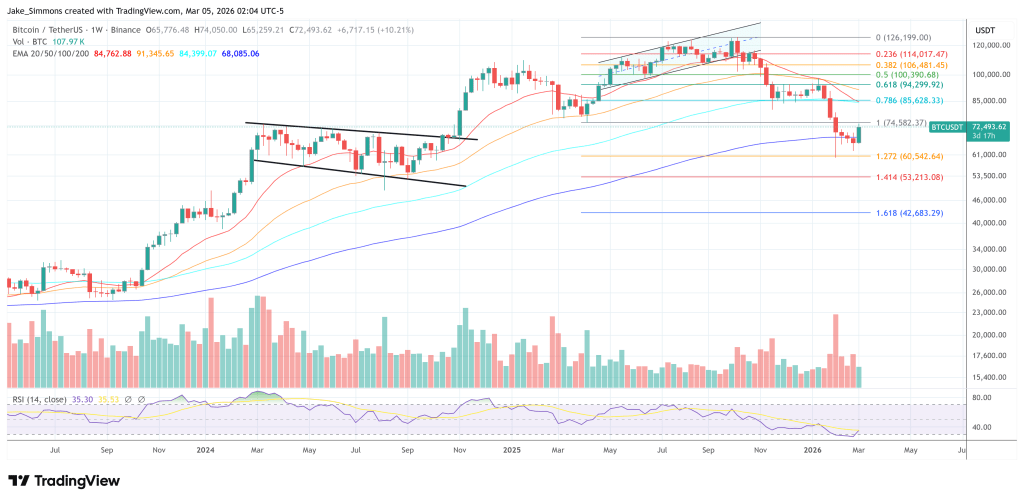
At press time, BTC traded at $72,493.
BTC faces the 1.0 Fib level, 1-week chart | Source: BTCUSDT on TradingView.com
Featured image created with DALL.E, chart from TradingView.com
Editorial Process for bitcoinist is centered on delivering thoroughly researched, accurate, and unbiased content. We uphold strict sourcing standards, and each page undergoes diligent review by our team of top technology experts and seasoned editors. This process ensures the integrity, relevance, and value of our content for our readers.
Revolut, the U.K. fintech giant that offers crypto trading, filed an application for a U.S. banking license with the Office of the Comptroller of the Currency (OCC), a key step in its push to expand in the American financial system.
If approved, the license would allow the London-based company to operate more like a traditional bank in the world’s largest economy. The company said it would gain direct access to payment networks such as Fedwire and the Automated Clearing House (ACH), systems that move trillions of dollars between banks each year.
A license could also open the door to lending products, including credit cards and personal loans. Today, Revolut offers banking services in the U.S. through Lead Bank, a Kansas City-based partner. That arrangement allows it to provide accounts and payments without holding its own charter.
The filing comes after Revolut dropped its plans to buy a U.S. bank in January to instead get a de novo banking license, which allows banks to start up from scratch.
It also comes a day after Kraken became the first cryptocurrency exchange to secure a Federal Reserve “master account,” which gives its banking arm direct access to the Fed’s core payment system.
Revolut, valued at about $75 billion, has said the U.S. market is central to its goal of building a global digital bank. Approval of a charter would mark one of the company’s biggest regulatory milestones outside Europe.
The crypto-friendly bank secured a restricted U.K. banking license in 2024 and holds banking licenses elsewhere. It isn’t a bank, however, in every region where it operates.
The first phase of bitcoin’s BTC$71,578.48 recent drawdown has not triggered panic among institutional investors, according to crypto asset management firm CoinShares.
Professional allocators reduced exposure modestly but largely maintained their positions compared with last year. Advisors trimmed holdings while hedge funds scaled back alongside the broader leverage unwind and shifting opportunities in other markets, the crypto investment manager said in a Tuesday report.
Longer-duration investors kept accumulating. “Endowments, pensions, and sovereigns continued to build quietly,” wrote analyst Matt Kimmell.
Bitcoin has struggled to regain momentum since hitting a record high near $125,000 in early October. The world’s largest cryptocurrency was trading around $72,370 at publication time.
Crypto markets have delivered muted performance in recent months as a mix of macro and market-specific pressures weighed on prices. Higher interest rates and a stronger dollar have dampened appetite for risk assets, while leveraged positions built earlier in the rally have been unwound. At the same time, profit-taking from long-term bitcoin holders and uneven flows into spot exchange-traded funds (ETFs) have limited momentum, leaving the sector struggling to regain a sustained upward trend.
Despite bitcoin falling about 23% during the period, global bitcoin ETF flows remained positive, suggesting the sell-off in the fourth quarter was driven more by long-time holders taking profits than by new institutional money exiting the market, Kimmell said.
Historically, crypto bear markets have redistributed supply from short-term traders to long-term holders. According to Kimmell, the emergence of ETFs now offers a new way to observe whether institutional capital follows the same pattern.
So far, the data points in that direction. A roughly 25% quarterly drawdown did not trigger broad institutional capitulation, the report said, with most declines in assets under management reflecting price moves rather than large investor outflows.
Still, CoinShares cautioned that the sample size remains small. The firm said the real test may appear in upcoming regulatory filings, which will capture institutional behavior during sharper moves, including bitcoin’s slide toward $60,000 and a single-day 17% drop.
Bitcoin and the broader crypto market moved higher this week, rebounding after weeks of choppy trading. The rally was driven in part by renewed risk appetite across markets and steady demand for bitcoin ETFs, helping the largest cryptocurrency regain momentum and lift major altcoins alongside it. Traders also pointed to short covering and positioning resets following the recent sell-off as factors behind the move.
Read more: CEO of crypto investment firm Keyrock says bitcoin is undervalued, entering ‘transition year’
AUSTIN, TEXAS – SEON, the command centre for real-time Fraud Prevention and AML Compliance, today released AI Reality Check: 2026 Fraud & AML Leaders Report, the second edition of its industry research, based on a global survey of 1,010 fraud, risk and compliance leaders across payments, fintech, financial services, retail, eCommerce and gaming.
The numbers tell an unexpected story: AI is everywhere, but operations are not getting more manageable. While 98% of organisations now use AI in fraud and AML workflows and 95% are confident it works, headcount plans jumped from 88% to 94% year-over-year, and 83% expect budgets to increase in 2026.
Complexity Is Outpacing Automation
AI has not reduced the workload — it has exposed how much work was always there. Fraud losses are hitting closer to revenue growth, threats are evolving faster and fragmented systems limit what AI can actually deliver at scale. Key year-over-year shift:
Leadership’s confidence in their teams’ performance is lagging. The number of leaders who disagreed with the statement, “fraud losses are growing faster than revenue,” dropped by almost 40% from the previous year
Inside the Numbers:
AI is baseline, not experimental
98% already integrate AI into daily workflows (only 2% still planning)
95% are confident AI can detect and prevent fraud (52% very confident)
Top use case: AI/ML for transaction monitoring (30%)
Fraud and AML investment keeps climbing
83% expect fraud/AML budgets to increase in 2026
94% plan to add at least one full-time hire (up from 88% in 2025)
85% plan to add a vendor, 49% plan to replace one
Fragmentation is the bottleneck
95% claim “some integration” between fraud and AML systems
Only 47% run fully integrated workflows; the rest rely on partial connections
80% say getting a unified view of data is challenging
For many, time-to-value remains slow
Only 10% go live in under two weeks
38% take 1–3 months, 24% take 4+ months
When implementations run long, top impacts include increased costs (52%) and prolonged fraud exposure (47%)
Teams are growing, not shrinking
94% plan to increase headcount despite automation gains
85% see AI agents as support/augmentation, not replacement (only 12% see eventual replacement)
Top fraud threats reported:
Account takeovers: 26%
Promo/discount abuse: 18%
Return fraud: 18%
“Fraud and financial crime were supposed to become more manageable as AI matured,” said Tamas Kadar, CEO and co-founder, SEON. “Instead, 2026 is the year leaders are confronting a more complicated reality. AI adoption is real, confidence is high, but the scale and pace of fraud — compounded by fragmented systems — continue to drive increased investment rather than reduced overhead. The bottleneck is no longer whether AI works. It’s everything around it: disconnected data, siloed teams, slow implementations. The organisations that pull ahead will be the ones that unify fraud and AML intelligence, shorten the distance between threats and controls, and treat integration as strategy, not plumbing.”
Fast-Growing Companies Invest in Integration Early
Organisations growing 51%+ are nearly twice as likely as slower peers to report that achieving unified visibility is “not very challenging.” They treat integration as infrastructure, not an IT project.
What’s Next: From “Does AI Work?” to “Can We Trust It?”
With adoption near-universal, the conversation is shifting to governance, explainability and accountability:
78% say decentralised digital identity will become central to fraud/AML
33% cite data privacy regulations (GDPR, CCPA) as the biggest external force shaping AML
25% point to criminals’ advancing use of AI and obfuscation techniques
Download the full report at https://seon.io/landing/2026-fraud-and-aml-leaders-report/
Research Methodology
The AI Reality Check: 2026 Fraud & AML Leaders Report surveyed 1,010 fraud, risk and compliance leaders at director level or above across North America, EMEA, LATAM and APAC. Respondents work in payments, fintech, financial services, retail, eCommerce and gaming. The research was conducted in Q4 2025.