Home Blog Page 859

NYSE Parent Company ICE Invests In Crypto Exchange OKX

0

Intercontinental Exchange, the parent company of the New York Stock Exchange, has made a strategic investment in crypto exchange OKX, valuing the platform at $25 billion, marking one of the most significant partnerships between a global exchange operator and a crypto trading firm.

The investment, announced Thursday, forms part of a broader collaboration between Intercontinental Exchange (ICE) and OKX aimed at connecting traditional financial markets with blockchain-based infrastructure. 

Financial terms of the deal were not disclosed, though ICE will take a seat on OKX’s board as part of the arrangement.

The partnership reflects a growing effort by established market operators to adapt to a financial landscape shaped by digital assets and tokenization. ICE, which operates derivatives markets and clearing houses alongside the NYSE, plans to integrate elements of OKX’s crypto market infrastructure into its own offerings.

One component of the agreement will see ICE license spot cryptocurrency price data from OKX. The exchange operator intends to use that data to develop U.S.-regulated crypto futures products, giving institutional investors access to digital asset exposure through established regulatory frameworks.

TradFi entering crypto-native environments

At the same time, the collaboration could extend the reach of ICE’s traditional markets into crypto-native trading environments. Subject to regulatory approval, OKX plans to provide its global user base access to tokenized equities and derivatives tied to markets operated by ICE, including securities listed on the New York Stock Exchange.

Tokenization refers to the process of representing traditional financial assets on blockchain networks. Advocates argue that blockchain-based securities can improve settlement speed, expand access to global investors and lower operational costs tied to clearing and recordkeeping.

ICE Chairman and Chief Executive Officer Jeffrey C. Sprecher said the relationship aligns with the company’s long-term effort to build blockchain-based infrastructure across trading, settlement and custody functions.

“Star has created a highly successful company with enormous distribution,” Sprecher said in a statement, referring to OKX founder and CEO Star Xu. “Connecting ICE and NYSE markets to OKX’s customer base opens the door to a new stage of financial market integration.”

OKX, which says it serves more than 120 million users worldwide, has built trading and custody infrastructure across centralized exchanges and on-chain applications. The company operates in multiple jurisdictions, including the United States, Europe, Singapore, the United Arab Emirates and Australia.

For OKX, the investment comes as the firm attempts to deepen its presence in the U.S. and reposition itself as a regulated global market operator rather than an offshore crypto exchange.

The collaboration also highlights a broader trend in which traditional financial institutions form partnerships with crypto firms rather than compete with them. Many large market operators are studying tokenized securities, which could reshape how equities and derivatives are issued, traded and settled.

ICE has explored several initiatives tied to blockchain-based markets. Earlier this year the company said it was building infrastructure designed to support tokenized assets and on-chain settlement for capital markets. 

The new relationship with OKX is expected to complement those efforts.

CORZ secures up to $1 billion loan facility from Morgan Stanley

0

Core Scientific (CORZ), the Texas-based digital infrastructure provider, has secured up to $1 billion in strategic financing from Morgan Stanley to support the development of its data center infrastructure.

The company announced the initial closing of a $500 million 364-day loan facility, with an accordion option that could expand total commitments by another $500 million, subject to standard conditions. Borrowings under the facility will carry interest at the Secured Overnight Financing Rate (SOFR), plus 2.50%.

According to CEO Adam Sullivan, the additional capital will allow the company to move faster on projects approaching service readiness, helping it better meet growing customer demand.

Core Scientific plans to use the funds for general corporate purposes tied to data center development. This includes equipment purchases, early-stage project costs, land acquisitions, and securing additional energy supply agreements needed to power future facilities.

This comes just days after Core Scientific’s Q4 earnings, during which the company disclosed that it sold $175 million worth of bitcoin as it pivots toward AI infrastructure.

Shares of Core Scientific were down around 1% in pre-market trading on Thursday.

Morning Minute: Kraken Cracks the Fed

0

Morning Minute is a daily newsletter written by Tyler Warner. The analysis and opinions expressed are his own and do not necessarily reflect those of Decrypt. Subscribe to the Morning Minute on Substack.

GM!

Today’s top news:

  • Crypto majors pump another 2-4% across the board; BTC at $73k
  • BTC ETFs see $1.15B in inflows to start March
  • Kraken gains access to Fedwire in “watershed moment” for crypto
  • a16z targets $2B for its 5th crypto fund, crypto vc raises at $4B+ for 2026
  • Tether invests $50M into Eight Sleep at $1.5B valuation as it expands into AI health & infra

🏛️ Kraken Cracks the Fed

For the first time in U.S. history, a crypto-native company just got a seat at the Federal Reserve’s table.

And the banking industry is furious about it.

📌 What Happened

Yesterday, Kraken Financial received approval for a Federal Reserve master account from the Federal Reserve Bank of Kansas City.

The account grants direct access to Fedwire, the Fed’s real-time settlement network. Until now, Kraken had to route all dollar transfers through intermediary banks. That’s over.

The approval is limited, meaning Kraken won’t earn interest on reserves held at the Fed, and it can’t tap the Fed’s emergency lending facilities. It’s a so-called “skinny” master account, similar to a concept the Fed floated last year.

But the significance is clear: Kraken can now settle dollar payments itself, on the same rails used by JPMorgan, Bank of America, and every other major U.S. bank.

Traditional banking groups didn’t wait long to respond.

The Bank Policy Institute and other trade groups immediately criticized the decision, warning it could threaten U.S. financial stability.

🗣️ What They’re Saying

“This milestone marks the convergence of crypto infrastructure and sovereign financial rails.” – Arjun Sethi, co-CEO of Kraken

Sen. Cynthia Lummis (R-WY) called it a “watershed moment for the digital asset industry.”

🧠 Why It Matters

Custodia Bank fought the Fed in court for years to get this and lost.

Now Kraken has it, and that’s a pretty big signal about where the regulatory environment stands under the current administration.

Kraken’s approval is explicitly being treated as a pilot for the “skinny” master account framework.

Ripple, Circle, and Paxos already have conditional OCC charters and are laying in wait. Likely just a matter of time until those dominoes fall as well.

As for the users, they are the big winners here.

Faster, more reliable fiat deposits and withdrawals are here. No more waiting 5-7 days for funds to clear (we all know how painful that can be when markets are pumping).

And the banks? Well, they may have lost another battle with the crypto companies…

🌎 Macro Crypto and Markets

Corporate Treasuries & ETFs

Meme Coin Tracker

  • Meme majors were mostly green; DOGE +1%, SHIB +0.4%, PEPE -3%, TRUMP -2%, PENGU +1%, SPX -4%, FARTCOIN +2%
  • WAR (+44%), Lobstar (+85%) and memecoin (+60%) led onchain movers

💰 Token, Airdrop & Protocol Tracker

  • Tether invested in Eight Sleep at a $1.5B valuation, helping the AI-powered sleep tech startup to develop new health features
  • Sui’s native dollar stablecoin, USDsui, launched with a unique structure that reinvests income from its backed assets into SUI buy and burns
  • USDai’s CHIP sale ended with $19.4M raised
  • Backpack announced a waitlist for access to its IPO available onchain
  • Polymarket removed its nuclear bomb market after public outcry
  • Paradex published a tokenomics update ahead of its DIME token airdrop going live today

🚚 What is happening in NFTs?

  • NFT leaders were mostly flat with ETH pumping; Punks even at 29.9 ETH, Pudgy -1% at 4.45 ETH, BAYC even at 6 ETH; Hypurr’s -1% at 450 HYPE
  • Moonbirds (+10%) led top movers; Normies +21%
  • Cambria announced a $1M raise at $30M FDV

Daily Debrief Newsletter

Start every day with the top news stories right now, plus original features, a podcast, videos and more.

Stellar (XLM) drops 3.5% as nearly all assets decline

0

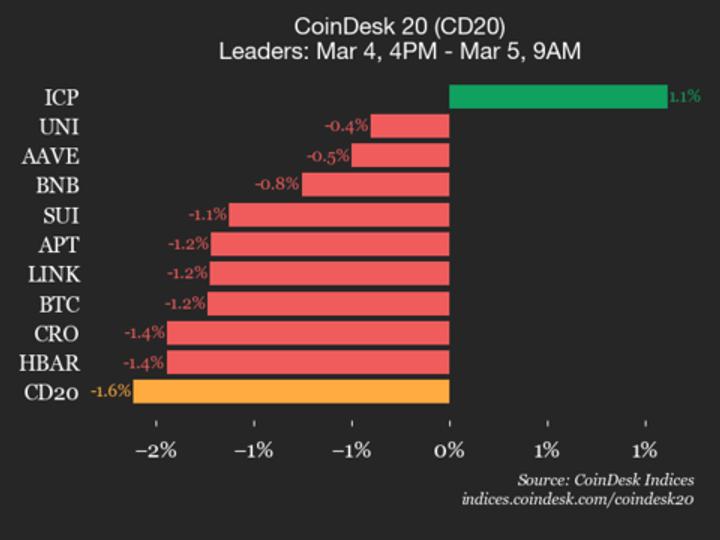
CoinDesk Indices presents its daily market update, highlighting the performance of leaders and laggards in the CoinDesk 20 Index.

The CoinDesk 20 is currently trading at 2064.51, down 1.6% (-33.92) since 4 p.m. ET on Wednesday.

One of 20 assets is trading higher.

Leaders: ICP (+1.1%) and UNI (-0.4%).

Laggards: XLM (-3.5%) and LTC (-2.8%).

The CoinDesk 20 is a broad-based index traded on multiple platforms in several regions globally.

Meth Detox Treatment and Safe Recovery Support

0

Meth addiction is still plaguing individuals, families, and communities in the nation. Since this stimulant has a strong influence on the nervous system and the brain, it is difficult to quit using this stimulant without help. Nevertheless, through proper clinical counseling, one can recover. At the initial stages, professional assistance in Meth detox may be the key to the relapse and permanent transformation. When patients start using medical-controlled care, they tend to be steadier and have a better outcome in the long term. In the case that you or a loved one are considering treatment, it is a crucial step towards healing that you should know how Meth detox works.

Learning how Methamphetamine Affects the Brain.

Methamphetamine produces a vast effect on the level of dopamine in the brain. This can lead to a person experiencing strong energy, confidence, and euphoria in the first place. However, in the long-term, the frequent use impairs the reward system of the brain. Therefore, natural pleasure becomes hard to achieve in the absence of the drug.

Once the person has quit meth, the brain cannot control itself. Such a transition may cause intense fatigue, depression, anxiety, and intense cravings. Thus, the initial stage of Meth detox is a period that should be closely observed and emotionally cared for. In the absence of formal treatment, most people are likely to relapse into substance use just to relieve these unpleasant symptoms.

The importance of Professional Detox.

Even though some will make efforts to quit independently, withdrawal symptoms soon become too overwhelming. As an example, the first few days of treatment may lead to a worsening of mood swings and depressive episodes. In other instances, people develop paranoia or commit suicide. Owing to these dangers, the detox of Meth under supervision offers a safer and more accommodating setting.

Doctors conduct assessments on physical and mental health before treatment. They then develop a unique care plan, which meets the needs of each individual. Clinicians observe hydration, sleep, nutrition and mental health symptoms throughout the process. This makes the clients less vulnerable and more stable to relapse.

The What to Expect and Stages of Withdrawal.

When quitting meth, there is no physical dependence that requires life-threatening symptoms, unlike other drugs. Nevertheless, the emotional and psychic impact may be severe. First, people can have what is generally referred to as a crash. In this phase, one is highly fatigued, hungry and in a state of deep depression.

The symptoms change their direction to irritability, anxiety, and cravings after the crash phase. The fact that the brain is re-adjusting to the creation of dopamine means that mood instability might last weeks. This is the reason why structured Meth detox programs frequently incorporate counseling and behavioral assistance at the start.

In the long run, the symptoms slowly improve. However, the cravings can persist for months. Thus, detox must never be out of context with the continuous therapy and rehabilitation.

The Importance of Mental Health Support in the Detox.

The use of methamphetamines is often accompanied by such mental health disorders as anxiety disorders, depression, or symptoms of trauma. Relapse is more probable in case these conditions are not treated. In the process of Meth detox, clinicians determine the co-occurring disorders and start handling them as soon as possible.

The therapeutic interventions can be cognitive behavior therapy, motivational interviewing and trauma-informed care. These methods make people learn about triggers and come up with more healthy coping strategies. In addition, early therapy develops confidence and prepares clients to long term recovery programs.

Health and Wellbeing: Medical Surveillance.

Although the withdrawal symptoms of meth are mostly psychological, the health aspect of the body also needs to be taken into consideration. Long term meth consumption may place a strain on the heart, harm the teeth, and impair the immune system. Hence, extensive assessments are done by medical teams during intake.

During Meth detox, the vital signs and sleep patterns are monitored by the healthcare providers. They can also prescribe drugs to treat extreme anxiety, insomnia or depressive symptoms. Professionals eliminate pain and make the experience more manageable. Therefore, people can better go through detox.

The Significance of an Organized Environment.

The role of the environment in early recovery is very high. Individuals who are trying detox in the same environment where they were using drugs before will always be triggered. Conversely, a specific treatment environment eliminates instant access to substances and negative stimuli.

In a formal Meth detox program, the daily routine promotes stability. Healthy eating, regular sleeping routines and therapy sessions bring about physical and emotional stability. Moreover, peer support encourages a feeling of togetherness and minimizes loneliness. Addiction functions well in the veil of secrecy, and therefore, open communication is an effective healing factor.

Relapse Prevention and Coping with Cravings.

The cravings may be unpredictable and overwhelming. Nevertheless, they usually tend to soar and fall like rocket waves. In the Meth detox, the therapists educate clients on managing the cravings through grounding, breathing and cognitive reframing.

Moreover, it is crucial to know what triggers a person. Relapse is often caused by stress, boredom, and unsolved trauma. By recognizing these factors at the initial stage, people acquire the means of reacting in a new way. Consequently, the probability of relapsing to meth use is lowered.

Introduction to Changing to Ongoing Treatment.

Detox is not a cure in itself that takes into account the underlying causes of addiction. Rather, it puts the body and mind at ease such that meaningful therapeutic work is now possible. Clients usually pass on to residential or partial hospitalization or to outpatient treatment after they finish the Meth detox.

The therapy of this second stage is aimed at rebuilding relationships, self-esteem and acquiring skills in life. Since the meth addiction may interfere with employment and family stability, thorough programs also cover these aspects. Little by little, people are taught to live a sustainable, substance free life.

Involvement of Family in the Recovery Process.

Very seldom does addiction affect an individual. Close ones frequently feel lost, frightened and hurting. Thus, recovery outcomes can be reinforced by engaging the loved ones in education and counseling.

When families are aware of what transpires in the Meth detox, they will feel better placed to support instead of judge. Family therapy sessions are characterized by honest communication and re-establishing trust. In the long-term, this cooperative practice will result in healthier relationships and sustainable recovery.

The Physical Recovery and Nutrition.

Nutritional deficiencies and weight loss are also common effects of long-term use of meth. With appetite back on track during the detox process, balanced meals are significant in the restoration of health. Protein, complex carbohydrates and hydration help to maintain brain recovery and energy levels.

Exercise is also a source of a better mood. Even a simple exercise like walking or stretching can help increase endorphins as well as decrease stress. Therefore, wellness practices in Meth detox enhance physical and emotional strength.

The Psychological Adventure of Early Sobriety.

Even though the detox is the first step of recovery, the emotional development progresses long after the elimination of the withdrawal symptoms. A large number of people are suffering from guilt or regret concerning their previous actions. Therapy however gives room to deal with such emotions constructively.

Clients are taught self-compassion and responsibility through regular counseling. By and by, confidence comes back. People start to dream of a healthier future instead of identifying themselves with addiction. This change usually begins in Meth detox and progresses with time.

Conquering Stigma and Seeking Help.

Even though there is increasing awareness, the stigma of substance use disorders still exists. Others fear being judged and will not want to consult. However, addiction is a medical issue that should be treated by professionals.

Making the decision to go through Meth detox makes one brave and ready to change. Treatment becomes accessible to recovery when people consider it as an investment to their well-being and not as a symbol of weakness.

Creating a Platform to long term sobriety.

The process of recovery requires staying consistent, communal, and supported to be sustained. Resilience is enhanced by attending therapy, support groups and planning relapse prevention following a detox. In addition, healthy routines lower the susceptibility to stress.

Sobriety makes many people find new interests and passions. Renewed purpose is also brought about by creative outlets, volunteer work and career development. Despite the issues that might occur along the way, skills acquired in the process of Meth detox will give a good base for overcoming them.

It Is Not too Late to hope and heal.

Meth addiction is not an easy thing to overcome immediately, but it can be done through structured treatment and care. Each phase of treatment is based on the other and the first step is safe and supervised Meth detox. By being able to deal with withdrawal symptoms, mental health requirements and lifestyle modification concomitantly, individuals acquire the stability to be able to achieve long-term healing.

At Silicon Valley Recovery, the holistic treatment starts with medically supervised detox and goes on to individualized treatment planning. Through professional support, evidence-based therapy and a conducive environment, people will be able to overcome addiction and regain a life that is characterized by clarity, strength, and hope.




OKB jumps 50% as NYSE owner Intercontinental Exchange backs OKX at $25B valuation

0

OKB, the native token of crypto exchange OKX, jumped around 50% today following news that Intercontinental Exchange, the publicly traded parent company of the New York Stock Exchange, made a strategic investment in the platform, Fortune reported.

CoinMarketCap data shows that OKB rose from $78 to roughly $118 shortly after the announcement. The token’s 24-hour trading volume also spiked by more than 1,000%.

The jump represents one of OKB’s biggest single-day moves since the token soared 170% on its tokenomics upgrade.

OKB jumps 50% as NYSE owner Intercontinental Exchange backs OKX at $25B valuation

The deal, which reportedly resulted from a meeting last summer between OKX executive Haider Rafique and NYSE chairman Jeffrey Sprecher, values the exchange at $25 billion and includes a board seat for the trading giant.

Under the partnership, OKX will provide ICE with crypto price feeds and plans to allow its users to trade tokenized stocks and derivatives listed on the NYSE, a feature expected to launch in the second half of 2026. Financial terms of the investment were not disclosed.

The move reflects growing efforts by traditional financial firms to expand into blockchain-based markets.

ICE has invested in the prediction market Polymarket and is building an infrastructure for tokenized securities. MoonPay, a crypto payments company, is also under consideration for an investment by the Wall Street giant, Bloomberg said last December.

Meanwhile, OKX is seeking to expand its US presence following a recent settlement with the Department of Justice.

Disclosure: This article was edited by Vivian Nguyen. For more information on how we create and review content, see our Editorial Policy.

N26 Strengthens Pan-European Operations with New Centre of Excellence in Madrid

0

N26 announced the opening of its new European Centre of Excellence in Madrid, strengthening its pan-European operations. Located in the Salamanca district, the 2,000m² space will serve as the company’s second Operations hub after Berlin, as well as a base for the growing local Spanish team.

The new Madrid hub plays a central role in N26’s long-term vision to build a profitable, resilient, pan-European banking platform. As the company continues to develop across its 24 markets, the addition of a second Operations hub enhances flexibility and scalability, diversifies operational risk, and strengthens business continuity across Europe.

The Madrid centre will work closely with the company’s first Operations hub in Berlin to ensure seamless service delivery across markets. Madrid was selected for its position as a well-connected, international European capital in one of N26’s core markets. Spain represents one of the company’s strongest growth markets with a well-established talent base.

By expanding its presence in the country, N26 aims to both contribute to and benefit from Spain’s dynamic banking ecosystem, tapping into highly skilled local financial and operational talent. The Madrid space will host a broad range of international functions, such as Banking roles, Customer Service and Operations, as well as local teams of the Spanish market.

Marcus W. Mosen, Co-CEO at N26, said: “The launch of our Madrid Centre of Excellence represents a strategic investment in the Spanish and broader South European market, reinforcing N26’s presence where we see great potential for growth. By establishing our second Operations hub serving our pan-European ambition, we are also positioning N26 at the heart of a thriving talent ecosystem, enabling us to scale efficiently and operate with strong resilience. This new office is a deliberate step in driving long-term growth and strengthening our footprint across Europe.”

Antón Díez Tubet, General Manager for Spain and Portugal at N26, said:  ”We are ideally positioned to continue growing and further solidifying our role as the leading alternative to traditional banking in Spain and in the region. The opening of our new Operations centre and base for the Spanish business symbolizes the ongoing commitment for growth and innovation in which Madrid, as a hub for financial and digital talent, will play a vital role.”

With a German banking license, N26 continues to expand its digital banking offering across Europe, bringing together investing, saving, spending, personal and business accounts in one seamless app experience. The opening of the Madrid Centre of Excellence further strengthens N26’s presence in Spain, where the company already operates a major technology hub in Barcelona.

This Barcelona tech hub, one of N26’s largest product and engineering centres in Europe, is home to more than 400 employees developing products and services for customers across all markets. 

Coinbase Executives Face Shareholder Lawsuit alleging Compliance Failures

0

A Coinbase shareholder filed a derivative lawsuit against several of the crypto exchange’s top executives and board members, alleging they failed in oversight of compliance and disclosures, exposing the company to legal and regulatory fallout.

The complaint was filed Tuesday in the US District Court for the District of New Jersey and was brought by shareholder Kevin Meehan on behalf of Coinbase Global. It cites CEO Brian Armstrong, co-founder Fred Ehrsam, and several current and former directors and senior executives, including chief legal officer Paul Grewal and chief financial officer Alesia Haas.

According to the filing, the defendants allegedly made false or misleading statements between April 2021, when Coinbase went public through a direct listing, and June 2023. The plaintiff argues that these oversight failures ultimately exposed Coinbase to regulatory enforcement actions.

In early 2023, Coinbase reached a $100 million settlement with the New York State Department of Financial Services (DFS) over deficiencies in its anti-money laundering (AML) compliance program. In another instance, the company was hit with a $5 million penalty from New Jersey’s Bureau of Securities related to the listing of unregistered securities.

Related: Trump met Coinbase CEO before slamming banks over crypto bill: Report

Shareholder suit seeks damages, insider profit clawbacks

The lawsuit seeks damages on behalf of Coinbase, along with corporate governance reforms and the clawback of compensation and profits allegedly earned by insiders while the company’s compliance issues persisted.

Because the case is structured as a shareholder derivative action, any financial recovery would go to Coinbase rather than directly to shareholders.

Coinbase faces new lawsuit. Source: PACER

The complaint also calls for a jury trial and accuses the defendants of unjust enrichment, abuse of control and breaches of fiduciary duty tied to what it describes as systemic compliance failures.

Cointelegraph reached out to Coinbase for comment, but had not received a response by publication.

Related: Coinbase opens stock and ETF trading to all US users in multi-asset push

Coinbase faces more lawsuits

In January, a Delaware judge allowed a shareholder lawsuit alleging several Coinbase directors conducted insider trading to move forward, despite an internal investigation that cleared the executives. The case claims that insiders, including Armstrong and board member Marc Andreessen, used nonpublic information to avoid more than $1 billion in losses by selling shares around Coinbase’s 2021 direct listing.