Home Blog Page 843

From Ban Threats To Bank Licenses: Russia’s New Crypto Play

0

Trusted Editorial content, reviewed by leading industry experts and seasoned editors. Ad Disclosure

The Bank of Russia has proposed letting banks and brokerage firms obtain licenses to operate crypto exchanges.

A New Crypto Play

A report published by Interfax on March 5 states that The Central Bank of Russia (CBR) Governor Elvira Nabiullina has proposed to allow banks and brokers to obtain crypto exchange licenses via a notification process, as based on their current licenses. This statement was made at the annual meeting of lending institutions with the Central Bank.

According to Nabiullina, the proposal aims to leverage the banking sector’s infrastructure for fighting money laundering and countering the financing of terrorism and fraud in order to better protect digital assets market clients. In what appears to be a conciliatory move between regulators and digital asset’s traders, Nabiullina directly addresses some of the main concerns typically raised by TradFi when arguing against crypto assets:

We hope that your extensive banking experience in AML/CFT [anti-money laundering and countering the financing of terrorism], as well as your experience in countering fraud, will help protect your clients in the crypto market once it is legalized.

The Crypto Proposal

The exchange permissions being notification‑based means that institutions could bolt cryptocurrency services onto existing financial licenses instead of going through a separate, standalone approval process.

Under the draft rules, crypto and stablecoins would be treated as “currency valuables”: Russians could own and trade them but using them as a domestic means of payment would remain restricted.

Regarding the risk level, Naibullina remain cautious. She clarified that there would be a temporary threshold for banks’ involvement in the asset class:

However, we would still like to limit the level of risk a bank takes in this area to one percent of capital. Let’s start by seeing how banks operate within the one percent cap, and then see whether we need to move forward.

According to the Interfax report, qualified investors may acquire crypto assets without restrictions, while non-qualified investors are limited to purchasing up to 300,000 rubles per year through a single intermediary. The proposal effectively turns banks into the primary regulated gateways for digital asset trading.

Russia’s Back-And-Forth

Since 2020, Russia has recognized digital assets as property but banned them as a means of payment. Russia flirted with a full ban in 2022 and then shifted to “regulate, don’t ban.” By 2024–2025, Russia allowed limited cross‑border use, legalized mining, and opened the market only to banks and “super qualified” investors, keeping retail, P2P, and foreign platforms in a gray zone.

A Change In The Tide

Russia has slowly but surely moved from hostility to tightly managed acceptance: the new push to license banks and brokers as cryptocurrency intermediaries is about pulling activity onshore, taxing it, preserving capital controls, and sidelining unlicensed foreign exchanges rather than outlawing crypto itself.

The central bank is pushing to finish the broader legal framework by mid‑2026, after which penalties for unlicensed intermediaries and offshore platforms that do not localize in Russia are expected to kick in.
Bitcoin, BTC, BTCUSD

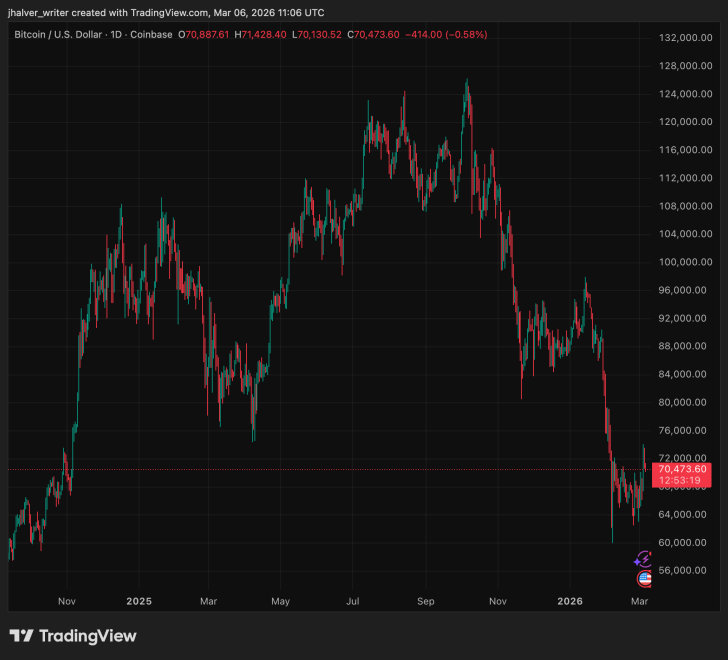
BTC's price trends to the downside on the daily chart. Source: BTCUSD on Tradingview

Cover image from ChatGPT, BTCUSD chart from Tradingview


Editorial Process for bitcoinist is centered on delivering thoroughly researched, accurate, and unbiased content. We uphold strict sourcing standards, and each page undergoes diligent review by our team of top technology experts and seasoned editors. This process ensures the integrity, relevance, and value of our content for our readers.


‘Serious investor base’ helps Solana ETFs defy Bitcoin amid slouching price – DL News

0

  • Since they launched in July, Solana ETFs have received $1.45 billion in trading action.
  • The token has fallen 57% over the same period.
  • Adjusted for market value, flows are double that of Bitcoin ETF counterparts.

Solana exchange-traded funds have defied brutal market conditions to accumulate nearly $1.5 billion in flows — outpacing Bitcoin by a factor of two in the process.

Since the product went live in July 2025, Solana has plunged to around $85, down from nearly $300 when traders could start trading the ETF. In fact, for Eric Balchunas, Bloomberg Intelligence ETF analyst, the timing was terrible.

“About as unlucky timing as you’ll ever see,” Balchunas wrote on X.

But Solana investors don’t seem to care.

“They managed to not only accumulate $1.5 billion in flows but not really give any of it up,” Balchunas said Thursday. “Both really good signs for the future.”

ETF flows refer to money put into and pulled out of the investment funds. Flows in March and February have been positive, suggesting investors view current prices as a buying opportunity rather than a warning sign.

According to Balchunas, the majority of Solana ETF holders are institutions filing 13Fs — hedge funds, asset managers, pension funds — which typically invest with longer time horizons than retail. Their willingness to accumulate through a cliffside 57% decline shows that they are confident about Solana’s long-term prospects.

Beating Bitcoin

Solana’s flows look even more impressive when they are adjusted for Solana’s market value relative to Bitcoin.

“If we adjust for the size of Solana versus Bitcoin market cap, it’s the equivalent of $54 billion in net new flows,” Balchunas said. “That’s about double where Bitcoin was at the same point.”

Beating Bitcoin in terms of ETFs is no small feat: the cryptocurrency had most successful launch in ETF history, bringing in upwards of $107 billion in its first year.

The composition of Solana holders also suggests some pretty important institutional conviction. Roughly 50% of Solana ETF assets come from 13F filers — institutional investors required to disclose holdings quarterly, according to Balchunas.

“Serious investor base,” he added.

Pedro Solimano is a markets correspondent based in Buenos Aires. Got a tip? Email him at psolimano@dlnews.com.

Curve Finance Warns PancakeSwap About Licensing Violation

0

The team behind the Curve Finance decentralized finance (DeFi) platform accused the PancakeSwap decentralized exchange (DEX) of using its code without the proper licensing.

The code is tied to the “StableSwap” feature used for swapping stablecoins and “tightly-pegged” assets on PancakeSwap Infinity, the latest version of the PancakeSwap DEX.

“If you want to enjoy using stableswap without legal problems and to borrow some of our expertise to keep users SAFU, you still can contact us for licensing and collaboration,” the Curve team said on X.

Source: Curve Finance

In a separate post, Curve said “deep stableswap expertise” is needed to safely integrate swap features, and cited the 2022 hack of the Saddle Finance DEX and the $116 million hack of DeFi protocol Balancer in 2025 as examples of swap-based code exploits.

The PancakeSwap team said it would reach out to Curve Finance to discuss the issue. “Indeed, better to be friends and build together,” the Curve team responded.

Cointelegraph reached out to both teams but did not receive a response by the time of publication.

The incident highlights the potential cybersecurity and legal issues that arise in decentralized finance as projects and protocols continue to iterate on products and expand features.

Related: Curve founder says DeFi must ditch token emissions for real revenue

PancakeSwap Infinity launches and goes cross-chain

PancakeSwap Infinity launched on the Arbitrum network and BNB Chain in April 2025, following the integration of one-click, cross-chain swaps that allow users to move digital assets between blockchain protocols.

The updated DEX introduced “hooks,” smart contract plug-ins that customize parameters for liquidity pools, including dynamic fee structuring, tailored rebates and onchain limit orders that execute when preset conditions are met.

Decentralized Exchange, DeFi, PancakeSwap, Curve Finance
Different types of liquidity pools on PancakeSwap Infinity. Source: PancakeSwap

The upgrade also lowered pool creation fees by up to 99% and was built to accommodate different liquidity strategies, according to PancakeSwap.

In July 2025, PancakeSwap Infinity launched on Base, an Ethereum layer-2 (L2) scaling network, and touted up to 50% cheaper trading fees when Ether (ETH), the native token of the Ethereum layer-1 blockchain network, was traded against ERC-20 tokens.

ERC-20 is the token standard for most assets minted on Ethereum, including the gas and governance tokens of Ethereum L2s, memecoins, and other projects issuing tokens on Ethereum.

Magazine: MakerDAO’s plan to bring back ‘DeFi summer’ — Rune Christensen