

While BIP 110 wants to restrict data through a consensus change and has almost no miner support, a new DOG Mode client wants the opposite and requires no vote at all.
Bitcoin Bulls Hold $64K, But For How Long?

Bitcoin (BTC) spent the week split across two scenarios. One highlighted improving onchain buying pressure and ETF inflows, while the other remained synced to sentiment gauges and news events that projected fear.
The spot and futures cumulative volume delta, a running tally of buy and sell orders, confirmed a $925 million net buying day for Bitcoin on July 15. This orderbook activity absorbed the entire post-CPI pullback in open interest and price rather than collapsing into it. Meanwhile, the spot Bitcoin ETFs added $107.7 million in net inflows on July 15, marking the second consecutive positive day following $181 million on July 14.
Bitcoin price, funding, open interest. Source: Hyblock
Funding rates spent most of the past week between 0.10% and 0.22%, then cooled sharply to 0.048%. Paired with open interest down 3.4% from Tuesday’s peak, this suggests leverage unwinding without a corresponding price decline, as Bitcoin was down only about 1.5% over the same stretch. This suggests that the longs deleveraging are simply stepping back from the post-CPI trade to adjust for Bitcoin hitting its local range highs near $65,000 to $66,000.
Despite the traction in spot, futures, and ETF markets, market sentiment has yet to catch up. The Fear & Greed Index sits near 26, still in “Fear” territory, despite Bitcoin’s roughly 4.4% bounce off its recent $62,100 low. For traders that use the metric in a contrarian sense, positive flows holding up while sentiment stays depressed has historically been a more durable setup than a rally where sentiment has already priced in.
An alternate interpretation is that real risk-off events remain present on the horizon. This week the US war in Iran resumed, oil prices shot above $85 and projections for a Fed rate hike by September 2026 remain above 44%.
The positive data for the week do not confirm a change in trend. Yes, two days of confirmed buying are notable, but they are not decisive.
Currently, funding is cooling toward neutral, spot ETF flows remain negative for the year, and a cluster of long liquidations sits roughly 1.5% below the current price ($63,200).
Bitcoin retreats from monthly high as Iran attacks U.S. bases and profit-taking sets in
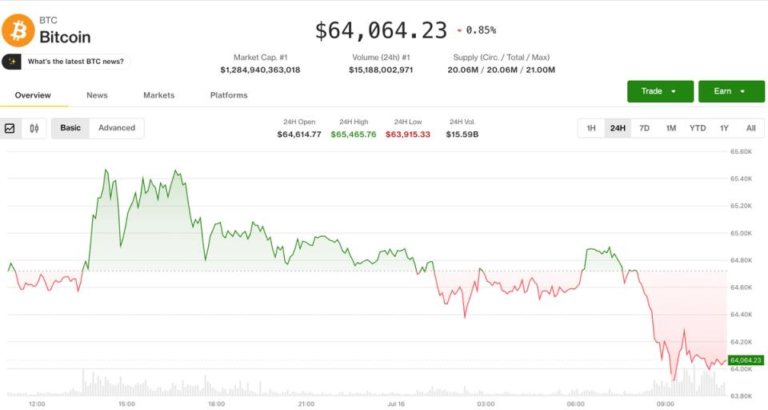
The crypto market is facing a wave of sell pressure with bitcoin and ether (ETH) losing 1.1% and 1.7%, respectively, since midnight UTC.
The shift to the downside comes after bitcoin rose to a monthly high of $65,500 on Wednesday, prompting some traders to take profits.
Altcoins PUMP and ZEC also declined, falling 4.4% each after Tuesday’s strong rallies faded, highlighting a lack of liquidity in both directions.
U.S. equities also lost ground. Futures on tech stock-dominant Nasdaq 100 index retreated by 0.25%, extending a downtrend that began 30 days ago.
One of the main catalysts for price action across all asset classes is the war in Middle East, with Iran launching attacks on U.S. military bases in neighboring Gulf states on Thursday and the U.S. continuing its wave of airstrikes.
Derivatives positioning
- Ether’s price has dropped by 1.7% since midnight UTC, slightly more than the decline in bitcoin. ETH’s underperformance seems driven by bullish plays unwinding rather than aggressive new short selling. That’s evident from the decline in open interest (OI) to 14.35 million ETH from the five-week high of 14.45 million ETH hit Wednesday. Futures tied to BTC show similar dynamics.
- Meanwhile, OI in XRP rose to a 10-day high of 2.21 billion XRP alongside a 0.6% drop in the spot price. This combination is taken to represent a growing bias for bearish exposure, although XRP’s positive funding rates contradict that interpretation. That said, the 24-hour cumulative volume delta (CVD) for XRP is negative, meaning short plays are being executed at market orders rather than passive limit orders.
- Another notable open interest gainer is SUI, the native token of the Sui blockchain. Positions have increased by 15%, although the total OI of 654 million tokens remains in line with levels seen earlier this week. The SUI token has dropped almost 2% over 24 hours.
- Broadly speaking, most coins, except BTC, ETH and XMR, have a negative 24 hour OI-adjusted cumulative volume delta (CVD), a sign of bears leading the price action.
- Bitcoin’s 30-day implied or expected volatility index is up 2% at 38%. Volatility tends to be mean-reverting, and, historically, sub-40% readings have consistently presaged renewed market turbulence.
- In Deribit-listed options, there has been a notable rise in both trading volume and open interest in BTC calls at $70,000 and $72,000 strikes. This likely reflects a large bull call spread that crossed the tape recently. The strategy bets that prices will rally to $72,000 by the end of July.
- In ETH’s case, the end-July expiry call at the $2,300 strike is the most traded bet of the past 24 hours. A call represents a bullish bet on the market.
Token talk
- Artificial intelligence token defied bearish crypto price action on Thursday, rising by 3.5% since midnight as it looks to test the $2.20 level of resistance, which caused a rejection and subsequent drop to $1.85 on July 2.
- The rest of the altcoin market tracked bitcoin and ether, with coins including HYPE, SOL and ENA losing 1.3%-1.8% since midnight while NEAR, JUP and DASH posted steeper losses.
- CoinMarketCap’s “Altcoin Season” indicator is still range-bound, currently at 48/100 after losing its perch at 58/100 on Monday as investors switched focus back to bitcoin.
- One recent area of interest in the altcoin sphere has been memecoins, notably tokens launched on Robinhood’s new blockchain. One, cashcat (CASHCAT), rose from relative obscurity to a $220 million market cap in its first week of Robinhood Chain going live. It has since fallen back to a $91 million market cap despite maintaining around $60 million in daily trading volume.
Bitcoin under $64,000 after new U.S. strike on Iran and Trump’s China allegation
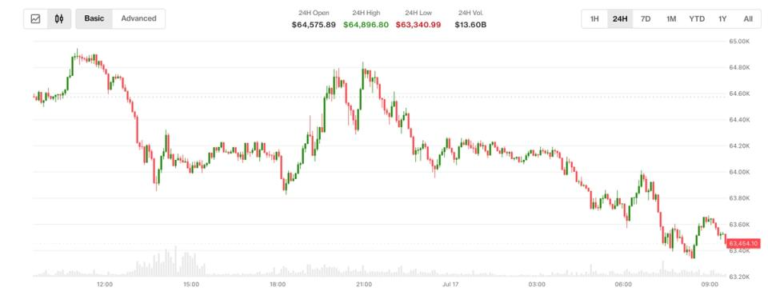
Bitcoin and Asian stocks fell Friday after fresh U.S. airstrikes on Iran raised geopolitical uncertainty. Additionally, President Donald Trump’s allegations that China tampered with the 2020 election hurt risk sentiment, sending the Australian dollar lower.
BTC, the leading cryptocurrency by market value, slipped to $63,600, extending Thursday’s nearly 1.4% slide from $65,000, according to CoinDesk data. As of this writing, the cryptocurrency traded just below its 50-day simple moving average, the widely-tracked gauge of near-term momentum.
Asian equity markets wilted, with Japan’s Nikkei trading nearly 3% lower at its lowest in over a month. Australia’s ASX 200 slipped by 0.5% alongside a 0.8% drop in futures tied to Nasdaq. Wall Street’s tech-heavy index fell by over 1.6% on Thursday.
Iran’s semi-official Fars news agency quoted Hormozgan Province Governorate, saying that U.S. airstrikes have hit five bridges in the southern Hormozgan province. A missile strike also hit Iran’s Chabahar maritime control tower. Surprisingly, WTI oil futures held steady at around $79 per barrel, ignoring the geopolitical stress from the fresh wave of U.S. attacks on Iran.
Visa, Stripe and Google join massive open-source project to let AI agents pay each other
The stakes are high because AI agents, which will likely account for a large share of internet commerce, including some in the form of tiny micropayments, could completely reshape the web. “It may seem nerdy to care about standards so much, but we have the opportunity to create this truly open public global financial system that everyone can have access to,” Dixon added.
Other premier members of the x402 Foundation include Ripple, Visa, Mastercard, American Express, Stripe, Adyen, Fiserv, Shopify, Google, Amazon Web Services and Cloudflare, alongside Circle, MoonPay and the Solana Foundation.
Coinbase initially shepherded the x402 payment protocol, which takes its name from the “402 payment required” response code built by early World Wide Web architects to allow browsers to pay for content.
However, card payments and the associated fees made micropayments unworkable, and internet business models evolved through advertising and subscriptions, leaving the 402 gateway unused.
Bringing x402 under the auspices of the Linux Foundation is exactly the right “open-source playground” for building a collaborative open standard, according to Alin Dragos, senior manager at AWS Payments, who has taken on the role of board chairperson for the x402 Foundation.
The plan, Dragos said, is to complement the original design of HTTP, the foundational set of rules that allows web browsers and servers to communicate.
The most popular bitcoin options bet has slipped $10,000 lower to a $70,000 strike: Crypto Daily
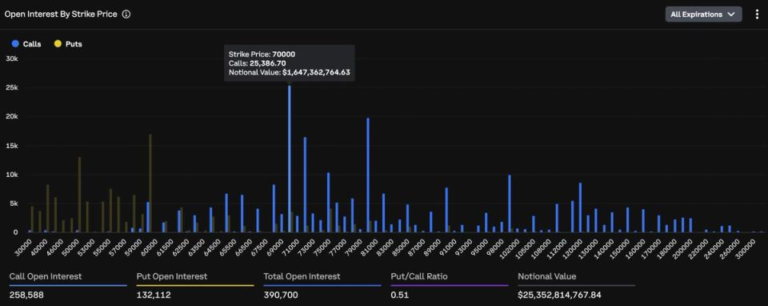
The implication does not stop there. According to Imran Lakha, founder of Options Insights, dealers hold a “net long gamma exposure” above $70,000. It means the dealers, who strive to maintain market-neutral exposure while making money from the bid-ask spread, would short or sell into strength above 70,000 to stay neutral or hedged.
“That hedging acts like a brake, capping how fast BTC can run once it gets up there,” Lakha said, adding that ether (ETH) isn’t as exposed to dealer gamma dynamics and can rip much faster.
Bitcoin was recently changung hands near $64,100, down nearly 1% since midnight UTC. Other major cryptocurrencies, including ether, XRP (XRP) and solana (SOL) nursed similar losses, while Nasdaq 100 index futures fell 0.5%.
“As always, there is a risk of a sudden sell-off amid financial market shocks, which could send BTC or global stock indices into a tailspin, but waiting for such moments is a thankless task,” said Alex Kuptsikevich, the chief market analyst at FxPro. “In such conditions, buying in a quiet market at less than half of peak levels looks like a perfectly reasonable tactic for the coming days or weeks.”
Stay alert!
Read more: For analysis of today’s activity in altcoins and derivatives, see Crypto Markets Today . For a comprehensive list of events this week, see CoinDesk’s “Crypto Week Ahead.”
Balaji Seeks Malaysia Deal After Network School Probe

Network School founder Balaji Srinivasan is seeking a memorandum of understanding with Malaysia after authorities probed his Forest City tech community over allegations it was hosting Israeli citizens using second passports.
Malaysia’s Home Affairs Ministry said Tuesday it was investigating Srinivasan’s start-up community in Johor following claims it included Israelis in violation of immigration laws. Initial checks found all 266 foreigners held valid documents.
Srinivasan said the agreement would give Network School legal certainty to continue investing in Malaysia. Without it, he said, the community could take its capital to countries that are more welcoming.
“I’d like to have a document which says not just abstractly that tech is welcome … but rather that we’re personally welcome,” Srinivasan said in a video directed at Malaysian Prime Minister Anwar Ibrahim on Thursday.
The episode highlights a tension faced by many crypto utopias, which aspire to build digital-native communities with their own institutions and economies, but still depend on conventional states for legal certainty.
Balaji, the former chief technology officer of Coinbase, launched his Network School in August 2024 in Johor’s Forest City, which is located about an hour from Singapore. It is marketed as a physical community of tech builders, creators and founders.
Srinivasan did not give the specifics of what a deal with Malaysia could include, but suggested it could be a memorandum of understanding or a modification of a special economic zone provision.
Related: Balaji calls for more ‘crypto tools’ for refugees amid Middle East tensions
“If not, then we will readily go somewhere else because I don’t want to be where we’re not welcome,” he said.
Srinivasan also announced that he is putting any further investment in Malaysia, including a $122 million plan to expand its community, on hold until it gets “sufficient assurance” that such issues don’t recur.
Instagram post led to immigration probe
Claims that the Network School was harboring Israeli citizens have been traced back to a social media post on Friday from activist group “Malaysian Protest 4 Palestine,” which accused the school of becoming a “gathering place for Israeli entrepreneurs.”
Israeli passport holders are forbidden from entering Malaysia, a Muslim-majority country, without written permission from the Malaysian Ministry of Home Affairs, as Malaysia does not recognize Israel and does not have any diplomatic relations with the country.
Magazine: Gambling on random Pokémon cards: Onchain gagcha hits record high as crypto sinks
Galaxy launches onchain yield vaults for institutions
Galaxy Digital (GLXY) has launched an institutional vault curation business on decentralized lending protocol Morpho, expanding its push into onchain finance with a product designed to help clients earn yield on idle stablecoin balances without managing decentralized finance (DeFi) infrastructure themselves.
The offering, called Galaxy Curator, is available through Fireblocks Earn, giving the custody platform’s more than 2,400 institutional clients access to curated onchain lending strategies from within their existing treasury and custody workflows, the company said in a press release Thursday.
The launch targets a longstanding challenge for institutional crypto holders. Large stablecoin balances often remain uninvested between settlements, deployments and operational holds due to the complexity and risk associated with directly interacting with decentralized finance protocols.
The rollout comes as professional vault curation has emerged as one of the fastest-growing segments of DeFi, with asset managers, trading firms and fintechs racing to package institutional-grade onchain yield products. Over the past year, firms including Bitwise, Gauntlet, Steakhouse Financial, Wintermute, Dialectic and RockawayX have launched or expanded curated vault offerings on Morpho.
Bitcoin Liquidity Magnets Determine BTC’s Directional Price Moves

Increased activity across Bitcoin’s (BTC) futures markets is playing the dominant role in its short-term price action, which keeps tracing back to where leveraged positions are stacked. Prices tend to gravitate toward where liquidity is most concentrated, and as Bitcoin battles to hold above $64,000, reviewing current liquidation scenarios may provide insight into BTC’s next move.
Liquidation heatmap data shows a cluster of short positions concentrated between $65,500 and $66,000, roughly 3% away from current market pricing. A push through $65,600 may put that shelf in play and could accelerate a larger rally toward $67,000.
Below market pricing, support is layered in the $63,500 to $63,750 range, with the closest cluster 1% away, and larger liquidity pools are found at $63,000-$63,250 (about 1.5% down) and $62,500-$62,750 (about 2.3% down).
Combined, long-side liquidity across the tracked window outweighs short-side liquidity by nearly two to one, potentially signaling that the bulk of a leverage built up over the past month hasn’t fully closed out.
BTC liquidation heatmap, 1-month lookback. Source: Hyblock
In the most bearish scenario, a wide liquidation band near $55,000 (which has built up over the full month lookback) is visible and stands out more than almost anything else on the chart. This magnet could exert its pull on price if support in the $62,500 to $63,750 were to give way.
The last few weeks of price action suggest that Bitcoin may remain rangebound between $60,000 and $67,000, and BTC’s aggregate open interest and funding rate back this view.
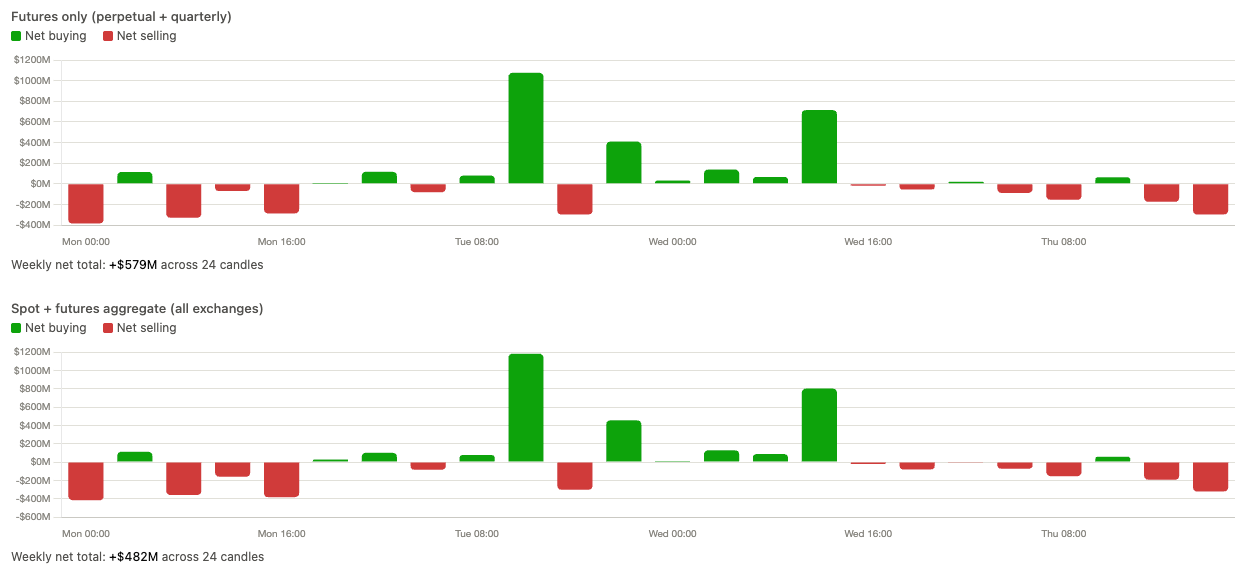
BTC spot and cumulative volume flows. Source: Hyblock
While OI has come down more than 3% from Tuesday’s peak, BTC price has barely moved, and as funding cooled toward neutral, spot and futures flows have favored the buy side over the past week.
Fed Chair Warsh Rules Out A Crypto Bailout

Federal Reserve Chair Kevin Warsh told the House Financial Services Committee on July 14 that the central bank will decline to rescue the cryptocurrency industry in a crisis, a message he delivered during his first semiannual monetary policy testimony as chair.
The exchange came from Rep. Brad Sherman (D-CA), a longtime crypto skeptic, who asked whether the Fed would backstop failing digital-asset firms the way it supported money market funds in 2008. Warsh rejected the premise. “We do not want to be in the bailout business, full stop,” he said. He added, “We want to be in a position where we’re not bailing out anybody, including crypto.”
Warsh, who took office May 15 and presided over his first FOMC meeting in June, framed the stance through his own history.
As a Fed governor under Chairman Ben Bernanke, he helped design the 2008 rescue effort. “I still have the scars from the 2008 financial crisis,” he said. “That is not something we want to repeat.” He argued that the post-crisis bailouts bred moral hazard, and he wants to spare digital assets the same fate.
For a market that spent years seeking legitimacy alongside traditional finance, the comments draw a hard line. Warsh, described as the first crypto-native Fed chair, has treated Bitcoin as a gauge rather than a ward of the state. During his nomination hearing he called Bitcoin “not a substitute for the U.S. dollar,” and he has used its price as a thermometer for whether monetary policy sits in the right place.
Warsh chimes in on the GENIUS Act rules deadline
The warning lands days before a pivotal deadline. Rules to implement the GENIUS Act, the stablecoin law enacted in 2025, are due Saturday, and Warsh confirmed the Fed is “racing” to publish its proposals on time.
The statute pays stablecoin holders ahead of other creditors when an issuer fails and requires full reserves behind each coin. With the stablecoin market near $310 billion, Sherman pressed the point that a run on one issuer could spread across the sector.
Warsh declined to offer an absolute pledge. He told lawmakers the Fed would act to limit “extraordinary” risks over the next four years, language that leaves room for intervention in a systemic event. American Banker noted that he declined to rule out any future step-in.
At the Senate Banking Committee the following day, Warsh urged banking regulators to coordinate on GENIUS Act rulemaking to prevent regulatory arbitrage, a race that lets firms hunt for the lightest oversight.
He paired that call with a defense of Fed independence on monetary policy and a pledge to shrink a balance sheet that sits near $6.7 trillion.
The takeaway for crypto is a market-discipline era: the Fed will set the rules of the road, yet firms that overreach will bear the cost of their own failures. For an industry that courted federal backing, Warsh’s message asks it to stand on its own.