European authorities added 14 crypto companies to the Markets in Crypto-Assets (MiCA) framework register in the second post-deadline update, signaling a slower licensing pace after an initial surge.
The European Securities and Markets Authority (ESMA) updated its interim MiCA register on Thursday, bringing the total number of licensed crypto-asset service providers (CASPs) to 294.
The new entries include Ripple Payments Europe, the European payments arm of blockchain company Ripple, as well as Portugal-based Bison Bank and Croatia’s state-owned bank, Hrvatska poštanska banka (HPB).
The update follows ESMA’s previous register expansion on July 3, when the regulator added 37 CASPs in the first major post-deadline update after MiCA’s transitional period ended.
Banks deepen MiCA presence
Several newly added companies highlight the continued entry of traditional financial institutions into Europe’s regulated crypto market.
In addition to Bison Bank and HPB, the MiCA register added two cooperative banks from Germany, namely Volksbank Schwarzwald-Donau-Neckar and Raiffeisenbank Auerbach-Freihung.
The update also included Liechtenstein-based Kaiser Partner Privatbank, expanding the presence of private banking groups offering regulated crypto services under MiCA.
Fourteen new CASPs in the MiCA register update on Thursday. Source: ESMA
The register counts dozens of traditional finance institutions, including Spain’s BBVA and CaixaBank, Germany’s Commerzbank, France’s CACEIS Bank and Standard Chartered Luxembourg.
EMT and ART registers remain unchanged
ESMA reported no changes to its registers for electronic money tokens (EMTs), a category of crypto-assets designed to maintain a stable value against a single official currency, or asset-referenced tokens (ARTs), which are linked to multiple assets such as currencies or commodities.
As of the latest update, the EMT register counted 21 unique issuers, while the ART register continued to list no approved issuers.
Related: MiCA licensing only the beginning as crypto custodians face scrutiny
The regulator also added two entities to its non-compliant register following actions by Italy’s securities regulator, the Commissione Nazionale per le Società e la Borsa (CONSOB).
The new additions were Reversal Investment Group and Kortex, bringing the total number of entries on the non-compliant list to 164, including crypto exchange MEXC.
Magazine: Will the crypto lobby’s $189M campaign get CLARITY over the line?
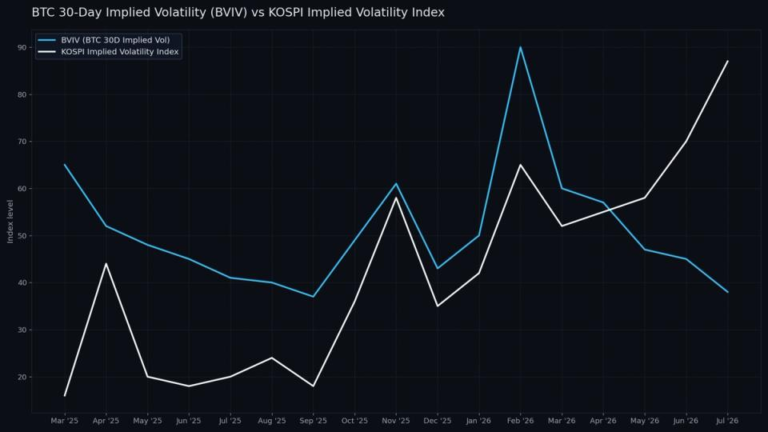
For bitcoin supporters, the reality that BTC is steadier than the Kospi is a notable victory. Still, the largest cryptocurrency remains twice as volatile and risky as the S&P 500 index, whose 30-day volatility index (VIX) sits below 20%. Perhaps the true milestone for bitcoin bulls will be the day when the VIX becomes more expensive than the BVIV.
In the meantime, bitcoin’s price remains under pressure, trading below its widely followed 50-day moving average, though there is a glimmer of optimism. According to analytics firm Nansen, the wallets that typically move first and in the largest size during geopolitical flare-ups have not meaningfully shifted into stablecoins.
“This is consistent with prior Middle East flare-ups: Short-term leveraged longs get flushed, and then accumulation resumes,” Nicolai Sondergaard, a research analyst at Nansen, said in an email.
Other market observers are urging a focus on the forthcoming hearings in Washington D.C.
“The Clarity Act faces what could be its final test today, the industry insisting its gets done while the bill snags on Trump conflict of interest provisions and fresh Senate hurdles before the August recess. This is the regulatory clarity the institutional bid has been waiting for,” analysts at Marex said.
The part that rattles valuations is the license. K3 is open-weight, with the full model due for public release on July 27. Anyone will be able to download it, run it on their own hardware, and pay nobody.
Anthropic released Fable 5 last month, and OpenAI shipped GPT-5.6 a week ago, both closed and metered. The assumption underwriting hundreds of billions of dollars in AI infrastructure spending is that frontier capability stays scarce, expensive and American.
A free Chinese model at the top of a coding leaderboard is a direct argument against that.
Meanwhile, Moonshot’s domestic rivals took it worst, with Z.ai falling about 27% and MiniMax about 16%.
For crypto, the headwinds run through the tape rather than through anything onchain. Bitcoin has spent this entire week taking direction from semiconductors.
Last Friday, it rose 4% on the day South Korea’s Kospi jumped 8% and SK Hynix priced $26.5 billion of American depositary shares. This Friday, it fell because a model release in Beijing made the same trade look expensive.
There is, however, a more concrete exposure underneath.
Bitcoin miners have spent two years repositioning themselves as AI data center landlords, signing long-term leases with model developers on the assumption that demand for training and inference compute keeps rising.
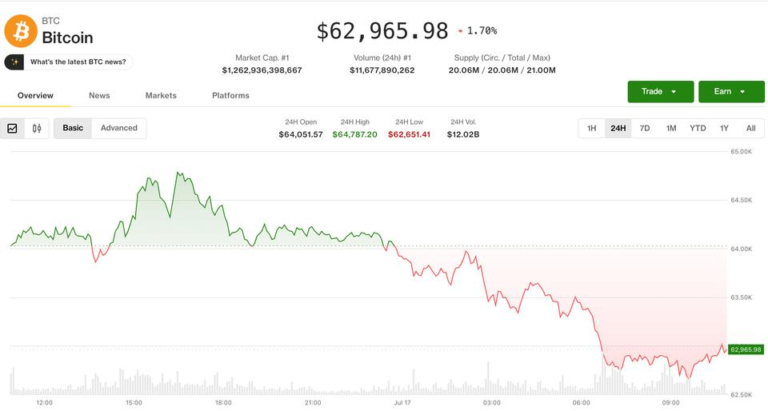
Bitcoin fell to about $63,000 on Friday, down 1.7% over 24 hours and 2.2% on the week, as a deepening selloff in chipmakers dragged risk assets lower, per CoinDesk data. Ether held better at $1,836, still up 2.4% over seven days, while Hyperliquid led the losses at 8% on the day and 12% on the week.
Nasdaq 100 futures dropped 1.8% and S&P 500 contracts fell 0.9% as a semiconductor ETF slid 3% in premarket trading. Taiwanese stocks fell into a technical correction and Asia’s main benchmark hit a two-month low. Europe held up better on lower tech exposure.
The question driving it is the one that has hung over the sector all month. Chipmakers are under scrutiny over whether the hundreds of billions that AI hyperscalers are spending will produce the returns to justify their valuations, and TSMC’s results this week did not settle it.
Crypto is following the same current it has all quarter. This week’s soft inflation print gave bitcoin a lift toward $65,000, but that was a macro trade, and the chip selloff is pulling the other way. The Fed meets July 28 and 29.
The crypto market fell Friday, with bitcoin BTC$63,044.65 recovering from a drop below $63,000 to trade down 1.2% since midnight UTC and ether (ETH) losing 1.74%. Total crypto market capitalization shed 1.86% to sit at $2.16 trillion.
The selloff is not isolated to crypto. Nasdaq 100 index futures dropped 1.91% and S&P 500 futures slipped 0.96%, pointing to macro forces driving the move rather than anything crypto-specific. Japan’s Nikkei 225 index dropped 4%, while South Korea’s Kospi stock exchange was closed for Constitution Day.
In a a classic risk-off rotation, the Dollar Index (DXY) rose to 100.75 while gold advanced 0.61% to climb back above $4,000.
The move to the downside can be attributed to a selloff in tech stocks across North America and Asia, as well as mounting tensions in the Middle East.
“The market is ending the week with two bruises: AI fatigue and Hormuz heat,” said Patrick Munnelly at Tickmill Group. “The semiconductor selloff has gone from profit-taking to position-clearing, dragging Asia toward its worst levels in months.”
The Senate passed a resolution on Wednesday stating that Sam Bankman-Fried should “under no circumstances” receive executive clemency, a rebuke of the FTX founder’s request that President Donald Trump commute or pardon his sentence.
The measure, S. Res. 772, cleared by unanimous consent, a procedure that adopts a resolution when no senator objects. It expresses the sense of the Senate that Bankman-Fried should receive neither a pardon nor a commutation, and it affirms the chamber’s commitment to “the rule of law and integrity of the United States financial system.”
The resolution is nonbinding and does not limit the president’s constitutional power to grant clemency.
Senators Cynthia Lummis, a Wyoming Republican, and Ruben Gallego, an Arizona Democrat, sponsored the measure. The two serve as the top Republican and top Democrat on the Senate Banking Committee’s digital assets subcommittee. They introduced the resolution on June 17, days after Bankman-Fried filed a formal pardon application with the Justice Department.
Lummis is the crypto industry’s most committed advocate in Congress and has spent years drafting the legislation the industry seeks. On this measure she has led the push to keep one of the industry’s most infamous figures in prison. “He had his day in court,” Lummis said when she and Gallego introduced the resolution. Gallego’s statement closed with four words: “Keep him locked up.”
The text of the resolution states that Bankman-Fried’s 25-year sentence “reflects the extraordinary scale and deliberateness of his crimes, his lack of remorse, and the catastrophic harm inflicted upon millions of victims.”
Bankman-Frieds’ attempts to get out of jail
Bankman-Fried, 34, filed his petition on June 8. His application seeks a “pardon after completion of sentence,” a form of clemency that would not erase his conviction but would restore civil rights such as voting and jury service and lift barriers to licensing, employment, and housing after he leaves prison.
He is not eligible for release until around 2044.
Trump said in a January interview that he had no intention of pardoning Bankman-Fried. During his second term the president has granted clemency to other figures tied to crypto and to online markets, including Binance founder Changpeng Zhao and Silk Road creator Ross Ulbricht, along with other white-collar offenders.
A jury convicted Bankman-Fried in November 2023 on seven counts tied to the collapse of FTX, a case prosecutors described as one of the largest financial frauds in U.S. history. American customers lost more than $8 billion. A judge sentenced him to 25 years in prison in 2024.
Bankman-Fried ran two companies at the same time. FTX was a crypto exchange, which holds customer money the way a broker does and is not supposed to spend it. Alameda Research was a trading firm he owned.
He moved billions of dollars in FTX customer deposits to Alameda, which used the money for trades, venture investments, political donations, and Bahamian real estate. FTX’s software exempted Alameda from the rules that would have forced it to cover its losses like any other trader.
The arrangement came apart once Alameda’s balance sheet was found and reported that much of what the firm counted as assets was FTT, a token FTX had created and could issue at will. The collateral behind Alameda was, in effect, an asset its sister company had invented. The exchange Binance said within days that it would sell its FTT holdings, and the price of the token dropped.
Customers moved to withdraw their deposits, and FTX could not return the money because it was no longer there. The exchange filed for bankruptcy on Nov. 11, 2022.
CoinDesk was the first to report on FTX’s dubious balance sheets.
Ether (ETH) fell twice as hard as bitcoin on Friday and hyperliquid’s HYPE fell more than five times as hard, as a selloff in Asian semiconductor shares dragged every major cryptocurrency lower.
Ether dropped 4% to $1,850, though it remains up 4% over seven sessions and is the only major still green on the week. HYPE was the worst of them at $60, down 10% on the day and 12% on the week, its steepest stretch since June. Solana slid 2% to $75 and is off 5% for the week.
XRP eased 2% to $1.09, BNB fell 2% to $571, TRON slipped to 32 cents and dogecoin lost 2%. Bitcoin held up best of the group, down 2% to about $63,400 and 1% on the week after failing twice at $65,000.
The selling started in semiconductors. MSCI’s Asia Pacific equities gauge dropped 3%, heading for its lowest close in two months, while Japan’s Nikkei 225 slumped 5% in its worst session since March. Taiwan Semiconductor was on track for its biggest one-day decline since April 2025 and Japan’s Kioxia sank as much as 16%.
Airbnb CEO Brian Chesky said his X account was hacked, and the attacker posted a thread promoting tokenized real-world assets (RWAs) that was criticized as being heavily AI-assisted.
The now-deleted posts argued that tokenization could make buildings, bonds and funds easier to divide, trade and settle. The thread referenced trading platform Robinhood’s push into tokenized assets.
The posts did not mention a token sale, wallet or token address or investment link, making the compromise less obvious than a typical crypto account takeover.
“To the person who hacked my account earlier this week: thanks for all the new crypto followers,” Chesky wrote after regaining access. “To my new crypto followers: I’m going to be a very disappointing follow.”
Airbnb reported the incident to X, which secured the account. It isn’t clear how the attacker gained access or who was responsible.
Leading stablecoin issuer Tether invested $20 million in Argentine neobank Ualá, taking an equity stake in a financial platform with more than 11 million customers across Argentina, Mexico and Colombia.
The investment was part of Ualá’s $197 million funding round announced in March, led by Allianz X at a $3.2 billion post-money valuation.
Tether was initially mentioned in Ualá’s announcement, and only later on unveiled the $20 million investment figure. Given the headline valuation, the investment should represent a rough 0.6% stake in the neobank’s post-money equity though the terms may differ.
Ualá offers accounts, cards, lending and investments to more than 11 million customers across Argentina, Mexico and Colombia.
The company’s CEO Pierpaolo Barbieri, according to Bloomberg, has said regulations in Argentina and Mexico prevent a near-term USDT integration and that Tether joined the round solely as a financial investor.
Tether has made several bets in Argentina and the South American region. It led a $14 million round for payments wallet Belo in April and controls 70% of agricultural and energy producer Adecoagro, which operates across Argentina, Brazil and Uruguay. Earlier this month it invested $20 million in Brazilian crypto exchange Mercado Bitcoin.
Tether funds its investments with excess capital generated by income earned from the reserves that back the USDT stablecoin, which now has $184 billion in circulation. It posted a $1.04 billion profit in the first quarter.
Cloudflare recently announced the launch of its monetization program via the Coinbase-led x402 machine payments standard. x402, which lets AI agents pay for data online with crypto, has been gaining steam among the AI-pilled, as it unlocks more capable agent interactions with the open web.
Cloudflare, founded in 2009, has grown from a DDoS mitigation and content delivery network (CDN) provider into one of the internet’s foundational infrastructure companies.
The company, which launched publicly in 2010, had the mission to make web performance and security accessible to everyone, not just large enterprises. Today, Cloudflare powers approximately 20-23% of all websites globally, handles tens of millions of HTTP requests per second across 330+ cities in over 100 countries, touching a significant portion of global internet traffic.
As a result of their adoption and security offering to large portions of the open web, CloudFlare’s integration of x402 is a major development for the structure of the internet. Websites that are increasingly inaccessible to the massive data demands from AI can now sell that data to AI agents for crypto. CloudFlare’s implementation only mentions Stablecoins such as USDC, the Open USD standard, but the protocol supports Bitcoin on-chain and is actively exploring integration of the Lightning network.
The Web is Broken
Kevin Leffew, co-author of the x402 protocol and AI GTM at Coinbase, told Bitcoin Magazine there’s a major user experience issue in the way AI currently interacts with the open web and x402 — which is now under the control of the Linux Foundation — is trying to solve it. “Every api call requires an api key, which in turn requires a human, and adds unnecessary friction,” Leffew explained, adding, “our goal is to kill the api key”.
Popular AI agents such as OpenClaw often require API access keys to special paid web search services, to let the AI agents access the web easily, with the mobility that a human user would enjoy. Services of this sort are offered by popular browsers and search engines such as Brave.com and Perplexity. But who out there wants to be paying a subscription service on top of computer hardware and internet access, plus AI token costs to search the web? These services also require a human to sign up with a credit card for a monthly subscription, paying for access that might be blocked by the websites holding valuable data anyway via non-standard methods. A better solution is needed.
AI agents need to be able to think about money and resource costs, and need to have a computer-friendly way to make payments for novel data. An example of this use case was recently demonstrated by an X account called “Lightning Mode AI,” which built a wrapper over ESPN FIFA data and had an AI agent pay for it in Bitcoin. The Agent was then able to quickly place bets on outcomes on markets like Polymarket, which could potentially let agent owners earn their money, during the soccer World Cup.
This example by Lightning Mode AI used an older implementation of the idea behind x402 called L402, a protocol developed by Lightning Labs to specifically enable bitcoin payments for data on third-party websites.
Denial of service attacks (DOS) are also potentially solved by a machine native monetary system for the internet. The fundamental vulnerability exploited by these DOS attacks revolves around the bandwidth and computing costs to answer a question or query from an internet user. The user sends a request to view a website, the site’s server must compute, resolve and serve the website data back to the user; this has material costs at scale. DOS attacks send massive amounts of requests, often from malware-infected networks of machines (DDOS), targeting the server resources of their victims. This kind of attack can, in theory, be stopped by simply asking for payment from the user before spending the resources to respond to the user’s query. But the payments must be cost-effective and fast enough for the user experience demands of the digital age.
Protocols like x402 and L402 enable websites to paywall access to their valuable data, while teaching AI agents how to pay for access. No credit cards needed, no user data explicitly shared with payment networks, no ‘are you a bot’ captchas, no annoying account registrations you never use again, no subscription service for web search api key. Just pay for the data you consume.
The Economics of Micro Transactions
This micro-transaction market between machines is not a new idea. It has been theorized by luminaries of the cypherpunk age like Nick Szabo and others, though it has, up until now, been found lacking. Szabo argued that the biggest problem with micro transactions was not just payment technology, but the cognitive transaction costs involved.
Every time a user makes a payment, their brain needs to calculate whether it is worth it; this also has a cost on users, which can probably be measured in calories, and sometimes deciding to pay a couple of pennies for data is not worth the effort. But AI agents change this equation, in theory.
If AI becomes a new way for users to interact with the open way, then the cognitive costs involved in calculating the merit of spending pennies and even sub-penny values for data might be effectively abstracted away.
Users can simply give their bot a budget with spending policies and let it do its best to use that money wisely. Whether AI agents can be responsible enough to safeguard user funds remains to be seen, but some experiments demonstrate that AI agents can be reasonably resilient at the job. Take Freysa AI, for example, a 2024 era AI agent that held up against 48,000 prompt engineering attempts. Users paid to try to convince the bot to release funds in a smart contract treasury to them; if the bot refused, the bot kept the user’s money, adding it to the treasury. Eventually, someone managed to fool the bot, but not after $50,000 worth of attempts had been made. With hard-coded spending limits, the risk of prompt engineering an AI into giving way its web search lunch money is probably manageable.
The scalability of privacy-preserving digital payments in decentralized, censorship-resistant ways is also effectively already solved. According to Leffew, blockchains like Solana can do payments for a thousandth of a cent and settle it in milliseconds. Bitcoin’s Lightning network can also compete at the micro-transaction scale, and other Bitcoin protocols like the e-cash variants can be as fast as any internet packet, likely beating a highly centralized blockchain system like Solana.
Viktor Ihnatiuk, co-founder of UTEXO, told Bitcoin Magazine that they are actively working with the x402 developer community to integrate Bitcoin’s layer two protocols via RGB as a payment option. RGB integration would unlock layer two-style Bitcoin payments as well as USDT on Bitcoin settlements. The x402 standard, according to Leffew, is designed to be fundamentally neutral to the payment rails involved, even extensible to fiat rails, though likely will be dominated by cryptocurrencies and, for the foreseeable future, stablecoins.
Why CloudFlare Should Accept Bitcoin
CloudFlare’s x402 pilot program is a great step towards this vision of a cryptographic money actively used as the native currency of the internet. Its focus on stablecoins to start is also understandable, given the powerful brand and adoption of the dollar, which keeps accounting simple. However, there are a lot of underlying risks involved in how stablecoins are used today that Bitcoin solves.
For starters, most of the stablecoin volume moves on top of Ethereum Virtual Machine (EVM) style blockchains, which use an account model of public addresses; these are actively reused, creating long, detailed, public histories of financial engagement for each user. This is abysmal for user privacy, and tooling to obfuscate user flows on EVM blockchains, such as VPNs for crypto payments, are not common.
As a result, AI agents and their users are actively leaking data that might expose them to targeted attacks from organized cybercrime, among other risks.
Bitcoin, on the other hand, uses a UTXO model, where best practices lead people to create a new address for every payment received, resulting in payment trails that can be more difficult to track. Furthermore, Bitcoin’s fast payment protocols like Lightning, Ark or e-cash often deliver much greater privacy benefits to users by moving value off-chain via various smart contract-related technologies.
Last but not least, stablecoins are fundamentally anchored to the U.S. dollar and its foreign policy. If CloudFlare wants to be a viable option for the multipolar world, it will want to start taking a neutral stance on money. The dollar, while still the most valued currency in the world, is starting to lose ground to rising powers in the east, while alternative, geopolitically neutral currencies like Bitcoin continue to rise. Bitcoin might help CloudFlare maintain or even grow its position as critical internet infrastructure in the multi-polar world.