

Crypto exchange-traded funds (ETFs) delivered a mixed but largely positive performance during the week of March 2–6. Bitcoin, ether, and solana funds finished with net inflows, while XRP ETFs ended the week slightly in the red. Bitcoin, Ether ETFs Post Weekly Gains as XRP Slips Institutional capital flowed in waves across crypto ETFs this week. […]
OpenClaw Forces Enterprise Strategy Questions
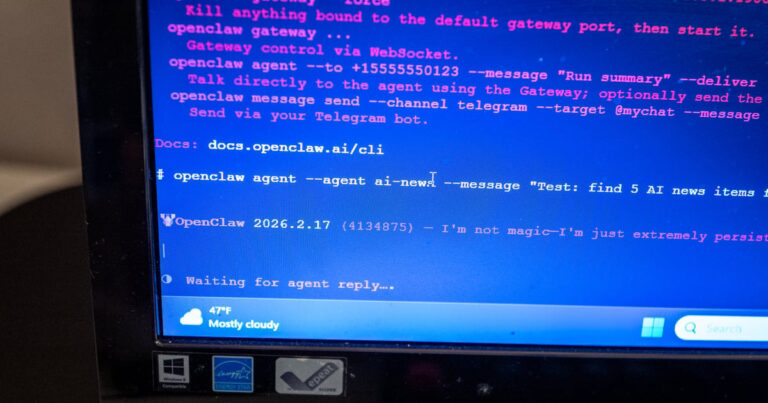
Citrini Research’s viral analysis of personal agents and the economic havoc they may well create might be correct. These personal agents — illustrated by OpenClaw — might rip through business models. The agents could connect customers directly with sellers, bypassing major retailers like Amazon.
Personal agents could create an environment where people, seeking DoorDash or Uber Eats-type gig economy services, gain access to delivery competitors coded in weeks on generative AI platforms.
White-Collar Meltdown
Citrini’s apocalyptic scenario imagines white-collar workers losing high-paying jobs to AI, then taking low-paying jobs at delivery services, only to lose those jobs to personal agents. But trust may be harder to automate.
Citrini’s paper set off a stock market panic, sparking a selloff of tech, software and payments stocks when it was published on Feb. 22. It sketches a scenario. What isn’t hypothetical is what OpenClaw, another viral phenomenon, has already triggered. The open source AI agent framework, now under the OpenAI brand, is forcing people to think about personal agents, not just as a security threat, but as a business disruptor – — something that can transform commercial landscapes. It can also change how employees work.
An employee can now instruct a personal agent to pull customer churn data from Salesforce and place it into a spreadsheet. The agent will handle the details. That removes a long-standing usage barrier for some employees, said Gregor Stewart, chief AI officer at cybersecurity firm SentinelOne.
Exporting and analyzing data requires a series of steps that some employees never learned. As a result, many employees didn’t use those capabilities. Improving productivity might encourage IT managers to allow personal usage within limits, Stewart said.
Making AI Easier
For IT, one key productivity gain is that agents lower the skill threshold required to use AI tools.
“OpenClaw can do anything that a dedicated developer could do at this point. It just lets you do it faster and without necessarily all the development experience,” said Kasimir Schulz, director of security research at HiddenLayer.
What OpenClaw accomplished, by bringing this technology into the mainstream, was more revolutionary. It enabled everyday people to “see what AI was capable of and see what AI isn’t as capable of as well,” Schulz said.
But the technology also brings a problem IT may have difficulty controlling: inference.
Stewart said that even if IT limits data access and restricts misuse, agents may still be able to infer missing information and draw sensitive conclusions. The agents can take all the documents they do have access to, “infer the last few bits,” and then, suddenly, “you have the entire pricing strategy of the company,” he said.
Autonomous agents are widely used. But corporate versions of agentic AI tools aim to tightly control them, unlike free-roaming personal agents.
Virally Popular but Security Risk
OpenClaw, created by Austrian software engineer Peter Steinberger, was released late last year and went viral in January and February. Users have already built more than 1.5 million AI agents with it. It has a number of capabilities that scare IT managers. It can grant root permissions, risk data exfiltration and malware exposure, and undermine compliance rules.
But on the plus side, “This is as bad as they will ever be,” said Alastair Paterson, CEO and co‑founder of Harmonic Security.
For now, Paterson said OpenClaw is full of security holes and too risky for corporate environments.
But that doesn’t stop Paterson from imagining a future in which personal agents can accomplish a lot.
He said he expects a quick shift and development of personal agents that will have security, compliance, and governance built in. That opens the doors to some interesting scenarios.
“Your agents will know your shoe size, your preferences, your health issues, where you live, the types of activities you like doing,” he said. But this gets to the trust issue. As agents take care of critical needs — such as travel, shopping, and even health — they will need to trust the agent.
Paterson argued that companies such as Google start with a trust advantage because so many people already use their services, but he questioned whether they can move fast enough.
Businesses will need to design systems, APIs, websites, and commerce platforms that let personal agents interact with them, he said.
“Companies that become agent-friendly the fastest,” he said, “are probably going to do better.”
A Hinge Moment
OpenClaw represents a tipping point for agents, argued Simon Ninan, senior vice president and global head of strategy at Hitachi Vantara, the data infrastructure arm of the Japanese multinational tech conglomerate Hitachi.
What OpenClaw demonstrated, Ninan said, is that agents act as orchestrators. They may have broad objectives and can assemble a wide range of resources to meet them. They are a threat to middlemen.
A speculative possibility is the big retailer or entities that sit between buyers and sellers now being bypassed by agents, Ninan said.
Another possible outcome is what happens when agents start interacting with other agents, he said. The agent may have been set up with a specific purpose, but the interaction with third-party agents modifies its behavior.
“You don’t even realize it’s happening until it’s happened,” Ninan said. For IT security teams, “if an agent is being used for a different purpose than what it was originally designed for, flag it.”
HiddenLayer’s Schulz characterized the overall risk as a “lethal trifecta.” That means the answer is “yes” to these three questions: Is untrusted content being fed into the agentic system? Does the agentic system have access to private data? And can the system communicate externally?
“OpenClaw and a lot of these other personal coding assistants have access to all three,” he said.
Disruption Could be Exaggerated
Schulz argued that the disruptive potential of personal agents may not be as profound as some imagine.
When someone connects to a service like a rideshare app, they aren’t just getting a ride. They are also getting the trust and liability protections the providers built into it, Schulz said.
“How do you make sure that you and the actual passenger feel secure? So, there’s still a lot more that those big enterprises actually have that can’t just be replicated with one OpenClaw instance.”
Puneet Bhatnagar, an independent AI and identity security expert, described the main driver behind personal agent adoption as “the consumerization of delegation.” In his view, personal AI agents now let people outsource cognitive and operational tasks across multiple applications, rather than being confined to a single app, enabling work patterns that previously weren’t possible.
The agent sits on your computer and can handle a browser, log into applications and perform other sophisticated tasks, Bhatnagar said. “That’s very powerful.”
OpenClaw has some Napster-like qualities. When the legally murky music downloading service emerged in 1999, it disrupted the music business before the industry could adapt. OpenClaw may prove similar. This time, the disruption is not confined to one sector. It may test the foundations of enterprise strategy itself.
XRP Price Stays Below $1.40 With 60% of Supply Now in the Red

XRP (XRP) traded at $1.35 on Monday, a 63% drawdown from its multi-year high of $3.66 reached in July 2025. As a result, many XRP holders are sitting on significant unrealized losses, underscoring the risks facing crypto investors in bear markets.
Key takeaways:
-
XRP’s 63% drawdown from its $3.66 multi-year high has left holders with over $50 billion in unrealized losses.
-
Key XRP levels to watch in the short term include $1.40, $1.30 and $1.27.
60% of XRP circulating supply now in the red
The XRP/USD pair trades 28% below its yearly open of $1.87, extending losses after it closed 2025 down 11.6%. The prolonged weakness has pushed a significant portion of its supply into the red.
Related: XRP faces $650M sell risk as charts hint at prices below $1
With XRP trading at $1.35 at the time of writing, roughly 36.8 billion XRP are currently held at a loss, representing $50.8 billion in unrealized losses, or more than 60% of the circulating supply, according to data from Glassnode.
XRP’s spot price is also below its aggregate holder cost basis, currently at $1.44, suggesting that long-term holders are increasingly under strain.

Spot XRP ETF investors are also feeling the pressure. Data from SoSoValue shows that these investors are reducing exposure to these investment products, which have recorded outflows for two consecutive days totaling $22.8 million.
More than $16.2 million in net outflows were recorded on Friday, marking the largest redemption since Jan. 29, when spot XRP ETFs saw $93 million in outflows.

The risk-off sentiment is also seen in global XRP investment products, which recorded more than $30 million in net outflows during the week ending March 6.
Key XRP price levels to watch below $1.40
The XRP/USD pair continued to trade within a range, with $140 as resistance and $1.30 a key support level that the bulls must hold to prevent further downside.
The price is now retesting the bottom of the range, as shown in the chart below.
“If buyers step in here, we could see XRP rotate right back toward the top of the range again,” analysts at CryptoPulse said, adding:
“If this level breaks, the range structure starts to shift and price could look for lower levels.”

A key area of interest lies between $1.30 and the local low of $1.27 reached on Feb. 28. If the price loses this level, the next stop could be the Feb. 6 low of $1.13, which is also the 200-week exponential moving average (EMA).

On the upside, bulls are now focused on flipping the 200-week simple moving average (SMA) into support at $1.40.
Glassnode’s UTXO realized price distribution (URPD), which shows the average prices at which ETH holders bought their coins, shows an important level at the 200-week SMA, where investors acquired $1.28 billion in XRP.

As Cointelegraph reported, the XRP price could rally to $1.60 and then $1.95, if the support at $1.40 is reclaimed.
This article does not contain investment advice or recommendations. Every investment and trading move involves risk, and readers should conduct their own research when making a decision. While we strive to provide accurate and timely information, Cointelegraph does not guarantee the accuracy, completeness, or reliability of any information in this article. This article may contain forward-looking statements that are subject to risks and uncertainties. Cointelegraph will not be liable for any loss or damage arising from your reliance on this information.
Treasury’s GENIUS Act Report Backs Mixers, But Wants a New ‘Hold Law’ For Crypto

Trusted Editorial content, reviewed by leading industry experts and seasoned editors. Ad Disclosure
Treasury sent Congress its GENIUS‑Act‑mandated report on “innovative tools” to fight crypto‑enabled illicit finance.
A Crypto’s “Hold Law” And A Privacy Paradox
In a 32-page report submitted to the US Congress this March, the U.S. Treasury Department has endorsed lawful uses of crypto mixers (a service that takes in cryptocurrency from many different users, mixes all those coins together, and then sends each user back an equivalent amount from the pool, but from different addresses than the ones they used to deposit) in favor of privacy.
However, it has also urged lawmakers to create a new “digital‑asset‑specific hold law” so platforms can freeze suspicious funds.
Mixers, Privacy And DPRK
The report notes favorably that mixing and similar tools “can be used by lawful users seeking to enhance financial privacy on public blockchains,” including for “protecting sensitive information about personal wealth, business transactions, or charitable donations from public view. It adds that Treasury “recognizes that privacy‑enhancing technologies, including mixers and other obfuscation tools, may serve legitimate purposes when used by compliant actors in line with applicable AML/CFT requirements.”
On the other side, the same report also stresses that North Korea’s cyber units and major ransomware crews rely on mixers, cross‑chain bridges, and rapid swaps as core infrastructure to launder massive hauls from hacks and fraud. The report cites billions of dollars in stolen digital assets tied to DPRK actors and details how those funds are pushed through mixers and into stablecoins before being bridged and cashed out, using the same tools that ordinary users might pick for privacy.
What The “Hold Law” Would Do
Therefore, to tackle this paradox, the report proposes a “hold law” that would ensure that legitimate, clean, users keep their privacy while unlawful or suspicious activity can be addressed. Under the proposal, crypto exchanges and other regulated platforms would gain a clear and legal “pause button” for suspicious funds. The report recommends that “Congress establish a digital‑asset‑specific statutory ‘hold’ authority” that would allow platforms “to temporarily retain or delay the movement of digital assets associated with suspected illicit activity while appropriate legal process is pursued.” Firms could temporarily hold or delay those assets when strong red flags appear, with statutory cover for doing so.
The idea would be to give law enforcement time to act against ransomware crews, large fraud schemes, or state‑sponsored hackers, while limiting the tool to narrowly defined, high‑risk cases so routine customer flows are not frozen by default.
TradFi and Legacy media have often linked mixers to money laundering, with Tornado Cash as the obvious cautionary tale. Ethereum co‑founder Vitalik Buterin has repeatedly argued that mixers are neutral tools, even saying he used Tornado Cash to make a private donation to Ukraine, and is now backing ‘compliant’ designs like Privacy Pools that aim to protect on‑chain privacy without commingling with known dirty funds.
Another Piece On The GENIUS Act Puzzle
The report is part of the broader GENIUS Act framework, the law Trump signed to create a federal regime for payment stablecoins and push “innovative” tools against illicit finance. It fulfills a mandate for Treasury to spell out how AI, digital identity, and blockchain analytics should be used under a risk‑based AML approach.
The report also proposes a preferred tech stack (AI, digital ID, blockchain analytics, APIs) that regulated platforms should deploy under a risk‑based AML approach.
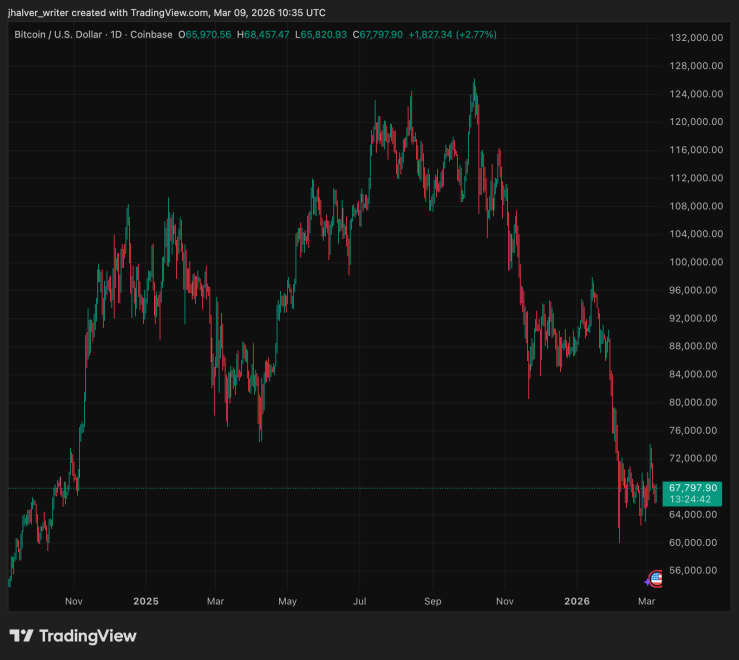
BTC's price trends to the downside on the daily chart. Source: BTCUSD on Tradingview
Cover image from ChatGPT, BTCUSD chart from Tradingview

Editorial Process for bitcoinist is centered on delivering thoroughly researched, accurate, and unbiased content. We uphold strict sourcing standards, and each page undergoes diligent review by our team of top technology experts and seasoned editors. This process ensures the integrity, relevance, and value of our content for our readers.
Avalanche (AVAX) Gains 2% as Index Trades Flat
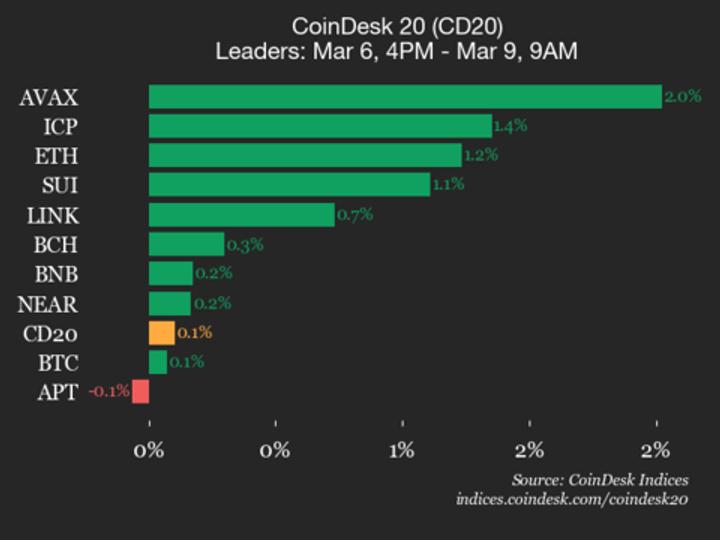
CoinDesk Indices presents its daily market update, highlighting the performance of leaders and laggards in the CoinDesk 20 Index.
The CoinDesk 20 is currently trading at 1948.46, up 0.1% (+2.05) since 4 p.m. ET on Friday.
Nine of the 20 assets are trading higher.
Leaders: AVAX (+2.0%) and ICP (+1.4%).
Laggards: AAVE (-4.5%) and HBAR (-2.1%).
The CoinDesk 20 is a broad-based index traded on multiple platforms in several regions globally.
Bitmine (BMNR) buys 61,000 ether (ETH) as Tom Lee sees end in sight for bear market

BitMine Immersion Technologies (BMNR), the largest Ethereum-focused treasury firm, purchased 60,976 ether (ETH) through last week, increasing the pace of accumulation as the firm bets crypto prices are nearing the end of what it calls a “mini winter.”
The latest purchase, worth some $120 million at current prices, lifted BitMine’s ETH holdings to over 4.5 million tokens, worth more than $9 billion, according to a Monday update from the company. This was the company’s largest weekly purchase in token terms in 2026 so far.
The firm has steadily added to its treasury throughout the market downturn, even as unrealized losses on its position now is estimated at around $7.8 billion, according to data from DropsTab.
Chairman Thomas Lee said the company stepped up buying from the recent weekly average of roughly 45,000 to 50,000 ETH as market signals suggest a potential bottom may be forming.
“We continue to believe that crypto prices are in the late/final stages of the ‘mini-crypto winter,'” Lee said in a statement.
“As the adage goes, nobody rings the bell at the bottom.” he said. “Therefore BitMine’s strategy is to slightly increase its pace of ETH accumulation.”
The firm said it now earns $174 million annual revenue from staking more than 3 million of its ether token holdings, which could grow to $259 million once all tokens are locked to earn a yield.
RWAs Will Run on Two Blockchain Rails, Says Redstone Co-Founder

Institutional adoption of real-world assets (RWAs) is splitting between public and permissioned networks, exposing a divide between the liquidity advantages of blockchains like Ethereum and the privacy demands driving systems such as Canton Network.
The divergence is becoming more pronounced as tokenized assets gain traction among major asset managers.
Marcin Kaźmierczak, co-founder of blockchain oracle provider RedStone, said product development is likely to occur on public blockchains, while permissioned systems are better suited for institutional processes that require confidentiality.
“There are some operations between institutions that simply have to stay private, and this is the value proposition that Canton offers very effectively,” Kaźmierczak told Cointelegraph.
Digital Asset’s Canton Network lets banks and asset managers tokenize and settle RWAs while keeping transaction details visible only to involved parties. The network says it processed $6 trillion in RWA value in 2025.
Rather than converging on a single architecture, banks and asset managers are building parallel systems designed to serve different functions within the tokenized financial stack, according to Kaźmierczak.
Ethereum’s Merge was Wall Street’s tokenization moment
Tokenization has become one of the main narratives behind institutional blockchain adoption beyond spot crypto exposure and exchange-traded funds (ETFs).
In June 2024, McKinsey estimated that tokenized assets could reach around $2 trillion by 2030. More optimistic projections have much higher forecasts, including a $30.1-trillion target by 2034 set by Standard Chartered and Synpulse.
Regulatory clarity in the US has contributed to the shift. The GENIUS Act, passed in 2025, created a federal framework for stablecoins, which serve as the settlement layer for many tokenized assets.

Kaźmierczak said confidence in Ethereum began improving earlier, after the network transitioned to proof-of-stake in 2022.
“In 2022, when I was talking to institutions, the Merge was like a big question mark for those institutions,” Kaźmierczak said. “They saw it worked without any hiccups, so it gave them this confidence.”
Kaźmierczak claimed that RWA projects among institutions started in 2023 or 2024, but as institutions work with yearly budgets, developments and project launches don’t occur in weeks or months like they do in crypto. That led to a cluster of institutions announcing tokenization projects last December, he said.
“It’s not that they started in Q4 last year. No, they started a year before, and now we are seeing the fruits.”
Today, over $26.4 billion worth of RWA tokens use blockchains as distribution layers, and over $15 billion of those are on Ethereum. It also holds the deepest liquidity as the veteran in the smart contracts circle, with over $160 billion in stablecoins.
Related: Why institutions still prefer Ethereum despite faster blockchains
Banks are splitting activity across public and private chains
Institutions separate market-facing activity from internal operations. On one hand, public blockchains provide liquidity, composability and access to decentralized finance (DeFi) strategies such as lending and tokenized vaults. On the other hand, permissioned networks are preferred for settlement processes, bilateral transactions and internal asset management workflows that cannot be exposed on open networks.
Systems such as Canton allow financial firms to automate those processes while keeping transaction details restricted to counterparties. That structure is closer to existing traditional financial (TradFi) infrastructure.

That division suggests institutional blockchain adoption may not converge on a single network model. Instead, financial firms appear to be building parallel infrastructure, with public chains handling liquidity and permissioned systems supporting operational processes behind the scenes, according to Kaźmierczak.
“There are some operations between institutions that just have to stay private, and this is the value proposition that Canton offers very effectively. That’s the reason we want to be on both of those legs,” he said.
Several major financial institutions were involved in the Canton Network from its inception. Digital Asset and a consortium of firms, including Microsoft, Goldman Sachs and Deloitte, announced the network’s launch in May 2023. In September 2024, Digital Asset and the Depository Trust & Clearing Corporation completed a pilot of the US Treasury Collateral Network on Canton.
According to RWA.xyz, the Canton Network has over $313 billion in represented RWA tokens, referring to assets that use the blockchain as a recordkeeping layer.
Related: Privacy tools are rising behind institutional adoption, says ZKsync dev
ZK-proofs vs. permissioned privacy
One of the clearest distinctions between the two institutional tracks lies in how privacy is achieved. While many blockchain projects pursue confidentiality through cryptographic tools such as zero-knowledge (ZK) proofs, Canton relies on permissioned data sharing, where transactions are visible only to the parties involved.
Not everyone in the industry agrees that this is the strongest model. Matter Labs CEO Alex Gluchowski said in a social media exchange with Digital Asset’s Yuval Rooz that ZK systems strengthen blockchain security by requiring cryptographic proofs that every state transition follows the protocol’s rules. Even if operators or administrators are compromised, attackers cannot insert invalid transactions into the ledger without generating a valid proof of execution.
Rooz, in a blog post, claimed that fully opaque implementations of ZK systems could make it harder to audit activity in financial markets. If transaction data becomes entirely hidden, errors or fraud could remain undetected, potentially recreating the kind of “black box” conditions that once enabled corporate scandals such as Enron.

The disagreement highlights a broader architectural question for institutional blockchain adoption, as Kaźmierczak pointed out.
Financial firms are experimenting with multiple approaches to balancing privacy, verifiability and control. Public networks continue to host market-facing liquidity and DeFi activity, while permissioned systems replicate institutional processes that require confidentiality, forming parallel rails for the tokenized financial system.
Magazine: Bitcoin may face hard fork over any attempt to freeze Satoshi’s coins
Cointelegraph Features publishes long-form journalism, analysis, and narrative reporting produced by Cointelegraph’s in-house editorial team with subject-matter expertise. All articles are edited and reviewed by Cointelegraph editors in line with our editorial standards. Research or perspective in this article does not reflect the views of Cointelegraph as a company unless explicitly stated. Content published in Features does not constitute financial, legal, or investment advice. Readers should conduct their own research and consult qualified professionals where appropriate. Cointelegraph maintains full editorial independence. The selection, commissioning, and publication of Features and Magazine content are not influenced by advertisers, partners, or commercial relationships. This content is produced in accordance with Cointelegraph’s Editorial Policy.
PAYSTRAX to Create Up to 150 New Fintech Jobs in Lithuania as It Scales Operations Across Vilnius and Klaipėda
WHY THIS MATTERS: PAYSTRAX’s decision to commit to a major headcount expansion in Lithuania—adding up to 150 new specialists—is highly significant not just for its operational scale, but as a validation of the broader Eastern European fintech hub model. In a climate where global firms often consolidate teams in larger financial centers, this investment reinforces the value of a strong, specialized talent pool and supportive regulatory environment, factors that have underpinned Lithuania’s rise as a licensing powerhouse. Crucially, the expansion is focused on enhancing core functions like in-house IT, compliance, and product development, including stablecoin settlements and Payment Facilitator (PayFac) services. This suggests the company is strategically positioning itself to address the growing complexity and diversification of merchant payment acceptance, from traditional acquiring to crypto and platform-based models.
PAYSTRAX, an international payment acquiring company headquartered in Vilnius, is accelerating its growth in Lithuania. The company plans to hire up to 75 new specialists in 2026 and bring on up to 150 new employees over the next three years. Founded in Lithuania by two Icelandic entrepreneurs in 2018, PAYSTRAX has grown from a startup to an established payments provider with more than 150 employees across six European offices.
The expansion will span both of PAYSTRAX’s Lithuanian locations – in Vilnius and Klaipėda – and will focus on strengthening the company’s IT, finance, marketing, account management, operations, and onboarding capabilities. In Klaipėda, PAYSTRAX has already moved into larger premises, and in Vilnius it added a second floor at its office to accommodate the growing team.
“Lithuania has been the heart of PAYSTRAX since day one. The talent, the ecosystem, and the work culture here have been instrumental to our growth – from our very first hires to becoming an award-winning international payments company,” says Johannes Ingi Kolbeinsson, Group CEO and co-founder of PAYSTRAX. “This expansion reflects our confidence in Lithuania as the right place to build the next generation of payment solutions.”
According to the company’s leadership, Lithuania’s highly educated workforce, strong English proficiency, and dedicated work culture have been key factors behind PAYSTRAX’s decision to keep scaling its operations in the country. The company highlights that Lithuanian professionals’ attention to detail and adaptability are particularly valuable in the heavily regulated payments industry.
“Combined with a growing fintech ecosystem and a stable business environment, these factors have made Lithuania a strategic and reliable location for our long-term development and operational growth,” says Mr Kolbeinsson.
PAYSTRAX operates as a principal-level payment card acquirer with licences from both Visa and Mastercard, serving online and point-of-sale merchants across 24 countries in the EEA and the UK. As part of its growth strategy, the company is developing new products and services, including more e-commerce platform integrations, a merchant portal with live business intelligence reporting, card payout capabilities, stablecoin settlements, and a Payment Facilitator (PayFac) service that enables platforms and marketplaces to manage payment acceptance at scale.
“We are building more of our technology in-house, which means we need strong IT talent, but we are also investing in marketing, customer success, and compliance,” says Monika Kareckaitė-Šiupinienė, Group CHRO of PAYSTRAX. “We are looking for both experienced professionals and ambitious newcomers who want to grow in fintech. Our hybrid working model means we can attract talent from across Lithuania, not just from the cities where our offices are located.”
Lithuania currently accounts for approximately 115 of the company’s 150 global employees, making it by far the largest hub within the PAYSTRAX network. In 2024, the company was recognised as “Company of the Year” at the Lithuanian Fintech Awards and earned a place among Lithuania’s top trusted companies, as recognised by the country’s largest company directory Rekvizitai.lt.
According to Minister of the Economy and Innovation Edvinas Grikšas, PAYSTRAX’s continued growth in Lithuania demonstrates the ability of the country’s fintech ecosystem to support companies from startup stage through to international scale:
“Lithuania has built one of Europe’s most dynamic fintech environments, and PAYSTRAX is an excellent example of how international founders can build globally competitive businesses here. Their decision to keep expanding in both Vilnius and Klaipėda aligns with our vision of ensuring that high-value investment and job creation reach beyond the capital.”
Elijus Čivilis, General Manager at Invest Lithuania, believes that PAYSTRAX’s trajectory from a two-person founding team to a 150-strong company headquartered in Vilnius is a compelling case study for Lithuania’s investment environment.
“PAYSTRAX’s story is one of the most complete growth journeys we have seen in Lithuania’s fintech sector: from incorporation to headquarters, from a handful of specialists to hundreds, and from a single office to a genuine multi-city operation,” he says. “Their expansion across Vilnius and Klaipėda continues to demonstrate that Lithuania offers the talent, infrastructure, and business environment needed to scale ambitious international fintech operations.”
Founded in 2018 by two payments industry veterans from Iceland – Johannes Ingi Kolbeinsson and Gunnar Mar Gunnarsson – PAYSTRAX now operates offices in Vilnius, Klaipėda, London, Leeds, Malta, and Reykjavík. The founders previously built Kortathjonustan (later KORTA PAY), one of Iceland’s pioneering payment companies, before choosing Lithuania as the base for their next venture. PAYSTRAX is an authorised Payment Institution in both the EU and the UK.
FF NEWS TAKE: The expansion of PAYSTRAX across two Lithuanian cities confirms that the country’s ecosystem is successfully nurturing fintechs from incorporation through international growth. This unquestionably moves the needle by providing a compelling case study that will attract other mid-sized payment providers looking for a scalable, regulated European base. The future focus must be on the uptake of their new offerings—particularly the PayFac service and stablecoin capabilities. Watch for how effectively PAYSTRAX leverages this talent infusion to integrate digital asset settlement with traditional payment acquiring to serve a new generation of e-commerce platforms.
Nigel Farage Acquires 6% Stake In Bitcoin Firm Stack BTC

Nigel Farage has taken a stake in a bitcoin treasury company led by former UK chancellor Kwasi Kwarteng, deepening links between the crypto sector and the populist political movement led by Nigel Farage.
Farage invested £215,000 in Stack BTC through his media company Thorn In The Side Ltd, according to disclosures tied to a fundraising round for the London-listed firm. The purchase gives the leader of Reform UK a stake of about 6.3% in the company.
The investment forms part of a £260,000 capital raise that also included participation from Blockchain.com. Stack issued 5.2 million new shares at 5 pence each, with the shares set to trade on the Aquis Growth Market.
Farage’s Bitcoin advocacy
Nigel Farage’s investment aligns with his long-term vision to integrate Bitcoin into the U.K.’s financial landscape.
“I have long been one of the UK’s few political advocates for bitcoin,” Farage said. “London and the UK have served as a center of global finance, and the country should aim to serve as a global hub for the crypto industry.”
In May 2025, during the Bitcoin 2025 conference in Las Vegas, he pledged to create a Bitcoin reserve at the Bank of England and introduce legislation that would favor the adoption of Bitcoin if he were to become Prime Minister.
Farage’s pledge includes fostering a regulatory environment that encourages Bitcoin integration into traditional financial systems.
Reform UK also became the first European party to accept Bitcoin donations. Partnering with UK-based payment firm Radom, the party aims to modernize fundraising and engage supporters interested in Bitcoin, reinforcing Farage’s role in crypto politics.
Nigel Farage has argued that the state could hold bitcoin as part of a sovereign wealth structure tied to technology and financial infrastructure.
The party also counts major crypto investor Christopher Harborne among its financial backers. Harborne, a businessman with ties to digital asset trading and venture investment, has contributed large sums to the party over the past several years.
Stack BTC’s role in Bitcoin treasury management
Stack BTC plays a pivotal role in helping corporations and institutions manage their Bitcoin holdings effectively.
The firm specializes in secure storage solutions, risk management strategies, and advisory services to help businesses integrate Bitcoin into their treasury operations.
By acquiring a stake in Stack BTC, Farage aims to enhance the firm’s capabilities, facilitating the adoption of Bitcoin among UK businesses as a viable treasury asset.
Strategy (MSTR) Spends $1.28 Billion To Buy More Bitcoin

Strategy, the bitcoin treasury company led by executive chairman Michael Saylor, purchased another 17,994 bitcoin for about $1.28 billion last week, continuing one of the largest corporate accumulation strategies in the digital asset market.
The company disclosed in a filing with the U.S. Securities and Exchange Commission that the purchases took place between March 2 and March 8 at an average price of $70,946 per coin. The acquisition brings the firm’s total holdings to 738,731 bitcoin.
Strategy has now spent roughly $56.04 billion to build its bitcoin position, with an average purchase price of $75,862 per coin. At the current price near $68,000, the company’s holdings carry a market value close to $50 billion.
The stash represents more than 3.4% of the fixed 21 million supply of Bitcoin, reinforcing MSTR’s status as the largest corporate holder of the asset.
Last week, Strategy purchased 3,015 bitcoin for about $204.1 million at an average price of $67,700 per coin, bringing its total holdings to 720,737 BTC at the time.
Strategy’s stock sales and stock issuance
The latest purchases were financed through a mix of equity sales and preferred stock issuance. The company sold 6,327,541 shares of its Class A common stock for about $899.5 million through an at-the-market program.
The company also raised roughly $377.1 million from the sale of 3,776,205 shares of its STRC perpetual preferred stock.
Strategy said about $6.71 billion in common stock remains available for issuance under its existing program. Another $3.16 billion in STRC preferred stock capacity remains available for sale.
The purchases form part of Strategy’s broader capital strategy designed to fund continued bitcoin accumulation. The company operates several perpetual preferred stock programs, including STRK, STRC, STRF and STRD, which together provide access to billions in potential financing.
Those offerings support the firm’s long-term “42/42” capital plan, which targets $84 billion in capital raises through equity offerings and convertible notes by 2027. The proceeds are intended to support continued purchases of bitcoin.
Saylor hinted at the acquisition before the official disclosure in a post on social media that referenced Strategy’s bitcoin tracker. The message stated that “the second century begins,” a reference to the firm surpassing 100 separate bitcoin purchases since launching its accumulation plans in 2020.
At the time, Strategy’s stock (MSTR) is trading up half a percent in pre-market. Bitcoin is trading slightly shy of $69,000.