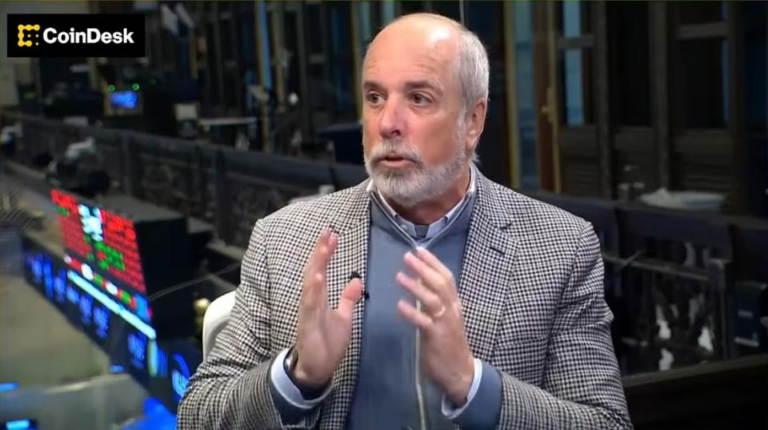
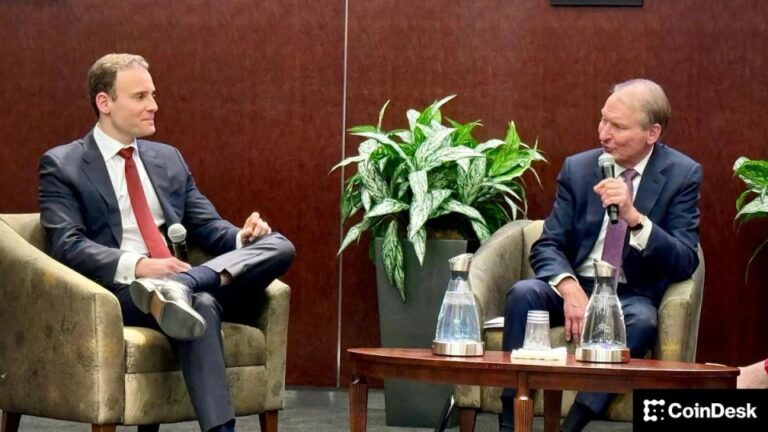
Latest developments: Edelman told CoinDesk’s Jennifer Sanasie on Markets Outlook that the dispute over whether stablecoins can offer yield is threatening progress on market structure legislation.
Banking groups argue allowing stablecoin issuers to offer yield would siphon deposits from traditional banks.
Edelman said banks are opposing the provision largely because stablecoins pose a competitive threat to their business models.
The issue has become a sticking point in negotiations around the Clarity Act, a proposed crypto market structure bill in Washington.
Despite siding with crypto on the economics, Edelman said the banking lobby is politically strong and “likely to win the argument.”
Why it matters: Edelman argues the industry should compromise rather than risk losing regulatory clarity altogether.
“I don’t think it’s the hill to die on,” Edelman said about the fight over stablecoin yield.
He said the broader legislation would provide long-awaited regulatory certainty for crypto companies and investors.
Prediction markets currently suggest the bill will pass, he said, though the timeline remains uncertain.
Edelman warned the bill could stall if it doesn’t pass before midterm elections.
The market outlook: Edelman believes regulatory clarity could quickly revive crypto markets.
If the bill fails, he expects a sharp but temporary drop in crypto prices as investors react.
Over the long term, crypto would still grow but at a slower pace without supportive legislation.
If clarity arrives, Edelman predicts crypto prices could surge and quickly reach new all-time highs.
He reiterated his long-term forecast that bitcoin could reach $500,000 by the end of the decade.
Reading between the lines: Edelman also pushed back on fears that quantum computing threatens Bitcoin.
Claims that quantum computers will break the Bitcoin blockchain are “one of the dumbest things I’ve ever heard anybody say,” Edelman said.
He argued the industry would develop defensive cryptography alongside any advances in quantum computing.
Even if such machines emerge, attackers would likely target larger financial systems or infrastructure before Bitcoin.
Edelman continues to recommend investors allocate up to 40% of portfolios to crypto broadly, focusing mainly on major assets such as bitcoin, ether and solana.
Looking ahead: Edelman expects consolidation among cryptocurrencies as the market matures.
He predicts roughly a dozen major cryptocurrencies will ultimately dominate the sector.
At the same time, tokenization could create hundreds of thousands of blockchain-based tokens representing assets like real estate, commodities and collectibles.
That shift could dramatically expand diversification opportunities for investors.
Best Crypto Presale to Buy: Pepeto Builds Exchange Infrastructure While DeepSnitch AI Offers a Dashboard the Market Already Has for Free
Pepeto
Line up every presale on the table and compare them on the numbers that matter. Pepeto does not just lead, it makes the comparison feel unfair. For example, the presale raised $7.87M while the Fear and Greed Index sat below 20. That is the detail that separates conviction from speculation. This is because hype money does not show up during extreme fear.
SolidProof completed the audit before the presale opened, not promised for later, not pending review, finished and verified before a single wallet committed a dollar. The cofounder built the original Pepe token from nothing to a $7 billion market cap. This means the person leading this project already proved at massive scale what every other presale founder is still promising to do for the first time.
Pepeto is building an exchange with a cross chain bridge connecting Ethereum, BNB Chain, and Solana, zero fee trading, and AI screening that verifies contracts before any token reaches the floor. A former Binance executive designed the architecture, and over 1,500 projects already applied to list. The best crypto presale to buy is not the one with the flashiest dashboard or the loudest marketing claims about 300x returns. Instead, it is the one where the audit is done, the founder already built billions in value, and the infrastructure creates revenue from every trade that flows through it.
That revenue flows permanently to presale wallets proportional to the size of each position. This means the more someone invested the more they earn from every transaction. The presale stages keep filling because the people already inside keep coming back to add more. As a result, that tells the full story about where real confidence lives.
DeepSnitch AI
DeepSnitch AI promotes five AI tools that scan wallets and flag contract risks. The project raised over $2M and is priced at $0.04399. The concept competes directly against free platforms like Dune, Nansen, and Arkham. These options already serve the same audience with years of track record and millions of existing users.
The deepsnitch price prediction of 100x to 300x assumes mass adoption in a category where free alternatives already dominate. In reality, analytics dashboards at this scale rarely sustain the demand needed for anything beyond a short term pump after listing. Furthermore, without exchange infrastructure, a bridge, or any revenue model that pays holders from actual trading volume, DeepSnitch AI remains a high speculative investment. Most of the upside is already priced into the current $0.04399 entry.
Conclusion
The US government just moved to protect decentralized finance permanently. The best crypto presale to buy is the one building the exchange that decentralized markets run on. Pepeto has $7.87M raised, a SolidProof audit, a cofounder who built $7 billion in value, and a former Binance executive behind the architecture. Thus, visit the Pepeto official website and enter the presale before the listing closes this entry. After that, every wallet that believed early starts earning from every trade that flows through the exchange.
Click To Visit Pepeto Website To Enter The Presale
FAQs
What is the best crypto presale to buy in 2026?
The best crypto presale to buy is Pepeto, with $7.87M raised, a completed SolidProof audit, exchange infrastructure led by a former Binance executive, and revenue sharing that rewards presale wallets from every trade permanently.
Is DeepSnitch AI a good investment?
DeepSnitch AI is a high speculative investment because it offers an analytics dashboard competing against free platforms like Dune and Nansen with no exchange, no bridge, and no revenue model that pays holders. The deepsnitch price prediction of 100x assumes adoption the analytics category has never delivered.
Why is Pepeto considered stronger than DeepSnitch AI for the best crypto presale to buy?
Pepeto raised $7.87M with a SolidProof audit and exchange infrastructure that generates revenue from every trade, while DeepSnitch AI raised $2M for a dashboard that competes with tools the market already uses for free. The deepsnitch price prediction ceiling realistically sits around 2x because analytics dashboards at this scale rarely sustain post listing demand.
Federal prosecutors in Manhattan want another chance to convict Tornado Cash developer Roman Storm, asking a judge to schedule a retrial this October on two criminal counts where jurors failed to reach a unanimous decision last year.
The request, filed Monday in the Southern District of New York, would reopen one of the most consequential legal battles over the boundaries of software development and criminal liability in the cryptocurrency industry.
The case centers on Tornado Cash, a decentralized crypto mixer designed to obscure the origin and destination of blockchain transactions.
Prosecutors argue the tool enabled large-scale illicit finance. Storm and his supporters argue the government is attempting to criminalize open-source code.
Storm’s first trial ended in August with a mixed outcome. A Manhattan jury convicted him of conspiracy to operate an unlicensed money-transmitting business but deadlocked on two other charges: conspiracy to commit money laundering and conspiracy to violate sanctions.
Those unresolved counts carry the heaviest penalties. A conviction on both could expose Storm to as much as 40 years in federal prison.
In their letter to Judge Katherine Polk Failla, prosecutors said a retrial date should be set now to avoid scheduling delays. They proposed a start in early or mid-October and estimated a new trial would last about three weeks.
Storm remains free on bail while the case continues.
A mixed policy shift in Washington
The retrial request arrives during a shift in the federal government’s public posture toward digital assets.
Last year, Deputy Attorney General Todd Blanche circulated a memo stating that the Justice Department “is not a digital assets regulator.” The guidance instructed prosecutors to avoid cases that attempt to impose regulatory frameworks through criminal charges against platforms, wallets, and similar infrastructure.
The memo also cautioned against targeting developers for the conduct of users who interact with decentralized tools.
At the same time, the U.S. Department of the Treasury has softened its language around privacy tools on public blockchains. In a March 2026 report to Congress under the GENIUS Act, Treasury acknowledged that digital asset mixers can serve legitimate purposes.
According to the report, lawful users may rely on such tools to shield sensitive financial information, including personal wealth, business payments, charitable donations, and consumer spending patterns.
Storm helped create Tornado Cash in 2019 as a privacy protocol for the Ethereum network. Unlike custodial mixers, the protocol operates through smart contracts rather than a centralized service operator.
Federal authorities have argued the tool facilitated more than $1 billion in illicit transactions, including activity tied to the North Korean hacking group known as the Lazarus Group.
Roman Storm: Making code a crime
Storm’s defense maintains that developers cannot control how decentralized software is used after deployment.
In a post on X following news of the retrial request, Storm said the first jury heard four weeks of evidence before failing to reach consensus on the two most serious charges.
“A jury of 12 Americans heard four weeks of evidence and deadlocked,” he wrote. “No verdict on money laundering. No verdict on sanctions violations.”
Storm framed the retrial effort as an attempt to redefine the legal status of code.
“The government’s response?” he wrote. “Try again to make writing code a crime.”
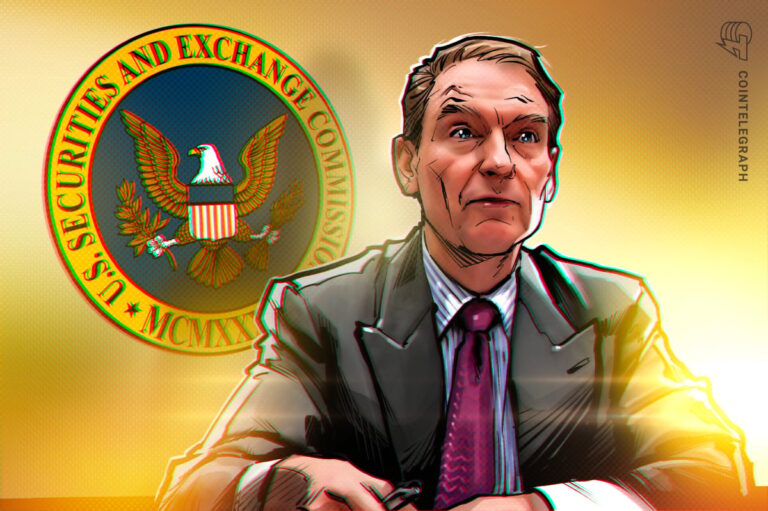
Paul Atkins, chair of the US Securities and Exchange Commission (SEC), said that an agreement with the Commodity Futures Trading Commission (CFTC) would lead to a new level of “coordination and collaboration,” including on enforcement.
In a Tuesday speech for the FIA Global Cleared Markets Conference in Florida, Atkins said that the SEC and CFTC were considering an updated memorandum of understanding on coordination between the two federal regulators. The SEC chair did not explicitly mention oversight of digital assets, but said “the regrettable era of duplicative enforcement actions and conflicting remedial obligations for the same conduct is over.”
“Conduct in a single operating environment means that the SEC and CFTC, within the bounds of their independent statutory authority and regulatory interests, should coordinate legal theories and remedial strategies,” said Atkins. “Fragmented, redundant enforcement does not increase deterrence—it only increases confusion.”
Atkins’s remarks followed similar statements from CFTC Chair Michael Selig striking a cooperative tone as US lawmakers worked to pass a comprehensive market structure bill expected to give the CFTC more authority in overseeing crypto. The bill, passed as the CLARITY Act in the US House of Representatives in July, has effectively been stalled in the Senate amid discussions on stablecoin yield, tokenized equities, and conflicts of interest.
Related: CFTC chair backs blockchain-based prediction markets as ‘truth machines’
The SEC, which oversees securities, and the CFTC, overseeing commodities, have sometimes overlapped in regulating cryptocurrencies that, according to many experts, do not clearly fall into a single agency’s purview. The SEC chair said the agency’s staff would be conducting joint meetings with CFTC officials on product applications, and launched a harmonization website for the two regulators.
“Firms should not be shuffled back and forth between regulators when a product touches elements of both regulatory frameworks,” said Atkins. “Nor should clarity depend on which agency happens to speak first. Where jurisdiction overlaps, the most effective response is a coordinated one.”
Leadership slots vacant after no nominations from Trump
As of Tuesday, the CFTC’s leadership consisted solely of Selig, whom the Senate confirmed in December. He replaced acting chair Caroline Pham, but remains the sole Republican-appointed commissioner in a leadership panel normally consisting of a bipartisan group of five people. Similarly, the SEC is being led by three Republican commissioners.
US President Donald Trump had not made any public statement as of Tuesday signaling that he plans to nominate additional commissioners to either agency.
Cointelegraph is committed to independent, transparent journalism. This news article is produced in accordance with Cointelegraph’s Editorial Policy and aims to provide accurate and timely information. Readers are encouraged to verify information independently. Read our Editorial Policy https://cointelegraph.com/editorial-policy
Trusted Editorial content, reviewed by leading industry experts and seasoned editors. Ad Disclosure
Recent movements in XRP have left some traders underwhelmed, particularly as many remain focused on its day-to-day price swings. However, one market analyst suggests that these short-term fluctuations can be misleading. By stepping back and examining the monthly chart instead, the analyst argues that a clearer and more bullish market structure begins to emerge.
Short-Term XRP “Noise
Recently, crypto analyst @Jaydee_757 took to X to highlight what he sees as a common mistake in how traders interpret XRP price movements. His argument centers on the tendency to judge the asset’s direction using short-term activity instead of the broader market trend.
Over the past day, XRP has traded gradually around the $1.30 range, posting modest gains and relatively small intraday swings. For traders focused on hourly or daily charts, this kind of movement can appear slow or uneventful. However, Jaydee argues that such price action represents only a small portion of the market’s overall structure.
According to him, this is where what traders call “noise” begins to dominate perception. When market participants closely track every minor fluctuation, those movements can draw disproportionate attention and trigger emotional reactions.
This effect becomes more noticeable during consolidation phases, when prices move sideways rather than trending strongly upward. Short-term traders may interpret these pauses as weakness or fading momentum, even though consolidation often forms before larger moves.
Jaydee notes that stepping back to a higher timeframe helps remove much of this distraction, allowing traders to focus on the underlying trend rather than the day-to-day volatility.
Monthly Chart Highlights Breakout And Possible Retest
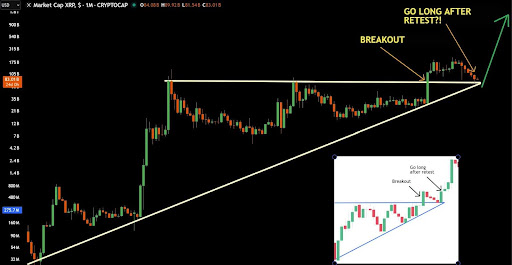
To illustrate this broader perspective, the analyst shared a chart of XRP’s market structure on the monthly timeframe. The chart highlights a large ascending triangle pattern that has formed over an extended period, with a horizontal resistance level at the top and a rising trendline connecting higher lows beneath it.
Source: X
Within the chart, XRP is shown breaking above that resistance line in a strong upward move. This breakout is marked clearly before the price pulls back toward the same level it previously surpassed. The analyst interprets this pullback as a potential retest of the former resistance, a common technical development that can confirm the level as new support.
If this retest holds, the chart outlines a possible continuation of the upward trend. The projected move points toward a higher target zone represented by a green box, indicating where XRP could advance if bullish momentum resumes.
Another highlighted region, labeled as a pink box, remains part of the broader setup and could still play a role during the current consolidation phase. While short-term price movements may continue within this range, the analyst’s macro outlook remains focused on the larger triangle breakout.
From that perspective, the current price action may simply reflect a transitional period rather than a breakdown in momentum. By concentrating on the long-term structure instead of day-to-day fluctuations, the analyst maintains that XRP’s broader trajectory remains firmly in view.
Bulls push for higher prices | Source: XRPUSDT on Tradingview.com
Featured image created with Dall.E, chart from Tradingview.com
Editorial Process for bitcoinist is centered on delivering thoroughly researched, accurate, and unbiased content. We uphold strict sourcing standards, and each page undergoes diligent review by our team of top technology experts and seasoned editors. This process ensures the integrity, relevance, and value of our content for our readers.
The prediction markets platform argued for an injunction against Ohio authorities, claiming that federal commodities laws superseded state laws on sport event contracts.
An Ohio federal court has denied a motion filed by prediction markets platform Kalshi for a preliminary injunction against Ohio state authorities over allegations that the company was operating in violation of gambling laws.
In an order filed Monday, US District Court for the Southern District of Ohio Chief Judge Sarah Morrison denied Kalshi’s request for an injunction that would have blocked the Ohio Casino Control Commission and state attorney general from regulating contracts on the platform, specifically for sports betting.
According to the judge, Kalshi had failed to show that the sports event contracts available on the platform were subject to the “exclusive jurisdiction” of the Commodity Futures Trading Commission (CFTC).
“Even if this Court were to find that sports-event contracts are swaps subject to the CFTC’s exclusive jurisdiction, Kalshi has not shown that the [Commodity Exchange Act, or CEA] would necessarily preempt Ohio’s sports gambling laws,” said the opinion and order, adding:
“Kalshi argues that Ohio’s sports gambling laws are field and conflict preempted by the CEA when it comes to sports-event contracts traded on its exchange […] Kalshi fails to establish that Congress intended the CEA to preempt state laws on sports gambling.”
Source: Courtlistener
The denial pushed back against the narrative from CFTC Chair Michael Selig, who said in February that the federal regulator had “exclusive jurisdiction” over prediction markets and threatened lawsuits against any authority claiming otherwise. Kalshi and prediction platforms face lawsuits in other US states over similar allegations involving unlicensed sports betting.
“This Court does not endeavor to explain why the CFTC has not exercised its authority […] with respect to the sports-event contracts,” said the Monday filing in Ohio. “But the agency’s inaction is not proof that the sports-event contracts are regulated by or permissible under the CEA—and the Court has concluded they are not.”
Related: CFTC chair backs blockchain-based prediction markets as ‘truth machines’
In a statement to Cointelegraph, a Kalshi spokesperson said that the company “respectfully disagree[d] with the Court’s decision, which splits from a decision from a federal court in Tennessee just a few weeks ago, and will promptly seek an appeal.”
CFTC guidance on prediction markets could be looming
Last week, Selig said that the federal regulator was working to provide guidance regarding prediction markets “in the very near future.” The CFTC chair is the sole Senate-confirmed commissioner in a panel normally consisting of five people.
Magazine: The debate over Bitcoin’s four-year cycle is over: Benjamin Cowen
Cointelegraph is committed to independent, transparent journalism. This news article is produced in accordance with Cointelegraph’s Editorial Policy and aims to provide accurate and timely information. Readers are encouraged to verify information independently. Read our Editorial Policy https://cointelegraph.com/editorial-policy
Aave has attracted nearly $800 million in deposits since launching on Mantle a month ago.
Total value locked (TVL) on Mantle, the Ethereum Layer 2 network affiliated with the Bybit crypto exchange, reached a new all-time high on March 9, crossing the $1 billion mark for the first time at $1.06 billion, according to DefiLlama.
The surge follows the launch of Aave, the largest lending protocol in decentralized finance (DeFi), on Mantle in mid-February. As of today, Aave on Mantle has surpassed $1.2 billion in total lending and borrowing market size.
Mantle’s DeFi TVL surged nearly fourfold from $255 million in the month following the Aave integration, rising 33% in the past week alone.
An incentive program that awards MNT tokens to users who lend and borrow on the network accompanied the Aave deployment, likely accelerating inflows.
Mantle is now the 12th-largest chain by TVL, according to DefiLlama, just trailing Polygon with $1.15 billion but ahead of Avalanche, which has roughly $800 million.
London-headquartered global payments service provider 3S Money has launched local French IBANs alongside the opening of a new office in Paris.
The move marks a significant step in the fintech’s broader European expansion and underscores its commitment to the EU’s second-largest economy.
Streamlining complex cross-border payments
Starting today, 3S Money corporate clients will gain direct access to local French IBANs. This functionality enables the seamless processing of SEPA Direct Debits, Instant payments, and SWIFT transfers.
The company specialises in serving clients that possess complex international structures and process high-value payments. Having already gained strong traction among French clients, 3S Money reports rising demand across globally connected industries, including international shipping, logistics, asset management, real estate, and travel.
A strategic European hub
Ivan Zhiznevsky, co-founder and CEO of 3S Money
The new Paris office builds on 3S Money’s established global footprint. Founded in 2018, the company maintains its headquarters in London with existing offices in Luxembourg, Amsterdam, Riga, Dubai, and Hong Kong. The Paris location will serve as a strategic hub to accelerate the company’s European presence, offering scalable, multi-jurisdictional infrastructure to businesses expanding internationally.
Ivan Zhiznevsky, co-founder and CEO of 3S Money, commented on the launch: “France, like other EU markets, needs a fintech that understands and supports the complex businesses built by entrepreneurs from across the globe. Our relationship-led approach means having a local team to stay close to our clients, delivering premium, bespoke service while combining local expertise and global infrastructure. France is a launchpad for European growth, and our Paris office allows us to power client’s cross-border expansion.”
The addition of French local IBANs bolsters 3S Money’s corporate payments offering. Customers now benefit from local business accounts across multiple jurisdictions, including:
The UK (GB IBAN)
Luxembourg (LU IBAN)
The Netherlands (NL IBAN)
The UAE (AE IBAN)
This suite comes with global coverage in all major currencies, allowing businesses to send and receive payments to any country in the world and manage international operations effortlessly through a single relationship.
To support these services, 3S Money’s French operations are authorised and regulated as an Electronic Money Institution by the Commission de Surveillance du Secteur Financier (CSSF) in Luxembourg. The operations also fall under the supervision of the Autorité de Contrôle Prudentiel et de Résolution (ACPR) in France
The U.S. Securities and Exchange Commission and the Commodity Futures Trading Commission — the sister agencies that will regulate most U.S. crypto activity — have been rivals in the past over crypto issues, but they’re now pursuing a formal memorandum of understanding to combine agency efforts, said SEC Chairman Paul Atkins.
“We are reorienting our approach toward a new golden age of regulatory coherence,” Atkins was set to say on Tuesday in remarks prepared for the FIA Global Cleared Markets Conference in Florida. “More than aligning our rules, a harmonized framework also demands coordinating our responses to the firms that operate within it, including those that have questions of interpretation or request exemptive relief.”
Atkins said he’s also directed his staff to begin setting up joint meetings with CFTC employees on product applications, and a new “harmonization” website will allow firms to request coordinated discussions with both agencies.
“Firms should not be shuffled back and forth between regulators when a product touches elements of both regulatory frameworks,” he said. “Nor should clarity depend on which agency happens to speak first.”
The division of roles between the SEC, which regulates securities and the exchanges on which they trade, and the CFTC, the commodities watchdog that oversees derivatives markets, has been a key source of friction in the process of establishing U.S. crypto trading. No formal rules have been set to say where crypto products belong, and years of regulatory actions and legal disputes have resulted.
Since the arrival of leaders appointed by President Donald Trump, the two agencies have embraced friendly crypto policies as a top priority, in line with the president’s requests. They’re now working on several, including policies to clarify how digital assets will be defined as securities and commodities.
The formalized cooperation will also extend to enforcement decisions and regulatory examinations, which will become a more routine element for crypto firms as they enter more deeply into federal oversight. That could save the companies from having to go through repetitive exams.
“Coordinated exam planning for dually regulated entities should become standard practice,” Atkins said. “Shared supervisory findings, subject to assurances of confidentiality, should be the norm rather than the exception.”
Atkins also revisited his intention to carve out a path for super-apps that allow users to conduct business across both agencies’ jurisdictions.
“In the technology world, a super-app integrates multiple services into a single seamless interface,” he said. “The user does not toggle between separate systems to complete related tasks. Instead, integration occurs invisibly behind the scenes.”
Read More: CFTC chair highlights wide crypto agenda, including rules on DeFi, prediction markets
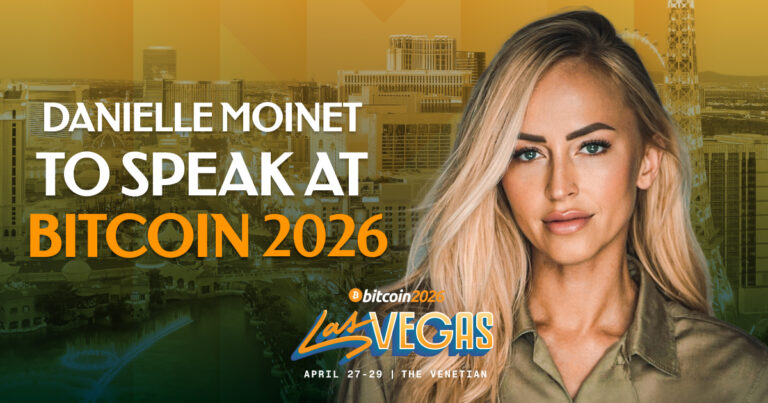
Danielle Moinet — known to millions of fans worldwide as WWE Superstar Summer Rae — has been officially confirmed as a speaker at Bitcoin 2026, bringing a one-of-a-kind perspective on Bitcoin, financial sovereignty, and breaking barriers to the world’s largest Bitcoin conference in Las Vegas.
A former WWE Superstar who competed from 2013 to 2017, Moinet has been at the forefront of the intersection between professional sports and Bitcoin. In January 2022, she made history by becoming the first-ever female professional athlete to convert a portion of her pay into Bitcoin — doing so ahead of her return to the ring at the WWE Royal Rumble. She had also previously made headlines as the first female professional athlete to hold an executive position at a crypto company, serving as Director of Marketing & Social Engagement at Cornerstone Global Management.
More than a trailblazer in name, Moinet has consistently used her platform to advocate for female athletes’ inclusion in the Bitcoin and broader financial freedom movement — making her one of the most compelling and culturally resonant voices the Bitcoin community has to offer. Her appearance at Bitcoin 2026 is a reminder that this revolution belongs to everyone.
Bitcoin 2026 Returns to Las Vegas Bigger Than Ever
Bitcoin 2026 will take place April 27–29 at The Venetian, Las Vegas, and is expected to be the biggest Bitcoin event of the year.
Focused on the future of money, Bitcoin 2026 will bring together Bitcoin builders, investors, miners, policymakers, technologists, and newcomers from around the world. The event will feature a wide range of pass types, including general admission passes designed specifically for those new to Bitcoin, alongside premium passes for professionals, enterprises, and institutions.
With multiple stages, immersive experiences, technical workshops, and headline keynotes, Bitcoin 2026 is designed to serve both first-time attendees and long-time Bitcoiners shaping the next era of global adoption.
Past Bitcoin Conferences in the U.S.
Bitcoin’s flagship conference has scaled dramatically over the past five years:
2021 – Miami: 11,000 attendees
2022 – Miami: 26,000 attendees
2023 – Miami: 15,000 attendees
2024 – Nashville: 22,000 attendees
2025 – Las Vegas: 35,000 attendees
🎟️ Get Your Bitcoin 2026 Pass
Bitcoin Magazine readers can save 10% on Bitcoin 2026 tickets using code ‘ARTICLE10‘ at checkout.
Stay at The official hotel of Bitcoin 2026, The Venetian, and get a guaranteed low rate plus 15% off your pass. Be in the middle of where the fun is all happening, and where the networking never ends.
Bring your whole team to Bitcoin 2026 and get 20% off your entire order, bring more than six in a group and get 25% off for a limited time.
Volunteer at Bitcoin 2026 and get Pro Pass access plus exclusive perks.
📍 Location: The Venetian, Las Vegas 📅 Dates: April 27–29, 2026
With tens of thousands of attendees expected and hundreds of major speakers like Arthur Hayes already confirmed, now is the time to lock in your ticket.
Buy Bitcoin 2026 Tickets — Save 10%
Why Attend Bitcoin 2026?
Bitcoin 2026 is the definitive gathering for anyone serious about the future of money. With 500+ speakers, multiple world-class stages, and programming spanning Bitcoin fundamentals, open-source development, enterprise adoption, mining, energy, AI, policy, and culture, the conference brings every corner of the Bitcoin ecosystem together under one roof.
From headline keynotes on the Nakamoto Stage to deep technical sessions for builders, institutional strategy discussions for enterprises, and beginner-friendly Bitcoin 101 education, Bitcoin 2026 is designed for everyone—from first-time attendees to the leaders shaping Bitcoin’s global adoption.
Whether you’re looking to learn, build, invest, network, or influence, Bitcoin 2026 is where Bitcoin’s next chapter is written.
Bitcoin 2026 Pass Types: Something for Everyone
Bitcoin 2026 offers a range of pass options designed to meet the needs of newcomers, professionals, enterprises, and high-net-worth Bitcoiners alike.
🎟️ Bitcoin 2026 General Admission Pass
Ideal for newcomers and those looking to experience the heart of the conference.
Limited access on Days 2 & 3
Entry to Main Stage
Access to Genesis Stage
Full access to the Expo Hall
🎟️ Bitcoin 2026 Pro Pass
Designed for professionals, operators, and serious Bitcoin participants.
Includes all General Admission features, plus:
Full 3-day access, including Pro Day
Entry to the Pro Pass Reception
Access to Enterprise Hall, Enterprise Stage, and Networking Lounge
Conference App networking features
Access to the Bitcoin For Corporations Symposium
Entry to Compute Village and Energy Stage
Complimentary lunch, coffee, tea, and snacks
Dedicated registration and check-in
Reserved seating at Main Stage
Huge savings when you bundle your hotel and Pro Pass
🐋 Bitcoin 2026 Whale Pass
The all-inclusive, premium Bitcoin 2026 experience.
Includes all Pro Pass features, plus:
Reserved seating at Main Stage
All-inclusive gourmet food and beverages
Entry to Whale Night and Whale Reception
Access to all official after-parties
Networking app access to connect with other Whales
Premium access to The Deep — an exclusive networking lounge with intimate speaker sessions
Complimentary stay at The Venetian when you bundle your whale pass and hotel (use promo code ‘WHALEHOTEL’ here)
This is the most immersive way to experience Bitcoin 2026.
🎉 Bitcoin 2026 After Hours Pass
Your ticket to the night.
Most deals are done with a drink in your hand. Get exclusive access to 3 official Bitcoin 2026 after-parties across Las Vegas — each with a 2-hour open bar — where the real conversations happen and the best connections are made.
Access to 3 official Bitcoin 2026 after-parties
2-hour open bar at each event
Evening events across Las Vegas, April 27–29
Network with Bitcoiners, builders, and industry leaders after hours
More headline speaker announcements are coming soon.