XRP exchange-traded funds have attracted more than $1.4 billion in cumulative net inflows despite a broader downturn across crypto markets since late 2025.
Bitcoin has fallen sharply from its October 2025 peak of around $126K to roughly $70K at press time, wiping out about 45% of its value, while many other digital assets have declined even further. Even as digital assets decline, XRP ETFs have continued gaining traction among investors.
According to a post on X from Bloomberg Intelligence analyst James Seyffart, spot XRP ETFs have accumulated more than $1.4 billion in net inflows since launching in early November 2025.
Seyffart shared data showing that the top 30 holders of spot XRP ETF shares controlled about $211 million worth of positions at the end of 2025. Goldman Sachs was the largest holder by a wide margin, owning nearly $154 million of those shares.
Bloomberg Intelligence analyst Eric Balchunas said the inflows are notable given the broader market downturn.
“Like Solana, this is really impressive given these launched into a brutal 45% drawdown,” Balchunas wrote. “My guess is this is largely XRP super fans versus casual retail.”
Data from SoSoValue also shows the funds have experienced relatively limited selling pressure. XRP ETFs have recorded only nine days of net outflows since launch, with three of those occurring during the past week.
Several issuers currently offer spot XRP ETFs, including 21Shares, Franklin Templeton, Bitwise, Canary Capital, and Grayscale.
XRP was last trading about 2.5% higher on the day near $1.40, though it remains roughly 62% below its all-time high of about $3.66 reached in July 2025.
Disclosure: This article was edited by Estefano Gomez. For more information on how we create and review content, see our Editorial Policy.
About $27 million was liquidated on the decentralized lending platform Aave over the last 24 hours, in what some market participants say may have been caused by a temporary pricing issue involving the token wstETH.
Blockchain data flagged by risk-management firm Chaos Labs shows a spike in liquidations in the past 24 hours. Some observers believe the event may have been linked to a price update in an oracle system that Aave uses to determine the value of collateral.
(AAVE liquidations over last 24 hours/ Chaos Labs)
Oracles are services that feed price data from the outside world into blockchain applications. Lending protocols like Aave rely on them to decide when a borrower’s collateral is no longer sufficient to back their loan — at which point the position can be liquidated.
While such scenarios are rare, most recently, a price-oracle setup misconfigured by DeFi lender Moonwell briefly valued Coinbase Wrapped ETH (cbETH) at about $1 instead of roughly $2,200, leaving the protocol with nearly $1.8 million in bad debt.
In Aave’s case, some say the issue may have involved wstETH, a token issued by Lido that represents staked ether. Because it accrues staking rewards over time, one wstETH is typically worth slightly more than one ETH.
According to a post from LTV Protocol on X, at the time of the liquidations, Aave’s oracle appeared to value wstETH at roughly 1.19 ETH, while the broader market valued it closer to 1.23 ETH.
Volume remained relatively low for wstETH trading pairs, with just $10 million being traded over the past 24 hours, so it is unlikely any astute traders capitalized on the pricing mismatch before it snapped back.
Aave spokesperson didn’t reply to CoinDesk’s request for comments.
(24-hour trading volume of wstETH/ CoinMarketCap)
Earlier in the day, risk firm LlamaRisk briefly published a post on the AAVE forum, attributing the liquidations to an issue with Chaos Labs’ risk oracle, before deleting it.
Chaos Labs later said the underlying oracle itself reported the correct market values, and that the liquidations were instead triggered by a configuration issue in the protocol’s CAPO risk oracle, which is designed to place limits on how quickly the value of yield-bearing tokens such as wstETH can increase.
According to Chaos Labs, the incident was caused by a mismatch between stale parameters stored in a smart contract, including a reference exchange rate and its associated timestamp. Because those values were not updated in sync, the CAPO system temporarily calculated a maximum allowed exchange rate that was lower than the real market value of wstETH.
That effectively caused the protocol to treat wstETH as about 2.85% less valuable than it actually was, pushing some borrowing positions below their safety thresholds, triggering liquidations.
Chaos Labs said the protocol incurred no bad debt, though liquidators — traders or bots that repay risky loans in exchange for discounted collateral — captured roughly 499 ETH in liquidation bonuses and profits from the temporary price discrepancy.
A Lido contributor told CoinDesk, “We are aware of the liquidations due to an incorrect wstETH to USD price reported by this oracle mechanism. The cause has nothing to do with wstETH itself, how it works or the Lido protocol which continue to operate normally.”
Oliver Knight contributed reporting to this story.
Read more: Aave governance rift deepens as major governance group exits $26 billion DeFi protocol
iAltA Holdings, a private markets infrastructure company based in New York, has officially acquired Delio, a leading provider of white-label operating systems for private markets distribution and reporting.
Based in Cardiff, Delio provides the investment structures and operating systems that enable wealth firms, asset managers, and other distributors to digitise, distribute, and report on private market products.
Its primary offering, the Delio Core OS, leverages configurable, low-code modules and tools to commoditise the workflows needed to deliver a digital client experience within alternative investing. Currently, the infrastructure is trusted by more than 50 global financial institutions across 18 regulatory jurisdictions and supports over 12,000 end clients worldwide.
Solving systemic private market issues
Incubated and backed by WestCap, iAltA was launched in 2025 by founding partners Scott Ganeles, Bill Sherman, Bill Crager, and Laurence Tosi. The firm operates with a unique holding structure that blends foundational technologies with core shared capabilities and strategic partnerships.
Scott Ganeles, chief executive officer and founding partner of iAltA, explained the strategic rationale behind the acquisition: “We founded iAltA because we saw a tremendous market need to solve systemic issues within the private market landscape for general partners and distributors. Delio has emerged as a digital infrastructure provider of choice for financial institutions seeking to integrate alternatives into their offerings while maintaining control over client experience.”
Gareth Lewis, founder and co-chief executive officer of Delio, echoed the need for enhanced market infrastructure: “Private markets have seen tremendous growth over the past few years, but the infrastructure has not kept up the demand for access and offerings . iAltA is our ideal partner since both our organisations were founded on the principle that the markets need more seamless and effective solutions to meet the challenges of demand. This partnership will increase both our reach and our impact.”
Boosting the Welsh fintech ecosystem
Delio has long been considered a cornerstone of fintech growth in Wales. Local government officials view the acquisition as a positive step for the regional economy.
Councillor Russell Goodway, cabinet member for investment and development in Cardiff Council, welcomed the news: “Cardiff Council is delighted to have worked with the local Delio team to support their plans to create more business space in the centre of Cardiff.”
Given the fresh opportunity for local expansion, Goodway stated he hopes the acquisition “will lead to further growth in employment in the City and a strengthening of Cardiff’s leading role as a Fintech growth centre in Wales and the UK.”
Ether price struggled as investors pulled $225 million from the spot ETFs, and Ethereum staking rewards underperformed compared to stablecoin yields.
Recent Ethereum network upgrades and plans for improved wallet security are positives, but fail to kickstart demand for Ether.
Ether (ETH) price has repeatedly failed to sustain levels above $2,100 over the past month, gradually eroding traders’ confidence in the altcoin. Even with a 7% rise between Monday and Tuesday, ETH derivatives metrics suggest a lack of interest in leveraged bullish positions, potentially signaling that bears remain in control.
ETH perpetual futures annualized funding rate. Source: Laevitas.ch
ETH perpetual futures dipped into negative territory on Tuesday, signaling increased demand for short (bearish) positions. More importantly, this metric has remained below the neutral 6% to 12% range for the past month. Part of this investor disappointment stems from a 54% price decline over six months, even though cooling onchain activity has also played a significant role.
Weekly base layer fees on the Ethereum network averaged $2.3 million over the past month, down from an $8 million peak in early February. While 7-day transaction counts stabilized near 14 million, the current industry focus on layer-2 rollup scalability has so far failed to generate fresh demand for native Ether.
ETH 30-day options delta skew (put-call). Source: Laevitas.ch
Contrary to perpetual futures markets, the ETH options risk gauge hovered near the neutral -6% to +6% range on Tuesday. Put (sell) options traded at a 7% premium relative to call (buy) instruments, suggesting confidence is slowly returning among Ether bulls. Furthermore, no competitor has yet challenged Ethereum’s $56 billion in total value locked (TVL).
Ether exchange-traded funds (ETFs) saw $225 million in net outflows between Thursday and Monday, reversing the $169 million in inflows seen on Wednesday. This metric serves as a proxy to institutional demand, which is currently held back by the 2.8% native staking reward rate. By comparison, stablecoin yields on Sky Lending (formerly MakerDAO) sat higher at 3.75%.
Weak spot ETH ETF demand and concerns with Ethereum’s roadmap
Excitement surrounding the ETF staking approval in the US, which occurred in late 2025, has not yet translated into sustainable demand. One could argue that the negative outcome was simply a result of bad luck, as the launch coincided with a broader crypto market downturn that began in early October after total market capitalization neared a $4 trillion all-time high.
Related: Was Ethereum ‘ultrasound money’ a mistake? ETH down 65% vs. BTC since pivot
ETH/USD (blue) vs. total crypto capitalization (orange). Source: TradingView
ETH has underperformed the broader cryptocurrency market since October 2025, and there are no signs that a reversal is underway. Investor sentiment is also impaired by a staggering $735 million net loss from the Ethereum treasury firm Sharplink (SBET US) in 2025. The company, chaired by Ethereum co-founder Joseph Lubin, released these financial results on Monday.
The pace of native chain scalability might have contributed to Ether’s negative performance. For instance, Ethereum co-founder Vitalik Buterin said on Saturday that account abstraction, equivalent to smart accounts, will likely be shipped “within a year,” after more than a decade under development. Transactions will be able to reference each other’s data, enabling quantum-resistant wallets.
Another advantage of the upcoming Ethereum Hegota fork is paying gas fees in non-ETH tokens using special-purpose decentralized exchanges, while adding a “general-purpose public mempool” and removing “public broadcasters” in privacy platforms such as Railgun and Tornado Cash. Buterin also said that he expects “progressive decreases” of slot time and finality time in the long term.
Overall, ETH derivatives and onchain activity point to low conviction in a bullish breakout above $2,200, but at the same time, there is no indication of worsening conditions or domination from bears.
This article does not contain investment advice or recommendations. Every investment and trading move involves risk, and readers should conduct their own research when making a decision. While we strive to provide accurate and timely information, Cointelegraph does not guarantee the accuracy, completeness, or reliability of any information in this article. This article may contain forward-looking statements that are subject to risks and uncertainties. Cointelegraph will not be liable for any loss or damage arising from your reliance on this information.
Trusted Editorial content, reviewed by leading industry experts and seasoned editors. Ad Disclosure
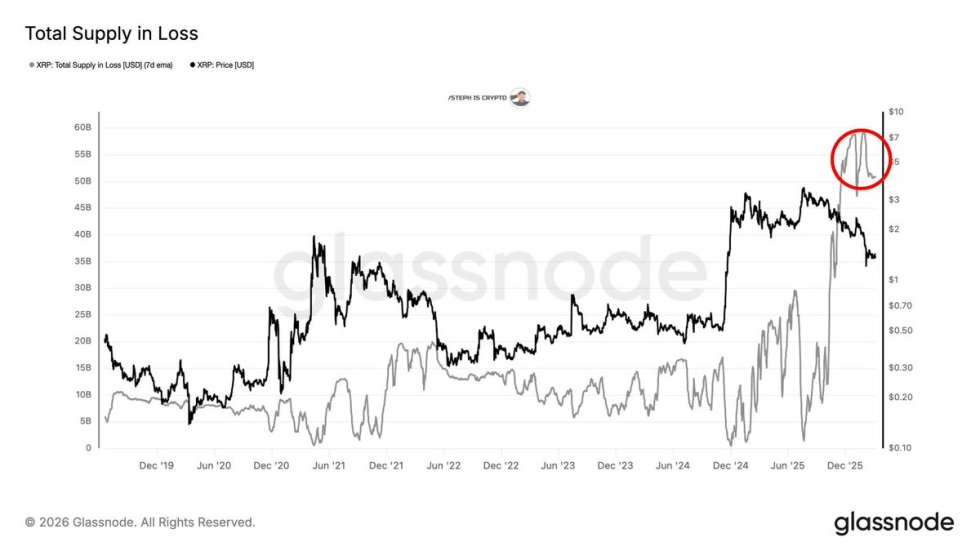
XRP briefly surged on Monday as the day drew to a close, but the leading altcoin is still heavily feeling the ongoing bearish pressure across the broader cryptocurrency market. During this highly volatile period, the level of supply sitting in a loss is growing rapidly, indicating a change in market dynamics.
XRP Share Of Supply In Loss Spikes
With the bearish side taking control of the market, XRP continues to face mounting pressure, keeping its price stuck below the $2 mark. A clear indication of the mounting pressure is the growing portion of XRP’s circulating supply slipping into the loss territory, which underscores the market strain on the altcoin.
Steph is Crypto, an investor and strategist, shared this development on X using data from Glassnode, a popular on-chain data analytics platform. After the expert’s examination of the chart, he reported that approximately 36.8 billion XRP are currently in loss amid recent price weakness.
This massive figure suggests that nearly 60% of the altcoin’s entire supply in circulation is underwater, demonstrating the lack of bullish activity. With more holders now sitting on notable unrealized losses, market sentiment is being shaped by broader uncertainty. Furthermore, this spike in loss-making supply typically indicates a pivotal stage in market cycles, when investor confidence is put to the test and volatility tends to rise.
Source: Chart from Steph is Crypto on X
When compared to highly bearish periods in past market cycles, this percentage of supply in loss appears to be quite higher. According to the expert, the current figure is more than the one seen during the COVID period, the China Ban, and the collapse of the FTX cryptocurrency exchange in 2022.
Nonetheless, with XRP trying to stabilize while a larger portion of its supply is still underwater, the present situation might lead to additional downward pressure or pave the way for a possible recovery when market dynamics eventually change.
Despite XRP’s share of supply in loss spiking, investors’ activity on cryptocurrency exchanges is painting a different picture of the market. More tokens have been leaving these centralized trading platforms at a significant and rapid rate.
X Finance Bull highlighted that XRP’s reserves on exchanges are shrinking, as the total balance fell by over 3 billion XRP, underscoring a major supply shift. Prior data shows that shrinking exchanges’ supply often leads to the tightening of the market, especially if buyers step in.
Major Liquidity Clusters Are Appearing
After weeks of sideways performance, Xaif Crypto, a technical analyst, has delved intoXRP’s liquidity heat map, revealing that the altcoin is at a crucial moment. Currently, the token is sitting between major liquidity clusters on both sides. At this point, the next decisive move could be triggered.
Xaif Crypto stated that a move into the upper zone might trigger liquidations and a fast parabolic squeeze. Volatility is growing because price action usually becomes highly sensitive to shifts in momentum as traders try to move the market toward one of the order books.
XRP trading at $1.39 on the 1D chart | Source: XRPUSDT on Tradingview.com
Featured image from Adobe Stock, chart from Tradingview.com
Editorial Process for bitcoinist is centered on delivering thoroughly researched, accurate, and unbiased content. We uphold strict sourcing standards, and each page undergoes diligent review by our team of top technology experts and seasoned editors. This process ensures the integrity, relevance, and value of our content for our readers.
Shares of Circle (CRCL), the crypto firm behind the USDC (USDC) stablecoin, could add to their recent remarkable surge, according to analysts at brokerage Bernstein.
The team, led by Gautam Chhugani, rate the stock at outperform with a $190 price target, suggesting about 60% upside from current $120 level. And that’s after the stock rallied more than 100% in the past few weeks following an earnings beat, which likely triggered a short squeeze.
Bernstein’s thesis centers on stablecoin adoption increasingly diverging from the broader crypto market.
Circle’s USDC supply briefly fell after the October liquidity shock in crypto markets but has since rebounded to just shy of its record $78 billion, even as bitcoin BTC$70,029.28 and the broader crypto markets remain well below its highs. The total market for U.S. dollar-backed stablecoins also remained steady at around $270 billion despite the crypto bear market, the report noted.
Transaction activity is accelerating as well, the report noted. Adjusted stablecoin volumes grew more than 90% year-over-year, while transaction velocity — a measure of how frequently tokens change hands — has increased, suggesting stablecoins are increasingly used beyond crypto trading.
Payments adoption is a key driver behind that, Bernstein said, as stablecoins are increasingly getting embedded with traditional card networks, enabling everyday transactions. Visa (V), for example, now supports more than 130 such stablecoin-linked cards across 50 countries, processing roughly $4.6 billion in annualized settlement volume, the report noted.
Circle is also expanding its Circle Payments Network, which allows institutions to send USDC cross-border and convert it into local currencies through banking partners. The network now includes about 55 institutions, with annualized volumes reaching $5.7 billion earlier this year, the report said.
Looking ahead, Bernstein also highlighted a potential new growth theme: AI-driven “agentic finance.” As autonomous software agents increasingly transact online, stablecoins could become a natural payment rail for micropayments between machines, such as for API calls or automated services.
To support that vision, Circle is building a high-throughput, payments-focused blockchain called Arc, designed for fast, low-cost transactions.
Read more: Why Circle and Stripe (And Many Others) Are Launching Their Own Blockchains
Prediction market platform Polymarket has teamed up with Palantir and TWG AI to build a monitoring system designed to detect suspicious trading and manipulation in sports prediction markets, a move that reflects growing pressure on the fast-growing sector to establish credibility.
The new system will use Palantir’s data infrastructure and TWG AI’s analytics to monitor trading activity across Polymarket markets. The companies say the platform will detect unusual trading patterns, screen participants and generate compliance reports that could be shared with regulators or sports leagues.
Polymarket founder and CEO Shayne Coplan said the goal is to bring “world-class analytics and monitoring to sports markets” while helping leagues and teams maintain confidence in the integrity of games.
The effort reflects a broader challenge facing prediction markets as they move from niche crypto experiments to platforms that increasingly influence public discussion about elections, economics and sports.
Prediction markets allow users to trade contracts tied to the outcome of real-world events. Because participants put money behind their views, proponents argue the markets can aggregate information efficiently and produce accurate forecasts.
But that same structure creates risks.
Prediction markets have faced criticism in recent years over the possibility that traders with inside knowledge could profit from events before the public becomes aware of them. Markets have emerged around sensitive topics such as policy decisions, military actions, labor strikes and political pardons, raising questions about whether participants might be trading on privileged information.
Carlos Pereira, a general partner at BITKRAFT Ventures, which manages more than $1 billion across investments in gaming, AI and digital assets, said those concerns could become a serious obstacle for the industry if they are not addressed.
“There has been what seems to be insider trading,” he said. “When you have a market that is new and by consequence a little bit fragile, making the news in negative ways can be dangerous.”
The monitoring system Polymarket is building resembles the kind of surveillance infrastructure used by traditional financial exchanges. According to the company, it will track trading before and after orders are placed, flag coordinated activity and identify traders who may be prohibited from participating.
For prediction market operators, the stakes are partly regulatory. Formal insider trading rules for these markets remain unclear in many jurisdictions, particularly in the U.S., where regulators are still debating how to classify them.
Efforts to strengthen monitoring could help the industry demonstrate that it can police itself.
Absent those safeguards, Pereira said regulators may feel pressure to intervene more aggressively.
“If markets don’t show they are trying to manage insider trading,” he said, “the odds of regulation becoming harsher and tapering growth would be much higher.”
German robotics startup Neura Robotics on Tuesday revealed plans to build Europe’s largest training center for physical AI, at Munich Airport.
Dubbed the TUM RoboGym, the center is being designed in partnership with the Munich Institute of Robotics and Machine Intelligence (MIRMI) at the Technical University of Munich (TUM).
The partners are jointly investing approximately $19 million in the project at launch, with Neura providing the majority, about $12 million. The center is expected to launch with about 26,000 square feet, with expansion planned in the near term, and operations slated to start later this year.
The center will house and train a fleet of humanoid robots, in what the partners say is a major milestone for scaling intelligent robotics and bolstering Europe’s standing in the global tech landscape.
“European sovereignty is extremely important in times of geopolitical competition between East and West,” Lorenzo Masia, director of the TUM RoboGym and executive director of TUM MIRMI, said in a release. “With this research and training center — one of the largest of its kind worldwide –we are creating a unique infrastructure in Europe for our researchers and students.”
Related:ABB, Nvidia Partner to Deliver Physical AI at Scale
Much of the data generated at the RoboGym will feed into the Neuraverse, Neura’s hardware-agnostic platform for robot training data.
The company says richer data will enable development of more precise AI models and capable robots, as well as a higher global standard for physical AI.
“For the advancement of intelligent robotics, the biggest challenge today is no longer the hardware, but access to high-quality, realistic training data,” David Reger, CEO and founder of Neura Robotics, said in the release.
The development came alongside Neura’s collaboration with Qualcomm, in which Neura will use the semiconductor giant‘s Dragonwing Robotics IQ10 processors as reference designs in its robots.
The companies said they aim to build the “brain and nervous system” of next-generation humanoid and general-purpose robots for both domestic and industrial settings. Financial terms were not disclosed.
Bitcoin (BTC) appears to have reclaimed $70,000 as support, although the market remains cautious as technical charts indicate a setup resembling the bull trap that occurred in January 2026.
Bitcoin’s sell-side liquidity has expanded sharply during the latest range retest. According to crypto trader Ardi, Bitcoin ask orders reached a two-month high. The trader said,
“Asks on Bitcoin just hit a 2-month high. $1.57B in sell-side liquidity stacked above price vs $1.125B in bids below.”
Bitcoin orderbook analysis by Ardi. Source: X
Within a 5% band around the spot price, the sell orders exceed demand by roughly 40%, creating a heavier supply layer above the market price. At the same time, the bids form a thinner support cushion below BTC price.
Ardi noted the last comparable setup occurred in January after Bitcoin briefly broke above $98,000. A similar sequence followed Bitcoin’s recent move above $72,000 before the price slipped back toward the middle of its range. Elevated ask liquidity during a retest often signals that traders are using rebounds to take profit.
Another positioning metric also turned in the same direction. The 30-day moving average of Bitcoin’s net taker volume remained positive at $83 million in March, indicating increased buying activity through market orders.
Bitcoin net-taker volume. Source: CryptoQuant
Related: Bitcoin price analysis warns of potential dip after $72K liquidity sweep
Will BTC’s underwater supply cap its rebound?
Bitcoin short-term holders’ (STHs) cost-basis data shows the average holder entered the market at significantly higher prices. The STH realized price, which tracks the average acquisition price of coins held for under six months, sits near $88,900.
According to Bitcoin researcher Axel Adler Jr., the largest supply cluster lies between $86,000 and $99,000, where many coins were accumulated between November 2025 and February 2026. This range forms the main breakeven area for a large share of the short-term market, making it a key market inflection zone.
On the positive side, realized profit and loss data shows selling pressure has begun to reduce. Crypto analyst Darkfost noted about $611 million in realized losses against $346 million in profit last week, bringing net weekly profit-and-loss to -$264 million.
That figure is far lower than the $2 billion weekly loss recorded during the February drop below $60,000.
Bitcoin realized loss 7-day average. Source: CryptoQuant
Compared with January’s retest, Bitcoin price currently sits much further below the main short-term cost-basis cluster. That distance limits the amount of breakeven selling that typically appears during smaller rallies.
As a result, many short-term holders may prefer to wait for higher prices, potentially closer to $86,000, rather than selling at a loss after holding through a month-long consolidation.
A move back above the $70,000 to $72,000 range eases part of the near-term selling pressure, but a more meaningful shift may require Bitcoin to reclaim the $86,000 to $89,000 range, where most of the short-term holders reach breakeven.
Related: Strategy records biggest STRC issuance day with estimated 1,420 BTC buy
This article does not contain investment advice or recommendations. Every investment and trading move involves risk, and readers should conduct their own research when making a decision. While we strive to provide accurate and timely information, Cointelegraph does not guarantee the accuracy, completeness, or reliability of any information in this article. This article may contain forward-looking statements that are subject to risks and uncertainties. Cointelegraph will not be liable for any loss or damage arising from your reliance on this information.
There is a war going on between crypto firms and traditional banks over stablecoins, and Jefferies analysts said that they could become a steady drag on bank earnings as digital dollar use spreads.
While stablecoins aren’t going to be an immediate existential threat to banks and aren’t likely to trigger a sudden run on U.S. bank deposits, Jefferies analysts estimate banks could see 3% to 5% core deposit runoff over the next five years. This would likely raise funding costs and chip away at banks’ profitability.
“The intermediate-term risk of gradual deposit runoff from emerging activity-based yield opportunities and payments use cases should not be ignored,” analysts led by David Chiaverini wrote in a report on Tuesday.
That “modest pressure” scenario would leave the average bank facing a roughly 3% hit to earnings, the analysts said.
It’s not hard to see why banks should be worried about growth in the stablecoin, which are cryptocurrencies designed to maintain a stable value and are typically pegged 1:1 to fiat currencies like the U.S. dollar or the euro.
They are already widely used in crypto trading, but since the GENIUS Act passed last year in the U.S., the market is expanding into payments, treasury management, and cross-border transfers. Supply reached $305 billion at the end of 2025, up 49% from a year earlier, while adjusted stablecoin transfer volume rose to $11.6 trillion in 2025, the report said.
The total market cap of the stablecoin sector currently sits around $314 billion, up from about $184 billion in 2022, according to DefiLlama data. And according to Jefferies’ calculations, it could reach $800 billion to $1.15 trillion in the next five years.
Stablecoin marketcap (DefiLlama)
That growth matters for banks because stablecoins can serve as digital cash that moves around the clock and plugs into decentralized finance platforms that offer yields above most bank accounts.
In fact, Bank of America CEO Brian Moynihan warned earlier this year that the broader banking system could be harmed by the “possibility of $6 trillion in deposits” moving into stablecoins and stablecoin-linked products offering yield-like returns.
The long-term threat
Jefferies’ core argument for stablecoins not being an immediate threat is that the new market structure bill in U.S. rules, as it stands now, limits their appeal as simple savings products, even as the bill’s passage is uncertain.
“CLARITY [act] would codify stablecoins as payment instruments, rather than savings products, by closing the ‘stablecoin yield loophole’ left open in GENIUS.”
The GENIUS Act, passed in July 2025, bars regulated stablecoin issuers from paying yield directly to passive holders. That restriction reduces the chance of a sharp near-term shift out of checking and savings accounts.
Also, banks and other traditional financial giants are either launching their own stablecoins or thinking about it to get ahead of the competition. Fidelity Investments launched its first stablecoin, the Fidelity Digital Dollar (FIDD). Bank of America’s Moynihan said the bank will issue a stablecoin if Congress legalizes it, and Goldman CEO said his bank has “an enormous number of people at the firm extremely focused on tokenization, stablecoins.”
Still, the report argues the longer-term risk should not be ignored.
“We see the potential for activity-based rewards for stablecoin transactions, payments, and settlement, as well as rewards from DeFi staking and lending protocols to pose a similar risk to bank deposits.”
So which banks are more exposed to this risk?
According to Jefferies, banks with larger concentrations of retail and interest-bearing deposits appear more exposed than custody banks or large institutions already investing in digital asset infrastructure.
“We view WTFC, FLG, WBS, EGBN and AX as the most exposed banks under coverage, given that they have the highest concentration of retail and interest-bearing deposits.”