

Mastercard moves to link traditional finance and crypto infrastructure through a sweeping global partner program, assembling dozens of industry players to accelerate blockchain-powered payments, remittances, and settlements across mainstream commerce networks. New Mastercard Crypto Alliance With 85 Firms Signals Powerful Blockchain Finance Shift Digital asset integration is expanding within traditional finance as Mastercard introduced a […]
Solance Selects SaaScada to Power Next-generation Payments Platform

Solance, a Dublin-based financial institution providing financial services for family offices, corporate service providers and corporates with multi-entity structures, has selected SaaScada to power its new multi-currency payments platform as part of its European launch.
Solance specialises in delivering financial solutions for niche sectors often underserved by traditional banks. Built around the principle that complexity should not be a barrier to access, the firm is developing a modern payments platform designed to combine efficient technology, strong governance and a relationship-driven service model.
Currently progressing through the licensing application process in Ireland, Solance is targeting a 2026 go-live. Alongside regulatory preparation, the company is building its technology platform to deliver a streamlined onboarding experience focused on speed, clarity and personalised support.
SaaScada’s cloud-native banking platform was selected to provide the real-time payments infrastructure powering Solance’s proposition, enabling rapid product deployment, scalable account structures and enhanced operational visibility, capabilities critical for managing sophisticated corporate arrangements.
“We are building Solance for companies that expect more from their financial partner, said Stefan Sluijter, CEO of Solance. Our ambition is to become the financial partner organisations rely on when they require expertise, responsiveness and a truly personal approach. To achieve that, we needed a technology platform capable of delivering both flexibility and reliability from day one. SaaScada provides the foundation to make that possible.”
By combining the efficiency and speed associated with neo-banks with the personalised, high-touch service traditionally found in private banking, Solance aims to set a new standard for how organisations access modern financial services.
“SaaScada provides configurability and real-time data needed to enable institutions launch and scale financial products quickly while maintaining precision and control,” said Nelson Wootton, CEO and Co-Founder of SaaScada, “Solance’s focus on solving real challenges for corporate clients is a strong example of how modern banking infrastructure can unlock new market opportunities. We are delighted to support their journey to launch.”
The partnership marks another step in the evolution of specialised financial services, where modern technology enables institutions to confidently serve segments that have historically been difficult to onboard and support.
Ghana opens crypto trading sandbox with 11 firms under new VASP law

Ghana’s Securities and Exchange Commission (SEC) said 11 companies have been granted access to a regulatory sandbox to test cryptocurrency and digital asset services under the country’s Virtual Asset Service Providers Act, 2025.
The program allows companies to run their products in a controlled environment while regulators monitor risks and compliance.
The sandbox will run for 12 months and sits at the center of Ghana’s early efforts to bring oversight to the crypto sector, according to a press release.
Companies in the first cohort include asset tokenization firms like Africoin, Blu Penguin, Vaulta, XChain and Goldbod as well as cryptocurrency exchanges like Hyro Exchange, HanyPay and WhiteBit.
The commission said firms whose products are market-ready and meet regulatory requirements could transition to a full license after six months. Others may remain in the sandbox for the remaining period to refine their services.
The SEC said the exercise will also help it shape detailed licensing guidelines for different types of crypto businesses. Data gathered during the pilot will inform rules covering areas such as investor protection, market integrity and anti-money laundering controls.
Once the sandbox closes, the regulator plans to publish the final guidelines and open the licensing process to a broader set of virtual asset service providers.
Legal Clash Deepens as Binance Files Defamation Suit While WSJ Reports DOJ Inquiry

Binance unleashes a legal battle against The Wall Street Journal over disputed reporting while the newspaper releases a new report on a U.S. investigation tied to the crypto exchange. Binance Sues WSJ as US Reportedly Probes Iran-Linked Crypto Activity A legal dispute between Binance and The Wall Street Journal intensified on March 11 after the […]
Hedera (HBAR) drops 1.8%, leading index lower
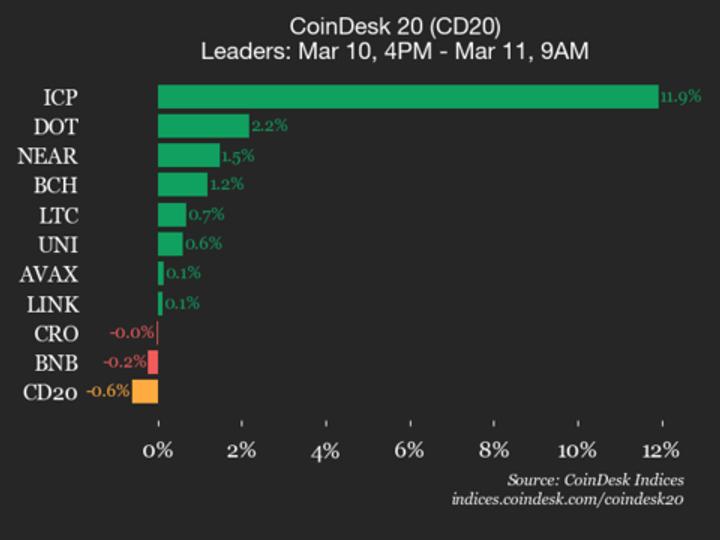
CoinDesk Indices presents its daily market update, highlighting the performance of leaders and laggards in the CoinDesk 20 Index.
The CoinDesk 20 is currently trading at 1980.55, down 0.6% (-12.31) since 4 p.m. ET on Tuesday.
Eight of 20 assets are trading higher.
Leaders: ICP (+11.9%) and DOT (+2.2%).
Laggards: HBAR (-1.8%) and XLM (-1.6%).
The CoinDesk 20 is a broad-based index traded on multiple platforms in several regions globally.
Meta Acquires Moltbook, the AI Agent Social Network

Facebook parent company Meta Platforms has acquired Moltbook, a social networking platform designed for AI agents to communicate with one another.
The deal was first reported by Axios, with Meta confirming the details with multiple outlets on March 10.
Exactly how Moltbook will be integrated into Meta was not immediately clear, and the financial terms of the deal were not disclosed. The companies confirmed that Moltbook’s co-founders Matt Schlicht and Ben Parr will join Meta’s research unit, Superintelligence Labs.
Launched in January, Moltbook was designed as a Reddit-like platform where AI bots can speak to one another, ask questions, and swap code and anecdotes.
Many of the software agents run on OpenClaw, an open source framework that enables users to speak to AI models, including Claude, ChatGPT, Gemini and Grok using natural language messaging apps such as WhatsApp, iMessage and Slack.
Moltbook has received significant online attention, particularly amid mounting concerns about granting AI greater autonomy. Yet tech leaders have been relatively dismissive about the site itself, with their interest instead being drawn to the underlying code and how humans interact with it.
Asked about the site in an Instagram Q&A, Meta’s CTO Andrew Bosworth said he didn’t “find it particularly interesting” that the AI bots communicate similarly to humans, given that they are trained on human language.
Rather, he said the intrigue, and security and other risks, lies in how humans were infiltrating the site — with some hacking into the network to pose as bots and write posts to disturb readers.
Speaking at the Cisco AI Summit in San Francisco in February, OpenAI CEO Sam Altman argued for OpenClaw as the true breakthrough.
“Moltbook maybe is a passing fad, but OpenClaw is not,” he said. “This idea that code is really powerful, but code plus generalized computer use is even much more powerful, is here to stay.”
Bitcoin Sees Modest Relief as US CPI Inflation Avoids Surprises

Bitcoin (BTC) broke back above $70,000 around Wednesday’s Wall Street open as US inflation data soothed anxious markets.
Key points:
-
Bitcoin bounces around a narrow range as US inflation data offers a modest tailwind.
-
Oil prices stay lower as an emergency release of 400 million barrels is confirmed.
-
BTC price expectations focus on future liquidations in the mid-$60,000 zone.
Bitcoin edges higher as CPI matches expectations
Data from TradingView showed BTC price action eking out modest gains, while failing to match local highs from the day prior.
The February print of the US Consumer Price Index (CPI) was in line with expectations at 2.4% year-on-year, per data from the Bureau of Labor Statistics (BLS).
“Over the last 12 months, the all items index increased 2.4 percent before seasonal adjustment,” it confirmed in an official statement.

This was a relief for risk assets already on edge over geopolitical instability and its potential impact on inflation. The Middle East conflict and global oil supply squeeze, however, were likely only to be truly reflected in March’s inflation data.
“The market will now await March’s data,” trading resource The Kobeissi Letter thus wrote in a response on X.
Other recent inflation gauges missed anticipated levels both to the upside and downside, making for a shaky overall picture of inflationary forces even before events in Iran.
Oil, a key risk factor for CPI going forward, stayed below the $90 mark on the day as the International Energy Agency (IEA) approved the emergency release of 400 million barrels — the largest such release ever recorded.

Trader eyes BTC price “breakout upwards” in March
With price still rangebound, Bitcoin market participants chose not to bet big up or down.
Related: Bitcoin faces ‘highly volatile’ setup as bulls eye return to $80K by month-end
“Very simple; buy the lower bounds, sell the higher bounds,” trader, analyst, and entrepreneur Michaël van de Poppe told X followers.
“I still think we’ll see that breakout upwards in this month to test higher grounds, but if not, I’m a buyer on lower levels.”

Trader Lennaert Snyder eyed downside liquidity for a potential local low, suggesting that this could come at around $65,000.
$BTC is compressing pre-CPI.
Bitcoin swept ~$71,563 liquidity and rejected like I mentioned yesterday.
I’m already in some shorts, and I’m willing to add if we get a MSB by losing the ~$69,268 low.
My short target will be the liquidity at ~$65,957. Letting 10% open for a… pic.twitter.com/DN3rb9lTha
— Lennaert Snyder (@LennaertSnyder) March 11, 2026
Data from monitoring resource CoinGlass put 24-hour crypto market liquidations at $240 million, with short positions accounting for a larger slice of the total.

This article does not contain investment advice or recommendations. Every investment and trading move involves risk, and readers should conduct their own research when making a decision. While we strive to provide accurate and timely information, Cointelegraph does not guarantee the accuracy, completeness, or reliability of any information in this article. This article may contain forward-looking statements that are subject to risks and uncertainties. Cointelegraph will not be liable for any loss or damage arising from your reliance on this information.
Iran Set To Deploy Mines, Oil Hits Highs — What It Means For Bitcoin

Trusted Editorial content, reviewed by leading industry experts and seasoned editors. Ad Disclosure
A White House official’s deleted social media post briefly pushed oil prices lower — only for them to snap back hard after US intelligence detected signs that Iran was moving to mine the Strait of Hormuz, the narrow waterway that carries roughly one-fifth of the world’s daily oil supply.
A Deleted Post And A Market Whipsaw
US Energy Secretary Chris Wright posted on social media that the US Navy had escorted an oil tanker safely through the Strait, a claim that briefly calmed markets and sent crude prices lower.
White House Press Secretary Karoline Leavitt then confirmed the post was false. Wright deleted it. Oil shot back up.
The episode rattled an already jittery market and drew a sharp rebuke from Iran’s Foreign Minister Abbas Araghchi, who accused Washington of deliberately spreading false information to manipulate oil prices.
“It won’t protect them from the inflationary tsunami they’ve imposed on Americans,” Araghchi said.
The intelligence that triggered the price surge came from CBS White House Correspondent Jennifer Jacobs, who reported that US intelligence assets had picked up signs of Iranian mine deployment activity in the Strait.
Brent crude climbed above $90 a barrel after dipping to an intraday low of around $82. West Texas Intermediate, the US benchmark, rose above $80 after touching $77 earlier in the session.
Both were still down significantly on the day, but the speed of the recovery underscored how sensitive traders are to any supply threat at this chokepoint.
Trump Warns Of Unprecedented Military Response Vs. Iran
US President Donald Trump escalated the standoff in a Truth Social post, ordering Iran to remove any mines placed in the Strait without delay.
“If, on the other hand, they remove what may have been placed, it will be a giant step in the right direction,” Trump wrote. He warned that failure to comply would bring military consequences at a level, in his words, “never seen before.”
The warning came a day after Trump had already drawn a hard line on the waterway, pledging a response “twenty times harder” if Iran moved to disrupt shipping there.

Image: Investing News Network
Iran’s foreign minister pushed back, claiming markets were not fully accounting for the scale of the potential supply shock.
“Markets are facing the biggest shortfall in history — bigger than the Arab Oil Embargo, Iran’s Islamic Revolution, and the Kuwait invasion combined,” Araghchi wrote.
Data from Bloomberg showed Hormuz traffic had effectively ground to a halt, with only Iran-linked vessels still passing through. Tehran has ruled out any negotiations with Washington, even as Trump said talks remained a possibility.
Bitcoin Slips Below $70,000 On Geopolitical Jitters
The turmoil in oil markets spilled into crypto. Bitcoin dropped below $70,000 after news of the mine deployment threat broke, pulling back from earlier gains that had kept BTC trading above that psychological level.
At the time of reporting, the coin was hovering around $69,200 — still up modestly on the day but well off its early March high of $73,000.
Featured image from Unsplash, chart from TradingView

Editorial Process for bitcoinist is centered on delivering thoroughly researched, accurate, and unbiased content. We uphold strict sourcing standards, and each page undergoes diligent review by our team of top technology experts and seasoned editors. This process ensures the integrity, relevance, and value of our content for our readers.
SEC and CFTC sign agreement to coordinate crypto and market oversight
The SEC and the CFTC announced a new Memorandum of Understanding aimed at strengthening coordination between the two agencies and improving regulatory clarity for financial markets, including digital assets.
The agreement outlines how the agencies will collaborate on policymaking, oversight, examinations, and enforcement while sharing information and aligning regulatory definitions. Officials said the move is designed to reduce duplicative rules and provide clearer guidance to market participants.
“For decades, regulatory turf wars, duplicative agency registrations, and different sets of regulations between the SEC and CFTC have stifled innovation and pushed market participants to other jurisdictions,” said SEC Chairman Paul Atkins. The updated agreement will help align regulatory definitions, coordinate oversight, and facilitate secure data sharing between the agencies, he said.
CFTC Chairman Michael S. Selig said the initiative reflects an effort to modernize regulatory frameworks as markets evolve. By coordinating oversight and eliminating overlapping rules, the agencies aim to provide more seamless supervision of financial markets, he said.
Alongside the agreement, the agencies launched a Joint Harmonization Initiative to advance coordinated oversight in areas where both regulators share authority. The effort will focus on clarifying product definitions, modernizing clearing and margin frameworks, streamlining regulatory reporting, and improving cross-market surveillance.
Officials said the initiative will also work toward developing a fit-for-purpose regulatory framework for crypto assets and other emerging technologies.
The Joint Harmonization Initiative will be co-led by Robert Teply from the SEC and Meghan Tente from the CFTC
Disclosure: This article was edited by Estefano Gomez. For more information on how we create and review content, see our Editorial Policy.
State Bank of India and MUFG Sign Strategic Partnership to Strengthen India–Japan Financial Collaboration
State Bank of India (SBI), India’s largest commercial bank, and MUFG Bank, Ltd., (MUFG) Japan’s premier global financial institution, today announced the signing of a Strategic Partnership Agreement to advance bilateral financial collaboration and strengthen the India–Japan economic corridor. The agreement aims to enhance mutual collaboration by further leveraging the complementary strengths of both institutions to facilitate cross-border capital flows, create new synergistic financing opportunities and support sustainable economic growth across two of Asia’s largest economies.
The alliance combines SBI’s unparalleled domestic reach and market leadership in India with MUFG’s extensive global network and cross-border structuring expertise, to support Japanese corporates expanding in India as well as Indian enterprises pursuing international growth, including entry into Japan and other global markets.
Building on a Strong Foundation
The partnership builds on a strong and expanding track record of collaboration between MUFG and SBI. Recently, SBI launched a USD 500 million + Greenshoe syndicated Gender loan facility to advance women’s economic empowerment, which is the largest gender‑themed loan by a financial institution globally and is arranged by MUFG. This builds on MUFG’s role in 2023 as Lead Social Loan Coordinator and Arranger for SBI’s inaugural USD 1 billion social loan in 2023, which is the largest social loan by a Bank in APAC. MUFG has also engaged with SBI CHAKRA Centre of Excellence (CoE) under its Project Finance & Structuring function, supporting the development of financing frameworks for India’s priority sunrise sectors aligned with the Viksit Bharat 2047 vision.
Through this agreement, the MUFG–SBI alliance is underpinned by a formalized and structured framework to further scale cooperation across priority industries and cross‑border opportunities.
Key Areas of Collaboration
With the partnership, SBI and MUFG will explore collaboration in structuring and financing projects with a specific focus on sectors such as M&A, Aviation and Real Estate finance to support Indian and Global clients. The banks will also cooperate on M&A advisory, trade finance and retail banking solutions, facilitating Japanese corporate linked potential inbound and outbound transactions by leveraging SBI’s deep expertise in the Indian market and MUFG’s extensive global network.
Both banks will also help facilitate the introduction of Indian mid-corporates and micro, small and medium enterprises (MSMEs) to Japanese corporate clients, identifying financing opportunities that deepen transaction-level collaboration.
A Strategic Partnership
The partnership aligns with the broader India-Japan “Special Strategic and Global Partnership” and supports the India-Japan Joint Vision for the Next Decade, which outlines a shared roadmap to deepen economic integration and long term investment between the two countries. Rising Japanese investment into India across infrastructure, manufacturing and emerging sectors, alongside the growing global ambitions of Indian corporates, underscores the need for coordinated financial platforms capable of supporting long-term capital formation.
Takuya Senoo, Regional Executive for India & Sri Lanka, MUFG Bank, Ltd., said: “India represents one of the most compelling growth markets globally, and the India–Japan corridor continues to deepen. We are witnessing strong momentum from Japanese companies expanding their presence in India, alongside increasing global ambition from Indian enterprises. Through our partnership with SBI, MUFG aims to provide integrated cross-border solutions that support both inbound investment into India and outbound expansion by Indian corporates. This collaboration reflects our long-term commitment to strengthening economic ties between Japan and India.”
Kishore Kumar Poludasu, Deputy Managing Director, International Banking Group, State Bank of India, said: “This strategic partnership brings together two institutions of scale and systemic importance in our respective markets. As trade and investment flows between India and Japan continue to expand, our collaboration with MUFG enhances our ability to provide comprehensive financing and advisory solutions to clients operating across both jurisdictions. We view this as a natural progression of our existing working relationship and a platform for deeper engagement across priority sectors.”
This partnership reflects the shared commitment of both institutions to the Indian economic growth story towards the culmination of the vision of Viksit Bharat 2047. By synergizing SBI’s unparalleled domestic reach as the national banking champion along with MUFG’s prominent international footprint, the partnership will serve as a vital bridge for investment flows and industrial collaboration between two of the largest global economies.