

The bitcoin mining industry is facing a severe hashrate shakeout, leading many independent operators to cease operations. In response, Hash2cash is pushing a high-tech rebranding by tokenizing hashrates on the TON blockchain. A High-Tech Pivot in a Brutal Market As the bitcoin mining industry grapples with a brutal hashrate shakeout that has forced many independent […]
European fintech Blackcat launches multi-wallet app combining euro and crypto accounts, completing rebrand

Malta, 11.03.2026 — Blackcat, the European fintech platform formerly known as Blackcatcard, today launched a completely rebuilt mobile app based on a multi-wallet architecture that combines euro accounts and crypto services in a single interface. The launch accompanies a formal rebrand that retires the Blackcatcard name — a change driven by how users had already begun referring to the product.
The new app allows users to create and manage multiple independent wallets — in euros or in supported cryptocurrencies — organised by purpose, use case, or asset type. Each wallet functions as a self-contained financial account within a single ecosystem, supported by a personal EUR IBAN with SEPA transfers, credit-grade cards or integrated crypto buy, sell, and transfer functionality.
The rebuild comes as European fintech moves beyond single-product offerings. According to AppsFlyer’s 2025 analysis of 187 finance apps across the UK, France, and Germany, the European financial app landscape has become increasingly fragmented, with traditional providers, neobanks, and international platforms each competing in siloed categories. Blackcat’s multi-wallet model is designed to consolidate these fragmented workflows into a single platform.
Regulated infrastructure
Blackcat’s fiat infrastructure is built on Papaya Ltd, a Malta-based Electronic Money Institution authorised and regulated by the Malta Financial Services Authority and a direct participant in the SEPA payment network. Crypto services are delivered through a separately licensed European partner, integrated through an open-banking technology, maintaining a clear separation between fiat and digital asset operations.
This direct SEPA participation means Blackcat processes euro transfers through its own infrastructure rather than routing them through intermediary institutions — a distinction that affects both speed and cost for end users, and one that relatively few EMI-based fintechs in Europe can claim.
Why multi-wallet matters
The multi-wallet model represents a departure from the account-plus-features approach. Rather than a single balance with spending categories or virtual pots layered on top, Blackcat’s wallets are architecturally independent — each with its own balance, transaction history, and potential integrations.
“The wallet-based architecture is a fundamental rethinking of how a financial app should be structured,” said Olegs Cernisevs, PhD, Chief Technology Officer at Blackcat. “Most fintech apps were built as digital copies of a single account. We built something closer to a personal financial operating system — where each wallet is a programmable unit that can eventually connect to different services, partners, and rails.”
What comes next
The wallet architecture is designed as a foundation for future functionality. Planned expansions include partner integrations, open-banking connectivity, and additional asset types — all embedded as native extensions of individual wallets rather than bolted-on features.
Blackcat is available on iOS and Android. More information at Blackcat.app
About Blackcat
Blackcat is a European fintech platform that combines everyday financial services — EUR IBAN accounts, SEPA transfers, cards, free internal account-to-account money transfers, cashback and bonuses — with integrated cryptocurrency functionality in a single multi-wallet application.
Fiat services are powered by Papaya Ltd, an Electronic Money Institution authorised and regulated by the Malta Financial Services Authority and a direct SEPA participant. Registration number C55146. Client funds are safeguarded in accordance with applicable legislation. Funds held in e-money accounts are not covered by the Depositor Compensation Scheme. You can get more information about terms and conditions on the website blackcat.app The bonus payment is a part of the loyalty program provided by Baltic Technology Solutions OU. Detailed terms and conditions can be found here. An integrated crypto exchange and custodial crypto wallets are provided by MANERIO Sp. z o.o. You can find more information at maner.io
About Papaya Ltd
Papaya Ltd. is a financial institution registered and headquartered in Malta. As an Electronic Money Institution (EMI) regulated by the Malta Financial Services Authority (MFSA), Papaya Ltd. provides digital payment infrastructure services including Mastercard payment cards and IBAN accounts for individuals and businesses, a PSD2-compliant solution enabling SEPA transfers, and offers co-branded and white-label mobile and online payment solutions. One of the first EMIs in Europe to secure direct access to SEPA, including both SEPA Credit Transfers (SCT) and SEPA Instant (SCT Inst).
Papaya Ltd. also acts as a correspondent institution, providing regulated access to the SEPA network for other financial institutions without their own direct SEPA membership.
The company also delivers PSD2-compliant API for fintech solutions as AISP and PISP, automated digital Know Your Customer (KYC) solutions, and personal and business International Bank Account Numbers (IBANs).
XRP Is Forming a Chart Pattern That Last Led to a 1,500% Price Rally

XRP’s (XRP) weekly price chart is starting to resemble a technical pattern that previously marked a major cycle low and preceded a sharp upside reversal.
Key takeaways:
-
XRP’s weekly chart fractal resembles the 2017 cycle low before a 1,577% surge.
-
An XRP price breakout requires a sustained move above the $2 resistance zone.
-
Declining exchange balances indicate XRP accumulation.
XRP fractal hints at a massive price rally ahead
A long-term fractal comparison between the 2017-2018 and 2024-2026 cycles suggests that XRP’s sharp sell-off from $3.66 multi-year highs mirrors a pattern that formed a price bottom, before a sharp reversal.
Related: XRP holders face $50B in unrealized losses as it trades below $1.40
On the weekly chart, XRP’s drop to $1.10 resembles a retest of the lower trendline of a symmetrical triangle from 2017 when the price dropped to $0.12, marking the local bottom.
Commenting, crypto analyst Javon said, “There is potential we see this overall run unfold in an identical manner,” adding:
“Doing so means that right now is only a temporary pullback before a move well above the $20 mark.”
In 2017, XRP consolidated inside the triangle as leverage reset, eventually breaking above the triangle’s upper trend line and rallying 1,577%.
Applying this framework, XRP bulls will be required to push the price above the $1.78-$2.30 resistance to confirm a sustained upward breakout.
Note that this is where the upper trendline of the triangle at $2, the 100-week simple moving average (SMA), and the 50-day SMA converge.
XRP’s UTXO realized price distribution (URPD) data shows large supply clusters that remain above the spot price. The $2 level accounts for 3.6% of the XRP supply, and $1.80 comprises 3.15%, forming heavy overhead resistance.

As Cointelegraph reported, buyers will have to break and sustain the XRP price above the downtrend line of the descending channel pattern at $2 on the daily chart to signal a long-term trend change.
XRP supply on exchanges continues downtrend
XRP’s multi-exchanges daily depositing/withdrawing transactions delta, a metric that tracks the net number of XRP transfer transactions across 15 major crypto exchanges, has dropped to record lows, according to data from CryptoQuant.
“When the metric declines, it suggests that more investors are withdrawing XRP into external wallets,” CryptoQuant analyst Amr Taha said in a QuickTake analysis, adding:
“This behavior often reflects accumulation and long-term confidence.”

This was echoed by fellow analyst Darkfost, who said the “number of XRP withdrawal transactions on Binance has shown several sudden spikes in recent days.”
This includes more than 14,000 withdrawal transactions from Binance on March 6, as shown in the chart below.
This indicates investors are “accumulating and then choosing to transfer their tokens to private wallets rather than keeping them on the exchange,” Darkfost added.

As a result, XRP balance on exchanges has dropped to 12.9 billion on Wednesday, levels last seen in May 2021.

Meanwhile, outflows from US-based spot XRP ETFs eased after Goldman Sachs emerged as the largest ETF holder, signalling institutional confidence in XRP’s long-term potential.
This article does not contain investment advice or recommendations. Every investment and trading move involves risk, and readers should conduct their own research when making a decision. While we strive to provide accurate and timely information, Cointelegraph does not guarantee the accuracy, completeness, or reliability of any information in this article. This article may contain forward-looking statements that are subject to risks and uncertainties. Cointelegraph will not be liable for any loss or damage arising from your reliance on this information.
Is Coinbase Sabotaging Bitcoin De Minimis Tax Exemption In Favor Of Stablecoins?

Trusted Editorial content, reviewed by leading industry experts and seasoned editors. Ad Disclosure
A new controversy has emerged within the cryptocurrency community, particularly on “crypto Twitter,” involving US-based exchange Coinbase (COIN).
Rumors are circulating that the exchange is actively opposing the proposed Bitcoin (BTC) de minimis tax exemption, allegedly to promote a regulatory framework that favors stablecoins over Bitcoin.
Coinbase’s Alleged Lobbying
As the US government seeks to establish a comprehensive regulatory framework for the crypto industry—especially following Donald Trump’s re-election campaign—tax exemptions have become a focal point in congressional discussions.
In a March 4 interview, Senator Cynthia Lummis mentioned that both the House Ways and Means Committee and the Senate Finance Committee are contemplating a $300 exemption, which would allow crypto users to utilize Bitcoin for transactions without incurring capital gains taxes.
“We’re trying to figure out the appropriate criteria for distinguishing when a transaction—such as a sale of Bitcoin—should be subject to capital gains taxes and when it can be used as a straightforward medium of exchange, akin to the US dollar,” explained Lummis.
However, industry insights shared by Marty Bent, managing partner at Ten31, indicate that Coinbase may be lobbying against such exemptions. Bent claimed on social media that the exchange is attempting to “nuke” the Bitcoin exemption while seeking to support stablecoins exclusively.
Allegedly, Coinbase representatives have informed legislators that “No one is using Bitcoin as money. A de minimis exemption for Bitcoin is a handout that will be DOA [dead on arrival].”
Accusations Fly
This revelation has garnered significant attention from leaders within the cryptocurrency sector. Conner Brown, Managing Director at the Bitcoin Policy Institute, expressed concern over the potential implications of such a move.
He stated that there has been a noticeable shift in legislative discussions favoring stablecoin-only exemptions over the past three months.
Brown emphasized that missteps in this area could represent a grave error for the US policy landscape, urging his peers to remain vigilant. “We’ve invested years in this fight, and we can’t let it slip away at the last moment,” he asserted.
The response from the crypto community has been largely critical, with some participants accusing Coinbase of aligning with traditional banking interests. Some have gone so far as to characterize the exchange as “just another branch of the fractional reserve banking system.”
As of now, Coinbase has not provided any official confirmation or response regarding the rumors circulating about its lobbying activities. It remains to be seen whether the exchange will address these allegations or clarify its stance in the ongoing discourse about Bitcoin and stablecoins.
Featured image from OpenArt, chart from TradingView.com

Editorial Process for bitcoinist is centered on delivering thoroughly researched, accurate, and unbiased content. We uphold strict sourcing standards, and each page undergoes diligent review by our team of top technology experts and seasoned editors. This process ensures the integrity, relevance, and value of our content for our readers.
OP Labs cuts 20 employees as Ethereum L2 developer narrows strategic focus

OP Labs, the development company behind the Ethereum layer 2 network Optimism, has let go of 20 employees as part of an organizational restructuring aimed at narrowing its strategic priorities and streamlining decision-making processes.
“This is not about finances,” OP Labs CEO Jing Wang said in a note. “OP Labs is well capitalized with years of runway. This is about doing fewer things well, making decisions faster, and reducing coordination overhead.”
The company said that it plans to support departing employees with severance, healthcare continuation, and help them find new roles.
Affected staff members will receive extended compensation packages and continued benefits as part of their separation agreements.
Jing has also committed to leveraging personal and professional networks to connect displaced workers with hiring opportunities across the blockchain ecosystem.
Industry-wide pressures
OP Labs joins a growing list of crypto companies that have adjusted workforce levels as the industry adjusts to weaker markets and shifting strategies.
Gemini cut about 25% of its workforce and exited the UK, EU, and Australian markets while shutting down its NFT marketplace and narrowing its focus to the US, AI tools, and prediction markets.
OKX also reduced staff in its institutional division as part of a global restructuring, while Block said it would eliminate roughly 4,000 jobs, with CEO Jack Dorsey pointing to AI advancements and changing business priorities.
The crypto sector last experienced mass layoffs during the 2022 market collapse, when companies reduced headcounts by 10% to 30% following failures tied to Terraform Labs and FTX that wiped roughly $2 trillion from the market.
Roughly 24,000 jobs disappeared that year as exchanges and mining firms moved into crisis management mode, according to Bressler, Amery & Ross.
Recent layoffs from 2025 to 2026 are mostly linked to operational streamlining, mergers, and shifts toward AI-driven and blockchain-focused initiatives.
While 2022 cuts were dominated by exchanges such as Coinbase and Crypto.com, newer layoffs are spread across sectors like DeFi, real-world asset platforms, and infrastructure providers.
Disclosure: This article was edited by Vivian Nguyen. For more information on how we create and review content, see our Editorial Policy.
From Blackouts to Bitcoin: South African Power Utility’s Surreal Pivot to High-Intensity Power Sales

Eskom, South Africa’s state-owned power utility, is reversing its previous stance by targeting high-intensity energy consumers, specifically bitcoin mining companies. Nyati announced plans to sell excess electricity generated during the day due to increased solar power usage. The Solar Paradox In a shift that seemed impossible only two years ago, South African state-owned power utility […]
Generic AI Falls Short for Banks: Glia’s New Benchmark Report Reveals the Power of Purpose-Built Tools

As regional financial institutions face rising technology costs and mounting pressure from megabanks and fintechs—which now capture 44% of all new checking accounts—the race to implement Artificial Intelligence (AI) has become a matter of survival. However, a staggering 95% of generative AI pilots are failing to reach production.
According to the newly released 2026 Banking AI Benchmarks Report by Glia, the solution lies in abandoning generic tools in favor of industry-specific AI. Based on real interaction data from 400 financial institutions that have successfully integrated banking-specific AI, the report establishes the financial services industry’s first empirical standards for AI return on investment (ROI) and operational capacity.
What “Good” Looks Like in Banking AI
The data reveals that purpose-built AI transcends simple automation, understanding the nuanced journeys of account holders. Glia’s report highlights several key performance benchmarks that define high-performing, banking-specific AI:
- 92%+ Understanding Rate: Industry-specific AI accurately interprets banking terms without needing repetition. For example, while a generic AI might misinterpret “CD” as a compact disc, banking AI correctly recognizes it as a “Certificate of Deposit”.
- Up to 94% Containment Rate: Banking AI resolves routine tasks like balance checks autonomously at a 94.8% rate. Conversely, it deliberately routes sensitive interactions, such as account closures (41% containment), to human staff to preserve personal relationships.
- Under 10% Escalation Rate: Customer-initiated escalation to a live agent remains under 10%, even for high-stakes needs like reporting fraud (6.0%) or a lost card (9.7%). For routine inquiries like check orders (2.5%) or account access (3.9%), customers usually choose banking AI over waiting for a human agent.
- 90-98% Automation of Call Wrap-Up Tasks: Financial institutions are reclaiming up to 12.7% of the agent workday by automating administrative post-call documentation.
Moving Beyond the AI Experiment

Dan Michaeli, co-founder and CEO of Glia, emphasized the danger of relying on unproven, generalist tools. He noted that when AI is banking-specific, it delivers the 24/7 support consumers prefer while reclaiming capacity for frontline teams to focus on complex, high-value moments.
“For community and regional financial institutions, choosing the right AI technology has moved beyond a technical discussion — it is now a matter of survival.”
Glia’s banking AI comes pre-trained on over 1,000 banking-specific user goals. This zero-hallucination architecture utilizes mathematically proofed policies and keeps humans in the loop, ensuring the AI cannot execute unauthorized actions.
Tyler Young, consumer banking director at Texas Tech Federal Credit Union, highlighted the practical benefits of this pre-trained library. He stated that without these tools and clear guidance, his team would likely still be stuck in the drafting phase of developing custom responses.
Binance Founder Reacts To Forbes $110B Net Worth Estimate

Trusted Editorial content, reviewed by leading industry experts and seasoned editors. Ad Disclosure
Binance co-founder and former CEO Changpeng Zhao has reacted to Forbes’ estimate that ranked his net worth among the 20 richest people on the planet, surpassing figures such as Bill Gates and Michael Bloomberg.
Binance’s CZ Among 20 Richest People On Earth
On Tuesday, Forbes estimated that Binance founder Changpeng Zhao, also known as CZ, is “now richer than ever,” with his net worth skyrocketing to $110 billion, up $47 billion from last year, on the annual World’s Billionaires list.
By February 10, 2026, Forbes’ real-time tracker listed CZ among the world’s richest individuals at $78.78 billion, while Bloomberg’s Billionaires Index placed his net worth around the $52.2 billion mark around the same time.
According to the list’s latest calculations, Zhao is currently the 17th-wealthiest person on earth, ranking above Bill Gates, whose net worth is at $108 billion. In addition, he sits among the 20 people worth twelve figures.
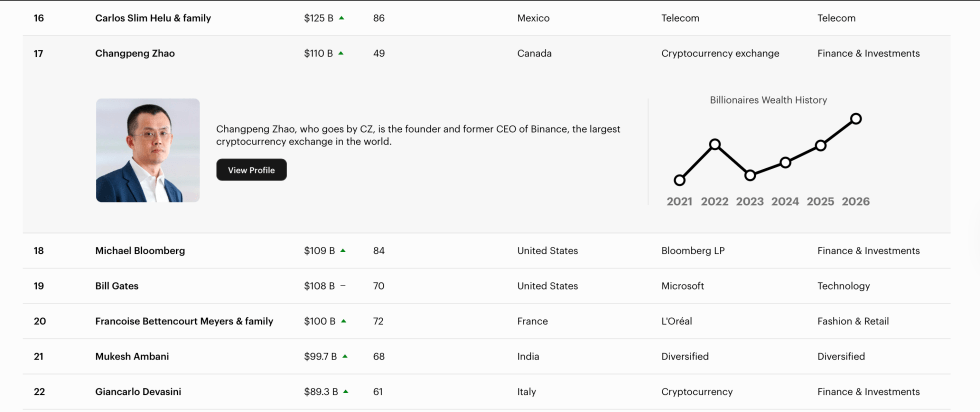
Binance founder ranks 17th on Forbes' annual World’s Billionaires list. Source: Forbes
Forbes acknowledged the crypto market’s downturn, noting that some of his assets, including his estimated 1,400 BTC stash and BNB holdings, have dropped around 25% over the past year.
However, they affirmed that the core of Zhao’s wealth remains Binance, citing it as the reason for his net worth’s surge despite the crypto market correction.
Conversations with industry insiders and comparisons with other crypto exchanges, including the publicly traded Coinbase, suggest Binance—still the world’s largest crypto exchange, with roughly 38% market share—is worth around $100 billion, and legal filings from the investigation indicate that Zhao owns about 90% of it.
Based on this data, Forbes concluded that “the exchange would likely sell for twelve figures, should CZ ever decide to offload it, even after applying a generous discount because it operates largely outside of U.S. regulations, unlike Nasdaq-listed Coinbase.”
CZ Calls Forbes Estimates A ‘Guess A Number’ List
In a series of X posts, Zhao affirmed that Forbes’ calculations were “definitely not accurate,” as Bitcoin (BTC) and crypto as a whole have significantly retraced from last year’s highs.
Last month, he shared his path to crypto wealth, which started when a friend suggested he take Bitcoin seriously at a Shanghai poker game, and led him to sell his apartment to bet a meaningful portion of his net worth into the flagship cryptocurrency in 2013.
The former CEO of Binance, who was pardoned last year by US President Donald Trump, revealed that he did not read the article, but argued that “you know it’s wrong” by just looking at their chart, deeming it a “guess a number” list.
He underscored that his net worth increase didn’t make sense given the current market environment, which has dragged BTC and BNB prices down over 50% from their 2025 peaks and 25% from their 2026 opening values.
“Crypto prices dropped by more than 50% in 2026 already. And my net worth went up? Wish they could apply some common sense and basic logic,” he wrote, adding that Forbes estimates are “way off.”
He emphasized his point by comparing his alleged net worth with Zhang Yiming, the founder of ByteDance, the company behind TikTok. ByteDance’s estimated yearly revenue sits at around $150 billion, according to public sources, while Binance’s undisclosed yearly revenue is estimated at around $5 billion.
Despite this, Forbes has calculated Zhang Yiming’s net worth at $69 billion, ranking 26th on the annual World’s Billionaires list, while CZ’s net worth was estimated at $110 billion.
“I think if I tried to claim I have a high net worth, they will rank me much lower, or maybe even remove me from the list,” Zhao joked, concluding that “They like to estimate the opposite.”
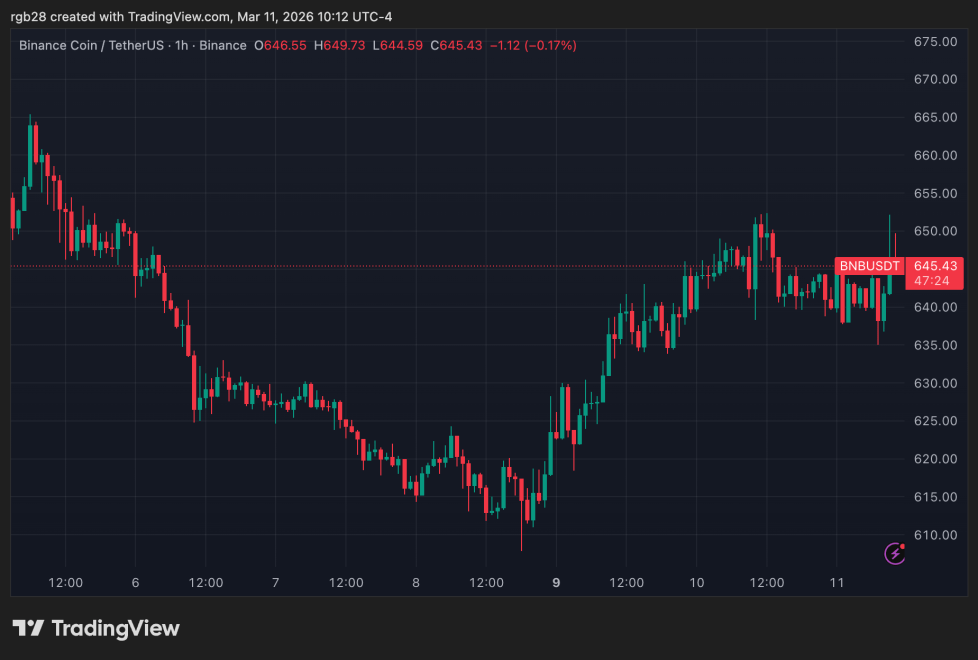
BNB trades at $645 in the one-week chart. Source. BNBUSDT on TradingView
Featured Image from CNBC, Chart from TradingView.com
Editorial Process for bitcoinist is centered on delivering thoroughly researched, accurate, and unbiased content. We uphold strict sourcing standards, and each page undergoes diligent review by our team of top technology experts and seasoned editors. This process ensures the integrity, relevance, and value of our content for our readers.
BONK.fun team account hacked and used to launch wallet drainer on site

BONK.fun, a Solana-based meme coin launchpad formerly known as LetsBONK, said Thursday that attackers took over a team account and used it to run a wallet drainer on the site.
The incident is under investigation, and users are urged to stop interacting with the website until the team confirms the platform is secure.
A malicious actor has compromised the BONKfun domain, do not interact with the website until we have secured everything.
— BONK.fun (@bonkfun) March 12, 2026
Launched in April 2025 by the BONK community alongside Raydium, BONK.fun allows users to deploy tokens without coding using dynamic logarithmic bonding curves.
The platform rapidly overtook Pump.fun to command 84% of Solana’s launchpad share by mid-2025.
However, engagement dropped as reward mechanisms became difficult to sustain and successful token launches slowed, while Pump.fun rebounded with major buybacks, its acquisition of Kolscan, and better scaling capacity.
By the end of 2025, BONK.fun controlled only 7% of the market, according to data from Dune. Its revenue also declined to around $84,000, while Pump.fun’s revenue topped $720,000.
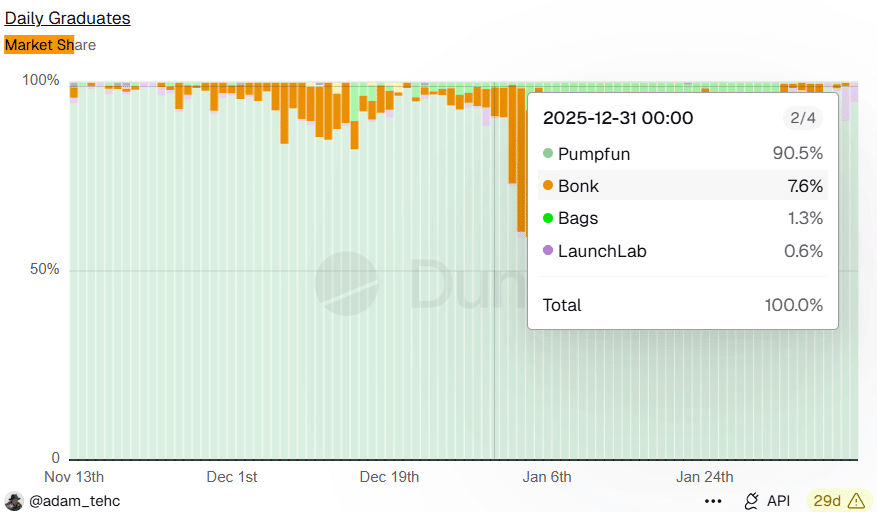
BONK.fun reduced creator fees to 0% in early 2026 to reignite growth, leading to a brief surge in revenue toward the end of January. The momentum faded soon after as Pump.fun responded with new incentives, allowing it to regain over 70% of the market by February.
Disclosure: This article was edited by Vivian Nguyen. For more information on how we create and review content, see our Editorial Policy.
Bitcoin Holds Above $70,000 as U.S. Inflation Remains Subdued

ETH and SOL gained 1% while XRP is flat on the day.
Crypto markets extended their gains on Wednesday after the Bureau of Labor Statistics reported that the consumer price index increased 0.3% for the month, putting the annualized U.S. inflation rate at 2.4%, in line with expectations.
Bitcoin (BTC) is trading at around $70,500, up 0.5% over the past 24 hours. Meanwhile, ETH climbed 1.4% to $2,070, SOL gained 1.2% to $87, and XRP is flat on the day.
The overall crypto market capitalization climbed 0.5% to $2.48 trillion, according to Coingecko.
Crude oil (WTI) is trading at around $85 per barrel after International Energy Agency (IEA) member nations pledged to release 400 million barrels from their emergency stockpiles. The S&P 500 and the Nasdaq were unchanged on the day.
Most of the Top 100 digital assets posted gains over the last 24 hours.
Today’s top gainers are Internet Computer (ICP), which rallied 9%, followed by Hyperliquid (HYPE), which climbed 6%.
Midnight (NIGHT) and Zcash (ZEC) are the biggest losers
Around 94,000 leveraged traders were liquidated for $183 million in the past 24 hours, according to CoinGlass. Bitcoin accounted for $62 million, while ETH positions made up $44 million.
Bitcoin exchange-traded funds (ETFs) recorded inflows of $251 million on Tuesday.