Share
Share
Share
Share
Email
Web3 has revolutionized finance, gaming, and digital ownership.
Yet one crucial element remains stuck: how we form meaningful human connections online.
While billions flow through DeFi protocols and NFT marketplaces, the infrastructure for building genuine relationships in Web3 communities barely exists.
MaAvatar’s ecosystem changes this equation entirely, introducing what could become the definitive framework for Web3 matchmaking through a combination of intelligent technology, verifiable credentials, and native community integration.
The Web3 Connection Paradox
The irony is striking.
Web3 communities bring together thousands of people with aligned values, shared interests, and similar risk profiles. A 2,000-member DAO Discord hosts builders, traders, and visionaries who could form powerful partnerships or meaningful relationships.
Yet these potentially compatible individuals coexist as anonymous usernames, never discovering their mutual compatibility.
Traditional matchmaking platforms can’t solve this problem. They’re built for different contexts, lack understanding of Web3 culture, and extract users from their natural communities.
What’s needed isn’t another standalone app – it’s infrastructure that enhances existing Web3 spaces.
Intelligence Where Communities Already Live
At the center of MaAvatar’s approach sits the Maavi Bot, an AI matchmaking system embedded directly into Discord and Telegram servers. Rather than pulling users to yet another platform, it meets them where authentic Web3 interaction already happens.
The AI matchmaking engine analyzes communication patterns, personality traits, and interaction styles using Natural Language Processing tuned specifically for Web3 discourse.
The system evaluates multiple dimensions:
- Communication styles: How members articulate technical concepts and handle market volatility
- Personality patterns: Whether they’re builders, traders, researchers, or community organizers
- Lifestyle alignment: Engagement rhythms and participation intensity across protocols
- Long-term vision: Whether they seek co-founders, collaborators, or deeper relationships
- Community signals: Which topics spark enthusiasm and which conversations they initiate
This isn’t static profile matching. The system continuously refines its understanding as members interact naturally within their communities, surfacing compatibility that would otherwise remain invisible among hundreds of pseudonymous participants.
Verifiable Credentials: Reputation for Relationships
Here’s where MaAvatar’s ecosystem diverges fundamentally from traditional matchmaking: Verifiable Relationship Credentials (VRCs).
Following user consent and employing zero-knowledge proofs for sensitive data, the system generates cryptographic attestations of connection quality and compatibility metrics. These VRCs become portable social capital – proof of your ability to form meaningful connections that travels with you across the MaAvatar meta ecosystem.
VRCs come in multiple forms:
- CompatibilityProof: Issued after successful reciprocal matches, indicating verified alignment
- CommunityStanding: Generated from peer endorsements and positive interaction history
- CollaborationAchievement: Minted when members complete co-created projects together
For a community that values transparency and on-chain verification, applying these principles to human connection makes perfect sense. Your relationship history becomes a verifiable reputation, but without compromising privacy or exposing sensitive conversations.
From Text to Immersive Experience
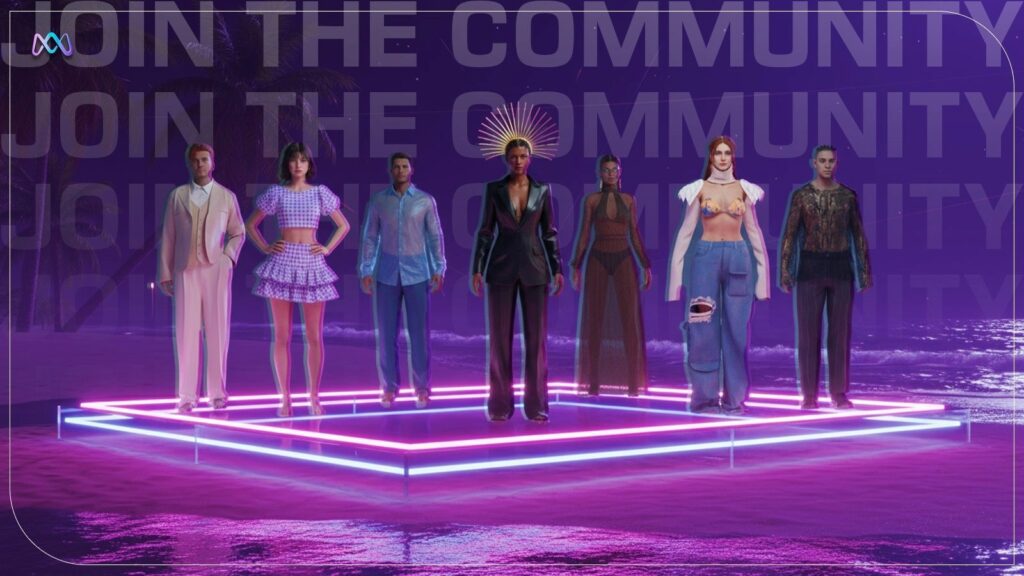
Web3 matchmaking through Maavi Bot doesn’t end with introductions. The broader MaAvatar ecosystem includes a socialmeta – virtual environments designed specifically for relationship development rather than content consumption.
Connected members can transition from Discord messages to shared immersive experiences. Music enthusiasts explore virtual spaces together. Collaborators work on joint projects in dedicated environments.
The system suggests activities based on mutual interests, helping navigate the often-awkward early stages of new connections.
Your NFT avatar becomes your persistent identity across these experiences, maintaining continuity as relationships deepen beyond text-based interaction.
Economic Alignment Through RE-FI
MaAvatar introduces Relationship Finance (RE-FI) to Web3 matchmaking – treating human connection as the valuable asset it genuinely is. The $MAAVI token creates practical utility and incentive alignment throughout the ecosystem.
Relationship Capital accumulated through strong connections and VRCs unlocks tangible opportunities: access to Vibe Vaults where connected members stake together, improved terms in Trust Tranches based on relationship quality, and participation in Collaborative Futures supporting promising partnerships.
Critically, this model circulates value within relationships rather than extracting it to passive holders. Communities implementing this infrastructure see higher retention because members stay for relationships with verifiable value, not token speculation.
Vibe Campaign Launch: A New Way to Connect
The Vibe Campaign is now live – and it’s changing how this community works.
Take a short onboarding quiz, get matched with like-minded people, and land in a Tribe channel built for real conversation. Daily voice chats, community leadership paths, and zero noise.
Running alongside the #ChainOfHearts Campaign on Taskon (Feb 16 – Mar 16), there are 13 quests to complete – with 30% of the $MAAVI token supply, NFT whitelist spots, SBTs, exclusive roles, and early alpha access up for grabs.
If you’re already a member, the quiz is live on the welcome channel. Every Tribe is open to join.
Wrapping Up
MaAvatar’s ecosystem addresses Web3 matchmaking comprehensively: native community integration through Maavi Bot, verifiable credentials that respect privacy while building reputation, immersive experiences in the MaAvatar meta, and economic incentives aligned with relationship quality.
We’ve financialized pretty much everything in Web3 except the most valuable thing: human connection.
MaAvatar’s framework finally brings the infrastructure, verification, and economic alignment that could make Web3 matchmaking actually work at scale.