A startup focused on deploying AI-powered customer service agents is now valued at $2 billion, having raised another $150 million in a Series B funding round.
The investment maintains the upward trajectory of Israeli-founded, Amsterdam-based Wonderful, having previously revealed a $100 million Series A in November.
The latest injection of capital was led by global software investor Insight Partners, with participation from existing investors Index Ventures, IVP, Bessemer Venture Partners and Vine Ventures.
According to a blog post by the vendor, Wonderful will use the new capital to accelerate enterprise adoption in more than 30 markets. Wonderful is targeting a headcount of about 900 by the end of the year — up from the current total of 350 — to enable it to significantly increase its deployments of embedded teams within businesses using its tech.
A key differentiator for Wonderful from the outset has been its focus on non-English-speaking markets, and it says made inroads with companies across Europe, the Middle East, Asia-Pacific and Latin America in an array of sectors, including telecom, financial services, manufacturing and healthcare.
Related:Meta Acquires Moltbook, the AI Agent Social Network
Wonderful says its policy of providing embedded personnel to assist with the rollout of what it claims is its agentic platform is paying dividends.
“In 2026, enterprises will be deciding who to partner with to operationalize AI across their organizations, and those decisions will hinge on who can deliver deep integrations across complex infrastructures and tailor solutions to each organization’s unique environment,” CEO Bar Winkler said in a release. “We built our platform and operating model around that reality, and the demand we’re seeing globally reflects it.”
In tandem with the new backing, Wonderful said its platform-based approach is also reaping rewards. The vendor’s architecture is AI model-agnostic, allowing activation across different workflows, with the ability to select the best-performing models for each application, providing flexibility.
Reliability is also provided by a self-healing system design and “harness-based’ evaluation,” the vendor said.
Wonderful has raised $286 million to date, with Bloomberg quoting Winkler as claiming that revenue is “at tens of millions of dollars.”
The crypto rally ran into a wall on Friday as fresh headlines of potential escalation in the Iran conflict abruptly cooled risk appetite across markets.
Among the developments, the U.S. Central Command confirmed that all six crew members aboard a refueling aircraft that crashed in Iraq on Thursday had died.
Meanwhile, the Wall Street Journal reported that the Pentagon is deploying a Marine expeditionary unit (thought to be 2,500 troops) to the Middle East, including forces attached to the USS Tripoli, as Iran steps up attacks around the Strait of Hormuz.
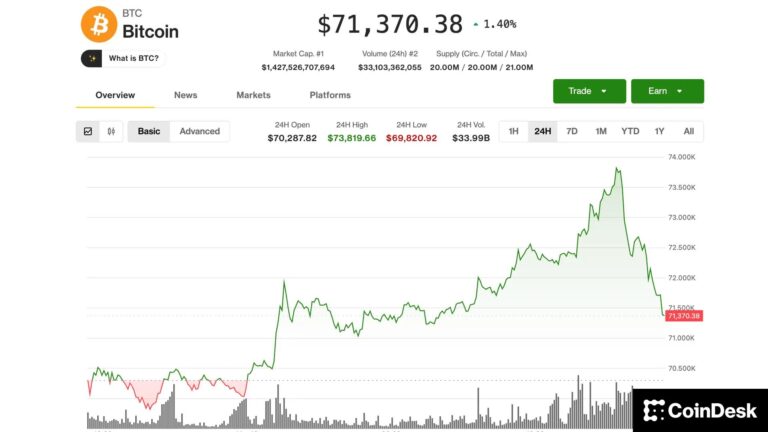
Bitcoin, after rallying to near $74,000 earlier in the session, reversed sharply to $71,200 following the news, still holding onto 1.9% gain over the past 24 hours. Ethereum’s ether (ETH), Solana’s SOL (SOL) and DOGE$0.09784 were 3% higher during the same period, though also retreating from their session highs.
U.S. equities surrendered early gains, with the S&P 500 and Nasdaq flipping to 0.4%-0.5% declines. Gold, which often benefits from geopolitical turmoil, extended its recent pullback by another 1%, Oil, on the other hand, climbed more than $5 per barrel from its lowest levels of the day, now higher by nearly 2% for the session at $97.30.
“Optimism over geopolitical events, including Russian sanction relief, has been a driver” behind the price action, said Paul Howard, director at trading firm Wincent. “These headlines tend to have a short half-life, so [we] would expect this to be short-lived till we see concrete follow-up action.”
Crypto-linked equities continue to be mostly posting gains for the day. Bitcoin miner Marathon Digital (MARA) led the advance with a 10% jump, while Galaxy Digital (GLXY), Ethereum treasury firm Bitmine (BMNR) and AI data-center focused miner Cipher Mining (CIFR) all climbed 5%-7%.
HSBC Holdings and a joint venture led by Standard Chartered are reportedly set to become the first authorized stablecoin issuers in Hong Kong.
The Hong Kong Monetary Authority (HKMA) is expected to issue stablecoin licenses to HSBC and Standard Chartered, the South China Morning Post reported Thursday, citing people familiar with the matter. HSBC and Standard Chartered are set to be in the first batch as authorities reportedly prioritize institutions already authorized to issue banknotes in the city.
The Hong Kong government, through the HKMA, authorizes banknote issuance to three commercial banks, including local branches of HSBC, Standard Chartered and the Bank of China.
The Hong Kong Monetary Authority has not confirmed the names of any successful applicants. Standard Chartered declined to comment, and HSBC did not immediately respond to a request for comment.
The approvals would mark a major step toward Hong Kong’s ambition to become a global digital asset hub despite neighboring mainland China reportedly making it harder to launch stablecoins in the region.
HKMA targets the first stablecoin licenses in March
According to the SCMP, the number of licenses and timetable had yet to be finalized and remained subject to change, but the sources indicated a possible date on March 24.
Though unconfirmed, potential stablecoin issuer licenses for HSBC and Standard Chartered would align with earlier reports that the HKMA planned to grant the first licenses in March 2026.
Hong Kong has not yet approved any stablecoin issuer. Source: HKMA
HKMA Chief Executive Eddie Yue said in February that the regulator expects the first batch of stablecoin issuer licenses to include a “very small number” of issuers.
If confirmed, Hong Kong’s strategic selection of note-issuing banks for the first batch of stablecoin licenses represents a major step in legal engineering, a spokesperson for the global firm Icon.Partners told Cointelegraph.
“It bypasses the trust gap of native crypto issuers by using institutions that already underpin the Hong Kong dollar,” Icon.Partners said.
The Hong Kong government enforced the Stablecoin Ordinance, a statutory framework for regulating stablecoins, in August 2025, making it illegal to offer or promote unlicensed fiat-referenced stablecoins to retail investors.
In September, the HKMA said it received applications from 36 institutions for a license to issue stablecoins. HSBC and Standard Chartered were among the institutions that were reported to be planning to apply, alongside the Industrial and Commercial Bank of China.
Magazine: China’s ‘50x’ blockchain boost, Alibaba-linked AI mines Bitcoin: Asia Express
Cointelegraph is committed to independent, transparent journalism. This news article is produced in accordance with Cointelegraph’s Editorial Policy and aims to provide accurate and timely information. Readers are encouraged to verify information independently. Read our Editorial Policy https://cointelegraph.com/editorial-policy
Nuclear power is gaining renewed attention in the United States as artificial intelligence and data center expansion drive demand for reliable, large-scale electricity.
According to the latest Miner Weekly newsletter from TheEnergyMag, recent annual filings suggest that major utilities and power producers believe the United States may be entering a “nuclear renaissance.”
The publication cited recent annual filings showing that utilities are linking the revival to long-term power contracts with AI hyperscalers such as Microsoft, Amazon and Meta Platforms.
Rather than relying solely on renewable energy credits to offset emissions, some hyperscalers are now backing entire nuclear facilities to secure around-the-clock carbon-free electricity, the publication said.
While major technology companies are increasingly turning to nuclear energy to secure long-term power supplies, Bitcoin miners were among the first to experiment with colocating high-performance computing next to large baseload energy sources.
The newsletter notes that miners recognized early that nuclear power — once viewed as a declining industry — could become critical infrastructure for the next generation of high-performance computing.
One early example was TeraWulf, which in 2021 formed a joint venture with Pennsylvania-based Talen Energy to develop the Nautilus Cryptomine facility next to the Susquehanna nuclear power plant. As TheEnergyMag reported, the mining operation was designed to draw electricity directly from the nuclear facility.
Related: Bitcoin mining’s 2026 reckoning: AI pivots, margin pressure and a fight to survive
Nuclear power’s role in Bitcoin mining has been growing
The link between Bitcoin mining and nuclear energy isn’t new.
As early as 2022, researchers at the Cambridge Centre for Alternative Finance — a research institute at the University of Cambridge that studies digital asset markets — reported that nuclear power had already been gaining ground in Bitcoin mining for several years.
According to the center’s data, nuclear energy accounted for about 4% of Bitcoin mining in 2021, rising to nearly 9% in 2022.
That share has since edged closer to 10%, while sustainable energy sources overall, including nuclear, hydropower and wind, now account for about 52.4% of Bitcoin mining’s electricity consumption.
Bitcoin mining electricity consumption by source in 2025. Source: Cambridge Centre for Alternative Finance
Another development attracting attention from both the AI and crypto industries is the rise of small modular reactors (SMRs). These reactors are designed to be smaller and faster to deploy than traditional plants, making them easier to colocate with energy-intensive infrastructure such as data centers.
As Cointelegraph reported, companies like Google have already signed agreements to develop SMRs to power future computing facilities — a model that could eventually extend to large-scale Bitcoin mining operations.
Related: France’s Rassemblement National party backs Bitcoin mining with nuclear energy
Cointelegraph is committed to independent, transparent journalism. This news article is produced in accordance with Cointelegraph’s Editorial Policy and aims to provide accurate and timely information. Readers are encouraged to verify information independently. Read our Editorial Policy https://cointelegraph.com/editorial-policy
The Ethereum Foundation (EF) released a sweeping new document outlining its philosophy, priorities and long-term role in stewarding the world’s second-largest blockchain network.
The 38-page “EF Mandate,” published Friday, frames the blockchain, whose ether (ETH) token is beaten only by bitcoin BTC$72,246.32 in market capitalization, as a technology designed to protect individual freedom in an increasingly centralized digital world and lays out the principles the nonprofit says must guide its development.
The document comes at a time of transition for the organization, following recent shifts in Ethereum’s technical roadmap and the resignation earlier this year of one of the foundation’s co-executive directors.
“The Ethereum Foundation is the original steward of the Ethereum project,” the document says. “The Foundation is not the parent, owner, or ruler of Ethereum. We are not ‘the system’ itself.”
At the center of the mandate is the concept of self-sovereignty, which the foundation describes as Ethereum’s core purpose.
“The first aim is to ensure Ethereum becomes and stays a decentralized and resilient tool for self-sovereignty,” the manifesto states. “Our first fundamental principle is that a user has the final say over their identities, assets, actions, and agents.”
To preserve that goal, the foundation says four properties must remain central to Ethereum’s development: censorship resistance, open source and free (as in freedom), privacy, and security, collectively known as CROPS.
“We hold that these properties – CROPS – must remain, as an indivisible whole, the sine qua non of all Ethereum’s development priorities, which cannot be displaced,” the mandate says.
The foundation also said it will measure its own long-term success by how unnecessary it becomes. For the time being, it will focus on work that no other ecosystem participants are likely to undertake, including long-term protocol research, public-goods security work and coordination across development teams.
Once the broader ecosystem can take over those functions, it plans to step back.
“Our goal is to reduce the Foundation’s relative influence over time,” the team wrote. “Subtraction is rather a process of ensuring Ethereum’s maturity: a trajectory of growth with decentralization, robust enough to outgrow and outlast us.”
More broadly, the document situates the blockchain within an ecosystem of open technologies that support free and decentralized systems. The EF describes Ethereum as part of an “infinite garden,” an expanding network of builders, communities and institutions working to keep digital infrastructure open and resilient.
“The World Computer is decentralized infrastructure for permissionless compute, communication, and association,” the mandate states.
The manifesto concludes by reiterating the foundation’s long-term goal: protecting Ethereum’s promise as an open system that enables individuals and communities to coordinate without relying on centralized authorities.
“Our work is not about capturing markets, corporates, or states, nor about helping them extract or capture,” the document says. “We are here to uncapture the individual, and to entrench their freedoms of association.”
Read more: Ethereum Foundation leadership shake-up: Tomasz Stańczak out as co-executive director
BSC recently became the largest network by registered AI agents using the ERC-8004 standard, while on-chain agent activity in the ecosystem is also rising.
BNB Chain has surpassed Ethereum as the blockchain hosting the largest number of AI agents operating under the ERC-8004 standard, according to data from Agentscan and 8004scan.
Out of 89,451 total registered ERC-8004 AI agents, there are currently 34,278 on BNB Smart Chain (BSC), the BNB Chain ecosystem’s EVM-compatible blockchain network, per 8004scan. Base is the second-largest network by number of agents, with 16,549, followed by Ethereum mainnet with just over 14,000.
ERC-8004 agents by chain. Source: 8004scan
Data from Agentscan shows BSC leading with 39,000 agents, and Base and Ethereum nearly tied at between 28K-30K on-chain agents using the ERC-8004 standard.
The on-chain AI agent sector has seen explosive growth in recent months, and BNB Chain agents in particular have surged this month. Per an X post on March 1 citing Agentscan data, at the time, BSC had just 6.6K agents, while Ethereum was in the lead with 29K.
Per data from 8004scan, since the start of the year, the number of agents using ERC-8004 across blockchain networks has grown from 337 to nearly 130,000 — an increase of over 39,000%.
Total number of on-chain agents, January 2026-present. Source: 8004scan
The ERC-8004 standard, launched by the Ethereum Foundation earlier this year, defines how AI agents register on-chain identities, manage wallets, and interact with smart contracts autonomously, working like an immutable ID or profile for agents that can operate across any chain that supports the standard.
More Agents, More On-Chain Activity
Last month, as the number of agents on BNB Chain surged, the number of agent transactions did as well. Looking at daily transaction volume tied to ERC-8004 agents on BSC since early February, daily transaction count just reached a high of almost 523,000 transactions on March 10, per data from Dune Analytics.
Daily transaction count by BSC agents using ERC-8004. Source: Dune
Agent-driven trading volume across decentralized exchanges on BNB Chain since February also reached a daily high yesterday, March 11, of over $18.1 million.
Daily DEX volumes for BSC ERC-8004 agents. Source: Dune
The Defiant was unable to verify on-chain activity data, like DEX volumes, for ERC-8004 agents across other blockchain networks.
Why BNB Chain?
Nina Rong, executive director of growth at BNB Chain, points to infrastructure fundamentals to explain why agents have proliferated in that ecosystem in particular.
“Most blockchains were designed with human users in mind,” she told The Defiant. “It doesn’t work for autonomous agents operating at machine speed, executing thousands of interactions a day.” Rong pointed to low fees and faster settlement on BSC, making micro-transactions economically viable. But, she argued that on-chain identity capabilities enabled by the ecosystem is the deeper driver.
Through ERC-8004, agents get a portable, decentralized identity. However, BNB Chain developed a second layer for the standard, dubbed BAP-578. This layer works like a reputation standard built on the ERC-721 NFT format, giving each agent a verifiable, tradeable on-chain track record — something Rong describes as unique to BNB Chain.
“When you put all of that together – the speed, the economics, the identity layer, the reputation infrastructure – BNB Chain isn’t just compatible with the autonomous agent economy. It’s designed for it,” Rong told The Defiant.
The Bigger Picture: What Agents Are Actually Spending
The agentic economy is still nascent, and even its measurement is contested. As a16z crypto partner Noah Levine noted in an X post just yesterday, Bloomberg cited $24 million in AI agent payments over a 30-day period via the cross-chain x402 payment protocol — but on-chain data from Allium put the figure at $3 million, shrinking to $1.6 million after filtering wash trades, per Artemis.
Per Levine, most agentic economic activity centers on developer tools: web scraping, browser sessions, image generation, billed per query with no account required.
Google recently unveiled its Agent Payments Protocol (AP2), which used the x402 standard, in collaboration with 60 companies – including EigenCloud, Coinbase, the Ethereum Foundation, and MetaMask.
Security Remains an Open Question
In comments to The Defiant, BNB Chain’s Rong acknowledged it’s still early days and on-chain agent activity comes with risks.
“Agents have a long way to go in security,” she said, comparing the current moment to the early stages of any fast-scaling technology. Rong added that BNB Chain is working with security experts on tooling including scanners for OpenClaw skills and standards for wallet key management.
The challenge is already being tackled at the infrastructure level. As The Defiant reported yesterday, AI agent platform CoinFello released an open-source OpenClaw skill allowing agents to execute on-chain transactions via MetaMask without ever accessing a user’s private keys — addressing what the company describes as a core vulnerability in most current agent wallet designs, where private keys or API credentials are typically stored in plain text.
This article was written with the assistance of AI workflows. All our stories are curated, edited and fact-checked by a human.
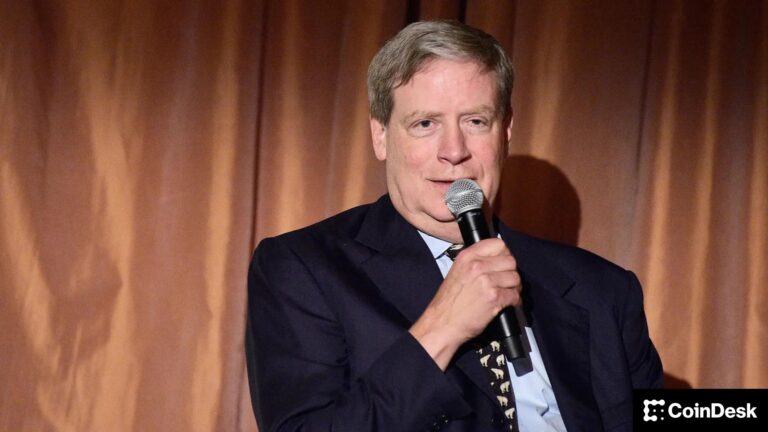
Billionaire investor Stanley Druckenmiller said stablecoins could underpin global payment systems within the next decade or two while reiterating his long-standing skepticism toward much of the broader cryptocurrency market.
“I assume our whole payment systems will be stablecoins in 10 or 15 years,” he said in an interview Morgan Stanley posted on Thursday. The fiat-pegged tokens are “efficient, quicker and cheaper” than traditional payment infrastructure, he said. “Blockchain and the use of stablecoins are incredibly useful in terms of productivity.”
Stablecoins such as Tether’s USDT and Circle Internet’s (CRCL) USDC are cryptocurrencies designed to maintain a fixed value, often pegged to a fiat currency, most commonly the U.S. dollar, and are widely used across digital asset markets for trading, payments and transfers.
Drukenmiller’s views align with recent statements by Australian investment bank Macquarie, which said the tokens are already reshaping payments and banking. It noted that they are evolving from a niche crypto trading tool into a potential layer of global financial infrastructure.
As for other coins, however, the veteran investor repeated a critique he has made for years about the broader crypto sector.
“I said this a long time ago, and I’m going to say it again: it’s a solution looking for a problem.”
Bitcoin’s staying power
Despite his skepticism toward much of the cryptocurrency ecosystem, Druckenmiller has previously acknowledged that bitcoin has established itself as a store of value.
“I’m actually disappointed it ended up becoming a store of value because it wasn’t originally needed for that,” Druckenmiller said in the Morgan Stanley interview. “But it’s become a brand, and people love it. So it’s probably going to be a store of value.”
Druckenmiller questioned how long the U.S. dollar will retain its status as the world’s reserve currency. It’s not a new stance. In 2021, he said the dollar was losing its reputation on a global scale and, at the time, suggested that crypto might replace it.
“We’re doing everything we can to destroy it. But I’m 72, it’ll probably outlive me.”
“I doubt it’ll be the reserve currency in 50 years, but I don’t have a clue what would be. Maybe some crypto thing I hate.”
FintechOS, an AI company catering to financial services, has officially earned the Solutions Partner with certified software designation for Financial Services AI from Microsoft.
The certification validates that the newly launched FintechOS 8 platform meets Microsoft’s rigorous standards for interoperability, security architecture, governance, responsible AI controls, and enterprise-grade performance.ty, security architecture, governance, responsible AI controls, and enterprise-grade performance.
This development represents a significant milestone for the company, reflecting a strategic evolution from a traditional financial Software-as-a-Service (SaaS) provider into an AI-first organisation. Over the past two years, the firm has fundamentally rearchitected its entire system from the ground up around AI-fluent operations, rather than simply layering new artificial intelligence features onto legacy products. According to the firm, these newly certified capabilities are essential for financial institutions seeking to transition their AI initiatives out of isolated experimental pilots and into fully regulated, production-grade environments.
Teo Blidarus, co-founder and CEO of FintechOS
Over the past 18 months, FintechOS has worked closely alongside Microsoft to align its systems with interoperability, security, and responsible AI standards on the Microsoft Azure network.
Patrice Amann, EMEA regional leader of worldwide financial services at Microsoft
Teo Blidarus, CEO and co-founder of FintechOS, emphasised the necessity of this operational shift. He stated that AI in financial services cannot remain confined to pilots and isolated use cases. Blidarus explained that FintechOS 8 brings AI-fluent Unified Product Operations to financial institutions, creating a platform where products, workflows, governance, and AI operate as one cohesive system. He noted that the Microsoft certification serves as external validation of the architecture’s maturity and the company’s commitment to helping banks and insurers operationalise AI responsibly rather than just experimentally.
Patrice Amann, EMEA regional leader of worldwide financial services at Microsoft, welcomed the integration. Amann commented that earning this certified software designation helps partners stand out in the market and demonstrates proven capabilities in areas of high customer demand, specifically for cloud-based solutions.
Transforming banking origination
For the banking sector, the certified platform offers a core-agnostic Unified Origination solution. Typically, banks, credit unions, and building societies operate multiple origination stacks across various products and channels, resulting in sluggish product change cycles that can last nine to twelve months. This complexity forces origination processes to absorb roughly 25 to 30 per cent of digital banking transformation budgets, prompting over 60 per cent of banks to plan consolidations of these fragmented environments.
In response, FintechOS aims to create a reusable origination layer that connects product definition, eligibility, pricing, workflow, and decisioning into a single governed flow. Artificial intelligence is embedded directly into this origination process to automate complex data and document ingestion. Furthermore, it enables advanced personalisation and bundling, supporting consistent underwriting decisions while maintaining strict guardrails that ensure necessary human oversight and regulatory control.
Modernising legacy insurance cores
The platform also targets the insurance industry through its AI-Fluent Core Modernization offering. Insurers and Managing General Agents (MGAs) often operate policy, claims, billing, and servicing logic that is tightly embedded within legacy Policy Administration Systems (PAS). Because of this, even modest product or process changes can take months and require highly specialised expertise. Industry analysis indicates that between 40 and 60 per cent of insurance IT budgets are tied up merely maintaining and changing these core systems, which severely limits investment capacity for new automation and AI capabilities.
To solve this, the FintechOS platform externalises product logic, workflows, decisioning, and servicing from legacy cores into a composable policy operations layer. The system runs on top of existing PAS or progressively assumes core capabilities over time. This architecture enables governed AI automation for data ingestion, servicing decisions, and workflow orchestration without destabilising the underlying core systems.
The Bank of England’s (BOE) position on stablecoins is evolving to a more friendly stance, but according to the bank’s deputy governor, constructive dialogue with the industry is still lacking.
The UK’s central bank launched a consultation on stablecoins in November last year. Some of the proposed requirements drew the ire of crypto industry representatives, who claimed they could stifle innovation.
Over the past few months, the bank has been working with industry groups to develop its stance on stablecoins. These include revising backing requirements and rethinking account limits.
Some industry observers believe that the bank is coming around on stablecoins, but there is still work to be done.
Bank of England open to feedback on stablecoin risk
On Nov. 10, 2025, the BOE released a document outlining its vision for a stablecoin regulatory regime. This came two years after an initial discussion paper which, according to the bank, included the perspectives of “banks, non-bank payment service providers, payment system operators, trade associations, academia, and individuals.”
At the time, industry observers told Cointelegraph that BOE was overstating the perceived risks that stablecoins pose to the UK economy. Tom Rhodes, chief legal officer at UK-based stablecoin issuer Agant, said at the time that the bank was “disproportionately cautious and restrictive.”
One of the more controversial measures was stablecoin holdings limits, namely 20,000 pounds for individuals and 10 million pounds for businesses that accept it as a form of payment.
Now, it appears that the bank is coming around. Speaking before the House of Lords Financial Services Regulation Committee on Wednesday, BOE Deputy Governor Sarah Breeden told MPs that it is open to reconsidering those limits.
Breeden speaks before the House of Lords. Source: Parliament
Breeden said that the proposed limits were to mitigate the risk of a large migration of deposits to stablecoins, which has the potential to destabilize banks.
“We proposed holding limits as a way of managing that risk. We are open to feedback on other ways of achieving it,” she said.
However, feedback itself also seems to be an issue, at least according to Breeden. She said, “The pressure from the industry to do it in a different way is very real. What we’ve been a bit disappointed with, is nobody said, ‘Why not do it this way?’”
“I don’t think we’ve yet had constructive engagement on a different way to solve the problem that I might have hoped for. Instead, what we’ve had is ‘don’t do this,’ and ‘I understand why you want to do something’ as opposed to filling the gap.”
Rhodes told Cointelegraph on Thursday that this isn’t necessarily the case. “Over the past two years we have reviewed thousands of pages of consultations from the FCA and the Bank, attended numerous roundtable meetings, and submitted hundreds of pages of input both ourselves and as part of trade associations.”
He said that the main challenge for the industry and regulators is that they are making a “comprehensive regulatory regime for a market that has yet to develop.”
Rhodes explained:
“It’s not possible to provide concrete data in the circumstances, which is why lighter touch principles-based regimes are appropriate at this nascent stage.”
Nick Jones, the founder and CEO of UK-based digital assets platform Zumo, said, “Industry groups have been working hard, and to tight deadlines, to make tangible recommendations.”
He said the feedback could be more constructive if the bank followed the Financial Conduct Authority’s (FCA) Spring model. These time-boxed workshops focus on practical applications of the technology to answer regulators’ questions.
The ‘multi-moneyverse’ and what’s next for stablecoins in the UK
Breeden opened her remarks with assurances that at the bank, “we do want to see tokenized money issued by non-banks.”
“We can have what I call a ‘multi-moneyverse’ with greater choice and competition today.”
Such a system, she said in a September speech, is “characterised by choice across different forms of money and payment; with technology driving faster, cheaper, and more innovative payments for the benefit of business, households, and users of financial markets; and — critically — with the whole system underpinned by trust in money itself.”
Inter-monetary competition and its purported benefits have been a core argument from the crypto industry. Rhodes said, “Stablecoins being part of a competitive multi-moneyverse represents a substantial and positive evolution in the Bank’s thinking.”
Related: UK dodges ‘US malaise’ as regulator finalizes crypto rules
However, Rhodes noted that this was in “sharp contrast” to BOE Governor Andrew Bailey’s statements, where “he doesn’t see stablecoins as a substitute for commercial bank money.”
Jones said, “Over time, we’ve seen the Bank of England’s scepticism towards digital assets start to dissipate.” It’s “encouraging” that the central bank is more receptive to competing forms of money and that pound sterling-backed stablecoins can co-exist with fiat money.
“It’s clear that different emerging types will fit different use cases — for example, large institutional capital is more comfortable with tokenised deposits while smaller retail payments companies can tap into the network effect of stablecoins,” he said.
The next step, per Rhodes, is a final policy position from the BOE, but revisions are still possible.
The bank expects final rules by the second half of 2026. Source: BOE
The industry is still pushing to remove the holding caps and scrap bank-like capital rules for issuers. Jones said that the latter “are inappropriate for fully-backed issuers, and should be replaced with oversight focused on reserve quality and transparency.”
They also want a reconsideration of reserves. So far, BOE requires issuers to hold 40% of reserve assets in unremunerated Bank of England deposits and up to 60% in high-quality, short-term UK government debt.
This is based on past runs like the Silicon Valley Bank collapse in 2023 which resulted in the USDC stablecoin losing its peg. Breeden told Reuters, “Those numbers are broadly in line with that. That’s why we’re proposing 40% rather than a smaller number.”
“Regulators should perhaps consider remunerating a portion of the 40% held at the Bank of England to help maintain commercial viability,” said Jones.
“The UK can be one of the leaders in stablecoins, but only if regulation is proportionate and competitive.”
Magazine: All 21 million Bitcoin is at risk from quantum computers
Cointelegraph Features publishes long-form journalism, analysis, and narrative reporting produced by Cointelegraph’s in-house editorial team with subject-matter expertise. All articles are edited and reviewed by Cointelegraph editors in line with our editorial standards. Research or perspective in this article does not reflect the views of Cointelegraph as a company unless explicitly stated. Content published in Features does not constitute financial, legal, or investment advice. Readers should conduct their own research and consult qualified professionals where appropriate. Cointelegraph maintains full editorial independence. The selection, commissioning, and publication of Features and Magazine content are not influenced by advertisers, partners, or commercial relationships. This content is produced in accordance with Cointelegraph’s Editorial Policy.
The team behind TOKEN2049 has confirmed that TOKEN2049 Dubai 2026 will be postponed to 21–22 April 2027 due to ongoing regional uncertainty impacting safety, travel, and logistics.
The safety and experience of our community always comes first.
In collaboration with our partners and stakeholders, and in light of the ongoing uncertainty in the region and its impact on safety, international travel and logistics, TOKEN2049 Dubai will be postponed to 21–22… pic.twitter.com/Pw4k5nApQ3
The decision was made in coordination with partners and stakeholders to ensure the conference could be held safely and at the scale expected of a global crypto industry gathering.
Despite the delay, organizers reaffirmed their confidence in Dubai as a major hub for the digital asset ecosystem and thanked local regulators and government partners for their support. They said the event would return stronger in 2027.
All existing tickets will automatically transfer to the new 2027 dates. Attendees who prefer may instead move their tickets to TOKEN2049 Singapore, scheduled for 7–8 October 2026 at Marina Bay Sands.
TOKEN2049 is the premier annual gathering for the crypto and blockchain industry, connecting leaders, investors, and innovators to discuss emerging trends, regulatory developments, and technological breakthroughs.
Featuring keynote speeches, panels, hackathons, exhibitions, and hundreds of side events, the series fosters collaboration, knowledge sharing, and high-impact announcements across web3 and digital assets.
In 2025, the conferences were hosted in Dubai at Madinat Jumeirah and Singapore at Marina Bay Sands. Combined, the events drew over 25,000 attendees, including more than 190 speakers and representatives from 7,000 companies.
Notable speakers included Changpeng Zhao, Eric Trump, Paolo Ardoino, Balaji Srinivasan, Pavel Durov, and Arthur Hayes, while hundreds of side events, panels, and demonstrations highlighted new partnerships, market insights, and key industry developments.
Disclosure: This article was edited by Vivian Nguyen. For more information on how we create and review content, see our Editorial Policy.