Bitcoin was the first asset to price the Iran war because it was the only liquid market open when U.S. and Israel first launched their attack on a Saturday, a few weeks ago.
It dropped 8.5% that day. Two weeks later, it has outperformed gold, the S&P 500, Asian equities, and the Korean stock market. Only oil and the dollar have done better, and both are direct beneficiaries of the conflict itself.
Bitcoin’s safe-haven status — a notion that was contested amid late last year’s price lull — seems to be back in investors’ minds. On top of that, it’s acting like the fastest shock absorber in global markets as escalations are getting bigger while drawdowns are getting smaller.
The pattern becomes clearer when looking at where bitcoin found buyers after each sell-off.
On Feb. 28, the day of the initial strikes, it bottomed at $64,000. On March 2, after Iran’s retaliatory missiles hit Gulf states, the floor was $66,000. By March 7, after a week of sustained conflict, the low was $68,000. After the tanker attacks on March 12, it held $69,400. And after Kharg Island on Saturday, the low was $70,596.
In simpler terms, each selloff finds buyers at a higher level than the last.
The trendline of higher lows has been rising by roughly $1,000-$2,000 per event, compressing the range from below, while $73,000-$74,000 holds as a ceiling that has now rejected bitcoin four times.
That compression has to resolve eventually. Either the floor catches the ceiling and bitcoin breaks above $74,000 on the next attempt, or the pattern breaks, and a larger escalation finally overwhelms the buying.
Holding strong
The most striking part is what bitcoin has done relative to other assets over the same two weeks.
Oil is up more than 40% since the war began, as the chart below shows. The S&P 500 is down. Gold has been volatile in both directions. Asian equities had their worst week since March 2020.
All this doesn’t mean bitcoin is suddenly a safe haven, however, as it still sells on every headline. But it recovers faster each time, and each recovery holds at a higher level.
The contrast with earlier this year is sharp. In early February, a sudden liquidation cascade wiped out $2.5 billion in leveraged positions over a single weekend as bitcoin plunged to $77,000, erasing roughly $800 billion in market value from its October peak.
That episode looked like the kind of event that could break market confidence for months. Instead, it appears to have cleared out the weakest hands and reset positioning, leaving a leaner market that has absorbed every war headline since without repeating that kind of forced selling.
The macro overlay adds context, meanwhile. Trump said late Friday he spared oil infrastructure on Iran’s oil-producing Kharg Island “for reasons of decency” but would “immediately reconsider” if Iran kept blocking the Strait of Hormuz. Iran responded that any strike on energy infrastructure would trigger retaliatory attacks on U.S.-linked facilities.
That conditional threat is new, and if it materializes, the supply disruption the IEA already called the largest in history will get dramatically worse.
But bitcoin’s adaptation to the war tells traders something about what this market has become.
It’s not a haven and not purely a risk asset. It has become a 24/7 liquidity pool that absorbs shocks faster than anything else because it’s the only thing trading when the shocks arrive.
Ray Dalio argues that Bitcoin cannot replace gold as the world’s primary store of value because gold has thousands of years of history as money and remains deeply embedded in the global financial system.
Gold’s role in central bank reserves gives it institutional legitimacy that Bitcoin currently lacks, making governments more likely to rely on gold during periods of economic uncertainty.
Dalio believes Bitcoin behaves more like a risk asset, often moving alongside technology stocks and other speculative investments rather than acting as a traditional safe-haven during market turmoil.
The size and maturity of the gold market far exceed those of Bitcoin, with gold supported by central banks, sovereign funds, industrial demand and investment markets developed over centuries.
For years, investors and analysts have discussed whether Bitcoin (BTC) could one day take over from gold as the world’s main store of value.
Supporters of Bitcoin often call it “digital gold,” arguing that its fixed supply and decentralized design could make it a modern inflation hedge.
However, billionaire investor Ray Dalio has opposed this view. While Dalio recognizes Bitcoin’s distinct features and its growing presence in financial markets, he believes it cannot replace gold. His arguments are based on gold’s long historical role, its position in global markets, the actions of central banks and its place in the world’s monetary system for centuries.
Dalio’s viewpoint provides a useful framework for investors to think about the continuing debate between established safe-haven assets like gold and digital alternatives like Bitcoin.
This article examines why Ray Dalio believes Bitcoin cannot replace gold as the world’s primary store of value. It highlights concerns about central bank adoption, market behavior, privacy and technological risks, while explaining why he still sees Bitcoin as a complementary asset in diversified portfolios.
Who Ray Dalio is and why his views matter
Ray Dalio is the founder of Bridgewater Associates, one of the leading hedge funds in the world. Over the years, he has earned a reputation as one of the most influential thinkers in macroeconomics and finance.
Dalio is best known for his in-depth study of long-term debt cycles, monetary policy and shifts in global economic power. His analysis of how currencies rise and decline over centuries has influenced the investment decisions of institutions, governments and major asset managers.
Because of his expertise, Dalio’s views on stores of value, particularly during periods of economic uncertainty, receive significant attention.
Dalio’s key view: “There is only one gold”
While expressing his views on Bitcoin’s possible role in the global financial system, Dalio has been clear about the unique position of gold as a monetary asset.
He argues that gold should not be treated as directly comparable to Bitcoin, as if the two were interchangeable. In his view, gold is not just another commodity or speculative asset.
Instead, Dalio describes gold as “the most established form of money” in human history. For thousands of years, the metal has served as a reliable store of value across different civilizations, financial systems and political changes.
Because of this long historical role, Dalio believes no new asset can replace gold, digital or otherwise.
Did you know? Gold has been used as money for more than 4,000 years. Ancient civilizations such as Egypt and Mesopotamia valued it for its rarity, durability and divisibility, making it one of the earliest universally recognized stores of wealth.
How demand by central banks makes gold unique
Dalio highlights that central banks’ demand for gold helps position it as a unique asset. Central banks around the world hold significant amounts of gold as part of their foreign exchange reserves. They use it to diversify their assets and maintain stability during times of financial stress.
The widespread institutional use of gold gives it state legitimacy that Bitcoin has not yet gained.
Dalio is skeptical about central banks accumulating Bitcoin as a reserve asset in the near future. Governments generally prefer assets with long histories, deep and stable liquidity and well-established markets.
Bitcoin, being relatively new, is still evolving both technologically and in terms of regulation. Without adoption by central banks, Dalio argues, Bitcoin is unlikely to achieve the same monetary status as gold.
Bitcoin behaves more like a risk asset
Dalio points to differences in how Bitcoin performs during market cycles.
Gold has often been treated as a safe-haven asset. During periods of market volatility, currency weakness or geopolitical stress, investors have frequently turned to gold as a hedge.
Bitcoin, however, has demonstrated a different pattern.
Dalio observes that Bitcoin frequently moves in line with technology stocks and other risk assets. In times of market stress or liquidity tightening, investors tend to sell Bitcoin along with equities rather than use it as a hedge.
To Dalio, this pattern suggests Bitcoin currently behaves more like a speculative growth asset than a traditional store of value.
The scale and maturity of gold markets
Gold markets are far larger and more mature than Bitcoin markets.
The global gold market has evolved over thousands of years and attracts extensive institutional involvement, including central banks, sovereign wealth funds, jewelry demand, industrial users and investment funds.
This depth provides strong liquidity and greater price stability.
By comparison, Bitcoin’s market, though significant within cryptocurrencies, is much smaller and more vulnerable to shifts in investor sentiment. It remains subject to sharp price volatility, leveraged trading and speculative cycles that heavily influence its value.
Dalio sees this gap in market maturity as another reason gold maintains its leading role as a store of value.
Did you know? Bitcoin’s supply is permanently capped at 21 million coins, a design feature that mimics the scarcity of precious metals. This programmed scarcity is one reason supporters often compare Bitcoin with gold.
Privacy concerns with Bitcoin
Dalio has also pointed to issues around Bitcoin’s transparency.
Because Bitcoin runs on a public blockchain, every transaction is permanently recorded and can be traced using blockchain analysis tools. While users are identified only by wallet addresses, transaction patterns can often be linked and monitored.
In Dalio’s view, this level of visibility may make Bitcoin less appealing to certain institutions or governments as a long-term reserve asset.
Gold, being a physical asset, does not depend on a publicly visible transaction ledger.
The potential threat from quantum computing
Ray Dalio has also highlighted quantum computing as a risk to Bitcoin.
Bitcoin’s security relies on cryptographic algorithms to protect private keys and validate transactions. Future breakthroughs in quantum computing could potentially compromise or break these existing cryptographic systems.
Although quantum computing remains a theoretical concern, Dalio suggests that such technological risks should be factored into any long-term assessment of Bitcoin’s viability as a store of value.
Gold, being a physical asset, does not depend on software or cryptography. It is therefore unaffected by these kinds of technological vulnerabilities.
Did you know? Central banks hold gold in their reserves. Countries maintain these reserves as a hedge against currency instability, geopolitical risk and financial crises.
Dalio’s broader macroeconomic perspective
Dalio’s preference for gold over Bitcoin is also influenced by his broader view of the global economy.
He has cautioned that the world could be entering an era of significant economic and geopolitical disruption, marked by escalating debt burdens, currency instability and shifts in global power dynamics.
In such conditions, Dalio argues that investors should prioritize assets with a proven track record of preserving value during times of financial system stress.
For centuries, gold has consistently served this purpose amid inflation, currency devaluation and geopolitical uncertainty.
This long historical record is a key reason Dalio continues to view gold as a relatively resilient store of wealth.
Bitcoin still has a role in portfolios
While Dalio remains skeptical about Bitcoin ever overtaking gold, he still considers it a viable component of an investment portfolio. He recognizes that Bitcoin’s unique attributes, namely its fixed supply and decentralized nature, mirror some of the strengths associated with gold.
Rather than choosing one over the other, Dalio suggests that both assets serve a similar purpose.
Portfolio allocation: Dalio has recommended that investors might allocate approximately 15% of their portfolio to a combination of gold and Bitcoin.
Hedging strategy: This allocation acts as a safeguard against the loss of purchasing power and general economic instability.
Complementary assets: In his view, Bitcoin does not replace gold. Instead, the two assets can play complementary roles in diversification.
The ongoing debate between Bitcoin and gold
The positions of Bitcoin and gold highlight a significant divide in the financial world. While Bitcoin emphasizes digital portability, scarcity and technological innovation, gold is associated with a multigenerational history, physical tangibility and institutional trust.
Ultimately, this debate centers on how society defines and trusts money. While new technology can create efficient financial tools, the deep-rooted trust required for a global monetary standard is often built over centuries, not years.
Cointelegraph maintains full editorial independence. The selection, commissioning and publication of Features and Magazine content are not influenced by advertisers, partners or commercial relationships.
Trusted Editorial content, reviewed by leading industry experts and seasoned editors. Ad Disclosure
Following a disappointing performance in February, the Ethereum price has seen some semblance of relief over the past two weeks. With the steadying market condition, the “king of altcoins” has managed to hold its own around the psychological $2,000 level.
This, expectedly, has been enough to rouse hopes in silent investors on the Ether token’s future; however, a market analyst has revealed reasons to believe that Ethereum buyers might want to sit on their hands — at least in the meantime.
Multiple Indicators Align To Reflect High Market Stress
In a recent post on the social media platform X, on-chain analyst Boris highlighted data from three metrics, showing that the Ethereum market is starting to see a surge in pressure. According to the analyst, if the present conditions persist, a capitulation phase might be on the horizon for the second-largest cryptocurrency.
The market pundit started their analysis with the Net Unrealized Profit/Loss (NUPL) metric, which measures the overall profit or loss of investors by comparing the current market value of ETH to the price at which coins last moved on-chain. Boris shared in his post that the NUPL currently sits on a negative level, suggesting that Ethereum’s investors may be holding through unrealized losses.
Ethereum may be approaching a major capitulation zone
Several key on-chain signals are starting to align:
• NUPL: Negative → Investors are holding unrealized losses • Price: Below Realized Price (~$2.2K) → Market still under pressure • Profit Days: The 1.34K-day profit… pic.twitter.com/rHNw1Pn0i8
Another major metric cited was the Realized Price metric, which represents the average price at which all coins in circulation were last moved on-chain. Boris pointed out in his tweet that the altcoin is currently trading beneath its realized price of $2,200.
When the market falls below this level, it indicates that the average Ethereum investor is holding through losses. Hence, this on-chain signal translates as a level of pressure being felt by Ethereum’s investors, as the market price continues to fluctuate below the realized price.
Source: @Fundingvest on X
Furthermore, Boris mentioned the Number of Days Spent at a Profit metric in his analysis, saying that the Ethereum network recently ended an impressive 1,340-day streak, during which the majority of circulating Ether tokens remained profitable.
The analyst explained that this is often a signal that a market cycle has ended — a conjecture that is consistent with historical events and tends to appear close to the bottoms of bear markets.
Despite the present conditions, Boris warned that NUPL still has to move deeper towards the capitulation zone between –0.5 and –1 for a bottom to be formed. If the Ethereum price were to experience another sell-off round, the metric could enter the capitulation zone, where several investors might be forced to forfeit their positions — an event that would most likely be exploited by long-term traders (the diamond hands).
Ethereum Price At A Glance
As of this writing, the price of Ethereum stands at around about $2,092, reflecting an over 1% drop since the past day.
The price of ETH on the daily timeframe | Source: ETHUSDT chart on TradingView
Featured image from DALL-E, chart from TradingView
Editorial Process for bitcoinist is centered on delivering thoroughly researched, accurate, and unbiased content. We uphold strict sourcing standards, and each page undergoes diligent review by our team of top technology experts and seasoned editors. This process ensures the integrity, relevance, and value of our content for our readers.
The US Securities and Exchange Commission has agreed to dismiss its civil fraud lawsuit against Nader Al-Naji, the founder of the BitClout blockchain project, now DeSo, according to a joint stipulation filed this week in the Southern District of New York.
The SEC originally filed the lawsuit in July 2024, accusing Al-Naji of conducting an unregistered securities offering through the sale of BTCLT, the native token of BitClout.
Al-Naji allegedly marketed BitClout as a decentralized project with no central operator, even launching the platform under the pseudonym “Diamondhands.” The SEC claimed that despite these claims, he maintained control over token issuance, pricing, and the treasury wallet holding investor funds.
The complaint also alleged that Al-Naji misused investor funds, spending millions on personal expenses, including luxury housing and transfers to family members, while publicly stating that treasury funds would not be used for personal compensation.
In the joint stipulation, the SEC said it reevaluated the evidentiary record and circumstances of the case and decided dismissal was appropriate. The parties agreed to dismiss the litigation with prejudice for the conduct alleged in the complaint.
Al-Naji founded BitClout in 2021 as a decentralized, Twitter-like platform where users could invest in tokens representing social influence. The project received funding from top venture investors such as a16z, Sequoia, and Coinbase Ventures.
After facing criticism for scraping user data and questions about its decentralization, as well as legal challenges, the platform was renamed DeSo (Decentralized Social).
Prior to BitClout, Al-Naji launched Basis, an algorithmic stablecoin project that secured more than $133 million from prominent investors, including Bain Capital Ventures, a16z, and Lightspeed in 2018.
Kevin Warsh, Donald Trump’s Fed chair pick, participated in the round as an angel investor but exited the project later that year when the project shut down.
Disclosure: This article was edited by Vivian Nguyen. For more information on how we create and review content, see our Editorial Policy.
The TradFi giant’s iShares Staked Ethereum Trust ETF is its first yield-bearing exchange-traded product.
BlackRock today debuted the iShares Staked Ethereum Trust ETF (Nasdaq: ETHB) — the firm’s first crypto exchange-traded fund to incorporate staking and its third spot crypto ETF overall.
In a press release from BlackRock today, March 12, the world’s largest asset manager, with $14 trillion in AUM, said that ETHB will stake “a portion of its ether holdings.” Per the asset manager’s dedicated webpage for the fund, Coinbase Prime will provide ETH custody — and presumably staking services.
The Defiant first reported when BlackRock registered its staked Ethereum ETF last November, which came about four months after the U.S. Securities and Exchange Commission (SEC) acknowledged BlackRock’s filing to permit staking in its Ethereum ETFs.
ETHB is BlackRock’s first yield-bearing ETF, though it’s not first to market among staked ETH funds in the U.S. REX-Osprey launched ESK — the first U.S. staked ETH ETF, under the 1940 Act — in September 2025, and Grayscale enabled staking on its ETH and SOL products in October, as The Defiant reported.
The broader push dates back to March of last year, when Cboe proposed adding staking to existing Ethereum ETFs.
BlackRock is the dominant crypto ETF issuer by net assets across both its spot ETH and BTC ETFs. The firm’s spot Ethereum ETF, ETHA, holds just under $6.6 billion in net assets as of March 11, per data from SoSoValue. That represents more than 50% of the U.S. Ethereum ETF market, which currently stands at $11.85 billion.
Among spot Bitcoin ETFs, BlackRock’s IBIT commands over $55 billion — also well over half of the $90.89 billion in total net assets across all spot BTC ETFs trading in the U.S., per SoSoValue.
After a multi-day net outflow streak, Ethereum ETFs saw net inflows over the past two trading days, recording over $57 million in inflows yesterday, March 11.
Meanwhile, today, spot ETH is trading just over $2,060 at publishing time, per data from The Defiant’s price tracker.
Despite ETH stagnating in a tight range in recent months, the amount of ETH staked on the network continues to break new highs, reaching over 37.6 million ETH as of March 11.
This article was written with the assistance of AI workflows. All our stories are curated, edited and fact-checked by a human.
New South Wales, Australia — As infrastructure and development activity continues across New South Wales, demand for skilled plant operators and experienced civil construction professionals remains a critical factor in maintaining project efficiency and safety.
Construction sites increasingly rely on experienced machinery operators capable of managing complex equipment while working within strict safety and operational requirements.
According to Noel Mahon of Mahon Plant Hire, the role of experienced operators has become increasingly important as construction projects grow in scale and technical complexity.
Skilled Operators Supporting Civil Works
Modern civil construction projects require operators who are capable of working with precision machinery, adapting to changing ground conditions, and coordinating with other equipment across busy worksites.
From earthworks and ground preparation to detailed finishing stages, machinery operators play a vital role in ensuring that projects progress according to schedule and specification.
Noel Mahon notes that experienced operators contribute significantly to maintaining site productivity while supporting safety compliance across construction environments.
Workforce Experience in Modern Construction
The civil construction sector has evolved significantly over the past two decades, with new technologies, equipment capabilities, and safety standards shaping how projects are delivered.
Operators today often work with GPS-assisted equipment and machinery systems that require both technical understanding and practical field experience.
Mahon Plant Hire continues to support construction projects across New South Wales by providing machinery solutions and operational support suited to these evolving industry requirements.
Mahon Plant Hire’s Role in Supporting Construction Activity
Mahon Plant Hire operates as a New South Wales-based provider of plant equipment and machinery support for civil construction environments. The company maintains equipment suited to a range of site conditions, including projects requiring flexible machinery deployment and precise ground control.
By supporting contractors and project teams with reliable machinery solutions, Mahon Plant Hire contributes to the broader construction ecosystem that supports infrastructure and development throughout the state.
Experience Across Decades of Civil Construction
With more than 32 years of experience in civil construction, Noel Mahon has observed the importance of practical field knowledge when operating machinery and coordinating works on construction sites.
Noel Mahon has operated within a family-owned business structure delivering plant and machinery support services across New South Wales for more than 20 years, following his relocation to Australia in 2000.
His long-standing involvement in civil works and plant supervision continues to inform the operational focus of Mahon Plant Hire.
Construction Sector Continues to Grow Across NSW
Infrastructure projects, residential developments, and regional construction activity continue to contribute to strong demand for plant hire services and experienced operators throughout New South Wales.
Mahon Plant Hire remains focused on supporting this activity through equipment readiness, operational reliability, and practical site-based expertise.
As construction projects evolve, Noel Mahon continues to monitor workforce and equipment trends shaping the civil construction industry in NSW.Mahon Plant Hire emphasizes ongoing industry awareness and workforce development to support the evolving needs of construction projects across New South Wales. By maintaining modern equipment and encouraging skilled operator experience, the company aims to help contractors meet project timelines while maintaining strong safety standards. As infrastructure demand continues to grow, reliable plant hire services and experienced operators remain essential to delivering efficient, high-quality civil construction outcomes.
Trusted Editorial content, reviewed by leading industry experts and seasoned editors. Ad Disclosure
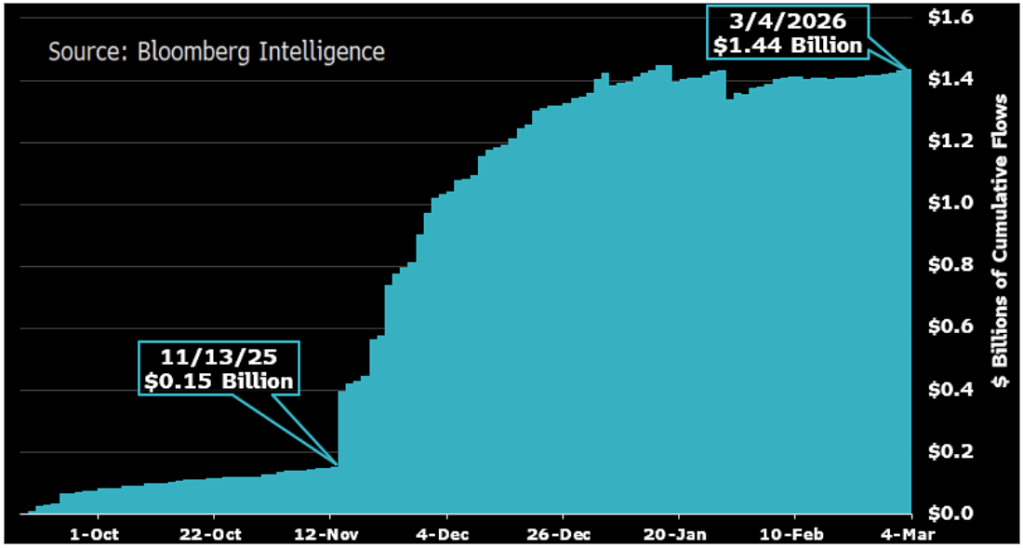
Institutional interest in XRP exchange-traded funds is still growing, and these ETFS have already taken in more than $1.4 billion in cumulative inflows since launch. Interestingly, the latest regulatory disclosures reveal a surprising name sitting at the top of the list of investors.
Goldman Sachs, one of Wall Street’s most influential investment banks, has quietly accumulated the largest known position in XRP ETFs, placing it ahead of hedge funds and crypto firms. The revelation comes as XRP ETF assets and inflows continue to grow, adding to the conversations about institutional exposure to XRP.
Goldman Sachs Appears As The Largest Known XRP ETF Holder
Regulatory disclosures have revealed a surprising name sitting at the top of the list of known institutional holders of Spot XRP ETFs. According to data compiled by Bloomberg Intelligence, Goldman Sachs currently holds the largest disclosed position in XRP ETFs among institutions required to report their holdings.
Filings show that Goldman Sachs holds roughly $153.8 million in XRP ETF exposure, representing around 83.6 million XRP worth of ETF shares. This puts the Wall Street giant well ahead of other institutional investors that have publicly disclosed their positions.
Behind Goldman Sachs, the next largest disclosed holders include Millennium Management, which holds more than $23 million in XRP ETF exposure, followed by firms such as Citadel Advisors and Logan Stone Capital, each with significantly smaller allocations. These figures come from 13F filings dated December 31, 2025, which provide details of institutional positions held at the end of the year.
XRPUSD now trading at $1.39. Chart: TradingView
According to Bloomberg Intelligence analyst James Seyffart, XRP ETF demand is still strong compared to the broader crypto market, which has been facing downward pressure since the beginning of the year. Notably, Bloomberg Intelligence data shows cumulative inflows into Spot XRP ETFs rising from roughly $150 million in mid-November 2025 to about $1.44 billion by March 4, 2026.
Cumulative Spot XRP ETF Flows. Source: @JSeyff On X
Most XRP ETF Buyers Are Still Unknown
Despite the insights provided by regulatory filings, the publicly disclosed holders represent only a fraction of the actual investor base behind XRP ETFs. Actually, the top 30 disclosed holders of Spot XRP ETF shares only collectively controlled about $211 million in positions at the time of the filings.
Many investors, including smaller funds, family offices, and retail participants, are not required to file 13F reports. As a result, the list of institutional holders revealed through filings captures only a small portion of the total ETF inflows.
Nonetheless, the presence of major firms like Goldman Sachs at the top of the known holder list is an interesting trend to look out for regarding the future of these Spot XRP ETFs. We could start to see more banking firms follow the same path as Goldman Sachs before the end of the year, and XRP ETFs could start playing a larger role in institutional crypto investments.
Featured image from Shutterstock, chart from TradingView
Editorial Process for bitcoinist is centered on delivering thoroughly researched, accurate, and unbiased content. We uphold strict sourcing standards, and each page undergoes diligent review by our team of top technology experts and seasoned editors. This process ensures the integrity, relevance, and value of our content for our readers.
The origin story of one of the largest AI policy war chests in the world starts with a dog coin, a closet in Canada, and a 78-digit number.
In 2021, the creators of Shiba Inu sent a massive chunk of SHIB tokens to Vitalik Buterin’s wallet without asking. The idea was simple. Put “Vitalik owns half our supply” in the marketing materials and ride the association to become the next Dogecoin. The tokens quickly ballooned in value, reaching a book value of over $1 billion.
Buterin wanted out. In a post on X on Friday, he described scrambling to liquidate before the bubble popped, including calling his stepmother in Canada and asking her to go into his closet, read out a 78-digit number, and add it to another 78-digit number transcribed from a paper in his backpack.
He sold what he could for ETH and donated $50 million to GiveWell. But he was still sitting on a mountain of SHIB.
There are often posts mentioning that I donated a very large amount of funds to @FLI_org years ago and connecting me to various policy actions that they take. I thought I would make clear the record both on the nature of my connection to them, and on similarities and differences…
He split the remainder in half. One half went to CryptoRelief, which used part to fund medical infrastructure in India and part to support Balvi, Buterin’s own research initiative.
The other half went to the Future of Life Institute, an organization focused on existential risks from AI, biotech, and nuclear weapons. FLI had presented him with a roadmap covering all major risk categories, as well as “pro-peace and pro-epistemics initiatives.”
Buterin expected FLI would cash out $10 to $25 million, given how thin SHIB’s liquidity was. Instead, they managed to liquidate roughly $500 million. CryptoRelief pulled off a similar exit from its half, he said.
A meme coin that nobody took seriously had just created a billion-dollar philanthropy event, and half of it went to an organization that would soon pivot its entire strategy.
That pivot is the reason Buterin posted on Friday. He said FLI underwent “an internal pivot by which they started focusing on cultural and political action as a primary method, quite different from the original approach.”
FLI’s justification, according to Buterin, is that AGI is advancing rapidly, and the organization needs to move aggressively to counter the lobbying budgets of large AI companies.
“My worry is that large-scale coordinated political action with big money pools is a thing that can easily lead to unintended outcomes, cause backlashes, and solve problems in a way that is both authoritarian and fragile, even if it was not originally intended that way,” he wrote.
He pointed to FLI’s biosafety approach as an example. The organization’s primary strategy has been to embed guardrails into AI models and bio-synthesis devices so they refuse to create dangerous outputs.
Buterin called this “very fragile,” noting that jailbreaks, fine-tuning, and other workarounds make such restrictions easy to circumvent. He warned that the logical endpoint of that approach leads to “let’s ban open-source AI” and then “let’s support one good-guy AI company to establish global dominance and don’t let anyone else get to the same level.”
“Approaches like this VERY EASILY backfire: they make the rest of the world your enemy,” he wrote.
He also flagged a structural problem with regulation-first strategies. When governments restrict dangerous technology, national security organizations inevitably get exempted, and those same organizations are often a source of the risk themselves. He cited government lab leak programs as an example.
However, Buterin said he’s been “heartened” by some of FLI’s recent work, specifically a “pro-human AI declaration” that he said, “unites conservatives, progressives and libertarians, America, Europe and China.” He also noted FLI has been researching ways to avoid the concentration of power from AI.
But the core message was clear. A donation Buterin never planned, from tokens he never wanted, funded an organization that pivoted away from the approach he believed in, and is now deploying hundreds of millions of dollars in ways that make him uncomfortable. He shared his concerns with FLI on “several occasions” before going public.
FLI did not immediately reply to CoinDesk’s request for comments on the donated amount and AI safety concerns.
WHY THIS MATTERS As AI adoption accelerates across enterprises, many organisations are struggling to move beyond experimentation and pilot programmes into structured, company-wide deployment. Trustpair’s appointment of a Chief AI Officer reflects a growing recognition that successful AI adoption requires governance, leadership and cross-department alignment rather than simply deploying new tools. By formalising a company-wide AI governance model that integrates IT, operations and people functions, Trustpair aims to ensure AI initiatives are tied directly to measurable business outcomes while maintaining strong security and compliance standards.
As most enterprises struggle to move AI past the pilot stage, Trustpair, the leading vendor fraud prevention platform for global enterprises, is making a different bet: dedicated executive leadership. Today, the company announced the appointment of co-founder Simon Elcham as Chief AI Officer (CAIO) and the formalization of its companywide AI governance model. The newly created role elevates Elcham, co-founder and former CTO, to lead a structured, cross-functional AI strategy grounded in Trustpair’s core belief that technology alone cannot drive AI adoption.
According to McKinsey’s 2025 State of AI report, nearly two-thirds of organizations have yet to scale AI across the enterprise, still stuck in experimentation and never achieving companywide adoption. For fast-growing companies, the risks can multiply: unmanaged AI leads to data security vulnerabilities, compliance gaps and organizational fragmentation, all of which become harder to address as the technology grows.
By bringing together technical leadership and people transformation under a unified framework from the outset, Trustpair has turned AI from a disconnected experiment into a measurable organizational asset.
“AI was already appearing organically across teams, but without shared practices, we were only capturing a fraction of what was possible,” said Baptiste Collot, CEO and co-founder of Trustpair. “Scaling AI isn’t about deploying more tools. It’s about aligning structure, security, and our people and culture around a common framework. Appointing Simon as Chief AI Officer is our commitment to making AI a permanent, companywide advantage, ensuring our teams are equipped, trained and engaged in this transformation.”
Simon Elcham, alongside Cyrille de la Brunetière, Chief Operations Officer and Céline Gallon, Chief People Officer, developed the “AI for teams” program, a structured governance model built to transform individual experimentation into institutional capability. The program is built on three pillars:
Business outcomes first: Every AI initiative starts with a clearly defined business objective. Use cases are selected based on measurable operational impact, not trend adoption.
Security and compliance by design: All tools are vetted against internal security standards and data protection requirements before deployment, with governance aligned to evolving regulatory expectations.
Organizational adoption and accountability: AI champions embedded within each department drive consistent practices and knowledge sharing.
“Most companies treat AI as a software rollout,” said Simon Elcham. “But adoption stalls when it remains isolated within IT. AI impacts workflows, decision-making, compliance and culture, and it must be governed as an organizational discipline. Our model bridges technical leadership and people strategy from day one.”
Early results from Trustpair’s internal deployment reflect measurable productivity gains. In a post-launch survey, employees reported reducing research and information synthesis time by an estimated 40-50%, with half of all respondents indicating significant efficiency improvements in daily workflows.
More importantly, AI usage shifted from informal experimentation to standardized practice, reducing shadow AI risks while improving quality control and oversight. As AI-driven fraud threats grow more sophisticated, Trustpair views internal AI governance as directly aligned with its broader mission: securing enterprise financial ecosystems with rigor and transparency.
Appointing a dedicated Chief AI Officer is emerging as the critical first step for enterprises looking to formalize executive ownership of AI governance and move beyond ad hoc adoption. As CAIO, Simon Elcham will lead Trustpair’s AI risk management framework, scale AI-enabled productivity across all business functions and build the internal systems that transform individual AI use into shared organizational capability. Trustpair believes this governance-first model will become standard for enterprises seeking to scale AI responsibly in highly regulated environments.
FF NEWS TAKE Enterprises are learning that scaling AI successfully requires more than technology—it requires leadership and governance.
The creation of a Chief AI Officer role signals a broader shift as organisations move from AI experimentation to structured, enterprise-wide adoption. Companies that establish clear governance frameworks and align AI initiatives with business goals are likely to see stronger productivity gains while reducing the risks associated with unmanaged AI deployment.
It’s not out of the realm of possibility that Strategy (MSTR) could be the owner of 1 million bitcoin — or nearly 5% of the 21 million bitcoin that will ever be created — by the end of 2026.
The company currently holds 738,731 BTC, meaning it would need to acquire another 261,269 BTC to reach the milestone. With roughly 297 days, about 42 weeks, remaining in 2026, that implies an average purchase pace of around 6,158 BTC per week.
Assuming an average bitcoin price of $85,000, Strategy would need to deploy roughly $523 million per week, or about $22.2 billion in total, to reach the 1 million BTC mark by year’s end.
Led by Executive Chairman Michael Saylor, the company’s recent purchases suggest that pace may be achievable. Just last week, Strategy added 17,994 bitcoin. This week’s acquisitions (likely to be disclosed on Monday) are likely to also be deep into the thousands.
The company’s STRC preferred stock issuance alone from Monday to Thursday suggested as much as 11,000 BTC purchases. And this doesn’t account for common stock issuance, which may have facilitated thousands more in bitcoin buys.
Longer-term, since launching its bitcoin treasury strategy in August 2020, Strategy has purchased an average of about 10,700 BTC per month, equivalent to roughly 128,000 BTC per year.
So far in 2026, the company has already acquired about 64,948 BTC, putting it well ahead of its historical annual average pace of accumulation.