

Prediction markets have a funny habit of saying the quiet part out loud, and right now the betting pits of the internet are whispering, shouting, and occasionally cackling about one thing: just how high bitcoin might climb before 2026 is done with us. Crypto Crystal Ball: Prediction Markets Reveal Bitcoin Price Odds for March and […]
Why crypto bulls think AI agents will make stablecoins the default payment layer

Your AI just made several payments while you read that headline. You approved none of them. Visa processed none of them. And if the crypto industry’s biggest bulls are right, that’s not a bug — it’s the entire future of the internet economy.
Coinbase founder Brian Armstrong thinks there will soon be more AI agents than humans making transactions on the internet. Binance founder Changpeng Zhao went further, predicting agents will make one million times more payments than people, all in crypto. The posts landed on the same day last week and lit up crypto X.
The core argument is structural.
AI agents can’t open bank accounts because banks require identity verification that software cannot provide, whereas a crypto wallet only needs a private key. No KYC, no compliance review, no waiting — and that asymmetry is what Armstrong was pointing at.
But the wallet problem is only half the picture. The other half is economics.
Agents don’t shop the way humans do. When an AI agent is executing a task — such as researching a topic, coordinating a supply chain, building a report — it might call dozens of specialized APIs in a single session.
Each call might be worth fractions of a cent, where it pays for GPU compute time, real-time data feeds, web scraping services, or hiring a sub-agent to handle translation. None of these transactions resembles anything Visa or Mastercard was designed to process.
Consider, for a moment, that this story was written by an agent, requested by a “chief” agent at CoinDesk tasked with increasing the site’s authority.
To produce it, that agent would have queried a real-time news API to verify Armstrong’s tweet ($0.002), pulled onchain data to search for volume figures ($0.004), cross-referenced press releases ($0.001), and pinged a financial context model for Visa protocol details ($0.003). It would finally generate the article at an additional cost, paying credits to another AI tool to actually write the piece.
The total cost of reporting is under two cents with six transactions, at the current figures offered by protocols such as x402.

In contrast, Stripe’s minimum processing fee on a single transaction is around $0.30. Running those six payments through a card network would cost more than 100 times the value of the payments themselves.
A human editor reviewing and publishing the piece might then be billed by a sub-agent that handled SEO optimization, another that ran plagiarism checks, and another that formatted for CMS software. Each micropayment is economically absurd on card rails, but trivial onchain.
This is the thesis behind x402, Coinbase’s open payment protocol that embeds stablecoin payments directly into HTTP requests — so an agent can hit a paywall, pay in USDC, and continue its task in the same interaction, no human required. Cloudflare, Circle, AWS, and Stripe are all backing it. Google’s open agent payments standard includes x402 as a settlement layer.
Every industry with high-frequency, low-value data exchange becomes a candidate.
In healthcare, an agent managing a patient’s insurance claim pays per document retrieved from a medical records API. In logistics, a procurement agent auctions freight slots across dozens of carriers in real time, settling the winning bid instantly. In the media, AI crawlers pay per article indexed rather than negotiating bulk licensing deals. In finance, a trading agent pays a specialist model fractions of a cent per risk signal consumed.
A caveat, however, is that the infrastructure is ahead of the demand.
CoinDesk reported this week that x402 currently processes around $28,000 in daily volume, with Artemis flagging roughly half of observed transactions as artificial activity rather than real commerce. The merchants x402 was built to serve are still rare.
Meanwhile, traditional finance is not standing still. Visa launched its Trusted Agent Protocol last October, and Mastercard completed Europe’s first live AI-agent bank payment inside Santander’s regulated infrastructure last week — both on existing card rails with cryptographic verification layered on top.
The most likely outcome is a split, where regulated commerce stays on card rails, while machine-to-machine payments — such as agents hiring agents, paying per API call, buying compute on demand — migrate to stablecoins because the economics demand it.
The open question is which bucket ends up bigger.
Analysts weigh in on Bitwise CIO Matt Hougan’s $1 million bitcoin call
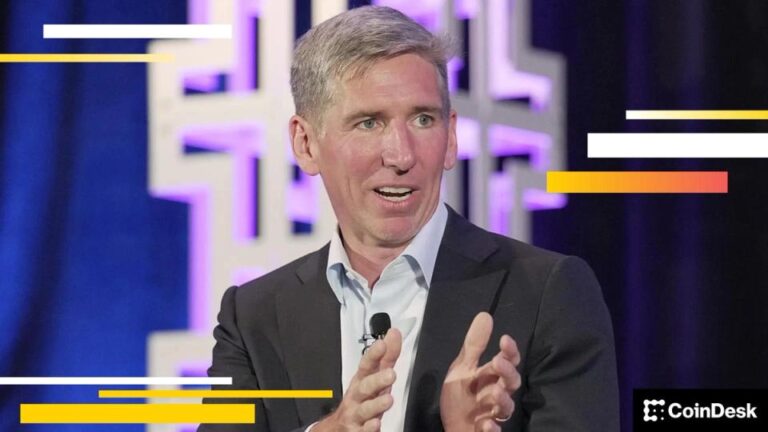
Bitcoin could eventually reach $1 million per coin if it captures a larger share of the global store-of-value market currently dominated by gold and government bonds, according to Bitwise Asset Management CIO Matt Hougan.
In a report earlier this week, Hougan said bitcoin’s long-term upside depends less on short-term market cycles and more on how much of the world’s wealth preservation market the cryptocurrency absorbs over time.
“One million sounds crazy,” said Hougan. “It implies bitcoin will rise 14x from today’s price.”
He pointed to several factors supporting that forecast, among them the rapid growth of the global store-of-value market, including gold, government bonds and other defensive assets, which has expanded from roughly $2.5 trillion in 2004 to nearly $40 trillion today. Bitcoin currently represents only about 4% of that market by value.
If the largest cryptocurrency were to capture roughly half of that market under current conditions, its price could approach that $1 million mark within roughly a decade, Hougan said. If the broader store-of-value market continues expanding, bitcoin would require a smaller share to reach that level.
The $1 million price fixation
The $1 million forecast has become a recurring theme across the crypto industry. President Donald Trump’s son Eric recently doubled down on his $1 million BTC call. In August, Coinbase CEO Brian Armstrong said bitcoin could reach that price by 2030.
Jack Dorsey, who ran X (formerly Twitter) until 2021 and co-founded payments firm Block (formerly Square), said bitcoin could reach $1 million in five years. Arthur Hayes, former BitMEX CEO, believes it could come as soon as 2028. Cathie Wood’s Ark Invest projected that bitcoin could reach $3.8 million by the end of the decade. Bernstein in 2024 forecast $1 million by 2033.
So why has the $1 million target become such a widely cited benchmark for bitcoin? CoinDesk asked several market analysts.
“It’s a clean headline and shorthand for the idea that Bitcoin could rival gold as a store of value. The exact number matters less than the share of global wealth Bitcoin captures,” said Mati Greenspan, market analyst and Quantum Economics founder.
For Jason Fernandes, also a market analyst and an AdLunam co-founder, the milestone is more psychological than a precise valuation target, reflecting the belief that bitcoin could ultimately win the store-of-value debate.
However, he also believes part of the narrative is driven by marketing dynamics. “Some of the narrative is promotional because round numbers travel well and align with holder incentives,” Fernandes said, though he added that the underlying thesis is not purely hype.
“I think many investors make a ‘static denominator’ mistake, valuing bitcoin against today’s store-of-value market instead of a much larger future one,” he said.
For Fernandes, the real question is not whether $1 million bitcoin is theoretically possible, but whether institutional adoption compounds long enough to justify that price.
Analysts agree on direction, but not the timeline
Some of the analysts who shared their comments with CoinDesk said Hougan’s projection is plausible over the long term, though most frame it as a decade-scale adoption story rather than a near-term forecast.
“Geopolitical tension strengthens the Bitcoin thesis,” said Greenspan. “In uncertain times, investors look for neutral stores of value, and Bitcoin increasingly sits in that bucket alongside gold.”
Greenspan said the milestone is possible but would likely take a decade or more, requiring continued institutional adoption and broader regulatory clarity.
Fernandes said Hougan’s argument is essentially a market-share thesis. Bitcoin does not need to replace gold outright, he said; it only needs to capture a portion of a growing global store-of-value market.
“A $1 million bitcoin assumes long-term adoption and market-share gains within the global store-of-value market,” Fernandes said. “It’s a thesis about bitcoin’s end state if it matures into a major global monetary asset.”
Institutional adoption remains the key driver
Hougan has argued that bitcoin’s fixed supply of 21 million coins and its decentralized network give it characteristics similar to those of traditional stores of value, such as gold.
Fernandes said the long-term $1 million thesis depends largely on continued institutional adoption and growth in the global store-of-value market.
“BTC doesn’t need to replace gold or fiat; it only needs to capture about 17% of a projected $121 trillion store-of-value market over the next decade to justify a $1 million price,” Fernandes said.
Greenspan said geopolitical uncertainty could further strengthen bitcoin’s appeal as a neutral asset.
“In uncertain times, investors look for neutral stores of value, and bitcoin increasingly sits in that bucket alongside gold,” he said, though he added that reaching such a valuation would likely take years of sustained adoption.
Nima Beni, founder of Bitlease, said the timeline could accelerate if confidence in traditional financial assets weakens.
“Bitcoin reaches $1 million when confidence in traditional ‘safe’ assets breaks,” he said, pointing to potential sovereign debt crises or disruptions in the gold market as possible catalysts.
Despite the bullish projections, analysts said bitcoin’s path toward such valuations would depend more on long-term adoption and macroeconomic conditions than on short-term market cycles.
Suspected $3.7M Exploit Hits Venus Protocol After Attacker Uses Illiquid Token as Collateral

Venus Protocol, a decentralized finance ( DeFi) lending platform on BNB Chain, is investigating unusual activity after an address allegedly used the illiquid $THE token as collateral to extract roughly $3.7 million in digital assets before large-scale liquidations began. Suspected $3.7M Venus Protocol Exploit Hits BNB Chain Lending Markets Onchain and social media alerts first […]
Ethereum Foundation Sells 5,000 ETH for $10.2M in OTC Deal: Ethereum Foundation

The Ethereum Foundation completed a $10.2 million over-the-counter sale of 5,000 ETH to BitMine at $2,042.96 per token as part of treasury management.
The Ethereum Foundation has completed an over-the-counter sale of 5,000 ETH to BitMine Immersion Technologies for $10.2 million, priced at $2,042.96 per token. The OTC transaction represents a strategic move by the foundation to manage its treasury and fund ongoing operations and ecosystem development initiatives.
The sale signals continued institutional engagement with Ethereum and the foundation’s active approach to treasury liquidity management. OTC deals of this scale are typically used to avoid market impact while securing capital for long-term protocol funding and ecosystem support.
Sources: Cointelegraph | KuCoin Insights | TokenPost | Our Crypto Talk | Coin Bureau
This article was generated automatically by The Defiant’s AI news system from publicly available sources.
Bitcoin (BTC) Recovers $73K as Investors Track This New Altcoin Under $1

Bitcoin has successfully reclaimed a major price level, sparking a wave of optimism across the digital asset space. While the market leader captures the headlines, a growing number of investors are turning their attention toward smaller, high-utility protocols. This shift suggests that capital is moving into assets that offer functional value in decentralized finance. Among these newcomers, one specific protocol is standing out for its innovative approach to credit and lending.
Bitcoin (BTC)
Bitcoin (BTC) has staged an impressive comeback today, Friday, March 13, 2026. The flagship cryptocurrency has climbed back above the $73,000 mark, showing a steady rebound after a period of consolidation. This recovery comes as institutional interest continues to grow, fueled by consistent inflows into spot Bitcoin ETFs. Analysts note that Bitcoin is currently moving within a bullish channel, with some experts predicting a push toward $85,000 or even $100,000 by the end of the year.
The positive movement in Bitcoin’s price has had a “halo effect” on the broader market. As Bitcoin stabilizes, investors often look for “altcoin” opportunities that can provide higher growth potential. The current trend shows a rotation of capital into utility-driven protocols that solve technical problems. This environment is perfect for new projects that are just beginning to launch their core infrastructure.
Mutuum Finance (MUTM)
As Bitcoin leads the market higher, Mutuum Finance (MUTM) is emerging as a top project for those seeking early-stage utility. Built on the Ethereum network, Mutuum Finance is creating a non-custodial hub for lending and borrowing. Its goal is to allow users to unlock the value of their crypto without needing to sell their long-term holdings.
The project is currently in Phase 7 of its presale. The token is priced at $0.04, which is a 300% increase from its starting price of $0.01 in Phase 1. The team has confirmed an official launch price of $0.06, giving early participants a clear value trajectory.
The project has already raised over $20.8 million from a community of more than 19,100 individual holders. With a fixed total supply of 4 billion tokens, 45.5% (1.82 billion tokens) have been dedicated to this early distribution phase.
The V1 Protocol and Dual-Market Model
Mutuum Finance has already moved into its functional testing phase with the activation of the V1 Protocol on the Sepolia testnet. The protocol anticipates a developing dual-market architecture that serves different types of users.
Peer-to-Contract (P2C): This market uses shared liquidity pools for instant loans. Lenders put assets like ETH or USDT into the pool, and borrowers can withdraw funds immediately based on automated interest rates.
Peer-to-Peer (P2P): This marketplace is for custom deals. Lenders and borrowers can negotiate their own terms, such as interest rates and time frames. This is ideal for niche or volatile assets that do not fit into standard pools.
A core feature of the v1 protocol is the mtToken system. When you deposit an asset into a liquidity pool, you receive an mtToken (like mtETH) as a digital receipt. These are not just placeholders; they are yield-bearing assets.
For example, if you deposit 1 ETH into the protocol, you receive 1 mtETH in return. As borrowers begin to repay their loans with interest, the value of the mtETH increases relative to the original ETH you provided. This system ensures that your balance grows automatically on the blockchain, removing the need for you to manually claim rewards or interact with the contract to realize your earnings.
Debt Tokens and Loan Tracking
When a user borrows from the protocol, they receive Debt Tokens that represent their outstanding obligation to the system. For instance, if you borrow 1,000 USDT, the system tracks this liability through 1,000 Debt mtUSDT.
To close your position and retrieve your collateral, you must return these Debt Tokens along with any interest that has accrued over the duration of the loan. This system provides a transparent way for both the user and the protocol to see exactly what is owed at any moment directly on-chain..
Understanding APY and LTV
The Annual Percentage Yield (APY) in Mutuum Finance is dynamic. In the P2C market, interest rates adjust based on the utilization rate of a pool. For example, if only 10% of a pool is borrowed, the interest rate stays low at around 2% to 3% to encourage more borrowing.
If utilization hits 90%, the rate spikes to 12% or 15% to attract more lenders and convince borrowers to repay their loans. In the P2P market, users can agree on a fixed APY for the duration of their loan to provide more predictability for long-term planning.
The Loan-to-Value (LTV) ratio determines how much you can borrow against your collateral using an over-collateralized model. For high-liquidity assets like ETH, the protocol allows a safe LTV of up to 75%. This means if you provide $10,000 worth of ETH as collateral, you can instantly borrow up to $7,500 in a stablecoin like USDT.
For more volatile tokens in the peer-to-peer market, the LTV may be lower, such as 35%, to protect against sudden price drops. If your LTV exceeds a certain limit due to a price drop, an automated Liquidator Bot can step in to sell a portion of the collateral to ensure lenders are always paid.
Building for 2027
The roadmap for Mutuum Finance is focused on long-term sustainability. Following the V1 testnet phase, the team plans to expand to Layer-2 networks like Arbitrum and Polygon to reduce transaction costs for users. They are also working on a native, over-collateralized stablecoin. This asset will be backed by the interest-earning collateral within the protocol, providing a stable medium of exchange for all participants.
Security is a primary focus for the project. Mutuum Finance has successfully completed a manual code audit with Halborn Security, a world-class firm. The project also maintains a 90/100 safety score from CertiK and operates a $50,000 bug bounty to keep the infrastructure battle-tested.
To make the project accessible, the platform supports card payments and features a 24-hour leaderboard that rewards the top daily contributor with a $500 bonus. As Bitcoin continues its recovery, protocols like Mutuum Finance are providing a clear example of how utility could drive the next crypto phase of the altcoin market.
For more information about Mutuum Finance (MUTM) visit the links below:
Website: https://www.mutuum.com
Linktree: https://linktr.ee/mutuumfinance

Stablecoin Regulatory Uncertainty Could Put Banks at a Disadvantage: Expert

Regulatory uncertainty around stablecoins could place traditional banks at a greater disadvantage than crypto companies, according to Colin Butler, executive vice president of capital markets at Mega Matrix.
Butler said financial institutions have already invested heavily in digital asset infrastructure but remain unable to deploy it fully while lawmakers debate how stablecoins should be classified. “Their general counsels are telling their boards that you cannot justify the capital expenditure until you know whether stablecoins will be treated as deposits, securities, or a distinct payment instrument,” he told Cointelegraph.
Several major banks have already developed parts of the infrastructure needed to support stablecoins. JPMorgan developed its Onyx blockchain payments network, BNY Mellon launched digital asset custody services, and Citigroup has tested tokenized deposits.
“The infrastructure spend is real, but regulatory ambiguity caps how far those investments can scale because risk and compliance functions will not greenlight full deployment without knowing how the product will be classified,” Butler argued.
On the other hand, crypto firms, which have operated in regulatory gray zones for years, would likely continue doing so. “Banks, by contrast, cannot operate comfortably in that gray area,” he added.
Related: USDC market cap nears record $80B amid ‘capital flight’ in UAE: Analyst
Yield gap could drive deposit migration
Another concern is the growing difference between returns available on stablecoin platforms and those offered by traditional bank accounts. Exchanges often offer between 4% and 5% on stablecoin balances, Butler said, while the average US savings account yields less than 0.5%.
He said history shows depositors move quickly when higher yields become available, pointing to the shift into money market funds in the 1970s. Today, the process could happen even faster, as transferring funds from bank accounts to stablecoins takes only minutes and the yield gap is larger.
Meanwhile, Fabian Dori, chief investment officer at Sygnum, said the competitive gap between banks and crypto platforms is meaningful but not yet critical. He said a large-scale deposit flight is unlikely in the immediate term, as institutions still prioritize trust, regulation and operational resilience.
“But the asymmetry can accelerate migration at the margin, especially among corporates, fintech users, and globally active clients already comfortable moving liquidity across platforms,” Dori said. “Once stablecoins are treated as productive digital cash rather than crypto trading tools, the competitive pressure on bank deposits becomes much more visible,” he added.
Related: Stablecoins could form backbone of global payments in 10 years: Billionaire
Restrictions on yield could push activity offshore
Butler also warned that attempts to restrict stablecoin yield could unintentionally drive activity into less regulated areas. Under current US law, stablecoin issuers are prohibited from paying yield directly to holders. However, exchanges can still offer returns through lending programs, staking or promotional rewards.
If lawmakers impose broader restrictions, capital could shift to alternative structures such as synthetic dollar tokens. Products like Ethena’s USDe generate yield through derivatives markets rather than traditional reserves. These mechanisms can offer returns even if regulated stablecoins cannot.
If that trend accelerates, regulators could face the opposite outcome of what they intend as more capital flows into opaque offshore structures with fewer consumer protections, according to Butler. “Capital doesn’t stop seeking returns,” he said.
Magazine: Bitcoin may take 7 years to upgrade to post-quantum — BIP-360 co-author
Cointelegraph is committed to independent, transparent journalism. This news article is produced in accordance with Cointelegraph’s Editorial Policy and aims to provide accurate and timely information. Readers are encouraged to verify information independently. Read our Editorial Policy https://cointelegraph.com/editorial-policy
Here’s Bitcoin’s Fate If The Strait Of Hormuz Remains Unsettled – Details

Trusted Editorial content, reviewed by leading industry experts and seasoned editors. Ad Disclosure
The Bitcoin market has experienced some significant price relief in recent weeks. After a series of intense corrections that forced prices to a local bottom of $60,000 in early February, the premier cryptocurrency presently trades around $71,000, reflecting a 7.19% gain in the past month.
Meanwhile, the global markets have been heavily rocked by heightened geopolitical tensions in the Middle East after the US and Israel launched a coordinated attack on Iran. Among many retaliation measures, the Islamic Republic of Iran has initiated a closure of the Strait of Hormuz, a major trade route that controls the passage of 20% of the world’s oil supply.
Blocked Strait of Hormuz Threatens Global Economic Stability
In a QuickTake post on CryptoQuant, the education and analytics page XWIN Research Japan shares key insights on the effects of a potentially prolonged Strait of Hormuz disruption on Bitcoin and the general market. Considering the lack of any equally effective alternatives, Iran’s opposition to trade through the Strait of Hormuz threatens a global energy supply shock. If the current decline in shipping activities persists and oil and gas prices continue to rise, a corresponding rise in inflation is expected, considering the importance of petroleum products in daily activities.
In regard to effects on financial markets, central banks typically respond to these conditions with a financial tightening policy by raising interest rates in an attempt to slow down economic activity. During such environments, investors are likely to move capital into fiat currencies, e.g., US dollars, to take advantage of interest rates to match potential devaluations from inflation. Meanwhile, there is also a significant decline in exposure to volatile assets.
Bitcoin’s Fate Amid Oil Supply Troubles
According to XWIN Research Japan, investors’ behavior towards Bitcoin during geopolitical stress events has shown that they view the cryptocurrency more as a risk asset than a financial haven. Therefore, it’s likely the BTC market experiences high levels of outflows if the Strait of Hormuz remains closed. However, this would only be an initial reaction as market stability is expected to occur later.
Therefore, the impact of the passageway disruption will be driven more by financial ecosystem response rather than the energy shock itself. The key factors in this situation include global liquidity level, policy responses, and general market leverage.

It’s also important that investors and traders monitor key derivative indicators such as the Open Interest (OI) and Funding Rates, as both metrics communicate key insights on the market condition. For example, a heightened Open Interest combined with extreme funding rates would signal overcrowded market positioning, which represents a risky market structure if a potential market shock occurred. At press time, Bitcoin trades at $71,639.
Featured image from Fox Business, chart from Tradingview

Editorial Process for bitcoinist is centered on delivering thoroughly researched, accurate, and unbiased content. We uphold strict sourcing standards, and each page undergoes diligent review by our team of top technology experts and seasoned editors. This process ensures the integrity, relevance, and value of our content for our readers.
‘Stretch the Orange Dots’: Saylor’s Signal Ignites Massive Bitcoin Buying Expectations

Expectations for another major bitcoin purchase from Strategy are building after Michael Saylor highlighted the firm’s growing treasury, reinforcing investor speculation that the company’s aggressive accumulation campaign is far from finished. Bitcoin Buying Machine: Saylor Post Ignites Expectations of Massive Strategy BTC Purchases Investor attention around corporate bitcoin accumulation intensified after Strategy Executive Chairman Michael […]
Bitcoin Inflection Point Forms At $70k As Institutional Demand Offsets Whale Sell-Off
Trusted Editorial content, reviewed by leading industry experts and seasoned editors. Ad Disclosure
Over the last day, the Bitcoin price has displayed sideways movement, without any apparent intent of a breakout. While this is a typical weekend price action, there has been an interesting update on the underlying dynamics keeping the flagship cryptocurrency grounded around $70,000.
Bitcoin LTH-SOPR Falls To 1.01 — What This Means
In a recent QuickTake post on CryptoQuant, on-chain analyst GugaOnChain reveals that a battle between different cohorts of Bitcoin investors is currently unfolding.
GugaOnChain cites the Long-Term Holder SOPR (Spent Output Profit Ratio) metric, which tracks whether long-term investors (who have held Bitcoin for at least 155 days) are selling their tokens profitably, or at a loss. Readings above 1 suggest that these investors are accumulating profits, while readings under 1 reveal otherwise.
According to GugaOnChain, the LTH-SOPR currently stands at 1.01, reflecting that Bitcoin’s long-term investors are exiting the markets at break-even, or with minimal profits. The analyst further explains that this means the “veterans are once again aggressively defending their acquisition cost at $70,675.”
At the same time, the Puell Multiple reflects a reading of 0.60, which GugaOnChain describes as a typical sign that the market is undervalued and that Bitcoin’s miners are starting to experience exhaustion. Usually, when the Puell Multiple falls to 0.5, it marks capitulation among miners.
It is worth noting that if the Puell Multiple should continue on its approach towards the 0.5 mark, the Bitcoin price could follow on such a bearish move, until its Realized Price at $54,000 is retested.
Institutional Demand Buffers Whale Distribution
Notably, GugaOnChain explains that the most significant development is still largely dependent on the dynamics between whale cohorts. As of March 13, there was a massive distribution of about 16,100 BTC among the whales holding between 1,000 and 10,000 BTC. Normally, such a large sell-off should trigger a sudden downturn in the Bitcoin price, but prices only retraced by about 0.33%. GugaOnChain points out that this is due to the absorption of supply by differing whale cohorts, and even institutional investors.
Specifically, the ‘Mega Whales,’ who have custody of more than 10,000 BTC, alongside the ‘Dolphins’ (holding between 100 and 1,000 BTC), both countered what should have been a devastating price drop. At the same time, institutional demand has been unrelenting over the week. During this period, spot ETFs have recorded a total of $763.4 million in net inflows, with $180.4 million coming in on March 13 alone.
While the Puell Multiple reflects the possibility of $54,000 being visited, GugaOnChain insists that ‘Smart Money currently validates $70k as the “inflection floor”’. As such, if the LTH-SOPR continues to prevail above 1.0, it would reflect that the current Bitcoin cost has been successfully defended. Interestingly, ETF’s conviction capital is already positioned for the next big move. As of this writing, Bitcoin trades for $71,000, reflecting a 0.5% gain in 24 hours.
Featured image from Flickr, chart from Tradingview
Editorial Process for bitcoinist is centered on delivering thoroughly researched, accurate, and unbiased content. We uphold strict sourcing standards, and each page undergoes diligent review by our team of top technology experts and seasoned editors. This process ensures the integrity, relevance, and value of our content for our readers.