Home Blog Page 764

A Complete Guide to Purchasing, Using, and Maintaining Tuning Forks

0

Tuning forks are precision instruments with applications ranging from medical diagnostics and musical calibration to sound therapy and biofield work. Knowing what to look for before you buy tuning fork equipment makes the difference between a tool that serves your practice well for years and one that underperforms or deteriorates quickly. This guide walks through every phase of ownership, from selecting the right type and frequency to mastering proper technique, caring for the instrument, and understanding the boundaries of what therapeutic sound work can reasonably claim to accomplish.

Choosing the Right Fork for Your Application

The first decision is whether you need a weighted or unweighted fork, and that choice depends entirely on how you intend to use it.

Weighted forks have small cylindrical masses attached to the ends of the prongs. This added weight lowers the natural oscillation frequency, producing deeper tones typically in the 50 to 200 Hz range with longer-duration vibrations. Because they vibrate more intensely through the stem than through the air, weighted forks are designed to be placed directly on the body. When applied to muscles, joints, or bone, they deliver mechanical vibration as a direct physical intervention. They are the right choice for hands-on bodywork applications.

Unweighted forks have smooth prongs and produce much higher frequencies, typically 300 to 4,000 Hz, with louder and purer audible tones. They are primarily used in the air around the head or body for sound therapy, meditation, and auditory work. If your practice centers on sound rather than physical contact, an unweighted fork is the appropriate instrument.

Material matters as well. Aluminum alloy is the most common material for therapeutic use. It is lightweight, produces a long sustain with rich overtones, and resists corrosion effectively. Steel forks, both stainless and carbon, are heavier and used primarily for musical tuning or medical diagnostics. Steel provides superior temperature stability and resists deformation better than aluminum, which is why the 512 Hz forks used in clinical hearing tests such as the Rinne and Weber assessments are steel instruments.

For frequency selection, three ranges come up most frequently in therapeutic contexts. The 128 Hz Otto Tuner is widely used for physical relaxation, joint pain relief, and grounding applications. The 528 Hz fork is associated in sound therapy practice with emotional release work. The 4096 Hz Crystal Tuner is a high-pitched instrument used for space clearing and high-frequency applications. Musical tuning typically uses the internationally standardized A440 Hz fork.

Preparing Your Fork Before Each Use

Proper preparation protects both the instrument and the accuracy of its frequency output.

Before every use, inspect the prongs visually for nicks, dents, or hairline cracks. Even a small structural irregularity can alter the frequency and degrade performance. If you are using the fork for direct physical bodywork, wipe the stem with 70% isopropyl alcohol between applications to maintain hygiene.

Temperature matters more than most users expect. Steel forks drift approximately 0.015 Hz per degree Celsius, and aluminum drifts at roughly 0.03 Hz per degree Celsius. Allow any fork that has been stored in a cold car or a warm bag to acclimate to room temperature before use. Holding the prongs in warm hands for too long during preparation can also temporarily shift the pitch.

Never strike a tuning fork against a hard surface such as a table edge, floor, or metal object. This can cause permanent structural deformation and will void most manufacturer warranties. Use a dedicated rubber activator block, a rubber mallet, or the soft part of your palm. These tools protect the instrument while producing the cleanest possible acoustic response.

Mastering the Activation Technique

How you strike the fork determines the quality and duration of the tone it produces.

Always hold the fork by the stem only, never by the prongs. The prongs function as coupled oscillators that move in synchronized relationship with one another. Touching them while they are vibrating immediately dampens the sound and breaks the resonance. For weighted forks, tap the weights gently but firmly against a rubber surface, allowing the weights to set into steady motion. For unweighted forks, strike the top third of one prong against your rubber activator. Striking lower on the prong will not activate the full tonal range.

Listen immediately after the strike. A properly activated fork produces a clear, sustained hum with a pure tone. A harsh metallic clashing sound, sometimes called a klang, means you have struck too hard and introduced distortion into the tone. Adjust the force of your strike until you consistently produce a clean, resonant sound.

Application Methods by Intended Use

Technique varies depending on whether your goal is physical, auditory, or musical.

For physical applications using a weighted fork, place the flat base of the stem firmly on a nodal point such as a joint, bone, or area of muscle tension. Hold it in place with light, steady pressure until the vibration fully dissipates into the body, which typically takes a few minutes per location. The mechanical vibration penetrates the tissue directly through contact.

For auditory and energetic work using an unweighted fork, hold the vibrating instrument approximately two to three inches from the ear. For broader application, move the fork in a slow figure-eight or sweeping motion around the head and body, allowing the sound waves to interact with the surrounding space.

For musical tuning, strike the fork and press the base of the stem directly against the body of the instrument, such as a guitar bridge or resonance box. The tone amplifies through the instrument via sympathetic resonance, providing a clear reference pitch for calibration. According to the Acoustical Society of America, this principle of sympathetic resonance is a well-documented physical phenomenon in which a vibrating object causes a nearby object to vibrate at the same frequency when the frequencies match.

Caring for Your Instrument

Routine maintenance preserves both the acoustic accuracy and the physical condition of the fork over years of use.

Wipe the fork with a dry microfiber cloth after each session to remove skin oils and residue. If light oxidation develops over time, appearing as dark spots on the metal, it can be gently addressed with a soft abrasive sponge and a small amount of acetone, which will not affect tuning accuracy or structural integrity when done carefully.

Store forks in a velvet or padded pouch in a stable environment. Dropping a fork on a hard floor can permanently alter its pitch. Keep forks away from strong magnets, extreme temperature swings, and high humidity. Salt air environments near the ocean are particularly aggressive on metal alloys and can accelerate oxidation significantly.

Quick Troubleshooting Reference

A few common problems appear regularly in tuning fork practice, and each has a straightforward solution.

If the sound dies quickly after activation, you are likely touching the prongs. Adjust your grip to hold exclusively by the stem. If you hear a harsh metallic ping rather than a clean tone, you are striking against too hard a surface. Switch to a rubber mallet or activator block. If the vibration from a weighted fork feels unusually weak, the weights may have loosened. Tighten the small side screws with an appropriate hex key. If the pitch sounds noticeably off, allow the fork to fully reach room temperature and inspect the prongs for any hairline cracks or dents.

Understanding the Evidence and Practical Limits

Tuning forks have established clinical validity in specific medical diagnostic contexts. The 512 Hz steel fork is a standard tool in the Rinne and Weber hearing tests used by audiologists and neurologists to assess conductive versus sensorineural hearing loss. That application is grounded in well-documented clinical evidence.

Therapeutic sound healing applications occupy a different category. Claims that specific frequencies can repair DNA or cure medical conditions are not supported by randomized controlled trials. Tuning fork therapy is a complementary wellness practice, not a medical treatment, and it should be positioned and practiced accordingly. Practitioners offering this work professionally should maintain appropriate liability insurance, which is available for sound healing modalities through specialized insurers, and should hold certification from a recognized training organization as a condition of that coverage.



Crypto’s CLARITY Act May Miss 2026 Window Without April Action

0

Trusted Editorial content, reviewed by leading industry experts and seasoned editors. Ad Disclosure

Reports indicate investment bank TD Cowen warned the CLARITY Act may not pass until 2027 and could take effect in 2029.

Lawmakers And Deadlines

The bill’s timetable is tight. Alex Thorn of Galaxy Digital said if the CLARITY Act doesn’t clear committee by the end of April, the chances of passage in 2026 fall sharply.

Senate leaders have signaled other items will take priority on the floor, leaving little room for a complex compromise.

Debate over stablecoin rewards is where many expect the fight to play out. Banks and crypto firms remain divided on whether yielding rewards via stablecoins undermines traditional banking models.

Some lawmakers and lobbyists are already trading hard lines; compromise will be needed for any bill to move.

A Senior Lawmaker Said Both Sides Would Have To Give Ground

Officials said members of the Senate Banking Committee expect give-and-take. A top Democrat on the panel warned that neither side is likely to be fully satisfied but that negotiations must continue for progress.

Timing is also a political problem. One senator has publicly said the chamber won’t act before April because it has other priorities, and that squeeze on the calendar makes a late push risky.

Meanwhile, US President Donald Trump has criticized banks for slowing the bill’s progress, adding public pressure to move the measure.

BTCUSD trading at $71,469 on the 24-hour chart: TradingView

Crypto Regulation: Timing Could Stretch Years

Some analysts expect the process to stretch past the next election cycle if consensus can’t be reached soon. That prospect raises the possibility that a market-structure package could be delayed for multiple sessions of Congress, or reworked under new leadership.

According to statements from a crypto-friendly senator, there’s still hope the bill can clear Congress by April — but that hope depends on quick committee action and compromises on key items.

Image: IQ.wiki

What’s At Stake

The bill’s outcome matters far beyond Washington. Clear rules could change how institutions engage with crypto, how exchanges operate, and how stablecoins are treated.

For now, the clock is the clearest fact: if the CLARITY Act doesn’t move fast, its path will get harder, and its timetable could stretch into the next Congress.

Featured image from Harris Sliwoski LLP, chart from TradingView

Editorial Process for bitcoinist is centered on delivering thoroughly researched, accurate, and unbiased content. We uphold strict sourcing standards, and each page undergoes diligent review by our team of top technology experts and seasoned editors. This process ensures the integrity, relevance, and value of our content for our readers.

MEV bros point to Eisenberg acquittal in high-stakes hearing – DL News

0

  • Brothers James and Anton Peraire-Bueno have asked a federal judge to toss their criminal charges.
  • Their month-long trial ended with a hung jury last year.
  • The judge said she would not schedule a new trial until she rules on the brothers’ request.

During a high-stakes hearing in New York on Friday, a lawyer for James Peraire-Bueno likened his $25 million scheme, which exploited crypto trading bots, to that of Mango Markets foe Avraham Eisenberg.

Like Eisenberg, Peraire-Bueno made millions when he took advantage of a design flaw in crypto software, the attorney said. And, like Eisenberg, Peraire-Bueno should be acquitted, he added.

Prosecutors have charged Peraire-Bueno and his brother Anton Peraire-Bueno with wire fraud, as well as conspiracy to commit wire fraud, launder money, and receive stolen property.

But a month-long trial ended last November with a hung jury.

Prosecutors want a retrial, which could begin later this year. But the brothers have asked the judge to toss all charges, arguing the government never presented enough evidence to secure a conviction.

Friday’s hearing was scheduled to settle the brothers’ request. Judge Jessica Clarke said she would issue a ruling on the matter before potentially scheduling a new trial, which would not begin before November.

The case is highly technical, covering the complex market that determines how pending transactions are ordered and settled on Ethereum.

Still, it’s the latest criminal case to seize the attention of US advocates of decentralised finance.

Crypto think tank Coin Center has called the brothers’ prosecution a “radical” attempt to “impose a novel and alien code of conduct” on Ethereum validators, the people running the software that powers the $88 billion network.

A conviction would “massively chill public participation in these innovative systems,” Coin Center wrote in a letter to the court last year. The DeFi Education Fund has also submitted a letter to the court arguing for the brothers’ acquittal.

‘Attacking Ethereum’

In 2024, the MIT-educated brothers were accused of “attacking Ethereum” and stealing $25 million from three traders.

The scheme was a classic bait-and-switch. It took advantage of the three traders’ MEV bots — Ethereum-based, automated trading programmes that scan the blockchain seeking profitable opportunities to front-run pending transactions.

The complicated scheme began when the brothers created more than a dozen Ethereum validators.

When one was selected to add a new block to the network, the brothers quickly proposed a “bait transaction” meant to trick the MEV bots into buying $25 million in illiquid crypto.

The bots expected to be able to buy, and then quickly sell the crypto at a profit.

Instead, the brothers were able to trick another component of the Ethereum block-building system known as MEV-boost into revealing the contents of the pending block.

That allowed the brothers to “tamper” with the block, changing the bait transaction from a purchase into a sell order, according to their indictment. That effectively put $25 million in stablecoins and other cryptocurrencies into the brothers’ pockets, leaving the bots holding the illiquid crypto.

Finally, the re-ordered block was added to Ethereum, sealing the transaction on an immutable ledger.

In the courtroom

The debate in the courtroom on Friday focused on the wire fraud charge and, specifically, whether a proposed transaction, such as the bait transaction, amounted to a “promise.”

Prosecutors argued switching the bait transaction from a purchase to a sale was a deception, as was the brothers’ use of a so-called invalid signature — the move that tricked MEV-boost into revealing the contents of the block that contained the bots’ orders.

James Peraire-Bueno’s attorney, Patrick Looby, disputed this.

“There was nothing in the lure transactions themselves that made a promise about that relative order” of transactions in the block, he told Judge Clarke.

Looby pointed to last year’s acquittal of Eisenberg, who had tricked the DeFi protocol Mango Markets into letting him borrow millions of dollars in crypto against nearly worthless collateral.

The judge in that case acquitted Eisenberg of his fraud charge, in part because the trader had merely taken advantage of a flaw in Mango’s design, and the service lacked any terms that forbade his behaviour.

Similarly, Ethereum and MEV-boost lack any terms of service, Looby said.

“What about the slashing penalty itself?” Clarke asked, referring to a penalty the brothers incurred when they submitted the invalid signature. “Does that operate like a rule?”

No, Looby shot back — it was merely a “disincentive.”

‘Deception, tricks’

Assistant US Attorney Danielle Kudla said it was up to jurors to decide whether the brothers had defrauded traders on Ethereum.

Whether there were terms of service was beside the point, she continued. Nearly every step the brothers took was done to trick the bots.

“This case has always been about deception, tricks, misrepresentations on the blockchain,” she said.

The bait transactions were designed to lure those specific bots, according to the prosecutor. At trial, the bots’ owners said they would not have allowed the programmes to execute those fateful transactions had they known what would happen next.

While MEV-boost didn’t have terms of service, it did have specifications stating the software was designed to prevent validators from modifying blocks. Moreover, MEV-boost creator Flashbots rushed to fix the bug that allowed the invalid signature, pushing a patch within 24 hours of the incident.

That made the case very different from Eisenberg’s, Kudla said. And prosecutors have appealed the judge’s decision to acquit Eisenberg, she added, suggesting courts have a ways to go before settling debates around blockchain-based fraud.

Tornado Cash co-founder Roman Storm has a similar motion for acquittal pending in the same court. His hearing is in April.

Aleks Gilbert is DL News’ New York-based DeFi correspondent. Have a tip? You can reach him at aleks@dlnews.com.

Bitpanda bets on banks, tokenization to expand globally ahead of IPO plans

0

Vienna, Austria-based crypto broker Bitpanda is leaning into a strategy it has been quietly building for years: keep its retail business anchored in Europe while expanding globally by supplying crypto infrastructure to banks and financial firms.

The company’s next phase of growth will focus less on raw user numbers and more on geographic reach, Vishal Sacheendran, vice president of global markets strategy and operations, told CoinDesk in an interview.

“It’s about having a footprint in more markets,” Sacheendran said.

That expansion is building on its steady growth. The company, which boasts more than 7 million users, reported this week €371 million ($430 million) in adjusted revenue for 2025, up 16% from the previous year, while its registered user base increased 25% to 7.4 million.

The firm is also weighing a public listing. Bitpanda is reportedly preparing for a potential IPO on the Frankfurt Stock Exchange as early as the first half of 2026, targeting a valuation between EUR 4 billion and EUR 5 billion. The plan comes as multiple crypto exchanges and infrastructure firms have either gone public or are planning to do so.

Bringing crypto to banks

The exchange spent the past decade largely focused on the European Union, where its app allows retail users to trade cryptocurrencies and other assets. But outside Europe, Sacheendran said the strategy needs to change. In some markets — especially smaller ones or those already dominated by global exchanges — launching a consumer app may not make sense.

Instead, Bitpanda wants to work through banks and financial institutions that already have distribution. “We don’t want to compete with exchanges everywhere,” he said. “There’s a big segment of the market that still trusts banks.”

The company formalized that approach earlier in March with the launch of Bitpanda Enterprise, a new institutional offering that packages the firm’s infrastructure for banks, brokers, asset managers, fintechs and corporate clients.

The unit builds on Bitpanda’s existing B2B business, previously known as Bitpanda Technology Solutions, and bundles several services into a single platform. These include API-based investment infrastructure for financial brands, institutional-grade custody, trading liquidity and settlement tools, and payment rails for crypto and stablecoins. The platform also includes token infrastructure for stablecoin issuance and systems designed to support tokenized assets.

UAE launchpad

One early example of that model came in July, when RAKBANK, one of the United Arab Emirates’ oldest lenders, launched crypto trading for retail customers through a partnership with Bitpanda. Instead of building its own infrastructure, the bank plugged into Bitpanda’s platform.

Sacheendran said deals like that often open doors elsewhere. Once one major bank adopts crypto services, others tend to follow. “When a top-tier bank starts offering it, the rest of the market takes notice,” he said.

Bitpanda’s pitch to institutional partners rests heavily on its regulatory positioning. The company has been operating under strict licensing requirements, including the European Union’s MiCA framework, widely seen as one of the most comprehensive crypto regulatory regimes.

Regulatory moat

That regulatory credibility travels, Sacheendran said, especially in emerging markets where regulators are still shaping their approach to digital assets. In many of those regions — including parts of Asia, Latin America and the Middle East — authorities are eager to develop the sector but want partners that already operate within strong compliance frameworks.

Asia-Pacific illustrates the complexity. The region is “very fragmented,” he said, with different rules in jurisdictions such as Hong Kong, Singapore, Japan and South Korea. Bitpanda’s approach there will be gradual: start small, test demand and scale where the regulatory and commercial conditions align.

On the product side, Bitpanda is evaluating derivatives trading, though Sacheendran noted that regulations differ widely across jurisdictions. He also expects tokenization to become a bigger theme in the coming years, particularly for assets such as bonds, money market funds and real estate.

Those markets could benefit from blockchain’s ability to enable around-the-clock trading and broader investor access, he said.

One area Bitpanda is unlikely to enter directly is stablecoin issuance. “We don’t build a stablecoin,” Sacheendran said, noting that the company prefers to provide infrastructure and operational support for institutions that want to launch their own.

Read more: Stricter MiCA rules could thin crypto industry across the EU, says Swiss wealth manager

Nasdaq and owner of NYSE turn to crypto exchanges to bring the $126T equity market onchain

0

Wall Street’s biggest exchanges are embracing digital assets by aiming to put the $126 trillion equity market on blockchains — but they are not going at it alone; rather, they are relying on crypto exchanges to get there.

Over the past week, two of the world’s most powerful exchange operators — Nasdaq and Intercontinental Exchange (ICE), the parent company of the New York Stock Exchange — teamed up with digital asset exchanges to merge equities with blockchains through tokenization.

Nasdaq is developing a framework that would allow publicly listed companies to issue blockchain-based versions of their shares while preserving traditional ownership rights and governance. To distribute those tokenized stocks globally, the exchange is working with Payward, the parent company of crypto exchange Kraken. The offering could go live as soon as the first half of 2027.

Meanwhile, just days earlier, ICE revealed a strategic investment in crypto exchange OKX at a $25 billion valuation. That deal includes plans to launch new tokenized stocks and crypto futures, allowing the exchange operator to tap into OKX’s 120 million user base.

The “everything” exchange

The flurry of deals points to a bigger transformation in how markets might function in the future.

For decades, stocks, bonds and funds traded on separate systems with limited trading hours. Blockchain technology promises a unified, always-on marketplace — one that in the industry believe could eventually host the settlement of all financial assets in the forms of tokens.

Antoine Scalia, founder and CEO of crypto accounting and compliance platform Cryptio, said the developments point to a broader shift toward what he calls the “everything exchange” – a marketplace where all asset classes trade on the same infrastructure.

“For a very long time, it was just crypto people pushing the narrative that traditional finance and crypto would merge,” Scalia said. “Now we see the major exchanges moving.”

“That’s a realization that eventually all assets will settle on blockchain rails,” he said.

This shift is being accelerated by a January SEC Staff Statement on Tokenized Securities, which finally clarified that tokenized equities carry the same legal weight as their “paper” counterparts. That gives Wall Street incumbents the legal cover to enter the market for tokenized equity trading.

‘Frenemy’

However, the key question, Scalia added, is which platforms will dominate that future market: traditional exchanges like Nasdaq or crypto-native venues such as Coinbase (COIN) and Kraken.

But that doesn’t mean the two sides are purely rivals. In many cases, they need each other.

Traditional exchanges are looking for access to crypto-native traders, while crypto platforms want the distribution and credibility that established financial infrastructure provides, Scalia said.

“Distribution works both ways,” he said. “Traditional exchanges want exposure to the crypto trading population, and there’s huge demand from crypto users to trade other types of assets. At the same time, crypto-native firms benefit from the reach of these traditional players to bring more people into crypto markets.”

The result is an unusual, “frenemy”-like relationship between potential competitors. “It’s a very interesting dynamic with frictions and complementarity,” Scalia said. “And it will be interesting to see how it plays out.”

Why tokenized stocks matter

Tokenized equities – currently $1 billion – are only a fraction of the global equity market, but the potential is massive as all kinds of assets are increasingly move towards non-stop, around-the-clock trading.

A joint report by Boston Consulting Group and Ripple forecasted that tokenized assets could grow 53% a year, reaching $18.9 trillion across all asset classes by 2033 as their base case.

Tokenized asset market projection (BCG/Ripple)

The market for tokenized stocks showcased even faster growth. The market value has tripled since mid-2025, RWA.xyz data shows, as Kraken, Ondo Finance, Robinhood and a slew of other exchanges and issuers rolled out token versions of equities.

The biggest advantage of putting traditional equities on blockchains is continuous price discovery, said Yuki Yuminaga, founder of tokenization startup Tenbin Labs. Unlike traditional stock markets today, which operate on fixed trading hours, blockchain-based assets never sleep and can trade around the clock. This will likely unlock more capital, improve liquidity and reduce market volatility.

Tokenizing stocks can also unlock more efficient lending and borrowing through decentralized finance (DeFi), Yuminaga added. Tokenized shares could be used as collateral in lending markets, increasing capital efficiency and enabling new financing opportunities, he said.

Giants like Nasdaq and NYSE entering the tokenized stocks game could also solve one of the biggest current pain points: liquidity.

“Tokenized equities have struggled with liquidity because traditional markets and onchain markets are separate,” Yuminaga said. “If Nasdaq connects those two pools of liquidity, that could change the equation.”

Time running out for Clarity bill, warns expert, as odds of passing ‘diminish by the day’ – DL News

0

  • Bill must pass committee stage by end of April, says Galaxy Digital.
  • Banks, crypto firms continue to disagree on stablecoin yield issue.
  • Other issues also hampering progress, expert warns.

If US lawmakers don’t fast-track their deliberations on the landmark Clarity bill, implementing the draft law may become impossible this year, a crypto industry insider has claimed.

The bill, the White House’s much-touted draft crypto regulatory framework, continues to divide the crypto community and bankers over the question of whether stablecoin issuers should pay yields.

“If Clarity doesn’t pass committee by the end of April, odds of passage in 2026 become extremely low,” Alex Thorn, a New York-based senior researcher at the crypto and data centre operator Galaxy Digital, wrote on X. “This needs to hit the Senate floor by early May. Floor time is running out, and the odds diminish [with] every day that passes.”

The hold-up has infuriated the White House at a time when geopolitical instability is leading to warnings of a Bitcoin bear market and a stock market collapse.

“The banks are hitting record profits, and we are not going to allow them to undermine our powerful crypto agenda,” President Donald Trump wrote on social media earlier this month.

Hurdles to clear

Thorn expressed pessimism about the chances of a breakthrough as lawmakers remain locked in talks.

“The framing right now is that the dispute over stablecoin rewards is holding up the Clarity Act,” he wrote. “But even if compromise is reached on rewards, there are very likely to be other hurdles.”

These hurdles could include regulations pertaining to the decentralised finance sector, the powers of regulators, or “even ethics,” Thorn said.

“It’s very possible that rewards are not the final hurdle, but instead just the current hill the bill is dying on,” he wrote.

The issue of crypto regulation is likely to become a major battleground for politicians ahead of the midterm elections in November.

Democratic Party leaders are preparing an assault on Trump’s crypto policies ahead of the key vote, officials told DL News last week.

Crypto market movers

  • Bitcoin is trading at $71,804 today, up almost 2% over the past 24 hours.
  • Ethereum is priced at $2,116, rising by 2% over the same period.

What we’re reading

Tim Alper is a News Correspondent at DL News. Got a tip? Email him at tdalper@dlnews.com.

Bitcoin set for best week since September 2025 as correlation with tech stocks weakens

0

Bitcoin is on track to close its strongest week since September 2025, rising about 8.5% and trading above $71,000.

The move stands out relative to other major assets.

Over the past week, bitcoin has begun to diverge slightly from the broader market. Using BlackRock’s iShares Bitcoin Trust (IBIT) as a five-day proxy, IBIT is up roughly 3.5% and approached a one-month high on Friday.

In contrast, iShares Expanded Tech Software ETF (IGV), gold and U.S. equities all trended lower as the week progressed. This suggests bitcoin is starting to lose its strong correlation with software and tech, at least in the short term.

BTC divergence versus IGV, QQQ and Gold. (TradingView)

The divergence comes as bitcoin started to diverge from its traditional counterparts. Since the start of the conflict in the Middle East, over two weeks ago, bitcoin has gained roughly 13%, outperforming traditional risk assets and safe havens alike. Over the same period, IGV has risen about 3%, while gold has fallen around 6%, and U.S. equities have also posted losses.

On a monthly basis, the asset is up about 7% so far in March, which would mark its first positive month since September. That rebound follows five consecutive negative months in which bitcoin declined as much as 50% from its October all-time high.

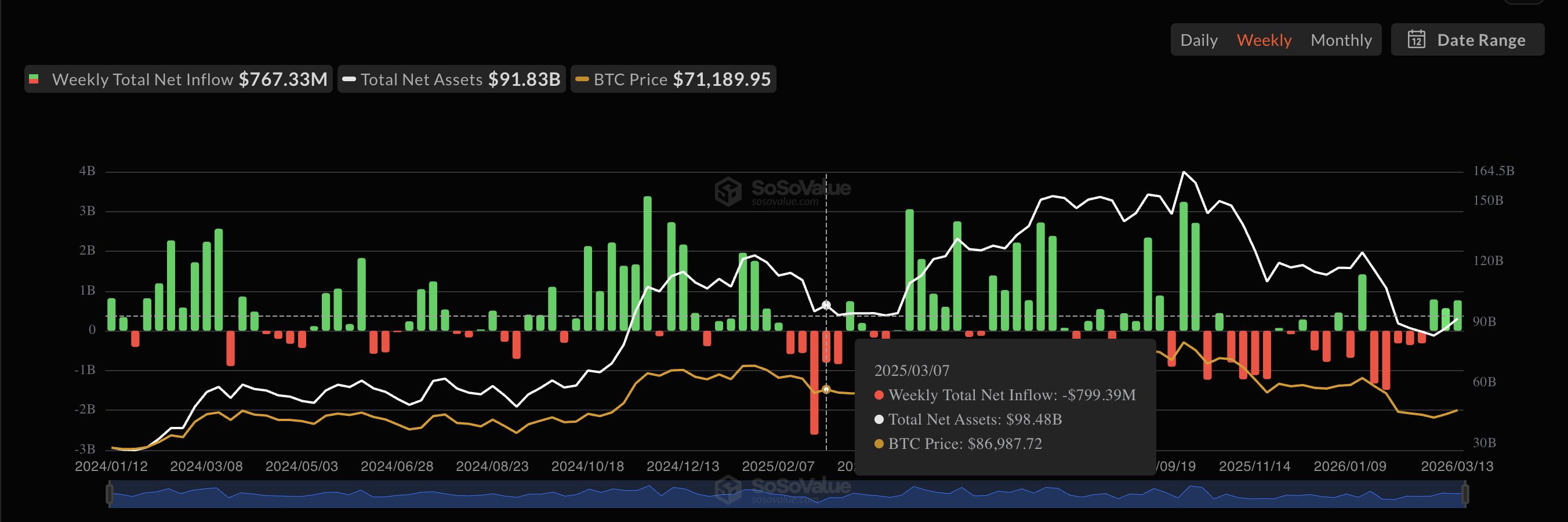
The buyers of the largest digital asset appear to be U.S., as institutional demand from the region appears to be gradually returning. US spot bitcoin ETFs have recorded approximately $1.3 billion in net inflows so far in March, putting them on track for their first month of net inflows since October.

However, the divergence doesn’t mean that bitcoin is completely out of the woods yet.

The market sentiment remains extremely cautious. The crypto fear and greed index has stayed in “extreme fear” territory. At the same time, perpetual futures funding rates remain negative. Funding rates are periodic payments exchanged between traders in perpetual futures markets to keep contract prices aligned with the spot market. When funding rates are negative, short sellers pay long positions, indicating that bearish positioning is dominant and traders are willing to pay to maintain short exposure.

While it may not mean bitcoin is all-clear to take off, it does show that investors aren’t pricing it as a purely risk asset anymore.

As CoinDesk analysis showed, the move might just mean bitcoin has potentially become a 24/7 leading indicator of how the overall market might trade in response to a macro event. The Middle East conflict is the perfect example of this, as the price moved before any other asset classes when the war first started. And now, it seems everything else is following its price action, while bitcoin remains steady.

Read more: Bitcoin’s recent crash to $60,000 warned stocks first – now they’re following

Buterin Says Its Time To Revisit Idea Simplifying Ethereum Node Setup

0

Ethereum co-founder Vitalik Buterin posted a proposal, or a pull request, on Saturday that would merge the backend programs used by nodes to interact with Ethereum’s Beacon Chain, which handles consensus and staking, and the protocol’s execution layer into one unified code structure to simplify node setup.

Ethereum node runners, also called validators, currently have to run two separate programs, which each require setup and synchronization to coordinate and communicate the data produced by Ethereum’s consensus and execution layers.

This raises the technical complexity of running a node or providing validation services for the Ethereum network, preventing ordinary users from running their own infrastructure and forcing reliance on third-party service providers.

Source: Vitalik Buterin

“I feel like at every level, we have implicitly made this decision that running a node is this oh so scary DevOps task that it is ok to leave to professionals,” Buterin said in a post on X. He continued:

“It is not. We need to reverse this. Running your own Ethereum infrastructure should be the basic right of every individual and household. ‘The hardware requirement is high, therefore it’s okay for the DevOps skill and time requirements to also be high,’ is not an excuse.”

Even those who can afford the high-end computing hardware to set up an Ethereum node and have the technical expertise typically lack the time to set them up, Buterin said, adding that “nodes should be easy.”

The Ethereum network and other smart contract blockchains have faced criticism for the technical complexity and hardware requirements to run a node, which has also raised centralization concerns about those networks.

Related: Ethereum Foundation publishes mandate clarifying role and goals

Buterin proposes partially stateless nodes to further decentralize the network

In May 2025, Buterin proposed partially stateless nodes, which do not maintain the full block history and only keep data that the node runner requires.

This reduces the hardware costs and data storage requirements for users running nodes for personal purposes, like sending transactions and verifying the blockchain. 

Decentralization, Ethereum, Vitalik Buterin, Nodes
An illustration showing how partially stateless nodes would only save portions of the blockchain state. Source: Ethereum Research

Disk space is usually the primary bottleneck for node operators, according to Go-Ethereum (GETH). Smart contract blockchain networks, like Ethereum, generate significant quantities of data that require ever-increasing storage space, making specialized node hardware a necessity.

“A market structure dominated by a few remote procedure call (RPC) providers is one that will face strong pressure to deplatform or censor users. Many RPC providers already exclude entire countries,” Buterin wrote.

In late January, Buterin said he had set aside 16,384 Ether, worth about $45 million, from his personal holdings to support privacy-preserving technologies, open hardware and secure, verifiable software. He added that the funds would be deployed gradually over the coming years as the Ethereum Foundation enters a period of what he described as “mild austerity,” while continuing to pursue its technical roadmap.

Magazine: Ethereum’s Fusaka fork explained for dummies: What the hell is PeerDAS?