Home Blog Page 761

BTC tops $74K, ether, solana, cardano move as much as 7%

0

Bitcoin briefly broke through the $74,000 resistance zone that it had rejected four times in two weeks, before reversing under that level.

The largest cryptocurrency was trading just above $74,000 on Monday morning, up 2.9% over the past 24 hours and 9.7% on the week. Ether surged 7.7% in 24 hours and 14.3% on the week to $2,261, its strongest weekly performance in months. Solana jumped 5.6% on the day and 12% on the week to $93.

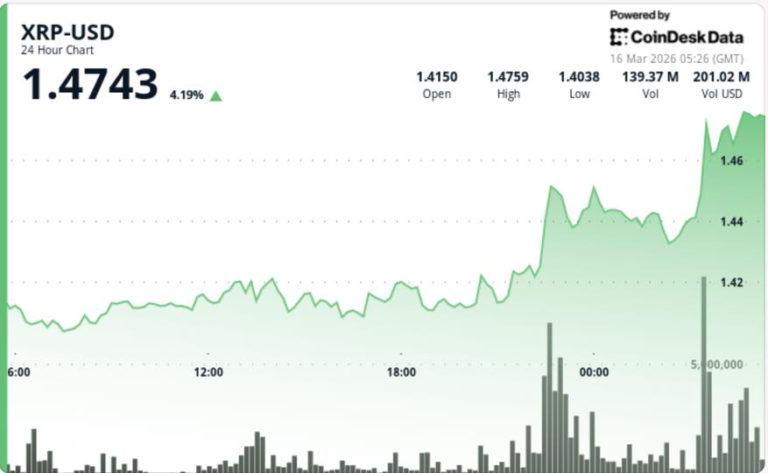
Dogecoin hit $0.10 for the first time since early March, up 4.6% daily and 10.6% weekly. BNB gained 3.8% to $683 with a 9.5% weekly gain. XRP rose 4.2% to $1.47, up 8.9% over seven days.

The move had a short squeeze behind it. CoinGlass data shows $344 million in total liquidations over the past 24 hours across 91,978 traders, with short liquidations accounting for $284.9 million, roughly 83% of the total. Ether shorts got hit hardest at $127.9 million, followed by bitcoin at $124.5 million and solana at $18.5 million.

The largest single liquidation was a $6.94 million BTC position on Bitfinex. The lopsided ratio confirms that the rally was fueled in part by bears getting forced out of positions, though the broad altcoin participation and macro backdrop suggest there’s more to it than just a squeeze.

The catalyst was a shift in tone from multiple directions at once. Trump said the U.S. was talking to Iran, though Tehran denied requesting talks or a ceasefire. Iranian Foreign Minister Abbas Araghchi said the Strait of Hormuz was only closed to ships from “enemies,” a notable softening from the blanket closure that had been in effect.

Two tankers carrying liquefied petroleum gas to India sailed through the strait on Sunday, the first commercial transit since the war began.

Oil reflected the change in mood. Brent traded around $104 after earlier climbing as high as $106.50 following the Kharg Island strikes, but pulled back as the Hormuz headlines hit. WTI dropped below $100. The dollar weakened 0.3%. S&P 500 futures advanced 0.5%, set for their first gain in five days. MSCI’s global equity gauge stabilized after three days of declines.

For crypto, the combination of easing oil, a weaker dollar, and even a hint of de-escalation is the exact macro cocktail that loosens the liquidity chain that has been choking risk assets since the war began.

The weekly numbers are the most impressive since before the war. Bitcoin’s 9.7% gain is strong but the altcoin outperformance is the signal that risk appetite is genuinely returning. When ether outperforms bitcoin by 4.6 percentage points and solana outperforms by 2.3 points on a weekly basis, capital is rotating down the risk curve rather than hiding in bitcoin.

The Fed meeting on March 17-18 arrives with different context than it had a week ago.

Oil is still elevated but the Strait of Hormuz showing signs of reopening changes the inflation calculus. The dot plot and Powell’s press conference on Wednesday will determine whether the market’s rate cut hopes survive or get crushed.

Ripple linked token jumps as breakout extends on broad bitcoin-led move

0

XRP pushed higher after clearing a key resistance level, extending a breakout from a multi-month consolidation range.

News Background

  • XRP’s latest move comes after several months of sideways trading, where the token repeatedly failed to sustain rallies above the mid-$1.40 area.
  • The breakout marks the first clear move above that ceiling since early 2026, shifting short-term momentum toward buyers.
  • While the price advance lacked a clear XRP-specific catalyst, activity on the XRP Ledger has continued to rise.
  • Tokenized real-world assets on the network recently climbed sharply, with the value of tokenized commodities approaching $1.14 billion during the first quarter.

Price Action Summary

  • XRP rose from about $1.41 to $1.47 during the latest 24-hour session
  • The token broke through the $1.426 resistance zone that capped previous rallies
  • Trading volume spiked to roughly 170 million tokens during the breakout
  • XRP traded within a roughly 5% intraday range

Technical Analysis

The key development was the breakout above $1.426, which had acted as a ceiling throughout recent consolidation. Once the level cleared on strong volume, price accelerated quickly toward the $1.47 area.

Short-term charts show a sequence of higher lows forming after the breakout, suggesting buyers are attempting to turn the former resistance zone into support.

Momentum remains constructive while XRP holds above roughly $1.43. The next technical barrier sits near the $1.48–$1.50 area, where previous rallies have stalled.

What traders say is next?

Traders are now focused on whether XRP can maintain support above the $1.43–$1.44 breakout level.

If that zone holds, the token could extend the move toward $1.50 and potentially the $1.55 region as momentum builds.

However, a drop back below $1.43 would weaken the breakout and could pull XRP back toward the previous consolidation range near $1.39–$1.40.

Bitcoin price spikes as Iran war rages on and investors pile into ‘redemption trade’ – DL News

0

  • Bitcoin’s price jumped on Friday.
  • It came despite no clear end in sight with geopolitical strife in the Middle East.
  • The wider crypto market is largely up.

On Friday, Bitcoin continued to do what it has done throughout its short history: the unexpected.

Despite taking a hit at the start of the US-Iran war two weeks ago, and experts warning that it could plunge as part of a broader risk asset selloff, the leading cryptocurrency is now trading above $72,000 after flirting with $74,000 earlier in the morning Eastern Time — for the first time since the beginning of February.

Bitcoin’s price is up over the past month. Source: CoinGecko.

Over the past day, the coin has risen 2%. Over the past month, it has shot up by more than 8%, according to CoinGecko data.

“Investors may be seeing Bitcoin and crypto as a whole as oversold compared to other assets, and as such are increasing exposures,” Carlos Guzman of GSR Research told DL News.

Bitcoin’s rise comes as US President Donald Trump said that the worst strikes on Iran are yet to come.

“We have unparalleled firepower, unlimited ammunition, and plenty of time,” the president wrote late at night on Thursday on his Truth Social platform. “Watch what happens to these deranged scumbags today.”

Risk asset or not?

Bitcoin — despite being described as a safe-haven in the past and trading in correlation with gold in short time frames — has been more correlated with risk assets like tech stocks as of late.

After a brutal selloff in October, when the leading cryptocurrency shed most of its year-to-date gains after more than $19 billion in bets were liquidated, the coin entered a bear market.

But the bottom may be in, according to Guzman, regardless of war.

“I believe the shift in sentiment is being driven in part by the resilience crypto prices have shown in recent weeks amid rising conflict and uncertainty, which I think is generating the perception that the market has bottomed,” he said.

Experts last month told DL News that an attack on Iran would most certainly lead to a dip in crypto prices, as war has previously led to digital asset selloffs.

But market observers were also torn about how long the selloff would last.

DeFi researcher Ignas wrote on X Friday that the asset was now being bought as part of a “redemption trade,” adding that geopolitical headwinds would actually help the asset.

Diana Pires, Chief Business Officer at sFOX, added that Bitcoin’s rise reflected “a rare decoupling from traditional risk assets.”

And in an email exchange with DL News on Friday, a research analyst at forex broker Pepperstone, Dilin Wu, said the asset’s “uptrend could be restarting” as institutions remain interested in buying it.

But she did add that “a spike in oil prices could weigh on risk sentiment and pressure Bitcoin, while boosting gold.”

Other assets

Bitcoin wasn’t the only cryptocurrency to experience a price bump on Friday: Ethereum rose by more.

The second biggest coin was recently trading more than 5% higher over a 24-hour period, hitting $2,137 at midday in New York.

Ethereum’s price is up too. Source: CoinGecko.

It came after the world’s biggest asset manager, BlackRock, debuted a new Ethereum exchange-traded fund, giving investors staking exposure.

Elsewhere, out of larger cryptocurrencies, Solana and XRP were also trading higher, by 3% and 2%, respectively.

Mathew Di Salvo is a news correspondent with DL News. Got a tip? Email at mdisalvo@dlnews.com.

What next as bitcoin’s price trades above its 50-day average?

0

Bitcoin’s price has risen past its key average for the first time in two months, signaling strengthening bullish momentum.

The cryptocurrency’s price has gained over 3% to $73,700 in 24 hours, topping the 50-day moving average, which stood at $71,125 at the time of writing. The positive price action follows days of resilient performance amid the Iran war and global equity turmoil, especially in Asian markets.

The so-called 50-day moving average is one of the most widely tracked momentum indicators in the market, which analysts recently cited as one of the formidable resistance levels holding back gains.

“This indicator often signals the medium-term trend, and a confident break above it would be an important turning point in the coming days,” Alex Kuptsikevich, senior market analyst at FxPro, said in an email.

Note, however, that the bullish breakout doesn’t necessarily promise a sustained uptrend. For instance, the previous one in early January was followed by an 8% price rise, but the momentum lasted just two weeks before selling resumed. Previous instances have delivered mixed results as well.

For now, the breakout, points to a continued move higher and perhaps increased volatility as prices move closer to the $75,000 mark. This is the level where market makers – those ensuring a smooth trading experience by providing liquidity on an exchange – hold net short gamma positions worth billions, as CoinDesk noted Friday.

So, as prices rise toward $75,000, they are likely to buy high to rebalance their net exposure to neutral. This could add to market volatility.

Bitcoin Resilience Study Reveals Targeted Attack Risk

0

Nearly three-quarters of all undersea fibre optic internet cables (which carry about 99% of international internet traffic) would need to fail to have a significant impact on Bitcoin, according to a study released earlier this year.

In research first published in February and last revised on March 12, researchers Wenbin Wu and Alexander Neumueller from the Cambridge Centre for Alternative Finance said they used P2P network data from 2014 to 2025 and 68 verified cable fault events to apply a country-level cascade model to determine Bitcoin’s physical infrastructure resilience.

They claim it to be the first longitudinal study of Bitcoin’s resilience to submarine cable failures, and it helps to answer a long-standing question about what would happen to Bitcoin if the internet were to be disrupted. 

Map of undersea cables. Source: SubmarineCableMap 

The researchers found that the critical failure threshold for random cable removal sits at 0.72 to 0.92, meaning 72% to 92% of all “inter-country” submarine cables would need to fail before more than 10% of network nodes disconnect. 

However, the Bitcoin network was more vulnerable to targeted attacks on certain subsea cable chokepoints, with researchers calling it an “order of magnitude more effective,” with a critical failure threshold of 0.05 to 0.20.

Tor routing provides greater resilience 

The study also found that Tor (The Onion Router) “creates a compound barrier to disruption,” given the current concentration of relay infrastructure in well-connected European countries.

Tor is similar to VPNs (virtual private networks), bouncing web traffic through a chain of volunteer-run servers around the world, wrapping each hop in a layer of encryption for privacy, like the layers of an onion.

Related: Is Tor still safe after Germany’s ‘timing attack?’ Answer: It’s complicated…

The Bitcoin network uses Tor to obfuscate nodes, meaning their physical locations are hidden. The paper revealed that 64% of Bitcoin nodes are essentially “invisible” to researchers.

“Tor adoption increases resilience under current relay geography rather than introducing hidden fragility,” it stated. 

This is because Tor relay infrastructure is concentrated in Germany, France, and the Netherlands — countries with extensive and redundant submarine cable connectivity — so cable failures rarely take down relay capacity.

Bitcoin network resilience has been improving with Tor adoption over time: Source: Wenbin Wu and Alexander Neumueller

Near-zero correlation between cable events and BTC price

The researchers concluded that 87% of the 68 verified historical cable fault events caused less than a 5% node impact, and cable events showed essentially zero correlation with Bitcoin (BTC) prices, or a statistically insignificant correlation coefficient of −0.02. 

They also note that the geographic diversification of BTC mining “has not materially altered infrastructure resilience,” which is consistent with physical cable topology rather than with hashrate distribution.

Magazine: Big questions: Would Bitcoin survive a 10-year power outage?