New General Ledger Reconciliation capability extends automation from medical lockbox through EHR posting and financial reporting
MediStreams, a leading provider of healthcare payment and remittance automation solutions, today announced the expansion of its reconciliation platform with General Ledger (GL) Reconciliation, completing what the company believes is the industry’s first and only end-to-end reconciliation solution for healthcare payments. The expanded platform will be demonstrated this week at the HFMA Revenue Cycle Conference, booth #7.
“Healthcare payments have always been difficult to reconcile because the money and the remittance data rarely arrive together. Our platform aligns those streams before the data reaches downstream sytems.” — John Koch, COO, MediStreamsShare
Healthcare providers receive payment data from multiple sources, including bank deposits, electronic remittance advices (ERAs), paper EOBs, and payer correspondence, which often arrive at different times and in different formats. This fragmentation creates operational inefficiencies, slows month-end close processes, and makes it more difficult for revenue cycle and finance teams to reconcile payments with complete accuracy.
Bridging the Gap Between Payment Data and Deposits
The MediStreams platform addresses this challenge by reconciling payments across the entire workflow, from medical lockbox and remittance conversion through posting validation and general ledger reconciliation, ensuring that every posted payment is aligned with the funds deposited in the bank.
“Healthcare payments have always been difficult to reconcile because the money and the remittance data rarely arrive together,” said John Koch, Chief Operating Officer of MediStreams. “Our platform aligns those streams before the data reaches downstream systems. By delivering funded posting files, MediStreams removes a significant reconciliation burden from revenue cycle and finance teams.”
Delivering Posting-Ready Files
Traditionally, providers post all incoming remittance data into their EHR or practice management systems and then rely on finance teams to determine whether those transactions correspond to actual bank deposits. This retroactive reconciliation process often requires significant manual effort and can delay the month-end close.
MediStreams takes a different approach by matching bank deposit information with remittance data across both electronic ERAs and paper EOBs before delivering posting-ready files into EHR and practice management systems. This ensures that only funded payments are posted, providing immediate assurance that posted revenue aligns with deposits received.
Extending Reconciliation to the General Ledger
The addition of General Ledger Reconciliation extends this capability further by enabling healthcare organizations to categorize and reconcile non-patient payments, such as operational deposits, interest, or other financial adjustments, that also appear in bank accounts. The platform generates journal-ready outputs that integrate directly with enterprise resource planning (ERP) and general ledger systems, enabling finance teams to reconcile accounts more efficiently and close their books with greater confidence.
Together with MediStreams’ existing capabilities, which include medical lockbox services, paper and PDF EOB conversion, ERA normalization, correspondence indexing, and financial and posting reconciliation, the new functionality enables organizations to reconcile payment activity faster and more accurately, giving leaders greater confidence in their financials.
Bitcoin derivatives remain bearish as traders hedge against a price drop despite BTC reclaiming the $74,000 level.
Fears of a global energy shortage mount as the Strait of Hormuz remains closed, forcing investors into safe-haven Treasury assets.
Bitcoin (BTC) climbed above $74,000 on Monday, following gains on the Nasdaq Index as investors await a keynote from Nvidia (NVDA US) CEO Jensen Huang at the chipmaker’s biggest event of the year, the Nvidia GTC 2026 global AI conference. A drop in oil prices and growth in the US manufacturing sector also helped support risk-on assets.
Despite this bullish background, Bitcoin derivatives suggest professional traders were unfazed by the rally that pushed prices to a 40-day high.
The annualized Bitcoin monthly futures premium relative to spot markets stood at a meager 2% on Monday, well below the neutral 4% to 8% range. This lack of enthusiasm has been the norm for the past 30 days, likely reflecting traders’ discomfort as Bitcoin traded down 31% in six months while gold gained 18% and the Nasdaq 100 Index stayed flat.
While it is difficult to pin down the exact drivers behind the price weakness, it can be partially attributed to a handful of events, including the absence of a clear execution timeline for the US Strategic Bitcoin Reserve. Meanwhile, the historic $19 billion liquidation event on Oct. 10, 2025, flushed out over-leveraged long positions and hit market makers’ risk appetite.
Furthermore, fears over quantum computing vulnerabilities emerged while Bitcoin decoupled from gold and silver as capital sought safety from the US and Israel-Iran war and signs of weakness in the US job market.
Bitcoin options signal fear despite institutional buying streak
Bitcoin 30-day options delta skew (put-call) at Deribit. Source: Laevitas.ch
The Bitcoin options delta skew on Deribit remained at 13% on Monday, signaling persistent fear that have dominated the market for five weeks. When whales and market makers avoid downside exposure, put (sell) options tend to trade at a 6% or higher premium relative to call (buy) instruments. The recent rally to $74,500 was unable to change traders’ sentiment.
USD stablecoin premium/discount relative to USD/CNY rate. Source: OKX
USD stablecoins traded at a 0.5% premium relative to the official US dollar to yuan exchange rate on Monday, suggesting a balanced inflow and outflow in the region. Heightened demand for Bitcoin usually pushes the indicator above the 1.5% neutral threshold. At the same time, periods of stress typically cause stablecoins to trade at a discount when trades rush to exit cryptocurrency markets.
Regardless of the outcome of the Nvidia GTC 2026 event, investors are closely tracking the development of the war in Iran. US benchmark West Texas Intermediate oil prices held near $95 per barrel after the US struck Iranian military assets late Friday night, while drone strikes reportedly halted oil loadings at the key port Fujairah in the United Arab Emirates, according to Yahoo Finance.
Related: Metaplanet raises $255M and adds warrant structure for Bitcoin buys
WTI oil (left) vs. US 5-year Treasury yield (right). Source: TradingView
The Strait of Hormuz, the world’s most important shipping lane for oil, reportedly remains “essentially closed,” causing analysts to reassess the risk of a “prolonged global energy shock.” Yields in the US 5-year Treasury dropped to 3.82% after peaking at 3.87% on Thursday, indicating that investors sought protection in government-backed assets amid the increasing uncertainty.
Bitcoin’s bullish momentum has been supported by Strategy buying 22,337 BTC during the previous week alone, while US-listed spot Bitcoin ETFs netted 11,117 BTC in inflows. Despite institutional appetite, the lack of confidence in Bitcoin derivatives is strong evidence that bear-market sentiment is not over.
This article does not contain investment advice or recommendations. Every investment and trading move involves risk, and readers should conduct their own research when making a decision. While we strive to provide accurate and timely information, Cointelegraph does not guarantee the accuracy, completeness, or reliability of any information in this article. This article may contain forward-looking statements that are subject to risks and uncertainties. Cointelegraph will not be liable for any loss or damage arising from your reliance on this information.
Sellers will attempt to halt the recovery at $74,508, but if buyers bulldoze their way through, the rally may reach $84,000.
Select major altcoins have risen above their overhead resistance levels, signaling solid demand at lower levels.
Bitcoin (BTC) rallied to $74,508 on Monday, a level that is a key near-term resistance. Crypto sentiment platform Santiment said in a recent report that wallets holding between 10 and 10,000 BTC have started accumulating, which in the past was a bullish sign.
US spot BTC exchange-traded funds (ETFs) have also attracted investors, recording five straight days of inflows last week. Bernstein said in a Monday research note shared with Cointelegraph that sustained inflows into BTC ETFs and steady corporate buying by companies such as Strategy have strengthened BTC’s long-term holder base, contributing to a more stable market structure during periods of stress.
Crypto market data daily view. Source: TradingView
BTC is showing signs of a trend reversal, but the bears are unlikely to give up easily. Higher levels are likely to attract sellers who will attempt to trap the aggressive bulls. Material Indicators cofounder Keith Alan said in a video analysis that BTC is still in a bear market, and the price may retest the support near $60,000.
Could buyers sustain BTC and major altcoins above their resistance levels? Let’s analyze the charts of the top 10 cryptocurrencies to find out.
S&P 500 Index price prediction
The S&P 500 Index (SPX) turned down from the 20-day exponential moving average (6,799) on Tuesday, indicating a negative sentiment.
The index may reach the 6,550 level, which is a crucial level to watch out for. If the price rebounds off the 6,550 level with force, the index may reach the 20-day EMA, where the bears are expected to step in. If the price turns down sharply from the 20-day EMA, the likelihood of a break below the 6,550 level increases. The correction may then deepen to the 6,350 level.
On the contrary, a close above the moving averages suggests that the index may remain inside the 6,550 to 7,002 range for a while longer.
US Dollar Index price prediction
The US Dollar Index (DXY) reached the 100.54 resistance on Friday, which is a critical level to watch out for.
The upsloping 20-day EMA (98.76) and the RSI near the overbought zone suggest that the path of least resistance is to the upside. If buyers thrust the price above the 100.54 level, the index might start a new uptrend to the 102 level and later to the 103.54 level.
Contrary to this assumption, if the price turns down sharply from the current level and breaks below the moving averages, it suggests that the index may remain inside the 95.50 to 100.54 range for some more time.
Bitcoin price prediction
BTC continued its upward march and reached the $74,508 resistance, where the bears are expected to mount a strong defense.
The 20-day EMA ($70,028) has started to turn up, and the RSI is in the positive territory, indicating that the buyers are attempting to take charge. A close above the $74,508 level will complete a bullish ascending triangle pattern, opening the gates for a rally to $84,000. Such a move suggests that the downtrend may be over.
Sellers will have to pull the BTC price below the moving averages to weaken the bulls. The BTC/USDT pair may then slump to the support line. A close below the support line tilts the advantage back in favor of the bears.
Ether price prediction
Ether’s (ETH) consolidation between $1,750 and $2,111 resolved to the upside with a breakout on Sunday.
The moving averages are on the verge of a bullish crossover, and the RSI is in the positive zone, indicating that buyers are back in the game. The ETH price may rally to $2,600 and then to $3,450. Such a move suggests that the ETH/USDT pair may have bottomed out at $1,747.
The 20-day EMA ($2,072) is the vital support to watch out for on the downside. A close below the 20-day EMA signals that the bears are active at higher levels. The pair may then tumble to $1,916.
BNB price prediction
BNB (BNB) closed above the $670 resistance on Sunday, but the bulls are struggling to sustain the higher levels.
The 20-day EMA ($646) is the critical support to watch out for on the downside. If the price bounces off the 20-day EMA with strength, the BNB/USDT pair may rally to $730 and subsequently to $790.
This positive view will be invalidated in the near term if the BNB price continues lower and breaks below the 20-day EMA. That may keep the pair range-bound between $570 and $670 for a while longer.
XRP price prediction
XRP (XRP) has risen above the 50-day simple moving average ($1.46), indicating sustained buying by the bulls.
If the XRP price closes above the 50-day SMA, the next stop is likely to be the breakdown level of $1.61. If the price turns down from $1.61 but finds support at the 20-day EMA ($1.41), it suggests a bullish sentiment. The XRP/USDT pair may then climb to the downtrend line.
On the contrary, if the price turns down from the overhead resistance and breaks below the 20-day EMA, it signals that the bears are selling on minor rallies. That may retain the price inside the descending channel pattern.
Solana price prediction
Solana (SOL) has reached the breakdown level of $95, which is a critical overhead resistance to keep an eye on.
If buyers overcome the barrier, the SOL/USDT pair may surge to $117. Sellers are expected to pose a substantial challenge at $117, but on the way down, if the bulls maintain the SOL price above $95, it suggests a positive sentiment. That increases the possibility of a rally to $147.
Instead, if the price turns down sharply from the current level and breaks below the 20-day EMA ($87), it suggests that the pair may extend its stay inside the $76 to $95 range for some more time.
Related: Bitcoin hits $74.4K six-week high as analysts see ‘more upside’ for BTC
Dogecoin price prediction
Dogecoin (DOGE) has risen above the 50-day SMA ($0.10), indicating that the bears are losing their grip.
The DOGE/USDT pair may rally to the breakdown level of $0.12, where the bears are expected to sell aggressively. If the DOGE price turns down sharply from $0.12, it points to a possible range formation. The pair may swing between $0.09 and $0.12 for a few days.
On the other hand, a break and close above the $0.12 resistance signals that the bulls are back in the driver’s seat. That clears the path for a rally to the $0.16 level, which is expected to behave as a stiff resistance.
Cardano price prediction
Cardano (ADA) has surged above the 50-day SMA ($0.28), indicating that the bulls are attempting a comeback.
The bears are expected to vigorously defend the downtrend line, but if the bulls prevail, the ADA/USDT pair may signal a short-term trend change. The ADA price may rally to $0.37 and then to $0.44.
Contrarily, if the price turns down sharply from the downtrend line and breaks below the moving averages, it suggests that the pair may continue to oscillate inside the channel for a few more days.
Hyperliquid price prediction
Sellers attempted to pull Hyperliquid (HYPE) back below the breakout level of $36.77 on Sunday, but the bulls held their ground.
That suggests the bulls are striving to flip the $36.77 level into support. If they manage to do that, the HYPE/USDT pair may ascend to $43 and then to $50.
The first support on the downside is at $36.77 and then at the 20-day EMA ($33.95). Sellers will have to tug the HYPE price below the 50-day SMA ($31.56) to suggest that the market has rejected the breakout above $36.77. The pair may then plummet to $29.
This article does not contain investment advice or recommendations. Every investment and trading move involves risk, and readers should conduct their own research when making a decision. While we strive to provide accurate and timely information, Cointelegraph does not guarantee the accuracy, completeness, or reliability of any information in this article. This article may contain forward-looking statements that are subject to risks and uncertainties. Cointelegraph will not be liable for any loss or damage arising from your reliance on this information.
Bitmine Immersion Technologies (BMNR), the largest ether-focused treasury firm, bought 60,999 ether (ETH) last week as it continues to build up its holdings of the second-largest cryptocurrency by market capitalization.
In token terms, the purchase was the company’s biggest this year, though only a small increase from the previous week’s 60,976 ETH haul.
The latest purchase, worth nearly $140 million at current prices, lifted Bitmine’s ETH holdings to 4,595,562 tokens, valued at more than $10 billion, according to a Monday update from the company.
The firm maintained a $1.2 billion cash holding, even though it increased its stake in Worldcoin-focused (WLD) treasury firm Eightco (ORBS) last week alongside its ETH purchase.
Bitmine’s stock was nearly 9% higher pre-market as crypto prices rebounded over the weekend. ETH has advanced 8.4% over the past 24 hours.
The firm has steadily added to its treasury throughout the recent market downturn, even as unrealized losses on its position are estimated at around $6.5 billion, according to data from DropsTab.
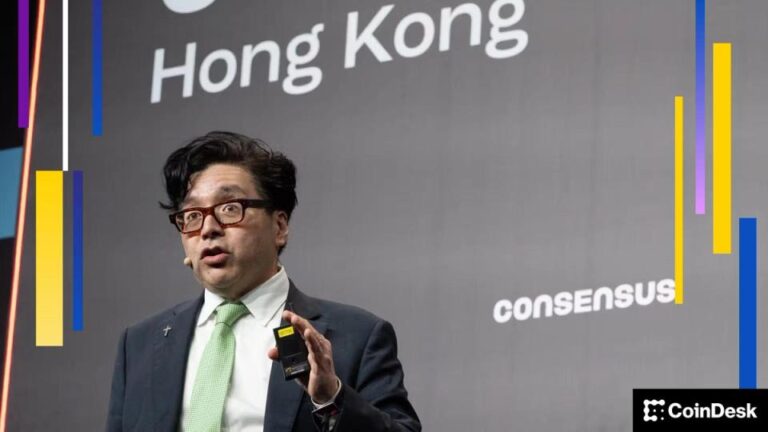
Chairman Thomas “Tom” Lee said recent geopolitical tensions have not weighed on crypto prices as much as other assets.
“Since the start of the Iran war, crypto prices have outperformed and Ethereum has outperformed the S&P 500 by 2,450 basis points,” Lee said in a statement. “In our view, higher oil is triggering concerns of slowing growth for the global economy. And when investors worry about growth, they buy ‘growth stocks’ including MAG7, software and crypto.”
Bitmine continues to generate income from staking a large share of its ether holdings. The firm said it now earns about $180 million in annualized revenue from staking 3.04 million ETH, with potential staking revenue reaching $272 million once more of its tokens are locked to earn yield.
Read more: Ethereum Foundation sells 5,000 ether to Tom Lee’s BitMine in $10.2 million deal
Total crypto capitalization is up 3.5%, with Layer 1s and memecoins leading the charge.
Crypto markets are off to a strong start this week, with major altcoins surging amid more than $400 million in short liquidations. Stocks rallied while oil dropped 5% after U.S. Treasury Secretary Scott Bessent told CNBC that Iranian oil tankers are being allowed to transit the Strait of Hormuz.
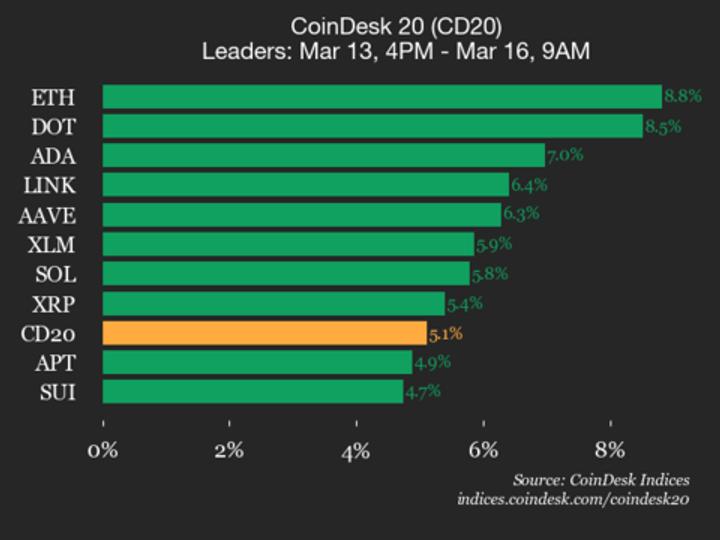
Bitcoin (BTC) is trading at around $74,000, up 3.5% over the past 24 hours. Layer 1 tokens are outperforming, with ETH surging 10% to $2,320, and SOL climbing 8% to $95.
Meanwhile, Polkadot (DOT) rallied 15%, Ripple (XRP) and Cardano (ADA) gained around 9%, and BNB added 2%.
ETH Chart
The overall crypto market capitalization climbed 3.5% to $2.61 trillion, according to Coingecko.
Michael Saylor’s Strategy purchased an additional 22,337 Bitcoin between March 9 and March 15 for approximately $1.57 billion at an average price of $70,194 per coin, according to a Monday SEC filing. The acquisition, one of the company’s largest to date, brings its total holdings to 761,068 BTC.
Nearly all of the Top 100 digital assets posted gains over the last 24 hours.
Today’s top gainers are Zcash (ZEC) and PEPE, which both surged 20%.
TRUMP and Bittensor (TAO) are the biggest losers, down 4% and 2%, respectively.
Around 120,000 leveraged traders were liquidated for $542 million in the past 24 hours, according to CoinGlass, with short positions comprising $420 million. Bitcoin accounted for $173 million, while ETH led with $220 million.
Bitcoin exchange-traded funds (ETFs) recorded inflows of $180 million on Friday, bringing last week’s total inflows to $767 million, according to SoSoValue.
The BFSI Philippines Summit 2026 is set to gather the country’s top banking, financial services, and insurance (BFSI) leaders on April 16, 2026 at the Novotel Manila Araneta City. Building on the decade-long success of the Digital Banking Asia series, the summit will convene over 300 C-level executives, decision-makers, regulators, and technology innovators to chart the next wave of AI-powered financial transformation.
With the Philippines at a pivotal moment in its digital economy journey, this year’s theme centers on the “AI-Everything Era,” highlighting how artificial intelligence is reshaping retail banking, insurance, fintech, compliance, and cybersecurity. Senior representatives from the Bangko Sentral ng Pilipinas, leading commercial banks, top fintech firms, insurance providers, and non-bank financial institutions across Asia are expected to participate.
Key agenda highlights include CEO-level discussions on building a smarter and more inclusive Philippine BFSI sector, expert panels on Central Bank Digital Currency (CBDC) and stablecoins, and deep dives into AI and Agentic AI applications in banking and insurance. Sessions will also tackle financial inclusion, workforce transformation, cyber resilience, RegTech, and SupTech innovation.
Beyond thought leadership, the summit will feature a curated exhibition floor showcasing next-generation core banking systems, advanced AI/ML tools, and cybersecurity platforms. Designed as a one-stop platform for collaboration, the BFSI Philippines Summit 2026 aims to unite the industry under one roof—driving trust, innovation, and inclusive growth in the evolving Philippine financial landscape.
Crypto wealth platform Abra said it plans to go public through a merger with special purpose acquisition company New Providence Acquisition Corp. III in a deal that values the firm at $750 million.
The combined company will be renamed Abra Financial Inc. and is expected to list on Nasdaq under the ticker ABRX, according to an announcement.
The transaction could deliver as much as $300 million in cash from the SPAC’s trust account, though the final amount depends on shareholder redemptions and deal expenses.
Founded in 2014 and based in San Francisco, Abra provides a range of services for crypto investors. Its platform allows institutions, registered investment advisers, family offices and wealthy individuals to store crypto, trade hundreds of tokens, earn yield and borrow against holdings.
Assets sit in segregated accounts called vaults rather than on the company’s balance sheet. The firm operates an SEC-registered investment adviser and frames its services as a bridge between traditional wealth management and crypto markets.
Abra said proceeds from the transaction will support product development, hiring and expansion into areas such as tokenized real-world assets and decentralized finance.
The company reported “hundreds of millions of dollars in assets” under management and aims to exceed $10 billion by 2027.
Abra was founded by CEO Bill Barhydt as a mobile crypto wallet and remittance app aimed at retail users. During the last crypto bull cycle, the company expanded into lending and yield products through its Abra Earn program and raised $55 million in 2021 from investors including Blockchain Capital, Pantera Capital and RRE Ventures.
The company shifted strategy after regulators challenged parts of its lending business. In 2023 and 2024, Abra reached settlements with U.S. state regulators and the Securities and Exchange Commission tied to unregistered lending and securities offerings.
The firm shut its U.S. retail operations and returned funds to customers before rebuilding the business around institutional and high-net-worth clients through its SEC-registered investment arm, Abra Capital Management.
The proposed merger is pending approval from shareholders and regulators before closing.
A U.K. High Court judge allowed a lawsuit over the alleged theft of more than 2,323 bitcoin to move forward last week, in a case that highlights how the country’s legal system is still adapting traditional property law to cryptocurrency.
U.K. resident Ping Fai Yuen claimed in court filings in last week that his estranged wife, Fun Yung Li, used CCTV cameras in their home to secretly obtain the recovery phrase to his hardware wallet and transferred 2,323 bitcoin BTC$74,659.40 without his permission in August 2023, according to the docket in the High Court of England and Wales.
The bitcoin was worth just under $60 million at the time of the alleged theft 30 months ago, but is now worth roughly $172 million at the current price of just over $74,000.
The stolen crypto was stored in a Trezor cold wallet secured by a PIN. But anyone with the wallet’s 24-word recovery phrase could recreate the wallet and move the funds, the court noted. It was then transferred through several transactions and now sits across 71 blockchain addresses not held at exchanges. The funds have not moved since Dec. 21, 2023, according to the court.
Yuen said he later installed audio recording devices in the home after his daughter warned him Li was trying to take the bitcoin. After discovering the transfer, Yuen confronted Li and assaulted her. He later pleaded guilty to assault occasioning actual bodily harm and two counts of common assault in 2024. Officers seized several hardware wallets and recovery seeds during a search of her home, though authorities later took no further action pending new evidence.
Earlier, according to the filings, the wife asked the court to throw out the case, arguing that because the husband’s main claim was conversion, which in England is a legal term traditionally used when someone takes physical property, it could not apply to digital assets, such as bitcoin.
The judged agreed with the wife, but ruled the case can still proceed under different legal claims that could allow the husband to recover the bitcoin if his allegations are proven. The case will now proceed to trial, the judge said.
Artificial intelligence-linked cryptocurrencies extended their surge Monday after Nvidia CEO Jensen Huang laid out the company’s vision for the next phase of AI infrastructure during his keynote at Nvidia’s GTC developer conference.
Among the big movers were AI-focused blockchain NEAR$1.3785, climbing more than 10% over the past 24 hours, reaching its strongest level since late January. Decentralized AI project Artificial Superintelligence Alliance’s FET token surged as much as 20% intraday before trimming gains later in the session.
Meanwhile WLD$0.4011 — the identity-focused crypto project co-founded by OpenAI CEO Sam Altman — rose about 10%, trading near $0.40, its strongest level since early March. Grass (GRASS), a decentralized network that lets users monetize unused internet bandwidth to train AI models, surged 13% to fresh 2026 highs.
The moves came as Huang reinforced in his speech Nvidia’s central role in the global AI boom. During the keynote, he said the company expects roughly $1 trillion worth of chip demand backlog through 2027, with hyperscale cloud providers accounting for about 60% of its business.
Huang also highlighted the rapid rise of agentic AI systems, praising the viral OpenClaw project that has gained traction among developers in recent weeks. He said that Nvidia worked to adapt the system into an enterprise-ready version called NemoClaw, designed to make autonomous AI agents safer for corporate use without exposing sensitive data.
While Huang did not reference crypto during the speech, a growing number of blockchain projects are betting that the next wave of AI agents will rely on crypto rails to transact and coordinate autonomously. Other projects are racing to build decentralized networks for computing power, AI training and agent infrastructure, pitching blockchain as an alternative to centralized AI platforms.
Shares of Nvidia (NVDA), widely seen as the bellwether of the AI trade, initially jumped about 2% during the keynote before pulling back. The stock ultimately closed roughly 1.5% higher on the day.