Home Blog Page 755

Nvidia Intros Data Factory, Robotics Models in Physical AI Push

0

Nvidia on Monday unveiled a spate of new features and models to accelerate uptake and development of physical AI. 

The burgeoning sector is defined as systems that enable machines to more intelligently respond to their physical environments.

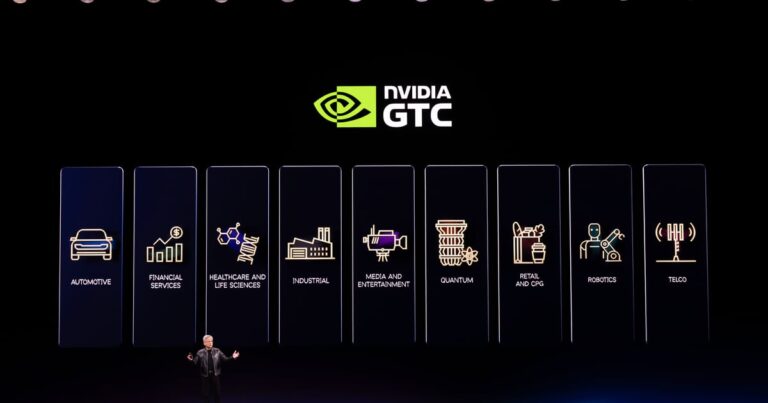
Introduced at the vendor’s GTC conference in San Jose, the releases focus primarily on Nvidia’s Physical AI Data Factory, an open reference architecture designed to transform real-world data into large-scale training datasets.

Rev Lebaredian, vice president of Omniverse and simulation technology at Nvidia, said during a pre-briefing that the system uses the company’s Cosmos world models and coding agents.

Specifically, the system is built around three components: Cosmo Curator, which processes datasets; Cosmos Transfer, which generates scenarios to expand the datasets; and Cosmos Evaluator; which verifies generated data before using it for training.

Together, the components automate the data generation process for robotics developers.

Related:Neura Launches Europe’s Largest Physical AI Training Center

“It’s a data factory designed specifically for physical AI,” Lebaredian said. “Cosmos unifies and manages all three stages, reducing manual work so developers can focus on building models.” 

The platform will initially be available on Microsoft’s Azure cloud platform. Nvidia said companies including Field AI, Hexagon Robotics, Milestone Systems, Skild AI, and TerraNine Robotics are early adopters.

Alongside the data architecture, Nvidia introduced Cosmos-3, a new world model that combines vision, reasoning and prediction to generate robot behaviors. 

The new Cosmos platform also includes what Nvidia described as the largest open video dataset for physical AI, along with frameworks for curating and evaluating large-scale video data.

A typical challenge in physical AI, according to Lebaredian, is that real-world training data is difficult to collect at scale due to the unpredictability of physical environments. 

“In the past, real-world data was the primary mode of training,” he said. “But the real world is diverse, unpredictable and full of edge cases. You simply cannot manually capture enough data to train for all of them.”

Instead, developers are increasingly turning to world models trained on internet-scale video and human demonstration data — enabling robotic training on a far greater scale than previously possible.

To stay ahead of this shift, Nvidia also rolled out early access to its AI-enabled video search and summarization tool, Metropolis VSS Blueprint. The system enables developers to build agents that analyze and act on massive streams of video data from edge to cloud.

Related:ABB, Nvidia Partner to Deliver Physical AI at Scale

Along with the product launches was a new partnership with T-Mobile. The companies are working to integrate physical AI applications into networks, bringing these agents to edge applications. 

Looking Ahead 

The moves reflect Nvidia’s growing drive into physical AI, which has become something of a buzzword as developers seek machines with elevated intelligence and perception capabilities.

“Autonomous vehicles represented the first wave of physical AI, but much more is coming down the pipeline,” Lebaredian said. “Soon we will have billions of AI agents running on billions of devices. The world’s industries will be transformed by physical AI and AI-driven physics.”

He identified the rise of humanoid robots as a key catalyst for market growth, with demand for physical AI systems anticipated to see a further upswing

“Today, roughly three million robots power the world’s industries,” Lebaredian said. “But the next generation of humanoid robots is now arriving, with deployments expected to grow nearly tenfold by 2026.”

“In this context, our models and frameworks are designed to support both existing and future robot platforms,” he added. “These systems will be more accurate, more lightweight and easier to deploy.”


Related:Humanoid Robots Now Assembling Cars in Europe and China

OpenSea delays launch of SEA token, citing challenging crypto market conditions

0

OpenSea co-founder Devin Finzer said Monday that the timeline for the launch of the highly anticipated SEA token is being pushed back, as the company seeks to ensure the rollout is fully prepared rather than forcing a debut amid difficult crypto market conditions.

In a post on X, Finzer said the OpenSea Foundation originally planned to take the first steps toward the launch during a March 30 event but has decided to delay the timeline for the NFT trading platform’s token. “A delay is a delay. I’m not going to dress it up, and I know how it lands,” he wrote.

Finzer said the foundation weighed moving forward with the previously planned date but ultimately concluded that SEA “only launches once,” and that taking additional time would help ensure the debut meets the expectations of the platform’s community.

As part of the update, Finzer said OpenSea will wind down its current rewards campaign structure, confirming that the ongoing rewards wave will be the last. Users who traded during rewards waves three through six will be able to opt in to refunds for the platform fees OpenSea retained during that period. If users choose to receive the refund, the “Treasure” rewards tied to those waves will be removed from their accounts, while those who keep their Treasures will still have them considered for allocations at the token generation event.

The team also said the OpenSea platform will reduce its own token trading fees to 0% for 60 days starting March 31, a move aimed at encouraging users to try the company’s revamped platform.

Finzer added that the foundation will wait to announce a new SEA launch timeline until it can provide a clear and deliberate schedule.

“We have huge ambitions as a company, and we’re here for the long game. Making all of non-custodial crypto delightful on mobile is just the beginning,” Finzer wrote. “That means we have to set a very high bar for everything we do, and it’s why I’m so protective of delivering a launch that’s worthy of this community and everything we’re putting into this.”

Read more: OpenSea Confirms Q1 Launch for SEA Token With Half of Supply Allocated to Community

Hyperliquid: Local Accumulation Trend Shows The Next Feasible Target For HYPE

0

Trusted Editorial content, reviewed by leading industry experts and seasoned editors. Ad Disclosure

Hyperliquid (HYPE) has climbed to fresh highs for the first time since November, bringing the market’s focus to the next potential price target. Recent chart analysis shared by @ArdinNSC on X points to a developing continuation structure built on a local accumulation trend. With multiple upside levels already cleared, the technical framework now centers on whether the market can extend the move toward the next target.

Accumulation Curve Structure Drives Breakout Momentum

The chart posted by Ardin highlights a clear local accumulation curve that developed over several weeks. Instead of reversing sharply, Hyperliquid (HYPE) formed a rounded structure where price gradually transitioned from decline into recovery. This curved formation reflected a prolonged phase where buyers steadily absorbed supply, allowing the market to stabilize before advancing.

As the accumulation process matured, HYPE’s price began pushing into higher levels that had previously acted as resistance. The first notable level sat near $36.50. Once this barrier was cleared, the upward move accelerated toward the next target positioned around $38.50.

Both levels were taken out within a short period, confirming that the earlier consolidation phase had evolved into a stronger expansion move. The breakout also coincided with price following the upward arc of the accumulation curve, reinforcing the idea that the structure served as a base for continuation rather than a temporary rebound.

With these resistance levels now behind the market, the chart shows Hyperliquid (HYPE) trading above them, effectively transforming former barriers into areas that could now support price during any short-term pullbacks.

Hyperliquid (HYPE) Retest Zone Holds Key To $40 Target

With the initial targets already reached, attention has shifted to whether Hyperliquid (HYPE) can sustain its position above newly reclaimed levels. The chart outlines a highlighted retest zone slightly below the current price, marking an area where the market may revisit if momentum cools.

Hyperliquid
Source: X

This region sits around the mid $34 range and represents the zone where earlier resistance could now act as support. In technical market behavior, such retests often serve as confirmation that a breakout is structurally sound.

If the market maintains stability above this support area, Hyperliquid’s (HYPE) accumulation curve suggests the trend may still have room to extend higher. Under this scenario, the next feasible upside objective identified in the analysis appears near the $40 level and potentially beyond.

At the same time, the chart outlines a secondary path for Hyperliquid (HYPE) if the market weakens. Losing the $36.50 level could trigger a move back toward a support zone around $34 to $35, where the chart suggests price may return for a structural retest if $36.50 fails.

For now, the structure remains centered on whether price can hold above recently reclaimed levels. Maintaining that footing keeps Hyperliquid’s (HYPE) pathway toward a $40 target aligned with the continuation structure that emerged from the earlier accumulation trend.

Hyperliquid price chart from Tradingview.com
Price continues toward $40 | Source: HYPEUSDT on Tradingview.com

Featured image from ChainUp, chart from TradingView.com

Editorial Process for bitcoinist is centered on delivering thoroughly researched, accurate, and unbiased content. We uphold strict sourcing standards, and each page undergoes diligent review by our team of top technology experts and seasoned editors. This process ensures the integrity, relevance, and value of our content for our readers.

TEAMZ Summit 2026 Is Just Around the Corner

0

This content is provided by a sponsor. PRESS RELEASE. TOKYO, Japan — TEAMZ Summit 2026, a premier global conference uniting leaders from the Web3 and AI industries, will be held at Happo-en in Tokyo. The event brings together leading companies, government representatives, startups, and investors shaping the next generation of technology — all under one […]

Bitmine’s Ether Holdings Reach 4.6M ETH, About 3.8% of Supply

0

Bitmine Immersion Technologies has accelerated the pace of its Ether purchases in recent weeks, chairman Tom Lee said Monday, following the company’s over-the-counter purchase of 5,000 ETH directly from the Ethereum Foundation.

Lee said Bitmine added 60,999 Ether (ETH) over the past week, up from a recent weekly average of about 45,000 to 50,000 ETH.

The purchases bring the publicly traded company’s Ethereum treasury to 4.596 million ETH, giving Bitmine control of about 3.81% of the token’s total supply. The company said its combined crypto holdings, cash and other investments total about $11.5 billion.

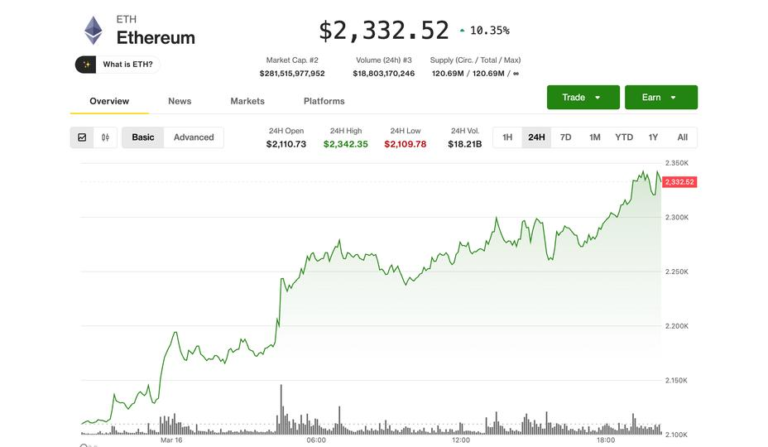
Bitmine said that 3,040,515 ETH, about 66% of its holdings, are currently staked, valued at roughly $6.6 billion at an Ether price of $2,185.

The company estimates its staking operations generate about $180 million in annualized revenue. It plans to expand staking through its Made in America Validator Network (MAVAN), expected to launch in the coming months.