Bitcoin held near $66,300 on Wednesday, consolidating a two-week high, as the semiconductor rally that has driven crypto all month extended into a second session and the Japanese yen sank to its weakest level in four decades.
The largest cryptocurrency was up nearly 1% on the day and 3% on the week, with about $31 billion changing hands and a 24-hour range of roughly $65,400 to $66,900.
Ether traded near $1,935, up 3% on the week. XRP added 2% to $1.14 and TRON edged up, while the day’s laggard was hyperliquid’s HYPE, down 4% to $60 and off 10% over seven sessions. Bitcoin’s dominance and the majors’ muted daily moves point to a market drifting higher on macro rather than any crypto-native catalyst.
The engine is still the chip trade. MSCI’s Asia Pacific equities gauge rose 1%, extending Tuesday’s biggest one-day gain in a month, with South Korea’s Kospi jumping 5% as a leveraged-position unwind that had pulled the benchmark nearly 30% off its peak appeared to be ending.
Samsung and SK Hynix led, following a more than 5% jump in a U.S. semiconductor gauge on Tuesday that clawed the index back out of a technical bear-market territory.
OpenAI caught the anomaly internally, while Hugging Face’s team detected and contained it. It called the incident “unprecedented,” and said extensive security steps will be put in place to prevent untoward incidents that may impact public systems or services.
“We are implementing strict controls in infrastructure configuration at the cost of research velocity while the vulnerabilities are patched,” the team said in its blog post. “We’re improving and adding stronger protections around future training and evaluations.”
A simple explainer on how the model broke out to cheat. (Shaurya Malwa/CoinDesk)
Why crypto developers should beware
Much of a crypto attack happens before funds move. Attackers scan code, test passwords, search for exposed credentials, analyze signing setups and look for a path into an administrator account.
OpenAI’s models carried out several parts of that process during the Hugging Face incident, moving from one weakness to another until they reached live production servers.
And the crypto market has plenty of places for that approach to work, as several attacks from earlier this year have shown. The weak point may be a smart contract, but it may also be a developer laptop, a poisoned software package, a bridge validator or or one signer in a multisig wallet.
Take Drift’s $285 million attack from earlier this year as an example, a theft that took a six-month social-engineering campaign to reach privileged access. An AI agent can, in theory, test many routes at once, keep track of failed attempts and continue working while its human operators sleep. Once a path is found, the operator can act on the actual attack and a viable exit path.
Two other supports lined up behind the move. U.S. spot bitcoin ETFs have now drawn inflows for five straight sessions totaling more than $600 million, the most sustained institutional buying since mid-July and a reversal of the eight-week outflow run that ran through late June.
And oil, which had climbed for two days on the war, pulled back, with Brent falling 1% to about $88.58 as Iran said mediators were circulating proposals to ease hostilities, including a reported suggestion for a 10-day halt in strikes.
“Current bitcoin and ether prices are low but fair, given the macro uncertainties pervading markets,” said Jeff Mei, chief operating officer at BTSE, who pointed to the Fed meeting as the event traders are positioned around.
“Traders expect rates to hold steady but are looking for more signals as to what’s to come later in the year,” Mei added.
The read on that meeting is where the rally meets its limit. The Federal Reserve gathers July 28 and 29, and markets put the odds of a July rate increase at about 15%, though a September move is still live.
Spot-market volume across crypto stayed subdued even as prices rose, the sign of a tape lifted by returning risk appetite rather than fresh conviction, and higher oil and Treasury yields remain the levers that could keep the Fed hawkish and cap risk assets.
Tech entrepreneur Jack Dorsey has announced a new group chat platform aimed at reducing teams’ reliance on platforms like Slack, in the Bitcoin maxi’s latest push for decentralization.
The Block co-founder wrote Tuesday on X that the new app, named Buzz, was “for teams of people and agents of all sizes” and “model-agnostic, decentralized, self-sovereign, and open source.”
Described as “A new native workspace for human and agent teams” on its website, Buzz users can “chat with teammates and specialized agents in one shared space, then move straight into planning, project management, coding, and PRs.”
A statement from parent company Block said that the new app was built on decentralized social networking Nostr protocol.
“The interface will feel familiar to anyone who’s used a modern team communication tool,” Block added.
“Every company is going to need a place where humans and agents work together,” Bradley Axen, head of AI capabilities at Block, said.
“The question is whether that place is proprietary or open. We built Buzz because we believe it should be open.”
Decentralize everything
Dorsey, whose firm Block owns companies Square and Cash App, has long been pushing for decentralized solutions: primarily with Bitcoin.
The billionaire founder of Twitter left the social media company to focus his efforts on payments and Bitcoin adoption in 2021, saying he wants the cryptocurrency to be the global currency and “everyday money.”
He has also described Satoshi Nakamoto’s Bitcoin white paper as “poetry.”
Cash App allows users to send and receive and buy and sell Bitcoin and point-of-sale terminals Square accept the orange coin via the Lightning Network.
Block also last year debuted a Bitcoin mining rig with swappable parts, with the idea that miners could cut costs on repairing and replacing the devices.
Galaxy Digital (GLXY) said it set up a $5 million fund for Bitcoin developers working to protect the network from the potential future threat posed by quantum computing.
The crypto financial services company said it will begin accepting applications for the Galaxy Bitcoin Quantum Readiness Initiative immediately, with grants focusing on developing quantum-resistant signature schemes, wallet migration tools and security audits. The company said it hopes other firms will contribute funding and research to accelerate the transition to quantum-resistant cryptography.
Bitcoin secures wallets and transactions with cryptographic techniques that current computers cannot break in a meaningful timeframe. While quantum computing is still too immature to attack the blockchain, advances in the technology have accelerated efforts across government and industry to adopt quantum-resistant standards before the threat becomes a reality.
In the event that quantum computers do become capable of breaking Bitcoin’s cryptography, roughly 6.9 million bitcoin BTC$66,384.56 could become vulnerable to theft, according to CryptoQuant research. At today’s price of about $66,800, that comes to about $461 billion.
Cointelegraph is committed to providing independent, high-quality journalism across the crypto, blockchain, AI, and fintech industries.
All news, reviews, and analyses are produced with full journalistic independence and integrity. For more details on our standards and processes, please read our Editorial Policy.
Despite ETH’s price gains, weak onchain activity and low DEX volumes signal trader caution.
Record Ethereum staking at 34% reduces sell pressure, yet sustained upside needs external catalysts.
Ether (ETH) tested the $1,950 mark for the first time in seven weeks on Tuesday, triggering $62 million in liquidations across leveraged bearish positions. The move delivered 29% gains from the $1,500 low on June 26 and aligned with the broader risk-on mood that drove Bitcoin (BTC) above $66,500. Can ETH push through to $2,100?
Total crypto market capitalization (left) vs. ETH/USD. Source: TradingView
Ether’s price largely tracked the overall crypto market trend, which shifted to positive momentum in July. Tuesday’s gains in the US stock market helped ease investor worries about stretched valuations after the artificial intelligence stock rally. Traders expect solid corporate earnings after 3M Company (MMM US) reported results Tuesday morning.
Google’s parent, Alphabet, is expected to report quarterly results on Wednesday after US stock markets close. Investors look for 64% growth in cloud services revenue amid heavy AI investments. Strong earnings could restore confidence and help push the cryptocurrency market past the $2 trillion total capitalization mark.
Weak Ethereum onchain metrics and muted ETH derivatives persist
Despite recent ETH price gains, Ethereum onchain metrics show stagnation. Demand for blockchain processing has not recovered to levels seen six months ago, partly because traders are showing less interest in memecoins and utility tokens. Some of Ethereum’s top projects posted losses of 50% or more year-to-date, including Ethena (ENA), Mantle (MNT) and Arbitrum (ARB).
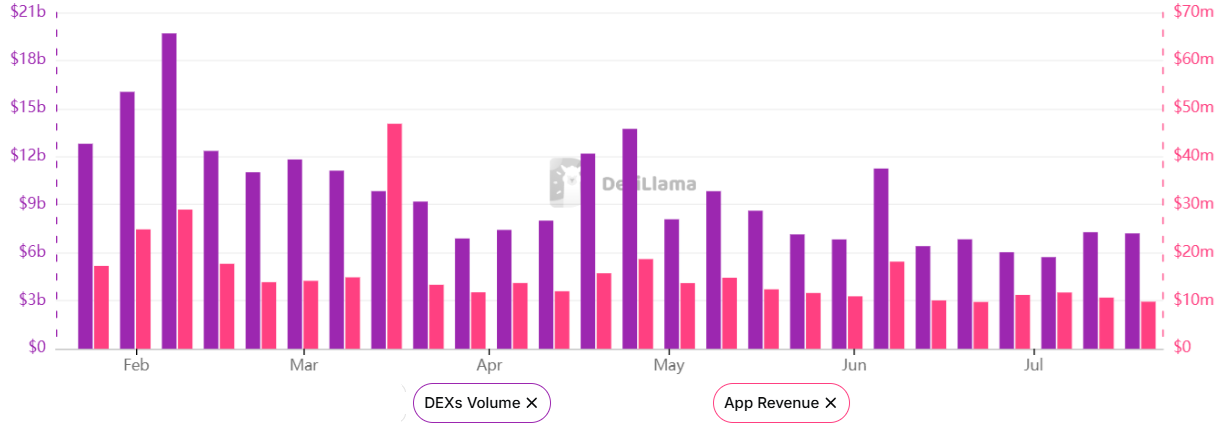
Weekly revenue for Ethereum’s decentralized applications (DApps) fell to the lowest levels since September 2024, hitting $9.8 million. Among the strongest performers are Sky (formerly MakerDAO) at $3.2 million in weekly revenue and Chainlink, which brought in $1.2 million over the same period. Overall, decentralized exchange (DEX) volumes dropped to $7.2 billion per week.
Ethereum’s weak onchain data mirrors the subdued mood in derivatives markets.
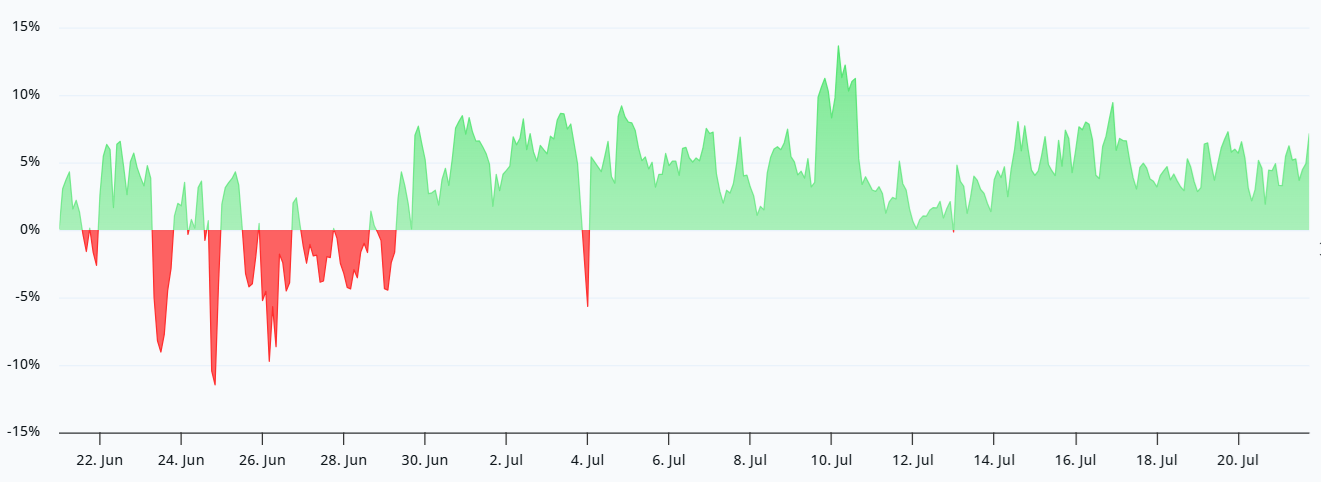
ETH perpetual futures annualized funding rate. Source: Laevitas
The annualized funding rate on ETH perpetual futures has struggled to remain within the neutral 6%-12% range over the past month. Still, sentiment has improved from the negative rates seen in late June, which reflected heavy bearish demand. Rising interest in Ethereum staking has likely boosted trader expectations for price gains and reduced downside risks.
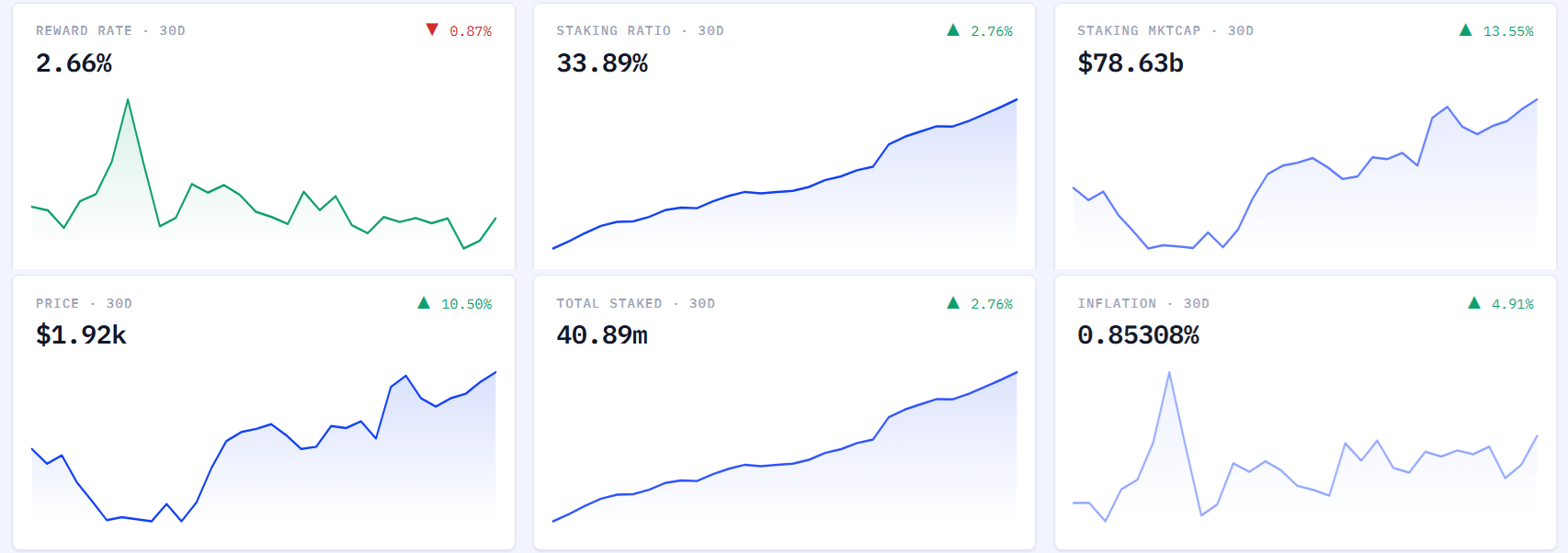
Ethereum staking data. Source: StakingRewards
According to Staking Rewards data, a record-high 34% of all ETH supply is now staked, up from 33% one month earlier. Analysts expect reduced sell pressure as long-term holders keep accumulating supply, including Tom Lee’s Bitmine Immersion (BMNR US), which added 156,719 ETH over the past month. The company now controls 4.8% of available supply.
ETH price is 61% below the all-time high from August 2025, which helps explain why bulls lack enthusiasm in derivatives markets. The soft on-chain metrics and six-month bear market have left traders skeptical about sustained upside.
Ether’s path to $2,100 likely depends on reduced risk aversion across markets, which makes Google’s revenue guidance on Wednesday especially important.
You might have heard about BIP-110; here’s why this fork is not just bad for Bitcoin, but it is built on a misunderstanding of what a Bitcoin node is and what it is good for. As well as why, because of this misunderstanding, BIP-110 will fail.
This article is a Take. Opinions expressed are entirely the author’s and do not necessarily reflect those of BTC Inc or Bitcoin Magazine.
BIP-110 is a Bitcoin Improvement Proposal titled as a Reduced Data Temporary Softfork. The BIP proposes a consensus change to Bitcoin, which attempts to limit the types and amounts of arbitrary data that can be added to consensus-valid transactions by limiting a wide range of Bitcoin’s scripting capabilities. BIP-110 is led by a pseudonymous developer known as Dathon Ohm and is widely supported by the Knots community, an alternative implementation of Bitcoin led by one of Bitcoin Core’s earliest contributors, Luke Dashjr and its supporters.
The BIP-110 consensus change is headed towards a mandatory signaling period in the coming weeks and thus a potential fork with the main consensus rules as implemented in Bitcoin Core. The proposal needs to gain a great deal of support from miners within the coming weeks to change Bitcoin consensus. As of the time of writing, miner signaling for BIP-110 stands at less than one percent.
The Knots community, widely made up of Bitcoiners running nodes on machines like Start9 and Umbrel, has rallied around Knots in protest of a series of development decisions made by Bitcoin Core, the primary open source development community and reference implementation of Bitcoin. While a majority of senior Bitcoin developers are either opposed or apathetic to the changes proposed by BIP-110, the movement has gained enough steam to become an ongoing topic of discussion on social media.
Supporters of BIP-110 believe that by running Bitcoin full nodes that signal for the consensus change, they alone can change Bitcoin. Here are the main concepts being debated, the biggest misconceptions about Bitcoin consensus, what a Bitcoin node is, and why BIP-110 is almost certain to fail.
The Power and Limits of a Bitcoin Node
Many of the disagreements and misconceptions in this recent cultural conflict within Bitcoin revolve around the idea of a Bitcoin full node. Influencers like Knut Svanholm, author and podcaster, have elevated the role of the full node to heights perhaps too close to the sun.
Knut recently tweeted: “Every person on Earth is a node in the Bitcoin network. Most to a minuscule extent, of course, but every node is first and foremost a person, not a machine. Which tools we use to interact with the network (and, by extension, to which extent they influence the network) is entirely dependent on the choices we make.”
Statements of this sort are poetically beautiful, philosophically grand, romantic even, but nevertheless technically incoherent and fundamentally meaningless. Knut’s tweet attempts to redefine what a ‘Bitcoin node’ means and fails at it, instead diluting the value of the term entirely. He might as well have said that every atom in the universe is a Bitcoin node, since apparently to him the term is all-encompassing.
Knut, though well-intentioned, is wrong. A Bitcoin node is something very specific. It is a full copy of all of Bitcoin’s transaction history, block headers and transaction-related data. Its purpose is very specific: to let users verify the integrity of Bitcoin’s supply and transaction history in relation to Bitcoin’s consensus rules.
Bitcoin nodes grant users a variety of benefits, such as privacy. Third-party wallet providers query their copy of the Bitcoin blockchain for the user’s balance and serve it back to the user via the wallet app. Most mobile wallets function this way, with users asking a third-party server for their balances; some, very few, can connect to a user-run local Bitcoin node, in which case the user’s public addresses and balances are not shared with any third-party wallet company.
Another benefit Bitcoin nodes grant users is the ability to check whether they are in consensus with the rest of the network, staying in sync. If the user mines Bitcoin or contributes any significant amount of hashing power to Bitcoin’s proof-of-work network, the node also provides the opportunity to assemble a block, choosing which transactions go into it. This is only possible if the user manages to mine a Bitcoin block, which is quite an achievement today, given the difficulty and steep competition.
Even new kinds of mining pools like Ocean, which attempt to decentralize block template production, letting retail miners have more influence over which transactions enter the chain, still need enough hashing power to win the proof-of-work race, resulting in sporadic blocks being mined and thus limited influence over the blockchain.
Bitcoin nodes also relay transactions across the network, with tens of thousands of them communicating via a flood network; this results in a censorship-resistant system where a small number of nodes can get controversial transactions to miners, bypassing any kind of filters, as demonstrated by Peter Todd’s relay libre. Thus, Bitcoin nodes can not easily filter which transactions enter the blockchain.
Even a large majority of Bitcoin nodes alone can not, however, change Bitcoin consensus. Not without having a large amount of economic activity entering the Bitcoin network through them, as exchanges do on behalf of millions of users. Not without having the protocol and application developer community behind them. Not without having the investor community behind them. Bitcoin is not a node democracy, contrary to popular memes today.
Bitcoin nodes do not grant you ‘citizenship’ in the ‘Bitcoin nation’. Satoshi Nakamoto was quite clear about this in the Bitcoin white paper. Bitcoin’s ultimate security and governance structure is: one CPU cycle, one vote, not one Bitcoin node, one vote. And miners, who run the CPU cycles over Bitcoin’s proof-of-work, are very sensitive to investor sentiment and the broader developer community, resulting in a distributed global protocol for money that is very difficult to change.
Bitcoin nodes ultimately let you know if you are connected to the network with the most accumulated proof-of-work and that its consensus rules are being followed, but a node alone does not let you change the consensus rules. Users who change the consensus rules of their Bitcoin node are, by definition, no longer running Bitcoin. As a result, changing Bitcoin consensus as a node runner is very difficult, and that’s a feature, not a bug. Bitcoin is money for enemies.
History and Bitcoin Consensus Games
Deep work has been done, trying to understand Bitcoin consensus, its various pillars and interest groups. Ren Crypto Fish, Steve Lee and Lyn Alden identified six of them in BCAP, an open-source effort to analyze Bitcoin consensus and risks in protocol upgrades. BCAP identified stakeholders such as Economic Nodes, Investors, Media Influencers, Miners and Protocol Developers, and Users and Application Developers
Historically, in the case of a consensus crisis, it is true that Bitcoin nodes have been used to signal support for one version of Bitcoin over another. Fork events like 2017’s Bitcoin Cash fork are often cited as examples of economic nodes winning against opposition by miners. 2017’s legendary User Activated Soft Fork (UASF) faced major opposition in theory; a large majority of mining pools and their corresponding collective hashrate supported the Segwit2x version of Bitcoin, with many exchanges and corporations having signed the infamous New York Agreement.
The Bitcoin node-supported soft fork won nonetheless, bluffing the Segwit2x version from a contested blockchain altogether. But that’s the thing: while the Bitcoin nodes technically won, they did so by having massive support from protocol developers, investors and media influencers: these nodes really had economic weight and rough consensus. BIP-110, on the other hand, does not have the protocol developers, nor does it have enough investors behind it. Michael Saylor has come out against it, with many industry leaders also openly opposing it or staying out of the matter entirely.
In fact, during the Bitcoin Cash fork, the limits of retail Bitcoin nodes were clearly understood. A Bitcoin node run by an exchange is orders of magnitude more influential than that of a retail user, as it introduces large amounts of new transactions to the Bitcoin network. The Bitcoin node of a major mining pool is far more influential than that of a hobbyist solo miner, as it more often assembles blocks and chooses which transactions settle to the blockchain.
Most Bitcoiners outside of exchanges use mobile wallets to access their Bitcoin. Such users and investors can ‘vote’ with their money, so to speak, by moving their bitcoins and economic activity elsewhere, be it to a wallet that supports their vision of Bitcoin, or their own full node. But while users remain on mobile wallets that talk to third-party nodes, those users have little individual influence over Bitcoin consensus. And the vast majority of mobile wallets are using a Bitcoin core-compatible back end.
The same goes for exchanges; their users effectively delegate consensus decisions to the exchange operators. In some cases, exchanges have put consensus issues to a user vote, weighed by their total holdings, returning that decision to end users weighed by capital; we may see this happen again with BIP-110.
Votes of the sort have started happening with Foundry today. One of the biggest Bitcoin mining pools in the world, Foundry, recently emailed its miners informing them that they can vote on the proposal with their hashrate. A high enough support could result in Foundry signaling for BIP-110, though that remains unlikely. Users who do not vote will effectively signal against BIP-110, defending the status quo. Thus apathy about the topic of BIP-110 would be a win for Bitcoin Core by default. BIP-110 supporters need to culturally win over a majority of the Foundry hash rate, who then must act to vote against the Bitcoin Core developer consensus, the most popular Bitcoin implementation and best supported codebase.
Today, miners are not signaling support for BIP-110 in any significant way. In fact, according to some data, this is one of the least supported soft fork attempts by miner signaling in Bitcoin’s history. Less than one percent of the blocks mined in the current difficulty adjustment period are signaling for BIP110.
Concluding Thoughts
BIP-110 has so far failed to gain consensus across major interest groups within Bitcoin; neither developers, investors, miners, nor large economic nodes support the consensus change. The result is likely to be a chain split in the coming weeks, which could have significant consequences for lightning wallets running on BIP-110-compliant nodes, ultimately resulting in a new, yet small blockchain that would probably have to change the proof-of-work used to stay alive.
The US Securities and Exchange Commission (SEC) has sued crypto mining investment business Mining Automatic and its founder, Zan Shaikh, alleging they raised $22 million from investors while spending only about 13% of the funds on mining operations.
Mining Automatic was operated by Massachusetts-based Bright Vision Distribution LLC, which the SEC said raised the money from more than 380 investors between June 2023 and May 2025.
The company allegedly promised guaranteed monthly returns from crypto asset mining despite operating a business that could not generate the advertised payouts. The SEC said investor money was instead used for marketing, personal expenses and unrelated ventures.
According to the complaint, the operation generated about $1.1 million from mining while paying investors roughly $1.8 million in purported returns. The SEC alleged the shortfall meant some payments were funded with money from other investors, giving the scheme “some of the hallmarks of a Ponzi scheme.”
Mining Automatic also allegedly spent about $7 million on advertising to attract new investors, while Shaikh used investor funds for real estate, vehicles, entertainment and transfers to his personal bank accounts.
Related: White House says it received no Democratic response related to SEC, CFTC vacancies
Mining Automatic stopped paying investors by March 2025, and the SEC said none had recovered their original investment. More than $20 million in principal remains unpaid, according to the complaint.
The SEC is seeking disgorgement, civil penalties and permanent injunctions, along with orders barring Shaikh from selling securities or serving as an officer or director of a public company.
SEC complaint against Mining Automatic. Source: SEC
SEC shifts crypto focus toward rulemaking
The lawsuit comes as the SEC has increasingly emphasized developing clearer rules for digital assets under Chair Paul Atkins. In June, the agency published its 2026–2030 Strategic Plan, identifying blockchain technology, tokenization and crypto market infrastructure as long-term priorities while reaffirming its investor protection mandate.
The SEC expanded on that approach in July with its 2026 rulemaking agenda, proposing new rules for crypto broker-dealers, digital assets traded on national securities exchanges and alternative trading systems, and potential exemptions and safe harbors for certain digital asset offerings.
The regulatory push coincides with congressional efforts to reshape US crypto oversight through the Digital Asset Market Clarity Act, which would clarify the respective roles of the SEC and Commodity Futures Trading Commission (CFTC), if enacted. The bill is expected to face a key Senate vote before lawmakers begin their August recess.
Magazine: Peter Brandt predicts the exact day Bitcoin’s bear market will be over
But the larger pull is simpler: AI is where the speculative money and investors’ attention are now going. The capital that once chased crypto is now chasing compute, chips and model builders, and every leap in what these systems can do widens that appeal.
Each result like Fable’s finding of the Jacobian conjecture strengthens the case for pouring capital into AI, and poses a difficult conundrum for crypto investors: Why hold a token that trades as a sidecar to the AI cycle when someone can own the vehicle itself?
AI’s capability curve is steep, and the steeper it gets, the more of the market’s risk appetite it draws away from everything else, crypto included.
What the problem actually was
Think of a machine that takes two numbers and gives back two new numbers, using only adding and multiplying. The question, first asked in 1939, was whether the machine can always be run backward: given only its answer, can the original two numbers be recovered every time?
Mathematicians had a quick way to check whether a machine looked reversible. The Jacobian conjecture said that if a machine passed that check, it should always be reversible.
Why the 87-year-old Jacobian conjecture is false, in one picture. (Shaurya Malwa/CoinDesk)
For 87 years, nobody could prove it was true, and nobody could find a machine that broke the rule.