A crypto lobbying organization has sued the state of Illinois over a last-minute tax provision inserted into the state budget last month.
TDC (otherwise known as The Digital Chamber) alleged that Illinois’ Digital Asset Tax Act violated both the U.S. and state constitutions and is preempted by a federal tax law. The lawsuit, filed Tuesday, asks a federal judge to block the Illinois state government from enforcing the tax.
The tax violates the Illinois state constitution’s uniformity and due process clauses, the Commerce Clause of the U.S. Constitution and the Internet Tax Freedom Act by specifying digital asset transactions, the suit said.
The Digital Asset Tax Act was passed and approved on short notice last month, right before the Illinois state government wrapped up its session for the year. The 0.2% tax applies to any entities that are based in Illinois or provide services with gross receipts of over $100,000. The tax takes effect in January.
TDC’s lawsuit said the Internet Tax Freedom Act alone created a rule that “electronic commerce would not be subjected to discriminatory state and local taxation.”
Lawmakers in the US House Committee on Agriculture’s Subcommittee on Commodity Markets, Digital Assets, and Rural Development held a hearing on how the Commodity Futures Trading Commission (CFTC) could address oversight of prediction market companies, including discussions of pending crypto market structure legislation.
In a Tuesday hearing on “Examining Customer Protections and Market Integrity in Sports Event Prediction Markets,” Carl Kennedy, a partner at New York law firm Katten Muchin Rosenman, said that the CFTC was likely too “short-staffed” to fully deal with the regulation and enforcement of prediction market platforms like Kalshi and Polymarket. According to the lawyer, the Digital Asset Market Clarity (CLARITY) Act under consideration in the US Senate could grant the commodities regulator additional authority not only to address digital assets but also the “explosive growth of prediction markets.”
“I do believe that with additional resources — they’re about to perhaps receive additional authorities under the CLARITY Act — with additional resources to address these new asset classes in the cash markets and crypto, as well as to deal with the explosive growth of prediction markets, I think that the CFTC certainly should receive additional resources,” said Kennedy.
Carl Kennedy at Tuesday hearing. Source: House Committee on Agriculture
Kennedy’s remarks were just one example of legal and regulatory experts chiming in on the CFTC’s approach to handling prediction markets under Chair Michael Selig. Since being confirmed by the Senate in December, the chair has unilaterally taken the position that the agency has “exclusive jurisdiction” over the companies, arguing that event contracts on the platforms are classified as “swaps” under the CFTC’s purview. Selig is the only Senate-confirmed member heading the CFTC in a leadership panel normally consisting of five commissioners.
Related: Trump claims he can ‘future proof’ crypto regulation with CLARITY Act
The CFTC chair’s position has led to what many Democratic senators call an “assault” on state authorities trying to regulate prediction market platforms, with some US states filing lawsuits against Kalshi and Polymarket over sports betting. Last week, he ordered Kalshi to ignore a ruling from a Michigan court, which the company said “put [it] in an impossible position” between state and federal authorities.
Some legal experts expect that one or more of the prediction markets cases could eventually reach the US Supreme Court to address the clash between state and federal regulators.
Text of CLARITY Act expected to be released soon
Republican senators pushing for a vote on the CLARITY Act in Congress before the chamber breaks for August state work periods say they expect to release the bill’s text soon. Details on how the bill could address prediction markets, ethics and other concerns from lawyers were not made public as of Tuesday.
In June, gambling industry groups petitioned the US Senate to add language to CLARITY “that explicitly prohibits event contracts tied to sports and casino-style gaming.” The White House also confirmed reports that the Trump administration “agreed to the most comprehensive and wide-ranging ethics provision in history“ and it had “bent over backward to accommodate [Democrats’] concerns.“
Magazine: Peter Brandt predicts the exact day Bitcoin’s bear market will be over
August 7 — the fast-approaching final day before the Senate’s summer recess — is seen as a major deadline for finishing the Clarity Act this year. Crypto insiders are expecting the bill to get to the floor as soon as the beginning of next week, which would fit with what Senate Majority Leader John Thune had previously indicated. The legislation could require several days to get to a final vote.
Earlier on Tuesday, CoinDesk had reported that a White House official said Trump agreed to “the most comprehensive and wide-ranging ethics provision in history,” though the actual language he’s accepted hadn’t yet been shared with Democrats. As of press time, it was still unclear if Democrats had seen the exact language. Still, the administration argued that it had “bent over backward” to satisfy Democrats, suggesting it would be their fault if the legislation doesn’t advance.
Trump’s agreement to a crypto constraint of his own business ties raises significant questions about how his involvement would be made sufficiently remote to comply with the limit. The president and his family are deeply connected to several crypto business initiatives, including their ownership stake in World Liberty Financial. While Trump has insisted he’s not conflicted as his administration imposes crypto policies that affect his own businesses, Democratic lawmakers have openly accused him of corruption.
Cointelegraph is committed to providing independent, high-quality journalism across the crypto, blockchain, AI, and fintech industries.
All news, reviews, and analyses are produced with full journalistic independence and integrity. For more details on our standards and processes, please read our Editorial Policy.
Spot market conditions have improved after months of weakness, with U.S. spot bitcoin ETFs shifting from persistent outflows to modest inflows. Still, the report cautioned that demand has yet to fully recover, with ETF flows and purchases by corporate bitcoin treasury companies such as Strategy (STR) remaining well below the levels seen earlier this year.
While bitcoin’s rebound has helped lift sentiment across the market after a difficult second quarter, Bitfinex cautioned that the recovery is “not yet healed.”
Bitcoin currently accounts for nearly 67% of spot crypto trading volume, up from roughly 50% a year ago, according to Bitfinex. The shift suggests investors continue to favor bitcoin over smaller tokens, a sign that traders remain defensive rather than embracing broad risk-taking.
‘Summer slumber’
Data from K33 Research paints a similar picture.
Head of research Vetle Lunde said institutional participation has continued to fade, with CME bitcoin futures open interest falling to its lowest level since 2023. Offshore perpetual futures positioning has remained largely unchanged, indicating speculative traders have been reluctant to add leverage despite bitcoin’s recent gains.
Spot trading activity has also stayed slow. Thirty-day bitcoin trading volume is running at just 62% of its annual average, according to K33, and late July has historically been the weakest period of the year. Average daily spot volume over the past week was roughly $2.3 billion, hovering near yearly lows even as prices recovered.
Bitcoin spot trading volumes (K33 Research)
K33 described the backdrop as a “promising, and typical, summer slumber.”
An April 2025 CoinDesk investigation found that Movement was examining whether it had been misled into signing a market-making agreement that handed a single counterparty unusual influence over MOVE’s circulating supply. Internal documents reviewed by CoinDesk at the time showed the arrangement allowed 66 million MOVE tokens to be sold into the market one day after the token debuted, contributing to a sharp decline in price.
The controversy centered on Rentech, a little-known intermediary that appeared in contracts connected to Chinese market maker Web3Port. According to documents obtained by CoinDesk, Movement executives later questioned whether the foundation believed Rentech was affiliated with Web3Port when it was not. Rentech has denied any wrongdoing or misrepresentation.
The fallout extended beyond Movement. Binance banned the market-making account involved in the token launch for what it described as misconduct, while Movement launched a token buyback program and hired outside firm Groom Lake to review the events surrounding the deal.
Movement Labs and co-founder Rushi Manche separated in May 2025.
More recently, the company attempted to chart a new course.
In June, Move Industries, a separate legal entity from MVMT Labs, the company that filed for bankruptcy, announced it would pivot away from competing with other Ethereum scaling networks and instead focus on cross-border payments, remittances and stablecoin settlement. The company said it had secured access to licensed payment infrastructure in the U.S., Canada and the European Union as it sought to build services aimed at emerging markets.
“If Senate Democrats block this historic legislation after the administration has bent over backward to accommodate their concerns, stakeholders should make no mistake: It is the Democrats who are blocking this legislation because they were never serious about a legislative outcome,” the White House official said.
Democratic negotiators such as Senators Kirsten Gillibrand, Ruben Gallego and Angela Alsobrooks reportedly haven’t received details of the agreement with Trump, who’d met personally with Republican senators last week. But many of the Democrats have drawn a line in the sand that the ethics provision — driven primarily by Trump’s own deep crypto connections — needs to be strong.
The dispute was heightened recently by the president’s disclosures that he’d pocketed more than $1 billion last year from his crypto interests.
The White House, Republicans and their crypto industry allies are already building their case against any Democrats who don’t accept the new answer to their ethics demands. It’s unclear when they’ll get to see it.
The industry is expecting full circulation of the Clarity Act legislative language as soon as Tuesday night or Wednesday, though that expectation has been repeatedly delayed since last week.
The Senate has fewer than three weeks to finish the bill, including the ethics piece, and get it through the political gauntlet of a floor vote before lawmakers leave town for their reelection campaigns. There’s technically enough time, but even without significant further debate, it would be tight.
The White House agreed to provisions in a crypto market structure bill that could ensure support from some Democratic lawmakers in the US Senate.
According to a Tuesday Punchbowl report, White House officials met with Republican Senators Cynthia Lummis and Bernie Moreno to reach an agreement on ethics language in the Digital Asset Market Clarity (CLARITY) Act under consideration in the Senate.
Neither Lummis nor Moreno have publicly announced the details of the deal, which could facilitate Democratic support in what is expected to be a tight Senate vote, but the report suggested that it could affect US President Donald Trump’s crypto investments.
Event contract on chances of CLARITY Act being signed into law in 2026. Source: Polymarket
The CLARITY Act, passed by the House of Representatives in July 2025 as part of Republicans’ “Crypto Week” agenda, has faced several delays in Congress due to government shutdowns, concerns from lawmakers over ethics, tokenization and stablecoin rewards and provisions for protecting developers from enforcement actions. Many lawmakers and industry advocates expect the Senate to consider the bill before the chamber breaks for August state work periods, but as of Tuesday, no vote appeared on the congressional calendar and the text of the bill had not been made public.
No certainty for 60-vote threshold
Last week, Trump urged the Senate to pass CLARITY “in honor of” the late Senator Lindsey Graham, whom the president said was “a big supporter” of the bill. Many crypto industry executives and lawmakers have publicly come out in support of the bill, but it’s unclear whether the legislation will pass the 60-vote threshold in the Senate, due to many Democrats’ concerns about potential conflicts of interest with the Trump administration.
Related: Ethics remain sticking point as crypto market structure bill goes to markup
Several Senate Democrats, including Elizabeth Warren, Chris Murphy, Jeff Merkley and Chris Van Hollen said that any CLARITY bill would be “worthless” without ethics provisions to address Trump’s ties to the crypto industry, including his memecoin and his family’s World Liberty Financial business. Cointelegraph requested details on the agreement from Lummis’ office but did not receive an immediate response.
A White House official told Cointelegraph that the administration was “committed to working with Congress to see the CLARITY Act advance and has agreed to the most comprehensive and wide-ranging ethics provision in history,“ adding that it had “bent over backward to accommodate [Democrats’] concerns.“
According to Coinbase vice chair Ryan VanGrack, Democrats have already been able to negotiate to include provisions on customer protection in the Senate bill. However, many lawmakers are calling for hearings to explore Trump’s investments and links to the industry before any potential vote.
Bitcoin price climbs amid CLARITY talks
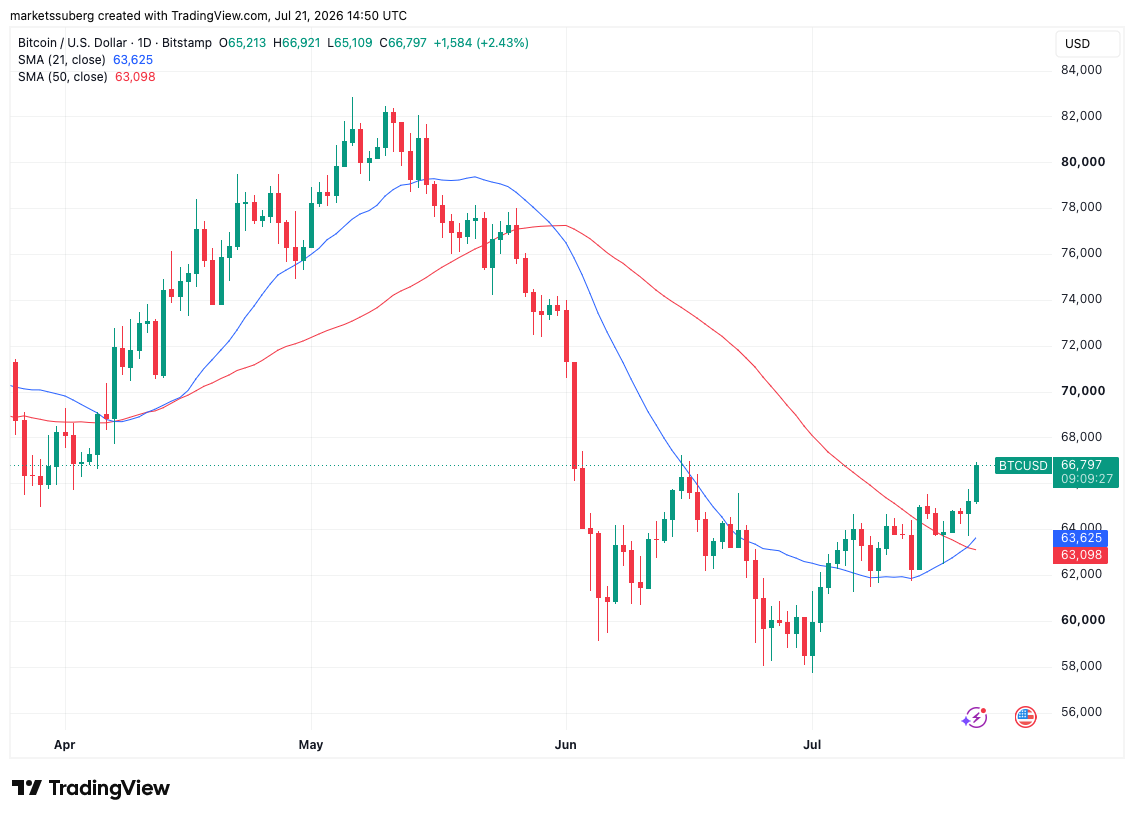
The price of Bitcoin (BTC) rose above $66,000 early on Tuesday, reaching a seven-week high amid reports of an ethics deal and Trump’s plans to introduce additional 10% international trade tariffs.
“The reason that prices are running upwards are entirely dedicated towards the potential approval of the Clarity Act,“ said Michaël van de Poppe, founder and chief investment officer of MN Fund and MN Capital, in a Tuesday X post. “Things are brighter and brighter, and as the charts technically look incredible from here, it looks likely that we’ll see the Clarity Act being approved shortly.“
Magazine: Will the crypto lobby’s $189M campaign get CLARITY over the line?
A series of rejections around the $65,000 mark had failed to quash traders’ enthusiasm, with calls for $67,000 or higher gaining momentum. Those short-term predictions continued on the day, with key psychological levels around $70,000 now on the horizon.
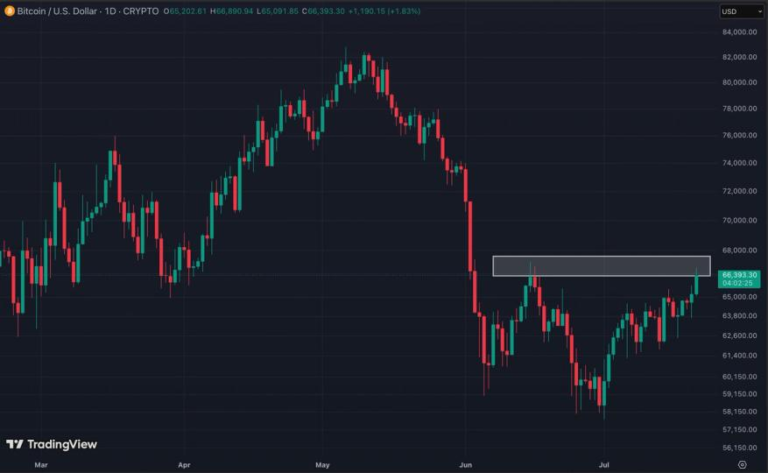
“$BTC reclaimed the range lows, and is now pushing higher – as expected,” trader Jelle wrote in his latest analysis on X.
“The area between 65 and 67k is resistance from the Q1 range, but given how we sliced through it on the way down – it might not put much of a fight up here either. Eyes on those 70k range highs if so.”
BTC/USD one-day chart. Source: Jelle/X
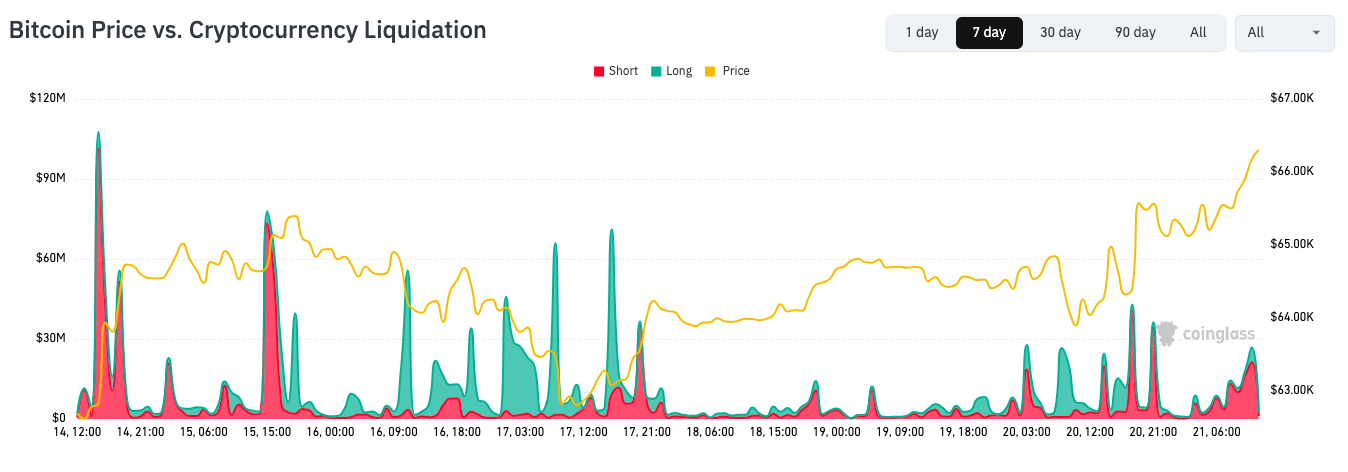
Short liquidations began to mount as the BTC price broke through range highs, with data from CoinGlass putting 24-hour cross-crypto liquidations at around $200 million.
BTC/USD vs. crypto liquidations (screenshot). Source: CoinGlass
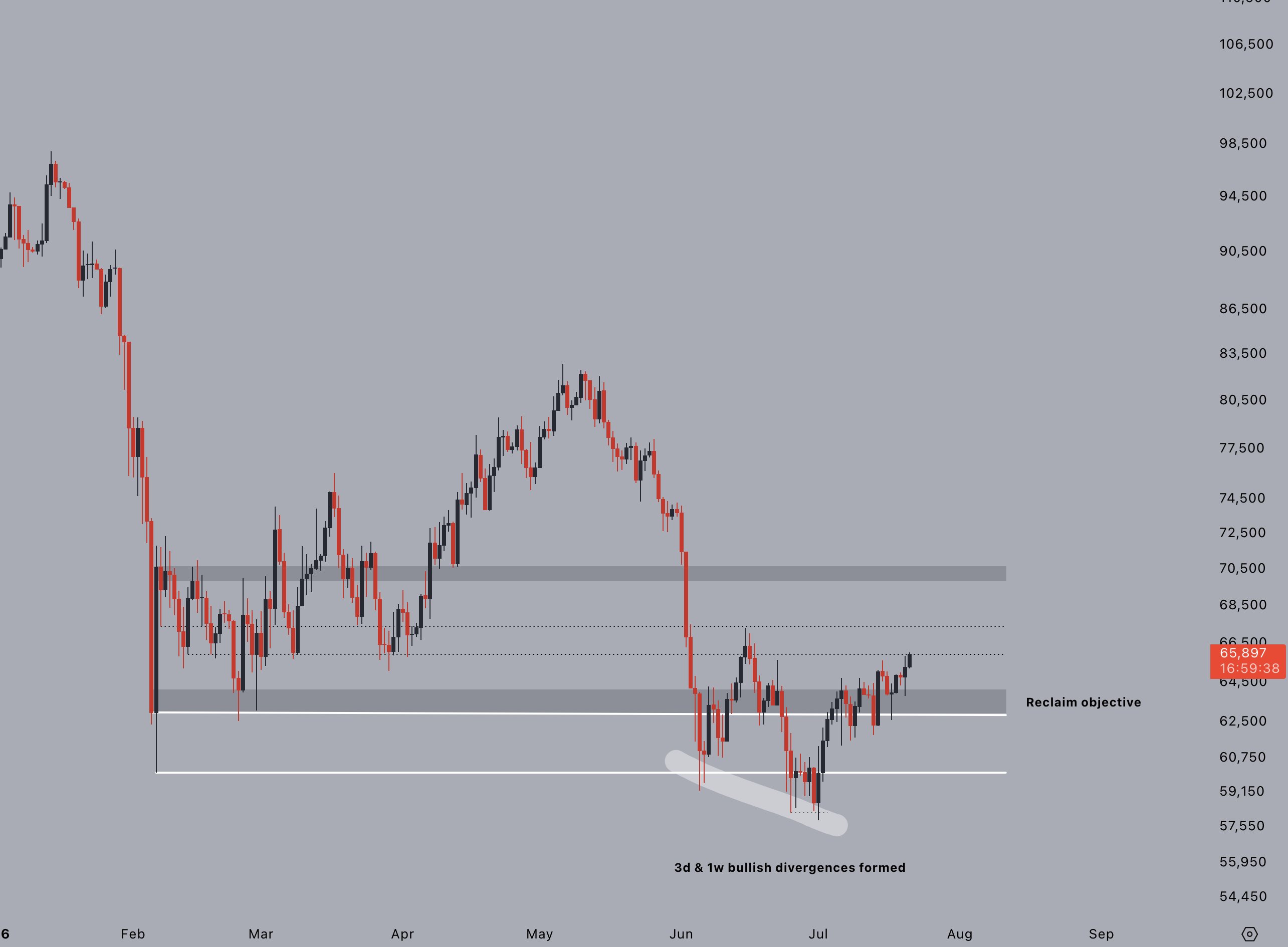
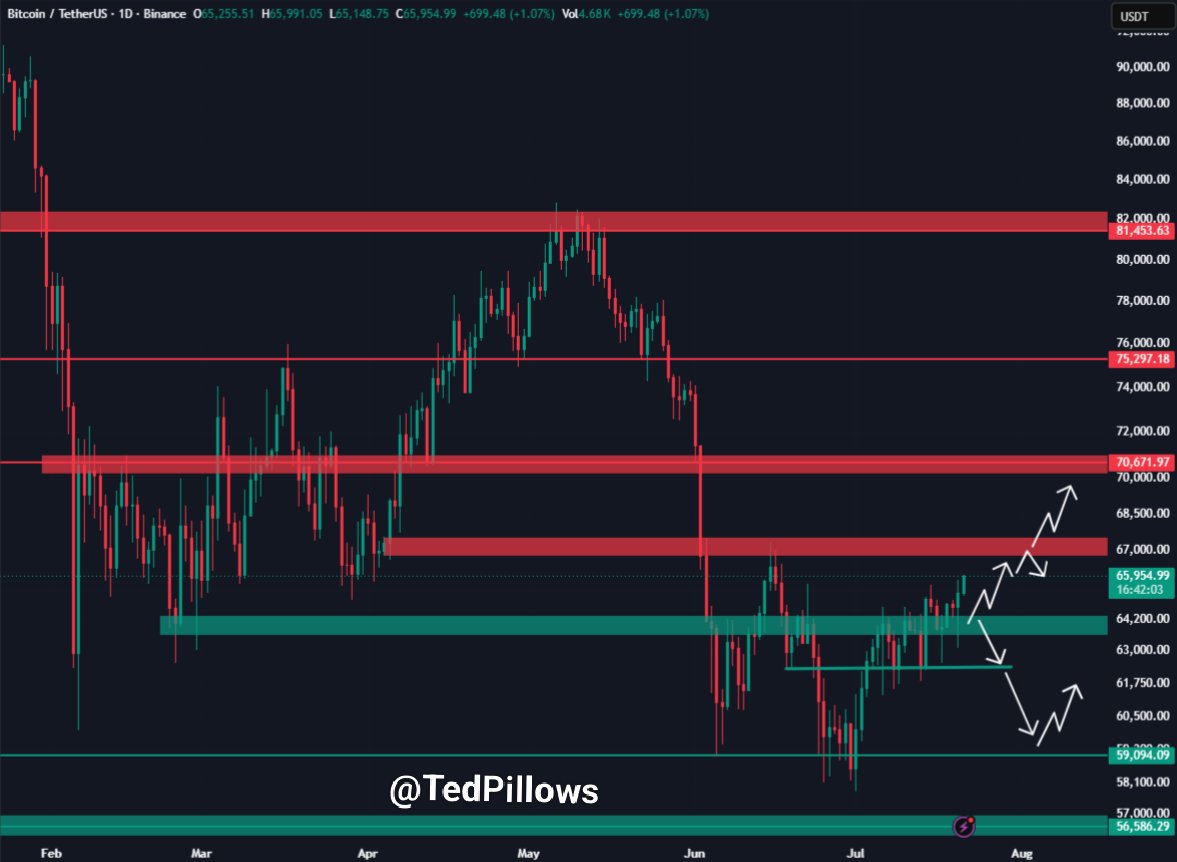
“$BTC has reclaimed the $65,000 level. The next key resistance is $67,500-$68,000, which means Bitcoin has some room to pump,” trader Ted Pillows said.
“If BTC manages to reclaim the $68,000 resistance too, it could rally another 5%-6% very quickly.”
BTC/USDT one-day chart. Source: Ted Pillows/X
Concerns had accompanied the start of the latest move, with commentator Exitpump seeing closing short positions fueling the upside.
“There’s very little real buying interest here,” they warned X followers while analyzing derivatives markets.
BTC derivatives hint at risk-on return
Observing options trends, trading company and market maker QCP Capital flagged “some demand” for higher Bitcoin bets into the end of July.
Related: Trader maintains $67K BTC price target: Five things to know in Bitcoin this week
Here, it noted the US Federal Reserve would hold its next meeting on interest-rate changes, with chair Kevin Warsh potentially offering fresh insight into future policy.
As Cointelegraph reported, market expectations remain that the Fed will leave rates unaltered before September. CME Group’s FedWatch Tool shows 83.4% probability that policy makers will stick with the current target range of 3.50-3.75% at their July 29 meeting. For the Sept. 16 FOMC meeting, there’s a 53.8% probability of a hike to 3.75-4.00%.
“There has been some demand for month-end BTC upside,” Monday’s QCP Market Colour analysis said.
“This positioning leaves dealers short upside gamma into the 28 to 29 July FOMC meeting, increasing the potential for an accelerated move higher should tensions around the Strait of Hormuz ease.”
QCP referred to the US-Iran war once again closing a key global oil route.
Upward momentum that began the day showed little signs of stopping despite macro conditions that seem to favor a risk-off mindset.
The US-Iran war saw further escalation on the day as Iran struck Amazon facilities in Bahrain in response to US strikes, while the Strait of Hormuz oil route remained closed.
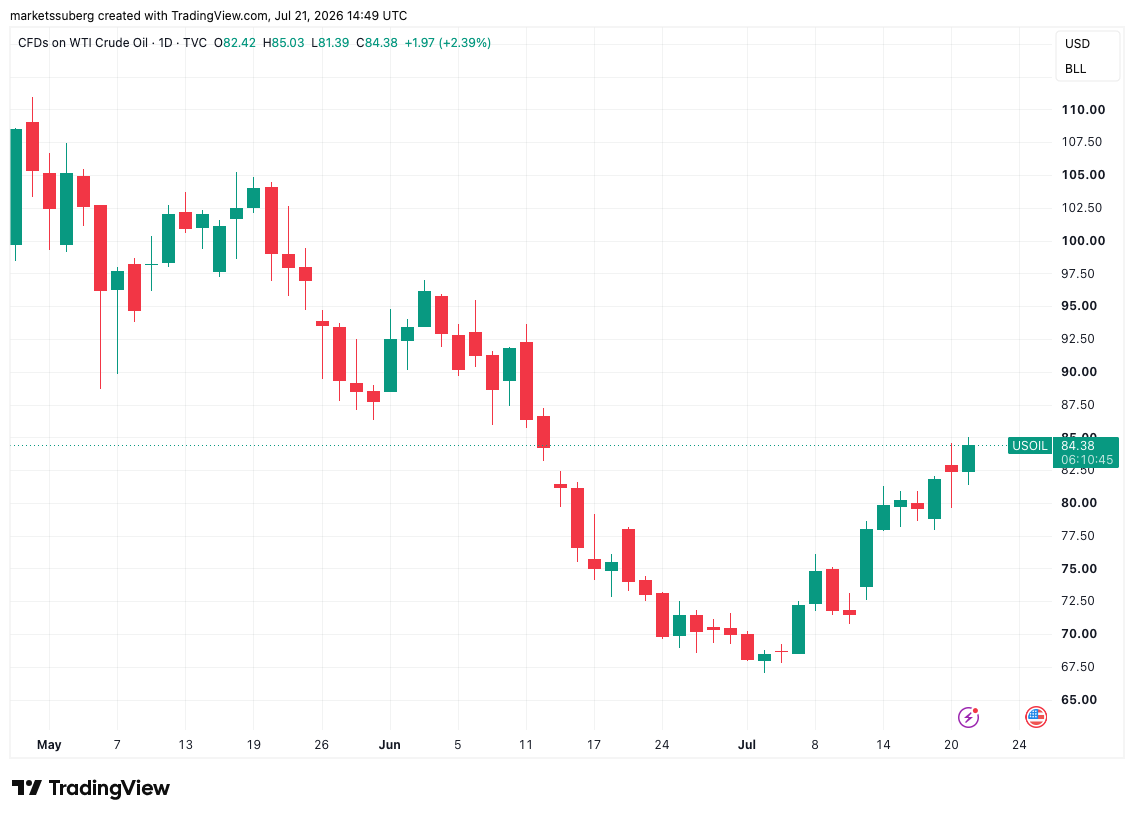
As a result, WTI crude oil prices reached their highest levels in over a month, nearing $85 per barrel.
CFDs on WTI crude oil one-day chart. Source: Cointelegraph/TradingView
Multiple media reported US president Donald Trump plans to introduce new 10% international trade tariffs. These would follow 50% measures imposed on Canada this week.
Despite these notional headwinds for crypto and risk assets, traders attributed the lack of bearish reactions to expectations that the situation would ultimately resolve in markets’ favor.
“Markets are pricing in peace,” YouTube channel host Crypto Rover summarized in a post on X to their 1.6 million followers.
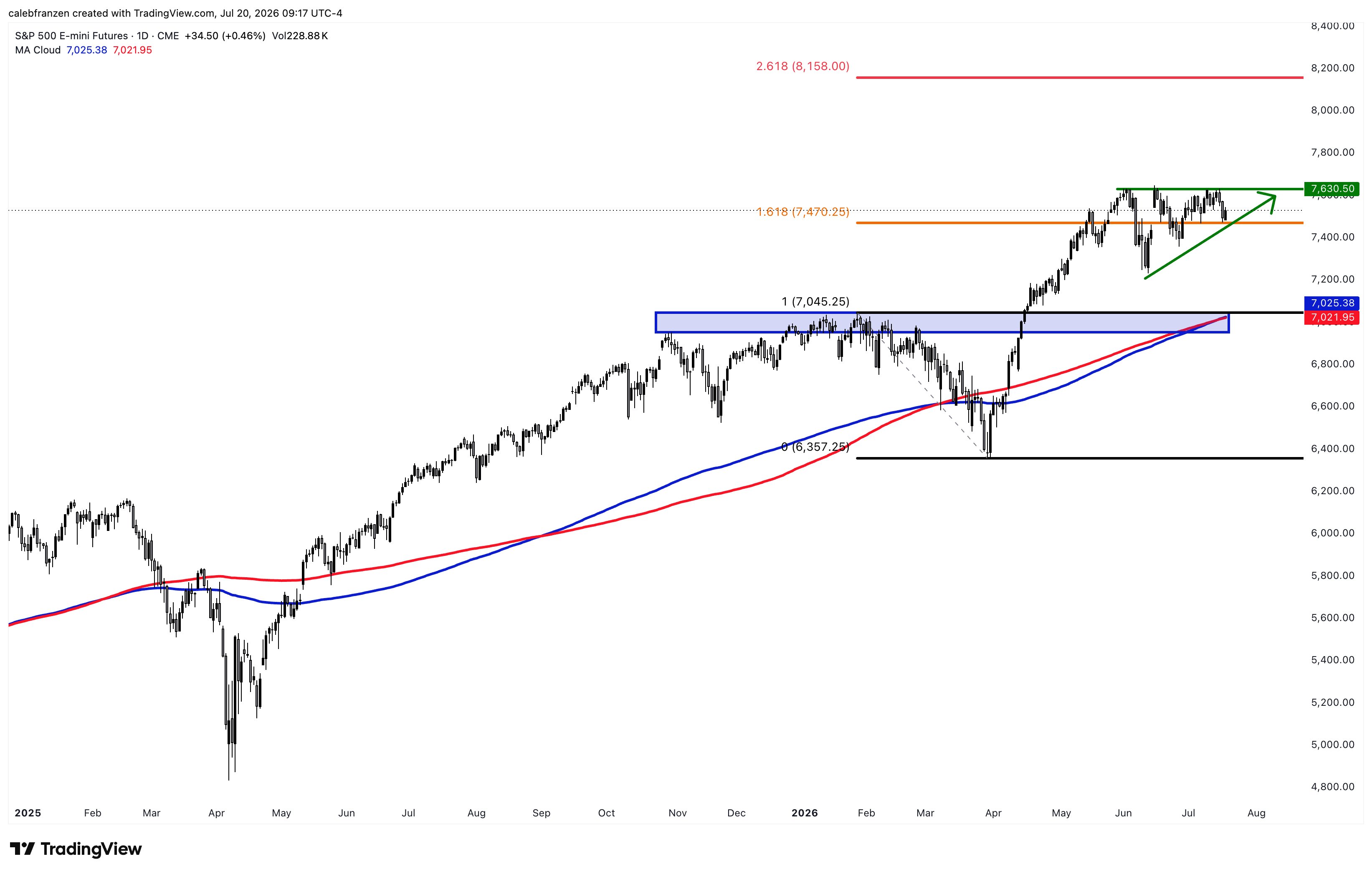
Caleb Franzen, creator of Bitcoin and macro analysis resource Cubic Analytics, was confident about the near-term trend in the S&P 500 index.
“I reiterate… I have zero fear, concern, or worry with S&P 500 futures looking like this,” he told X followers on Monday.
While some traders looked for a retest of levels up to and including $70,000, Keith Alan, cofounder of trading resource Material Indicators, was conversely cautious on the BTC price outlook.
Related: Trader maintains $67K BTC price target: Five things to know in Bitcoin this week
Despite a “golden cross” involving the 21-day and 50-day simple moving averages (SMAs) on Monday, the bear market, he warned, had gone nowhere.
“Bear Markets don’t always look like Bear Markets, especially in lower timeframes,” he wrote in his latest X analysis.
“The macro trend will be challenged if Bitcoin pushes above the 21-Week SMA. Until that happens, the Bear Market remains intact.”
BTC/USD one-day chart with 21-week, 50-week SMA. Source: Cointelegraph/TradingView
The 21-week SMA stood at $69,720 at the time of writing, coinciding with Bitcoin’s then-all-time high from 2021.
Alan acknowledged that there was “no real resistance” until $67,250.