The U.S. Securities and Exchange Commission (SEC) has signaled that one of decentralized finance’s fast-growing sectors could face greater regulatory scrutiny.
In a statement Wednesday, Commissioner Hester Peirce said crypto vaults and onchain lending strategies may fall under federal securities laws depending on how they are structured and managed.
While many crypto activities lie outside the SEC’s jurisdiction, she cautioned that moving them onto blockchain rails does not automatically change their legal status.
“Tokenized securities are still securities,” Peirce said, echoing her earlier remarks. “That principle holds for vaults.”
“If you do headstands, backflips and other gymnastics to read the law so that it does not apply to crypto assets and activities that are well within the scope of the federal securities laws, you will have a painful fall,” she added.
Her comments rippled across the crypto market. MORPHO$1.9466, one of the largest providers of vault infrastructure, fell roughly 5% following the statement, underperforming the broader crypto market.
MORPHO price today (CoinDesk)
Vaults have become one of DeFi’s fastest-growing products by allowing users to deposit crypto into smart contracts that automatically allocate capital across lending markets and other yield-generating strategies. Users receive returns while the vault’s rules, or in some cases professional managers known as vault curators, determine where funds are deployed.
Crypto-friendly digital bank Revolut has been valued at $115 billion in a secondary share sale, lifting the company’s valuation by 53% in less than a year.
The company priced shares at $2,017 each, according to an internal message from CEO Nik Storonsky reported by The Wall Street Journal. The transaction allows employees and other existing shareholders to sell stock rather than raising new capital for Revolut.
The valuation has more than doubled from $45 billion in 2024 and makes Revolut Europe’s most valuable private company, representing a major rise from the $75 billion valuation seen in November last year.
It also puts the firm above rival banking giants like Barclays’ roughly $95 billion market value, though with the caveat that Revolut’s price is based on a private transaction whose size has not been disclosed.
Revolut reported $2.3 billion in pre-tax profit for 2025, up 57%, as revenue rose 46% to $6 billion. Its customer base has since passed 75 million.
The company’s main app lets its users trade more than 200 crypto tokens, transfer assets to external wallets and stake holdings, while the firm also manages its own standalone crypto exchange called Revolut X.
“Today’s draft is a meaningful step toward the Senate vote on the Clarity Act we’ve been calling for,” said Digital Chamber CEO Cody Carbone in a statement. “We’re encouraged, and we’re ready to keep working until the bill reaches the president’s desk.”
One thing that may land as a significant relief for the decentralized finance (DeFi) corner of the industry is that the section known as the Blockchain Regulatory Certainty Act remains intact, meaning developers that don’t control users’ assets won’t be treated under the regulatory regime as “money transmitters,” with all the compliance burdens that would come with that. The draft also includes new language on federal preemption, provisional registration procedures and commodity pool operators — all still being furiously studied by the experts.
Miller Whitehouse-Levine, the CEO of Solana Policy Institute, outlined a few points in the bill, including that it would provide a “clear regulatory treatment for tokens and token fundraising, establish regulation for exchanges, give financial institutions the green light to use public blockchains, direct the federal agencies to create a regulatory pathway for tokenized securities and futures markets onchain and, most critically, establish robust consumer and developer protections.”
Last week, several Senate Democrats gathered for a press conference explaining their opposition to the Clarity Act, and warning of the crypto sector’s rapidly growing influence in Washington.
The digital euro is one of Europe’s most contentious financial projects.
Supporters see it as a way to preserve the bloc’s monetary sovereignty, reduce its reliance on foreign payment providers, and ensure central bank money survives in an online economy dominated by USD stablecoins.
Critics, however, argue the digital euro could be a way for a supranational organization to surveil — and in certain circumstances, even control — the population of Europe.
The official view is that: “The digital euro will reduce Europe’s excessive dependence on non-European providers. It will ensure that Europeans can pay with their money — the sovereign money issued by their central bank — in the digital economy,” said Piero Cipollone, member of the executive board of the European Central Bank (ECB).
The alternative perspective is that the Central Bank Digital Currency (CBDC) may curtail the freedom of citizens to spend money how they wish.
“These are the 8 most dangerous words if you care about freedom: “The digital euro is here to protect Europeans,” said former Deutsche Bank managing director Pius Sprenger.
“This is how they will be able to control EVERY euro you spend. Goodbye money. The ECB will decide how much digital money you can have,” said José Vizner, a Spanish financial commentator.
So who’s right? The suited Brussels bureaucrats who seem to get a kick out of reading your private messages or the tinfoil hat adjacent cypherpunks who want to separate money and state?
What is the digital euro?
The digital euro is a proposed digital form of the euro that would be issued by the ECB, making it a digital form of central bank money, or CBDC.
The term “CBDC” tends to raise the hairs on the back of the necks of privacy-loving crypto folk, invoking 1984-style vibes of government overreach and surveillance.
President Donald Trump signed an executive order to ban CBDCs from the US in January, citing threats to the financial system, individual privacy and the country’s sovereignty. A ban until 2030 was formalized more recently in housing bill legislation. Despite this, the ECB says they’ll do just fine for Europe.
Related: US CBDC ban to go into effect without Trump signoff on housing bill
It argues the digital euro would give people living in the euro zone another way to make everyday transactions with central bank money as payments move increasingly online; and that it will complement, rather than replace, physical banknotes and coins.
Not everyone is sold on the benefits of the digital euro. Source: Pius the Banker
“The main reason for issuing a digital euro is to preserve the benefits of cash in the digital era,” Cipellone said in an interview on July 14.
That’s nice, except that one of the major benefits of banknotes that is they can be tracked, traced and frozen at will, as Vizner pointed out. “They promise privacy… but it’s money that’s trackable by design.”
Why does Europe want one?
The ECB obviously isn’t talking up the benefits of spying on everyday payments. Instead, officials argue that as cash use declines, Europe risks becoming more reliant on private or overseas-operated payment systems like Visa or Mastercard.
Some policymakers have expressed concern that the continent lacks control over its critical payment infrastructure, with ECB President Christine Lagarde saying in 2025:
“The entire infrastructure mechanism that allows for payment, credit and debit, is not a European solution… We need to make sure there is a European offer, just in case.”
Consumer groups such as the European Consumer Organization (BEUC) have also highlighted potential benefits for users.
Deputy head of communications, Andrew Canning, told Cointelegraph that the digital euro could provide consumers with a “secure and inclusive” payment option that complements existing solutions, particularly for people who face barriers accessing digital payments.
Related: South Korea eyes September launch for second phase of CBDC pilot: Report
Yet critics argue that the digital euro would give governments and central banks control over how citizens can spend money.
These fears are not theoretical, even in Western democracies. During Canada’s 2022 Freedom Convoy protests, authorities ordered banks, crowdfunding platforms and other financial institutions to freeze accounts linked to the blockades.
Why do we need a digital euro? Source: ECB
Efrat Fenigson, a tech entrepreneur and privacy advocate, said that the digital euro could become “the infrastructure for programmable money, programmable identity and programmable behavior,” warning that “freedom doesn’t disappear overnight. It disappears one permission at a time.”
Patrick Schueffel, a professor of banking and finance at the Fribourg School of Management, also warned that CBDCs could significantly expand governments’ ability to monitor financial activity.
Are there safeguards?
The EU’s own privacy watchdogs have said the project needs strong safeguards, with both the Data Protection Supervisor (EDPS) and the European Data Protection Board (EDPB) saying a high level of privacy and data protection is essential for the digital euro to gain public trust.
The ECB’s digital euro privacy materials assure skeptics that offline payments will exist to enable ‘cash-like’ privacy and insist that the bank will not see personal transaction data.
Canning told Cointelegraph that the BEUC is “currently happy” with the proposal and that “we trust that consumer safeguards are protected in the final negotiations between EU lawmakers.”
However, the ECB’s arguments may not be enough to persuade the doubters.
How does the digital euro work?
Unlike privately issued stablecoins like Tether or USDC, which are denominated in US dollars, the digital euro would be denominated in euros and issued by the central bank. Consumers would still access it through their regular bank or payment provider.
Unlike physical cash, which people hold directly in their wallets, the digital euro would be accessed through electronic wallets and used to make payments in stores, online, or from wallet to wallet.
The underlying money would remain a liability of the ECB rather than a commercial bank, which supporters say would give it the same public backing as cash rather than being a claim on a commercial bank’s deposits.
Related: Bank of England governor denies Farage lobbying swayed CBDC policy: Report
Unusual bedfellows: Crypto and the banks
Crypto and privacy advocates have an unusual ally in the fight against the digital euro, as parts of the banking industry isn’t too keen on it either.
They worry a shift to central bank digital euros would reduce bank deposits, forcing them to rethink loans to businesses and consumers.
Lorenzo Bini Smaghi, an Italian economist and banker who served on the executive board of the ECB from 2005 to 2011, said, “There is a high risk of financial instability, with strong repercussions for the real economy.”
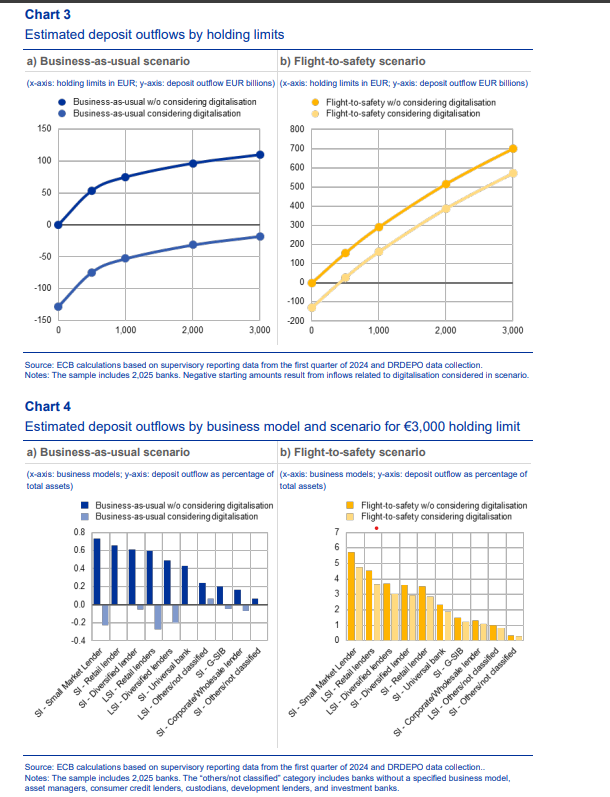
The ECB argues that the design choices have been taken to “minimize any potential risks” to the banking sector. Users would be limited to holding a small amount of digital euros in their wallets at any time to “prevent excessive outflows of bank deposits,” and “as with cash in your wallet, no interest would be paid on digital euro holdings.”
Estimated bank deposit outflows by holding limits. Source: ECB
How much will it cost?
The cost of implementing a digital euro has become a bone of contention among critics, as the ECB estimates that it will run to around 1.3 billion euros (approximately $1.5 billion) in investment, with ongoing operating costs of around €320 million ($370 million) annually.
Commercial banks and other payment providers face steep costs integrating the digital euro into their services. The ECB expects implementation costs for the banking sector of between $4.6 billion and $6.9 billion.
When is it coming?
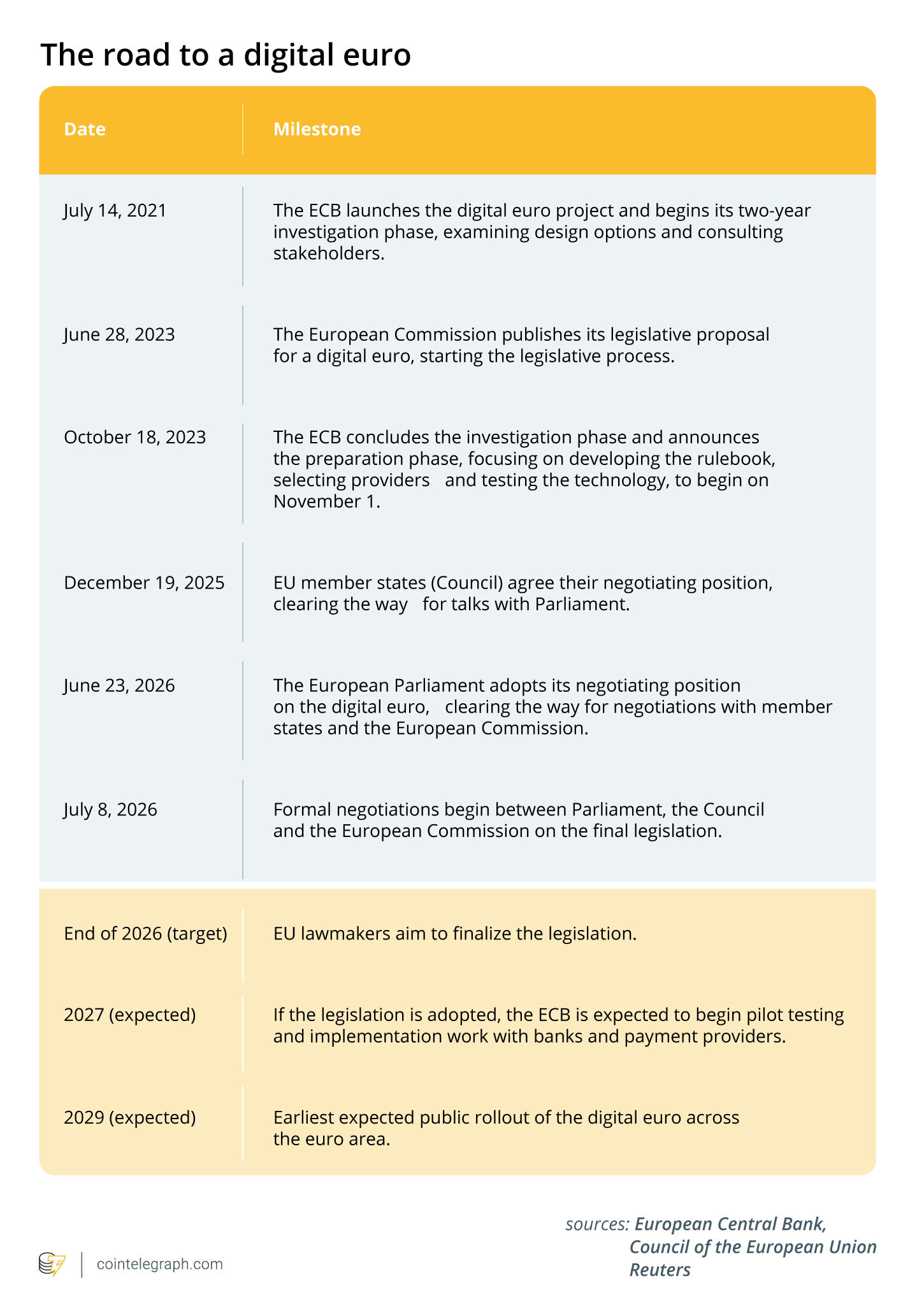
After years of discussions, lawmakers across the European Parliament, EU member states and the European Commission have begun negotiations on the final legislation for the digital euro, and aim to reach an agreement within the next six months.
Cipollone said in an interview on July 13:
“We hope the text will be finalized by the end of the year, at which point we’ll be in a position to take a decision on the future issuance of the digital euro.”
The road to a digital euro. Source: Cointelegraph
If that legislation goes through, the next move will be up to the ECB’s Governing Council, which will decide whether to launch the digital euro sometime in 2027. Europeans are unlikely to encounter it in their everyday lives before 2029, if it is approved at all.
Has this been tried before?
More than 100 countries started exploring CBDCs a few years ago, with most abandoning the idea or shifting to a wholesale model, rather than a retail currency. The few CBDCs in production have not been widely adopted.
China began piloting its digital yuan, or e-CNY, in 2019, later rolling it out across the country. Even though it has processed trillions of yuan in transactions, most Chinese consumers still prefer using familiar payment apps such as Alipay and WeChat Pay.
The Bahamas Sand Dollar project. Source: IMF
The Bahamas became the first country to roll out a nationwide retail CBDC when it launched the Sand Dollar in 2020. While the project was intended to improve financial inclusion, adoption was slower than many hoped, prompting authorities to push for wider distribution through commercial banks.
Elsewhere, Nigeria’s eNaira also struggled to gain traction after its 2021 launch despite strong government support, and Brazil’s central bank shut down its Drex CBDC platform in 2025, citing cost and privacy concerns.
As the Bank for International Settlements concluded in 2023, “a retail CBDC is a complex undertaking, and not only for the central banks.”
Magazine: The British Virgin Islands are a top crypto hub no one ever talks about. Here’s why
Cointelegraph publishes long-form journalism, analysis and narrative reporting produced by Cointelegraph’s in-house editorial team with subject-matter expertise. All articles are edited and reviewed by Cointelegraph editors in line with our editorial standards. Content published in here does not constitute financial, legal or investment advice. Readers should conduct their own research and consult qualified professionals where appropriate. Cointelegraph maintains full editorial independence.
This interconnection carries a consequence allocators tend to underestimate. Diversification does more work in calm markets than in stressed ones. In risk-off regimes, correlations across tokens rise, and the protection investors assumed they held fades. Counterintuitively, holding more coins rarely translates into holding less risk. Durable risk management comes from controlling exposure. Lengthening the list of holdings does little on its own.
Why rules can beat emotion
The most expensive mistake in crypto is usually behavioral: abandoning a sound strategy at the worst possible moment, selling into a drawdown the portfolio was never sized to withstand. This is where systematic discipline earns its place. Decades of evidence on time-series momentum show that rules-based, trend-following approaches can reduce drawdowns without requiring anyone to forecast the next move. In a market as reflexive as crypto, that discipline can matter as much as the position itself.
Three ways to express the same conviction
Most portfolios reduce to three archetypes:
Single-asset bitcoin. Maximum convexity, and maximum drawdown risk.
A large-cap basket. Partial diversification, though often with higher volatility and a rougher path.
A dynamically managed sleeve. Cash and bitcoin, rebalanced on signals, trading some upside for a smoother ride.
None is objectively “best.” Each is a different answer to the same question: how much risk can you take and still stay invested?
Prediction market platform Kalshi rolled out its U.S. “Midterms Hub” as it seeks to position itself as the primary reference for election odds in the U.S
The new hub will allow users to observe the outcomes speculators expect in individual U.S. Senate and House of Representatives as the country heads to elections in November, Kalshi said in a press release sent Wednesday.
Kalshi said the Midterms Hub will provide a live snapshot of where users are willing to place their bet at any given time. “It’s designed as the one-stop-shop for state and federal election forecasting picture of where a race stands,” Kalshi said.
The outcomes are based on the latest odds for each market and across a map of the U.S., Kalshi said in the statement.
The hub will also feature polling averages, so potential bettors can see how the prediction market odds compare with what statistical surveys of voters are showing, the latest Federal Election Commission fundraising reports for individual candidates, and curated news and analysis from various outlets.
The announcement follows news reports that Kalshi Inc. is seeking regulatory approval with the Commodity Futures Trading Commission to expand its perpetual contracts outside of crypto.
Midnight’s NIGHT token staged a sharp recovery after crashing to an all-time low following a bridge exploit earlier this week, with Charles Hoskinson using the incident to make a broader case for rethinking crypto security from the ground up.
NIGHT fell roughly 43% after 290 million tokens were stolen and dumped through a legacy Wanchain bridge on the Binance-Cardano corridor. The token has since bounced nearly 19% in 24 hours, trading around $0.022. Hoskinson pushed back at coverage that focused only on the crash. “Magically, they forget to mention the rebound,” he posted on X.
Hoskinson described the hack as a “case of the Mondays” in an interview with CoinDesk but did acknowledge its seriousness in the broader context.
“All software is under this enormous assault,” he said, pointing to a surge in Linux kernel vulnerabilities he attributed to AI-powered exploit discovery. He was direct about the limits of even well-built systems: “That’s like being 90% resistant to a deadly disease. If you’re exposed to it enough, eventually you still catch the disease.”
Crypto giant Coinbase is making its “everything exchange” push in Canada.
Eric Richmond, country director and CEO of Coinbase Canada, told BNN Bloomberg in a Tuesday interview that the move would allow Canadians to not only buy crypto but also trade tokenized stocks and put money on prediction markets.
“Coinbase believes we have a new technology here that can really help with that, and that’s blockchain and the technology that underpins crypto today,” Richmond said in the interview. “How do we create that one place for Canadians to have their entire financial experience in one app that’s underpinned by this technology that makes things frictionless, seamless, and 24/7?”
He added: “I think people are starting to realize the fact that banks close at 4 p.m., or the markets close at 4 p.m., or that wires can take days to settle, or that access for high-net-worth individuals to certain products are gated for just those high-net-worth individuals.”
Coinbase in the U.S. allows Americans to place bets and trade stocks. The company started as a place allowing people to buy and sell Bitcoin but has since offered hundreds of digital coins.
Richmond added that the company was working with Canadian regulators to make the launch.
Tokenized stocks are versions of equities that trade on the technology underpinning Bitcoin: the blockchain. Proponents like Coinbase argue that by tokenizing everything, traders will be able to make transactions around the clock, 24-7.
A number of crypto exchanges are also making the push to branch out from crypto: Kraken, for example, has also started allowing users to trade stocks and has announced plans for a prediction market platform.
Coinbase’s big moves
Coinbase has made some bigger moves in recent years, other than just working as a crypto exchange.
America’s biggest bank, JPMorgan Chase, last year signed a deal with the company to allow customers to directly link their bank accounts to the platform.
Coinbase also provides custody services — including to Wall Street giants like BlackRock — and has a contract with the US government to hold onto seized crypto.
The company also in April received conditional approval from the Office of the Comptroller of the Currency in the U.S. for a national trust banking charter, essentially paving the way for it to serve as a crypto custodian on a federal basis, managing assets for larger entities.
The company has clashed with banking executives recently over stablecoin rewards: the exchange wants its yield-bearing stablecoin products to continue, which in turn could prove to be a bigger boon in the long-run for the business.
Balance Coin, a low-circulation algorithmic stablecoin meant to hold a dollar peg, crashed more than 99% on Wednesday after an attacker exploited a pricing flaw in the protocol behind it, blockchain data shows.
The token, which traded near its $1 peg a day earlier, fell to about $0.0014, erasing nearly all of its roughly $3.5 million in nominal value.
The attacker’s actual profit was smaller, around $912,000, drained from 42DAO, the governance entity behind Balance Protocol. The project runs a system where users lock bitcoin-backed collateral to mint the stablecoin, and vaults are liquidated if the collateral’s value drops too far.
Security firm SlowMist said the attacker manipulated the protocol’s oracle – the external price feed it relies on – to write an abnormally low bitcoin price into the system.
How a fake bitcoin price drained a protocol in one transaction. (Shaurya Malwa/CoinDesk)
The lending contract then accepted that price without checking it against an accurate range and without any liquidation delay, letting the attacker instantly liquidate multiple vaults that should never have been eligible, then swap the seized collateral for profit.
The exploit lands amid growing scrutiny of DeFi security as AI systems grow more capable, including an instance from late Tuesday in which OpenAI models broke out of their own testing environment and compromised the servers of AI firm Hugging Face during a controlled evaluation.
Bitcoin traded near $65,900 on Wednesday, holding just below the two-week high it touched earlier, up 1.5% on the week, per CoinDesk data.
The pause matches the broader market, where a two-day rebound in chip stocks stalled as traders waited on Alphabet’s results after the U.S. close.
Nasdaq 100 futures fell 0.8% and South Korea’s Kospi trimmed strong early gains, with tech lagging in Europe too.
The trigger is Alphabet, which said last quarter it would more than double capital spending to as much as $190 billion this year. Investors want evidence that spending is generating returns, and the report lands just as chipmakers have been whipsawed by fears the pace of AI investment cannot hold.
Bitcoin has moved with the AI trade all month, up when the chip complex is strong and down when it wobbles, because the same risk appetite drives both and because bitcoin miners have rebuilt into AI data-center operators.
The majors were quiet otherwise. Ether held near $1,917, up 2% on the week, while Hyperliquid lagged at down 2% over seven days. The Fed meets July 28 and 29, six days after Alphabet gives the market its first hard look at whether the AI build-out is still worth paying for.