That shift is already beginning. Robinhood launched AI-powered investing tools in May that let agents trade stocks and make purchases for users. CEO Vlad Tenev has said AI agents will eventually rival the capabilities of human traders, while OpenAI and Anthropic are racing to build increasingly autonomous systems that can navigate software and complete complex tasks on their own.
For Kaul, those agents introduce a problem that today’s payment systems weren’t built to solve.
Many transactions between AI agents could be worth only fractions of a cent, such as paying for an API call, a second of computing power or access to a dataset. Traditional payment networks become expensive when fees cost more than the transaction itself.
That’s where Kaul believes blockchains come in.
She argued public blockchain networks are better suited to machine-to-machine payments because they offer programmable transactions, cryptographic identity and near-instant settlement. Instead of relying on banks or card networks, AI agents could hold digital assets and pay one another directly over blockchain rails.
If that happens at scale, demand for blockchain networks could grow alongside AI adoption.
Since agents would need native cryptocurrencies to pay network fees, Kaul argued rising transaction volumes could increase demand for those tokens while generating more revenue for developer incentives, network security and decentralized applications.
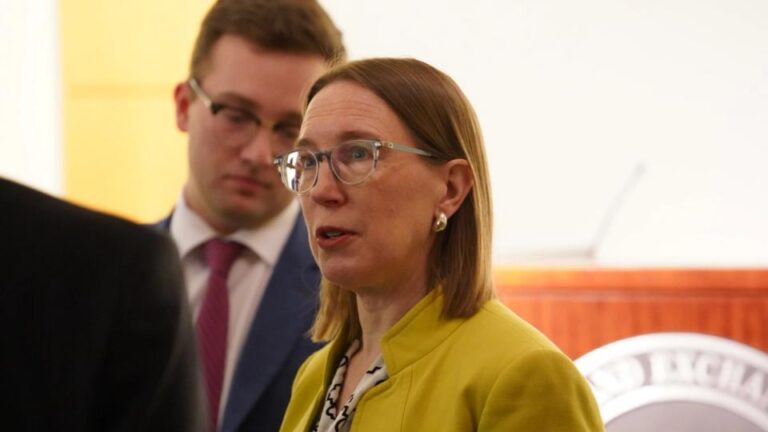
SEC Commissioner Hester Peirce said crypto vaults and onchain lending products may fall under US securities laws, urging developers to assess whether products that actively manage user assets require regulatory compliance.
In a statement published Wednesday, Peirce said crypto vaults and lending strategies that involve discretionary decisions, including allocating assets, selecting yield-generating activities, setting lending terms and determining liquidation thresholds, may fall within the scope of federal securities laws depending on their structure and operation.
She said some vaults could be treated as securities offerings or investment companies, while parties managing vault allocations or lending parameters could also trigger investment adviser requirements.
Peirce said that some onchain loans may also qualify as securities depending on how they are structured, distributed and used.
“Moving activities that fall within the scope of the federal securities laws onchain, as a general matter, does not take those activities outside the scope of the laws the Commission administers,” Peirce said.
Peirce urged developers and operators to consult the SEC if their products may fall within its jurisdiction and invited feedback on how existing rules could better accommodate onchain finance.
Related: SEC sues Mining Automatic and founder over alleged $22M crypto mining scheme
Crypto vaults grow as regulators scrutinize onchain yield products
Crypto vaults pool user assets into onchain strategies designed to generate yield through lending markets, staking or liquidity pools. Their use has expanded this year as companies package sophisticated DeFi strategies into products aimed at both retail and institutional investors.
In April, Sentora opened its Smart Yield platform to the public, allowing users to compare and access DeFi vaults based on strategy, yield and risk metrics. Earlier, Wallet in Telegram launched self-custodial Bitcoin (BTC), Ether (ETH) and USDT (USDT) vaults that provide automated yield generation without requiring users to transfer assets to a centralized custodian.
Kraken followed in May with a Bitcoin vault offering up to 2.5% variable APY by deploying wrapped Bitcoin across decentralized lending protocols including Aave and Morpho. Rewards are paid in Bitcoin and fluctuate based on borrowing demand in the underlying markets.
The products have also exposed users to technical risks. In December, decentralized finance protocol Yearn disclosed a roughly $9 million exploit affecting its legacy yETH yield vault, though the protocol said its V2 and V3 vaults were not effected.
If crypto vaults were to fall under federal securities laws, their operators could be required to register with the SEC or qualify for exemptions while complying with disclosure and other regulatory requirements.
Source: Yearnfi
Magazine: The digital euro: Surveillance money, or a better alternative to cash?
Federal prosecutors filed five civil forfeiture complaints seeking more than $25 million in cryptocurrency that investigators say came from international romance and investment scams targeting people in the U.S. and Canada.
The complaints, filed in U.S. District Court for the District of Columbia, stem from separate Secret Service investigations.
Agents traced funds through hundreds of wallet addresses and frozen crypto linked to more than 270 suspected investment scam transactions, more than 200 romance scam victims and several victims in the Washington area, according to the U.S. Attorney’s Office.
The two largest cases seek about $12.1 million tied to online romance schemes and $10.4 million linked to fraudulent investment platforms. Another three complaints seek roughly $1.23 million, $2.39 million and $285,000.
In one case, scammers cut off contact after a victim tried to withdraw money from what appeared to be a crypto investment account. In another, fraudsters contacted someone who had already lost money and claimed they could recover it for a fee in what’s known as a recovery scam.
The cases are part of the Scam Center Strike Force, which launched in November 2025. The U.S. Attorney’s Office said the task force has recovered more than $800 million.
Senate Republicans have released the proposed text for the Digital Asset Market Clarity (CLARITY) Act, including language on ethics that would bar all US federal officials — including President Donald Trump — from issuing or sponsoring any digital asset.
In the 616-page text of the CLARITY Act made public on Wednesday, US lawmakers included language that the White House described as the “most comprehensive and wide-ranging ethics provision in history.“ The bill said all public officials, employees and their spouses would be barred from issuing or sponsoring digital assets and crypto platforms would similarly be blocked from listing assets issued or sponsored by federal officials.
Text of CLARITY Act released on Wednesday. Source: Cynthia Lummis
According to Senator Cynthia Lummis, one of the bill’s chief advocates, the ethics provisions would also apply to Trump, who faces significant pushback from lawmakers over earning more than $1.4 billion in 2025 from his crypto ventures. The ban on public officials would only be temporary, expiring on Jan. 20, 2029 — the day Trump’s second term as president will end.
The US Attorney General will largely be responsible for enforcing the ban rather than state authorities. As of Wednesday, Trump’s former personal attorney and acting AG Todd Blanche was awaiting a Senate confirmation vote to head the Justice Department.
“I wouldn’t support the bill if that’s the language,” said Senator Angela Alsobrooks in a Tuesday statement to Politico on having the DoJ behind enforcement of ethics. “But we’ll keep working from that floor to reach an agreement that holds us all accountable.”
The CLARITY Act, which awaits a potential vote in the Senate before returning to the House of Representatives and possibly Trump’s desk, still needs support from several Democratic lawmakers to meet a 60-vote threshold. Many Democrats have explicitly said that they will not vote for any bill without strong ethics language to address what some have called the president’s “crypto corruption.”
Will enough Democrats sign onto the bill?
Notably, CLARITY’s ethics provisions did not appear to include children of public officials in its temporary ban. All three of Trump’s sons are co-founders of his family’s World Liberty Financial crypto business, and two launched a Bitcoin (BTC) mining company, American Bitcoin.
“This bill applies one ethics standard to everyone, including the President of the United States, and backs it up with real enforcement, real penalties, and a Department of Justice mandate to act,” said Lummis on behalf of the US Senate Banking Committee’s subcommittee on digital assets. “This is not talk.”
Related: Nigerian president signs order on approach to crypto regulation, taxes
Senate Majority Leader John Thune reportedly plans to put CLARITY up for a vote on the Senate floor sometime next week regardless of whether it has enough support from Democrats to pass. The chamber only has a few weeks to hold a vote before it breaks for state work periods.
“[E]thics is far from the only thing at stake,“ said Solana Policy Institute President Kristin Smith in reaction to the CLARITY text. “The Senate has added a full disclosure regime, an entire illicit finance section, and improved spot market regulation […] The Senate has a real chance to pass durable, bipartisan market structure legislation.“
Magazine: The digital euro: Surveillance money, or a better alternative to cash?
Senate Republicans published a new draft of the Clarity Act earlier Wednesday, including an ethics provision that the White House and President Donald Trump agreed to.
Senator Bernie Moreno, one of the lead Republicans on the bill, said in a post on X (formerly Twitter) earlier Wednesday that it was “the most powerful ethics language in U.S. history.”
“Don’t listen to the DC Democrat lies,” his post said.
The ethics provision has been an outstanding issue for over a year, stretching back to the Senate’s work on the stablecoin-focused Guiding and Establishing National Innovation for U.S. Stablecoins (GENIUS) Act last year, but the issue took on a renewed focus in recent weeks after Trump shared his latest financial disclosure showing he made over $1.4 billion from his crypto ventures in 2025.
It’s unclear when the bill may hit the Senate floor, though Republican Majority Leader John Thune’s office told CoinDesk that he’s still planning on moving forward in the coming days.
The Senate leaves town after August 7 for the summer recess, and the Senate has other issues to take up as well. It will need 60 votes to advance, meaning as many as 10 Democrats may need to vote for the bill. “We have been working in good faith with our Republican colleagues for the past year and will continue doing so to get this over the finish line,” the Democratic lawmakers said.
A group of Democrat Senators said in a statement late Wednesday that the bill still fell “short” of where it needed to be to get their support, but that they would keep working on it with Republicans. Senator Elizabeth Warren, the top Democrat on the Senate Banking Committee, argued Wednesday that the policy as written would let Trump continue his crypto businesses largely untouched, and any improper activity would be ignored by his loyal Department of Justice and then legally fenced off from prosecution once he leaves office.
Other outstanding issues
Beyond ethics, lawmakers may continue to negotiate over illicit finance provisions, Lummis said.
“We think we’ve landed in a good place,” she said, because the effort addresses the Bank Secrecy Act, money-laundering protections, sanction coverage for exchanges and decentralized finance (DeFi).
Some of the new additions were made at the request of law enforcement, such as a provision addressing crypto automated teller machine (ATM) fraud.
There is also a safe harbor for crypto platforms to freeze funds if they suspect the assets are tied to suspicious transactions, particularly if those companies are cooperating with law enforcement, she said.
The text also includes a provision saying it is the “sense of Congress” that at least two of the commissioners on the Securities and Exchange Commission and Commodity Futures Trading Commission would be nominated in consultation with the minority party. Right now, neither agency has any Democratic commissioners, with the SEC helmed by three Republicans, while the CFTC just has a single commissioner running the agency.
An affiliate of the cryptocurrency-aligned political action committee (PAC) Fairshake is attempting to influence voters in a primary race for Michigan’s 13th congressional district, with about $1 million in media on the line.
In filings with the US Federal Election Commission (FEC) as of Tuesday, the Protect Progress PAC had spent more than $986,000 on ads supportive of Democratic incumbent Shri Thanedar and opposing his challenger, Donavan McKinney. The reported expenditures came two weeks before the Democratic candidates were set to face off in an Aug. 4 primary to determine who will stand in the November general election.
Source: FEC
The media spending echoed Protect Progress’ moves from 2024, when the PAC spent about $1 million supporting Thanedar. That year, he defeated Democratic primary candidates with 54.9% of the vote, and Republican and other party challengers in the November election with 68.6%.
Fairshake and its affiliates reported having $191 million in their war chest to potentially influence voters in key elections. The PACs are just a few of many aligned with the industry attempting to send what they consider “pro-crypto” candidates to the next US Congress. Others included Fellowship, backed by Cantor Fitzgerald and Anchorage Digital, and the Blockchain Leadership Fund, a hybrid PAC backed by Anchorage and Chainlink Labs.
Related: Crypto-backed candidates notch wins in three US state primaries
McKinney did not run against Thanedar in 2024, nor had he appeared to have made any significant public statement directly supporting or opposing digital assets. Thanedar, in contrast, voted for many crypto-related bills while serving in the House of Representatives, including the CLARITY Act, GENIUS Act and Promoting Innovation in Blockchain Development Act. He also reportedly lost more than $600,000 in the second quarter of 2026 after investing $3.7 million of campaign funds into crypto companies.
“Shri has voted for every bill [Donald] Trump and the crypto lobby have brought to Congress,” said McKinney in a Tuesday statement on the PAC spending, adding:
“The crypto lobby is paying my opponent back for helping Trump make over $1 billion since taking office.”
PAC’s sights set on Washington as well
In addition to Protect Progress’ activity in Michigan, the PAC spent more than $100,000 on media supporting Representative Greg Stanton’s reelection bid in Arizona. Like Thanedar, Stanton voted in favor of CLARITY and GENIUS in the House. He won his primary on Tuesday for Arizona’s 4th congressional district with 65% of the vote.
The state of Washington’s party primaries, also scheduled for Aug. 4, could see some influence from a Fairshake affiliate. According to FEC filings, the Defend American Jobs PAC spent more than $65,000 on media to support Amanda McKinney, a Republican running for Washington’s 4th district who has made at least one public statement supporting crypto. Representative Dan Newhouse announced in 2025 that he would not pursue reelection in the district.
Magazine: Will the crypto lobby’s $189M campaign get CLARITY over the line?
“I don’t have any real political insights, but I expect that there is sufficient momentum behind this,” said Paul via WhatsApp. “And I believe that since this is now in the remit of the HM Treasury, Bank of England and the Financial Conduct Authority, it doesn’t require much political intervention to proceed. If anything, I think this might support increased demand for U.K. debt at a convenient time for the U.K. government.”
Changing capital flows
Paul said moving sovereign debt onchain changes how capital flows through the financial system, making it more than a back-office adjustment. Natively digital bonds allow market participants to settle trades instantly and move collateral between venues without the delays of traditional market infrastructure.
This programmability alters the dynamics of intraday repo markets, a change that market participants believe could free up tens of billions of dollars in idle liquidity. Currently, the U.K. gilt market sees aggregate daily trading volumes exceeding 45 billion pounds.
However, one key obstacle remains: the lack of a standardized onchain payment method.
“Santander issued a tokenized corporate GBP-denominated bond way back in 2019, so we have been demonstrating that bonds can be tokenized for nearly seven years,” said Jannah Patchay, founder of Markets Evolution. “The challenge then, as now, was how to settle that bond on-chain using a counterparty risk-free settlement asset, and we do not yet have a compelling solution.”
Tesla (TSLA) held its bitcoin BTC$65,905.98 holdings unchanged during the second quarter, maintaining its treasury of 11,509 BTC as the cryptocurrency’s price declined 14% over the three-month period.
The electric vehicle maker reported an after-tax impairment loss of $112 million on its digital asset holdings, according to its latest earnings release. Tesla has neither bought nor sold any bitcoin since 2022.
Bitcoin fell from about $83,000 at the start of the second quarter to roughly $58,000 by the end of June amid broader macroeconomic uncertainty and volatility across risk assets. The cryptocurrency was recently trading at $65,840.
Tesla remains one of the largest publicly traded corporate holders of bitcoin, though its holdings are significantly smaller than those of firms such as Strategy (MSTR), which has continued to aggressively accumulate the cryptocurrency.
The company’s crypto update came alongside mixed second-quarter financial results. Tesla reported non-GAAP earnings per share of $0.33, missing analyst expectations of $0.55. Revenue came in at $28.2 billion, topping consensus estimates of $27.6 billion.
Gross margin was 16.8%, while GAAP net income totaled $1.11 billion. The company also reported negative free cash flow of $1.1 billion for the quarter.
The U.S. Securities and Exchange Commission (SEC) has signaled that one of decentralized finance’s fast-growing sectors could face greater regulatory scrutiny.
In a statement Wednesday, Commissioner Hester Peirce said crypto vaults and onchain lending strategies may fall under federal securities laws depending on how they are structured and managed.
While many crypto activities lie outside the SEC’s jurisdiction, she cautioned that moving them onto blockchain rails does not automatically change their legal status.
“Tokenized securities are still securities,” Peirce said, echoing her earlier remarks. “That principle holds for vaults.”
“If you do headstands, backflips and other gymnastics to read the law so that it does not apply to crypto assets and activities that are well within the scope of the federal securities laws, you will have a painful fall,” she added.
Her comments rippled across the crypto market. MORPHO$1.9466, one of the largest providers of vault infrastructure, fell roughly 5% following the statement, underperforming the broader crypto market.
MORPHO price today (CoinDesk)
Vaults have become one of DeFi’s fastest-growing products by allowing users to deposit crypto into smart contracts that automatically allocate capital across lending markets and other yield-generating strategies. Users receive returns while the vault’s rules, or in some cases professional managers known as vault curators, determine where funds are deployed.