Home Blog Page 70

OKX launches AI Marketplace for Autonomous Agent Economy

0

Cryptocurrency exchange OKX has rolled out the beta launch of its marketplace for artificial intelligence (AI) agents.

The OKX AI platform enables users to list their own AI agents, enables AI agents to find work, transact autonomously and build an onchain reputation, according to a Tuesday announcement shared with Cointelegraph.

The platform connects two marketplaces: An agent marketplace where builders can earn income by listing their AI agents for services and a task marketplace where agents post work and find other agents for their tasks.

Agentic AI is expected to drive a 24-fold increase in token consumption, that is units of compute, by 2030 as consumers and enterprises adopt the technology, Goldman Sachs Research said last month. OKX is the latest crypto platform to venture into AI infrastructure, following similar initiatives from Coinbase, MetaMask and Nansen. 

The marketplace will remain in beta until “consistent, repeat usage patterns” emerge among users, with trading, onchain activity and research tasks expected to become the primary early categories on the platform, a spokesperson for OKX told Cointelegraph. 

“OKX is economic infrastructure for agentic commerce. Nobody is combining identity, reputation, payments, and a skills marketplace into one platform,” explained the spokesperson.

OKX AI agent marketplace. Source: OKX.ai 

AI agent builds will be paid in Stablecoins, initially Tether’s USDT (USDT) and Paxos’ Global Dollar (USDG). Payments will settle through escrow-based contracts for complex work or instant pay-per-call transactions for standardized services.

Disputes will be resolved by a staked network of evaluators, instead of a central entity. All types of tasks will contribute to the same onchain reputation of AI agents, which is managed through the OKX Agentic Wallet.

The marketplace launches with support from companies including Amazon Web Services (AWS), AltLayer, CertiK, the Ethereum Foundation, the Solana Foundation, Opentensor Foundation and StraitsX.

Onchain reputation seeks to prevent malicious AI agents

The onchain reputation and escrow system is built to create trust in AI agents by tracking their work history. Agents with no track record or a history of failed or disputed work will be less likely to get hired by other agents.

For larger projects, payment sits in escrow until the task is completed and verified, which aims to “limit” the damage a bad actor can cause in a single transaction.

A spokesperson for OKX said that the onchain reputation system will prevent agents from hiring other malicious agents, especially as more transaction history accumulates.

The spokesperson said the platform is working on additional defense layers, including more sophisticated dispute resolution and an anomaly detection system against coordinated bad-actor behavior.

Crypto platforms join AI wave as agentic payments increase

Cryptocurrency platforms are venturing into autonomous AI infrastructure. On June 12, Coinbase launched a tool that allows AI agents to make payments and trade crypto on behalf of users.

Days earlier, MetaMask launched a self-custodial cryptocurrency wallet that enables AI agents to transact across decentralized finance protocols within user-defined spending and security limits, as reported by Cointelegraph on June 8.

In January, crypto analytics platform Nansen launched autonomous cryptocurrency trading tools that enabled users to execute trades through natural language prompts, instead of traditional charts or order books.

Related: Not every AI agent needs its own cryptocurrency: CZ 

Agentic payment activity on Coinbase’s Base network topped 100 million transactions on June 3, signaling that machine-to-machine payments have moved beyond the proof-of-concept.

Cumulative agentic transfer volumes on Base. Source: Chainalysis

The x402 protocol allows software agents to make onchain payments directly through web requests. 

Magazine: ‘Accidental jailbreaks’ and ChatGPT’s links to murder, suicide

Trump’s Crypto Income Beats Real Estate in 2025

0

US President Donald Trump’s cryptocurrency ventures generated more income for him in 2025 than his real estate and resort businesses, according to his latest financial disclosures. 

Donald Trump’s annual financial disclosure report was released by the US Office of Government Ethics on Tuesday, revealing more than $1.4 billion in income from crypto-related ventures last year. 

The filings show Trump has profited substantially from an industry that he’s simultaneously regulating, which critics say creates a conflict of interest. In 2025, his administration pushed pro-crypto policy, a friendlier regulatory environment and executive orders favorable to digital assets, while his family’s ventures generated vast income as crypto markets surged to an all-time high. 

In a statement to the media, White House Deputy Press Secretary Anna Kelly said Trump had “proudly made the United States the crypto capital of the world.”

“Neither the President nor his family has ever engaged — or will ever engage — in conflicts of interest,” she added.

Memecoins and WLFI top earners 

According to the 927-page disclosure, the licensing and sale of memecoins such as Trump Coin (TRUMP) generated the most income for Trump, with about $635 million coming from “royalties” in a “license agreement with Celebration Coins.”

Meanwhile, the Trump family’s DeFi platform, World Liberty Financial, was the second-biggest earner, generating about $588 million from “proceeds from token sales.” 

The disclosure also revealed that Trump earned $197 million from selling equity in a stablecoin venture.

Trump’s memecoin income disclosures. Source: US OGE

This combined crypto income dwarfs the second category, real estate and resorts, with the president reporting more than $290 million in income related to revenue from his Mar-a-Lago Club in Palm Beach, Florida, and various golf clubs and resorts he owns. 

The filing also shows Trump owns more than $50 million of Bitcoin (BTC) and between $5 million and $25 million in Ether (ETH) stored in cold wallets, along with USDC (USDC) and USD Key (KEY).

Source: Galaxy Digital

Public Citizen calls for action  

The Trump Organization said in a statement that “the breadth and depth of this filing further underscores our ​commitment to transparency,” according to Reuters. 

“At nearly 1,000 pages, it represents one of the most comprehensive financial disclosure reports ever submitted and demonstrates ​a level of financial ⁠transparency unmatched in presidential history.”

Related: Donald Trump has 10 days to decide on housing bill with CBDC ban

Public Citizen, a nonprofit consumer advocacy group, called it an “obscene crypto grift” in a statement on Tuesday,

“Trump’s personal profit interest has now aligned him with the crypto industry, paving the way for dangerous legislation that will facilitate mass rip-offs and even threaten financial system stability,” said Public Citizen co-president Robert Weissman as he called on Congress to take action.

Magazine: Bitcoin slides to $58K, XRP hits $1 but onchain data promising: Market Moves

Bitcoin ETFs had their worst month ever in June, shedding $4.5 billion

0

U.S. spot bitcoin ETFs recorded $4.5 billion in net outflows in June, their worst month since launching in January 2024, per SoSoValue data.

The previous record was $3.48 billion in February 2025. June’s figure beat that by 29%.

BlackRock’s IBIT, the largest fund by assets, accounted for $3.55 billion of the monthly total alone, including $212 million on June 30, the ninth consecutive day of net outflows. Total ETF assets have fallen to about $71 billion from roughly $83 billion at the start of the month.

[@portabletext/react] Unknown block type “image”, specify a component for it in the `components.types` prop

Two events may have set the streak in motion. SpaceX debuted June 12 and within days had absorbed billions in risk capital, with retail buying on its first trading day breaking all single-session records and the offering raising $75 billion in total.

Five days later, Kevin Warsh’s first Fed meeting as chair turned the dot plot toward hikes, took rate cuts off the table, and gave institutions a reason to reduce exposure to volatile assets.

Ripple-linked token holds $1 as network activity improves

0

• Selling pressure broke support near $1.0350 during the June 30 session before XRP tested $1.0249 and stabilized.

• Buyers stepped in near the lows, with volume rising to 92.73 million XRP at 01:00 UTC, about 134% above the 24-hour average.

• A late rebound pushed XRP from $1.024 to $1.038, with volume spiking to 3.88 million during the break above $1.032 resistance.

Technical Analysis

• The key development is that XRP continues to defend the $1.00 area even as sentiment across crypto remains weak.

• The leverage reset improves the short-term setup. Open interest has collapsed, funding rates have turned negative and forced liquidations have cleared out crowded long positions.

• The bounce from $1.02 showed buyers are still active near support, but the move has not yet reclaimed the levels needed to shift momentum higher.

• XRP remains below major moving averages, with the 20-day EMA near $1.11, the 50-day near $1.20, the 100-day near $1.31 and the 200-day near $1.52.

• The 14-day RSI has recovered to about 33, showing selling pressure has eased, but momentum remains weak and below neutral levels.

• Bollinger Bands have narrowed after June’s selloff, pointing to lower volatility, but XRP still needs to reclaim the middle band near $1.12 to show a stronger recovery.

Crypto Leads $517 Million Corporate Surge Into 2026 Midterms

0

Cryptocurrency companies have become the single largest corporate political spenders in the United States, pouring $189 million into the 2026 midterm elections — more than they spent during the entire 2024 election cycle — according to a new report from the consumer advocacy group Public Citizen.

The crypto sector accounts for 37% of the $517 million that corporations have reported spending on the 2026 midterms so far, a figure that already surpasses the previous record of $461 million set during the full 2024 cycle. 

Months remain before Election Day.

The report, authored by Public Citizen researcher Rick Claypool and published June 30, draws on Federal Election Commission data and finds that corporations have now spent nearly one third of the $1.58 billion in total corporate election spending since the Supreme Court’s 2010 Citizens United decision — all in a single election cycle.

Corporate super PACs pioneered by crypto

At the center of the spending surge is a category the report calls “corporate supremacist super PACs” — political committees structured not around party affiliation, but around advancing the interests of specific industries. The strategy, pioneered by the crypto sector in 2024, is now being replicated across multiple industries.

The primary crypto-aligned vehicle, Fairshake, has received $82.6 million in corporate contributions this cycle — 60% of its $135 million total. Coinbase contributed $33 million to Fairshake, and Ripple Labs added $48.5 million. Josh Vlasto, a co-leader of the super PAC and a former chief of staff for New York Gov. Andrew Cuomo, said the group is building “an aggressive, targeted strategy” to support pro-crypto candidates across the country.

Andreessen Horowitz, the venture capital firm that ranked among Fairshake’s top backers in 2024, has shifted focus for the 2026 cycle. 

The firm contributed $50 million to Leading the Future, a super PAC oriented around AI policy. Leading the Future has raised $75.1 million in total, with corporate contributions making up 67% of that figure. Combined with direct donations from co-founders Marc Andreessen and Ben Horowitz, the firm’s political footprint reaches $115.5 million.

A third sector-specific super PAC, Win for America, has received $43 million from online betting companies FanDuel and DraftKings, which contributed $19.5 million each. Win for America’s corporate contributions represent 100% of its reported funding.

MAGA Inc. also a major beneficiary

Beyond sector-specific super PACs, corporations have directed significant sums to MAGA Inc., the super PAC originally created to support Trump-endorsed candidates. MAGA Inc. has received $120.6 million in corporate contributions this cycle — 35% of its $342 million total raised.

Crypto.com parent Foris Dax contributed $35 million to MAGA Inc., making it the top corporate donor to the committee. Other crypto contributors include Gemini Trust Company ($4.4 million), Blockchain.com ($5 million), and Ondo Finance ($2.1 million).

Tools for Humanity Corporation — which runs OpenAI CEO Sam Altman’s biometric identity startup — contributed $5 million to MAGA Inc. days before Trump’s inauguration. Altman has since stated publicly that he “would love to see money out of politics.”

OpenAI president Greg Brockman and his wife Anna gave $25 million to MAGA Inc. and $25 million to Leading the Future, with The Wall Street Journal reporting that Brockman and OpenAI’s global affairs chief Chris Lehane were involved in initiating the latter super PAC.

Undisclosed spending is likely higher

The $517 million figure does not capture all corporate political activity. Meta Platforms is spending an additional $65 million through non-federal super PACs to counter state-level AI regulation, and Anthropic has pledged $20 million to a group backing AI safety-oriented candidates — funds not yet reflected in FEC disclosures. 

Dark money organizations, which are not required to disclose their donors, add further uncertainty to the total.

Phantom Hires Ventuals Founders After Hyperliquid Perps Venue Winds Down

0

The Solana wallet is bringing on the three-person team behind a pre-IPO perpetuals platform, deepening its push into derivatives.

Phantom, the largest Solana wallet by market share, said the team behind Ventuals is joining the company this week, weeks after the Hyperliquid-based perpetuals venue shut down.

The hires are Ventuals co-founders Alvin Hsia and Emily Hsia, along with engineer Aris Samad, Phantom said in an announcement on its X account and a company blog post. The deal is not a purchase of the company or its product.

Ventuals wound down its onchain pre-IPO trading platform in mid-June, reporting more than $650 million in lifetime trading volume and over 500,000 HYPE raised across its run.

The move folds talent from one of Hyperliquid’s earliest pre-IPO perpetuals builders into a consumer wallet that has been expanding aggressively into derivatives. Phantom added in-wallet perpetual futures, powered by Hyperliquid, in July 2025, and has since extended into equity and pre-IPO-style markets. Hiring the Ventuals founders gives Phantom people who built and operated their own markets on Hyperliquid.

HYPE, the token underpinning Hyperliquid, traded around $65, down about 2% over 24 hours, roughly in line with Bitcoin’s 2.8% slide over the same period, and up about 6% over the past week, according to CoinGecko.

Phantom has not said what the Ventuals founders will build at the company or whether the hire signals a deeper move into pre-IPO or equity perpetuals.

A Team With Hyperliquid Pedigree

Ventuals described itself as the first onchain derivatives protocol for private, pre-IPO company valuations, with each market tracking a synthetic price rather than a claim on shares. Alvin Hsia was the company’s chief executive and Emily Hsia its chief technology officer; both previously worked at Goldfinch and Airbnb, and earlier co-founded a project called Shadow.

The team built its markets through Hyperliquid’s HIP-3 framework, which lets outside developers deploy and run their own perpetual-futures markets backed by a HYPE stake. Ventuals’ flagship contracts let traders take leveraged positions on the valuations of OpenAI and Anthropic, neither of which is publicly traded. In the wind-down, those markets were frozen at their trailing 24-hour average prices and settled, and the team confirmed there would be no Ventuals token.

Phantom’s Derivatives Push

Phantom is the dominant wallet in the Solana ecosystem, with roughly 39% of Solana wallet market share and 15 million to 20 million monthly active users, and a $3 billion valuation set in a January 2025 Series C led by Sequoia Capital and Paradigm. The wallet has moved well beyond storage, adding swaps, staking, a prediction-market feature and, since mid-2025, perpetuals.

Phantom’s perps product runs on Hyperliquid and surpassed $10 billion in cumulative trading volume within months of its July 2025 launch, the company has said. It has since added equity perpetuals deployed through HIP-3. The Ventuals founders’ background in deploying and running such markets maps directly onto that roadmap, though Phantom did not detail the team’s specific roles.

Taiwan passes key crypto law, raising the bar with with licensing, reserve mandates, and tough penalties

0

Taiwan has taken a major step forward in overseeing its digital asset sector by enacting comprehensive new regulations for cryptocurrency operations.

On Tuesday, lawmakers in the Legislative Yuan approved the Virtual Asset Service Act during its third reading, forwarding it to President Lai Ching-te for formal signing, which is anticipated within the next ten days.

Once signed, the Executive Yuan will set the official start date for the rules.

The legislation requires all virtual asset service providers, including cryptocurrency exchanges and platforms, to secure explicit licensing from the Financial Supervisory Commission (FSC) before they can legally operate in the country.

It also brings in tougher standards around cybersecurity protections, keeping customer funds separate from company assets, and strengthening internal governance and risk management.

Platforms that are already registered for anti-money laundering compliance will receive a 12-month grace period to submit license applications and up to 21 months in total to obtain full FSC approval and any other required permits. Until now, crypto businesses operating in Taiwan only needed to register for anti-money laundering compliance.

MSTR nears 11th losing month in the last 12 as bitcoin weakness weighs hard

0

Strategy (MSTR) stock is set to end the month around 41% lower, its worst monthly performance since 2022, with one trading day remaining.

MSTR is on course to mark its 11th negative month out of the last 12. Shares traded as low as nearly $80 on Friday before rallying more than 12% on Monday following the company’s announcement of its new capital management framework.

The stock reached an all time high of $540 per share in November 2024, before a sustained decline began the following July, coinciding with the debut of its perpetual preferred security, STRC.

STRC sits above the common stock in the capital structure and so offered investors a lower volatility alternative to owning MSTR shares. At the same time, the need for continued issuance of common stock to help fund STRC’s dividend obligations increased dilution concerns, contributing to the stock’s prolonged underperformance.

Since STRC’s IPO, bitcoin has fallen by almost 50%, while MSTR has declined by roughly 77%.

Meanwhile, bitcoin is on track to post its third consecutive negative quarter and has fallen 20% in June.

Bitcoin and ether test the price floor as U.S. equities, dollar hold steady

0

Bitcoin fell 1.5% on Tuesday after failing to hold above $60,000 on Monday. It now trades at $59,250, looking set to challenge the weekend lows of $58,800. Ether (ETH) is down by 1.73% since midnight UTC, trading at $1,580 after failing to break through $1,640.

Both assets are now testing critical multiyear support levels. Ether has bounced from this level twice before, in April 2025 and October 2023, while bitcoin is trading around its lowest point since late 2024. A failure to hold would leave both tokens without an obvious floor.

The altcoin market saw exaggerated downside on Tuesday, with DeFi tokens ethena (ENA), jupiter (JUP) and ether.fi (ETHFI) all falling between 3.3% and 7.5% as risk appetite continues to wane.

The weakness stands in contrast to traditional markets, where U.S. equities have been steady since midnight. The S&P 500 and Nasdaq 100 futures posted gains of 0.03%, while the Dollar Index (DXY) added 0.25%.

Derivatives positioning

  • HYPE, the native token of decentralized exchange Hyperliquid, has gained over 4.3% in the past 24 hours and is the only major token trading noticeably in the green.
  • The rally looks spot-driven, and hasn’t excited traders into taking on more derivatives risk for now. Open interest (OI) in HYPE futures remains around 40 million tokens, a level it’s held since at least June 22.
  • While overall positioning stays light, it leans bullish. Annualized funding rates are sitting close to 10%, a sign that perpetual futures are trading above the spot price.
  • The biggest OI gainer of the past 24 hours among major cryptocurrencies is , the largest memecoin by market value. Open interest has jumped to 16 billion tokens, the highest since the Oct. 10 crash and up from 13 billion a day earlier.
  • The inflows look bearish rather than bullish, however, given the negative funding rates and negative 24-hour OI-adjusted cumulative volume delta. The CVD signals that sellers are the more aggressive side, hitting sell orders to cross the spread and fill their bearish bets at the best available bid.
  • Bitcoin, ether and XRP futures markets offer little excitement, with open interest locked in recent ranges. Positioning in SOL remains elevated, with OI near record highs, a signal of potential volatility ahead.
  • Volatility indexes continue to point to market calm. BTC’s 30-day implied volatility gauge, BVIV, dropped by 11% to 44% on Monday and has held around that level since. Ether’s equivalent index, EVIV, is telling the same story.
  • On Deribit, BTC puts continue to trade at a 10%-plus premium to calls across all time frames, a sign of persistent downside concerns. ETH shows a similar pattern at the short end — weekly puts carry a comparable premium — while further out puts are noticeably cheaper than calls.
  • Block flows featured a BTC short straddle, an options strategy that profits from low volatility and price consolidation.

Token talk

  • Native DeFi tokens struggled on Tuesday, and the negative sentiment didn’t stop there. AI tokens FET, TAO and RENDER all fell, as did privacy coins zcash (ZEC) and monero (XMR).
  • Even hyperliquid (HYPE), which has outperformed its peers in recent weeks, is trading at $65.3 after dropping by 2.2% on Tuesday. HYPE’s chart appears to be in more of a consolidation phase after last month’s rally as opposed to a corrective phase, this is characterized by two higher highs alongside two higher lows.
  • One token in the black on Tuesday is stellar lumens (XLM). The token forked from Ripple in 2014 is maintaining bullish sentiment after DTCC, the largest U.S. financial markets clearinghouse, said it will connect its tokenized securities platform to the Stellar network in the first half of 2027. The announcement spurred a 100% rally in late May.
  • Another token bucking the trend is lighter (LIT), which is benefiting from its similarities to HYPE in that it is the native token of a decentralized perpetual exchange. LIT is up by 23% over the past week, notching a double-digit gain in the past 24 hours alone.

Bitcoin Open Interest Surges Into Lows After US Dollar Hits New 40-Year Yen High

0

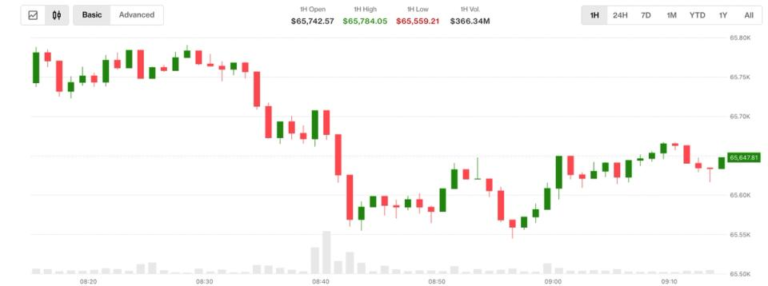
Bitcoin (BTC) fell toward $58,000 around Tuesday’s Wall Street open as the clock ticked down to a brutal quarterly close.

Key points:

  • US stocks’ Q2 gains leave Bitcoin far behind as bulls nurse losses of nearly 20%.
  • Bitcoin faces renewed pressure from the risk of Japanese government moves to support the yen.
  • BTC price weakness is forcing capitulation by top buyers, says analysis.

Bitcoin “about to get spicy” amid 40-year dollar/yen high

Data from TradingView showed downside gaining the upper hand as volatility increased into the US session.

BTC/USD one-hour chart. Source: Cointelegraph/TradingView

With $60,000 increasingly looking lost as support, commentators saw the tussle between bulls and bears continuing on short time frames.

“Open Interest pumping, noticed some large longs entering on this dip, it’s about to get spicy,” commentator Exitpump wrote in fresh analysis on X.

BTC/USD order-book data. Source: Exitpump/X

Trader Killa eyed a repeat of weekly price patterns, in which Mondays formed the swing low or high of the following week.

“$BTC Keeps consolidating in this price range. Marginally higher lows and equal highs,” trader Daan Crypto Trades continued

“Look out for whichever direction breaks first, I think a quick move should follow after that seeing how compressed this is becoming.”

BTC/USDT perpetual contract one-hour chart. Source: Daan Crypto Trades/X

Bitcoin thus reinforced its divergence from US stocks with total Q2 losses nearing 20%.

By contrast, trading resource The Kobeissi Letter noted the S&P 500 was up 14% over the quarter, marking its best performance since 2020.

“This would mark the 2nd-largest quarterly gain since the 2008 Financial Crisis recovery,” it added in an X post alongside data from Bloomberg. 

“At the same time, the Nasdaq 100 is up +25%, on track for its strongest quarter in 5 years. This would also mark the Nasdaq 100’s 2nd-best quarterly performance in 25 years.”

US stocks performance comparison. Source: The Kobeissi Letter/X

Kobeissi described an “accelerating” global stocks rally, with the US providing the impetus. 

In a potential headwind for crypto, the US dollar hit new multidecade highs against the Japanese yen, increasing the odds of government intervention.

USD/JPY reached 162.50 on the day, its highest since the mid 1980s.

USD/JPY 12-month chart. Source: Cointelegraph/TradingView

“Whether it’s Japan, India, South Korea or MSTR, It’s the same problem,” analyst and YouTube personality George Gammon summarized to X followers on the day. 

“You’ve got dollar liabilities and not enough dollars. So you sell assets to get dollars putting downward pressure on the asset. Yen, Rupees, Won, or Bitcoin.”

Bitcoin hodlers “appear to be cutting losses”

In new research, onchain analytics platform CryptoQuant warned of a fresh round of Bitcoin investor “capitulation.”

Related: BTC price RSI prints key 2026 signal: Five things to know in Bitcoin this week

At sub-$70,000 levels, contributor Crypto Sunmoon warned that those who had bought BTC around all-time highs were now selling at a loss.

“Since the break below $70K, exchange inflows have risen sharply, with the majority of this volume consisting of coins held for roughly six to twelve months, coins most likely accumulated near the cycle highs,” they wrote in a Quicktake blog post. 

“This pattern is consistent with capitulation among cycle-top buyers, as holders appear to be cutting losses rather than continuing to hold through the drawdown.”

Source: CryptoQuant

CryptoQuant data showed onchain movements increasingly involving coins that last moved around all-time highs, along with increasing inflows to exchanges.

“For some, this will be a painful stretch. That said, capitulation events of this kind among cycle-top investors have historically coincided with long-term bottom formation, a pattern observed in both the 2018 and 2022 cycles,” Crypto Sunmoon added.