Interactive Brokers has launched crypto trading for eligible retail investors across the European Economic Area, extending its digital asset offering through Interactive Brokers Ireland Limited, an authorized crypto-asset service provider.
The rollout gives users access to 11 digital assets, including Bitcoin, alongside equities, options, futures, currencies, bonds, and mutual funds within a single account interface.
The offering is enabled through an integration with Zero Hash, which provides backend crypto and stablecoin infrastructure for institutional platforms. The partnership expands an existing relationship between the two firms and opens access to a market of roughly 450 million people across the EEA.
Clients can trade these assets across Interactive Brokers’ platform suite, including Trader Workstation, IBKR Desktop, Client Portal, IBKR Mobile, and IBKR GlobalTrader.
The company said the integration allows investors to manage digital assets and traditional securities in one place. The platform provides a unified portfolio view and shared infrastructure for execution, risk monitoring, and capital allocation.
“Our clients want the flexibility to diversify into crypto-assets while maintaining the tools, pricing, and trust they rely on,” said CEO Milan Galik. He added that combining asset classes within one platform supports more efficient management of liquidity and portfolio exposure.
Interactive Brokers set commission rates between 0.12% and 0.18% of trade value. The firm said the service avoids spreads, markups, and custody fees, while allowing limit orders for price control. Crypto markets on the platform operate on a continuous basis, reflecting the 24/7 structure of digital asset trading.
Growing bitcoin offerings in Europe
The EEA expansion builds on existing crypto offerings in other regions. Interactive Brokers already provides digital asset trading in the United States through its domestic entity and in the United Kingdom through Interactive Brokers (U.K.) Limited.
The latest rollout marks a continuation of the firm’s effort to integrate crypto within its global brokerage framework.
The move comes as European regulators implement new digital asset rules that formalize licensing requirements for crypto service providers. By operating through its Irish affiliate, Interactive Brokers aligns its offering with regional regulatory standards while expanding product access for retail clients.
The firm said the launch addresses demand from investors seeking exposure to crypto markets without relying on separate exchanges or wallets. By consolidating asset classes under one platform, Interactive Brokers positions its brokerage model as a bridge between traditional finance and digital assets.
Tehran’s call for a guaranteed ceasefire to end the conflict has increased the odds for a ceasefire by April 7 to 8.5% YES, up from 8% yesterday. The chance of the Iranian regime falling by June 30 has dropped to 10.5% YES, down from 14%.
The ceasefire market saw minor shifts, with most activity in longer-term sub-markets. April 30 rose to 39.5% YES, suggesting traders expect diplomatic progress later in the month. April 15 increased to 19.5% YES. The largest odds jump is between April 15 and April 30, indicating a potential mid-April catalyst.
In the regime fall market, odds for a June 30 collapse decreased. Tehran’s negotiation stance suggests the regime remains stable enough for diplomacy, lowering the chance of an imminent collapse. The June 30 market is at 10.5% YES, showing traders’ doubts about immediate regime change.
USDC traded in the ceasefire markets reached $1,378,713 in the past 24 hours. The largest move was a 4-point spike in the April 30 market, likely due to diplomatic discussions. With $32,218 needed to shift the April 7 market by 5 points, it’s resistant to small trades but open to larger strategic changes.
Tehran’s ceasefire demand hints at a diplomatic breakthrough, but without concrete steps, it remains speculative. At 8¢, a YES share for a ceasefire by April 7 pays $1 if it resolves — a 12.5x return. This bet requires belief in an imminent formal announcement within six days.
Watch for involvement from Oman or Qatar as intermediaries, and statements from CENTCOM or the UN Secretary General, which could indicate real progress toward a resolution.
Markets Impacted
Get prediction market intelligence as a structured API feed. Early access waitlist.
Disclosure: This article was edited by Estefano Gomez. For more information on how we create and review content, see our Editorial Policy.
Despite record investment in cybersecurity, Canadian organizations are experiencing a “security maturity illusion,” creating vulnerability to attacks.
CDW Canada,a leading provider of technology solutions and services for Canadian organizations, today released its annual Canadian Cybersecurity Study, Navigating Ransomware, Modern Architectures and the Maturity Paradox, which explores the evolving state of cybersecurity among Canadian organizations. The study, sponsored by CDW Canada, conducted and analyzed independently by IDC Canada, surveyed over 700 IT security, risk and compliance professionals.
The findings reveal a clear shift in Canada’s threat landscape. As AI capabilities advance, cybercriminals are becoming more targeted and strategic in their approach. Enterprise organizations saw the sharpest increase in cyber incidents, signaling a shift, by bad actors, away from high-volume simple attacks, toward more complex environments with higher financial rewards.
AI, higher returns driving attacks
Over the past few years, adoption and experimentation with AI tools have introduced new efficiencies, not only for businesses but also for attackers. AI-enabled tactics are allowing cybercriminals to scale attacks faster and with greater precision.
The result is a surge in enterprise attacks, with average incidents per enterprise climbing from 191 to 342 year-over-year, and more than half (52 percent) of enterprise organizations reporting suffering a breach. Additionally, infiltration-based incidents grew, signaling deeper access into systems rather than surface-level disruption.
“The rapid evolution of cyberthreats and the clear pivot toward high-value enterprise environments signal a more calculated and strategic attacker mindset,” said Ivo Wiens, Field Chief Technology Officer, Cybersecurity at CDW Canada. “At this stage, bridging these gaps is imperative and organizations need partners with a proven understanding of the modern threat landscape.”
Unfortunately, despite improvement in cyber incident detection, enterprise organizations continue to suffer dozens of successful breaches each year. The study revealed gaps in the defence frameworks of Canadian organizations that are often targeted the most.
Cloud remains the biggest threat for large Canadian organizations
As organizations continue expanding their cloud environments, misconfigurations and identity management gaps are exposing critical systems and posing immediate security risks.
In 2026, enterprise cloud infection rates reached the highest level ever recorded in the study’s history, indicating a widening gap between cloud adoption and the maturity of cloud security practices. While cloud incidents declined among smaller organizations, enterprise cloud-related incidents increased year over year, highlighting how larger, more complex environments are becoming increasingly vulnerable.
Most importantly, many cloud security failures stem not from technology shortcomings but from how cloud environments are configured and maintained. This creates weakness and challenges the defence framework, increasing the impact when incidents occur and causing broader disruption, business impact and longer downtime. Average enterprise cloud downtime increased from 16 days to 20 days per incident, making cloud breaches one of the most disruptive incident types.
Larger investments lead to potential false sense of security
While Canadian organizations invest in modern cybersecurity tools, the gaps in people, identity and supplier security are often overlooked. The study reports that security spending reached a five-year high, with 20 percent of IT budgets now dedicated to security and 57 percent of organizations report security funding as good or readily available. Despite this progress, most organizations in Canada still lack strong, consistent practices to manage internal risks related to employees and contractors, which can turn these easily manageable events into severe business disruptions.
To contain impact, recover quickly and maintain trust, organizations must ensure their security frameworks are cohesive and strategically aligned. Without this, even minor vulnerabilities can destabilize the organization.
“Canadian organizations are investing more than ever in cybersecurity, but spending alone doesn’t equal security,” said Ben Boi-Doku, Chief Cybersecurity Strategist at CDW Canada. “By setting clear expectations for AI deployment, Canadian organizations are taking an important step toward managing risk, strengthening business continuity and preserving trust in an increasingly complex threat environment.”
A cautious approach towards AI
As AI adoption accelerates, Canadian organizations are taking a more deliberate approach to its deployment. Today, AI model monitoring, auditing and assurance tools were identified as a priority by 51 percent of organizations in Canada, highlighting that AI adoption is driving new security spending.
The responsible use of AI is a huge factor in mitigating risks; nearly half (45 percent) of organizations chose identity and access security for AI workloads, underscoring concerns around misuse and unauthorized access.
Organizations are also setting clear expectations for AI adoption. More than half (56 percent) require proven accuracy and lower false positive rates before deploying AI systems, while 51 percent expect transparency in how AI models make decisions. Additionally, 45 percent of organizations emphasize the need for traceability and auditability of AI-driven actions to ensure alignment with compliance and risk frameworks.
By Omkar Godbole (All times ET unless indicated otherwise)
As the new quarter gets underway, the crypto market is sending a subtle but important signal: traders seem a bit more cautious about bitcoin BTC$68,322.40 than ether (ETH).
You can see this in the options market, where more experienced traders and institutions go to hedge risk or generate extra returns. Think of options as a kind of insurance. Traders can buy protection against price drops (puts) or bet on price increases (calls), depending on their outlook.
Right now, one key metric, called a risk reversal, is negative for both bitcoin and ether across different time frames. In simple terms, that means puts, or downside protection, is more expensive than bullish bets. When traders are willing to pay more for put options, it usually signals lingering fears of a price drop. That’s perfectly normal, considering the brutal downtrend in bitcoin and ether since October.
But here’s where it gets interesting: that caution is stronger for bitcoin. Put options on bitcoin are more expensive than those on ether across all time frames, suggesting traders are more worried about BTC’s downside risk.
The difference becomes even clearer when zooming further out. Longer-dated ether options, such as those expiring next March, are only slightly bearish, while bitcoin’s equivalent options carry a much steeper premium for downside protection.
In short, the market is betting that ether will be relatively resilient. That would signal a bullish trend change in the ether-to-bitcoin ratio, which has been in a downtrend since August (see the technical analysis section).
Ether has risen 5% over the past 24 hours, outpacing bitcoin BTC$68,322.40, XRP (XRP), solana (SOL), and the CoinDesk 20 Index. Several smaller tokens associated with quantum-computing-resistant technology have rallied by 20% or more.
Analysts said a firm breakout in BTC above its 50-day moving average of $68,680 will likely strengthen the bullish momentum.
In traditional markets, the 10-year U.S. Treasury yield fell for the fourth straight day while futures tied to the Nasdaq and S&P 500 rose nearly 0.5%. Together, these things point to risk-on sentiment ahead. Stay alert
Read more: For analysis of today’s activity in altcoins and derivatives, see Crypto Markets Today
What to Watch
For a more comprehensive list of events this week, see CoinDesk’s “Crypto Week Ahead”.
Crypto
Macro
April 1, 8:15 a.m.: U.S. ADP Employment Change for March (Prev. 63K)
April 1, 10:00 a.m.: U.S. ISM Manufacturing PMI for March (Prev. 52.4)
Earnings (Estimates based on FactSet data)
Token Events
For a more comprehensive list of events this week, see CoinDesk’s “Crypto Week Ahead”.
Governance votes & calls
April 1: HTX to host a live X Spaces session with World Mobile.
April 1: KuCoin to host a live X Spaces session with Katana.
Unlocks
April 1: SUI$0.8938 to unlock 1.10% of its circulating supply worth $38.29 million.
Token Launches
April 1: Orexn (OXN) enters a phased exchange listing period after the token generation event.
Conferences
For a more comprehensive list of events this week, see CoinDesk’s “Crypto Week Ahead”.
Market Movements
BTC is up 0.61% from 4 p.m. ET Wednesday at $68,622.64 (24hrs: +3.34%)
ETH is up 1.47% at $2,136.90(24hrs: +5.27%)
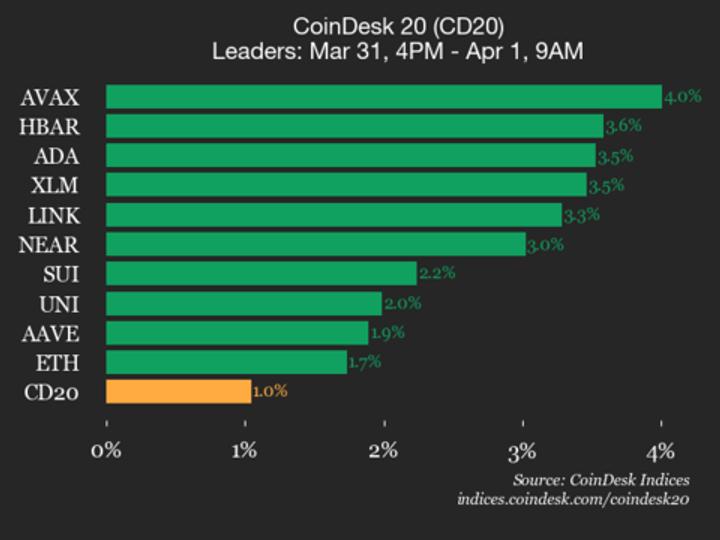
CoinDesk 20 is up 0.62% at 1,968.28 (24hrs: +3.62%)
Ether CESR Composite Staking Rate is unchanged at 2.76%
BTC funding rate is at 0.0033% (3.5193% annualized) on Binance
CD20, April 1 2026 (CoinDesk)
DXY is down 0.37% at 99.59
Gold futures are up 1.5% at $4,748.80
Silver futures are down 0.69% at $74.40
Nikkei 225 closed up 5.24% at 53,739.68
Hang Seng closed up 2.04% at 25,294.03
FTSE is up 1.63% at 10,342.45
Euro Stoxx 50 is up 1.75% at 5,667.09
DJIA closed on Tuesday up 2.49% at 46,341.51
S&P 500 closed up 2.91% at 6,528.52
Nasdaq Composite closed up 3.83% at 21,590.63
S&P/TSX Composite closed up 2.61% at 32,768.04
S&P 40 Latin America closed up 4.26% at 3,623.86
U.S. 10-Year Treasury rate is down 3.2 bps at 4.279%
E-mini S&P 500 futures are up 0.33% at 6,592.25
E-mini Nasdaq-100 futures are up 0.48% at 24,030.25
E-mini Dow Jones Industrial Average Index futures are up 0.36% at 46,750.00
Bitcoin Stats
BTC Dominance: 58.72% (-0.04%)
Ether-bitcoin ratio: 0.03111 (0.89%)
Hashrate (seven-day moving average): 1,004 EH/s
Hashprice (spot): $32.37
Total fees: 2.47 BTC / $166,441
CME Futures Open Interest:104,900 BTC
BTC priced in gold: 14.5 oz.
BTC vs gold market cap: 4.58%
Technical Analysis
The ether-bitcoin ratio is stuck in a prolonged downtrend. (TradingView)
The chart shows daily swings in the ether-bitcoin ratio in the candlestick format.
The ratio has been trending lower since August, showcasing ether underperformance relative to bitcoin. This downtrend is represented by the yellow line that connects the steady decline over seven months.
The outlook would flip bullish if the ratio rises past this trendline. Such a move would confirm renewed investor preference for ether, as suggested by the options market.
Crypto Equities
Coinbase Global (COIN): closed on Tuesday at $174.61 (+8.60%), +1.80% at $177.75 in pre-market
Circle Internet (CRCL): closed at $95.41 (+6.12%), +2.69% at $97.98
Galaxy Digital (GLXY): closed at $18.45 (+7.58%), +1.94% at $18.81
Bullish (BLSH): closed at $35.73 (+7.39%), +0.95% at $36.07
MARA Holdings (MARA): closed at $8.16 (+4.62%), +1.35% at $8.27
Riot Platforms (RIOT): closed at $12.36 (+4.48%), +2.35% at $12.65
Core Scientific (CORZ): closed at $14.96 (+7.55%), -0.40% at $14.90
CleanSpark (CLSK): closed at $8.51 (+4.03%), +2.12% at $8.69
CoinShares Valkyrie Bitcoin Miners ETF (WGMI): closed at $34.82 (+7.70%), +1.81% at $35.45
Exodus Movement (EXOD): closed at $6.50 (+4.84%), -0.92% at $6.44
Crypto Treasury Companies
Strategy (MSTR): closed at $124.80 (+2.77%), +1.48% at $126.65
Strive (ASST): closed at $10.02 (+6.94%), +1.90% at $10.21
SharpLink Gaming (SBET): closed at $6.45 (+7.32%), +2.02% at $6.58
Upexi (UPXI): closed at $0.99 (+3.90%), +6.49% at $1.05
Lite Strategy (LITS): closed at $1.16 (+11.54%)
ETF Flows
Spot BTC ETFs
Daily net flow: $117.5 million
Cumulative net flows: $56.09 billion
Total BTC holdings ~ 1.29 million
Spot ETH ETFs
Daily net flow: $31.2 million
Cumulative net flows: $11.59 billion
Total ETH holdings ~ 5.70 million
Source: Farside Investors
While You Were Sleeping
Trump says Iran war could end in ‘two weeks’, with or without deal (euronews): Trump, who will address the nation Wednesday night, said the war in Iran could end in two to three weeks. However, Israeli Prime Minister Benjamin Netanyahu said its war on Tehran will continue.
Iran fires missiles across Middle East as Trump signals exit (Bloomberg): Iran fired missiles across the Middle East while Israel and the U.S. kept up their bombardment of the Islamic Republic, even as Trump fueled market optimism by signaling he’s preparing to end the war.
UAE wants to force Hormuz open and is willing to join the fight (The Wall Street Journal): The UAE is preparing to help the U.S. and other allies open the Strait of Hormuz by force, Arab officials said, a move that would make it the first Persian Gulf country to join the war.
Crypto asset manager CoinShares to list on Nasdaq after $1.2 billion SPAC deal (CoinDesk): CoinShares, a leading European digital asset manager with over $6 billion under management, is set to begin trading on the Nasdaq Stock Market under the ticker symbol CSHR.
The US Department of the Treasury issued a notice of proposed rulemaking (NPRM) on Wednesday and is seeking public comment on proposed regulations for state-level stablecoin governance frameworks under the GENIUS Act.
The GENIUS stablecoin regulatory framework, also known as the “Guiding and Establishing National Innovation for US Stablecoins Act,” gives states the authority to regulate stablecoins with a market cap of less than $10 billion, as long as the regulations do not deviate significantly from federal policies.
The Treasury outlined several non-negotiable stablecoin regulations that must be in line with Federal regulations, including a 1:1 reserve backing with cash or high-quality cash equivalents and monthly reporting requirements.
The NPRM published by the US Treasury Department. Source: US Department of the Treasury
States must also comply fully with federal anti-money laundering and sanctions policies for stablecoins, while upholding bans on token rehypothication, or using the same asset to support multiple claims.
Under the proposal, states are allowed to impose their own liquidity, reserve, risk management, regulatory procedures, enforcement and administrative rules, as long as the rules impose higher financial thresholds or are more restrictive than the federal regulations.
“State-level regulatory regimes must lead to regulatory outcomes that are at least as stringent and protective as the Federal regulatory framework,” the proposal said.
The public must submit comments within 60 days of the NPRM announcement. Once a stablecoin issuer passes the $10 billion threshold, it will automatically be under the regulatory jurisdiction of the federal government, meaning the largest stablecoin issuers will be regulated exclusively at the federal level.
Related: FSB flags dollar stablecoins as bigger risk for emerging markets in annual report
GENIUS Act becomes law, but uncertainty remains over yield-bearing stablecoins
US President Donald Trump signed the GENIUS Act into law in July, which was considered a landmark moment for crypto regulations.
Despite the landmark regulations, uncertainty about yield-bearing stablecoins and whether stablecoin issuers can share interest with token holders has stalled the CLARITY crypto market structure bill in Congress.
Some crypto companies, led by Coinbase, argue that yield-bearing stablecoins provide savers with a competitive alternative to traditional savings accounts, which typically have interest rates far below 1%.
The banking lobby continues to oppose yield-bearing stablecoins over fears that the tokens will cause deposit flight and erode the sector’s market share.
Magazine: GENIUS Act reopens the door for a Meta stablecoin, but will it work?
Cointelegraph is committed to independent, transparent journalism. This news article is produced in accordance with Cointelegraph’s Editorial Policy and aims to provide accurate and timely information. Readers are encouraged to verify information independently. Read our Editorial Policy https://cointelegraph.com/editorial-policy
Drift Protocol said it was investigating unusual activity on April 1 and urged users not to deposit funds, according to a post on X.
Drift Protocol is experiencing an active attack. Deposits and withdrawals have been suspended. We are coordinating with multiple security firms, bridges, and exchanges to contain the incident. This is not an April Fools joke. We’ll provide additional updates from this account as… https://t.co/03SRPq4fHj
In a later update, the Solana-based perpetuals platform said it was experiencing an active attack and had suspended deposits and withdrawals while it coordinated with security firms, bridges, and exchanges to contain the incident.
The protocol did not attach a loss figure to the incident in its public statements, but blockchain tracking accounts quickly began describing it as a possible nine-figure exploit.
Drift Protocol appears to have been exploited, with over $270M in assets suspiciously transferred to wallet HkGz4K. 🚨
One widely cited estimate came from Lookonchain, which said Drift appeared to have been exploited and that more than $270 million in assets had been transferred to a wallet beginning with HkGz4K.
Story in development.
Disclosure: This article was edited by Estefano Gomez. For more information on how we create and review content, see our Editorial Policy.
EDX Markets, an institutional crypto exchange, has applied to the US Office of the Comptroller of the Currency (OCC) to establish a national trust bank that would provide crypto custody, asset management and trade-settlement services.
The proposed entity, EDX Trust, would operate as a non-depository national bank, separating custody and settlement from trading while continuing to route order matching through EDX’s existing platform.
In its application, the company said the model is intended to address structural risks in crypto markets, where trading, custody and brokerage are often combined within a single platform, creating potential conflicts of interest and single points of failure.
EDX said the trust bank would provide fiduciary asset management services, invest client cash and stablecoin balances in highly liquid assets, and facilitate trading through a riskless principal model with end-of-day net settlement.
The bank would operate online from Chicago and target institutional clients such as broker-dealers, futures commission merchants and registered investment advisers, according to the filing.
EDX said moving these functions into an OCC-chartered entity would allow it to offer services nationwide under a single regulatory framework while meeting custody requirements for regulated institutions.
Founded in 2022, EDX Markets is backed by traditional market participants including Citadel Securities, Virtu Financial, Fidelity Digital Assets and Hudson River Trading.
EDX Markets Holding Company trust bank application for digital asset activities. Source: OCC
Related: Fed’s Barr backs stablecoin clarity but warns of run risks
Crypto companies seek US bank charters
The application comes as crypto and financial companies increasingly pursue national trust bank charters to expand institutional services under federal oversight.
Earlier this month, Zerohash, a blockchain infrastructure company, applied for a US national trust bank charter to expand its stablecoin and custody services for banks, brokerages and fintechs.
Source: Zerohash
Other recent applicants include Coinbase, which applied in October and is still awaiting a decision, as well as Laser Digital and Payoneer, which filed applications earlier this year to expand custody and stablecoin-related payment services.
Traditional financial institutions are also entering the space. In February, Morgan Stanley applied for a de novo trust bank charter to support digital asset services through a separate entity.
At the same time, the OCC has continued approving applicants, issuing conditional licenses last month to Bridge, Stripe and Crypto.com, following approvals in December for Ripple Labs, Circle Internet Group, Fidelity Digital Assets, Paxos and BitGo.
However, the pace of approvals has drawn scrutiny. In February, the American Bankers Association urged the OCC to slow the process, citing unresolved oversight under pending US stablecoin legislation.
Magazine: A newbie’s guide to surviving crypto winter
Cointelegraph is committed to independent, transparent journalism. This news article is produced in accordance with Cointelegraph’s Editorial Policy and aims to provide accurate and timely information. Readers are encouraged to verify information independently. Read our Editorial Policy https://cointelegraph.com/editorial-policy
Trusted Editorial content, reviewed by leading industry experts and seasoned editors. Ad Disclosure
Australia has passed its first comprehensive digital-asset framework, locking in a licensing regime for crypto platforms and custodians under the existing financial‑services law.
A New Comprehensive Crypto Framework
The Corporations Amendment (Digital Assets Framework) Bill 2025 that passed just today has one key requirement. Now, most centralized exchanges and tokenized custody platforms that hold client assets must obtain an Australian Financial Services Licence (AFSL), coming under ASIC’s full oversight on custody, disclosure, governance, and risk management.
Rather than policing individual crypto assets, the law zeroes in on the intermediaries that hold costumers’ funds, seeking to curb risks such as fund mixing, bankruptcies, and asset abuse that have fueled past crypto blowups.
The law doesn’t just cover spot trading. It carves out two fresh classes of regulated firms: DigitalAssetPlatforms (DAPs) and tokenized custody platforms (TCPs). The legislations subjects them both to the same fundamental rulebook that governs brokers and asset managers. This is key for real‑world asset tokenization and institutional products.
According to the bill itself, businesses will have 18 months to comply with the new licensing and operational standards. The only exemptions are for very small providers with low annual transaction volumes. It is worth noting that this 18-month shift could create temporary friction in on‑ramps, liquidity fragmentation, and higher spreads as platforms rework banking relationships and risk controls.
What This Means For The Market
Bringing exchanges and tokenization providers fully under the Corporations Act could finally give TradFi the legal certainty it has been waiting for. With these businesses operating under the same familiar framework that governs traditional securities and managed funds, banks, pension funds, and asset managers gain clearer lines of accountability, standardized disclosures, and enforceable investor protections. That clarity lowers reputational and compliance risk for institutions that have been reluctant to touch digital assets, potentially opening the door to new products, deeper liquidity, and more direct participation in tokenization and crypto markets.
The new legislation, introduced and read for the first time at the ending of November 2025, could unlock up to A$24 billion a year in productivity and efficiencies across the financial sector if tokenization and digital asset infrastructure scale, government‑backed estimates. The now passed bill positions Australia as one of the most proactive jurisdictions in the global race for crypto regulation. This new more EU‑style, MiCA‑like regime competes with hubs such as Singapore and Hong Kong in the race to host compliant digital asset platforms.
Short term, it is safe to expect the possible delistings of niche tokens, tighter onboarding and KYC, and periodic volatility as local liquidity migrates toward fully licensed venues. Medium term, we could see deeper order books on fewer, heavily supervised platforms, more institutional flow, growing tokenization plays, and a clearer split between “regulatory premium” assets and unloved, hard‑to‑list tokens
If the framework lands well, Australia could become a regulated gateway for Asia‑Pacific crypto capital.
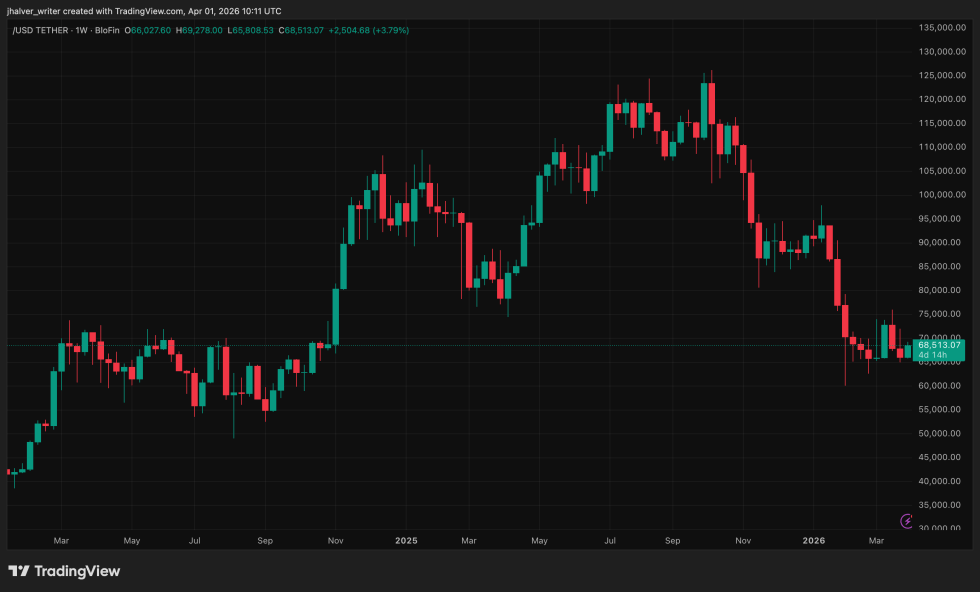
At the moment of writing, BTC trades for $68k. Source: BTCUSDT on Tradingview
Cover image from Perplexity, BTCUSDT chart from Tradingview
Editorial Process for bitcoinist is centered on delivering thoroughly researched, accurate, and unbiased content. We uphold strict sourcing standards, and each page undergoes diligent review by our team of top technology experts and seasoned editors. This process ensures the integrity, relevance, and value of our content for our readers.
Buyers will have to sustain Bitcoin above $69,000 to gain the upper hand in the short term.
Select major altcoins may break above their near-term resistance, signaling buying at lower levels.
Bitcoin (BTC) is facing resistance at $69,000, but the bulls continue to exert pressure. A minor positive in favor of the bulls is that the US spot BTC exchange-traded funds have recorded $186.9 million in inflows this week, according to Farside Investors data.
Is this a good level to buy BTC, or could it fall further? That’s a question troubling investors. Alphractal founder Joao Wedson said in a post on X that BTC’s previous market cycles suggest a historical bottom may form “in late September or early October 2026.”
Crypto market data daily view. Source: TradingView
Veteran trader Peter Brandt also believes that BTC could bottom in September or October. Brandt told Cointelegraph that a complete recovery to a new all-time high may happen only by the second quarter of 2027 but he added that it “is all guesswork.”
Could BTC and select major altcoins rise above their overhead resistance levels? Let’s analyze the charts of the top 10 cryptocurrencies to find out.
Bitcoin price prediction
Buyers are attempting to sustain BTC above the moving averages, indicating solid buying at lower levels.
If they succeed, the BTC/USDT pair may remain inside the bullish ascending triangle pattern. Buyers will have to thrust the BTC price above the $76,000 level to seize control. The pair may then surge to the $84,000 level.
This positive view will be negated in the near term if the BTC price turns down and breaks below the $65,000 level. That will invalidate the positive setup, resulting in long liquidation. The pair may then tumble to the $62,500 to $60,000 support zone.
Ether price prediction
Ether (ETH) closed above the 20-day exponential moving average ($2,085) on Tuesday, and the bulls are attempting to push the price to the $2,200 overhead resistance.
If buyers overcome the barrier at $2,200, the ETH/USDT pair is expected to pick up momentum and rise to $2,400. Sellers will attempt to vigorously defend the $2,400 level, as a close above it opens the gates for a rally to the $3,050 level.
Time is running out for the bears. They will have to quickly pull the price below the $1,916 level to stay in the game. If they do that, the ETH price may plummet to the critical $1,750 support.
BNB price prediction
Buyers are attempting to push BNB (BNB) above the moving averages, but the bears have held their ground.
Sellers will strive to pull the BNB price below the immediate support at $596. If they manage to do that, the BNB/USDT pair may slip to the vital support at $570. Buyers are expected to defend the $570 level with all their might, as a close below it signals the resumption of the downtrend. The next stop on the downside may be $500.
Alternatively, a close above the moving averages may push the price to the stiff overhead resistance of $687. A close above the $687 level will be the first sign of strength. The pair may then march to $730 and thereafter to $790.
XRP price prediction
XRP (XRP) is trying to form a base near the $1.29 level, but the bulls are struggling to push and maintain the price above the moving averages.
That suggests the bears have kept up the pressure. If the XRP price turns down and breaks below the $1.27 level, it signals that bears have overpowered the bulls. The XRP/USDT pair may then decline to the $1.11 level.
On the contrary, a break above the moving averages indicates that the bulls are back in the game. The pair may rise to the breakdown level of $1.61 and then to the downtrend line. A close above the downtrend line signals a potential trend change.
Solana price prediction
Solana (SOL) is attempting to form a floor at the $76 level, but the relief rally is facing stiff resistance at the moving averages.
The flattish moving averages and the relative strength index just below the midpoint do not give a clear advantage either to the bulls or the bears. If the price breaks above the moving averages, the bulls will endeavor to push the SOL/USDT pair above the $95 resistance. If they succeed, the rally may extend to the $117 level.
Contrarily, if the SOL price turns down sharply from the $95 level, it suggests that the range-bound action may continue for a while. Sellers will be back in command on a close below the $76 level.
Dogecoin price prediction
Dogecoin (DOGE) remains stuck between the moving averages and the critical $0.09 support, but the tight range trading is unlikely to continue for long.
If buyers thrust the DOGE price above the moving averages, the relief rally may reach $0.10 and then the $0.12 resistance. Sellers are expected to fiercely defend the $0.12 level. If the price turns down from the overhead resistance, the DOGE/USDT pair may consolidate between $0.09 and $0.12 for a few more days.
Sellers will seize control on a close below the $0.09 level. The pair may then sink to the Feb. 6 low of $0.08 and eventually to the $0.06 level.
Hyperliquid price prediction
Hyperliquid (HYPE) fell below the breakout level of $36.77 on Tuesday, but the bears are struggling to sustain the lower levels.
The bulls are attempting to make a comeback by swiftly pushing the HYPE price back above the 20-day EMA ($37.57). If they can pull it off, the HYPE/USDT pair may rise to $41.59 and subsequently to the $43.76 level. Sellers will attempt to halt the up move at $43.76, but if the bulls prevail, the pair may climb to $50.
This positive view will be invalidated in the near term if the price turns down and breaks below the 50-day simple moving average ($33.97). That suggests the market has rejected the break above the $36.77 level.
Related: Strategy set to resume buying Bitcoin via STRC: Will BTC price hit $80K?
Cardano price prediction
Cardano (ADA) is facing resistance at the $0.25 level, but a positive sign is that the bulls have not ceded ground to the bears.
Buyers will attempt to overcome the barrier at the moving averages. If they do that, the ADA/USDT pair may reach the downtrend line, which is a crucial resistance to watch out for. A close above the downtrend line signals a potential short-term trend change.
Sellers are likely to have other plans. They will attempt to defend the moving averages and pull the ADA price below the $0.23 level. If that happens, the pair may slide to the Feb. 6 low of $0.22.
Bitcoin Cash price prediction
Bitcoin Cash (BCH) has been trading between the 50-day SMA ($485) and the $443 support for the past few days.
The failure of the bulls to clear the 50-day SMA suggests that the bears are active at higher levels. Sellers will attempt to strengthen their position by pulling the BCH price below the $443 level. If they manage to do that, the BCH/USDT pair will complete a bearish head-and-shoulders pattern. That opens the doors for a drop to the $375 level.
Instead, if buyers drive the price above the 50-day SMA, it signals demand at lower levels. The pair may then ascend to the $520 to $540 zone.
Chainlink price prediction
Chainlink (LINK) is facing resistance at the moving averages, but a positive sign is that the bulls have kept up the pressure.
That improves the prospects of a close above the moving averages. If that happens, the LINK price may rally toward the $10 level. Sellers will attempt to defend the $10 level and keep the LINK/USDT pair range-bound for some more time.
The next trending move is expected to begin on a close above $10 or below $8. If buyers pierce the $10 level, the pair may rise to $10.94 and later to the $11.61 level. Alternatively, a drop below the $8 support may sink the price to $7.15 and then to $6.
This article does not contain investment advice or recommendations. Every investment and trading move involves risk, and readers should conduct their own research when making a decision. While we strive to provide accurate and timely information, Cointelegraph does not guarantee the accuracy, completeness, or reliability of any information in this article. This article may contain forward-looking statements that are subject to risks and uncertainties. Cointelegraph will not be liable for any loss or damage arising from your reliance on this information.