Bearish sentiment is rising as Bitcoin options professional traders lose confidence that the $66,000 level will hold for long.
The exit of David Sacks as the Crypto and AI czar and a lack of a clear US Strategic Bitcoin Reserve plan added to investors’ doubts.
Bitcoin (BTC) fell to $65,530 on Friday, an 8% decline from the $71,300 level seen on Thursday. This move wiped out over $210 million in leveraged bullish Bitcoin futures and left most call (buy) options worthless during the $18.6 billion monthly expiry. Traders now anticipate a 53% chance that Bitcoin will stay below $66,000 by April 24.
April 24 Bitcoin option prices at Deribit. Source: Deribit
On Friday, the April 24 Bitcoin $66,000 put (sell) options traded at 0.0566 BTC or roughly $3,730. With a 53% implied probability of Bitcoin trading below $66,000 by late April, the mood remains decidedly bearish following the increased uncertainty in the US and Israel-Iran war, pushing traders into a risk-averse mode.
US inflation threats and stalling crypto, Bitcoin legislation
Rising oil prices and a potential $200 billion in extra US military spending led investors to demand higher returns on government bonds and dragged the S&P 500 to its lowest levels since September 2025. West Texas Intermediate (WTI) oil surged to $100 on Friday, while 5-year Treasury yields reached 4.07%, up from 3.72% three weeks prior.
US 5-year Treasury yield (left) vs. S&P 500 (right). Source: TradingView
Inflationary fear and weaker corporate earnings perspectives alone cannot explain Bitcoin’s 20% underperformance against the S&P 500 in 2026. Other factors are likely at play, including investors’ discomfort over the lack of progress on the US Bitcoin Strategic Reserve.
David Sacks has stepped down from his role as the Trump administration’s crypto and AI czar. While Sacks remains an advisor on the President’s Council on Science & Technology, his departure follows earlier comments that inflated Bitcoin investors’ expectations. Sacks had previously hinted that the US could acquire more Bitcoin through budget-neutral methods without raising taxes.
Related: US lawmakers publish crypto tax proposal without Bitcoin tax exemption
Bitcoin 30-day options delta skew (put-call) at Deribit. Source: Laevitas
The Bitcoin options delta skew jumped to 15% on Friday, showing that put options are trading at a significant premium relative to call instruments. In balanced market conditions, this metric usually ranges between -6% and +6%. The current level indicates a lack of conviction among whales that the $66,000 level will hold. Fear has largely dominated the Bitcoin options market since mid-January.
Friday’s monthly options expiry at $68,610 proved unfavorable for neutral-to-bullish strategies, as 97% of call options became void. Bears gained the upper hand as put options at $69,000 or higher surpassed $2 billion in open interest. Critically, part of Friday’s downward move reflects a growing unwillingness among traders to maintain Bitcoin exposure over the weekend.
Crypto markets cut risk on Friday due to uncertainty. Source: X/WhalePanda
X social platform user WhalePanda, suggested that the crash in risk markets anticipates President Trump making “another dumb escalating move” after US markets close. Consequently, the current fear seen in the options market could reverse if no major geopolitical events occur before Monday.
During bearish cycles, traders often rush for the exits at the mere sight of any event that could be deemed negative. Investors should not take Bitcoin’s implied odds at face value, as these metrics are heavily impacted by recent news and headlines. However, expectations could shift more favorably if Iran effectively releases a counter-offer to the US peace proposal.
This article does not contain investment advice or recommendations. Every investment and trading move involves risk, and readers should conduct their own research when making a decision. While we strive to provide accurate and timely information, Cointelegraph does not guarantee the accuracy, completeness, or reliability of any information in this article. This article may contain forward-looking statements that are subject to risks and uncertainties. Cointelegraph will not be liable for any loss or damage arising from your reliance on this information.
Institutional investors are piling into the asset.
But will it be enough to get the price up to $80,000?
A version of this article appeared in our The Roundup newsletter on March 27. Sign up here.
Hi. Eric here.
Bitcoin has had a raw few months.
After achieving a $126,000 record high in October, a $19 billion wave of liquidations triggered a massive sell-off that saw the cryptocurrency lose roughly half of its total value.
And since February 28 when the US and Israel attacked Iran, the price of Bitcoin has trembled around $70,000.
But despite the downturn and the tsunami of gallows humour flooding social media feeds, investment firms are surprisingly positive about the market conditions.
“We are reluctant to call it a ‘crypto winter’ given how busy we are with prospective investors,” Zach Pandl, head of research at Grayscale, told me. “The current feeling at Grayscale could not be more different than the tone on Crypto Twitter — probably because we can see the institutional capital coming.”
Pandl represents one of the investment firms I spoke to this week that say that institutional investors are revving up to inject money into crypto assets. Indeed, VanEck estimates that institutional investors will pile up to $13 trillion into Bitcoin by 2030.
That wave of investment comes as James Butterfill, head of research at CoinShares, told me that he expects that the price will creep towards $80,000 over the next month or so.
His argument is simple. Whales, which he defines as individuals or entities that own over 10,000 in Bitcoin, started to take profit in October. If previous cycles are anything to go by, sell-offs usually ebb after six months, which would be around April or May this time around.
Once that sell-off ends, the price will go up, Butterfill said.
That’s an optimistic outlook. Punters on Polymarket bet that Bitcoin’s price has a 69% chance of reaching $80,000 in 2026. Conversely, they put the chances of it dropping to $55,000 at 74%.
To be sure, there are plenty of factors threatening to drag down the price.
The conflict in the Middle East still weighs on markets, and has eroded the probability that the Federal Reserve will cut interest rates this side of July. Higher interest rates are usually bad for risk-on assets like cryptocurrencies.
Elsewhere, there’s the upcoming midterms in the US. Republicans seem to be in for an absolute beating, despite the crypto lobby heavily favouring their candidates. If Democrats retake the House, that will likely grind crypto legislation to a halt.
Unless banks, crypto companies, and politicians on Capitol Hill find a way to move forward with the Clarity Act before that, the landmark crypto markets bill is unlikely to get passed before 2028.
Polymarket bettors give the bill a 61% chance of getting passed this year, down from 82% in February.
Still, after almost a month of war, it’s good to see some glimmers of hope.
Bad actors are now using the large language models that power AI chatbots like ChatGPT and Claude to search thousands of lines of code a second. Their goal? Identify vulnerabilities that have slipped by developers and auditors. Check out Tim Craig’s report.
Sam Bankman-Fried, the disgraced co-founder of the defunct FTX crypto exchange, wants to get out of prison. However, he keeps getting in his own way, Aleks Gilbert reports.
After seeing his Ledger co-founder get kidnapped and tortured, Éric Larchevêque is on a mission to arm crypto workers and influencers in France.Tim Alper reports.
Post of the Week
The Clarity Act has been stuck in a legislative limbo for months. The core problem? Whether the law should allow passive yield on stablecoins. The banks say no, crypto says yes and so far no one is budging.
Iran escalation and $171 million in ETF outflows drive BTC below $66,000.
Bitcoin fell to its lowest level in more than two weeks on Friday, dropping below $66,000 as a $14 billion options expiry collided with escalating Middle East tensions and a broader risk-off rout across global markets.
BTC was trading near $65,900 at press time, down roughly 4.5% over the past 24 hours, according to CoinGecko. Ether slipped to $1,983, also off 4%, while Solana tumbled 5.5% to $83. The total crypto market cap fell 3.4% to $2.36 trillion.
BTC Chart
The Crypto Fear & Greed Index sits at 13, deep in “Extreme Fear” territory
Nearly $443 million in long positions were liquidated over the past 24 hours, compared with just $58 million in shorts, according to Coinglass, suggesting traders had been positioned for a rally that has not materialized as the U.S.-Iran conflict entered its 28th day.
Almost all of the Top 100 digital assets posted losses over the last 24 hours.
Ondo Finance bucked the bearish trend, rising more than 8% over 24 hours — though it gave back most of its gains by midday — after announcing a partnership with Franklin Templeton to tokenize five ETFs across growth, large-cap, fixed income, equity income, and gold strategies through Ondo Global Markets.
Worldcoin (WLD) and MORPHO are today’s biggest losers, plunging 10% and 8%, respectively.
Macro Pressure Mounts
The selloff extended across traditional markets. The Nasdaq 100 fell to 23,300, now 10% below its January high. Oil topped $96 per barrel as diplomatic efforts to de-escalate the Iran conflict stalled, fueling inflation fears and pushing back expectations for Federal Reserve rate cuts.
The CME FedWatch tool shows a 96% probability that the Fed will hold rates steady at its next meeting, with 4% of the market now pricing in a 25-basis-point hike, a scenario that was virtually unthinkable a month ago.
U.S. spot Bitcoin ETFs recorded a net outflow of $171 million in a single day, the largest in three weeks, per CoinGlass data. Institutional demand has cooled notably since the Fed’s hawkish March rate decision, with recent days showing mixed, low-conviction flows.
At MoneyLive 2026, we asked the attendees “What Sport or Team Would You Sponsor?” which revealed a fascinating blend of corporate strategy, personal passion, and aspirational brand alignment. The answers ranged from global high-performance giants to deeply personal boyhood football clubs, demonstrating the diverse motivations behind brand investment.
One attendee immediately pointed to Formula One, citing its unique mixture of “high-performance sport and business” as the perfect corporate fit which highlights a strategic view where a sponsorship investment must deliver both widespread excitement and quantifiable commercial value through a premium brand association.
For many others at MoneyLive, however, the choice was clearly driven by heart and lifelong loyalty. Football dominated the personal preferences, with attendees eagerly naming their beloved teams. One declared a desire to sponsor their “very expensive club,” Chelsea, noting that it would be “really really cool” if budget were no object, emphasizing aspiration over practicality. Another lifelong fan, a self-proclaimed “Cockney Reds,” expressed deep loyalty, wishing to support their boyhood team of Manchester United.
The importance of local connection was represented by a supporter of Brentford, who dreams of seeing their company logo on a Premier League shirt, showcasing community pride while another attendee, immersed in a “household of boys who are very much Chelsea fans,” offered a diplomatic nod to “the Blues”.
Beyond men’s football, a strong and clear sentiment for women’s sports emerged. One participant passionately championed the Lionesses (England women’s national football team) or the Red Roses (England women’s national rugby team), or “both”, underscoring the rapidly growing visibility and impactful role of female athletes in modern sports marketing.
Finally, for a touch of classic prestige and tradition, one participant chose Tennis, specifically naming Wimbledon as their ultimate sponsorship target, representing a choice focused on established, global prestige. The responses at MoneyLive collectively illustrate that while strategic business decisions are critical, successful sponsorship often boils down to shared values, brand resonance, and, fundamentally, passion for the game.
Bitcoin’s fall below the $66,000 support heightens the risk of a drop to the $62,500 level.
Select major altcoins have broken below their immediate support levels, opening the gates for further downside.
Bitcoin (BTC) is under pressure from the bears, who are attempting to sustain the price below the $66,000 level. The uncertainty regarding the US and Israel-Iran war is capping the upside and putting downside pressure. US spot Bitcoin exchange-traded funds recorded $171 million in outflows on Thursday, the biggest since the $348 million in redemptions on March 3, according to Farside Investors data.
Although BTC is facing selling on rallies, the bulls have successfully defended the $60,000 level since Feb. 6. Glassnode said in its latest Week On-chain newsletter that the sharp contraction in BTC’s entity-adjusted realized profit from $3 billion per day in July 2025 to $0.1 billion currently suggests that the bear market is transitioning into its later stages.
Crypto market data daily view. Source: TradingView
A positive sign in favor of the bulls is that BTC whales and sharks have continued to accumulate. Santiment said in a post on X that large BTC holders owning between 10 and $10,000 BTC have boosted their holdings by 0.45% in the past month. Historically, an upside breakout happens when large wallets are accumulating, and retail is selling.
Could BTC and select major altcoins hold on to their crucial support levels? Let’s analyze the charts of the top 10 cryptocurrencies to find out.
Bitcoin price prediction
Buyers could not maintain BTC above the $72,000 level on Wednesday. That may have attracted sellers who pulled the price below the support line of the ascending triangle pattern on Friday.
If the BTC price closes below the support line, the bullish pattern will be invalidated. That may intensify selling, pulling the BTC/USDT pair to the $62,500 to $60,000 support zone.
Instead, if the price turns up sharply from the current level and breaks above the $72,000 level, it suggests that the bulls are attempting to get back into the driver’s seat. The pair may then challenge the crucial $74,508 resistance. If buyers overcome the barrier, the pair may surge to $84,000.
Ether price prediction
Ether (ETH) turned down and fell below the breakout level of $2,111 on Thursday, indicating that the bears are trying to make a comeback.
Sellers kept up the pressure and pulled the ETH/USDT pair below the 50-day SMA ($2,044) on Friday. The ETH price may decline to the $1,900 level, which is likely to attract buyers. However, if the bears prevail, the pair may collapse to the vital $1,750 support.
This negative view will be invalidated in the near term if the price turns up sharply and breaks above the $2,200 level. That enhances the prospects of a rally above the $2,400 level.
BNB price prediction
BNB (BNB) has been oscillating between $570 and $687 for the past few weeks, signaling buying near the support and selling close to the resistance.
There is minor support at $607, but if the level gives way, the BNB/USDT pair may slump to the $570 level. A strong bounce off the $570 support suggests that the pair may remain inside the range for a while longer.
The next trending move is expected to begin on a close below $570 or above $687. If buyers clear the overhead hurdle, the BNB price may jump to $790. Alternatively, a close below $570 might sink the pair to the psychological level at $500.
XRP price prediction
XRP (XRP) turned down from the moving averages on Thursday, indicating that the bears remain in control.
The XRP price may slide to $1.32 and then to $1.27. Buyers will attempt to aggressively defend the $1.27 level, but if the bears prevail, the XRP/USDT pair may decline to the support line.
The first sign of strength will be a close above the moving averages. The pair may then rise to the breakdown level of $1.61, which is expected to pose a substantial challenge for the bulls. If buyers pierce the $1.61 level, the next stop is likely to be the downtrend line.
Solana price prediction
Buyers attempted to push Solana (SOL) above the $95 resistance on Wednesday, but the bears held their ground.
The SOL price has dipped below the 50-day SMA ($86), indicating that the bulls have given up. That suggests the SOL/USDT pair may extend its stay inside the $76 to $95 range for some more time.
The next trending move is expected to begin on a break above or below the range. If the bulls propel the price above $95, the pair may reach the $117 level. On the downside, a close below $76 might sink the pair to $67.
Dogecoin price prediction
Dogecoin (DOGE) rose above the moving averages on Wednesday, but the bulls could not sustain the higher levels.
The DOGE price turned down on Thursday, and the bears have pulled the DOGE/USDT pair below the critical $0.09 support. If the sellers sustain the price below $0.09, the pair may collapse to $0.06.
Buyers are unlikely to give up easily. They will attempt to defend the $0.09 level and swiftly push the price above the moving averages. If they succeed, the pair may ascend to $0.10 and later to $0.12.
Hyperliquid price prediction
Hyperliquid (HYPE) turned down from $41.59 on Wednesday but is likely to find support in the zone between the 20-day EMA ($37.64) and the breakout level of $36.77.
If the HYPE price bounces off the $36.77 level, it suggests that the bulls are trying to flip the level into support. Buyers will endeavor to strengthen their position by pushing the HYPE/USDT pair above the $43.77 level. If they can pull it off, the pair may start its northward march toward $50.
Contrary to this assumption, if the price continues lower and breaks below $36.77, it suggests that the bulls are losing their grip. The pair may tumble to the 50-day SMA ($33.34), which is likely to attract buyers.
Related: Ether traders see ‘further decline’ as ETH price slips below $2K
Cardano price prediction
Buyers pushed Cardano (ADA) above the 50-day SMA ($0.27) on Wednesday but could not sustain the higher levels.
The ADA/USDT pair turned down sharply on Thursday, signaling that the bears had renewed their selling. There is strong support at $0.25, but if the level breaks down, the ADA price may slump to $0.22.
This negative view will be invalidated in the near term if the price turns up sharply from the $0.25 level and closes above the moving averages. That clears the path for a rally to the downtrend line.
Bitcoin Cash price prediction
Bitcoin Cash (BCH) fell below the 20-day EMA ($468) on Thursday, indicating that the bears are attempting to retain control.
The BCH/USDT pair may descend to the $443 support, which is a crucial level to watch out for. If the bears sink the BCH price below the $443 level, the pair will complete a bearish head-and-shoulders pattern. That may start a drop to $375.
On the contrary, if the price turns up from the $443 level, it signals solid buying at lower levels. The pair may form a range between $443 and the 50-day SMA ($491) for some time. Buyers will have to push and maintain the price above the 50-day SMA to signal the start of a sustained recovery toward $520.
Chainlink price prediction
Chainlink’s (LINK) rebound fizzled out at $9.50 on Wednesday, indicating that the bears are selling on rallies.
The price turned down sharply on Thursday, and the bears have pulled the LINK/USDT pair below the support line of the ascending channel pattern. If the LINK price closes below the channel, the pair may drop to $8.05 and then to $7.15.
Buyers are likely to have other plans. They will attempt to retain the price inside the channel and push the pair above the $9.50 level. If they do that, the pair may rally to the resistance line.
This article does not contain investment advice or recommendations. Every investment and trading move involves risk, and readers should conduct their own research when making a decision. While we strive to provide accurate and timely information, Cointelegraph does not guarantee the accuracy, completeness, or reliability of any information in this article. This article may contain forward-looking statements that are subject to risks and uncertainties. Cointelegraph will not be liable for any loss or damage arising from your reliance on this information.
AI Tool Integration Just Got Standardized — MCP Downloads Cross 97 Million in March 2026
Anthropic open-sourced MCP on Nov. 25, 2024, alongside reference servers for Google Drive, Slack, Github, and Postgres, with native support built into Claude Desktop. Early adopters included Block and Apollo; IDEs such as Zed, Replit, Codeium, and Sourcegraph began integration within weeks.
The protocol defines how AI models connect to external tools, databases, APIs, and workflows. An MCP host, such as Claude Desktop, ChatGPT, or VS Code Copilot, communicates with an MCP server, a lightweight wrapper around a specific tool or data source. One server can serve every compatible client without per-model custom code.
The official project site describes it as “a USB-C port for AI applications.” That framing captures the practical shift: instead of building separate connectors for each AI platform, developers expose a single MCP server and gain compatibility across Claude, ChatGPT, Gemini, Microsoft Copilot, and any other MCP-compatible client.
OpenAI added full MCP support across ChatGPT and its Agents SDK in March 2025, which analysts have identified as an inflection point in adoption. Google, Microsoft, AWS, and dozens of other platforms followed through mid-2025.
In December 2025, Anthropic donated MCP to the newly formed Agentic AI Foundation (AAIF) under the Linux Foundation. OpenAI and Block joined as co-founders. Platinum members include AWS, Google, Microsoft, Cloudflare, Github, and Bloomberg. The governance structure mirrors that of Kubernetes and Pytorch — vendor-neutral and community-managed.
As of March 2026, more than 10,000 active MCP servers exist across public and enterprise deployments. The combined Python and Typescript SDKs account for the 97 million monthly download figure, up from roughly 100,000 at launch in late 2024. The crypto sector has moved quickly to build MCP infrastructure. Bitgo launched an official MCP server in March 2026, enabling AI tools and development environments to interact with its institutional digital asset custody platform via natural language.
Coinbase released a Payments MCP through its Developer Platform in late 2025, connecting AI agents to crypto wallets, onramps, and stablecoin transactions. Crypto.com released a Market Data MCP server providing live price quotes, order books, and candlestick charts. Coingecko launched its own server supplying real-time data for more than 15,000 cryptocurrencies and 1,000-plus exchanges.
Cross-chain protocol Debridge deployed an MCP server in February 2026, enabling non-custodial swaps and bridging across EVM chains and Solana. Enterprises building internal AI tooling have shifted away from one-off API connectors. Publishing a single MCP server gives a product instant interoperability with every major AI client, a network effect that proprietary integration approaches cannot replicate.
Security researchers have flagged that many public MCP servers have not undergone formal audits. The Linux Foundation stewardship brings standardized authentication and transport requirements, but deployment-level security remains the responsibility of individual server maintainers.
The protocol reached that comparison point in under 18 months. The MCP specification, SDKs, and reference implementations are available at github.com/modelcontextprotocol. The core documentation lives at modelcontextprotocol.io.
FAQ 🤖
What is the Model Context Protocol (MCP)? MCP is an open-source protocol that standardizes how AI applications connect to external tools, databases, and APIs without requiring custom integrations for each model.
How many monthly downloads does the MCP SDK have in 2026? The combined Python and TypeScript MCP SDKs reached approximately 97 million monthly downloads as of March 2026.
Which AI platforms support MCP? Claude, ChatGPT, Gemini, Microsoft Copilot, Cursor, and VS Code Copilot all ship native MCP support as of early 2026.
Which crypto companies have launched MCP servers? BitGo, Coinbase, Crypto.com, CoinGecko, and deBridge have each released official MCP servers connecting AI agents to crypto data and transaction infrastructure.
Intercontinental Exchange has now deployed nearly $2 billion into the onchain prediction market, underscoring Wall Street’s growing conviction that event-based trading is here to stay.
Intercontinental Exchange, the parent company of the New York Stock Exchange, on Friday announced a new $600 million direct cash investment in Polymarket, completing the exchange operator’s structured investment arrangement with the prediction market platform.
The investment is part of a broader equity capital fundraise by Polymarket, according to a press release from ICE. The company also expects to purchase up to $40 million in Polymarket securities from existing holders, which would close out its obligations under the deal first announced in October 2025. The valuation of Friday’s investment is expected to be disclosed after Polymarket completes its fundraising.
ICE made an initial $1 billion direct investment in Polymarket at that time, in what was the largest single investment ever made in a prediction market company. That deal valued Polymarket at roughly $8 billion pre-investment and established ICE as a global distributor of Polymarket’s event-driven data.
ICE’s interest in Polymarket extends beyond a passive equity stake. In February, ICE launched the Polymarket Signals and Sentiment Tool, a product that normalizes real-time and historical prediction market data into structured feeds for institutional traders. The tool packages Polymarket’s crowd-sourced probability assessments as market signals alongside traditional financial instruments.
Prediction Market Arms Race
The capital injection comes amid an unprecedented wave of institutional investment into prediction markets. Rival platform Kalshi raised approximately $1 billion at a $22 billion valuation earlier this month in a round led by Coatue Management. Polymarket is reportedly targeting a valuation of around $20 billion in its current round, according to The Wall Street Journal.
Prediction market monthly volumes have grown 130-fold since early 2024, making it one of the fastest-growing categories in finance. Open interest across platforms crossed $1 billion for the first time in February.
Regulatory Crosswinds
The investment arrives against a complex regulatory backdrop. The CFTC recently issued an advance notice of proposed rulemaking signaling its intent to build a comprehensive regulatory framework for prediction markets. Meanwhile, some lawmakers have introduced legislation that would block prediction markets from offering contracts on war and sports outcomes.
At the state level, regulators continue to challenge the industry — Arizona’s attorney general recently filed criminal charges against Kalshi, alleging it operates an illegal gambling business in the state.
Still, institutional capital appears undeterred by the regulatory uncertainty. For ICE, the completion of its nearly $2 billion investment arrangement signals that one of the world’s largest market infrastructure operators views prediction markets not as a passing novelty but as a category that may eventually sit alongside equities, futures, and fixed income.
This article was written with the assistance of AI workflows. All our stories are curated, edited and fact-checked by a human.
Cyprus, March 24, 2026—Gems Trade, a next-generation centralized cryptocurrency exchange (CEX) and the core trading hub of the Gems Ecosystem, announces its partnership with Fireblocks, the world’s most trusted digital asset infrastructure company. Through this partnership, Fireblocks will provide the custody and transaction infrastructure to secure digital assets and control how they move across the exchange, giving Gems Trade stronger oversight and operational control.
As the crypto exchange market matures, competition is no longer driven solely by listings. Users, market makers, and institutions increasingly evaluate platforms based on the strength of the infrastructure supporting them and whether it can mitigate risk before a single incident escalates into a platform-wide disruption. However, many exchanges still rely on fragmented security setups, where wallet management, approvals, and monitoring operate in silos. These disconnected environments can slow response times, increase operational risk, and weaken user confidence, especially during periods of peak volatility.
To address these challenges, Gems Trade is integrating Fireblocks’ multi-party computation (MPC) security architecture, which reduces single-key risk by distributing transaction authorization across multiple secure systems. Operationally, this means transfers follow defined approval steps, while monitoring tools track activity and maintain auditable transaction records.
This approach helps protect against internal and external threats and supports operational continuity during technical disruptions or unexpected events. As the platform scales, the infrastructure is designed to support the security standards of retail and professional traders, market makers, and institutions.
This partnership reflects Gems Trade’s broader strategy to build a platform where performance, security, and trust converge. Evolving from the broader Gems ecosystem, Gems Trade has expanded into a full trading venue powered by the $GEMS token, bringing traders, projects, and investors together in a single, high-performance environment.
“As an exchange, we know that we are only as strong as the infrastructure behind us,” said Omri Hanover, Head of Project at Gems Trade. “We’re proud to partner with one of the most trusted infrastructure providers in crypto, strengthening the foundation behind our exchange as we enter our next phase of growth. Security will always be our top priority, and this collaboration supports a safer, more resilient environment for everyone engaging with the Gems ecosystem.”
“Gems Trade is building for a market that increasingly demands both performance and security at the infrastructure level,” said Omer Amsel, Head of Web3 at Fireblocks. “We’re proud to support that growth by providing the security and operational layer the team can build on as they scale.”
Morgan Stanley plans to price its proposed spot bitcoin BTC$65,998.68 exchange-traded fund (ETF) at 14 basis points, a level just below current low-cost options for similar products, according to an amended filing with the U.S. Securities and Exchange Commission (SEC). The move could set off a new round of fee competition among existing funds.
The latest S-1 filing, filed Friday, shows the bank undercutting rivals that charge closer to 15 to 25 basis points. The lowest fee on the market today is Grayscale’s Bitcoin Mini Trust ETF BTC$65,998.68, which carries a 0.15% expense ratio. Larger funds, including BlackRock’s iShares Bitcoin Trust (IBIT), priced their products at 25 basis points.
On paper, the gap looks narrow. In practice, it may be enough to shift money.
Spot bitcoin ETFs offer near-identical exposure. Each fund holds bitcoin and aims to track its price. That leaves cost as one of the few variables investors and advisors can act on. A financial advisor can move a client from one ETF to another with a single trade, keeping the same exposure while lowering annual fees.
That dynamic has shaped the ETF market before, and lower-cost products tend to attract inflows, while higher-fee funds can see assets drift out over time. Grayscale’s flagship product, its Bitcoin Trust (GBTC), holds about $10 billion in assets, down from $29 billion at launch in January 2024.
Morgan Stanley’s scale adds another layer. Its wealth management arm oversees trillions in client assets and has one of the largest adviser networks in the industry. Even small allocation changes across that base could move billions of dollars between funds.
The pricing decision also points to strategy. By entering with a lower fee, Morgan Stanley may be aiming to quickly gain share in a market where products are hard to differentiate. Cost and access, not structure, often decide which funds grow.
The filing follows confirmation from the New York Stock Exchange that it has issued a listing notice for MSBT, signaling the product could begin trading quickly if approved.
If regulators sign off, the fund would be the first spot bitcoin ETF issued directly by a major U.S. bank, setting up a new phase of competition where fees and distribution drive the outcome.
Trusted Editorial content, reviewed by leading industry experts and seasoned editors. Ad Disclosure
A recent survey by Coinbase and EY-Parthenon shows that institutional investors are more allocated to Solana over XRP and Dogecoin. This contrasts with the current trend in spot crypto ETFs, where XRP ETFs boast more net assets than SOL and DOGE ETFs.
Institutions Are More Invested In Solana Than XRP And Dogecoin
The survey shows that more institutions are investing in Solana than XRP and Dogecoin. 36% of these participants had allocations to SOL as of January 2026, while 38% plan to add to their allocations. Meanwhile, 18% allocated to XRP as of January, while 25% plans to add the token to their allocations this year.
Dogecoin is far behind Solana and XRP, with 2% of these institutions investing in DOGE as of January 2026, while 2% plan to add the meme coin to their allocations. It is worth noting that SOL is only behind Bitcoin and Ethereum and is well ahead of Chainlink, Binance Coin, Cardano, Tron, and Bitcoin Cash.
Source: Chart from Cftassets
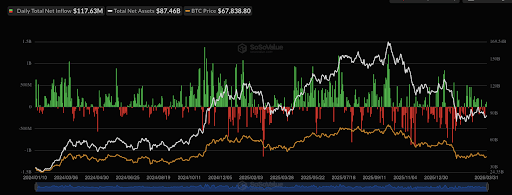
This survey contrasts with the current trend among crypto ETFs, showing that investors allocate more to XRP ETFs than to Solana and Dogecoin ETFs. SoSoValue data shows that the XRP ETFs currently boast net assets of $949.15 million, representing 1.14% of the XRP’s market cap. Meanwhile, the Solana and Dogecoin ETFs boast net assets of $849.65 million and $9.12 million, respectively.
Furthermore, the XRP ETFs have seen more inflows since they launched than the Solana and Dogecoin ETFs. The XRP ETFs currently boast total net inflows of $1.21 billion, while the SOL and DOGE ETFs have seen inflows of $993.38 million and $7.64 million, respectively.
Institutions Holding Spot ETFs Over Spot Crypto
The survey also showed that most of these institutions are gaining crypto exposure through the crypto ETFs rather than holding spot crypto. As of January 2025, 64% of these institutions held spot crypto ETFs to gain exposure to Solana, XRP, Dogecoin, and other digital assets. This figure has climbed to 66% as of January 2026, signaling that more institutions are investing in crypto amid regulatory clarity.
Furthermore, 39% of these institutions held spot crypto as of January 2025. However, this figure has decreased to 36% as of January 2026, suggesting that institutions prefer to gain crypto exposure through an ETF wrapper rather than holding crypto directly. These institutions have also been seeking crypto exposure through the digital asset treasury companies (DATs). As of January 2025, 51% of these institutions invested in these DATs, and that figure increased to 53% as of January 2026.
At the time of writing, the XRP price is trading at around $1.36, down over 2% in the last 24 hours, according to data from CoinMarketCap.
SOL trading at $85 on the 1D chart | Source: SOLUSDT on Tradingview.com
Featured image from Freepik, chart from Tradingview.com
Editorial Process for bitcoinist is centered on delivering thoroughly researched, accurate, and unbiased content. We uphold strict sourcing standards, and each page undergoes diligent review by our team of top technology experts and seasoned editors. This process ensures the integrity, relevance, and value of our content for our readers.