OpenAI’s GPT-5.4-Cyber further underscores the need for the cybersecurity community to rethink its strategy and bolster its defenses against bad actors, even as the model responds to rival Anthropic’s controversial Mythos platform.
OpenAI rolled out GPT-5.4-Cyber on April 14, a few days after the Mythos limited release. The model is an expansion of OpenAI’s Trusted Access for Cyber (TAC) program, which provides cybersecurity professionals access to advanced AI models for defense security tasks. It is a fine-tuned version of GPT-5.4 that enables capabilities such as binary reverse engineering that cyber experts can use to analyze compiled software for potential malware and vulnerabilities. Cyber is only available to vetted security vendors, organizations, and researchers, according to OpenAI.
The model is notably a response to Anthropic’s release of Claude Mythos, which the Claude maker said is too powerful to release widely and is accessible only to select large companies. It is also evidence that cybersecurity experts need to be vigilant in finding ways to ensure they are prepared to defend against attacks by malicious users.
Related:The Real AI Shift Isn’t New Models. It’s Control.
“The fact that they’re potentially opening it more broadly is going to be more helpful for the community because more people are going to have a chance to look at it,” said Lionel Litty, CISO at Menlo Security.
A Chance to Prepare
GPT-5.4-Cyber’s release through TAC could provide cybersecurity experts and researchers with further insights into how to prepare for cyberattacks, because, unlike Mythos, more people have access to it, Litty said. The AI-powered security platform protects organizations against cyber threats, including malware, ransomware, and phishing.
However, those with bad intent could also take advantage of that opportunity.
“There’s more chances of it being misused,” Litty said. He added that even with OpenAI’s security model being more open, “it remains to be seen where things fall in terms of how useful it’s going to be for us that are on the defensive side versus attackers.”
Despite uncertainty about who will use the capabilities, the message is clear: it is time for cybersecurity experts to prepare for the misuse of this iteration of generative AI technology.
“Most people knew this was coming, but it has become more urgent,” Litty said.
Enterprises need a clear understanding and visibility into what is happening in their organizations, and to assess whether components such as IT infrastructure need updating due to the organization’s new ability to rapidly discover new vulnerabilities, he added. On the other hand, bad actors’ ability to exploit security holes is accelerating, underscoring the need for enterprises to remediate security issues.
Related:Anthropic Releases Good but not Great Claude Opus 4.7
“This is where having a pretty good understanding of what you have in place, what needs to be secured and how a good process is in place, taking advantage of AI yourself is going to be important,” Litty said.
Beyond automation, enterprises need to be ready for software to be compromised and prepared with effective countermeasures, Litty added.
“You want to make sure that you can limit the damage,” he said. “Make sure you have a containment strategy in place.”
Rethinking the Strategy
Not only is the release of Cyber and Mythos a chance for cybersecurity experts to prepare for malicious attacks, but it might also signal that it is time to reconsider their overall defense strategy.
“They have to rethink how to do more autonomous reliability management or even more zero-cost oriented,” said Gartner analyst Arun Chandrasekaran. Enterprises should use AI to bolster their cybersecurity measures.
“The usage of AI, hopefully in cybersecurity, will significantly increase, with the improvements in capabilities that we’re seeing with these AI models,” Chandrasekaran said.
Related:Stellantis Ramps Up AI Strategy With Microsoft Deal
Ether’s (ETH) rally to $2,400 is nearly 38% above its swing low at $1,750, but is ETH’s price move simply a momentum trade, or do longer-term data points suggest a paradigm shift at play?
ETH accumulation addresses absorb 6.5 million Ether
Ether’s recent rally was preceded by an 89% surge in daily active addresses (DAA), which jumped to 730,278 from 384,763 on April 5.
The increase in Ethereum’s active addresses indicates increased user interaction with the network, which is generally a positive.
The chart below shows that activity increased significantly as Ether price rose to $2,300.
Ethereum daily active addresses. Source: CryptoQuant
Similar activity has been consistently observed near macro bottoms since 2022, preceding significant ETH price rallies.
Daily inflows into accumulation addresses have also increased since mid-2025, reaching an all-time high of 1.14 million ETH in November 2025. The inflows have continued to climb in 2026, averaging 200,000 ETH per day, with a spike to over 358,000 on Thursday.
Related: ETH/BTC ratio hits 10-week high as Ether outpaces Bitcoin: Are new price highs next?
The amount of ETH held in accumulation wallets, or holders with no history of selling, has increased by 6.5 million to 26.16 million from 19.64 million on Jan. 1, representing a 33% increase.
The ETH supply held in accumulation addresses is a key indicator for traders and market participants, as it reflects overall confidence in Ether’s long-term outlook.
ETH inflows into and balance in accumulation addresses. Source: CryptoQuant
The total value of ETH staked further reinforces this outlook. The metric now stands at 39.2 million ETH, signaling growing investor confidence.
Staked ETH supply. Source: Dune
As Cointelegraph reported, Ether supply held on exchanges has fallen to multi-year lows, further tightening liquidity on order books.
The ETH/USD pair may resume its prevailing bullish trend after breaking out of a cup-and-handle (C&H) chart pattern, as shown in the chart below. A 12-hour candlestick close above the cup’s neckline at $2,400 may signal the start of a stronger uptrend.
The target is set by adding the cup’s depth to the breakout point, which comes to around $2,960, an approximately 22% increase from the current price.
The relative strength index has risen to 68, suggesting that ETH bulls are back in control.
Trader TheSkayeth spotted a larger C&H pattern forming over the last two months on the daily time frame, saying ETH was “setting up for a massive move.”
“If the cup and handle pattern continues, I think we get to the golden zone next.”
ETH/USD daily chart. Source: X/TheSkayeth
The measured target of this larger formation is $3,150, which is 30% above the current level.
Applying this framework, ETH bulls will need to hold above the $2,350-$2,400 zone to confirm a sustained upward breakout.
As Cointelegraph reported, a close above the $2,400 level would increase the prospects of the ETH/USDT pair rising to $2,800 and later to $3,050.
This article is produced in accordance with Cointelegraph’s Editorial Policy and is intended for informational purposes only. It does not constitute investment advice or recommendations. All investments and trades carry risk; readers are encouraged to conduct independent research before making any decisions. Cointelegraph makes no guarantees regarding the accuracy or completeness of the information presented, including forward-looking statements, and will not be liable for any loss or damage arising from reliance on this content.
Bitcoin (BTC) rallied above $78,000 to hit another 10-week high on Friday as crypto and equity markets reacted to cooling tensions in the US and Israel war in Iran. The rally above range highs also resulted in a large liquidation of leveraged Bitcoin positions.
More than $660 million in short positions were liquidated, with Bitcoin accounting for $353 million of that total. Ether (ETH) followed with $160 million in short liquidations.
Related: Three things Bitcoin must do to hold highs above $76K: Analysts
Across the board, $826 million was wiped from the futures market over the last 24 hours.
Crypto market liquidations. Source: CoinGlass
The single biggest liquidation occurred on Hyperliquid, where a $15.75 million BTC-USDT short position was closed.
Large clusters of short liquidations typically amplify the reach of asset rallies and data from CoinGlass showed a 13% rise in Bitcoin’s aggregate futures open interest (OI) over the last 24 hours.
Total Bitcoin open interest. Source: CoinGlass
Even though futures longs (buyers) and shorts (sellers) are always matched, rising OI suggests greater leverage and market participation, which, in this case, appears to be on the side of bulls.
Hyblock data showed ask liquidity sitting between $77,500 and $78,000 being absorbed as BTC rallied to its intra-day highs on Friday.
BTC net short positions. Source: Hyblock
Bitcoin MACD forecasts a “big move“
Bitcoin’s moving average convergence divergence (MACD) indicator has signaled a buy on its weekly chart, a pattern that has historically preceded sharp price rallies.
The MACD is a popular momentum indicator used in technical analysis that helps traders identify the strength, direction and duration of a trend of an asset’s price.
The indicator reached its lowest level in history and has formed a bullish cross on the weekly chart, as shown in the figure below.
“Not only do we have a 1W MACD bullish cross and break of trend, we have it from the lowest point the MACD has ever dropped to,” analyst Sykodelic said in a recent post on X, adding:
“We are at a very important level here, and the weekly close will be very important.“
Previous instances show that Bitcoin tends to rise sharply when the MACD line (blue) crosses above the signal line (orange). The last time this happened was at the bottom of the 2022 bear market, which preceded a 376% increase in BTC price.
“A big move usually follows whenever this weekly MACD bullish cross happens,” analyst Mikybull Crypto said in a recent post on X.
Fellow analyst The Chart Report told their followers that previous crossovers have “historically produced a 93% win rate with a median 12-month return of +195%.”
Other Bitcoin analysts suggest that the altcoin could continue its recovery to retest higher resistance levels, with BTC price targets set at $90,000 and above.
This article is produced in accordance with Cointelegraph’s Editorial Policy and is intended for informational purposes only. It does not constitute investment advice or recommendations. All investments and trades carry risk; readers are encouraged to conduct independent research before making any decisions. Cointelegraph makes no guarantees regarding the accuracy or completeness of the information presented, including forward-looking statements, and will not be liable for any loss or damage arising from reliance on this content.
The price of bitcoin BTC$77,345.21 has again pushed above $76,000 alongside about a 10% plunge in the price of crude oil on an apparent reopening of the Strait of Hormuz.
“The passage for all commercial vessels through Strait of Hormuz is declared completely open for the remaining period of ceasefire,” said Iranian Foreign Minister Seyed Abbas Araghchi in an X posting.
President Trump quickly responded on Truth Social, thanking Iran for the full reopening.
The news sent the price of WTI crude oil down nearly 10% to $85.90 per barrel, about its lowest price since shortly after the outbreak of the war in early March.
Alongside bitcoin has risen to $76,400, up 3 over the past 24 hours. U.S. stock index futures are higher by about 1% across the board.
Why the $76,000 area is important
Bitcoin was trading around the $76,000-$78,000 level in the days before the Feb. 5 crash that sent its price tumbling all the way back to $60,000. In recent days, BTC has risen above $76,000 on numerous occasions, only to be met with a wave of quick selling.
Technicians believe that a sustained break to around $77,000 could set the stage for a return to significantly higher levels.
More green shoots over Iran
Separately, Axios reported that the U.S. and Iran are negotiating over a three-page plan to end hostilities. Among the discussion points: the U.S. releasing $20 billion in frozen Iranian funds in return for that country giving up its stockpile of enriched uranium.
With AI advances, the focus is usually on what’s being launched, whether it’s a new model, a new agent or a new capability.
But this week, the stories feel different.
The shift isn’t about what AI can do next. It’s about how organizations are managing it.
A new pattern is taking shape. As AI adoption accelerates across the enterprise, governance, infrastructure and workforce readiness are struggling to keep up.
That tension is most evident in the growing focus on agentic AI governance. This week, Salesforce and Databricks introduced tools designed to help enterprises manage AI agents. Those releases follow a similar move by AWS, which introduced the Agent Registry platform to bring some structure to how AI agents are built, managed and governed across environments.
As agents spread across systems, they can quickly introduce new layers of complexity affecting security, accountability and oversight. That’s why governance is becoming a prerequisite for scaling AI, not an afterthought.
Related:OpenAI GPT-5.4-Cyber is More Open Than Claude Mythos
OpenAI’s latest updates to its Agents SDK system emphasize secure deployment, signaling that even at the development layer, the focus is shifting toward making these systems more reliable and usable in real-world environments.
The same shift is emerging at the architecture level. The concept of a “context layer” is gaining traction as a way to capture reasoning, business rules and decision logic, the pieces that make AI systems usable in actual enterprise settings, not just technically capable.
At the same time, the infrastructure required to support all of this is expanding at an unprecedented pace. Amazon’s planned $200 billion investment in AI infrastructure reflects a broader move toward building capacity ahead of demand, while Oracle’s partnership with Bloom Energy highlights a growing turn toward on-site power sources as energy constraints become harder to ignore.
On the ground, this is starting to look a lot more structured. Stellantis’ expanded partnership with Microsoft is one example, with the multinational automotive giant working AI into core parts of the business, from sales to engineering.
In the public sector, Dubai’s plan to train 50,000 government employees points to something similar.
At a certain point, scaling AI stops being just a technology problem. It becomes a workforce challenge.
Taken together, these developments point to a broader shift.
AI is moving out of its experimental phase and into an operational phase where success depends less on access to the latest model and more on the ability to govern what’s already in place.
Related:Anthropic Releases Good but not Great Claude Opus 4.7
While this transition may not generate the same level of excitement as a new release, it’s the work that will determine how far and how fast AI actually scales.
Also in AI This Week:
Beyond those shifts, this week’s coverage points to how AI is starting to influence behavior, decision-making and risk across different parts of the business.
Meta’s new ‘AI Zuckerberg’ is a mirror for every C-suite
Meta is reportedly building an AI version of its founder that will act as a “digital proxy,” interacting with employees, answering questions and simulating his presence.
Anthropic releases good but not great Claude Opus 4.7
Anthropic’s latest release, Claude Opus 4.7, improves coding and long-running task performance, while falling short of the more powerful cybersecurity-focused Mythos model.
Exploring the context layer for AI systems
A growing focus on “context layers” highlights the need to capture reasoning, business rules and decision logic to make AI systems more aligned and context aware.
AI spreading at ‘historic speed,’ according to Stanford report
Stanford’s latest AI Index report finds that 53% of the world’s population now uses generative AI, underscoring both its rapid growth and widening gaps between countries.
Related:Stellantis Ramps Up AI Strategy With Microsoft Deal
Starburst intros AI assistant to boost analysis, exploration
Starburst introduced its AI Data Assistant, AIDA, aimed at moving beyond basic text-to-SQL queries by enabling more context-aware data analysis across federated environments.
World, the Sam Altman-backed digital identity project, has unveiled on Friday what it calls its most significant upgrade yet to World ID, positioning the system as “full-stack proof of human” infrastructure aimed at consumers, enterprises and AI agents.
The overhaul, announced at an event in San Francisco, comes as concerns mount across the tech industry over bots, deepfakes and AI agents impersonating humans online, a trend World is explicitly targeting with a broader push into authentication, payments and internet services. Altman’s other major project is OpenAI, the firm behind ChatGPT and tools using the large language model AI platform.
World’s system relies on its custom-built “Orb” devices to establish what it calls proof-of-humanity. To obtain a World ID, users must visit an Orb in person, where the device scans their face and iris to generate a unique cryptographic code representing that individual.
The images are deleted after processing, according to the company, and only anonymized fragments of the code are sent across a distributed network to confirm the person has not previously registered. The result is a credential that can prove someone is a unique human online without revealing their identity or personal data. Some critics, however, have flagged the use of biometric scanning via the Orb as a controversial aspect of the system.
At the core of the update is a redesigned architecture intended to improve privacy, security and usability. New features include account-based identity, multi-key support, recovery mechanisms, which give capabilities typically expected in large-scale security systems.
“World 4.0 is powerful, scalable and open,” senior executive Daniel Shorr said at the event. “In the age of AI, being human will be incredibly valuable and the internet will want to know you’re human,” he added.
The company is also introducing a dedicated World ID app, currently in beta, which will allow users to manage credentials and authenticate across platforms. The app reflects a broader ambition to make proof-of-human identity as seamless as logging into a social media account.
From dating apps to Zoom calls
Alongside the protocol update, World detailed a slate of integrations aimed at embedding its identity layer across consumer platforms.
On the consumer side, the company is expanding partnerships with platforms like Tinder, where users can display a “verified human” badge, and rolling out “Concert Kit,” a tool designed to help artists reserve tickets for verified individuals to combat scalper bots.
Gaming and online communities are another focus, with partnerships involving Razer and Mythical Games, while Reddit has signaled it is exploring similar identity tools for bot detection.
Enterprise use cases are also central to the rollout. World said it is working with Zoom on a feature called “Deep Face,” which verifies that a meeting participant is a real human rather than a deepfake, and with Docusign to incorporate proof-of-human checks into digital agreements.
In addition, World is rolling out new tooling, including “AgentKit,” to allow developers to attach credentials that prove there are humans to agents, which will be needed for sensitive actions and enable agent-based commerce tied to verified individuals.
The company is working with firms including Okta, Vercel and Browserbase on these capabilities, which aim to establish a trust layer for automated workflows without requiring personal data.
‘World ID is on the way to being a real human network for the internet,” said Sam Altman, the co-founder of World, at an event marking the announcement in San Francisco.
Read more: Sam Altman’s World Crypto Project Launches in US With Eye-Scanning Orbs in 6 Cities
At InsurTech NY, Jai Mansukhani, Co-Founder of General Magic laid out the company’s approach to solving one of insurance’s most time-consuming problems: manual customer service and inbound communications.
Mansukhani explained that General Magic is automating these workflows for brokerages that handle personal lines and small business insurance, focusing on helping people save time and reduce the flood of inbound calls.
The core of General Magic’s solution is building AI agents that are deployed on popular digital messaging platforms like iMessage, WhatsApp, and SMS which allow customers to complete all their insurance work, from pre-quote and post-quote engagement to claims coordination, simply over text.
Attending InsurTech NY was a major priority for General Magic to gain exposure, especially as their engineering team is based in Toronto and they plan to open a second office in New York. Mansukhani noted he is particularly focused on observing the rise of AI-native brokerages and carriers and sees this as an interesting trend where companies are trying to ‘rip and replace’ legacy systems or acquire insurance brokerages to fast-track a self-serve insurance approach.
A core focus for General Magic right now is tracking how this infrastructure develops and how receptive carriers are to this AI-driven evolution of the insurance industry.
Bitcoin soared above $76,000, opening the doors for a further rally toward $84,000.
Several major altcoins are showing strength, signaling broad-based buying by the bulls.
Bitcoin (BTC) skyrocketed above the $76,000 resistance on Friday after Iran’s foreign minister said that the Strait of Hormuz will remain open for the remainder of the ceasefire between the US, Israel and Iran.
Another positive sign for the bulls is that BTC’s rise has been supported by solid accumulation by the whales. According to CryptoQuant data, BTC whales holding more than 1,000 BTC have added about 270,000 coins in the past 30 days, the largest buying spree since 2013.
However, some analysts remain skeptical about BTC’s advance. Glassnode said in its latest Week Onchain newsletter that the current recovery has more legs to it, but is likely to face selling pressure at the True Market Mean at $78,100. Buyers will have to sustain the price above $78,100 on a mid-term basis to create a “structural shift toward a bull market.”
Crypto market data daily view. Source: TradingView
Another cautious view came from trading resource Material Indicators. In a video posted on X, Material Indicators said that BTC will have to cross the yearly open at $87,500 and the 50-week moving average near $97,000, and the relative strength index has to close above the 41 level on the weekly time frame to confirm that a bull market has returned.
Could BTC and select major altcoins sustain above their overhead resistance levels? Let’s analyze the charts of the top 10 cryptocurrencies to find out.
Bitcoin price prediction
BTC surged above the $78,000 level on Friday, its highest level in ten weeks, indicating sustained buying by the bulls.
The upsloping 20-day exponential moving average ($72,136) and the RSI near the overbought zone indicate that the bulls are attempting to seize control. A close above the $76,000 level will complete a bullish ascending triangle pattern, opening the door to a rally to $84,000, then to the pattern target of $92,000.
The moving averages are critical support levels to watch on the downside, as a close below them suggests the bears remain in control. The BTC/USDT pair may then tumble toward the triangle’s support line.
Ether price prediction
Sellers attempted to halt the recovery at the $2,415 level in Ether (ETH), but the bulls continued to exert pressure and did not allow the price to dip below the 20-day EMA ($2,235).
If the ETH price closes above the $2,415 resistance level, the recovery may extend to $2,800, then to $3,050. Such a move suggests that the ETH/USDT pair may have bottomed out at $1,748.
This bullish view will be invalidated in the near term if the price turns down sharply and breaks below the moving averages. That suggests the break above the $2,415 level may have been a bull trap. The pair may then decline to the $1,916 level.
XRP price prediction
XRP (XRP) closed above the 50-day simple moving average ($1.38) on Wednesday, indicating that the bears are losing their grip.
The 20-day EMA ($1.37) has started to turn up gradually, and the RSI is in the positive territory, indicating an advantage to the bulls. The XRP price may rally to the downtrend line of the descending channel pattern, which is expected to behave as a formidable hurdle. If buyers clear the hurdle, the XRP/USDT pair will indicate a potential trend change.
The moving averages are the vital support to watch out for on the downside. If the support breaks down, the pair may retest the crucial $1.27 level.
BNB price prediction
BNB (BNB) closed above the 50-day SMA ($626) on Thursday, indicating that the selling pressure is reducing.
If the BNB price remains above the moving averages, the next stop is likely to be the $687 level. Sellers will try to halt the recovery at $687, but if buyers bulldoze their way through, the rally may reach $730 and eventually $790.
On the contrary, if the price turns down from the current level or the overhead resistance and breaks below the moving averages, it signals that the BNB/USDT pair may remain within the $570 to $687 range for a while longer.
Solana price prediction
Solana’s (SOL) close above the moving averages suggests that the bulls are attempting to push the price to the $98 resistance.
Sellers are expected to fiercely defend the $98 level. If the SOL/USDT pair turns down sharply from $98 and breaks below the moving averages, it signals that the consolidation may extend for a few more days.
The first sign of strength on the upside will be a break and close above the $98 resistance. That opens the doors for a rally to the $117 level, where the bears are again expected to step in.
Dogecoin price prediction
Dogecoin (DOGE) turned up from the moving averages on Wednesday and rallied to the $0.10 level on Thursday.
Sellers will strive to halt the recovery at the $0.10 level, but if buyers do not give up much ground from the current level, it increases the possibility of a rally to $0.11 and subsequently to $0.12.
The bears are likely to have other plans. They will attempt to pull the DOGE price back below the moving averages. If they succeed, the DOGE/USDT pair may plummet to the solid support at $0.09.
Hyperliquid price prediction
Sellers are attempting to pull Hyperliquid (HYPE) back below the breakout level of $43.76, but the bulls have held their ground.
If the HYPE price continues higher and breaks above the $46 level, it suggests that the bulls have flipped the $43.76 level into support. That increases the likelihood of a rally to the $50 to $51.43 zone.
Time is running out for the bears. They will have to pull the HYPE/USDT pair below the 20-day EMA ($40.78) to make a comeback. If they manage to do that, the pair may slump to the 50-day SMA ($37.38).
Related: Bitcoin price quietly sets new 10-week high as trader sees $88K in weeks
Cardano price prediction
Cardano (ADA) continued its recovery and is likely to test the resistance at the downtrend line of the descending channel pattern.
Sellers are expected to aggressively defend the downtrend line, but if the bulls prevail, the ADA/USDT pair may climb to $0.32, then to $0.37. Such a move signals a potential short-term trend change.
On the contrary, if the ADA price turns down from the downtrend line and breaks below the moving averages, it suggests the pair may remain within the channel for some time.
Bitcoin Cash price prediction
Bitcoin Cash (BCH) pierced the 20-day EMA ($447) on Thursday, but the relief rally is facing selling at the 50-day SMA ($454).
The 20-day EMA is flattening out, and the RSI is near the midpoint, suggesting that the selling pressure is reducing. If bulls prevent the BCH price from dipping below $443, it could signal a shift in sentiment. That increases the likelihood of a break above the 50-day SMA. If that happens, the BCH/USDT pair may surge to $486, then to $520.
Alternatively, if the price breaks below $443, it signals that the bears remain sellers on rallies. The pair may then plunge toward the solid support at $419.
Chainlink price prediction
Chainlink (LINK) is attempting to break above the $8 to $10 resistance, where bears are expected to mount a strong defense.
If the price turns down from the overhead resistance and breaks below the moving averages, it suggests that the LINK/USDT pair may consolidate inside the range for a few more days.
On the other hand, if the LINK price closes above the $10 level, it indicates that the consolidation has resolved in favor of the bulls. The pair may then rally to the $11.61 level, where the bears are expected to step in. There is resistance at $10.94, but it is likely to be crossed.
This article does not contain investment advice or recommendations. Every investment and trading move involves risk, and readers should conduct their own research when making a decision. While we strive to provide accurate and timely information, Cointelegraph does not guarantee the accuracy, completeness, or reliability of any information in this article. This article may contain forward-looking statements that are subject to risks and uncertainties. Cointelegraph will not be liable for any loss or damage arising from your reliance on this information.
Trusted Editorial content, reviewed by leading industry experts and seasoned editors. Ad Disclosure
Cardano is already being used by roughly 200 large companies in Germany through agentic AI deployments, even if those firms do not realize the blockchain is sitting underneath their stack, according to Cardano Foundation CEO Frederik Gregaard. The claim, made during an interview with Jane King on GBBC’s Markets on Chain series from the New York Stock Exchange published April 16, points to a version of blockchain adoption that is less visible to end users but potentially more embedded in enterprise infrastructure.
200 German Companies Use Cardano Without Even Knowing It
Gregaard framed the Cardano Foundation’s role as pushing blockchain into systems people use without necessarily recognizing it. “We have about 200 companies in Germany who live on agentic AI, fairly large companies, and they don’t even know they’re using Cardano as a security layer, as a digital identity layer and as an accountability layer,” he said. “Part of when you have, for instance, agentic AI who’s using data from two different databases, [is] ensuring that the agentic AI is who they say they are, that they have the data they claim without disclosing it, because we want privacy.”
That argument was central to Gregaard’s broader pitch: blockchain, in his view, is becoming an underlying trust and coordination layer for AI-driven systems rather than simply a rails story for tokens or payments. He described a model where users could interact with seamless consumer applications while Cardano handles provenance, identity and compliance in the background. The point was less about visible crypto branding than about infrastructure-level deployment.
Payments still featured prominently. Gregaard said AI agents in some of these systems are already transacting using a regulated stablecoin called USDM, with microtransactions used to meter prompt activity and align incentives between participants. “The AIs are actually paying themselves using regulatory compliant stablecoins,” he said. “There’s a microtransaction happening just to do the prompts. And that’s also part of the security layer, which ensures that one database who has more computing power than the other doesn’t do unlimited prompts and can circumvent the security.”
Why Cardano Could Strive In The EU And US
The interview also tied that enterprise and AI narrative to policy. Gregaard said the US stablecoin framework under the GENIUS Act had moved the market closer to Europe’s MiCA regime, but argued the more consequential shift could come from the Clarity Act. He said he expects that legislation, if passed, to unlock materially broader blockchain usage beyond financial applications, adding that “hundreds of companies” are already waiting on that kind of legal certainty. He further claimed that recent regulatory language had made clear that “Cardano is a commodity,” and suggested the US could move faster than Europe on this front.
Alongside adoption, Gregaard leaned heavily on security. He said Cardano’s on-chain governance model and distributed validator base make it harder to compromise through a single point of failure, a contrast with networks he described as effectively controlled by a small number of insiders. He also argued that Cardano is emerging as a “first level quantum secure environment” through its interoperability with legal entity identity standards, which he said is drawing interest from banks, brokers, exchanges and central securities depositories.
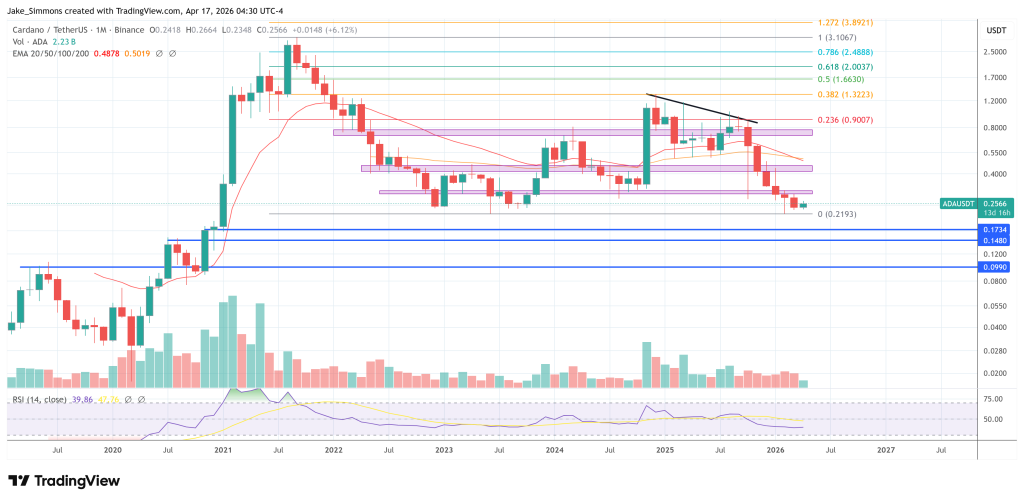
At press time, Cardano traded at $0.2566.
ADA hovers below key resistance, 1-monthly chart | Source: ADAUSDT on TradingView.com
Featured image created with DALL.E, chart from TradingView.com
Editorial Process for bitcoinist is centered on delivering thoroughly researched, accurate, and unbiased content. We uphold strict sourcing standards, and each page undergoes diligent review by our team of top technology experts and seasoned editors. This process ensures the integrity, relevance, and value of our content for our readers.
Have you had “deploy a stablecoin” and “build an AI agent” on your business to-do list since the beginning of the year?
You know these technologies will create business efficiencies, but finding the time to really get a grasp, a hands-on grasp, of these solutions has proved hard to find. You might even feel like you’re falling behind.
Not for long, you hard-working department head.
CoinDesk is launching the School of Stablecoins and Agentic Commerce at its upcoming Consensus 2026 conference, happening May 5-7 in Miami. These programs include interactive sessions with expert hosts leading you through the biggest cost-saving stablecoin use cases and the easiest implementations of AI agents that can lighten your workload and maybe even secure some big-time bets.
These sessions are for finance and product leaders, operators and entrepreneurs, and executive teams navigating what’s next.
Each workshop has plenty of complements on CoinDesk’s program of keynotes, fireside chats and panel discussions, allowing you to take the big picture insights and turn them into concrete tools you can take back to your team.
Take payments for example. During the “Stablecoins Go Global” panel discussion, you get inspired to adopt USDC in your business. But where do you practically start? “Setting Up a Stablecoin Wallet and Dashboard” hosted by Circle on the University workshop stage.
Or consider AI agents. After hearing the conversation at the “Agents Meet the Enterprise” panel, you want someone to give you a step-by-step tutorial on setting up OpenClaw and writing killer prompts that 10x your efficiency. We’ve got you covered.
Over the course of the three-day show, you’ll get workflow walkthroughs, product demos, and actionable insights for becoming your company’s crypto and AI guy or gal. And that’ll come in handy given these aren’t just niche tools for tech fanatics, or even just the intersection of DeFi and TradFi; these are products and services that every user and business can benefit from.
In this current era of unprecedented innovation and change, CoinDesk University is the place to learn from the visionaries and developers actually building these tools. You’re getting your education directly from the source with these powerful sessions.
Take a look at our current schedule of University workshops here. You’ll be favoriting all these to your schedule.